Mostrando entradas con la etiqueta UCSD. Mostrar todas las entradas

viernes, 22 de diciembre de 2017

Electric eel inspires bio-friendly power source, what happens next may shock you

Could a device inspired by the electric eel offer a safer way to power medical implants?
Scientists are always on the lookout for safer, more natural ways to power devices that go into our bodies. After all, who really needs toxic battery elements and replacement surgery?

One organism that is pretty good at generating biocompatible power (for itself, at least) is the electric eel, and scientists have now used the high-voltage species as a blueprint for a promising new self-charging device that could one day power things like pacemakers, prosthetics and even augmented reality contact lenses.

Electric eels generate voltage through long stacks of thin cells that run end-on-end through their bodies. Called electrocytes, these cells create electricity by allowing sodium ions to rush into one end and potassium ions out the other, all at the same time. The voltage created by each cell is small, but together, the stacks within a single eel can generate as many as 600 V.

To recreate this effect, researchers from the University of Fribourg, the University of Michigan and the University of California San Diego turned to the difference in salinity between fresh and saltwater. They deposited hydrogel, ion-conducting blobs onto clear plastic sheets and separated them with ion-selective membranes.

Hundreds of blobs containing salt and freshwater were arranged in an alternating pattern. When the team had all these gel compartments make contact with one another, they were able to generate 100 V through what is known as reverse electrodialysis, where energy is generated through differing salt concentrations in the water.

While the eel triggers the simultaneous contact of its electrocytes using a neurotransmitter called acetylcholine as the command signal, the team achieved this by carefully working a special origami pattern – called a Miura-ori fold – into the plastic sheet. This meant that when pressure was applied to the sheet, it quickly snapped together and the cells shifted into exactly the right positions to create the electricity.

The device, which the team calls an artificial electric organ, isn't in the same ball park as an eel in terms of output, but the researchers do have some ideas around how to boost its efficiency. It points to the metabolic energy created by ion differences in the eel's stomach, or the mechanical muscle energy, as some of the possibilities, but does note that recreating these would be a major challenge.

"The electric organs in eels are incredibly sophisticated, they're far better at generating power than we are," Mayer said. "But the important thing for us was to replicate the basics of what's happening."

The research was published in the journal Nature. You can hear from Mayer in the video below.


Source: University of Fribourg, University of Michigan

ORIGINAL: NewAtlas
Nick Lavars
December 14th, 2017

martes, 7 de junio de 2016

Former NASA chief unveils $100 million neural chip maker KnuEdge

Add caption
It’s not all that easy to call KnuEdge a startup. Created a decade ago by Daniel Goldin, the former head of the National Aeronautics and Space Administration, KnuEdge is only now coming out of stealth mode. It has already raised $100 million in funding to build a “neural chip” that Goldin says will make data centers more efficient in a hyperscale age.

Goldin, who founded the San Diego, California-based company with the former chief technology officer of NASA, said he believes the company’s brain-like chip will be far more cost and power efficient than current chips based on the computer design popularized by computer architect John von Neumann. In von Neumann machines, memory and processor are separated and linked via a data pathway known as a bus. Over the years, von Neumann machines have gotten faster by sending more and more data at higher speeds across the bus as processor and memory interact. But the speed of a computer is often limited by the capacity of that bus, leading to what some computer scientists to call the “von Neumann bottleneck.” IBM has seen the same problem, and it has a research team working on brain-like data center chips. Both efforts are part of an attempt to deal with the explosion of data driven by artificial intelligence and machine learning.

Goldin’s company is doing something similar to IBM, but only on the surface. Its approach is much different, and it has been secretly funded by unknown angel investors. And Goldin said in an interview with VentureBeat that the company has already generated $20 million in revenue and is actively engaged in hyperscale computing companies and Fortune 500 companies in the aerospace, banking, health care, hospitality, and insurance industries. The mission is a fundamental transformation of the computing world, Goldin said.

It all started over a mission to Mars,” Goldin said.
Above: KnuEdge’s first chip has 256 cores.Image Credit: KnuEdge
Back in the year 2000, Goldin saw that the time delay for controlling a space vehicle would be too long, so the vehicle would have to operate itself. He calculated that a mission to Mars would take software that would push technology to the limit, with more than tens of millions of lines of code.

Above: Daniel Goldin, CEO of KnuEdge.
Image Credit: KnuEdge
I thought, holy smokes,” he said. “It’s going to be too expensive. It’s not propulsion. It’s not environmental control. It’s not power. This software business is a very big problem, and that nation couldn’t afford it.

So Goldin looked further into the brains of the robotics, and that’s when he started thinking about the computing it would take.

Asked if it was easier to run NASA or a startup, Goldin let out a guffaw.

I love them both, but they’re both very different,” Goldin said. “At NASA, I spent a lot of time on non-technical issues. I had a project every quarter, and I didn’t want to become dull technically. I tried to always take on a technical job doing architecture, working with a design team, and always doing something leading edge. I grew up at a time when you graduated from a university and went to work for someone else. If I ever come back to this earth, I would graduate and become an entrepreneur. This is so wonderful.

Back in 1992, Goldin was planning on starting a wireless company as an entrepreneur. But then he got the call to “go serve the country,” and he did that work for a decade. He started KnuEdge (previously called Intellisis) in 2005, and he got very patient capital.

When I went out to find investors, I knew I couldn’t use the conventional Silicon Valley approach (impatient capital),” he said. “It is a fabulous approach that has generated incredible wealth. But I wanted to undertake revolutionary technology development. To build the future tools for next-generation machine learning, improving the natural interface between humans and machines. So I got patient capital that wanted to see lightning strike. Between all of us, we have a board of directors that can contact almost anyone in the world. They’re fabulous business people and technologists. We knew we had a ten-year run-up.

But he’s not saying who those people are yet.

KnuEdge’s chips are part of a larger platform. KnuEdge is also unveiling KnuVerse, a military-grade voice recognition and authentication technology that unlocks the potential of voice interfaces to power next-generation computing, Goldin said.

While the voice technology market has exploded over the past five years due to the introductions of Siri, Cortana, Google Home, Echo, and ViV, the aspirations of most commercial voice technology teams are still on hold because of security and noise issues. KnuVerse solutions are based on patented authentication techniques using the human voice — even in extremely noisy environments — as one of the most secure forms of biometrics. Secure voice recognition has applications in industries such as banking, entertainment, and hospitality.

KnuEdge says it is now possible to authenticate to computers, web and mobile apps, and Internet of Things devices (or everyday objects that are smart and connected) with only a few words spoken into a microphone — in any language, no matter how loud the background environment or how many other people are talking nearby. In addition to KnuVerse, KnuEdge offers Knurld.io for application developers, a software development kit, and a cloud-based voice recognition and authentication service that can be integrated into an app typically within two hours.

And KnuEdge is announcing KnuPath with LambdaFabric computing. KnuEdge’s first chip, built with an older manufacturing technology, has 256 cores, or neuron-like brain cells, on a single chip. Each core is a tiny digital signal processor. The LambdaFabric makes it possible to instantly connect those cores to each other — a trick that helps overcome one of the major problems of multicore chips, Goldin said. The LambdaFabric is designed to connect up to 512,000 devices, enabling the system to be used in the most demanding computing environments. From rack to rack, the fabric has a latency (or interaction delay) of only 400 nanoseconds. And the whole system is designed to use a low amount of power.

All of the company’s designs are built on biological principles about how the brain gets a lot of computing work done with a small amount of power. The chip is based on what Goldin calls “sparse matrix heterogeneous machine learning algorithms.” And it will run C++ software, something that is already very popular. Programmers can program each one of the cores with a different algorithm to run simultaneously, for the “ultimate in heterogeneity.” It’s multiple input, multiple data, and “that gives us some of our power,” Goldin said.

Above: KnuEdge’s KnuPath chip.
Image Credit: KnuEdge
KnuEdge is emerging out of stealth mode to aim its new Voice and Machine Learning technologies at key challenges in IoT, cloud based machine learning and pattern recognition,” said Paul Teich, principal analyst at Tirias Research, in a statement. “Dan Goldin used his experience in transforming technology to charter KnuEdge with a bold idea, with the patience of longer development timelines and away from typical startup hype and practices. The result is a new and cutting-edge path for neural computing acceleration. There is also a refreshing surprise element to KnuEdge announcing a relevant new architecture that is ready to ship… not just a concept or early prototype.”

Today, Goldin said the company is ready to show off its designs. The first chip was ready last December, and KnuEdge is sharing it with potential customers. That chip was built with a 32-nanometer manufacturing process, and even though that’s an older technology, it is a powerful chip, Goldin said. Even at 32 nanometers, the chip has something like a two-times to six-times performance advantage over similar chips, KnuEdge said.

The human brain has a couple of hundred billion neurons, and each neuron is connected to at least 10,000 to 100,000 neurons,” Goldin said. “And the brain is the most energy efficient and powerful computer in the world. That is the metaphor we are using.”

KnuEdge has a new version of its chip under design. And the company has already generated revenue from sales of the prototype systems. Each board has about four chips.

As for the competition from IBM, Goldin said, “I believe we made the right decision and are going in the right direction. IBM’s approach is very different from what we have. We are not aiming at anyone. We are aiming at the future.

In his NASA days, Goldin had a lot of successes. There, he redesigned and delivered the International Space Station, tripled the number of space flights, and put a record number of people into space, all while reducing the agency’s planned budget by 25 percent. He also spent 25 years at TRW, where he led the development of satellite television services.

KnuEdge has 100 employees, but Goldin said the company outsources almost everything. Goldin said he is planning to raised a round of funding late this year or early next year. The company collaborated with the University of California at San Diego and UCSD’s California Institute for Telecommunications and Information Technology.

With computers that can handle natural language systems, many people in the world who can’t read or write will be able to fend for themselves more easily, Goldin said.

I want to be able to take machine learning and help people communicate and make a living,” he said. “This is just the beginning. This is the Wild West. We are talking to very large companies about this, and they are getting very excited.

A sample application is a home that has much greater self-awareness. If there’s something wrong in the house, the KnuEdge system could analyze it and figure out if it needs to alert the homeowner.

Goldin said it was hard to keep the company secret.

I’ve been biting my lip for ten years,” he said.

As for whether KnuEdge’s technology could be used to send people to Mars, Goldin said. “This is available to whoever is going to Mars. I tried twice. I would love it if they use it to get there.

ORIGINAL: Venture Beat

viernes, 12 de diciembre de 2014

HP Will Release a “Revolutionary” New Operating System in 2015

Hewlett-Packard’s ambitious plan to reinvent computing will begin with the release of a prototype operating system next year.

WHY IT MATTERS 
U.S. data centers consumed 91 billion kilowatt-hours of electricity in 2013—twice as much as all the households in New York City—according to the Natural Resources Defense Council

Closeup of HP Memristor devices on a 300 millimeter wafer.

Hewlett-Packard will take a big step toward shaking up its own troubled business and the entire computing industry next year when it releases an operating system for an exotic new computer

The company’s research division is working to create a computer HP calls The Machine. It is meant to be the first of a new dynasty of computers that are much more energy-efficient and powerful than current products. HP aims to achieve its goals primarily by using a new kind of computer memory instead of the two types that computers use today. 

The current approach originated in the 1940s, and the need to shuttle data back and forth between the two types of memory limits performance. “A model from the beginning of computing has been reflected in everything since, and it is holding us back,” says Kirk Bresniker, chief architect for The Machine. 

The project is run inside HP Labs and accounts for three-quarters of the 200-person research staff. CEO Meg Whitman has expanded HP’s research spending in support of the project, says Bresniker, though he would not disclose the amount. The Machine is designed to compete with the servers that run corporate networks and the services of Internet companies such as Google and Facebook. Bresniker says elements of its design could one day be adapted for smaller devices, too. HP must still make significant progress in both software and hardware to make its new computer a reality. In particular, the company needs to perfect a new form of computer memory based on an electronic component called a memristor (see “Memristor Memory Readied for Production”). 

A working prototype of The Machine should be ready by 2016, says Bresniker. However, he wants researchers and programmers to get familiar with how it will work well before then. His team aims to complete an operating system designed for The Machine, called Linux++, in June 2015. Software that emulates the hardware design of The Machine and other tools will be released so that programmers can test their code against the new operating system. Linux++ is intended to ultimately be replaced by an operating system designed from scratch for The Machine, which HP calls Carbon. Programmers’ experiments with Linux++ will help people understand the project and aid HP’s progress, says Bresniker. He hopes to gain more clues about, for example, what types of software will benefit most from the new approach. 

The main difference between The Machine and conventional computers is that HP’s design will use a single kind of memory for both temporary and long-term data storage. Existing computers store their operating systems, programs, and files on either a hard disk drive or a flash drive. To run a program or load a document, data must be retrieved from the hard drive and loaded into a form of memory, called RAM, that is much faster but can’t store data very densely or keep hold of it when the power is turned off. HP plans to use a single kind of memory—in the form of memristors—for both long- and short-term data storage in The Machine. Not having to move data back and forth should deliver major power and time savings. Memristor memory also can retain data when powered off, should be faster than RAM, and promises to store more data than comparably sized hard drives today. 

The Machine’s design includes other novel features such as optical fiber instead of copper wiring for moving data around. HP’s simulations suggest that a server built to The Machine’s blueprint could be six times more powerful than an equivalent conventional design, while using just 1.25 percent of the energy and being around 10 percent the size. HP’s ideas are likely being closely watched by companies such as Google that rely on large numbers of computer servers and are eager for improvements in energy efficiency and computing power, says Umakishore Ramachandran, a professor at Georgia Tech. That said, a radical new design like that of The Machine will require new approaches to writing software, says Ramachandran. 

There are other prospects for reinvention besides HP’s technology. Companies such as Google and Facebook have shown themselves to be capable of refining server designs. And other new forms of memory, all with the potential to make large-scale cloud services more efficient, are being tested by researchers and nearing commercialization (see “Denser, Faster Memory Challenges Both DRAM and Flash” and “A Preview of Future Disk Drives”). “Right now it’s not clear what technology is going to become useful in a big way,” says Steven Swanson, an associate professor at the University of California, San Diego, who researches large-scale computer systems. HP may also face skepticism because it has fallen behind its own timetable for getting memristor memory to market. When the company began working to commercialize the components, together with semiconductor manufacturer Hynix, in 2010, the first products were predicted for 2013 (see “Memristor Memory Readied for Production”). Today, Bresniker says the first working chips won’t be sent to HP partners until 2016 at the earliest.


ORIGINAL: Tech Review 
December 8, 2014

martes, 4 de marzo de 2014

Venter's New Goal: World's Largest Sequencing Operation


Dr. Venter is founder, chairman, and CEO of the J. Craig Venter Institute. [Industrial Biotechnology]


J. Craig Venter, Ph.D. and two co-founders today launched a genomics and cell therapy-based diagnostic and therapeutic company that he vowed will assemble the world’s largest human gene sequencing operation, using $70 million in Series A financing.

Human Longevity Inc. (HLI) says it will compile the most comprehensive and complete human genotype, microbiome, and phenotype database – with plans to sequence up to 40,000 human genomes per year, then quickly scape up to 100,000 human genomes per year. HLI will sequence a variety of people, both healthy and ill, from children to centenarians.

Both the sequencing operations and the new company’s efforts to help develop cell-based therapeutics are aimed at addressing aging-related diseases.

HLI will initially focus its clinical sequencing efforts on cancer, and will look to identify therapeutic solutions for cancer as well as other aging-related diseases, such as diabetes and obesity, heart and liver diseases, and dementia.

HLI is going to change the way medicine is practiced by helping to shift to a more preventive, genomic-based medicine model which we believe will lower healthcare costs,” D. Venter said in a statement. “Our goal is not necessarily lengthening life, but extending a healthier, high performing, more productive life span.

HLI will operate from labs in San Diego, and has already purchased two Illumina HiSeq X Ten Sequencing Systems, with the option to acquire three additional systems.
http://res.illumina.com/images/systems/hiseq/hiseq-x-ten.jpg
The HiSeq X Ten is a set of ten ultra-high-throughput sequencers, purpose-built for large-scale human whole-genome sequencing.

Dr. Venter is the founder and CEO of Synthetic Genomics, as well as founder, chairman, and CEO of the J. Craig Venter Institute (JCVI). HLI said it is establishing a collaboration and research services agreement with JCVI covering proteomics, infectious disease diagnostics, and the human microbiome, with the new company agreeing to license intellectual property from the institute.

JCVI is one of three partners with which HLI has established strategic collaborations; the others are Metabolon and University of California, San Diego.

HLI and UCSD have agreed to develop protocols and procedures to enable whole genome, microbiome and tumor sequencing and analysis of consenting UC San Diego research patients. Collaboration has begun by the company with the UC San Diego Moores Cancer Center. HLI said it will seek to extend this type of agreement and program with UC San Diego to other clinical centers worldwide.

Joining the biotech research pioneer and entrepreneur as co-founders of HLI are Robert Hariri, M.D., Ph.D., and Peter H. Diamandis, M.D.

About Human Longevity, Inc.


Human Longevity Inc. (HLI) is a genomics and cell therapy-based diagnostic and therapeutic company. Using advances in genomic sequencing, the human microbiome, proteomics, informatics, computing, and cell therapy technologies, HLI is building the world’s most comprehensive database on human genotypes and phenotypes to tackle the diseases associated with aging-related human biological decline. HLI I also leading the development of cell-based therapeutics to address age-related decline in endogenous stem cell function. HLI is concentrating on cancer, diabetes and obesity, heart and liver diseases, and dementia.

The market for healthy human longevity is enormous. Globally, total healthcare expenses run over $7 trillion, with nearly half of these funds being spent in the senior (65+) years of a person’s life to help keep them alive longer. Using the combined power of HLI’s core areas of expertise – genomics, informatics, and stem cell therapies, HLI is going to change the way medicine is practiced by furthering the shift to a preventive, genomic-based medicine model.

HLI revenue streams will be derived from database licensing to pharmaceutical, biotechnology and academic organizations, sequencing, and development of advanced diagnostics and therapeutics.

Funding

HLI has secured $70 million in its initial round of funding. Our investors are a diverse group of individuals and companies who share our common goal and passion of changing healthcare, tackling the diseases of aging, and extending the healthy human lifespan.


ORIGINAL:
Genetic Engineering News
Mar 4, 2014

sábado, 7 de diciembre de 2013

"We’re Up All Night To Get Data:" The Next Awesome Science Parody

Add caption
You all must know by now that I’m a sucker for excellent science music video parodies. This one, by the folks at UCSD Neuroscience, is my latest favourite. Set to the tune of Daft Punk’s ‘Get Lucky’, this video captures the (sometimes) desperate journey to fill your conference poster before the deadline looms. It’s full of fun references to graduate school, academia and publishing – and the production value is awesome. The video was created as a party invitation for the UCSD Neurosciences Graduate Program Social, and if the party is anything like the video I’m sorry that I won’t be there.


Enjoy!

Carin Bondar
About the Author: 
Carin Bondar is a biologist, writer and film-maker with a PhD in population ecology from the University of British Columbia. Find Dr. Bondar online at www.carinbondar.com, on twitter @drbondar or on her facebook page: Dr. Carin Bondar – Biologist With a Twist. Follow on Twitter @drbondar.


ORIGINAL: Scientific American
By Carin Bondar
November 7, 2013

lunes, 5 de agosto de 2013

“Citizen science” apps, happiness, and monogamy

ORIGINAL: OBR Review
by: Roundtable Review News
Friday, 2nd August 2013

BAY AREA
New app puts smartphones to work for science If you have ever wondered what it might be like to walk on an asteroid or wished you could improve the lives of people around the world, you can now get a little closer to these dreams by simply charging your smartphone. A new Android app developed at Berkeley through the Berkeley Open Infrastructure for Network Computing (BOINC) aims to use your smartphone to advance computationally intensive research. The app, also called BOINC, allows users to donate idle computing power to projects that would otherwise require cost-prohibitive supercomputers. BOINC was available as of July 22 from the Google Play Store for Android versions 2.3 and later and by default only runs when the phone is plugged in, has greater than 95% charge, and is connected to WiFi. The projects currently available through BOINC include  
  • Asteroids@Home, which aims to better define the physical properties of asteroids;  
  • FightAIDS@Home, which searches for more effective AIDS treatments;  
  • Einstein@Home, which searches radio telescope data to identify pulsars; and 
  • other math and natural science projects that deal with the analysis of complex algorithms surrounding large quantities of data. 
Though not yet available for iPhones, two-thirds of all smartphones are Android based and that means a lot of potential power for science.

SAN DIEGO
UC San Diego receives grant to promote science at the intersection of biology and physics A professor of biology and physics at UCSD, Suckjoon Jun, has received a $1.15 million grant from the National Science Foundation (NSF) to create “boot camps” designed to introduce local high school and college students to quantitative biology. Jun describes quantitative biology as the application of “quantitative rigor” traditionally found in the physical sciences to biological questions. For example, this approach can be used to model complex processes such as drug interactions in human patients before the drugs are actually tested in clinical trials. In Jun’s lab, he utilizes a device he developed to analyze cell growth at the single cell level. Dubbed the “mother machine”, the instrument allows Jun’s lab to probe how cells sense their size and when to divide, and has potential to shed light on a variety of basic biological problems, such as the aberrant cell division that occurs in cancer. The NSF grant pairs Jun with a biology professor at San Diego State University, Anca Segall, who will help establish and run the boot camps. The goal of the boot camps, Jun says, is to first “spread the culture of quantitative biology” among young scientists in the San Diego area, and then to implement quantitative biology curriculum and undergraduate research opportunities at local universities.

LOS ANGELES
New amyloid-targeting compound for Alzheimer’s discovered Researchers at the University of California, Los Angeles have identified compounds that target amyloid beta fibrils, the protein aggregates found in abundance in the brains of Alzheimer’s patients. The research team, led by UCLA professor David Eisenberg, employed a structure-based approach to identify promising compounds – a technique that has been used for drug design in infectious and metabolic diseases, but had not yet been applied to neurodegenerative diseases like Alzheimer’s. To identify their candidate compounds,
  • the team used their detailed knowledge of the atomic structure of the amyloid beta protein to find compounds that would interact with that structure. They first computationally screened 18,000 compounds, and 
  • then tested those with a strong potential for binding amyloid beta in a cell culture model. Of the tested compounds, they identified 8 compounds and 3 compound derivatives that significantly protected cells from amyloid beta’s toxic effects. Interestingly, these compounds did not reduce protein aggregation in culture, but they did increase amyloid fibril stability and reduce cell toxicity. 
These results support the idea, which has been gaining traction in recent years, that smaller oligomers of amyloid beta, and not the larger fibrils, are actually the main culprit for cellular toxicity and Alzheimer’s symptoms. The researchers speculate that their compounds may prevent toxic effects by tightly binding to amyloid beta fibrils and preventing oligomers from breaking free. The results are a promising step in the right direction for developing therapies for Alzheimer’s disease, and also demonstrate that the structure-based approach is an effective, viable option for drug design that could be applied to many other neurodegenerative conditions.
Happiness may aid proper gene expression in immune cells If you’re happy and you know it, your genes will surely show it according to a new study from UCLA and the University of North Carolina. What you may not know is that what type of happiness yours is will also affect your genes. Previous research has established that during periods of stress, threat, or uncertainty, the genes related to the inflammatory immune response are turned on, whereas the activity of those related to antiviral responses significantly decreases. The question is then does happiness and well-being have a similar effect? Barbara Fredrickson of the University of North Carolina and Steven Cole of UCLA’s Cousins Center for Psychoneuroimmunology sought to answer this by assessing the happiness of 80 healthy adults while accounting for potentially problematic psychological and behavioral factors. The study, published in the current online edition of PNAS, further divides the happiness measurements into two different categories:
  • eudaimonic well-being and 
  • hedonic well-being. 
Those individuals with high eudaimonic well-being, which is happiness that stems from a sense of purpose and meaning in life, exhibited reduced expression of inflammatory genes and increased expression of antiviral and antibody genes, the opposite of the stress response. However, those individuals with high hedonic well-being, or happiness from self-gratification, showed high expression of inflammatory genes and low expression of antiviral and antibody genes. Despite the differences in immune factor expression, the hedonics did not report feeling any worse than the eudaimonics. The moral appears to be that even if we can’t feel the difference, our systems still benefit more from doing good for others instead of ourselves.
LONDON
Aggressive form of leukemia puts stem cells to sleep Scientists from Queen Mary, University of London have found that malignant cells comprising Acute Myeloid Leukemia (AML), an aggressive blood cancer, actually put their stem cell counterparts in the bone marrow to sleep, rather than outcompeting them as originally believed. Conducted with support from the London Research Institute, this discovery could open the door to new treatment strategies where these ‘sleeping’ stem cells are reawakened. While healthy bone marrow generates the hematopoietic stem cells that become our various blood cell types, including red blood cells and platelets, the bone marrow of AML patients is instead colonized by leukemic myeloid cells incapable of any further development. Dr. David Taussig, who led the research project, said, “The widely accepted explanation has held that AML causes bone marrow failure by depleting the bone marrow of normal hematopoietic stem cells by killing or displacing them. However, we have found that samples of bone marrow in both mice models and patients with AML contain the same, or more, of these normal stem cells than usual. So the cancer isn’t getting rid of them, instead it appears to be turning them off so they aren’t going on to form healthy blood cells. If we can find out how the cancer cells are doing this, we can look at exploiting it to find ways to wake these stem cells up.

Monogamy as a mating strategy evolved due to infanticide Social monogamy arose relatively late in primate evolution – only about 16 million years ago. The scientific community have proposed three major hypotheses:
  • Monogamy provides more effective parental care for infants; 
  • it prevents females from mating with rival males; or 
  • it protects against the risk of infanticide, which is very high among some primate species, including chimpanzees and gorillas, and is often explained by the desire of a rival male to quickly return a mother to a fertile state. 
A team of researchers from UCL, University of Manchester, University of Oxford and University of Auckland have now confirmed an evolutionary pathway for the development of social monogamy in humans and other primates. The findings, published in the Journal PNAS, collected data from 230 primate species and indicate that only the presence of infanticide reliably increases the probability of a shift to monogamy. The team also found that following the emergence of social monogamy males were more likely to care for their offspring. Dr Kit Opie of the UCL anthropology department and lead author of the study said: “This is the first time that the theories for the evolution of monogamy have been systematically tested, conclusively showing that infanticide is the driver of monogamy. This brings to a close the long running debate about the origin of monogamy in primates.” These findings are in contrast with those reported recently by a team of researchers from the University of Cambridge and further described in the Cambridge news section. These conflicting studies have rekindled the monogamy debate. Phyllis Lee, a behavioural ecologist at the University of Stirling, UK, said: “Both papers have been carefully researched and will be discussed for some time to come.”
CAMBRIDGE
Second study finds an alternative explanation for the evolution of monogamy A comparative study carried out by researchers at the University of Cambridge has revealed that social monogamy, where one female and one breeding male are closely associated with each other over several breeding seasons, appears to have evolved as a mating strategy. This contrasts with previous theories that explained monogamy as a means to elicit extra parental care from the father. Instead, it has been suggested that paternal involvement evolved after the onset of monogamy. The research, published in Science, shows that monogamy in mammals evolved where males were unable to monopolise and defend multiple females. This generally corresponds to habitats with low densities of females. Furthermore, it was found that species with diets that rely on high quality but patchily distributed food sources are more likely to become monogamous. Although these findings were based on investigation of 2500 mammalian species, the human species was not included in the analysis, and the researchers are sceptical that the results tell us much about human breeding systems.

domingo, 20 de enero de 2013

RNAi drug company promises delivery – of both results and RNA

ORIGINAL: OBR Review
January 9, 2013

RNA interference may be a widely used technique in molecular biology, but adapting this biological process to the development of RNAi-based drugs has posed a vexing problem for scientists since its discovery in 1998, which earned Craig Mello and Andrew Fire the Nobel Prize in 2006. A recent advancement by UCSD professor Steven Dowdy shows promise in allowing the short nucleic acids composing RNA and microRNA molecules to cross cell membranes, and in this way blocking the activity of genes involved in cancer and other diseases.

UCSD School of Medicine. biomedsci.ucsd.edu. 
The technology, which is protected intellectual property of the University of California San Diego and revolves around “masking” the negative charge of double-stranded RNA molecules with specific side groups which are then later clipped off by a naturally occurring enzyme, has been licensed in an exclusive deal to the three-month old, half-dozen-employees spin-out company Solstice Biologics LLC. The company was founded by Prof. Dowdy along with Chief Scientific Officer Curt Bradshaw, former vice president of chemistry at CovX Pharmaceutical, a company which was acquired by Pfizer in 2007. Prof. Dowdy was also the scientific founder of Traversa Therapeutics, which filed for bankruptcy in April last year.

Previous companies that have invested copiously in attempting to solve this problem with no robust results include pharmaceutical giants such as Merck, Alnylam, and Roche. Professor Steven Dowdy and colleagues may however be nearing a solution with their cell-permeable RNAi pro-drug, which they called RiboNucleic Neutrals (RNNs). Other companies, such as Merck, have favoured an approach using antisense nucleic acid analogues such as morpholinos, which mimic single stranded nucleic acids and are able to cross the cell membrane in a neutral or slightly positively charged state. Unlike small interfering RNA, morpholinos do not degrade their target RNA molecules, but instead bind to complementary sequences and prevent binding of other interacting partners via steric blocking.

The company has announced in a January 4th press release a partnership with San Francisco-based VenBio and Aeris Capital AG in the form of a $18 million USD series A commitment to the San Diego start-up to achieve a set of pre-established “milestones and goals” over the next 18 months, said VenBio’s Dr. Corey Goodman, who also sits on Solstice’s board as executive chairman. While it is unclear at this early stage whether the technology will actually work in humans and animals, the potential therapeutic benefits are great, and can be applied to a wide range of diseases.

Dr. Goodman, previously a tenured professor at Stanford University and at University of California Berkeley and head of Pfizer’s Biotherapeutics and Bioinnovation Center, further explained that this early stage financing will allow further development of the technology platform and testing to ensure that the process “works and is safe for humans”. He anticipates the company to license the RNN technology to drug developers, once at least one working therapeutic has been taken into early clinical trials. In case the RNAi drug will fail to provide the expected results, he envisaged that the underlying technology could be sold to a reagent company for developing research lab chemicals. The global market for RNAi drug delivery was worth $7 billion USD in 2010, and is expected to grow to nearly $24.1 billion by 2015 according to a January 2011 report by BCC Research.

viernes, 28 de septiembre de 2012

Researchers Create Living ‘Neon Signs’ Composed of Millions of Glowing Bacteria

ORIGINAL: Biology.UCSD.edu
December 18, 2011
By Kim McDonald

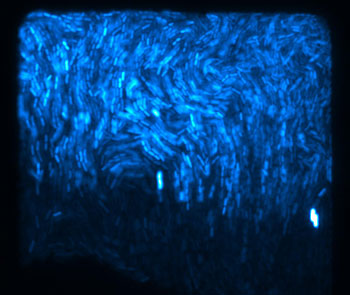
Thousands of fluorescent E. coli bacteria

 make up a biopixel. Hasty Lab, UC San Diego
In an example of life imitating art, biologists and bioengineers at UC San Diego have created a living neon sign composed of millions of bacterial cells that periodically fluoresce in unison like blinking light bulbs.

Their achievement, detailed in this week’s advance online issue of the journal Nature, involved attaching a fluorescent protein to the biological clocks of the bacteria, synchronizing the clocks of the thousands of bacteria within a colony, then synchronizing thousands of the blinking bacterial colonies to glow on and off in unison.

A little bit of art with a lot more bioengineering, the flashing bacterial signs are not only a visual display of how researchers in the new field of synthetic biology can engineer living cells like machines, but will likely lead to some real-life applications.

Using the same method to create the flashing signs, the researchers engineered a simple bacterial sensor capable of detecting low levels of arsenic. In this biological sensor, decreases in the frequency of the oscillations of the cells’ blinking pattern indicate the presence and amount of the arsenic poison.

Because bacteria are sensitive to many kinds of environmental pollutants and organisms, the scientists believe this approach could be also used to design low cost bacterial biosensors capable of detecting an array of heavy metal pollutants and disease-causing organisms. And because the senor is composed of living organisms, it can respond to changes in the presence or amount of the toxins over time unlike many chemical sensors.

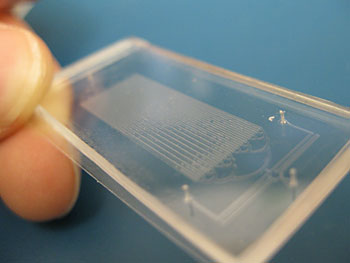
Tiny microfluidic chips allow the researchers to
 synchronize the bacteria to fluoresce 
or blink in unison
These kinds of living sensors are intriguing as they can serve to continuously monitor a given sample over long periods of time, whereas most detection kits are used for a one-time measurement,” said Jeff Hasty, a professor of biology and bioengineering at UC San Diego who headed the research team in the university’s Division of Biological Sciences and BioCircuits Institute. “Because the bacteria respond in different ways to different concentrations by varying the frequency of their blinking pattern, they can provide a continual update on how dangerous a toxin or pathogen is at any one time.

This development illustrates how basic, quantitative knowledge of cellular circuitry can be applied to the new discipline of synthetic biology,” said James Anderson, who oversees synthetic biology grants at the National Institutes of Health’s National Institute of General Medical Sciences, which partially funded the research. “By laying the foundation for the development of new devices for detecting harmful substances or pathogens, Dr. Hasty’s new sensor points the way toward translation of synthetic biology research into technology for improving human health.

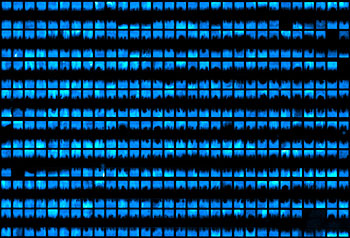
The smaller chips contain about
500 blinking bacterial colonies or biopixels
The development of the techniques to make the sensor and the flashing display built on the work of scientists in the Division of Biological Sciences and School of Engineering, which they published in two previous Nature papers over the past four years. In the first paper, the scientists demonstrated how they had developed a way to construct a robust and tunable biological clock to produce flashing, glowing bacteria. In the second paper, published in 2010, the researchers showed how they designed and constructed a network, based on a communication mechanism employed by bacteria, that enabled them to synchronize all of the biological clocks within a bacterial colony so that thousands of bacteria would blink on and off in unison.

Many bacteria species are known to communicate by a mechanism known as quorum sensing, that is, relaying between them small molecules to trigger and coordinate various behaviors,” said Hasty, explaining how the synchronization works within a bacterial colony. “Other bacteria are known to disrupt this communication mechanism by degrading these relay molecules.

But the researchers found the same method couldn’t be used to instantaneously synchronize millions of bacteria from thousands of colonies.


miércoles, 29 de agosto de 2012

Modeling the Cell

ORIGINAL: The Scientist
By Jef Akst
July 23, 2012

The first full computer model of a single-celled organism mimics the bacterium’s behaviors and paves the way to more complete disease models.

Digital DNA, Art in Public Places,
Palo Alto, California FLICKR, 
WONDERLANE
Mycoplasma genitalium, a bacterium known to cause urethritis, made headlines in 2008 when J. Craig Venter and colleagues announced that they had manufactured and assembled the organism’s 600,000 base pair genome. Now, the microbe is in the news again—this time for becoming the first organism to be fully modeled by a computer program.

Bioengineering professor Markus Covert of Stanford University and colleagues scoured some 1,000 papers in the scientific literature to glean the information needed about the functions of M. genitalium proteins and genes to model how the bacterium behaves in the real world. In the end, they constructed a computer simulation that incorporates every known gene function. The team published its results last week (July 19) in Cell.

So far, it all works great,” Covert told The Chronicle of Higher Education. “We were able to recapitulate a lot of the behaviors of the cell.” Running hundreds of simulations, the researchers identified key factors involved in processes such as cell growth. They also were able to test the effects of knocking out individual genes—an exercise that proved “extremely predictive,” Covert said.

Past modeling studies have created programs that reflected certain functions of cells, such as the metabolism of E. coli, but this is the first to model an entire organism. But with only 460 genes, however, M. genitalium is a relatively simple. (By comparison, the metabolic E. coli model involved about 1,300 genes.) Still, the new model is an important first step.”He did this for the entire cell,” bioengineer Bernhard Palsson of the University of California at San Diego told The Chronicle. “So that’s the achievement here.”

Such models could help uncover mechanisms involved in cancers and other diseases, Covert added. “The simple fact is, there’s no way we are going to wrap our heads around cancer or any complex disease without a computer model, and so I see this as definitely a big start,” he told The Chronicle.

lunes, 13 de agosto de 2012

Descubren el secreto de los arcoiris gemelos

ORIGINAL: BBC Mundo
Jueves, 9 de agosto de 2012

A la izquierda se ven arcoiris múltiples. A la derecha se puede observar el extraño fenómeno del arcoiris gemelo, con dos arcos que nacen de uno común.
Un equipo internacional de científicos utilizó simulaciones para descifrar el secreto de un fenómeno óptico excepcional, tanto por su rareza como por su belleza: el arcoiris gemelo. El trabajo es presentado esta semana en la conferencia de diseño gráfico y animaciones SIGGRAPH 2012, que tiene lugar en Los Angeles.

A diferencia del arcoiris doble, que consiste en dos arcos separados y concéntricos, el gemelo se ve como dos arcos que se dividen a partir de una base común.

Contenido relacionado


La clave del arcoiris gemelo está en la combinación de gotas de diferentes formas, según los investigadores. "Simulaciones anteriores asumían que las gotas eran esféricas. Esta forma puede explicar los arcoiris comunes o dobles, pero no los gemelos", señaló Wojciech Jarosz, uno de los autores del estudio, que también contó con la participación de investigadores de la Universidad de San Diego en California y la Universidad de Zaragoza.

Jarosz y sus colegas simularon arcoiris virtuales, considerando la forma de las gotas y sus interacciones complejas con la luz.

Los arcoiris resultan de la interacción de la luz solar con pequeñas gotas de agua en la atmósfera. Al caer, las gotas de agua se achatan o aplanan, debido a la resistencia del aire y este cambio en la forma es más prominente en las gotas de mayor tamaño.

Estas gotas acaban adoptando una forma similar a una hamburguesa, por lo que han sido llamadas "burgeroides".

"A veces se juntan dos precipitaciones diferentes. Cuando contienen gotas de tamaños distintos, cada conjunto produce arcoiris algo deformados, que se combinan para formar un arcoiris gemelo", dijo Jarosz.

Gotas aplanadas

"Afortunadamente ha habido muchos estudios previos sobre la forma física de las gotas cuando caen en el aire", dijo a BBC Mundo Iman Sadeghi, de la Universidad de San Diego, otro de los investigadores.

"Estos trabajos proveen una representación precisa de las interacciones de gotas de diferentes tamaños. Crear la geometría de las gotas en 3D a partir de estas representaciones fue muy fácil", señaló Sadeghi.

"Como demostramos en nuestro estudio, la gotas de mayor tamaño tienen formas no esféricas y esto afecta fundamentalmente el arco primario pero no el secundario. Por lo tanto, si tenemos una mezcla de gotas de agua esféricas y no esféricas, vermos dos arcos primarios y otro secundario que se superpone. Así es como se forman los arcoiris secundarios".

Aplicaciones

Los arcoiris resultan de la interacción de la luz solar con pequeñas gotas de agua en la atmósfera.
El hallazgo ocurrió durante un trabajo conjunto para Disney Research, el instituto de investigaciones en diseño gráfico, animaciones y computación financiado por la compañía cinematográfica.

La meta original era "lograr una forma mejor de representar digitalmente un arcoiris en películas animadas o juegos de video".

"Al comprobar que los métodos actuales de simulación no podían explicar el fenómeno, el misterio nos alentó a continuar con la investigación".

Jarosz y sus colegas creen que las nuevas simulaciones podrían tener aplicaciones futuras en meteorología, permitiendo inferior el tamaño de gotas de agua a partir de imágenes digitales.

miércoles, 6 de junio de 2012

Neuroscientists reach major milestone in whole-brain circuit mapping project

May 31, 2012

Projections from a motor cortex AAV injection (credit: CSHL)
Cold Spring Harbor, NY – Neuroscientists at Cold Spring Harbor Laboratory (CSHL) reached an important milestone today, publicly releasing the first installment of data from the 500 terabytes so far collected in their pathbreaking project to construct the first whole-brain wiring diagram of a vertebrate brain, that of the mouse

Add caption
The data consist of gigapixel images (each close to 1 billion pixels) of whole-brain sections that can be zoomed to show individual neurons and their processes, providing a “virtual microscope.” The images are integrated with other data sources from the web, and are being made fully accessible to neuroscientists as well as interested members of the general public (http://mouse.brainarchitecture.org). The data are being released pre-publication in the spirit of open science initiatives that have become familiar in digital astronomy (e.g., Sloan Digital Sky Survey) but are not yet as widespread in neurobiology. 


Each sampled brain is represented in about 500 images, each image showing an optical section through a 20 micron-thick slice of brain tissue. A multi-resolution viewer permits users to journey through each brain from “front” to “back,” and thus enables them to follow the pathways taken through three-dimensional brain space by tracer-labeled neuronal pathways. The tracers were picked to follow neuronal inputs and outputs of given brain regions.

We’re executing a grid-based “shotgun” strategy for neuronal tract tracing that we first proposed a few years ago, and which I am pleased to note has gained acceptance elsewhere within the neuroscience community,” says Partha P. Mitra, Ph.D., the Crick-Clay Professor of Biomathematics at CSHL and director of the Mouse Brain Architecture (MBA) Project. After the initial June 1 release, project data will be made public continuously on a monthly basis, Mitra says.

Project addresses a large gap in knowledge

Our project seeks to address a remarkable gap in our knowledge of the brain,” Mitra explains. “Our knowledge of how the brain is wired remains piecemeal and partial after a century of intense activity. Francis Crick and Ted Jones emphasized this in an article published in Nature nearly 20 years ago. Yet to understand how the brain works (or fails to work in neurological or neuropsychiatric disease), it is critical that we understand this wiring diagram more fully. Further, there remain fundamental questions about brain evolution that cannot be addressed without obtaining such wiring diagrams for the brains of different species.