Mostrando entradas con la etiqueta Sostenible. Mostrar todas las entradas

miércoles, 23 de julio de 2014

Bamboo Engineering

MIT scientists, along with architects and wood processors from England and Canada, are looking for ways to turn bamboo into a construction material more akin to wood composites, like plywood.
(Learn more: http://bit.ly/WCNN7e)

Such bamboo products are currently being developed by several companies; the MIT project intends to gain a better understanding of these materials, so that bamboo can be more effectively used.

Video: Melanie Gonick, MIT News

Additional footage courtesy of MyBoringChannel and Frank Ross 
(http://myboringchannel.com/)

Music sampled from: Radio Silence 


jueves, 20 de marzo de 2014

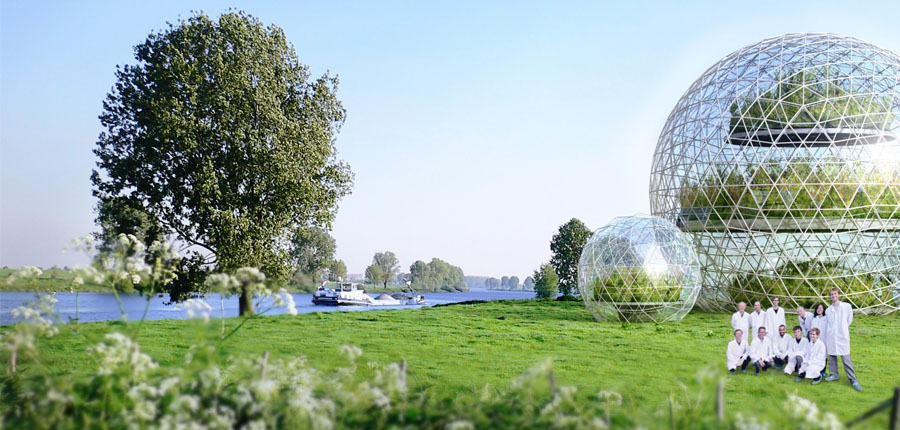
Dutch Polydome Could Be Used to Provide the Majority of NYC’s Food


Multidisciplinary design firm Except recently unveiled its Polydome concept for meeting the world’s skyrocketing agricultural demands. Using advanced greenhouse technology, meticulously planned crop groupings and absolutely no synthetic pesticides or fertilizers, the system can produce an abundant 10-15 lbs per square foot of vegetables, fish, and even honey. If grown atop rooftops, this bounty of food could even provide the majority of New York City’s food supply.


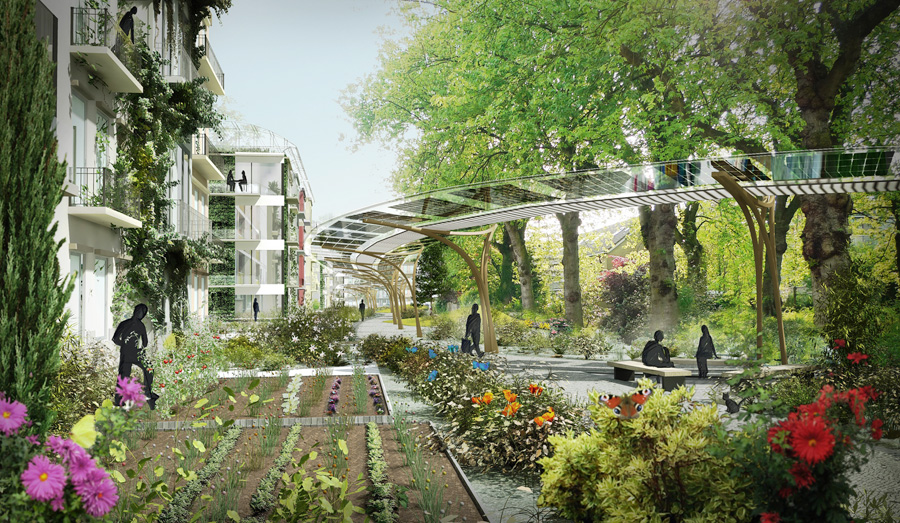
Unlike conventional monoculture greenhouses that produce only one crop, Polydome is a polyculture system with over 50 different crops growing at once interspersed among livestock and insects. This diversified system connects waste, water and energy flows enabling food production to be fully zero-waste.

Although the Polydome system uses recent advances in greenhouse technology such as integrated solar photovoltaics, Except’s greatest success was in designing optimal “crop clusters.” These are groups of plants, such as the Three Sisters, that use space, light and nutrients together in a way that maximizes productivity. The clusters are interchangeable, like Lego blocks, with many possible combinations that can be chosen to meet local food demand.


Depending on the plants and clusters chosen, Polydome systems can be entirely zero-waste. Inedible plant waste is reused as mulch, compost, and fish feed, while animal waste is used as natural fertilizer. Furthermore, mushroom cultivation, chickens and composing provide the high levels of carbon dioxide that plants thrive on, rather than generators or fossil fuel combustion.

To further maximize productivity, the system also uses stacked hydroponic crops. High profit crops such as strawberries and lettuces are suspended above soil crops, quickly growing in a hydroponic solution. This solution is loaded with nutrients from the wastewater of the Polydome’s fish aquaculture system.


Except suggests that their advanced greenhouse design could be coupled with restaurants, supermarkets and other food vendors. But as BrightFarms has demonstrated, a greenhouse like this could be planted atop any building, brightening the prospects of this concept reaching fruition.


ORIGINAL: Inhabitat
07/19/11

sábado, 1 de marzo de 2014

Could Solar-powered Desalination Solve California's Water Supply Problem?


California is suffering through its worst drought in decades, and it has gotten so bad that officials announced that 17 communities across the state are in danger of running out of water within 60 to 120 days. But what if the solution to California’s water crisis is as simple as sunlight – a resource the state has in abundance? That’s exactly what California-based startup WaterFX is proposing with its solar-powered desalination system. Renewable desalination could solve water scarcity issues not just in California but in other drought-stricken and desertified areas across the world.


WaterFX‘s system cleans water with a Concentrated Solar Still (CSS), which collects the sun’s thermal energy and transfers it through pipes filled with heat transfer fluid to a heat pump. The heat is then used for the distillation process, which evaporates freshwater out of the saltwater source. The condensate is then recovered as pure, fresh H2O. A thermal storage system holds excess heat for the times when the sun isn’t shining.


If we roll out the technology … we could produce 8% of all the water used in California, with just the land that was fallowed during the last drought,” WaterFX Founder and Chairman Aaron Mandell recently told Forbes Magazine. “That’s enough water for over 7M acres of irrigated farmland. You would begin to change the economics and change the course of how water is used. The whole idea is to wean the State off of the Central Aqueduct and become water independent. The current system is unsustainable and unreliable.

However solar desalination systems are not without their challenges – it takes a lot of energy to suck up large quantities of ocean water, and the process can capture local marine life as well. There’s also the issue of solar desalination’s byproducta salty sludge that can harm ecosystems if it’s pumped back into the ocean.

Other parts of the world working on renewable desalination include
South Australia, where Sundrop Farms has installed a desalination plant near Port Augusta;
Qatar, where the Sahara Forest Project is experimenting with a pilot system; and
Saudi Arabia, where there are plans to build a solar-powered plant in Al-Khafji. Saudi Arabia currently uses the equivalent of around 300,000 barrels of crude oil a day for its desalination plants, so switching from fossil fuels to renewable energy could have a huge positive impact on climate change and sustainability.

What we are trying to do is to develop a model that can be replicated. The problems in California are identical to those in many parts of the world. China is depending on delicate river systems to provide water for all types of economic growth that will not be sustainable. We could also do this in Saudi Arabia – they use an enormous amount of oil for water consumption, to evaporate or move water around the country,” said Mandell.

Images via WaterFX


ORIGINAL: Inhabitat
by Josh Marks
02/27/14

domingo, 9 de junio de 2013

A solar powered self-sustaining home - isolee by tjep

ORIGINAL: DesignBoom

dwelling is self-sustaining, running on solar energy collected via its rooftop
An ecologically friendly getaway - an escape from the reality of our busy days - 'isolée' is a small dwelling which combines smart technology with attention to detail, offering one a quaint retreat which has little impact on the environment.

Conceived by frank tjepkema of tjep, the intelligent house ensures minimal fuel reliance. From its exterior, a solar tree of circular photovoltaic panels extends from the rooftop, each following the movement of the sun throughout the course of the day to maximize absorption. the massive shutters which span the length of the building, are fastened to the main body of the structure via hinges equipped with electrical motors. the solar energy generated from the cabin is used to operate this computer controlled network, angling the louvered panels to the inhabitants liking, automatically closing when a storm approaches.

first floor entry where one is immediately invited into the living room

A wood burning stove is built into a cavity in the side of the house, and can be accessed from both the exterior and interior - with wood storage located on the outside, easily reached from the living room. a heating system - also electrically powered through the collected solar energy - is integrated into the structure, warming the interior using the heat which is emitted from the stove. all of the LED lighting within runs on rechargeable batteries, with water being the only external supply required by the house, drawn from a well.

the kitchen is built around the stairwell which diagonally intersects the interior
Composed of three levels, a stairwell cuts diagonally across the height of the home, connecting each floor. at the first floor entry, one is welcomed by the living room; the second floor houses the kitchen and dining area; the third and last floor functioning as a bedroom, with a bathroom and walkout terrace. employing a minimal product design ethos, the entire structure is secured to the ground at only four points, much like a piece of furniture.

the third floor bedroom has a hidden bathroom and walkout terrace
'I was curious to see what would happen if you gave a house the same sort of detailed design that’s found in all sorts of products we use every day. the cars we drive, the computers and tablets we use, the smartphones – all sophisticated, aesthetically sound objects. and then we go home, where we’re surrounded by a stack of bricks.' - frank tjepkema


large expansive shutters are electrically powered to angle at the inhabitant's desired position
wood storage is located on the exterior, with direct access to the supply from the first floor living room

worm's-eye perspective


exploded view of the dwelling
concept sketches

miércoles, 8 de mayo de 2013

Plant-e: living plants generate electricity

ORIGINAL: Plant-e


Technology
Plant-e develops products in which living plants generate electricity. These products are based on technology that was developed at Wageningen University, which was patented in 2007. The patent is now held by Plant-e. The technology enables us to produce electricity from living plants at practically every site where plants can grow. The technology is based on natural processes and is safe for both the plant, and its environment.

Via photosynthesis a plant produces organic matter. Part of this organic matter is used for plant-growth, but a large part can’t be used by the plant and is excreted into the soil via the roots. Around the roots naturally occuring micro-organisms break down the organic compounds to gain energy from. In this process, electrons are released as a waste product. By providing an electrode for the micro-organisms to donate their electrons to, the electrons can be harvested as electricity. Research has shown that plant-growth isn’t compromised by harvesting electricity, so plants keep on growing while electricity is concurrently produced. 

For more information on the technology and recent publications see


PlantPower - living plants in microbial fuel cells for clean, renewable, sustainable, efficient, in-situ bioenergy production
From 2009-01-01 to 2012-12-31 | PLANTPOWER website

Objective
Living plants in microbial fuel cells might be used as future large-scale Europe wide green energy providers. Such a system can produce in-situ 24 hours per day green electricity or biohydrogen without harvesting the plants. That this might become true was indicated by our first small scale proof of principle experiments describing the so called Plant Microbial Fuel Cell (Plant-MFC) (Strik, 2008, De Schamphelaire, 2008). The Plant-MFC aims to transform solar radiation into green electricity or biohydrogen in a clean and efficient manner. In the Plant-MFC concept, living plants and living microbes form an electrochemical system that is capable of sustainable production of green electricity or biohydrogen from solar energy. By its nature, the Plant-MFC is in potential 5 times more efficient than conventional bio-energy systems.

The technology might be implemented in several ways, ranging from local small scale electricity providers to large scale energy wetlands and islands, high-tech energy and food supplying greenhouses and novel biorefineries. This way, affordable bioenergy maybe produced in Europe as well as in developing countries. Plant-MFCs can be integrated in landscapes invisibly which makes this technology socially highly acceptable. However, exploration of new areas of science and technology is necessary to overcome Plant-MFCs bottlenecks and to make this principally clean, renewable and sustainable technology come true. It is now time to show that significant independent European biofuel and bioelectricity production is possible; we propose that Plant-MFCs can be an excellent choice for our future. We expect that Plant-MFC technology can at least cover 20% of Europe s primary energy need in a real clean and sustainable way. The Plant-MFC concept has several attractive qualities which can provide the significant break through for sustainable energy production in Europe. It will reinforcing competitiveness of Europe since Plant-MFC is world-wide implementable.

Project details
Project reference: 226532
Status: Completed

Total cost: EUR 5 209 687
EU contribution: EUR 3 989 080

Programme acronym: 

Subprogramme area: 
ENERGY.2008.10.1.1

Contract type: 
Collaborative project (generic)

Results

Documents

Publications (28)

L
Results

aure Lapinsonniere - Matthieu Picot - Frederic Barriere
David P. B. T. B. Strik - Matthieu Picot - Cees J. N. Buisman - Frédéric Barrière
M. Picot - R. Rodulfo - I. Nicolas - A. Szymczyk - F. Barriere - M. Rabiller-Baudry

jueves, 28 de marzo de 2013

FireFly. El Triciclo del siglo XXI

ORIGINAL: Ecoinventos
by DAVID
27 MARZO, 2013


El clima a partir de ahora no será un impedimento para andar en bicicleta, independientemente de la estación o mes del año, ya que desde Geospace Studio nos llega este vehículo de tracción humana habilitado para cualquier tipo de clima.


El clima a partir de ahora no será un impedimento para andar en bicicleta, independientemente de la estación o mes del año, ya que desde Geospace Studio nos llega este vehículo de tracción humana habilitado para cualquier tipo de clima.


Bautizado como FireFly, este vehículo es un triciclo con una estructura que protege al conductor de la humedad, el frío, gracias a su chasis protector, y también de la noche gracias a sus luces.


Así los ciclistas podrán montar en bici todo el año sin importar la estación del año, el tiempo y también aumentando su seguridad.


FireFly es un transporte ecológico, mas cómodo y seguro, que nos muestra hacia donde debe tender el diseño de vehículos más ecológicos.

Visto en: elsafari.cl
Quizás también le interese:

domingo, 18 de noviembre de 2012

Home Aquaponics Kit: Self-Cleaning Fish Tank That Grows Food

ORIGINAL: Kickstarter
by Nikhil & Alejandro


The Aquaponics Garden: an elegant table-top fish tank that cleans itself & grows fresh food at the same time. A closed-loop ecosystem!

Launched: Nov 15, 2012
Funding ends: Dec 15, 2012

Check out this recent article from GOOD Magazine on this campaign!

Grow fresh produce right in the comfort of your own home - beans, basil, thyme, baby greens, oregano, mint, parsley, spinach and so many other delicious foods!

Follow our Kickstarter journey on Facebook and Twitter!

Perfect for the classroom!
A Beautifully Simple & Closed-Loop Ecosystem Right on Your Table
An elegant table-top experience
Fun for families!
Great for classrooms and science projects

So What's Happening Inside?
Aquaponics Garden

So what's happening? The fish, they poo and they pee, and all that waste-water gets broken down by beneficial bacteria into nutrients

The waste-water from the fish is then pumped up & upcycled as an awesome organic fertilizer for the plants. The plants take up the nutrients and, at the same time, clean the water which then falls back down for the fish.

There is no soil - the plants are growing just on rocks - all the nutrients coming from the fish (no need for any artificial fertilizers - it's all organic!!)

There is no need to clean the water because of the plants - it's a self-cleaning fish tank!

What Can I Grow?

Choose from a variety of fresh produce, including spinach, baby greens, oregano, beans, basil, mint, parsley & thyme.

Harvesting Basil_Aquaponics Garden
All You Have to Do is Feed Your Fish

You can pick from a ton of different types of fish that will work great in the system - including our favorite, the Betta fish we have pictured in our system!
Feeding Fish_Aquaponics Garden
What Comes With My Aquaponics Garden?

Each Aquaponics Garden comes with the entire system - ready to go & no assembly required!

Includes:
  • The tank & garden top - food and pet safe!
  • Air pump to bring your nutrients up and oxygenate the water
  • 5 pots with pebbles (from which the plants will grow)
  • Organic seeds (mixture of various herbs)
  • Fish food and water conditioners to get started right away
Just add water & fish and watch your system take off! Our goal was to make this incredibly intuitive and easy to setup!

Who We Are
2 Recent College Grads On a Mission to Help People Grow Their Own Food at Home

Help Bring This to Life - Pledge Today
Add caption
Add caption
Add caption
FAQ

  1. How many fish can I keep? The industry standard is 1" of fish for 1 gallon of water. This is a 3 gallon tank, so you can have 1 larger 3" fish, or a few smaller 1" fish. If you'd like to host other types of fish, the system will allow it, but you should transfer them out to a larger tank when they grow in size.
  2. What kind of fish can I put in my tank? Many types will work well, but we highly recommend some ornamental fish like Bettas, cloud fish, danios, or small goldfish. These are some of the easiest fish to keep, but depending on your expertise, you can keep others!
  3. How big is the unit? It's roughly 10" wide, by 11" high, by 6" deep - smaller than your average toaster oven! The tank itself holds 3 gallons of water. When empty, it's super-light, just a few pounds!
  4. What is it made out of? We are finalizing the exact materials, but are exploring various combinations of recycled plastics, acrylic, and glass.
  5. Can I grow flowers in my system? Absolutely!!
  6. How many different types of plants can I grow? There are 5 "pots" to plant in, and you pick and choose what combo of plants to grow in them as you please! Five of the same, or one of each. You can get creative!
  7. Does it need sunlight - I thought fish don't like sun? We recommend putting the tank right next your window, with the back up against a wall. That way there's no direct light coming into your tank, but at the same time, enough ambient sunlight to help the plants grow. If you'd like to place the kit right against a window, we suggest just placing a backer against the back clear panel to prevent direct sunlight from hitting the tank (which can cause algae growth!) We're working on finding the best tint for the back right now.
  8. 8) Can I grow year-round? Yes! If it's too cold though for the fish you choose or you don't have proper light in the winter, we suggest investing in some inexpensive water-heaters and grow-lights to guarantee consistent growth! We'll have our favorite suggestions on our site, and links to buy them, when we are reading to ship in late February.
  9. 9) Can I use my own seeds? Absolutely! We don't believe in the pricey subscription model when it comes to food! You don't need to buy any special replacement pre-seeded pods from us - use your own seeds!

RISKS AND CHALLENGES

Some of the challenges that we are currently working to solve and create the best possible solutions for are below. We will constantly be updating our Kickstarter community as we learn more and make decisions on the below areas.

Some manufacturing challenges:
  1. Keeping costs down on the accessory inputs: Manage costs by getting many of the additional inputs donated for free. We are looking to partner with various suppliers of fish food and water conditioners to offer starter kits for free with our Aquaponics Garden. By keeping their brand on these starter packs, it'll expose their brand to many more customers and make up for the donation of the starter packs. These relationships are still being finalized, and there is a risk of added costs if we cannot make these happen.
  2. Manufacturing of the Pot: We are still determining how the actual pot will be manufactured - will it be one injected molded pot, or 3 different parts sonic welded together (a U shaped piece) with a clear front and back panel. Although the separate pieces will look cleaner and offer more precise angles, it is more expensive. We are working with our manufacturer to understand the capability of their equipment to create the product in one pot-shaped unit and hopefully maintain quality and keep price down.
  3. Sustainability - we are looking into the best options to use entirely recycled plastic or glass. This is still being finalized and maintaing a low cost will be a challenge for these two solutions. We'll be constantly updating the KS community as we work on this!
  4. Time-line: We are confident here as we have a partner locally that has already committed to being able to manufacture this - which would reduce the months of time wasted in shipping by using foreign manufacturers.
  5. Colored Kits - we are still finalizing the exact way the colored/tinted back panel will be applied to the clear back - through an adhesive or a hook-mechanism. The problem with the adhesive has been being able to easily remove it if a customer wants to change the color. The hanging method adds more parts/tooling and drives the cost up.
  6. Etching - the exact font size of how big the names will be (for the LIFETIME LEGACY reward) is being finalized - there is a challenge/balance of having names be small enough to fit more names/make it accessible to more and big enough where it can be etched and readable. We will keep you informed!!

Leave a comment with any other questions!

Thanks!

Alejandro and Nikhil


FAQ


Have a question? If the info above doesn't help, you can ask the project creator directly.Ask a question
Report this project to Kickstarter

592backers
$34,868pledged of $100,000 goal

26days to go
Back This Project$1 minimum pledge


This project will only be funded if at least $100,000 is pledged by Saturday Dec 15, 2:59am EST.

Project by
Nikhil & Alejandro

Oakland, CAContact me

First created · 2 backed
Nikhil Arora (1120 friends)
Website: http://backtotheroots.com

See full bio

Pledge $1 or more
18 backers


***BEHIND THE SCENES ACCESS*** Get access to private Kickstarter updates & fun(ny) pics from the journey!
Estimated delivery: Dec 2012


Pledge $10 or more
40 backers


***PHOTO MURAL*** Your picture will go up on the photo mural we're creating at our farm featuring all of our supporters. Your name will also be added to our website's product page so everyone knows who helped bring this to life!
Estimated delivery: Dec 2012


Pledge $25 or more
25 backers


***T-SHIRT*** Everyone will know about your love for the Aquaponics Garden when you wear your limited edition Sustainably Delicious t-shirt! (Int'l delivery not guaranteed by Dec 2012)
Estimated delivery: Dec 2012
Add $15 to ship outside the US


Pledge $40 or more
150 backers Sold out


***BE THE FIRST*** Save on an Aquaponics Garden pre-order by being one of the first 150 people in the world to own the kit.
Estimated delivery: Feb 2013
Add $50 to ship outside the US

Pledge $50 or more
273 backers


***AQUAPONICS GARDEN PRE-ORDER*** Whether you're buying one for your home or kid's classroom, you'll save 33% from the planned retail price and enjoy free shipping in the US by pre-ordering today!
Estimated delivery: Feb 2013
Add $50 to ship outside the US


Pledge $100 or more
45 backers


***CUSTOM COLORED AQUAPONICS GARDEN*** Add a bit more pop to your experience by tinting the back panel to the color of your choice! Includes: t-shirt. (Estimated delivery date of t-shirt: Dec 21 2012; Estimated delivery of kit: late Feb 2013; Items will ship together in late Feb 2013 for international backers)
Estimated delivery: Dec 2012
Add $50 to ship outside the US


Pledge $500 or more
13 backers Limited (137 of 150 left)


***LIFETIME LEGACY*** Your name will be permanently engraved on the bottom of every single kit we sell. As we scale, thousands of customers worldwide will always remember who helped make this possible! Includes: t-shirt & custom colored kit. (Estimated delivery date of t-shirt: Dec 21 2012; Estimated delivery of kit: late Feb 2013; Items will ship together in late Feb for international backers)
Estimated delivery: Dec 2012
Add $50 to ship outside the US


Pledge $2,000 or more
0 backers Limited (20 of 20 left)


***JOIN THE FAMILY*** In order to have the honor of hosting you at our annual company retreat, we will fly you out to San Francisco and put you up for 3 nights in early Jan 2013. Meet the Back to the Roots Family and experience our fun, fun(ny), and fun(ky) culture. Help us strategize and think through how to grow this movement of making food personal again! Includes: t-shirt, custom colored kit & liftetime legacy engraving. (Estimated delivery of t-shirt: Dec 21, 2012; Estimated delivery of kit: late Feb 2013; Estimated time of trip: Early January 2013; US domestic flights only)
Estimated delivery: Dec 2012
Add $50 to ship outside the US


Pledge $10,000 or more
0 backers Limited (10 of 10 left)


***INSPIRE YOUR COMMUNITY*** Alejandro and Nikhil will fly out to you and host an educational seminar for your community. We’ll be leading a discussion to inspire people towards a more sustainable future by growing your own food and eating local. We will cook a delicious, locally-sourced meal for all in attendance. Includes: t-shirt, custom colored kit & liftetime legacy engraving. (Estimated delivery of t-shirt: Dec 21, 2012; Estimated delivery for kit: Late Feb 2013; All details for event will be finalized directly with you)
Estimated delivery:

lunes, 20 de agosto de 2012

Tree Museum With a Collection of 2,000 Trees Opens in Switzerland

ORIGINAL: Inhabitat
by Bridgette Meinhold,
06/15/10

Yesterday the Tree Museum opened outside of Zurich in Rapperswil-Jona, Switzerland, showcasing an incredible collection of 2,000 different species of trees. The museum was designed and built by Swiss landscape architect Enzo Enea with the help of Oppenheim Architecture + Design (OAD), who designed Enzo Enea’s new headquarters. The Tree Museum and the sustainably-built headquarters are located on the grounds of a 14th Century monastery, and the museum displays Enea’s personal collection of trees, which he has gathered over the past 17 years.


Enzo Enea selected Chad Oppenheim from a group of eight leading architects from around the world to design the headquarters along with the Tree Museum. Enea chose Oppenheim because he felt that he best understood what he wanted to accomplish with the Tree Museum — the headquarters are designed to act as the perfect backdrop to showcase the trees. The building itself does include a number of sustainable features, such as the use of sustainably-sourced local wood, which blends with the surrounding forest, natural daylighting, efficient insulation, a green roof and a geothermal heating and cooling system.

The Tree Museum houses 2,000 trees on 2.5 acres, with a special installation of about 50 species personally curated by Enea from around the world. Trees are highlighted against sandstone wall backdrops and include 22 different varieties ranging from Taxus baccata to English yew, Pinus sylvestris, and Scotch pine. Enea has collected these trees over the last 17 years during various projects when trees had to be removed from the site. So instead of getting rid of them, he kept them and now has his own special museum, where visitors can view hundreds of trees for a reasonable fee.

sábado, 21 de julio de 2012

Bicicleta de bambú - La Social

ORIGINAL:  Sustentator


La Bambucicleta es el resultado perfecto en materia sustentable. Debido a que el bamboo crece de manera muy rápida, al crecer absorbe CO2 generando más oxígeno. El otro gran punto a favor es que fabricar una bicicleta de bamboo necesita muchísima menos energía que la que se necesita para hacer una bicicleta de metal.

¡Menos CO2 y más Oxígeno!