Mostrando entradas con la etiqueta Autonomía. Mostrar todas las entradas

miércoles, 19 de noviembre de 2014

3-D Printer Powered Up on the International Space Station

NASA astronaut Butch Wilmore installs a 3-D Printer in the Microgravity Science Glovebox on the International Space Station. Image Credit: NASA-TV

Darian Bryant, left, and Melissa Hopper, stowage engineers with the Payload Operations Integration Center at NASA's Marshall Space Flight Center in Huntsville, Alabama, work with NASA astronautBarry "Butch" Wilmore to calibrate the first 3-D Printer flown on the International Space Station. Image Credit: NASA/MSFC/Emmett Given

Today, NASA took a big step toward changing the way we plan for long-duration space voyages when astronaut Barry “Butch” Wilmore successfully installed and prepared the first 3-D printer for upcoming manufacturing operations on the International Space Station.

"This printer is a critical first step for in-space manufacturing," said Jason Crusan, director of NASA's Advanced Exploration Systems Division at NASA Headquarters in Washington. "Additive manufacturing with 3-D printers will allow space crews to be less reliant on supply missions from Earth and lead to sustainable, self-reliant exploration missions where resupply is difficult and costly. The space station provides the optimal place to perfect this technology in microgravity."

Wilmore installed the printer in the station’s Microgravity Science Glovebox and started the printer, which extruded plastic to form the first of a series of calibration coupons, a small plastic sample about the size of a postage stamp. After calibration of the printer is complete and verified, the printer will make the first NASA-designed 3-D printed object in space. The goal of the 3-D Printing in Zero-G Technology Demonstration on the space station is to show that additive manufacturing can make a variety of parts and tools in space. The 3-D printerheats a relatively low-temperature plastic filament to build parts layer on top of layer in designs supplied to the machine.

Before the printer left Earth in September 2014 on SpaceX’s fourth commercial cargo resupply mission, engineers loaded the first files to be printed. These initial parts -- primarily test coupons -- will be returned to Earth for detailed analysis and comparison to identical ground control samples made earlier this year prior to launch with the same printer while it was at NASA’s Marshall Space Flight Center in Huntsville, Alabama.

"The goal of the first phase of printing is to verify that the 3-D printing process works the same in microgravity as it does on the ground," said Niki Werkheiser, NASA's 3-D printer project manager at Marshall. "Once we confirm that the process works, we will move to the second phase of printing which focuses more on the design and utilization of the parts we print, which will ultimately lead to establishing an on-demand machine shop in space."


Niki Werkheiser, project manager for the NASA's 3-D Printing investigation at the Marshall Space Flight Center, explains the calibration and check-out process during a recent episode of Space Station Live on NASA-TV. (Video: NASA)


NASA contracted Made In Space, Inc. at NASA’s Ames Research Center in Moffett Field, California, to design and build the printer. Going forward, Made In Space engineers will use NASA-provided software and work with controllers at NASA’s Payload Operations Integration Center (POIC) in Huntsville to send commands directly to the printer from the ground. As the first objects are printed, NASA and Made In Space engineers will monitor printing via downlinked images and videos. The majority of the printing process is controlled from the ground to limit crew time required for operations.

"We’re approaching the most exciting moment of this experiment after years of intensive work, which dates back to Made In Space's first microgravity testing with NASA's Flight Opportunities Program in 2011," said Aaron Kemmer, CEO of Made In Space, Inc. “Our team is on standby to send the command to print the first object in space. We are taking everything we are learning on the space station and using it to design an even more elaborate 3-D printer, which will be available for anyone to use.

That printer is scheduled to be launched to the station next year and will be available to meet manufacturing needs of both NASA and commercial users.

NASA invited students to propose what they would print in space as part of a Future Engineers competition. Students can create and submit a digital 3-D model of a tool they think astronauts need in space. The winning student will watch from the POIC alongside the operations control team as their design is printed in space. The deadline for entry is Dec. 15.

Learn more about additive manufacturing at NASA's 3-D printing website or follow updates on Twitter at @NASA3DPrinter.


Joshua Buck
Headquarters, Washington
202-358-1100

Tracy McMahan
Marshall Space Flight Center, Huntsville, Ala.
256-544-0034

Dan Huot
Johnson Space Center
281-483-5111

ORIGINAL: NASA
By Bill Hubscher International Space Station Program Science Office
November 17, 2014
martes, 18 de noviembre de 2014

Jellyfish Barge

The World Bank predicts that the world population will grow to almost 10 billion in the next four decades. By 2050, the global demand for food is expected to be 60-70% higher than today. Scarcity of water and cultivable land are the main obstacles to meet the quantitative and qualitative shifts of the world’s demand. Most of the potentially arable land is concentrated in a few geographical areas, and it is extremely scarce in many of the regions with high population growth rates, such as North Africa and the Arabian Peninsula. Agriculture is the human activity that relies most on the existing water resources. Currently in many parts of the world, such India, Pakistan and Southern Spain, the demand for water for agricultural purposes is satisfied by unsustainable methods such as over-extraction from underground reservoirs.

The scarcity of arable land and fresh water for agriculture is being exacerbated by changes in the climate, exposing many areas to increased risks and contribute to make them even more vulnerable to the problem of water and food security. The rising sea level, for example, contributes to flooding of extensive areas of fertile land with salt water. This phenomenon has already begun to occur with alarming frequency all over the Bay of Bengal.

Video by Studiomobile

Floating, self-sufficient cultivation module


© Matteo de Mayda 2014

Tackling these challenges in a holistic way can produce considerable improvement in water and food security of coastal communities. Jellyfish Barge is a module for crop cultivation that doesn’t rely on soil, fresh water and chemical energy consumption. Jellyfish Barge is a floating agricultural greenhouse, able to purify salt, brackish or polluted water using solar energy. Jellyfish Barge is built with low-cost technologies and simple materials, also appropriate to the self-construction paradigm. It consists of a wooden base of about 70 square meters that floats on recycled plastic drums and supports a glass greenhouse for crop cultivation.

Inside the greenhouse, a high-efficiency hydroponic cultivation method provides up to 70% of water savings compared to traditional hydroponic systems. The Jellyfish Barge has an innovative automated system with remote monitoring and control. Required water is supplied by 7 solar desalination units arranged around the perimeter that are able to produce up to 150 liters per day of clean fresh water from salt, brackish, or polluted water. Solar distillation is a natural phenomenon: in the seas, the sun’s energy evaporates water, which then falls as rain water.

The solar desalination system of the Jellyfish Barge replicates this phenomenon on a smaller scale, sucking in moist air and forcing it to condense within the drums in contact with the cold surface of the sea. The low energy required to power fans and pumps is provided by solar panels, mini wind turbines and an innovative system that exploits waves to produce electricity.


According to FAO, long-term successful strategies for agricultural development depend on technological innovation as well as on the ability of small farmers to be economic agents and to meet their own needs. Thus, Jellyfish Barge is novel in its ability to respond effectively with limited resources. For this reason it has been designed relatively small in size, capable of supporting two families, and is thus easy to build even in conditions with economic constraints. However, it is modular, so a single element is completely autonomous, while various flanked barges create a stronger and more resilient organism.


Jellyfish Barge comes from a project by Antonio Girardi and Cristiana Favretto (Studiomobille) called Jellyfish Farm. It exploits the seawater desalinization process to cultivate floating vegetable gardens. The installation is sort of “neo-nature”, where recycled objects become an autonomous living organism.


© Studiomobile 2010


Jellyfish Barge is also a new sustainable lifestyle.
© Pnat 2014

See above how it can be inproved!

ORIGINAL: PNAT

jueves, 20 de marzo de 2014

Dutch Polydome Could Be Used to Provide the Majority of NYC’s Food


Multidisciplinary design firm Except recently unveiled its Polydome concept for meeting the world’s skyrocketing agricultural demands. Using advanced greenhouse technology, meticulously planned crop groupings and absolutely no synthetic pesticides or fertilizers, the system can produce an abundant 10-15 lbs per square foot of vegetables, fish, and even honey. If grown atop rooftops, this bounty of food could even provide the majority of New York City’s food supply.


Unlike conventional monoculture greenhouses that produce only one crop, Polydome is a polyculture system with over 50 different crops growing at once interspersed among livestock and insects. This diversified system connects waste, water and energy flows enabling food production to be fully zero-waste.

Although the Polydome system uses recent advances in greenhouse technology such as integrated solar photovoltaics, Except’s greatest success was in designing optimal “crop clusters.” These are groups of plants, such as the Three Sisters, that use space, light and nutrients together in a way that maximizes productivity. The clusters are interchangeable, like Lego blocks, with many possible combinations that can be chosen to meet local food demand.


Depending on the plants and clusters chosen, Polydome systems can be entirely zero-waste. Inedible plant waste is reused as mulch, compost, and fish feed, while animal waste is used as natural fertilizer. Furthermore, mushroom cultivation, chickens and composing provide the high levels of carbon dioxide that plants thrive on, rather than generators or fossil fuel combustion.

To further maximize productivity, the system also uses stacked hydroponic crops. High profit crops such as strawberries and lettuces are suspended above soil crops, quickly growing in a hydroponic solution. This solution is loaded with nutrients from the wastewater of the Polydome’s fish aquaculture system.


Except suggests that their advanced greenhouse design could be coupled with restaurants, supermarkets and other food vendors. But as BrightFarms has demonstrated, a greenhouse like this could be planted atop any building, brightening the prospects of this concept reaching fruition.


ORIGINAL: Inhabitat
07/19/11

domingo, 16 de febrero de 2014

Robots with insect brains

(Credit: Freie Universität Berlin)

German researchers have developed a robot that mimics the simple nervous system used for olfactory learning in the honeybee, using color instead of odors.

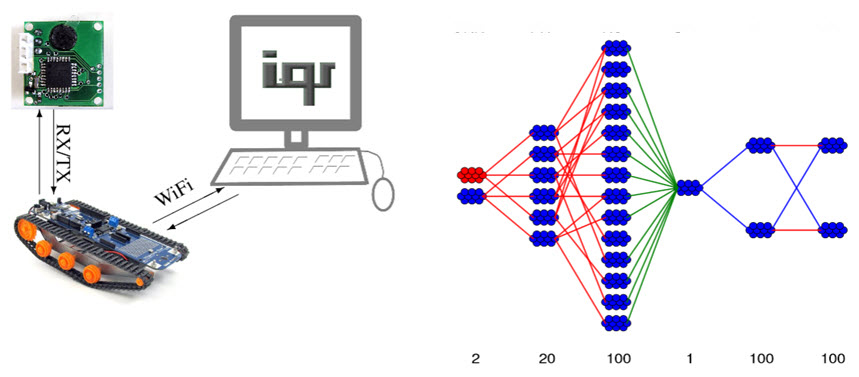
The researchers have installed a camera on a small robotic vehicle connected to a computer. The computer program replicates, in a simplified way, the sensorimotor neural network of the insect brain and operates the motors of the robot wheels to control its motion and direction based on the colors.

The network-controlled robot is able to link certain external stimuli with behavioral rules,” said Professor Martin Paul Nawrot, head of the research team and professor of neuroscience at Freie Universität Berlin. “Much like honeybees learn to associate certain flower colors with tasty nectar, the robot learns to approach certain colored objects and to avoid others.

The learning experiment

The scientists located the network-controlled robot in the center of a small arena with red and blue objects on the walls. Once the robot’s camera focused on an object with the desired color, the scientists triggered a light flash. This signal activated a “reward sensor nerve cell in the spiking neural network. The simultaneous processing of red and the reward caused the robot to move toward the object; blue made it move backwards.

Left: robot hardware. The camera output is processed on the Arduino board and is sent to the open-source iqr spiking neural network simulator software as a 1 or 0, depending on whether or not a colored region was found, and is translated into spike trains.
Right: neural network architecture from sensory input to motor output. Red or blue connections indicate excitatory or inhibitory synapses. Green connections indicate modulatory synapses that are adjusted during reinforcement. Numbers under each group indicate the number of artificial neurons (credit: L. I. Helgadóttir et al.).

“Within seconds, the robot accomplishes the task to find an object in the desired color and to approach it,” explained Nawrot. “Only a single learning trial is needed, similar to experimental observations in honeybees.

The scientists are planning to expand their neural network by adding more learning principles.

Future real-world applications
Our work and the paper focus on basic science,Tim Landgraf, head of the Biorobotics Lab at Freie Universität Berlin, explained to KurzweilAI in an email interview. “We first want to understand how fundamental processes like learning and memory enable the animal (many of our studies use the honeybee as a model) to accomplish complex tasks.

Ultimately, this will improve our understanding of the function of our own human brain. And once we understood how we can employ realistic, brain-like processing structures to solve real-world problems, this will have an impact on how robots or artificial systems in general are being programmed.

Rather than writing millions of lines of code for solving problems, we will lean back and watch adaptive, neural systems learn the structure of their environments. First as virtual brains in a simulation of the world and then, once they have sufficiently matured, in the real world.

As far as we know, we were the first to show that robots can be conditioned in a one-shot learning experiment with spiking neural networks.” However, he admits that the biggest unknown is the neuromorphic (spiking) hardware. “Currently, researchers are using simulations on big computing machines, nothing that would fit on a robot. Neuromorphic chips emulate neuronal activity in small analog circuits. They might be available commercially within the next ten years or so. I can’t say whether they will be powerful enough (number of neurons, synaptic plasticity, etc.) to be applicable in complex real-world scenarios by then.

Funding for the research is provided by the National Bernstein Network Computational Neuroscience in Germany and the German Federal Ministry of Education and Research.


Abstract of 6th International IEEE/EMBS Conference on Neural Engineering (NER) paper
Insects show a rich repertoire of goal-directed and adaptive behaviors that are still beyond the capabilities of today’s artificial systems. Fast progress in our comprehension of the underlying neural computations make the insect a favorable model system for neurally inspired computing paradigms in autonomous robots. Here, we present a robotic platform designed for implementing and testing spiking neural network control architectures. We demonstrate a neuromorphic realtime approach to sensory processing, reward-based associative plasticity and behavioral control. This is inspired by the biological mechanisms underlying rapid associative learning and the formation of distributed memories in the insect.

References:
L. I. Helgadóttir, J. Haenicke, T. Landgraf, R. Rojas, M. P. Nawrot, Conditioned behavior in a robot controlled by a spiking neural network, 6th International IEEE/EMBS Conference on Neural Engineering (NER), 2013, DOI: 10.1109/NER.2013.6696078

Related:
Robots with Insect Brains

ORIGINAL: KurzweilAI

February 14, 2014

lunes, 2 de diciembre de 2013

Stepping on the gas. Fuel-cell cars


CARMAKERS’ plans to use hydrogen as a fuel looks like it will avoid the dead end that the gas reached in keeping airships aloft. A series of announcements about hydrogen-powered vehicles at recent big car shows in Tokyo and Los Angeles have reinvigorated its claim as a fuel of the future. Hyundai could have a car in production by next year. But the drawbacks to hydrogen still threaten its re-emergence as one of the clean fuels of the future.

None of the successors to the internal-combustion engine has yet set much of a pace. Electric cars are costly; their batteries take a long time to charge but drain quickly. Hybrids, which combine battery and petrol engines, are also expensive and complex. So the need to comply with strict new mileage and emissions standards around the world has renewed the faith of some carmakers in fuel cells. These use hydrogen drawn through a permeable membrane coated with a layer of platinum where the gas combines with oxygen from the air to create water vapour and current that can be used to run electric motors.

Hydrogen power is back in fashion partly because of constant tinkering with the technology. Honda has reduced the size of its fuel-cell “stack” by a third, making it small enough to stuff under the bonnet where a conventional engine would go. Hyundai claims to have cut manufacturing costs by 50% over the past two years. Both unveiled new fuel-cell vehicles in Los Angeles. Toyota revealed its new model car in Tokyo. Several others, including General Motors, which recently formed a fuel-cell partnership with Honda, are close to announcing new hydrogen cars.

Reducing the price of fuel cells helps hydrogen to compete with battery-laden competitors. Moreover, a hydrogen tank can be refilled in the same time it would take to fill up with petrol. And where most electric vehicles have a range of below 160km, all three of the new hydrogen cars are promising up to 480km.

Getting the gas to fill up a fuel-cell tank is a more fundamental problem. Hydrogen is usually tied up in more complex molecules, such as hydrocarbons. Proponents advocate extracting it from natural gas, which is cheap in America thanks to the fracking boom. The problem is that compressed or liquefied natural gas is already being used directly in trucks and other fleet vehicles. Some carmakers have launched natural-gas version of current models, which have modified internal-combustion engines, making them far cheaper than fuel-cell alternatives.

Another source is hydrolysis, using electricity to split water into hydrogen and oxygen. But the energy required to collect, store and convert hydrogen back to electricity means that approach “only makes sense if you use green energy,” contends Rudolf Krebs, Volkswagen’s head of electric propulsion. VW sees fuel-cells as a future backup for batteries in hybrids.

Nissan’s boss, Carlos Ghosn, a hydrogen sceptic, raised another concern at the Tokyo show. “Where is the infrastructure? Who’s going to build it?There are only a handful of hydrogen filling stations in California, the likely first market for fuel-cell cars, though state lawmakers have approved funding for a scheme that would set up 100 by 2020. Similar plans are afoot in Germany and Japan. Hydrogen may find a role in cleaning up driving. But battery power and ever more frugal versions of gasoline and diesel engines will make for a traffic jam of likely alternative power sources for the future motorist.

ORIGINAL: The Economist
by P.E. and S.W. | LOS ANGELES
Dec 2nd 2013 

jueves, 11 de octubre de 2012

Coches de hidrógeno: un sueño que no muere

POR PETER FAIRLEY
TRADUCIDO POR LÍA MOYA (OPINNO)
MIÉRCOLES, 10 DE OCTUBRE DE 2012

Una mejor tecnología y los elevados costes de las baterías han reavivado el interés por los vehículos de hidrógeno.

Para mediados de la década de 2000, el sueño de los coches de hidrógeno se había desvanecido ante tercas consideraciones prácticas como la falta de estaciones para repostar y las ineficientes pilas de combustible. Pero mientras la industria automovilística lucha por superar las limitaciones de los vehículos eléctricos de batería, el sueño sigue vivo. Ha quedado patente en el salón del automóvil de París.
Máquina de sueños: Este año Hyundai, la ambiciosa empresa automovilística coreana, planea ofrecer en arrendamiento una versión de pila de combustible de su ix35. 
Fuente: Peter Fairley

Cuando se inauguró el salón el mes pasado, los vehículos eléctricos de batería ocuparon un lugar prominente. Pero los vehículos de pila de combustible de hidrógeno también estuvieron omnipresentes. Los visitantes del salón podían probar siete coches con pila de combustible de los principales fabricantes (incluyendo un todoterreno que Hyundai tiene pensado ofrecer en arrendamiento este invierno) y toda una serie de llamativos prototipos que traían a la mente visiones de un futuro impulsado por hidrógeno.


Los fabricantes vuelven a mostrar interés por el hidrógeno porque los problemas clave de las pilas de combustible –su capacidad limitada para convertir hidrógeno en electricidad y su propensión a congelarse- se han superado en los últimos años. Al mismo tiempo, las ventas de los primeros vehículos eléctricos de batería producidos a gran escala –el rival tecnológico de la pila de combustible para lograr emisiones cero- no acaban de arrancar debido a que su autonomía sigue siendo decepcionante y su precio elevado.

Incluso Nissan, que domina el mercado del vehículo eléctrico con el Leaf, su supercompacto, y prevé vender 1,5 millones de vehículos eléctricos para 2016 con su socio Renault, ha presentado un potente todoterreno de pila de combustible como prototipo en París. Esta estrategia de la empresa es el reflejo de ideas generalizadas en la industria automovilística, según la consultora KPMG. De los 200 ejecutivos encuestados en su Encuesta Global a Ejecutivos Automovilísticos de 2012, quienes predecían que los compradores de coches eléctricos en 2025 preferirán un coche con pila de combustible superaban en un 25 por ciento a quienes apoyaban la tecnología de las baterías.

Los fabricantes creen en la capacidad del vehículo con pila de combustible”, afirma Kevin See, analista senior para la consultora de Boston (EE.UU.) Lux Research. “Elimina el quebradero de cabeza de la autonomía, lo que los convierte en una opción de emisiones cero con el rendimiento necesario para servir a una base de consumidores más amplia”.

Los coches de pila de combustible del salón de París son capaces de multiplicar por mucho los 120 kilómetros de autonomía del Nissan Leaf aprobado por la Agencia de Medioambiente de Estados Unidos. El gas de hidrógeno comprimido en un tanque de fibra de carbono a una presión de 700 bares –el estándar actual de la industria- es capaz de propulsar el ix35 de Hyundai durante 600 kilómetros. Y Toyota presume de que su prototipo de berlina FCV-R es capaz de llegar a los 720 kilómetros.

Nissan no ha hecho público un cálculo de la autonomía de su todoterreno de pila de combustible, el TeRRA. Pero ante las quejas de compradores del Leaf decepcionados porque la autonomía del vehículo va empeorando con el tiempo, no cuesta ver por qué la tecnología de pila de combustible resulta atractiva.


Sin embargo, según Gerald Killmann, el director de I+D para grupos motopropulsores de Toyota en Europa, este renovado entusiasmo por los coches de hidrógeno no tiene que ver solo con la autonomía. Además de resolver las preocupaciones respecto a temas clave como la conducción en climas fríos y el repostaje rápido, en los últimos años Toyota ha conseguido que sus sistemas de pila de combustible sean mucho más pequeños.

La torre de pilas de combustible del FCV-R es aproximadamente la mitad en tamaño y peso que la generación anterior de torres desarrollada en 2008 en términos de kilovatios producidos. Killmann afirma que la berlina de pila de combustible que Toyota piensa empezar a comercializar en 2015 en Japón, Norteamérica y Europa será técnicamente parecida al FCV-R. Hyundai también ha conseguido hacer más pequeño su grupo motor ya que su torre de pilas de combustible funciona con el aire ambiental, eliminando por tanto la necesidad de aparatosos compresores que hacen ruido y chupan una gran cantidad de energía. 

Lo que aún no está preparado para un consumo masivo es el coste de los coches eléctricos con pila de combustible. Killmann explica que ahora mismo producir el FCV-R costará cerca de 1000.000 euros. Toyota espera dejar ese coste por lo menos en la mitad para 2015 gracias a que desarrollarán todos los componentes ellos mismos, como ya hicieron con su coche híbrido. 

See señala que a los vehículos de pila de combustible aún les queda un obstáculo crucial que superar: la falta de estaciones de repostaje de hidrógeno. En la actualidad no hay más de 280 en todo el mundo y a muchas de ellas no se puede acceder públicamente, según Ulrich Buenger, coordinador de H2Moves, un proyecto de demostración de pilas de combustible financiado con 20 millones de euros por la Unión Europea. Hacer que suban esas cifras será caro, puesto que instalar una estación de servicio de hidrógeno cuesta aproximadamente un millón de euros.

Buenger predice que el coste de instalación de las estaciones de servicio de hidrógeno caerá hasta los 300.000 euros, el precio de una bomba de gas natural, con cada una que se instale, un proceso que se está acelerando en Europa. Alemania tiene 14 estaciones de hidrógeno abiertas al público y una colaboración entre el sector público y el privado anunciada este año tiene como objetivo instalar 36 más para 2015, lo suficiente como para poder enlazar la mayoría de las ciudades. Esta primavera Dinamarca presentó un plan parecido. Y el viernes pasado Air Products, productor mundial de productos químicos anunció planes para construir dos estaciones de servicio de hidrógeno en Londres, con lo que habría un total de cinco en la ciudad. 

Pero este tipo de planes no se dan en Estados Unidos, donde la página web del Departamento de Energía de Estados Unidos presenta una lista de tan solo 7 estaciones públicas en el país, todas ellas en California.

Existe una razón potente para ser optimista respecto a que esto podría cambiar, afirma Buenger: el suministro abundante de gas natural proveniente de la fractura hidráulica, que supone una importante fuente de hidrógeno. “Cada vez hay un mayor interés en la tecnología de pila de combustible debido a los nuevos recursos de gas natural”, afirma. 

miércoles, 7 de diciembre de 2011

La lógica brutal del Cambio Climático

ORIGINAL: GRIST

El consenso en la política estadounidense de hoy es que no hay nada que ganar de hablar sobre el cambio climático. Es divisivo, el electorado tiene preocupaciones más apremiantes, y muy poco se puede lograr de todos modos. En respuesta a este consenso en evolución, un montón de gente en la coalición de halcones climáticos (en términos generales) han aconsejado a un nuevo enfoque del origen del cambio climático y vuelve a centrar la discusión en la innovación, la seguridad energética y la competitividad económica.

Esto no va a funcionar. Por lo menos no va a funcionar si queremos evitar consecuencias terribles. ¿Por qué no? Es muy sencillo: si va a haber alguna esperanza de evitar que la civilización esté en peligro por la alteración del clima, los EE.UU. y otras naciones deben actuar de forma inmediata y agresiva en una escala sin precedentes. Esto significa pasar a pie de emergencias. "En pié de guerra: Hitler está en marcha y nuestra supervivencia está en juego". Eso simplemente no será posible a menos que haya una masa crítica de personas a bordo. No es el tipo de cosa que puede colarse en forma gradual.

Es desagradable hablar de esta manera. La gente no quiere oír eso. No quieren creerlo. Traen a cuento una enorme gama de mecanismos de defensa psicológicos y conductas para evitarlo. Suena "extremo" y nuestra heurística instintivamente tiende a confundir "extremo" con "mal". La gente muestra el mismo tipo de evasión que cuando se enteran de que ellos o un ser querido está gravemente enfermo. Pero ningún médico aconsejaría la retención de un diagnóstico de un paciente, ya que podría molestarlos. Si estamos en este problema tan serio, sin duda hay que empezar por decir la verdad sobre él.

Así que vamos a tener algunas conversaciones reales sobre el cambio climático.

Para escuchar "verdades incómodas de hoy" (ejem), nos dirigimos a Kevin Anderson, profesor de la energía y el cambio climático que fue, hasta hace poco, director de la principal, institución de investigación del clima del Reino Unido, el Programa de Energía Tyndall. Anderson en sí mismo es un investigador de publicaciones y, en su calidad de director Tyndall, fue el responsable de enlazar varias líneas de investigación y pruebas en una historia coherente. Este año, con su colega Alicia Bows, publicó un documento "de lectura obligatoria" llamado "Más allá del cambio" peligroso "el clima: los escenarios de emisiones para un mundo nuevo" [PDF]. Si la lectura de trabajos académicos no es lo tuyo, también ofrece una presentación digerible aquí, o aquí con diapositivas. (en Inglés) (Descubierto a través del excelente canal Twitter de Alex Steffen.)

Vamos a ver la lógica de Anderson.