Ciencia en Canoa, by Vanessa Restrepo Schild.

Páginas

  • INICIO
  • About
  • The author
  • Opinión colgante
  • Graphic Adventure
  • EcoSecretos
Mostrando entradas con la etiqueta Bioenergía. Mostrar todas las entradas

sábado, 13 de diciembre de 2014

Biodiversidad, la apuesta científica de Colombia

Colciencias busca poner al país entre los tres más innovadores de América Latina.

 Yaneth Giha, directora de Colciencias. Foto: Carlos Ortega / EL TIEMPO
Tener 3.000 nuevos doctores, lograr una tasa de patentes anual de 1.000, trabajar con 11.000 empresas y realizar la primera Expedición BIO son algunos desafíos de Colciencias, el Departamento Administrativo de Ciencia, Tecnología e Innovación, para hacer de Colombia el país estrella en innovación en América Latina para el 2025.

La biodiversidad será el eje transversal de esta ambiciosa política, en cabeza de Yaneth Giha, directora de la entidad, quien sueña con un gran instituto en el país que trabaje en enfermedades transmitidas por vectores y 12 museos interactivos para acercarnos a la ciencia.

Sabe que su tarea es compleja, pero asegura que los científicos, la academia, los empresarios y el Gobierno están sintonizados en este propósito. En entrevista con EL TIEMPO, Giha habló de cómo trabajará para sacar a Colombia del séptimo lugar en la región en producción científica, para ponerlo entre los tres primeros.

¿Por qué la biodiversidad como eje de su política?
Es lo que hace a Colombia un gran laboratorio para transformar el conocimiento mundial. Hay una frase del científico estadounidense de Harvard E. O. Wilson, que dice que “la biodiversidad es para Colombia lo que el petróleo es para Arabia Saudí”. Es el recurso, además renovable, más importante que puede tener un país. Es donde se encuentran posibilidades de hacer cosas para muchos sectores: para salud, cosméticos, energía, agro. Tenemos que aprovechar que somos el país más biodiverso por metro cuadrado.

Uno de sus retos es hacer la primera Expedición BIO, ¿de qué se trata?
Lo que intenta es que dejemos de hablar de que Colombia es el país más biodiverso y empecemos a usar esa biodiversidad como corresponde. Vamos a tener seis nodos en el país a donde enviaremos grupos interdisciplinarios para que hagan un inventario de la biodiversidad y empiecen a definir en qué se puede usar. Esos nodos van a estar en los 
  • los Llanos, 
  • el Amazonas, 
  • el Chocó, 
  • el Eje Cafetero, 
  • el Tayrona y 
  • Nariño.
¿Cómo está el país frente a la región en temas de ciencia, tecnología e innovación?
La gran visión que tenemos es que Colombia debe ser uno de los países más innovadores de América Latina en el 2025; por lo menos estar entre los tres primeros. Hoy, en producción científica estamos séptimos en la región. Debemos empezar a producir mucho más conocimiento de alto impacto, pero también debe haber más empresas innovadoras que saquen productos de manera permanente.

¿Seguimos viendo la ciencia como un tema lejano para nuestra realidad?
Con los resultados que vayamos teniendo a lo largo de los años este tema se irá poniendo cada vez más en primer nivel de importancia. Creo que ya lo es, pero falta que como sociedad le demos ese nivel para que de ahí en adelante sea como la típica bola de nieve con la que todo empieza a pasar.

¿Por dónde empezar?
En el país tenemos tres grandes actores en esta materia: 
  • Por un lado están las universidades, de donde sale el 80 por ciento de la investigación del país. 
  • El segundo son los centros de investigación y de desarrollo tecnológico, que son de alguna manera el vínculo entre las universidades y 
  • el tercer actor, las empresas. 
Necesitamos de manera permanente fortalecer las tres instancias.

¿Cómo acercar a las empresas?
Hoy, las empresas colombianas no innovan, menos del 1 por ciento no lo hacen de manera permanente. Vamos a trabajar con 8.000 empresas en los próximos años; pasaremos de 800 en los años anteriores. Que incorporen en su ADN empresarial la innovación, pero además les vamos a enseñar cómo hacerlo. La segunda estrategia es aceleración de la innovación. Vamos a trabajar con 2.000 empresas -en el pasado lo hemos hecho con 100- que tienen proyectos que los pueden llevar a otro nivel. Les ponemos una empresa para que los ayude a llegar a ese nivel. Y si se revisa la tasa de patentes, también se requiere un incremento muy importante: 213 patentes en el 2012. Corea es un ejemplo que está lejano: en el 2012 pidió 150.000 patentes. Nuestra meta es lograr una tasa anual de 1.000.

¿Contempla estrategias para vincular a las empresas con la academia?
El año pasado armamos las Oficinas de Transferencia Tecnológica. Lo que estas hacen es coger el conocimiento que se tiene en un lugar, que en su mayoría es con los científicos, y lo transfiere a una empresa, que es la que lo puede usar. También estamos en la idea de sacar ‘Spin offs’, que resultan cuando una universidad y una empresa se juntan, generan nuevo conocimiento y se arma una empresa a raíz de esto. Vamos por 50 nuevas empresas de base tecnológica muy grande.

¿Cómo estamos en formación de nuestros científicos?
Necesitamos empezar a tener una base humana de alguna manera de más alto nivel y en disciplinas claves para que la producción científica se incremente. Más del 70 por ciento de la gente se está enfocando en estudios muy altos en ciencias sociales, eso se seguirá trabajando, pero trataremos de equilibrarlo con las disciplinas de STEM (por su sigla en inglés, ciencias, tecnología, ingeniería y matemáticas).

¿Qué falta para acercar más a los jóvenes a la ciencia?
Falta dar un poco más esa educación con contexto para que la gente entienda para qué es la ciencia, cómo hacer que los niños entiendan toda la gama increíble del conocimiento que hay allí. Esperamos tener una nueva generación en 10 años para que esté enganchada con la ciencia. También queremos crear 12 museos interactivos, es una manera más práctica de entender el valor de la ciencia y que se entiendan todos sus usos.

¿Y ese trabajo irá a las regiones?
Todo esto tiene que pasar allá. Colombia debe tener una estrategia en la que a nivel de país definimos cuáles son las regiones que tienen cosas listas que pueden llevarlas a otro nivel. Si bien hay tres o cuatro muy avanzadas, hay otras que están en un nivel medio que necesitan crear capacidades y estamos en el plan de generárselas. Y otras que están en niveles básicos, donde no hay grupos de investigación. En Antioquia, Atlántico, Valle del Cauca y Santander ya podemos empezar a trabajar, son lugares donde pueden pasar cosas increíbles muy pronto.

Para abrirnos campo entre los mejores tenemos que difundir lo que hacemos, ¿los científicos ven esto importante?
Se los dije, tengo que sacarles los secretos. Necesitamos que ellos sientan que los suyo es importante, que entiendan que el conocimiento que generan tiene una utilidad para la sociedad más allá de sus propios artículos. Colciencias será el gran articulador para visibilizar lo que pasa en el país en ciencia e innovación.

¿Se trabaja de cerca con los investigadores que están afuera en grandes proyectos?
Tenemos una base de datos de nuestros investigadores en el exterior, pero no solo se trata de eso sino de juntarlos. El año entrante vamos a hacer seis encuentros de temas importantes para el país, atrayendo a quienes están afuera y adentro.

Expertos señalan que la mejor política científica es crear oportunidades en abundancia, ¿lo estamos haciendo acá?
Creo que en el país las hay y las universidades son el espacio que las está ofreciendo. Sin embargo, hay que fomentar espacios en las empresas para que ese conocimiento también llegue a ese lado de la cadena, que se puede convertir en el gran detonador de cambios en el país a nivel de competitividad. Además, hay que convocar a los investigadores en torno a temas estratégicos que marquen al país.

En esa orden, plantea macroproyectos para vincularlos más a ello, ¿cuáles serían?
Sueño con tener un gran instituto en Colombia que trabaje en enfermedades transmitidas por vectores, porque tenemos unos desarrollos impresionantes en malaria, dengue, tuberculosis. Sueño con un gran proyecto de biorefinería y que Colombia se convierta en un país con centros especializados en temas agrícolas para que las cadenas sean mucho más productivas y eficientes. Las tres cosas en las que Colombia puede llegar a ser líder son las que el mundo pide: 
  • salud, 
  • energía y 
  • alimentos.

¿Podremos asumir el costo de esta política tan ambiciosa?
Estamos haciendo unas revisiones profundas de cuánto nos cuesta cada una de las metas. Por ejemplo, tener el programa de doctorados, vamos a trabajar en 3.000 becas en los próximos años, lo que nos cuesta unos 100.000 millones de pesos anuales y vamos a hacer el esfuerzo para que Colombia tenga esto porque es la base humana que hace la investigación. Estamos revisando cuánto nos cuesta tener ese gran centro de investigaciones en enfermedades transmitidas por vectores. Así estamos haciendo con todas las estrategias que vamos a desarrollar.

VIDA


ORIGINAL: El Tiempo
Por: VIDA
12 de diciembre de 2014
Posted by Unknown at 5:45 0 comments
Enviar por correo electrónicoEscribe un blogCompartir en XCompartir con FacebookCompartir en Pinterest
Etiquetas: América Latina, Biodiversidad, Bioenergía, Colciencias, Colombia, Innovación, Salud, visión

martes, 4 de noviembre de 2014

Urban Algae Farm Gobbles Up Highway Air Pollution


A French and Dutch design firm has come up with an elegantly simple way to harness the wonderful power of nature in order to clean up the environment: an algae farm suspended over a small stretch of highway in Geneva, Switzerland.


Gizmodo/Cloud Collective

Algae are a diverse group of organisms that, like plants, generate energy from photosynthesis using sunlight and carbon dioxide, churning out oxygen along the way. Since CO2 is a pollutant that’s produced by car engines, a busy highway riddled with environmentally damaging emissions is the perfect place to set up an urban algae farm.


Cloud Collective
The bioreactor consists of a closed system of transparent, algae-filled tubes that are hooked up to secondary equipment such as filters, pumps and solar panels. Thriving on the abundance of CO2 and sunlight, the algae will bloom and mature inside the tubes, filtering the air before being extracted and used for a variety of applications. According to the company that came up with the idea, Cloud Collective, the material could be used to create biodiesel, green electricity, medication, cosmetic products or even foods. That’s quite an impressive list.

“The functioning and the placement of this bioreactor signal practices of the future: food production in an urban environment, the conservation of green space and the reinterpretation of existing infrastructures,” the Cloud Collective writes on their website.

Cloud Collective

At the moment, the bioreactor is a proof of concept system that was built as part of a garden festival in Geneva, which “focuses on the co-habitation of the urban and the natural within the context of the urban expansion of Geneva.” However, it demonstrates how easy it could be to scale-up and install over larger areas.

Check out Cloud Collective’s video of the system here:


ORIGINAL: IFLScience
by Justine Alford
November 4, 2014

Posted by Unknown at 12:29 0 comments
Enviar por correo electrónicoEscribe un blogCompartir en XCompartir con FacebookCompartir en Pinterest
Etiquetas: Algae, Bioenergía, Biomasa, CO2, Contaminación, Energía, Granja, Suiza, Transporte, Vehículos

domingo, 2 de noviembre de 2014

USC Scientists Create New Battery That’s Cheap, Clean, Rechargeable… and Organic

Image: USC professor Sri Narayan's research focuses on the fundamental and applied aspects of electrochemical energy conversion and storage to reduce the carbon footprint of energy use and by providing energy alternatives to fossil fuel, Wednesday, June 10, 2014 in Los Angeles. (USC Photo / Gus Ruelas)

Scientists at USC have developed a water-based organic battery that is long lasting, built from cheap, eco-friendly components.

The new battery – which uses no metals or toxic materials – is intended for use in power plants, where it can make the energy grid more resilient and efficient by creating a large-scale means to store energy for use as needed.

“The batteries last for about 5,000 recharge cycles, giving them an estimated 15-year lifespan,” said Sri Narayan, professor of chemistry at the USC Dornsife College of Letters, Arts and Sciences and corresponding author of a paper describing the new batteries that was published online by the Journal of the Electrochemical Society on June 20. “Lithium ion batteries degrade after around 1,000 cycles, and cost 10 times more to manufacture.”

Narayan collaborated with Surya Prakash, Prakash, professor of chemistry and director of the USC Loker Hydrocarbon Research Institute, as well as USC’s Bo Yang, Lena Hoober-Burkhardt, and Fang Wang.

“Such organic flow batteries will be game-changers for grid electrical energy storage in terms of simplicity, cost, reliability and sustainability,” said Prakash.

The batteries could pave the way for renewable energy sources to make up a greater share of the nation’s energy generation. Solar panels can only generate power when the sun’s shining, and wind turbines can only generate power when the wind blows. That inherent unreliability makes it difficult for power companies to rely on them to meet customer demand.

With batteries to store surplus energy and then dole it out as needed, that sporadic unreliability could cease to be such an issue.

“‘Mega-scale’ energy storage is a critical problem in the future of the renewable energy, requiring inexpensive and eco-friendly solutions,” Narayan said.

The new battery is based on a redox flow design – similar in design to a fuel cell, with two tanks of electroactive materials dissolved in water. The solutions are pumped into a cell containing a membrane between the two fluids with electrodes on either side, releasing energy.

The design has the advantage of decoupling power from energy. The tanks of electroactive materials can be made as large as needed – increasing total amount of energy the system can store – or the central cell can be tweaked to release that energy faster or slower, altering the amount of power (energy released over time) that the system can generate.

The team’s breakthrough centered around the electroactive materials. While previous battery designs have used metals or toxic chemicals, Narayan and Prakash wanted to find an organic compound that could be dissolved in water. Such a system would create a minimal impact on the environment, and would likely be cheap, they figured.

Through a combination of molecule design and trial-and-error, they found that certain naturally occurring quinones – oxidized organic compounds – fit the bill. Quinones are found in plants, fungi, bacteria, and some animals, and are involved in photosynthesis and cellular respiration.

“These are the types of molecules that nature uses for energy transfer,” Narayan said.

Currently, the quinones needed for the batteries are manufactured from naturally occurring hydrocarbons. In the future, the potential exists to derive them from carbon dioxide, Narayan said.

The team has filed several patents in regards to design of the battery, and next plans to build a larger scale version.

This research was funded by 
  • the ARPA-E Open-FOA program (DE-AR0000337), 
  • the University of Southern California, and 
  • the Loker Hydrocarbon Research Institute.

ORIGINAL: USC
Contact: Robert Perkins at (213) 740-9226 or perkinsr@usc.edu
June 25, 2014
Posted by Unknown at 10:19 0 comments
Enviar por correo electrónicoEscribe un blogCompartir en XCompartir con FacebookCompartir en Pinterest
Etiquetas: Agua, Almacenamiento de Energía, ARPA-E, Batería, Bioenergía, Ecológicamente amigable, Orgánica, Producción Limpia, Recargable, USC

This Algae Farm Eats Pollution From the Highway Below It


A highway overpass is the last place most of us would think to install a farm. But algae, that wonderful little ecological miracle, is different. Since it consumes sunlight and CO2 and spits out oxygen, places with high emissions are actually the perfect growing area. Which is why this overpass in Switzerland has its own algae farm.

Built this summer as part of a festival in Genève, the farm is actually fairly simple: It thrives on the emissions of cars that pass below it, augmented by sunlight. A series of pumps and filters regulate the system, and over time, the algae matures into what can be turned into any number of usable products. According to the designers behind it, the Dutch and French design firm Cloud Collective, those uses can range from combustable biomass to material for use in cosmetics and other consumer-facing products.

Of course, this is just a proof of concept—an installation to explain how easy it would be to do this on a larger scale. But that's just as important, at this point. Injecting an emerging system like algae into the public consciousness, bit by bit, shows how realistic a larger scale version could really be. [Cloud Collective; DesignBoom]

ORIGINAL: Gizmodo
By Kelsey Campbell-Dollaghan
Posted by Unknown at 8:41 0 comments
Enviar por correo electrónicoEscribe un blogCompartir en XCompartir con FacebookCompartir en Pinterest
Etiquetas: Algae, Bioenergía, Biomasa, CO2, Contaminación, Energía, Granja, Suiza, Transporte, Vehículos

viernes, 11 de abril de 2014

Juicy ‘bio-organic nanotech’ can turbo-charge smartphone batteries in 60 seconds or less

Most smartphone’s batteries don’t even make it through a single day, especially if the person using the phone is frequently sending emails, posting on social media, listening to music, watching videos, and calling and texting, among other things. We consider ourselves lucky if it lasts after lunchtime.

But the biggest problem isn’t so much the battery dying, but charging the bloody things – with most devices it takes a good couple of hours at least to fully charge it. This depends on whether you’re still using your device while it juices up, and if you’re using an original charging cable. It takes longer when you use fake ones, and you’re putting your device and yourself at risk.

Wouldn’t it be great if someone came up with a way to rapid-charge our mobile phones in say, a matter of minutes – or even seconds?
Say ‘hi’ to bio-organic nanotech, your new best friend

It sure would, and so it’s good to know that Israeli startup StoreDot is working on a new type of battery for mobile devices that it claims can be fully charged in less than a minute.

Watch this video to see what it’s capable of:


If true that’s pretty damn impressive company, but how on earth can it do it that? Well, it’s pretty complicated, but the company, which launched in 2011, specializes in developing ‘peptide-based quantum dots’ that were originally discovered during Alzheimer’s research at Tel Aviv University.

Quantum dots, for all you non-nerdy types, are nanocrystals of semiconductor material where the physical dimensions allow quantum mechanics to effect electronic properties. Still with us?

Previously, quantum dots were made from toxic materials such as arsenic or heavy metals such as cadmium, meaning they were unsuitable for commercial use. Now though, StoreDot has found a way to use bio-organic materials, making the technology safer.

“We were able to take the same peptides that participate in biological processes in our body and to create nano-crystals — these are stable, robust spheres,” explained Dr Doron Myersdorf, CEO and Founder or StoreDot, in an interview with TechCrunch.

The Nanodots are chemically synthesized organic peptide molecules that measure about 2nm in diameter. These are easily synthesized and show diverse electrochemical properties including red, green and blue luminescence. StoreDot’s previous focus was on creating faster memory chips, before it expanded to image sensors, and finally, better mobile batteries that charge faster.

StoreDot is showing off the fast-charging tech at the Think Next symposium in Tel Aviv. Though this is something consumers would obviously love to see on the next iPhone or Galaxy device, StoreDot says that the technology is still several years from mass production and market availability. The prototype is currently way too bulky, and according to Myersdorf, it will take one year for the company to replicate the technology at a smaller scale, and after that it’s still got to build a battery that actually fits inside one of today’s typical slim and sexy smartphones. And even after this, Myersdorf says we can expect to wait another two years to reach the required energy density so that our super-fast charging batteries can last for the entire day.

All of this means that we probably won’t see these fast-charging batteries in devices until at least 2016 at the earliest, and even then that’ll only be the case if OEMs are open to using this kind of technology.

“The only disadvantage is that the industry is not ready for it. The ecosystem is not ready,” Myersdorf says.

“This is a new type of material, with new physics, new chemistry, that is actually coming from nature… Everything we do we try to imitate and to follow and to let nature take its course. To create these nano-crystals we don’t need a huge fabrication facility. We mix some basic elements — like hydrogen, nitrogen, helium.”

StoreDot received $6.25 million in venture funding last year, and it’s hoping to make another $20 million in order for them to push forward with its bio-organic components. Samsung is said to be one of its early investors, which may mean its Galaxy devices will be among the first to utilize StoreDot’s technologies.

Myersdorf also pointed out that his vision for the company is for the industry as a whole to accept Nanodots as a “legitimate, viable, stable, cost-effective material” for use in semi-conductors, energy, storage, and displays, as it delivers advantages for both manufacturers and end-users.

ORIGINAL: Silicon Angle
Mellisa Tolentino
April 8TH
Posted by Unknown at 22:04 0 comments
Enviar por correo electrónicoEscribe un blogCompartir en XCompartir con FacebookCompartir en Pinterest
Etiquetas: Bio-Orgánicos, Bioenergía, Biología Sintética, Biomimicry, Materiales, Nanocristales, Nanotecnología, Péptidos, Quantum-Dots

martes, 4 de marzo de 2014

Spanish Town Become World's First to Run its Vehicles on Sewage

 
Photo via Shutterstock

Say you’re a small town looking to add some green energy options to your city. You could invest in good old wind or solar power, or in the case of one Spanish town, you could just ask your citizens to flush their toilets. That’s the concept behind Chiclana de la Frontera’s sewage treatment plant, which is the world’s first plant that will be used to convert sewage into renewable biofuel.


images from All-gas and Dan X. O’Neil

Using wastewater and sunlight, the plant creates an algae biofuel that can be used to run vehicles. Carbon dioxide produces an algae biomass that is then converted into gas. The plant produced its first batch of algae recently, but once out of the pilot phase, the plant should be able to produce enough fuel to run 200 cars annually. On top of creating clean fuel, the plant is also cheaper than a conventional sewage plant, making it doubly good for the town.

In order to create the fuel, the plant requires a lot of land
— about 10 football fields when all is said and done — and a lot of sunshine. Chiclana de la Frontera fits the bill perfectly because of its sunny location and abundant land. Other cities in southern Spain have their eye on the project, and at least 300 other small towns have been identified that would also be ideal sites for a plant.

The project is known as All-gas, and its owner, a company named Aqualia, is the third largest private water company in the world. The company is betting that investing in environmentally friendly business will help fill the gap left by the construction downturn in the wake of the economic recession. The European Union has financed three-fifths of the project in order to test out the potential for algae power.

via Reuters


ORIGINAL: Inhabitat
by Kristine Lofgren, 
06/27/13 
Posted by Unknown at 8:34 0 comments
Enviar por correo electrónicoEscribe un blogCompartir en XCompartir con FacebookCompartir en Pinterest
Etiquetas: Aguas Negras, Algae, Bioenergía, Biomasa, España, Reciclaje

lunes, 20 de enero de 2014

Nanoribbons let beating hearts power their own pacemakers

Researchers show that materials called piezoelectrics, packaged onto flexible strips attached to animal hearts, can supply power for medical devices where batteries pose problems.

A thin strip with piezoelectric power generators can convert this cow heart's movements into electrical power to run pacemakers or other medical devices. 
(Credit: University of Illinois and University of Arizona)

Pacemakers supply electrical pulses so hearts can keep a steady beat -- and maybe now it's time for hearts to return the favor.

As electronics spread to smaller and smaller devices, a new technology called energy harvesting can in some cases solve the problem of supplying electrical power. Researchers at the University of Illinois-Champaign have shown they can harvest energy from the movement of internal organs to power pacemakers and other medical devices that today depend on hard-to-change batteries.

The researchers attached small flexible strips they call piezoelectric nanoribbons to organs like the hearts of cows, sheep, and pigs.

The research offers a new option for power pacemakers -- surgically embedded devices that issue electric pulses to keep hearts ticking rhythmically -- as well as heart rate monitors and other medical devices embedded in the human bodies.

They're not the first to try the idea , but their approach -- using flexible strips and a piezoelectric made from lead zirconate titanate -- generates three to five times more current, the researchers said in a Tuesday paper in the Proceedings of the National Academies of Science. In addition, an encapsulation technique protects it from the body's immune system, and it's been tested to maintain its flexibility throughout 20 million flexes. The flexible strips are better suited to real-world bodies than typically rigid electronic devices, they argue in the paper.

"Heart rate monitors, pacemakers, cardioverter-defibrillators, and neural stimulators ... rely on battery power for operation. Means for harvesting power directly from natural processes of the body represent attractive alternatives for these and future types of biomedical devices," the researchers said in the paper. "Here we demonstrate a complete, flexible, and integrated system that is capable of harvesting and storing energy from the natural contractile and relaxation motions of the heart, lung, and diaphragm at levels that meet requirements for practical applications."

Piezoelectric materials already are widely used in everything from sensors to tiny loudspeakers because of a handy property: they produce voltage when compressed, or alternatively compress when a voltage is applied to them. That means piezo electrics can be used as physical sensors since they can convert pressure into an electrical signal that can be measured.

The technique could work on the outside of the body, too. That could be helpful for the hotly active wearable computer field, though the mechanical energy of human movement is more likely to power sensors than something as power-hungry as a mobile phone processor.

Energy harvesting, also called scavenging, is an area of active research relevant to people designing sensors and other small electronic devices. Other energy sources include heat, shock waves, vibrations, and chemical reactions.

One example of energy harvesing: the Holst Centre R&D lab in the Netherlands is developing an energy harvesting system that powers a car tire pressure sensor , including a wireless network to transmit data to the car 's control computer.

ORIGINAL: CNet
by Stephen Shankland 
January 20, 2014
Posted by Unknown at 14:39 0 comments
Enviar por correo electrónicoEscribe un blogCompartir en XCompartir con FacebookCompartir en Pinterest
Etiquetas: Bioenergía, Marcapasos, Nanotecnología, Piezoelectricidad, Titanato Circonato de Plomo, U of Illinois-Champaign

viernes, 20 de diciembre de 2013

DNA Motor Transports Cargo Along Carbon Nanotube

Illustration: Tae-Gon Cha/Purdue University

DNA nanotechnology has become one of the great hopes of molecular manufacturing in which large-scale objects could potentially be assembled from the most basic building blocks, atom-by-atom. Research is slowly revealing that many of the assumptions about DNA manufacturing are accurate, such as the ability of meeting design specifications down to atomically precise accuracy.

In the latest development for DNA manufacturing, researchers at Purdue University have developed a DNA motor that can transport nanoparticles up and down a carbon nanotube. While protein-based motors are doing this all the time in biological systems, the DNA the researchers have developed marks the first time that a synthetic molecule has been used to accomplish the same feat.

The DNA-based motor does not travel as fast as a protein-based motor does, but it does have the benefit of being controlled, of operating outside its natural environment and can be switched on or off.

The research, which was published in the journal Nature Nanotechnology (“A synthetic DNA motor that transports nanoparticles along carbon nanotubes”), demonstrated that DNA enzymes could transport cadmium sulfide nanocrystals along the length of a single-walled nanotube, deriving energy to carry its cargo by eating up RNA left along its path.

"Our motors extract chemical energy from RNA molecules decorated on the nanotubes and use that energy to fuel autonomous walking along the carbon nanotube track," said Jong Hyun Choi, a Purdue University assistant professor of mechanical engineering, in a press release.

The DNA enzyme has a core and two arms that come out from the top and bottom of the core. Movement of the DNA occurs as that core of the DNA enzyme cleaves a strand off the RNA. After one strand of RNA has been sliced off, the upper arm of the DNA enzyme grabs onto another strand of RNA and pulls the entire body along.

When the researchers concede that the DNA is slower at moving then their protein-based counterparts, they aren’t kidding. It took 20 hours for the DNA motor to move down the length of the carbon nanotube, which was several microns long.

While the researchers believe that increasing the temperature and acidity of the environment could speed up the process, it’s not clear how much they could speed it up.

It’s also not clear how RNA will always be around to help DNA motors to travel around in different environments. While molecular manufacturing adherents will no doubt be encouraged by this research, we may not need to worry about “grey goo” overrunning our planet as nanobots go about eating everything up to feed themselves.


ORIGINAL: IEEE Spectrum
By Dexter Johnson
Posted 19 Dec 2013 | 21:14 GMT
Posted by Unknown at 7:50 0 comments
Enviar por correo electrónicoEscribe un blogCompartir en XCompartir con FacebookCompartir en Pinterest
Etiquetas: ADN, Bioenergía, Biología Sintética, Fabricación Molecular, Motor, Nanotecnología, Nanotubos de Carbono, Purdue

martes, 10 de diciembre de 2013

Skin pigment could power safe, implantable battery

Melanin could be used for more than tanning
(Image: Shelbi Lynn Awabdy/Getty)
Your body may use it to catch a tan, but now the skin pigment melanin has been repurposed for the first time to make batteries. These may one day offer a safer way to power electronic devices that can be swallowed or inserted into the human body for drug delivery or internal monitoring.

Rechargeable lithium-ion batteries are widely used in electronics because they are very efficient and can hold their charge for long periods. But because they contain lithium, these batteries are potentially toxic if used long-term inside the body. So Christopher Bettinger at Carnegie Mellon University in Pittsburgh, Pennsylvania, wanted to find a way to build batteries from biological materials.

"If we could safely ingest devices, then we could overcome a lot of the issues we have with current implanted devices, such as infection and inflammation," says Bettinger. "So we started with substances that are biologically derived and occur in the human body naturally, like sodium, water and melanin."

Skin power

To make the bio-battery, Bettinger and his team engineered positively charged anodes out of a mixture containing high levels of melanin, the substance that creates pigment in humans and many other animals. They then introduced sodium ions and loaded the anodes into a steel mesh structure. Melanin's uniform chemical structure means it can pack in plenty of ions, which is key to determining how much charge a battery can hold. This battery could discharge for up to 5 hours, although at a lower power output than standard batteries.

Other biomaterials such as plant matter have been tested as potential electrodes, but they require extra chemical modifications to hold a charge. By contrast, melanin can be used in its natural form, and it is very possible that it could be simply harvested from human skin, says Bettinger. However, using a source with a much higher density of the pigment – the ink sac of a squid, for example – would be more efficient.

"This paper describes a really clever route to producing batteries out of biodegradable materials," says John Rogers at the University of Illinois at Urbana-Champaign. Although the current version isn't fully biodegradable, it shows how batteries could one day be made to dissolve harmlessly in the body.

"The idea is that such technologies could be used as power sources for systems that go into the body, monitor a wound-healing process, deliver therapy as necessary and then naturally disappear after the wound is completely healed. Similar sorts of systems might be designed to treat cancerous tumours, or to treat bone fractures or torn ligaments."

The researchers also found that natural melanin is better at holding charge than synthetic versions. But the melanin battery is not as efficient as the lithium-ion variety, partly because natural melanin is usually found in very dense granules, says Bettinger. Finding a way to make it spongy would help it soak up more sodium ions and pack in even more charge.

Journal reference: PNAS, DOI: 10.1073/pnas.1314345110


ORIGINAL: New Scientist
by Nicola Guttridge
21:10 09 December 2013 
Posted by Unknown at 10:25 0 comments
Enviar por correo electrónicoEscribe un blogCompartir en XCompartir con FacebookCompartir en Pinterest
Etiquetas: Bioenergía, CMU, Intracorporal, Melanina, No Contaminante

lunes, 4 de noviembre de 2013

Vanessa, la paisa que no se ha graduado y hace ciencia en Oxford

Vanessa Restrepo Schild en el laboratorio. También es presidenta de Kairos Society para Colombia. Foto Cortesía
Con 20 años Vanessa Restrepo adelanta su proyecto científico en esa universidad, pero no ha terminado aún biología en la U. de A. Un caso sui generis. Tiene varias ideas para desarrollar.
No es una joven cualquiera aunque tiene pinta de serlo. Ha logrado a sus 20 años lo que pocos pueden ser: investigadora en la Universidad de Oxford (Reino Unido), donde anda ahora sin haberse graduado siquiera de bióloga.

En las últimas semanas ha tenido más notoriedad por su prototipo de vehículo que se mueve con agua, aunque ya era reconocida en Medellín por su talento.

Vanessa Restrepo Schild en el laboratorio. Foto Cortesía
Vanessa Restrepo Schild, antioqueña, graduada en San José La Salle, hija única, ha vivido con su madre Patricia. Anda metida en laboratorios, codeándose con doctores y postdoctores, dirige su propia investigación en Oxford, pero en lo otro es una chica normal.

Ahorra para darse sus gusticos, tiene amigos, novio, le gusta salir a comer o a bailar y disfruta mucho lo que hace. Tanto que no se ve en otro rol, aunque tiene claro que lo suyo es producir cosas a partir de la biología sintética.

Muy segura de sí, aprendió inglés por su cuenta viendo televisión, cree que nunca se le subirán los humos pero no titubea al hablar de lo que ha logrado y quiere.

La Feria Explora de 2010 fue su primer éxito con el carro del futuro que ganó en la categoría energía y transporte, luego de lo cual conoció a la investigadora Lucía Atehortúa.

¿Qué hacés en Oxford?"Soy directora de investigación en el Departamento de Química, dirijo un proyecto bajo la supervisión de un profesor, el Director del Grupo, un científico muy importante en su tema y mis compañeros son en su mayoría postdoctores y algunos cuantos doctores. También soy Delegada de Colombia ante la Mesa Redonda de Biotecnología (es una selección que se hace para que se cree una versión en el país del que se es delegado). Y estudio algunos cursos porque son importantes para la investigación".

¿Pero acá en la U. de A. acabaste qué?"Estaba cursando Biología con énfasis en Biología Molecular"

¿Y no terminaste o estás terminando allá?"El pregrado sigue en curso. Me llaman un caso sui generis en la U. de A. y en el Departamento, porque es la primera vez que algo así sucede".

¿Qué es eso del carro movido por agua, a qué nivel lo hiciste?"Es un carro de "juguete", digo de "juguete" por su simpleza como carro y porque usé piezas de carros de juguetes convencionales y para aprendizaje de principios científicos, pues no tenía suficientes conocimientos en ingeniería para hacerlo desde cero.

Lo interesante es un reactor que desarrollé en el colegio y que se conecta a este carro, es una imitación muy rudimentaria de procesos acoplados a la membrana de algunas células. Los usé para crear potenciales y corriente; esta es mínima, funciona para que el carrito apenas se alcance a mover.

El reactor está compuesto de membranas con elementos proteicos y catalizadores artificiales que imitan aquellos encontrados en algunas membranas celulares. Ingresa agua de inundación y se activa el proceso. Es importante resaltar que el agua hace parte del proceso, es la inspiración pero no es un combustible en este caso. Cuando yo estaba en la Feria le llamaba combustible pues no sabía cómo más llamarla. ¿Qué logramos obtener? Gradientes protónicos, gases y nuevamente agua y esta se libera como vapor. Mi visión es que tengamos tecnología ecoamigable. Y ese es mi sueño, tiene muchísimos retos pues el reactor se nos puede descomponer al tener materia orgánica.

En cuanto a lo del nivel, es un proyecto de feria de ciencia, no está listo para ser publicado todavía, es un trabajo de mucha paciencia y humildad. Apenas estoy iniciando una línea de investigación que quizás sea el cimiento para que este tipo de tecnología algún día se pueda escalar y masificar. En ese entonces era una niña que se acababa de convertir en científica y cada día debo seguirme esforzando por merecer ese título".

¿En qué va? "Estamos haciendo controles para demostrar verdaderamente cuál es el mecanismo que logra obtener la corriente. Debemos irnos a lo más básico, replicar cada paso y caracterizar lo que estamos encontrando allí. Todavía no estamos listos para decir qué pasa paso a paso, para reproducir nuestros resultados. Ya han pasado tres años, se está trabajando en el tema, me desempeño desarrollando los experimentos, pero soy una investigadora como todos mis colegas, con muchas ideas y esta es una más, es interesante pero todavía no está. Para mí y mis colegas es algo magnífico aunque debemos tener paciencia y cautela antes de decir que ya está listo".

En el colegio inventaste el reactor ¿cómo fue? ¿Siempre te interesó la ciencia?"Era 2010, la época de las inundaciones. No quería ver noticias porque siempre eran más y más problemas y me dolía tener que ver el dolor ajeno y no hacer nada, que no pasara nada, que nadie arreglara la situación. Y le dije eso a mi mamá y me dijo algo que me sacudió: pues si te vas a poner a criticar a los que no están haciendo nada pues tú tampoco estás haciendo nada. Si quieres ver algo diferente haz tú la diferencia. (Mi mamá me dice que nunca se hubiera imaginado lo que luego sucedió).

Mi relación con la ciencia comenzó desde que tengo memoria, como desde los tres años. Siempre me he cuestionado el mundo que me rodea. Me hacía preguntas de todo hasta llegar a los átomos, hasta donde mis papás me podían explicar. Tuvieron que explicarme cómo funcionaba un motor a combustión a los cinco años porque yo tenía que saber. Y fue porque estaba cruzando una calle con mi mamá y nos tuvimos que tapar la cara por el humo de los carros y yo no podía creer que la vida tuviera que ser así".

¿Cuál es el proyecto?"Me encargo de producir energía. El grupo antes no la producía. Ellos tienen una línea para sistemas artificiales celulares y allí entré yo a producir energía con las células artificiales. Como el proyecto fue mi idea y planteé la experimentación pues mi profesor me nombró directora de proyecto, siendo la primera del Departamento que a sus 20 años es Directora de Investigación".

¿Cuánto tiempo más allá? "El próximo año llego a Colombia, debo recibir mi título de bióloga, iniciar un grupo de investigación en este tema para lanzar una start-up que use células artificiales para diversas aplicaciones, a eso me comprometí con Medellín en el Plan de Ciencia y Tecnología, y me regresaré a hacer mi doctorado. Luego estaré en el lugar del mundo que sea más propicio para avanzar y seguir impulsando que el impacto de esta tecnología llegue a Colombia de primera mano. Me apasionan mucho esos temas, y tengo una relación muy especial con RutaN. Me motiva mucho lo que hacen y cuentan conmigo para todo".

¿De pronto no te estás perdiendo la juventud?"Depende de donde lo veas porque aunque paso mucho tiempo en el laboratorio estoy con mis colegas, mis amigos y disfrutamos todos los momentos. Es cierto, la carga es muy tesa. Porque debo responder por toda la investigación, tengo reuniones semanales, debo estar a la altura de un postdoc y muchas veces eso genera mucho estrés, lo admito, pero cuando me detengo a pensar con calma no me imagino mi vida sin hacerlo y en realidad amo esa responsabilidad.

Siento que tengo una vida personal muy linda, tengo un novio maravilloso, muchos amigos, salgo a comer, a bailar, a tomarme algo, pero soy ñoña en el sentido de que no me he emborrachado en mi vida ni quiero hacerlo".

¿Todo para vos es la biología sintética?"Mi sueño es que el mundo use sistemas biológicos como tecnología. No lo es todo en mi vida pero es lo que quiero hacer. Como robots que puedan hacer lo que muchos animales. Por ejemplo, ser tan pequeños y tener la habilidad de vuelo de muchos insectos. Estarían hechos de células artificiales e imitarían los mecanismos de estos animales".

¿Cómo fue trabajar con Lucía Atehortúa?"¡De las mejores experiencias de mi vida… Lucía es genio por donde la mires. Lo que ella ha logrado desarrollar es asombroso. Y, como mi mentora, me enseñó y me dio todos los cimientos para mi formación científica. Tiene una calidad humana especial. Es brillante, es cercana, noble, humilde".

¿Qué otras ideas tenés en la cabeza que serán muy útiles?"Un sistema de detección de enfermedades de difícil diagnóstico temprano. Está casi listo porque es muy elemental y no requiere escalado. Se lanzará en Medellín en pocos años."

¿No es muy superficial nuestra juventud? ¿Estamos llenos de profesionales mediocres?"Las cosas nunca son fortuitas, lo que se siembra es lo que se recoge. Eso me lo decía mi mamá desde chiquita. Si, en la televisión se ven la cosas que se ven, yo creo que tú sabes a lo que me refiero, con muchas series que no le aportan al país, esa es la juventud que están educando porque a veces educa más un televisor. Y con los profesionales es igual, a todos nos mueven nuestras pasiones y debemos ser educados para perseguir nuestra estrella polar. Pero cuando educan a los jóvenes a que les de pena ajena todo, a que no se puedan resaltar a sí mismos, casi que tener autoestima está mal. Cuando estaba en el colegio no me consideraban muy bonita. Siempre he sido delgada, no tenía pechos prominentes ni nada de ese tipo y cuando me preguntaban que si me consideraba linda yo decía que sí, me gozaban, y me dolía pero no iba a decir mentiras porque mi concepción de belleza no estaba en tener pechos prominentes ni cumplir con un estereotipo"

EN DEFINITIVA
Una joven antioqueña, Vanessa Restrepo Schild, muestra en Oxford su capacidad para hacer ciencia. Un caso especial, porque aún no termina su pregrado en la Universidad de Antioquia.

ANTECEDENTES

El liderazgo fue puerta de entrada
¿Cómo llegó a la Universidad de Oxford? Ser una joven líder fue la condición que le valió a Vanessa Restrepo Schild el ingreso a esta universidad.

Cuenta que “Reid Hoffman me seleccionó como estudiante líder mundial y me becó para estudiar emprendimiento con él. Gracias a eso logré ser parte de una red privilegiada de individuos y conocí al Presidente de la Mesa Redonda de Biotecnología de Oxford”.

ORIGINAL: El Colombiano
Por RAMIRO VELÁSQUEZ GÓMEZ
4 de noviembre de 2013
Posted by Unknown at 8:57 0 comments
Enviar por correo electrónicoEscribe un blogCompartir en XCompartir con FacebookCompartir en Pinterest
Etiquetas: Bioenergía, Energía Alternativa, LinkedIn, Lucía Atehortúa, RutaN, U of Oxford, Universidad de Antioquia, Vanessa Restrepo Schild

martes, 1 de octubre de 2013

La colombiana que pudo mover un carro con agua en vez de gasolina

Con apenas 17 años, Vanessa Restrepo Schild se convirtió en la primera persona en el mundo en crear energía a partir de los procesos biológicos del agua.

Vanessa Restrepo Schild
Para aplicar ese desarrollo diseñó el prototipo de un carro a escala que no necesita combustible fósil gracias a la energía que le da el recurso hídrico.

Restrepo habló con este Diario sobre el invento que puede “cambiar la gasolina por agua” y acerca de la actualidad en el proceso de patentes al cual calificó como “poco amigable con el investigador colombiano”.

A pesar de haber conocido a Manuel Elkin Patarroyo, Raúl Cuero y Rodolfo Llinás, la verdadera inspiración la encuentra en la doctora Lucía Atehortúa, coordinadora de Biotecnología de la Universidad de Antioquia, con quien “hubo química inmediatamente y nos pusimos a trabajar en nuestro primer proyecto”.

Su gran habilidad le abrió las puertas para convertirse en la investigadora más joven en la historia de la Universidad de Oxford.

EL NUEVO SIGLO: ¿Cómo fue su primer contacto con un laboratorio de investigación?

VANESSA RESTREPO SCHILD: Mi primer contacto fue durante Feria Explora del 2010, donde presenté mi proyecto El Carro del Futuro en el laboratorio de robótica.

Al finalizar la feria, me llevé el primer puesto con esta creación y esto me empezó a abrir las puertas en el mundo científico de Antioquia.

Así conocí a la doctora Atehortúa, quien me recibió con los brazos abiertos en su laboratorio de Biotecnología de la Universidad de Antioquia.

Al cabo de un par de semanas ya estaba dirigiendo nuestro primer proyecto llamado Nanopila.

ENS: ¿Cómo funciona El Carro del Futuro?

VRS: Mi inspiración fueron las inundaciones que vivió el país en el 2010. Pensé: “¿Qué tanta agua podría sustituir la gasolina en los automóviles?”.

Con un pequeño motor, y luego de que el recurso hídrico cumplía su proceso biológico, empezaba a darle energía al automotor para que empezara su desplazamiento.

ENS: Luego de crear El Carro del Futuro, ¿cómo va con la patente?

VRS: La solicitud de patentes en Colombia no es amigable con el investigador.

No hay apoyo a los inventores durante el proceso. No hay a quién acudir. Tras varias solicitudes aún nos encontramos en proceso de peritaje.

Tras vencerse varios requerimientos para conseguir la patente apareció la Universidad de Oxford para darme su apoyo en este arduo proceso.

Migran también las patentes


ENS: ¿Es decir que la patente no va a ser colombiana sino que pertenecerá al Reino Unido?

VRS: Lastimosamente la migración de conocimiento en el país es inevitable.

El científico colombiano gasta mucho más tiempo en oficinas acreditando su invento que investigando en los laboratorios.

Hay una diferencia abismal entre Colombia y muchos de los países que protegen el conocimiento.

Acá, en la Universidad de Oxford y muchas de primer nivel en el mundo tienen una oficina especializada que realiza la patente sin obstáculo alguno.

ENS: Según la Superintendencia de Industria y Comercio, para 2012 se esperaban 480 solicitudes de patentes de las cuales solo llegaron 130. ¿A qué se le puede atribuir la escasez de solicitudes?

VRS: En Colombia no existe el conocimiento adecuado para conseguir una patente con éxito. No se puede consultar al personal calificado para encargarle esa tarea.

El hecho que las patentes dependan de la Superintendencia de Industria y Comercio hace que se vuelva un trámite netamente burocrático, con el agravante que la intermediación del sector privado es inexistente.

Caso contrario: en Reino Unido, donde las oficinas de ISIS-Innovation, que representan la esfera privada del conocimiento, sí tienen personal preparado para la tarea, representando de manera exitosa al científico, frente a las instituciones competentes que aprueban la patente.

ENS: Históricamente, el hombre ha buscado la inspiración en la naturaleza. Ahora ¿cómo podemos aprender de ella para crear tecnología?

VRS: Para mí, la naturaleza es la máxima expresión de la tecnología.

La evolución de los seres vivos lleva muchísimo más tiempo que los seres humanos. Nosotros somos nuevos. Entonces, nosotros hacemos un teléfono, luego un celular, luego un Blackberry, luego un Iphone y cada vez se tienen más respuestas.

Pues resulta que la evolución de los seres vivos tiene tantas incontables preguntas como innumerables respuestas.

Ya quisiéramos nosotros poder tener un avión que se pueda mover en el aire como muchas aves o insectos, poder nadar como los peces, que se nos curen solas las heridas como los delfines, poder ver sin ver como los murciélagos, computadores como nuestro cerebro.

¿Y yo qué hago? Pues estudio las células o moléculas que lo hacen posible, para construir células y tejidos artificiales que hacen lo mismo de manera rápida y económica.

Bióloga y diseñadora

ENS: Pero, ¿cómo hace un biólogo para diseñar tecnología?

VRS: Lo que yo hago es aprender de los sistemas biológicos. Que ellos me cuenten sus secretos para yo poder entenderlos y luego yo crear las versiones sintéticas.

Cuando hablo de sintético, no me refiero a usando otros materiales, sino construyendo células con sus mismas moléculas, solo que diseñadas no para que creen vida sino para que sean materiales.

ENS: ¿Cómo llegó a ser la persona más joven en pertenecer a un grupo de investigación en la Universidad de Oxford?

VRS: Después de ganar varios premios como Mujer Joven Talento y Start-Up of You Student Fellowship tuve la oportunidad de interactuar con conexión con el presidente de la Mesa Redonda de Biotecnología de la Universidad de Oxford con quien me entrevisté y quien me dijo: “¿Tú qué haces en Colombia?, Tú tienes el perfil para estar en Oxford”.

Luego de eso, ingresé al grupo de biología sintética más importante a nivel mundial.

ENS: ¿Qué les hace falta a los jóvenes científicos de nuestro país?

VRS: Creer en sí mismos. Y seguir adelante con sus ideas contra viento y marea, creando sus propias oportunidades.

ENS: ¿Dónde veremos a Vanessa en los próximos 10 años?

VRS: Liderando mi compañía de biología sintética que surgirá con el Plan CTI (Ciencia, tecnología e innovación) perteneciente a Ruta N de Medellín.

Me imagino liderando sociedades de estudiantes motivados para hacer de este mundo un mejor lugar a través de mi Corporación Delffos, que ya está fundada y operando.

ORIGINAL: El Nuevo Siglo
Juan Gómez. Especial para El Nuevo Siglo
Septiembre 29, 2013
Posted by Unknown at 8:37 0 comments
Enviar por correo electrónicoEscribe un blogCompartir en XCompartir con FacebookCompartir en Pinterest
Etiquetas: Agua, Bioenergía, Entrevista, Lucía Atehortúa, Propiedad Intelectual, SIC, Vanessa Restrepo Schild

miércoles, 18 de septiembre de 2013

JBEI Technoeconomic Model: The Sequels

ORIGINAL: Berkeley Lab
Lynn Yarris
September 09, 2013
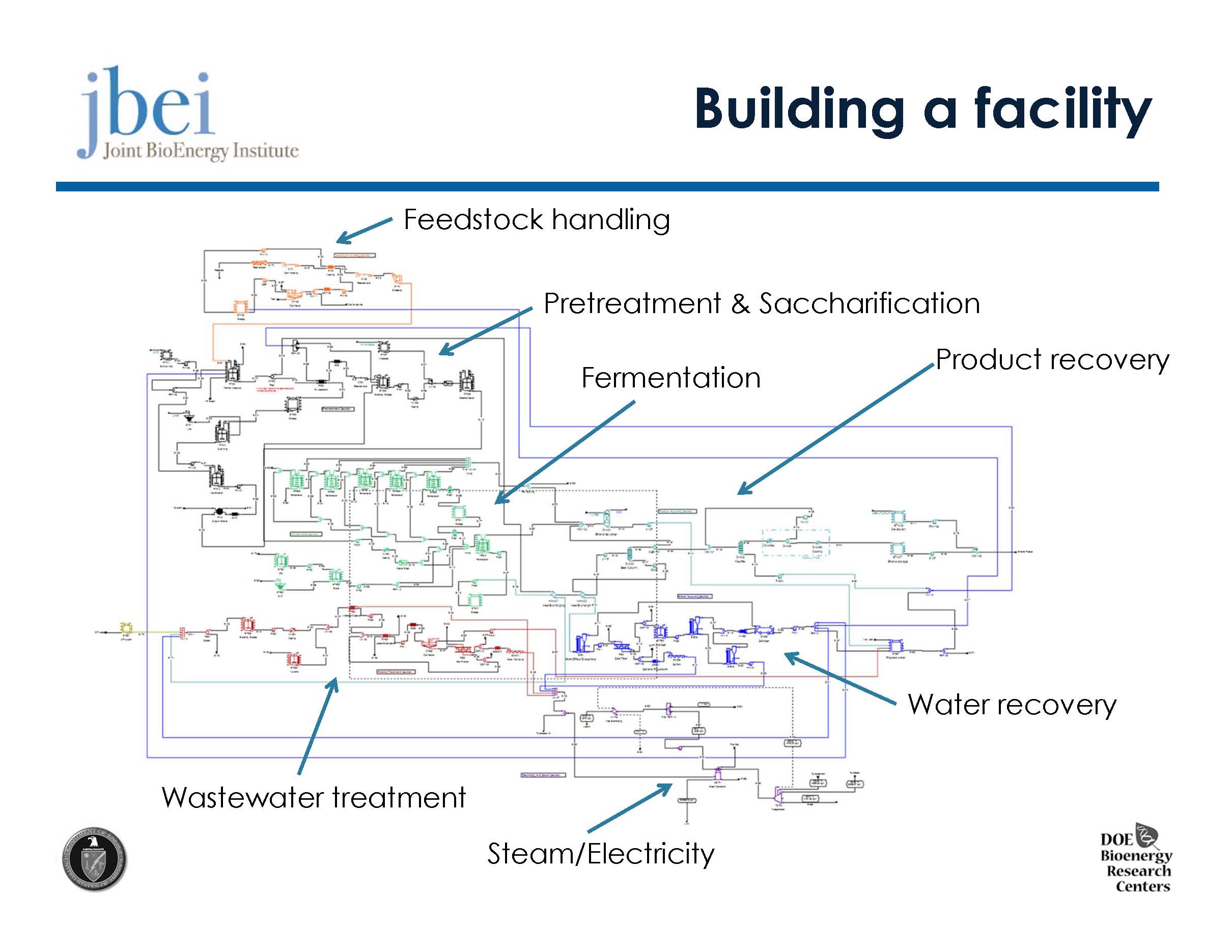
Using JBEI’s technoeconomic models, researchers can provide fuel production input factors to calculate fuel, energy and greenhouse gas output and derive production costs based on different processing strategies.

Now available on-line from the Joint BioEnergy Institute (JBEI) are two new, improved versions of a technoeconomic model created in 2010 to accelerate the development of next generation biofuels that are economically competitive with petroleum-based fuels. Incorporating the latest state-of-the-art technologies relevant to bioethanol production, these new wiki-based models simulate critical factors in the biorefinery process, such as production costs and energy balances, under different scenarios. This enables researchers to concentrate their efforts on the most promising strategies for cost-efficient biorefinery operations. Both new models correspond to refinery process configuration and performance scenarios, with one reflecting the best current technologies and the other reflecting projected technological developments.

“Two aspects were improved in the new models, configuration and performance, configuration, which encompasses the chemical engineering steps in the biorefinery process, and performance, which looks at how well each of those steps accomplish their intended purpose,” says Daniel Klein-Marcuschamer, a researcher with JBEI’s Deconstruction Division and one of the creators of both the original and the latest versions of the technoeconomic models. “The configuration is the same for both models, but the models differ in key process performance parameters, such as pretreatment, saccharification, and fermentation.”

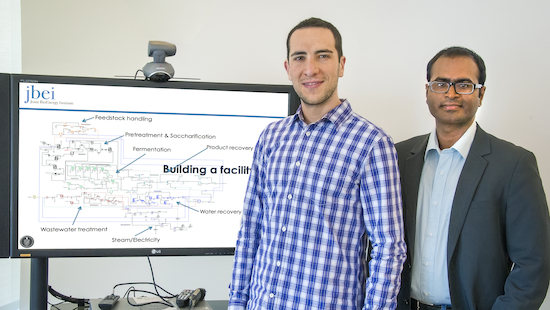
Daniel Klein-Marcuschamer (left) and Murthy Konda at the Joint BioEnergy Institute (JBEI) are developing technoeconomic models for optimizing biorefinery operations. (Photo by Roy Kaltschmidt)

Like their predecessor, the new models are formulated to simulate a lignocellulosic ethanol biorefinery that uses corn stover feedstock. From a comprehensive set of fuel production input factors, users can calculate the resulting ethanol, energy and greenhouse gas output, and can derive production costs, then vary the input values to test the effectiveness of different processing strategies. Murthy Konda, also with JBEI’s Deconstruction Division, working with Klein-Marcuschamer, updated the original technoeconomic model on the basis of research and analytical studies published since 2010.

“Over the last few years, there has been a significant research effort globally within the field of biofuels,” Konda says. “Subsequently, there is a need to ensure that the model-based tools such as our techno-economic models are up-to-date. Addressing this need is our current release of updated models. As before, we expect these new models will continue to be useful to biofuel research community. Eventually, we will be modeling scenarios for other types of biofuels using other types of feedstocks. Already we have started modeling biorefineries based on JBEI’s in-house ionic liquid pretreatment of biomass technologies.”

The new models have been released in the same wiki as the original along with accompanying notes. The 2010 model is still accessible so that current users can transition to the new models as needed. First-time users are encouraged to use the new models to take advantage of the updated research results and software.

Development of the JBEI technoeconomic models has been supported by Blake Simmons, who heads JBEI’s Deconstruction Division, and Harvey Blanch, JBEI’s Chief Science and Technology Officer. Both hold appointments with Berkeley Lab’s Physical Biosciences Division as do Konda and Klein-Marcuschamer.

JBEI is one of three Bioenergy Research Centers funded by the U.S. Department of Energy to advance the development of the next generation of biofuels. It is a scientific partnership led by Berkeley Lab and including the Sandia National Laboratories, the University of California (UC) campuses of Berkeley and Davis, the Pacific Northwest National Laboratory, the Carnegie Institution for Science, and the Lawrence Livermore National Laboratory.

Additional Information

The JBEI technoeconomic models for biorefinery operations is free and available for downloading here
Posted by Unknown at 11:58 0 comments
Enviar por correo electrónicoEscribe un blogCompartir en XCompartir con FacebookCompartir en Pinterest
Etiquetas: Bioeconomía, Bioenergía, Bioetanol, DOE, Efecto Invernadero, JBEI, modelo

domingo, 23 de junio de 2013

World’s first microalgae façade goes ‘live’

ORIGINAL: IBA-Hamburg 

25 Apr 2013

BIQ
Natural, efficient and unique: the BIQ is setting new standards as the first building in the world to have a bioreactor façade. Microalgae are cultivated in the glass elements that make up its “bio skin”. These are used to produce energy, and can also control light and provide shade. Inside, an innovative living concept is aimed at ensuring maximum design versatility for everyday life, and gives us a glimpse into urban life in the future. With its innovative living concept, futuristic exterior, and “intelligent” algae façade, the BIQ is a highlight of ”The Building Exhibition within the Building Exhibition”.


A Building with a Second Green Skin 
The sides of the building that face the sun have a second outer shell that is set into the façade itself. Microalgae – tiny plants, most no larger than bacteria – are produced within this shell. They enable the house to supply its own energy. The only thing that the algae have to do is simply to grow. They are continuously supplied with liquid nutrients and carbon dioxide via a separate water circuit running through the façade. With the aid of sunlight, the algae can photosynthesise and grow. This façade is the first of its kind in the world and makes use of the very latest energy and environmental technology.
 

Microalgae – a Smart Energy Solution 
The algae flourish and multiply in a regular cycle until they can be harvested. They are then separated from the rest of the algae and transferred as a thick pulp to the technical room of the BIQ. The little plants are then fermented in an external biogas plant, so that they can be used again to generate biogas. Algae are particularly well suited for this, as they produce up to five times as much biomass per hectare as terrestrial plants and contain many oils that can be used for energy.


An Energy Concept that Calls upon Natural Forces 
The BIQ has a holistic energy concept: it draws all of the energy needed to generate electricity and heat from renewable sources – fossil fuels remain untouched. It is able to generate energy using the algae biomass harvested from its own façade. Moreover, the façade collects energy by absorbing the light that is not used by the algae and generating heat, like in a solar thermal unit, which is then either used directly for hot water and heating, or can be cached in the ground using borehole heat exchangers — 80 metre-deep holes filled with brine. This remarkably sustainable energy concept is therefore capable of creating a cycle of solar thermal energy, geothermal energy, a condensing boiler, local heat, and the capture of biomass using the bio-reactor façade.


More than just a Shell: the BIQ Demonstrates what Tomorrow’s Façades can do
The BIQ building shows that in the future façades will be able to serve a number of different functions, and be much more than an aesthetic cladding to protect against rain and cold. While the northeast- and northwest-facing sides of the building have an elaborately decorated shell to draw the eye, the algae within the southwest and southeast façades produce biomass for renewable energy. In addition, the façade also serves the conventional purposes of insulating the building from sound, heat, and cold, and provides shade in bright sunlight. Spacious balconies give the residents sweeping views over the park, as well as the chance to see the natural power plant contained in the algae façade up close. However, visitors can also observe this film of matter as it grows. The greenness of the façade shows that the algae are breaking down the carbon dioxide and processing it through photosynthesis. This renewable form of energy production is thus visible from outside the building, and is an intentional part of the architectural concept.

Living on Demand
Inside, the BIQ reveals how we might live in the future. The ever greater interconnectedness between living and working and the increased demand for adaptable housing spaces means that there will be a call for versatile residential ground plans in the future. Two of the total of fifteen apartments to be housed in the BIQ do not have separate rooms, but rather enable the inhabitants to configure their living arrangements “on demand”. Depending on their needs, individual functions of the apartment – bathroom, kitchen, sleeping area – can be swapped about or combined to form a “neutral zone”. In this way, the necessities of everyday life determine the appearance of the apartment, and the versatile layout can be adapted to suit the residents and their daily lives at any given time.
Posted by Unknown at 10:50 0 comments
Enviar por correo electrónicoEscribe un blogCompartir en XCompartir con FacebookCompartir en Pinterest
Etiquetas: Alemania, Algas, Arquitectura Verde, Bioenergía, Biomasa, Biomimicry, Biorreactor, Cladera de Condensación, Energía Geotérmica, Energía Solar, Fotosíntesis, Microalgas, Sostenibilidad
Entradas antiguas Inicio
Suscribirse a: Entradas (Atom)

VANESSA RESTREPO SCHILD

VANESSA RESTREPO SCHILD
Co-founder and editor of Ciencia en Canoa

Buscar en este blog

Small Acts...

Small Acts...
Small acts, when multiplied by millions of people, can transform the world.

PeerJ

Cargando...

Greentech Media: Headlines

Cargando...

Most Recent

Random Posts


TOTAL DE GASES DE EFECTO INVERNADERO EN LA ATMÓSFERA EN TONELADAS MÉTRICAS

www.know-the-number.com

Our Climate is Changing!
Please download Flash Player.

@cienenca

Tweets by @cienenca

Cuántas personas han visitado la Página

Translate


¿Qué es CIENCIA en CANOA?

Ciencia en Canoa es un blog que comparte acontecimientos ambientales de alto impacto.

EVOLUCIÓN DEL CONCEPTO


2010 - 2011 Ciencia en Canoa inspirado en Ciencia en Bicicleta.

La bicicleta va por los pueblos, por las calles, repartiendo el conocimiento, llega a una región a la que no puede acceder porque hay agua en el medio, entonces se baja de la bicicleta y sigue viajando en la canoa por el agua repartiendo conocimiento en las comunidades más abandonadas.

Se usa el Pirarucú (Arapaima gigas) -un animal endémico de Colombia que habita en la selva del Amazonas y es cazado indiscriminadamente- como el símbolo de la canoa. El reconocimiento de la naturaleza como medio de transporte.


2012 Ciencia en Canoa inspirado en la expresión indígena.

Las bicicletas son metálicas, simbolizan la perpetuación de la industrialización en nuestros tiempos. El crecimiento población y la desbordante demanda de productos es la mayor preocupación de éste siglo que se enfrenta al aparente irreversible cambio climático y de allí donde surge la búsqueda por la preservación. Surgen palabras como biodegradable, autosostenible y ecoamigable como pilares para el desarrollo.

En una relación endosimbiotica sin nuestra especie estar dentro de otra o viceversa se crea esa conexión, ese aprendizaje del otro como fuente de ideas aquella similitud que nos permite construir con la esencia de nuestros cuerpos, que para aquellos que son vida están hechos de los mismos materiales.


VANESSA RESTREPO SCHILD
30/12/2011


Add to iGoogle
Follow @CienEnCa


This Week in Science - The Kickass Science Podcast

Cargando...

Archivo del blog

  • ▼  2019 (7)
    • ▼  noviembre (1)
      • The scientists who are creating a bio-internet of ...
    • ►  septiembre (3)
    • ►  febrero (1)
    • ►  enero (2)
  • ►  2018 (15)
    • ►  noviembre (1)
    • ►  agosto (9)
    • ►  mayo (3)
    • ►  enero (2)
  • ►  2017 (50)
    • ►  diciembre (4)
    • ►  noviembre (2)
    • ►  octubre (3)
    • ►  septiembre (2)
    • ►  agosto (1)
    • ►  junio (5)
    • ►  mayo (1)
    • ►  abril (4)
    • ►  marzo (11)
    • ►  febrero (12)
    • ►  enero (5)
  • ►  2016 (139)
    • ►  diciembre (1)
    • ►  noviembre (6)
    • ►  octubre (10)
    • ►  septiembre (19)
    • ►  agosto (2)
    • ►  julio (7)
    • ►  junio (27)
    • ►  mayo (16)
    • ►  abril (13)
    • ►  marzo (16)
    • ►  febrero (6)
    • ►  enero (16)
  • ►  2015 (296)
    • ►  diciembre (30)
    • ►  noviembre (25)
    • ►  octubre (12)
    • ►  septiembre (27)
    • ►  agosto (9)
    • ►  julio (32)
    • ►  junio (29)
    • ►  mayo (32)
    • ►  abril (25)
    • ►  marzo (43)
    • ►  febrero (16)
    • ►  enero (16)
  • ►  2014 (500)
    • ►  diciembre (27)
    • ►  noviembre (51)
    • ►  octubre (3)
    • ►  septiembre (17)
    • ►  agosto (31)
    • ►  julio (21)
    • ►  junio (14)
    • ►  mayo (17)
    • ►  abril (42)
    • ►  marzo (97)
    • ►  febrero (95)
    • ►  enero (85)
  • ►  2013 (997)
    • ►  diciembre (98)
    • ►  noviembre (35)
    • ►  octubre (13)
    • ►  septiembre (97)
    • ►  agosto (97)
    • ►  julio (117)
    • ►  junio (78)
    • ►  mayo (82)
    • ►  abril (93)
    • ►  marzo (107)
    • ►  febrero (90)
    • ►  enero (90)
  • ►  2012 (1461)
    • ►  diciembre (64)
    • ►  noviembre (71)
    • ►  octubre (133)
    • ►  septiembre (148)
    • ►  agosto (148)
    • ►  julio (170)
    • ►  junio (156)
    • ►  mayo (197)
    • ►  abril (140)
    • ►  marzo (126)
    • ►  febrero (48)
    • ►  enero (60)
  • ►  2011 (147)
    • ►  diciembre (16)
    • ►  noviembre (17)
    • ►  octubre (19)
    • ►  septiembre (12)
    • ►  agosto (16)
    • ►  julio (14)
    • ►  junio (15)
    • ►  mayo (9)
    • ►  abril (7)
    • ►  marzo (7)
    • ►  febrero (7)
    • ►  enero (8)
  • ►  2010 (25)
    • ►  diciembre (5)
    • ►  noviembre (8)
    • ►  octubre (12)

Entradas populares

  • Los ‘Steve Jobs’ criollos
  • Plants 'Talk' To Each Other Using Nanoscale Sound Waves To Help Them Grow, Study Suggests
  • Motor de Google Earth fue presentado en Cumbre Ambiental de Cancún
  • Devolver a la vida colores prehistóricos
  • 5 Ways to Make STEM More Exciting For Students
  • #BicisPorLaVida hoy 22 de septiembre
  • The scientists who are creating a bio-internet of things
  • How Fluorescence Works - The Science
  • Only for Children
  • UC Berkeley installing first CO2 sensor network in Oakland

Etiquetas

Colombia (330) Biodiversidad (236) Agua (229) Medio Ambiente (157) Biomimicry (154) Contaminación (152) Cambio Climático (133) Ciencia (128) Educación (128) Estados Unidos (117) Innovación (113) Investigación (109) Minería (106) ecosistema (106) Evolución (105) Salud (103) Biología (102) Medellín (99) MIT (95) Video (94) Cultura (93) Energía (92) Google (92) Océano (92) ADN (90) NASA (85) Física (83) Computación (82) Genética (82) Amazonía (74) Combustible Fósil (72) Bacteria (67) Calentamiento Global (66) IBM (63) Deforestación (62) Japón (62) Economía (61) Comportamiento (60) Conservación (59) Nanotecnología (59) Biotecnología (58) Emisiones de Carbono (58) Materiales (57) Tecnología (56) Brasil (54) Gobierno (54) Descubrimiento (52) Antioquia (50) Arte (50) modelo (50) Astronomía (48) Protección (48) Transporte (48) China (47) Inundación (47) TED (47) Agricultura (45) Emergencia (45) Urbanismo (45) Desplazamiento Indígena (44) Geología (42) Nanomaterial (41) Colciencias (39) Especie en vía de Extinción (39) Matemáticas (39) Genómica (37) Aves (36) Jóvenes (36) Sequía (36) Australia (35) Abejas (34) Ambiente (34) Bioinformática (34) Exploración (34) Hidroelectricidad (34) Parques Naturales (34) Química (34) Bioenergía (33) Imagen (33) Naturaleza (33) Riesgo (33) Canadá (32) Política (32) biocomputación (32) Ecología (31) Sostenible (31) Vanessa Restrepo Schild (31) Ártico (30) Alemania (29) Bogotá (28) microscopía (28) Aire (27) Oro (27) Libro (26) Suiza (26) Efecto Invernadero (25) Entrevista (25) U de A (25) Arquitectura (24) Planeación (24) Chile (23) Ecuador (23) Recursos (23) 2012 (22) Bosques (22) Mujer (22) Reciclaje (22) Visualización (22) Bosque Húmedo Tropical (21) Desarrollo (21) Hongos (21) Imágenes (21) ONU (21) Clima (20) Premio (20) Tierra (20) Antropología (19) México (19) Reserva Natural (19) Smart Grid (19) Africa (18) Fauna (18) Fotografía (18) Hábitat (18) Satélite (18) Sociedad (18) Laboratorio (17) Solar (17) Alteración Antropogénica (16) Hidrología (16) Ilegal (16) Impacto Ambiental (16) Invención (16) Legislación (16) Ley (16) Mar (16) Medios (16) Música (16) Opinión (16) Pesticidas (16) Tailandia (16) Mercurio (15) Parque Explora (15) Alimento (14) Conferencia (14) Paleontología (14) Polinización (14) Seguridad (14) 2011 (13) Ambiental (13) Carbón (13) Deshielo (13) Especies (13) Flores (13) Pacífico (13) Tortuga (13) Bioluminiscencia (12) Financiación (12) Mutación (12) Nivel del Mar (12) Nuclear (12) Planta (12) Antártica (11) Bosque Tropical (11) Congreso (11) Corrupción (11) Global (11) Incendio Forestal (11) Jardín Botánico (11) Reforestación (11) Suelos (11) Botánica (10) EPFL (10) Lluvia (10) Renovable (10) BBC (9) El Carro del Futuro (9) Endangered Species (9) Espacio (9) Naciones Unidas (9) Población (9) Sir David Attenborough (9) Caza (8) Consumo (8) EPM (8) Gases (8) Gorila (8) ISS (8) La Niña (8) Nueva Zelandia (8) Orgánica (8) Patente (8) Reglamentación (8) Autonomía (7) Carro Eléctrico (7) Filipinas (7) Flora (7) Social (7) Trabajo (7) ACAC (6) Estadística (6) Evento (6) Inundaciones (6) Personajes (6) Políticas (6) Presupuesto (6) 2010 (5) Agua Subterránea (5) Andrés Hurtado García (5) CIENCIA EN CANOA (5) Charles Darwin (5) Comunidad (5) Congo (5) Control (5) Feria Científica (5) Fósiles (5) Galápagos (5) IPCC (5) Manizales (5) Radiación (5) Respeto (5) Temperatura (5) Tiempo (5) crecimiento (5) fósil (5) árbol (5) Alcaldía (4) Capital de Riesgo (4) Cuenca Hidrográfica (4) Entomología (4) Habitat (4) Huracán (4) Mercado de carbono (4) Mosca (4) Mujeres Jóvenes Talento (4) Negocios (4) Ocean (4) Parásitos (4) Resultados (4) USA (4) CAR (3) Cesar (3) Ciencia En Los Barrios (3) Concurso Mujeres Jóvenes Talento (3) Contaminación Genética (3) David Attenborough (3) Ecoturismo (3) Emergencias (3) Guayacán (3) IDEAM (3) IEA (3) Investigación Espacial (3) Mono (3) Mundial (3) Parque Tayrona (3) Partículas (3) Pesca Ilegal (3) Pingüino (3) Ser Humano (3) Tornados (3) Vías (3) acuerdo (3) Administración (2) Agrocombustibles (2) Aleta (2) Arctic (2) Bonobo (2) Carnívora (2) Cautiverio (2) Centro América (2) Ciudades (2) Convenio Diversidad Biológica (2) Deslizamientos (2) Disciplina (2) Energía Química (2) Estabilidad (2) Extremo (2) Historia Natural (2) Holograma (2) Humedales (2) Ilustración (2) Imágen (2) Incendio (2) Informe (2) Intervención (2) Irregularidades (2) Logros (2) Mapas (2) Mejoramiento Genético de Alimentos (2) Modelo de Negocio (2) Pequeño (2) Puerto Rico (2) Ranas (2) Relatividad (2) Secretaría de la Mujer (2) Sistema (2) Sur Äfrica (2) Tornado (2) Unicelular (2) Video Game 3D (2) Vía Láctea (2) fractales (2) ojo (2) Albinismo (1) Altura Marina (1) Alvaro Cogoyo (1) BST (1) Bio 2030 (1) Biofelicidad (1) Bosque Seco Tropical (1) Campaign (1) Construcción ilegal (1) Corporación (1) Cundinamarca (1) Célular (1) Efecto Lock-in (1) Estados Unidos de América (1) Expouniversidad (1) Fosil Fuel (1) Gasoducto (1) Gen Hox (1) Herramienta (1) Humberto Maturana (1) Iberoamérica (1) Industria acuícola (1) Interactiva (1) Invernal (1) Isabelinismo (1) LSU (1) Laboratorios de Investigación y Desarrollo (1) Malpelo (1) Mascota (1) Mayas (1) Muros Verdes (1) Naciones Unidad (1) Nativas (1) Neutrinos (1) Normas (1) Nueva Guinea (1) Observaciones (1) Periodista (1) Petición (1) Pisos (1) Pluricelular (1) Pol'iticas (1) Precámbrico (1) Propiedad (1) Proridades (1) Reflexiones (1) Rio de Janeiro (1) Suramerica (1) Tormentas Eléctricas (1) Vertebrado (1) Virtual Reality (1) Vocaloid (1) confocal (1) África Oriental (1) Économía (1)

EcoEarth.Info Environment

Cargando...

Seguidores

Business

Flickr Widget

Recent

Comments

Popular Posts

  • Electric Eels Found To Leap Out Of Water To Shock Predators
    Electric Eels Found To Leap Out Of Water To Shock Predators
    Main image credit:  Josh More/Flickr CC BY-NC-ND 2.0 ELECTRIC EELS HAVE BEEN FOUND TO SHOW SHOCKING LEAPING BEHAVIOR. As if growing...
  • The olm: the blind cave salamander that lives to 100
    ORIGINAL: Discover Magazine The olm is a blind, cave-dwelling salamander, also called the proteus and the “human fish”, for its pale, ...
  • Smart Contact Lenses Will Give You Superhuman Vision
    LAS VEGAS — Your future contact lenses could give you superhuman vision. Just one year after eyewear startup Innovega announced a pro...
  • How to Make Moss Graffiti
    ORIGINAL: WikiHow Edited by Teresa and 19 others Moss graffiti, also called eco-graffiti or green graffiti , replaces spray p...
  • Lego-like modular components make building 3-D 'labs-on-a-chip' a snap
    Modular fluidic and instrumentation components developed by researchers at the University of Southern California Viterbi School of Engi...
  • The scientists who are creating a bio-internet of things
    The internet of things connects devices across the globe. Now researchers are considering how bacteria can join the network. by Emerging T...
  • Physicists confirm (what biologists have already konwn for years)  there's a second layer of information hidden in our DNA
    Physicists confirm (what biologists have already konwn for years) there's a second layer of information hidden in our DNA
    Liya Graphics/Shutterstock.com Theoretical physicists have confirmed that it's not just the information coded into our DNA that sh...
  • Luke Bawazer on Genetically Evolving Technology
    Luke Bawazer on Genetically Evolving Technology
    ORIGINAL: 33rd Square April 1, 2013  Synthetic Biology    Luke Bawazer 's research in synthetic biology aims to ...
  • Colombia Magia Salvaje
    Colombia Magia Salvaje
    Sinopsis Colombia Magia Salvaje es una aventura que llevará a los colombianos por paisajes inexplorados y a conocer especies enca...
  • Absurd Creature of the Week: 10-Foot Bobbit Worm Is the Ocean’s Most Disturbing Predator
    ORIGINAL: Wired By Matt Simon 09.06.13 Image: Wikimedia If I could go back to my childhood I would have never waited for rain...

RSS

Entradas
Atom
Entradas
Comentarios
Atom
Comentarios

Contact

Vanessa Restrepo Schild
Research Scientist

cienciaencanoa@gmail.com

Research Interests
Biochemistry and Physiology

FB:
http://www.facebook.com/pages/Ciencia-en-canoa/168229513187101
Copyright © Ciencia en Canoa created by Vanessa Restrepo Schild & Hugo Angel. Imágenes del tema: Storman. Con la tecnología de Blogger.