Mostrando entradas con la etiqueta Arte. Mostrar todas las entradas

domingo, 16 de noviembre de 2014

Solar-Powered Glowing Bicycle Path In Netherlands Inspired By Van Gogh’s Starry Night

Dutch artist and designer Daan Roosegaarde has created a beautiful and innovative glowing bike path that, when illuminated at night by glowing pebbles and LEDs, looks like Van Gogh’s famous Starry Night painting.

The kilometer-long bike path, which was created using both glow-in-the-dark technology and solar-powered LEDs, is located in Brabant, the Dutch county where Van Gogh was born and raised. The swirling, glowing forms on the path’s surface will help bicyclists stay on track when they ride at night.

We’ve seen similar glowing paths before in the U.K. We can only hope that more artists and innovators join forces to create such beautiful and environmentally friendly paths!


ORIGINAL: Bored Panda
 by Dovas

lunes, 28 de abril de 2014

The First Poem Published in a Scientific Journal

An ode to the ocean’s bioluminescent marvels.

Image courtesy of the J. Woodland Hastings Lab, Harvard University
We’ve already seen science as a muse of painting, music, sculpture, and design. In 2001, the poetic muse struck Smith College life sciences professor and clock researcher Mary E. Harrington who, smitten by the circadian rhythms of the bioluminescent algae Gonyaulax polyedra, penned a poem about these whimsical organisms. It appeared on the pages of the June 2001 issue of the Journal of Biological Rhythms and is considered the first poem to be published in a strictly scientific journal. (I discovered it through a passing mention in the excellent Internal Time: Chronotypes, Social Jet Lag, and Why You’re So Tired.)


If the lazy dinoflagellate
should lay abed
refuse to photosynthesize,
realize:
the clock will not slow

but it will grow fait
weaker
weaker

barely whispering at the end
”rise”
”rise”

to little effect.
The recalcitrant Gonyaulax
arms crossed
snorts
“No longer will
they call my life
(my life!)
‘just hands’.
I am sticking to the sea bed!”

ORIGINAL: Brain Pickings

domingo, 6 de abril de 2014

The First Poem Published in a Scientific Journal

An ode to the ocean’s bioluminescent marvels.

Image courtesy of the J. Woodland Hastings Lab, Harvard University
We’ve already seen science as a muse of painting, music, sculpture, and design. In 2001, the poetic muse struck Smith College life sciences professor and clock researcher Mary E. Harrington who, smitten by the circadian rhythms of the bioluminescent algae Gonyaulax polyedra, penned a poem about these whimsical organisms. It appeared on the pages of the June 2001 issue of the Journal of Biological Rhythms and is considered the first poem to be published in a strictly scientific journal. (I discovered it through a passing mention in the excellent Internal Time: Chronotypes, Social Jet Lag, and Why You’re So Tired.)


If the lazy dinoflagellate
should lay abed
refuse to photosynthesize,
realize:
the clock will not slow

but it will grow fait
weaker
weaker

barely whispering at the end
”rise”
”rise”

to little effect.
The recalcitrant Gonyaulax
arms crossed
snorts
“No longer will
they call my life
(my life!)
‘just hands’.
I am sticking to the sea bed!”

ORIGINAL: Brain Pickings

domingo, 16 de febrero de 2014

Sci-Fi Device Lets Men And Women Swap Bodies


Using virtual reality and neuroscience, this machine lets you see, hear, and even feel what it's like in another person's body. 

Happy Presidents Day! We're celebrating by revisiting some of our most popular stories of the year. Enjoy.

Talk about going on a gender bender.

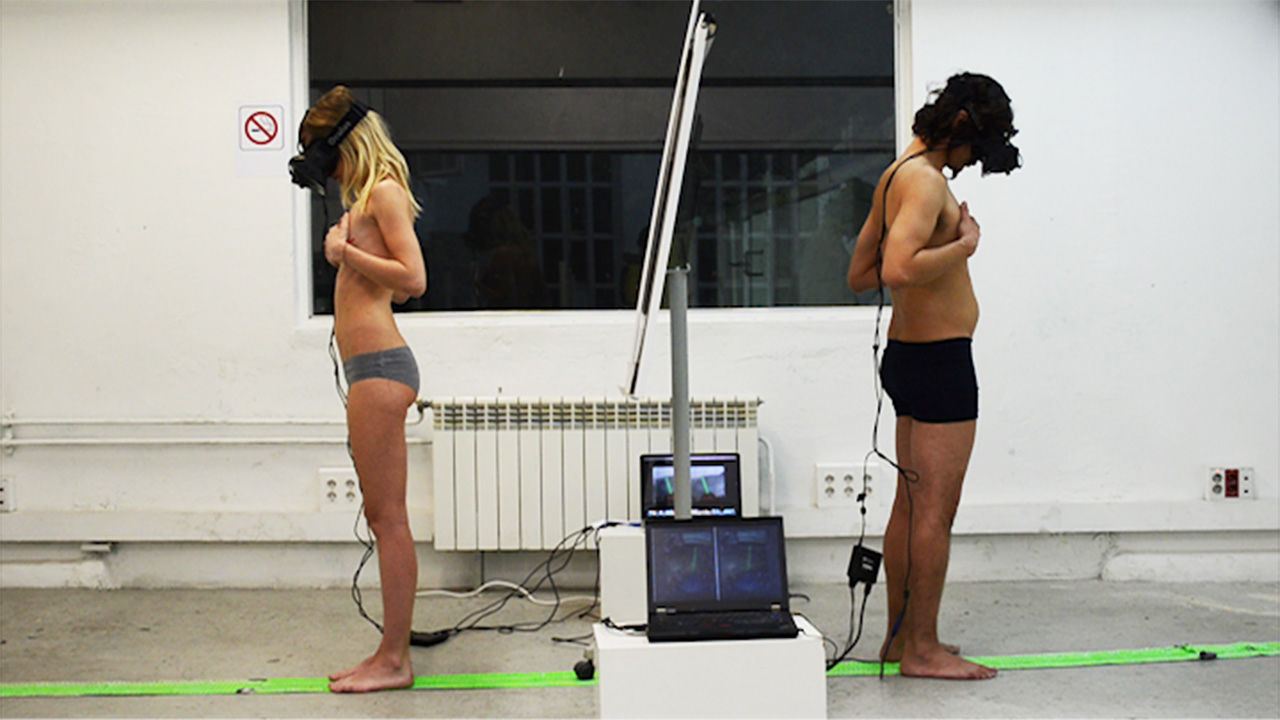
A new machine created by a Spanish design collective combines virtual reality with advanced neuroscientific techniques to let men and women swap bodies with each other. Called The Machine To Be Another, it's all done in the hopes that body transference will help scientists explore and quantify concepts like sexism, gender identity, and bias.

Based in Barcelona, Be Another Lab is made up of Philippe Bertrand, Daniel Gonzalez Franco, Christian Cherene, and Arthur Pointea, a collection of interdisciplinary artists whose fields range from programming and electronic engineering to interactive system design and neuro-rehabilitation. Together, the goal of Be Another Lab is to explore the concepts of empathy through technology, science, and art.


In most neuroscience experiments that examine issues of empathy and bias, participants "trade places" with others using digital avatars. If a study wants to explore empathy for the handicapped, for example, scientists might sit subjects down in front of a computer and make them play a video game in which they are confined to a wheelchair, then ask them a series of questions about how the experience made them feel. But none of it is real.

Be Another Lab takes a different, more visceral approach to exploring empathy. Instead of using digital avatars, the group uses performers to copy the movements of a subject: for example, racial bias is studied by having a subject's actions mirrored by a performer of color.


"We believe this allows for a deeper experience for a user, knowing that their point of view is that of an actual human being, and not a virtual avatar," says Bertrand. "In the last year, we’ve observed that subjects tend to demonstrate empathetic feelings towards the performers they didn't have before. They say that the experience has raised their awareness about the performers' social conditions, that they were able to go 'deep into this other person's life.'" They say that the experience has raised their awareness.

With The Machine To Be Another, Bertrand and company have taken this approach to the next level by leveraging the tech of a paid Oculus Rift virtual reality headset. In the project, two participants stand in front of one another, and put on their headsets which allow them to effectively see out of one another's eyes. When they look at each other, they see themselves. When they speak, they hear the other person's voice in their ears.


But this isn't where the simulation ends. Working together, the two participants are encouraged to sync their movements, touching objects in the room, looking at things, and exploring their 'own' bodies simultaneously.

"The brain integrates different senses to create your experience of the world," explains Bertrand. "In turn, the information from each of these senses influences how the other senses are processed. We use these techniques from neuroscience to actually affect the psychophysical sensation of being in your body."


In other words, in combination with being fed video and sound from their partner's headset, by moving and touching things at the same time, the Machine To Be Another can actually convince people that they are in someone else's body as long as the two partners remain in sync.

It's a radical idea that Be Another Lab is only beginning to explore. Right now, their experiments have mostly focused on gender swapping, which the team hopes will also explore issues in regards to transgender and queer bias. The group is currently looking to partner with organizations, experts and activists to help them further perfect their techniques.

They say to truly understand someone, you have to walk a mile in their shoes. Thanks to the Machine To Be Another, you won't just walk that mile, you'll feel the blisters on the other person's feet.

ORIGINAL: FastCo Exist

martes, 11 de febrero de 2014

Blooming marvellous! Pretty flowers that open up before your eyes are the world's first ever INFLATABLE 3D printed objects

Richard Clarkson created the design as part of his seamless blossom project
Flowers open as air is pumped into chambers, revealing a colourful core


They were produced using Objet’s 3D printer which is able to simultaneously print a mix of both a flexible and rigid material

As remarkable as 3D printing is, most objects created using the technique have, up until now, been limited to rigid structures.

But this could be about to change with a new generation of materials that are allowing designers to create morphing 3D designs.

Richard Clarkson from Victoria University of Wellington has become one of the first to make use of multi-material 3D printing by creating inflatable rubber-like flowers.

Scroll down for video...

MULTI-MATERIAL 3D PRINTING

As well as creating beautiful art installations, multi-material 3D printing aims reduce the number of manufacturing steps for one object.

it allows, for instance a working product to be created with different properties without the need to bring together separate components.

Experts claim it increases speed to market by allowing organisations to prototype increasingly complex parts. It also reduces waste products by using exactly the right amount of material required.

The flowers, created as part of the ‘seamless blossom project’, open up as air is pumped into inner chambers, revealing a colourful inner core.
Mr Clarkson claims they are the first ever inflatable objects to be created with 3D printing.


‘Basically, it’s a curved hollow chamber with flexible rubber. As you inflate it, it creates a gap of air that pushes against the inner layer, forcing the outer layers open. It almost blooms, like a flower,’ he said.


Recent advances in 3D printing now allow the simultaneous layering of different build materials in a single print


Incredible inflatable 3D printing technology shows flowers...


Seamless Blossom - Richard Clarkson (video)

A screenshot from the computer aided design (CAD) programme Richard Clarkson used to create the flowers


The flowers were created using Objet’s multi-material printer which is able to simultaneously print a mix of both a flexible and rigid material at point of print.


Mr Clarkson has designed his project as an interactive installation without any electronics, sensors or computer control, working only on air pressure.


It is the first in what experts are predicting could be a wave of 3D printed objects that use different materials to morph shape.


Last year, for instance, U.S. architect Skylar Tibbits announced a project to develop morphing materials in collaboration with Minneapolis-based group Stratasys

Mr Clarkson has designed his project as an interactive installation without any electronics, sensors or computer control, working only on air pressure


The flowers, created as part of the 'seamless blossom project' open up as air is pumped into inner chambers, revealing a colourful inner core


Mr Tibbits has now set up a radical lab at the Massachusetts Institute of Technology (MIT) to create materials that self-assemble.


Like Mr Clarkson, the MIT lab plans to use of multi-material 3D printing to programme different properties into various parts of a product’s geometry.


The idea is that these parts will have varying water-absorbing characteristics that activate a change in shape when they come into contact with moisture.

Te technique could lead to structures such as self-assembling furniture, or water pipes that know when to expand and contract.

Mr Clarkson claims these flowers are the first ever inflatable objects to be created using 3D printing

The technique could lead to structures such as self-assembling furniture, or water pipes that know when to expand and contract

ORIGINAL: Daily Mail
By Ellie Zolfagharifard
24 January 2014

lunes, 27 de enero de 2014

"Aquí ".

"¿Saben por qué hay siluetas doradas de pumas en algunas paredes de nuestra ciudad? ¿Los han visto?"

Aquí, es el proyecto de arte ganador de una de las Becas para la Creación Artística y Cultural, otorgada por la Alcaldía de Medellín en el 2013, en la modalidad de Creación en Dibujo. Fue concebido a propósito de una noticia sorprendente publicada en el blog http://www.aburranatural.org/, dedicado a la bíodiversidad en el Valle de Aburrá, a principios de este año: en las montañan que rodean nuestra ciudad habita el puma (Puma concolor). 

La existencia de este felino, el segundo más grande de América, es un indicador de la riqueza en la biodiversidad de un ecosistema y al mismo tiempo garantiza que ésta se conserve; regulan la población de sus presas, evitando proliferen sin control y afecten negativamente el medio en el que viven; mantienen la vigorosidad de las especies que le sirven de alimento, cazando individuos débiles y viejos y asegurando la reproducción de especímenes sanos; al manetener equilibrada la población de distintas especies animales, se garantiza la correcta distribución de semillas que aseguran a su vez la diversidad vegetal necesaria en cada hábitat. Las necesidades alimenticicas y de territorio convierten a los grandes felinos en los animales más frágiles y susceptibles de desaparecer ante el deterioro ecológico. Su existencia tan cerca de una ciudad como Medellín, centro urbano más poblado del departamento de Antioquia, es, tristemente, una manifestación de la dramática reducción de su hábitat; aunque hay registros históricos de que alguna vez habitaron esta zona, no había habido indicios de que permanecieran en ella y se presume que han llegado desplazados de otros lugares. Sin embargo, que puedan habitar las monatañas que rodean el Valle de Aburrá, también indica que aún estamos rodeados por reservas naturales con una diversidad biológica que les permite sobrevivir. 

Quiero, a través del arte, rendir un homenaje a los pumas, celebrar el privilegio de vivir cerca de ellos y proponer una reflexión acerca de nuestra responsabilidad en la conservación del frágil equilibrio del medio ambiente que nos rodea.

Este proyecto consiste en la reproducción de tamaño natural de siluetas de los pumas en muros de espacios públicos de la ciudad para con ellas generar su presencia en el contexto urbano. Están plasmados en laminilla de oro, con la intención de que brillen con la incidencia de la luz del sol, de la iluminación nocturna o de las luces de los carros, haciendo que los transeúntes los descubran a su paso por el brillo fugaz que proyectan, evocando la fugacidad del momento en que logramos avistar animales salvajes que pasan veloces y nos dejan tan solo un destello de su presencia.


Algunas de las reproducciones de los pumas son realizadas con la ayuda de niños, jóvenes y adultos que asisten a distintas actividades culturales de los Parques Biblioteca de la ciudad de Medellín, en el contexto de unos talleres en los que les expongo mi proceso creativo, les propongo reflexionar acerca de las implicaciones de nuestras acciones en el medio ambiente y el sentido de pertenencia con el entorno natural. Al final, reproducimos juntos a los pumas en algún muro de la biblioteca.


ORIGINAL: Sara Herrera Fontán
Por Sara Herrera Fontán sarahfg5@hotmail.com
domingo, 24 de noviembre de 2013 

sábado, 25 de enero de 2014

StrandBeests: 3D Print Crazy Live Animals… Well Almost

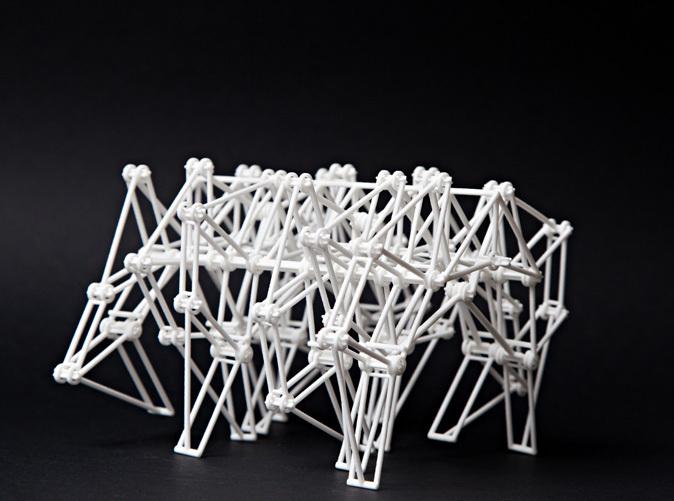
While browsing Shapeways this afternoon I stumbled upon something that caught my eye. No, it’s not another life saving device that has been 3D printed, or even something that you can get any real use out of, but I still could not look away. What are these 3D Printed objects you may ask? They’re Strandbeests, and they have been created by an extremely talented fellow by the name of Theo Jansen.

Theo is a 65 year old Dutch artist with quite the imagination, who gained fame for his work with PVC piping in the 1990′s to create what were also known back then as StrandBeests. They were basically large structures that could move on their own, many resembling animals or insects. Because of the fact that they have several leg-like extremities, they also usually have the ability to move on sand better than wheels can. Unlike a wheel, only small portions of the “Animals” need to touch the ground. Many Strandbeests can move on their own with the help of a wind driven propeller. The work was quite an engineering as well as artistic feat.

Theo has recently decided to take those same skills and apply them to 3D modelling and printing, bringing his creations to Shapeways so that anyone around the world can buy his famous StrandBeests. He has produced the following video, somewhat humorous, showing off his new 3D printed Beests, comparing them to wild animals:


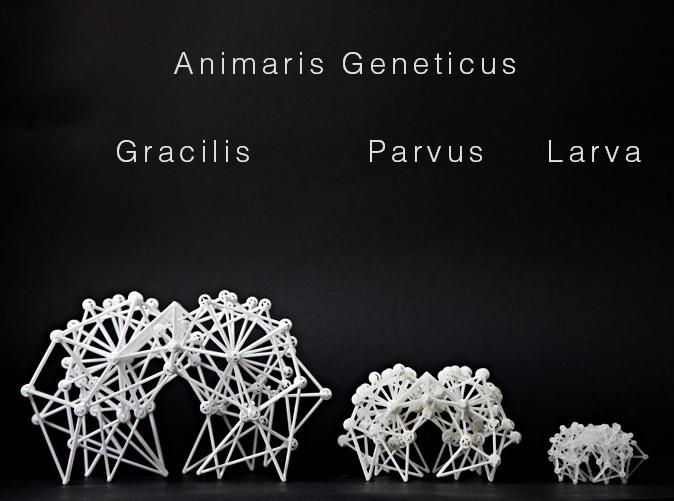
Currently he is offering four different Strandbeests on Shpaeways, they include the following:
  • Animaris Geneticus Gracilis
  • Animaris Geneticus Larva
  • Animaris Geneticus Ondularis
  • Animaris Geneticus Parvus
Prices for his little works of art range anywhere from $39 to $110, and make amazing coffee table toys. You can discuss these little creatures in the 3DPrintBoard Forum here: http://3dprintboard.com/showthread.php?1518-Introducing-Theo-Jansen-s-StrandBeests


ORIGINAL: 3DPrint
by Randall Desmond
January 24, 2014

lunes, 13 de enero de 2014

Andy Lomas Lets Digital Systems Bloom In "Morphogenetic Creations" Exhibit


Andy Lomas, a digital artist and mathematician, likes to let the virtual world spin out of control. Using software code to creates very basic rules, Lomas then sits back and watches his digital “growth systems” bloom, fractalize, shape-shift, and otherwise behave in organic and emergent ways.

Yesterday, at the Los Angeles Center for Digital Arts (LACDA), Lomas’s Morphogenetic Creations opened, giving digital art enthusiasts the opportunity to see his dynamic virtual systems up close. The exhibit includes work from the Aggregation, Flow, and Cellular Forms series. To coincide with the exhibit, Lomas uploaded a view of these digital growth videos to Vimeo. Startlingly beautiful to behold, they’re a bit like Ernst Haeckel’s Art Forms of Nature animated with a cyberpunk edge.


I recently rang up Lomas, who lives in the United Kingdom, to talk about Morphogenetic Creations. We talked about his background in mathematics, his early fascination with D’Arcy Wentworth Thompson’s On Growth and Form, and how his work as a computer-generated effects artist for film (The Matrix sequels and Avatar), where highly-predictable outcomes and stability predominate, served as a springboard for the more random digital forms he now creates.

The Creators Project: What can people expect to see at the Morphogenetic Creations exhibit at LACDA?

Andy Lomas: There will be four animation pieces from the Cellular Forms series in the windows, but also then some 44x44-inch big prints of new and old work. They’re ridiculously high-resolution at 12,000x12,000 pixels.


Another thing I have at LACDA for the Aggregation series are picture frames with these old, Victorian-style stereo viewers to create a 3D effect. The frame only contains two pictures, but through the stereo viewer it really looks like this three-dimensional thing. I believe they’re going to pull those out for this exhibit as well.

Is Cellular Forms the most recent series?

The two Cellular Forms videos are the most recent. They’re almost exactly the same date because they’re basically differently rendered versions of the same thing. That would be Cellular Forms and Cellular Forms (X-Ray version).


What I quite like is the idea that there are two things: the creation of these three-dimensional data structures, where the goal is to create the most organic things possible with very simple rules; and that there is no one correct way of doing that. One shows you everything solid, while the other gives you an x-ray that reveals what’s actually going on inside. Neither is the original, if you like. They’re just different views into the data.

And you wrote the software code for this series?
Yeah, I wrote the software for Cellular Forms. I’m a code junky. I write it for my own pleasure. There are two main parts to the code. 
  • One is what I call the simulation engine, which is the thing that is actually almost like running a growth process. It starts with a sphere or ball of cells, with rules for how they divide and have forces between them, how it moves, changes shape, and grows over time.  
  • Then there is the rendering stage, which takes the data produced by that simulation and turns it into something you can see. It produces pixel data out of cell data, if you like.

Did you use this code in your film work, or did you build it on the side for this specific purpose?
It’s completely built on the side. It’s very much a labor of love. When I worked on The Matrix sequels for this company I was working with then, another person there used a much simpler version of what’s called Diffusion Limited Aggregation for some of the effects work. It was used for when Agent Smith was turning other people into other Smith’s with these tendril things. DLA inspired the code I wrote.

When you’re doing things for films, you have to construct things in a very different way—you have to make things very controllable and directable. Whatever you do, when the director or visual effects supervisor looks at it and says, “That’s great, but can you change this and modify that,” that is what you spend most of your time doing. One of the things I like about my own work is that it is trying to be almost exactly the opposite. You’re hoping for the things which are unexpected.


It’s almost like growing plants; you don’t know exactly how a plant is going to grow. But, you start to learn that if you cross-breed that with that, then it might do something interesting. Maybe nine of the plants end up really uninteresting, but one does something really interesting and maybe different than what you thought it would. People talk about emergence, where things emerge that you didn’t expect, which you almost can’t use in professional production.

Do you prefer the lack of control that your solo work affords you?
I’ve got to say that I prefer the lack of control. As soon as things become digital, people think that they can control everything. When you get to a certain level of complexity, you can explore it more than control it. I prefer the things where 99% of the time it doesn’t produce anything interesting, but that 1% of the time is like, “Wow, that’s really cool.” I’m not a control freak director. I actually want the work to surprise me instead of do exactly what I thought it was going to do.


What specifically might have influenced Cellular Forms and your other series?
I’ve always been fascinated by sculpture and form. I also used to scuba dive and look at coral. To my mind, organic things go from really hideous to incredibly beautiful, whereas most engineered things go from ugly to something quite interesting. In organic forms, there is a very visceral reaction. Trees look beautiful and mold looks ugly, and things like that.


My original background is in mathematics, which I studied as an undergraduate. One of the main areas I got interested in is what’s called Dynamical Systems, which is sort of the math behind Chaos Theory and Complexity Theory—the math of how things change over time when you almost reapply the same rule again and again and again. So, the combination of those two, it’s almost like how simple could the rules be to make something that is as beautiful as a tree or coral or something like that. So, those two have always been like two germs working together. And, to my mind, computers are the things that allow you to actually try that out.


Any other critical influences in your work?
There was a Scottish mathematician named D’Arcy Wenthworth Thompson, who wrote a book about a hundred years ago now called On Growth and Form, which is basically him talking about the constraints of the real world. When you think about how things grow, are the sorts of forms that you see in the real world just the results of almost the only things that can grow? With a computer we can actually test that. Often, it doesn’t work quite how you expected.

For more of Lomas' work, head over to his website here.

@djpangburn

By DJ Pangburn
Jan 10 2014

domingo, 29 de diciembre de 2013

Gorgeous Computer-Generated Flowers Bloom: Photos


British philosopher and mathematician Bertrand Russell once said, "Mathematics, rightly viewed, possesses not only truth, but supreme beauty." One look at these computer-generated images from Daniel Brown and Russell's words come to life.

Brown, a London-based designer, programmer and artist who specializes in digital technology and interactive design uses custom algorithms to "grow" gorgeous floral artwork that will blow your mind. Here are 11 of our favorites.
Courtesy Daniel Brown


It all started in 1999, when Brown demonstrated a computer program and mathematical model that used special code to produce fractals. The resulting animations were almost hypnotic. "It was the first time I realized that non-technical people could aesthetically appreciate mathematical formulas if they saw them 'come alive,'" he said.
Courtesy Daniel Brown


Brown created the pieces in this slideshow for the Victoria and Albert Museum and the D'Arcy Thompson Zoology Museum, as well as projects for corporate clients. A swimming accident in 2003 broke Brown's spinal cord, causing paralysis. As a result, he uses a finger-splint device and a large track pad to operate a computer. Even without this added challenge, his flowers are uniquely beautiful; no two look exactly the same.
Courtesy Daniel Brown


Several years ago Brown produced a three-story-high projection of flowers for the Victoria and Albert Museum. Each petal generated contained combinations of images from the museum's textile collection. The work was named in honor of D'Arcy Wentworth Thompson, a pioneering bio-mathematician known for his 1917 book On Growth and Form.
Courtesy Daniel Brown


Last year, the D'Arcy Thompson Zoology Museum at the University of Dundee in Scotland contacted Brown after seeing his Victoria and Albert Museum work and asked him to create a piece for them. Brown said he used generative design to create the realistic flowers for this newer exhibition, which went up last spring. Each flower shape is determined by an algorithm that is then altered to take into account natural variation.
Courtesy Daniel Brown


Another mathematical formula is used to generate the color and texture applied to the shapes. Each arrangement is grown over about 50 seconds, resembling time-lapse photography that's been sped up. "After this, they fade out and another arrangement is created," he said.
Courtesy Daniel Brown


Brown's original pieces only used two-dimensional computer graphics that mimicked a 3-D look. However, in the past few years, computer technology has evolved so that he can simulate surfaces, behaviors and lighting in real time.

Sometimes Brown produces a flower that even amazes him. "I can't work out the particular parameters that would have gone into it, and am left scratching my head," he said. "Because the flowers regenerate every minute or so, it's a fleeting moment, and there is something almost poetic knowing that no one will ever see that one flower again."
Courtesy Daniel Brown


D'Arcy Wentworth Thompson was a Scottish scientist and scholar who took various natural processes such as evolution and tried to question them mathematically. He sought to discover out how differences in shape and form between two genetically related species could be mathematically modeled, Brown explained.

He also wondered about physical processes like weather, and how they could change one shape into another. Getting contacted by the D'Arcy Thompson Zoology Museum was the ultimate honor, Brown said. "I couldn't think of a more fitting thing to do for one of my scientific heroes."
Courtesy Daniel Brown


Brown's flowers are so realistic that occasionally museum visitors won't realize they're computer graphics and will insist on asking him what kind of flowers they are. Other reactions are more visceral.

"When my work was on show in the Victoria and Albert Museum, young children -- toddlers rather -- would run up to the wall it was being projected on and try and hug it," he said. "At that moment people stop seeing technology, and just see beauty."
Courtesy Daniel Brown


While he's staying quiet about plans for future art projects, Brown said he looks forward to a future when 3-D printing is refined enough to print realistic versions of his computer flowers.

Courtesy Daniel Brown


He imagines he'll be able to make ever more intricate and extraordinary flowers. "Although I was both an artist and programmer before my injury, I have switched to creating art purely with code," Brown said. "In that way I consider myself incredibly lucky. I think I had one of the only jobs in the world that could 'survive' such a life changing event as that."

To see more images, visit Daniel Brown's Flickr page.
Courtesy Daniel Brown


ORIGINAL: Discovery
by Alyssa Danigelis
Nov 21, 2013

lunes, 23 de diciembre de 2013

Can Bees Be Trained to Sniff Out Cancer?

Credit: Susana Soares

Some insects, such as bees, have a sense of smell so acutely sensitive that they can locate the faintest of odors in a room, even if it consists of only a few molecules. But scientists are particularly intrigued by the fact that these bugs can even be taught to detect various chemicals, from methamphetamines to ingredients in explosives. They’ve even been shown to effectively diagnose diseases like tuberculosis and diabetes.

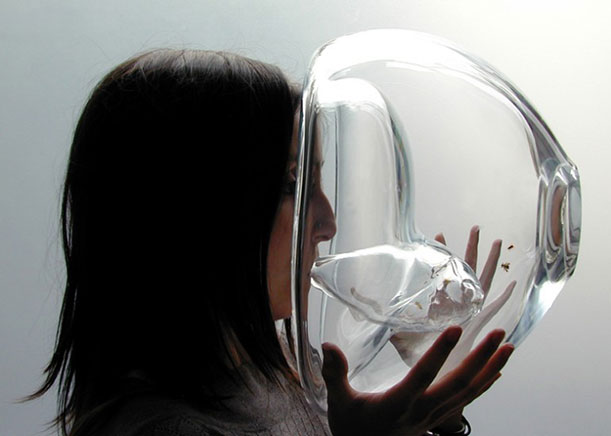
U.K.-based product designer Susana Soares has created a simple, elegant way of harnessing bees to screen for a number of diseases, including cancers, like tumors of the lung and ovaries. Her glass apparatus, called “Bee’s,” features a large chamber and a smaller connected chamber housed within it. After training the bees to associate a specific chemical odor with a food reward, such as sugar, the insects are released into the diagnostic device through an opening. Patients would simply blow into the smaller compartment and wait to see if a swarm gathers toward something alarming in the person’s breath.

The project, part of her master’s thesis at London’s Royal College of Art, began in 2007 when Soares came across research on bees and their phenomenal olfactory abilities. After talking to researchers in the field, she learned that certain diseases, such as lung cancer, noticeably alter the composition of bodily fluids, producing odorous compounds that show up in urine and sometimes blood. Some investigators have even been experimenting with various sensory methods to home in on these “biomarkers.” In Philadelphia, for instance, scientists have trained mice to identify the scent of lung cancer. Trained dogs have also been used to sniff out ovarian cancer. Others have focused on replicating these animal abilities in electronic nose devices that are calibrated to pick up these biomarkers undetectable to human noses.

Insects offer key advantages over mammals and electronics, however, because of their antennae. For example, electronic nose devices have trouble detecting an odor amid more complicated conditions, like when there’s a greater mixture of gases, as is found in human breath. And studies have revealed that sniffer dogs identify odors correctly only about 71 percent of the time, while also requiring at least three months’ training. Bees, in contrast, have achieved an accuracy rate of 98 percent and can be trained in about 10 minutes.

In developing “Bee’s,” the Portuguese native needed something that enabled the user to easily transport bees into the instrument and safely suck them back out using a vacuum. The source material also had to be malleable enough to shape into a system with well-defined pathways that don’t impede their movement. She eventually settled on glass as the material because of its flexibility and transparency. “To know the results of a breath test, you’d have to see the behavior of the insects,” she says. “Everything is about their behavior.”

Prototypes have undergone field testing, and although it didn’t find any instances of cancer, it did turn up a case of diabetes that was later confirmed. It’s unlikely, though, that the concept will amount to anything beyond being an exhibition curiosity. While there was a brief period in which she felt ambitious enough to reach out to potential collaborators, the process proved so time consuming and unfruitful that she ultimately gave up. The only organizations that seemed even remotely interested in her idea were a handful of charities. So for now, “Bee’s” exists as one of those purely academic exercises to show, as she puts it, the “symbiotic relationship” humans have with nature and how “technology and science can better foster these relationships.”

“I think there’s only four labs in the world doing research into insects for disease screening, which shows you that this approach doesn’t go over well in the western world,” says Soares. “Medical and health technologies are a big business, and the bottom line is they just don’t see how something like this can be profitable.”

Glen C. Rains, an agricultural professor at the University of Georgia, largely concurs, though he adds that there are more complex issues besides economics. The entomologist, as well as licensed beekeeper, has dealt with numerous challenges while developing a similar device called the Wasp Hound, which uses a batch of five wasps to detect the presence of bedbugs. Rains’ system is a bit more elaborate in that it uses a camera to record the wasps’ behavior. The data is then fed into software that analyzes these movements to determine if the bugs actually did indeed detect these unwanted guests. After over a decade of development, Rains has forged a partnership with Bennett Aerospace, an engineering firm, to refine the technology for large-scale real applications.

“The whole notion is definitely something people find fascinating,” he says. “But once you get into how it would work or how they make money, there’s no model for how it would be done.”

While there’s a tried-and-true market for electronic technologies, Rains points out that disease screening systems based on insects requires a separate infrastructure that the industry players haven’t bothered to think through. Facilities, for instance, would need a way to efficiently obtain odor samples for training and, obviously, a beekeeper on site who can manage and train the insects. After a few positive results, the insects’ willingness to buzz towards the chemical starts to diminish significantly, as they start to catch on to the fact that a sugary reward no longer await them at the other end. Thus, in a lab setting, bugs would need constant retraining throughout the day. But what’s encouraging, he adds, is that the enlisting of bugs for clinical purposes isn’t unprecedented, with the use of maggots and leaches to clean wounds being a well-accepted medical practice.

Despite these challenges, Soares has left at least the back door open to such a possibility, if someone with the right resources is willing to take a risk. “It has the potential to save so many lives,” she says. “It can even be an open-source concept, so for anyone who is interested, I’d be happy to talk.”
ORIGINAL: Smithsonian
December 13, 2013


01-intro

02-a-diagnostic-tool
03-a-precise-object

02-robert-hooke

Bee´s / Project
Bee's explores how we might co-habit with natural biological systems and use their potential to increase our perceptive abilities.

The objects facilitate bees' odour detection abilities in human breath. Bees can be trained within 10 minutes using Pavlov’s reflex to target a wide range of natural and man-made chemicals and odours, including the biomarkers associated with certain diseases.

The aim of the project is to develop upon current technological research by using design to translate the outcome into systems and objects that people can understand and use, engendering significant adjustments in their lives and mind set.

How it works

The glass objects have two enclosures: a smaller chamber that serves as the diagnosis space and a bigger chamber where previously trained bees are kept for the short period of time necessary for them to detect general health. People exhale into the smaller chamber and the bees rush into it if they detect on the breath the odour that they where trained to target.


01 & 02 Person preparing to exhale into the small chamber
03 Negative diagnostic: bees did not detect traces of odour they were trained to target
04 Positive diagnostic: bees rushed to the small chamber were they detect the targeted odour


What can bees detect?

Scientific research demonstrated that bees can diagnose accurately at an early stage a vast variety of diseases, such as: tuberculosis, lung and skin cancer, and diabetes.

Diagnostic tool 2: person exhaling into the diagnostic chamber, 26*15 cm, prototype 2007; borosilicate; Vilabo, Portugal


Precise object

The outer curved tube helps bees avoid from flying accidentally into the interior diagnosis chamber, making for a more precise result. The tubes connected to the small chamber create condensation, so that exhalation is visible.

Precise object, 22*12 cm, prototype 2007; borosilicate; Vilabo, Portugal


Detecting chemicals in the axilla
Apocrine glands are known to contain pheromones that retain information about a person's health that bees antennae can identify.

Diagnostic tool 4 (25*16 cm) prototype 2008; borosilicate; Vilabo, Portugal

The bee clinic

These diagnostic tools would be part of system that uses bees as a biosensor.

The systems implies:
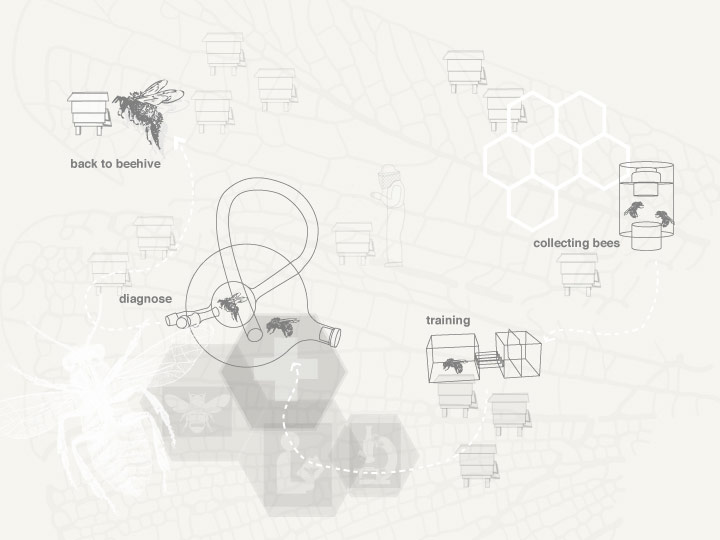
  • A BEE CENTRE: a structure that facilitates the technologic potential of bees. Within the centre is a BEEFARM, a TRAINING CENTRE, a RESEARCH lab and a HEALTHCARE CENTRE.
  • TRAINING CENTER: courses can be taken on beetraining where bees are collected and trained by beetrainers. These are specialists that learn beetraining techniques to be used in a large scope of applications, including diagnosing diseases.
  • BEE clinic: bees are used at the clinic for screening tests. These insects are very accurate in early medical diagnosis through detection on a person's breath. Bees are a sustainable and valuable resource. After performing the diagnose in the clinic they are released, returning to their beehive. 

Bee Graphic - Complete Cycle


What if people started to be screened by bees for cancer?
Which one would we trust more, a machine or a biosensor?
Could bee training become a profession?

Bee training
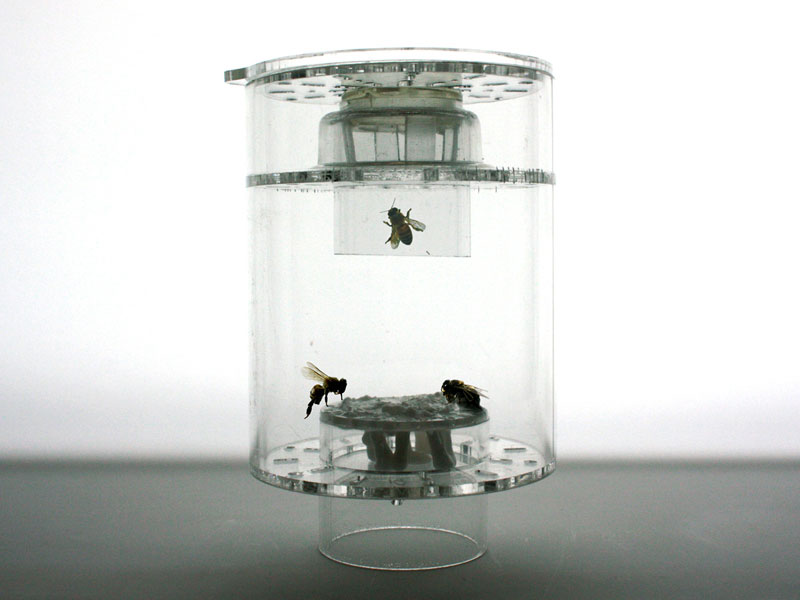
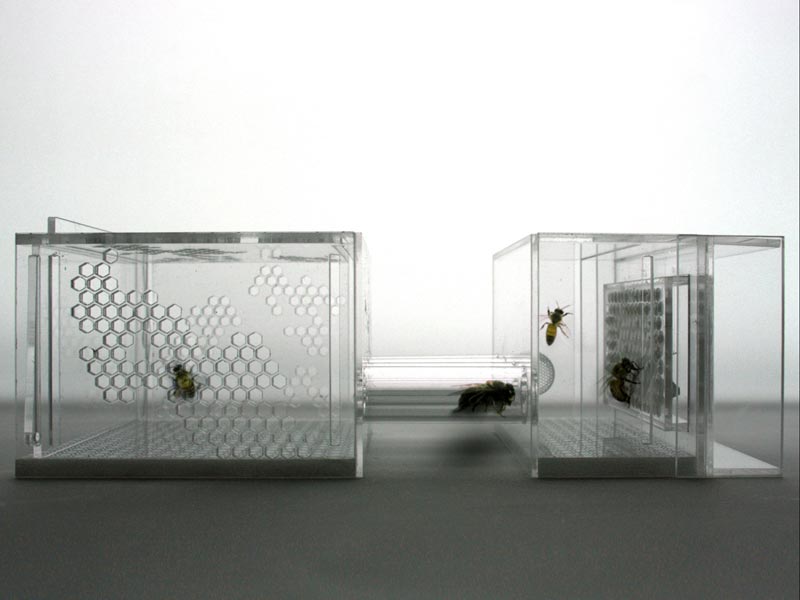
Bees can be easily trained using Pavlov’s reflex to target a wide range of natural and man-made chemicals odours including the biomarkers associated with certain diseases. The training consists in baffling the bees with a specific odour and feeding them with a solution of water and sugar, therefore they associate that odour with a food reward.
05 Bee catcher: this object is use to collect bees for training, a sugary solution is used to attract them inside - 15*9 cm, prototype 2009; acrylic.


06 Bee training object - 20*7*9 cm, prototype 2009; clear acrylic & hip.

Acknowledgements:
  • Calouste Gulbenkian Foundation
  • Royal College of Art, Design Interactions Department: Professor Anthony Dunne and Ms. Fiona Raby
  • Crisform: Designer Sónia Durães and Glass Master Mateus
  • Vilabo: Mr. João Gomes
  • London Beekeeper Association: Mr. David Perkins
  • Inscentinel, Bee research team at Rothamsted Research, UK: Dr. Mathilde Briens
Credits:
Susana Soares

Models:
Bernardete Fernandes
Clarie Ducruet
Margarida Martins