Mostrando entradas con la etiqueta Fun. Mostrar todas las entradas

miércoles, 16 de septiembre de 2015

El juego de cartas “Mujeres de Ciencia”


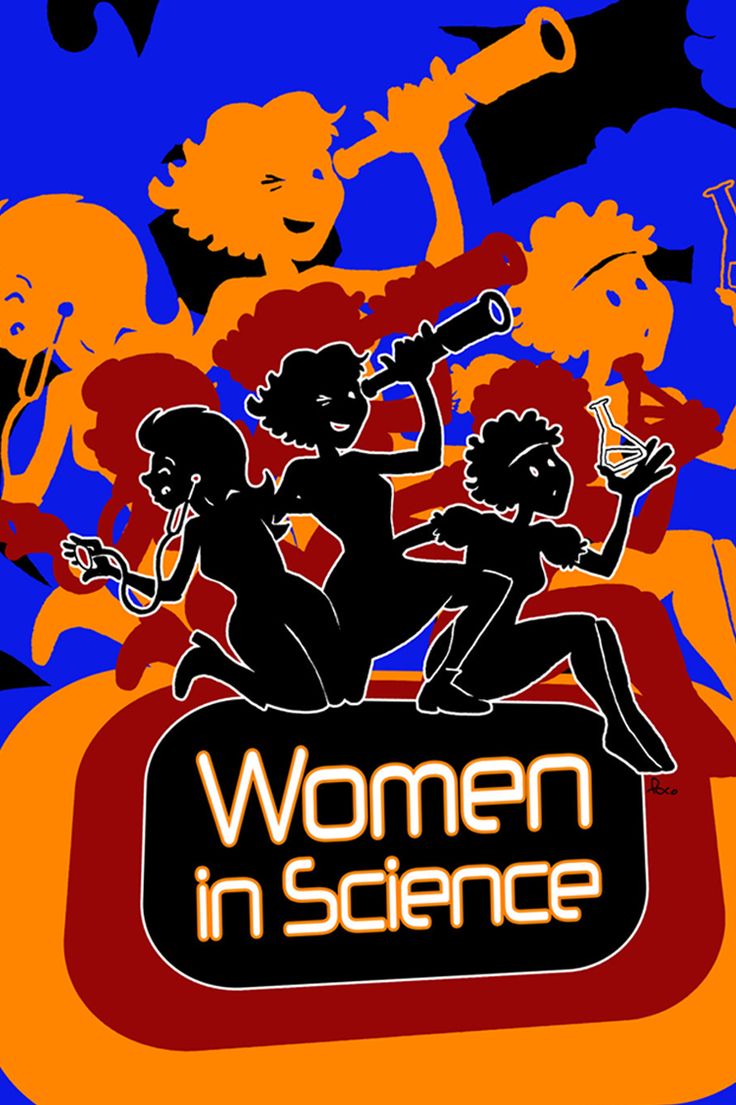
El juego de cartas Women in science presenta a 44 científicas de disciplinas variadas. La baraja –una idea de Anouk Charles y Benoît Fries– está compuesta por 52 cartas dibujadas por el artista Francis Collie.

Jugando con esta singular baraja, se puede aprender sobre las aportaciones de estas mujeres, algunas de ellas muy poco conocidas.

Además, este juego pretende ofrecer modelos tanto a chicas como a chicos, para que se animen a estudiar carreras de ciencias.

Reglas del juego
El objetivo del juego es reunir cuatro cartas del mismo color para formar un laboratorio. La primera persona que forma tres laboratorios, gana la partida. Cada jugador o jugadora recibe seis cartas. Se coloca el mazo (boca abajo) en el centro de la mesa y una primera carta boca arriba.

En cada turno, el jugador o jugadora decide coger la primera carta del mazo o la situada boca arriba, y se desprende de una carta, dejándola boca arriba en el montón de descarte.

Algunas cartas tienen dos colores y pueden usarse para construir laboratorios de cualquiera de los dos colores. La carta reclutamiento permite a un jugador o jugadora coger cualquier personaje del montón de descarte. La carta prestigio permite robar dos personajes de un laboratorio adversario (se destruye el laboratorio y los personajes restantes se reenvian a la mano de su propietario). La cartaclon permite a un jugador o jugadora hacer una copia de un personaje que posee; se sitúa junto a la carta con el personaje calcado cuando se forma un laboratorio, y no pueden separarse hasta el final de la partida.

Al final de cada turno, cada jugador o jugadora sólo puede tener seis cartas en la mano, dejando las sobrantes en el montón de descarte.

Cuando se terminan las cartas del mazo en el turno de una persona, queda eliminada de la partida; sus cartas y sus laboratorios se barajan junto a las cartas del montón de descarte para formar un nuevo mazo, y el proceso vuelve a comenzar.
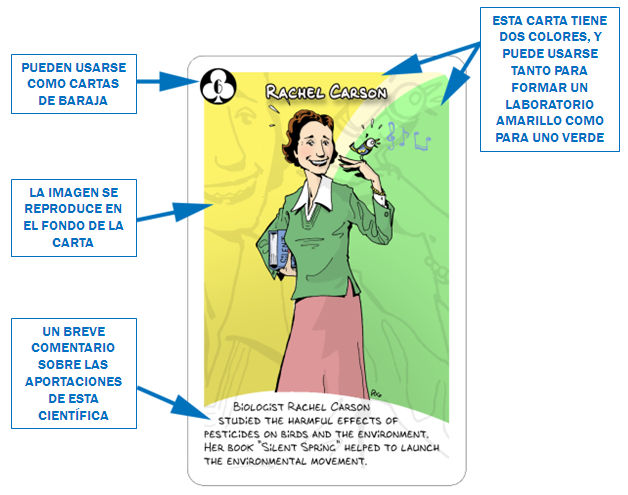
Imagen creada por Marta Macho Stadler a partir de ésta.

Además, las cartas pueden utilizarse para cualquier otro juego de baraja francesa (corazones, diamantes, tréboles y picas).

Los colores que permiten formar los laboratorios son cinco y representan a diferentes disciplinas de la ciencia –los laboratorios se forman con científicas que pueden colaborar entre ellas–: amarillo (enfermería, medicina, salud), fucsia (educación, psiquiatría, psicología), lila (informática, matemáticas), naranja (física, inventos) y verde (biología, geología, química).

Las científicas representadas –junto al color y el número y palo de la baraja que la identifica– son:
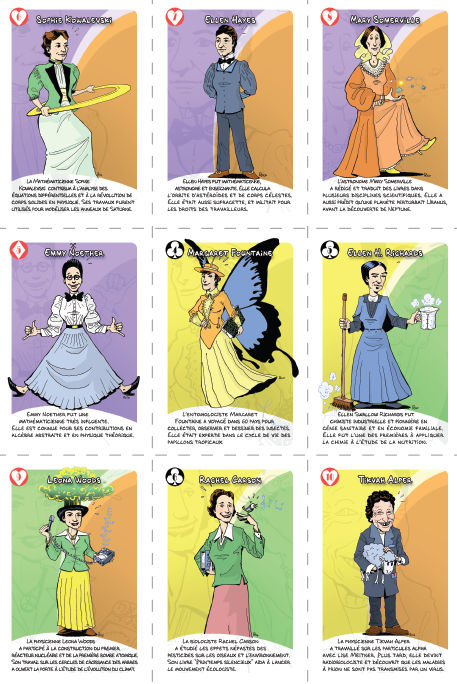

Corazones
1. Chien-Shiung Wu(naranja)
2. Cecilia Payne (naranja)
3. Lise Meitner (naranja)
4. Maria Telkes (verde-naranja)
5. Lillian Gilbreth (naranja-fucsia)
6. Sofia Kovalevskaya (lila-naranja)
7. Ellen Hayes (lila-naranja)
8. Mary Somerville (lila-naranja)
9. Leona Woods (verde-naranja)
10. Tikvah Alper (amarillo-naranja)
V. Ruby Payne-Scott(naranja)
D. Margaret E. Knight(naranja)
R. Yvonne Brill (naranja)

Diamantes
1. Rose Dieng-Kuntz (lila)
2. Grace Hopper (lila)
3. Dian Fossey (verde-lila)
5. Emmy Noether (lila)
6. Euphemia Haynes (lila)
7. Katherine Johnson (lila-naranja)
8. Sophie Germain (lila)
9. Ada Lovelace (lila)
10. Irène Joliot-Curie (naranja)
V. Hedy Lamarr (naranja)
D. Dorothy Hill (verde)
R. Margaret Mead (fucsia)
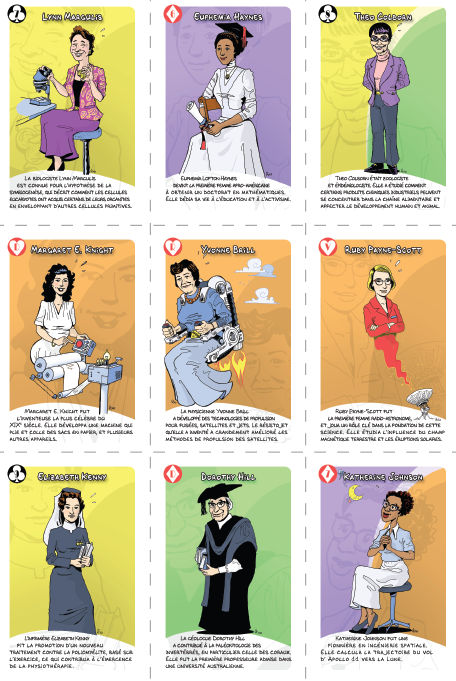
Tréboles
1. Tewhida Ben Sheikh(amarillo)
2. Françoise Dolto(amarillo-fucsia)
3. Rosalind Franklin(amarillo)
4. Margaret Fountaine(amarillo)
5. Ellen H. Richards(amarillo-verde)
6. Rachel Carson (amarillo-verde)
7. Lynn Margulis (amarillo-verde)
8. Theo Colborn (amarillo-verde)
9. Elizabeth Kenny(amarillo)
10. Dorothy Hodgkin(amarillo)
V. Marie Tharp (verde)
D. Inge Lehmann (verde)
R. Wangari Maathai(verde)

Picas
1 y 2. Carta ‘reclutamiento’ (Albert Einstein)
3 y 4. Carta ‘prestigio’
5, 6, 7 y 8. Carta ‘clon’
9. Karen Horney (fucsia)
10. Alice Miller (fucsia)
V. Melanie Klein (fucsia)
D. Maria Montessori (amarillo-fucsia)
R. Nettie Stevens (amarillo)

Esta baraja se puede adquirir en inglés –Women in science– y en francés –Femmes de science–.

Además, en este enlace (cartas en francés) o este enlace (cartas en inglés) se puede solicitar el envío –gratuito– de un fichero pdf para imprimir la baraja completa.


Sobre la autora
Marta Macho Stadler es doctora en matemáticas, profesora del Departamento de Matemáticas de la UPV/EHU y colaboradora en ::ZTFNews y la Cátedra de Cultura Científica de la UPV/EHU.


ORIGINAL: MujeresEnCiencia
9 septiembre, 2015

jueves, 11 de junio de 2015

16 on-point responses from female scientists to Nobel winner's sexist comments

Image: Twitter Amelia Cervera / Danielle Spitzer

LONDON — How do you respond to sexist comments if you're a female scientist who has been told that you should be in a single-sex lab because male scientists might fall in love with you? You mock them on Twitter, of course.

Female scientists have been tweeting photos of themselves (and some historical figures) with the hashtag #distractinglysexy in response to Sir Tim Hunt's comments on Tuesday. He told a conference in South Korea that the "trouble with girls" is they fall in love with you, you fall in love with them and that then when they're criticised, they cry.

See also: Nobel-winning scientist resigns after sexist comments about women in labs

British biochemist Hunt, who was awarded a Nobel Prize in Physiology or Medicine in 2001, resigned from his role at University College London following the controversy.

After news of his comments spread, they sparked outrage in the science community in Britain and beyond.

Here are 16 of the best #distractinglysexy tweets:
I'm really glad that Curie managed to take a break from crying to discover radium and polonium #distractinglysexypic.twitter.com/txYVHoidK5 — Amy Remeikis (@AmyRemeikis) June 11, 2015

It's just really hard working in a coed lab because I'm too distracting to the male scientists #distractinglysexypic.twitter.com/9cZMUpy6TL— Danielle Spitzer (@dspitzzz) June 11, 2015 

Nothing like a sample tube full of cheetah poop to make you #distractinglysexypic.twitter.com/tdBTLRos4p — Sarah Durant (@SarahMDurant) J
 
Still #distractinglysexy after a full day of cell culture. Didn't even cry this time, so proud! #HeyaTimHuntpic.twitter.com/RdAxxLJ1fY— Lucie de Beauchamp (@lu_debeauchamp) June 11, 2015 

Tears, laughter, romance, dirty dirty flotation: #archaeology makes me so hot right now  #distractinglysexypic.twitter.com/Ke2KtDAXZi— Lorna Richardson (@lornarichardson) June 11, 2015

Planting this giant field experiment in the snow was probably the most #distractinglysexy week of my career so far. pic.twitter.com/bowL2vFdKg— Maggie R Wagner (@GolfXrayEcho) June 11, 2015

Filter mask protects me from hazardous chemicals and muffles my woman cries. Double win! #DistractinglySexypic.twitter.com/5kYlm6SNud— Amelia Cervera (@ameliacervera) June 11, 2015

My lenses bring all the profs to the yard. #distractinglysexypic.twitter.com/tgDNzg28gJ — Nermeen Youssef (@Cleo2atra) June 11, 2015
 
Oh don't mind me. I'm just pipetting while being #distractinglysexy #TimHunt #WomenInSTEM #womeninscience pic.twitter.com/95ywMimBno— Meg Massa (@MegMassa) June 11, 2015
 
Hearts in the palm of our hands #distractinglysexy #TimHunt @VagendaMagazine pic.twitter.com/KA1askiwCD— ash (@ashcl0ud) June 11, 2015
 
I made it through these brain dissections without falling in love or crying. Phew! #distractinglysexy  #TimHunt pic.twitter.com/q5PVkM9zCx— Sonja Vernes (@Sonja_Vernes) June 11, 2015

Guess I can't save the lives of my geological counterparts - I'm too #distractinglysexy to the team. As if! #TimHunt pic.twitter.com/QwXSYPhLQr— Lisa P to the O (@xLiserx) June 11, 2015

I had 3 marriage proposals after this talk. Shame I cried too much to accept #distractinglysexy #captioncompetition pic.twitter.com/Bv8yYmKhMK— Sammie Buzzard (@TreacherousBuzz) June 11, 2015

To save you all time, I have designed an easy to print off sign for your lab. You are welcome. #distractinglysexy pic.twitter.com/3LAPboJhb4— Steve Diggle (@stevediggle) June 11, 2015

Ha! Best #distractinglysexy signage ever! pic.twitter.com/dgx097F0x4 — Cindy Renate (@CindyRenate) June 11, 2015
You might think we're covered up for bug and sun protection, but it's really just because we're #distractinglysexy pic.twitter.com/O5fQH0bJgQ Rachel Penczykowski (@RachelPenczy) June 11, 2015

Have something to add to this story? Share it in the comments.


ORIGINAL: Mashable
4 hours ago

martes, 10 de diciembre de 2013

in PLOS - parody of Lady Gaga's "Applause"

"We're touched and can't stop laughing after watching this video made by grad students at UCB D-lab. Highly recommended!" (PLOS)


ORIGINAL: DLab Follies

sábado, 7 de diciembre de 2013

"We’re Up All Night To Get Data:" The Next Awesome Science Parody

Add caption
You all must know by now that I’m a sucker for excellent science music video parodies. This one, by the folks at UCSD Neuroscience, is my latest favourite. Set to the tune of Daft Punk’s ‘Get Lucky’, this video captures the (sometimes) desperate journey to fill your conference poster before the deadline looms. It’s full of fun references to graduate school, academia and publishing – and the production value is awesome. The video was created as a party invitation for the UCSD Neurosciences Graduate Program Social, and if the party is anything like the video I’m sorry that I won’t be there.


Enjoy!

Carin Bondar
About the Author: 
Carin Bondar is a biologist, writer and film-maker with a PhD in population ecology from the University of British Columbia. Find Dr. Bondar online at www.carinbondar.com, on twitter @drbondar or on her facebook page: Dr. Carin Bondar – Biologist With a Twist. Follow on Twitter @drbondar.


ORIGINAL: Scientific American
By Carin Bondar
November 7, 2013