Mostrando entradas con la etiqueta Computación. Mostrar todas las entradas

lunes, 17 de noviembre de 2014

Machine Learning Algorithm Ranks the World's Most Notable Authors

Deciding which books to digitise when they enter the public domain is tricky; unless you have an independent ranking of the most notable authors.


Public Domain Day, 1 January, is the day on which previously copyrighted works become freely available to print, digitise, modify or re-use in more or less any way. In most countries, this happens 50 or 70 years after the death of the author.

There is even a website that celebrates this event, announcing all the most notable authors whose works become freely available on that day. This allows organisations such as Project Gutenberg to prepare digital editions and LibriVox to create audio versions and so on

But here’s an interesting question. While the works of thousands of authors enter the public domain each year, only a small percentage of these end up being widely available. So how to choose the ones to focus on?

Today, Allen Riddell at Dartmouth College in New Hampshire, says he has the answer. Riddell has developed an algorithm that automatically generates an independent ranking of notable authors for a given year. It is then a simple task to pick the works to focus on or to spot notable omissions from the past.

Riddell’s approach is to look at what kind of public domain content the world has focused on in the past and then use this as a guide to find content that people are likely to focus on in the future. For this he uses a machine learning algorithm to mine two databases. The first is a list of over a million online books in the public domain maintained by the University of Pennsylvania. The second is Wikipedia

Riddell’s begins with the Wikipedia entries of all authors in the English language edition—more than a million of them. His algorithm extracts information such as the article length, article age, estimated views per day, time elapsed since last revision and so on.

The algorithm then takes the list of all authors on the online book database and looks for a correlation between the biographical details on Wikipedia and the existence of a digital edition in the public domain. 

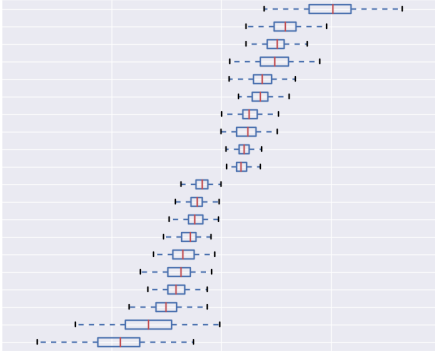
That produces a “public domain ranking” of all the authors that appear on Wikipedia. For example, the author Virginia Woolf has a ranking of 1081 out of 1,011,304 while the Italian painter Giuseppe Amisani, who died in the same year as Woolf, has a ranking of 580,363. So Riddell’s new ranking clearly suggests that organisations like Project Guttenberg should focus more on digitising Woolf’s work than Amisani’s.

The beauty of this approach is that it is entirely independent. That’s in stark contrast to the committees that are often set up to rank works subjectively.

Of the individuals who died in 1965 and whose work will enter the public domain next January in many parts of the world, the new algorithm picks out T S Eliot as the most highly ranked individual. Others highly ranked include Somerset Maugham, Winston Churchill and Malcolm X.

As well as by year of death, it’s possible to rank authors according to categories of interest. For example, the top-ranked Mexican poet is Homero Aridjis, the top-ranked French philosopher, Jean-Paul Sartre and the top-ranked female American writer, Terri Windling.

Riddell says his ranking system compares well with existing rankings compiled by human experts, such as one compiled by the editorial board of the Modern Library. “The Public Domain Rank of the authors selected by the Modern Library editorial board are consistently high,” he says.

It is not perfect, however. Riddell acknowledges that his new Public Domain Ranking is likely to reflect the biases inherent in Wikipedia, which is well known for having few female editors, for example.

But with that in mind, the ranking is still likely to be useful. It should be handy for finding notable authors in the public domain whose works are not yet available electronically because they have somehow been overlooked. “Flannery O’Connor and Sylvia Plath stand out as significant examples of authors whose works might be made available today on Project Gutenberg Canada, “ says Riddell. (Canada follows the 50 year rule rather than 70).

It may even change the nature of Public Domain Day. “Public Domain Rank promises to facilitate—and even automate—Public Domain Day,” says Riddell.

Handy!

Ref: arxiv.org/abs/1411.2180 Public Domain Rank: Identifying Notable Individuals with the Wisdom of the Crowd 

ORIGINAL: Tech Review
November 17, 2014

lunes, 3 de noviembre de 2014

Google CEO: Computers Are Going To Take Our Jobs, And 'There's No Way Around That'

Google+/Larry Page Google CEO Larry Page

When Google co-founders Larry Page and Sergey Brin formed the company in 1998, they sought to package all the information on the internet into an index that's simple to use.

Today, Google is much more than a search engine. The company appears to be involved in every type of new technology ranging from self-driving cars to contact lenses that can test for disease.

In a recent interview with the Financial Times, CEO Larry Page provided some insight as to why the company has decided to take on so many different tasks.

Part of the reason is because Page believes there's this inevitable shift coming in which computers will be much better-suited to take on most jobs

"You can't wish away these things from happening, they are going to happen," he told the Financial Times on the subject of artificial intelligence infringing on the job market. "You're going to have some very amazing capabilities in the economy. When we have computers that can do more and more jobs, it's going to change how we think about work. There's no way around that. You can't wish it away."

But people shouldn't fear computers taking over their occupations, according to Page, who says it "doesn't make sense" for people to work so much.

"The idea that everyone should slavishly work so they do something inefficiently so they keep their job — that just doesn't make any sense to me," he told the Financial Times. "That can't be the right answer.

Based on Page's quotes in the Financial Times, it sounds as if he feels like Google has an obligation to invest in forward-thinking technologies.

"...We have all these billions we should be investing to make people's lives better," Page said to the Financial Times. "If we just do the same thing we did before and don't do something new, it seems like a crime to me."


ORIGINAL: BusinessInsider
OCT. 31, 2014

miércoles, 24 de septiembre de 2014

Made With Code


We started Made with Code because even though technology runs more and more of our lives, women aren't represented in the companies, labs, research, creative arts, design, organizations, and boardrooms that make technology happen

If girls are inspired to see that Computer Science can make the world more beautiful, more usable, more safe, more kind, more innovative, more healthy, and more funny then hopefully they will begin to contribute their essential voices. 

As parents, teachers, organizations, and companies we're making it our mission to creatively engage girls with code. Today, less than 1% of girls are interested in CS. Tomorrow, we can make that number go up.

domingo, 31 de agosto de 2014

5 Robots Booking It to a Classroom Near You

IMAGE: ANDY BAKER/GETTY IMAGES

Robots are the new kids in school.

The technological creations are taking on serious roles in the classroom. With the accelerating rate of robotic technology, school administrators all over the world are plotting how to implement them in education, from elementary through high school.

In South Korea, robots are replacing English teachers entirely, entrusted with leading and teaching entire classrooms. In Alaska, some robots are replacing the need for teachers to physically be present at all.


Robotics 101 is now in session. Here are five ways robots are being introduced into schools.

1. Nao Robot as math teacher

IMAGE: WIKIPEDIA

In Harlem school PS 76, a Nao robot created in France, nicknamed Projo helps students improve their math skills. It's small, about the size of a stuffed animal, and sits by a computer to assist students working on math and science problems online.

Sandra Okita, a teacher at the school, told The Wall Street Journal the robot gauges how students interact with non-human teachers. The students have taken to the humanoid robotic peer, who can speak and react, saying it's helpful and gives the right amount of hints to help them get their work done.

2. Aiding children with autism


The Nao Robot also helps improve social interaction and communication for children with autism. The robots were introduced in a classroom in Birmingham, England in 2012, to play with children in elementary school. Though the children were intimidated at first, they've taken to the robotic friend, according to The Telegraph.

3. VGo robot for ill children


Sick students will never have to miss class again if the VGo robot catches on. Created by VGo Communications, the rolling robot has a webcam and can be controlled and operated remotely via computer. About 30 students with special needs nationwide have been using the $6,000 robot to attend classes.

For example, a 12-year-old Texas student with leukemia kept up with classmates by using a VGo robot. With a price tag of about $6,000, the robots aren't easily accessible, but they're a promising sign of what's to come.

4. Robots over teachers


In the South Korean town of Masan, robots are starting to replace teachers entirely. The government started using the robots to teach students English in 2010. The robots operate under supervision, but the plan is to have them lead a room exclusively in a few years, as robot technology develops.

5. Virtual teachers


IMAGE: FLICKR, SEAN MACENTEE
South Korea isn't the only place getting virtual teachers. A school in Kodiak, Alaska has started using telepresence robots to beam teachers into the classroom. The tall, rolling robots have iPads attached to the top, which teachers will use to video chat with students.

The Kodiak Island Borough School District's superintendent, Stewart McDonald, told The Washington Times he was inspired to do this because of the show The Big Bang Theory, which stars a similar robot. Each robot costs about $2,000; the school bought 12 total in early 2014.


jueves, 10 de julio de 2014

Can The Human Brain Project Succeed?


Image: Getty Images

An ambitious effort to build human brain simulation capability is meeting with some very human resistance. On Monday, a group of researchers sent an open letter to the European Commission protesting the management of the Human Brain Project, one of two Flagship initiatives selected last year to receive as much as €1 billion over the course of 10 years (the other award went to a far less controversy-courting project devoted to graphene).

The letter, which now has more than 450 signatories, questions the direction of the project and calls for a careful, unbiased review. Although he’s not mentioned by name in the letter, news reports cited resistance to the path chosen by project leader Henry Markram of the Swiss Federal Institute of Technology in Lausanne. One particularly polarizing change was the recent elimination of a subproject, called Cognitive Architectures, as the project made its bid for the next round of funding.

According to Markram, the fuss all comes down to differences in scientific culture. He has described the project, which aims to build six different computing platforms for use by researchers, as an attempt to build a kind of CERN for brain research, a means by which disparate disciplines and vast amounts of data can be brought together. This is a "methodological paradigm shift" for neuroscientists accustomed to individual research grants, Markram told Science, and that's what he says the letter signers are having trouble with.

But some question the main goals of the project, and whether we're actually capable of achieving them at this point. The program's Brain Simulation Platform aims to build the technology needed to reconstruct the mouse brain and eventually the human brain in a supercomputer. Part of the challenge there is technological. Markram has said that an exascale-level machine (one capable of executing 1000 or more petaflops) would be needed to "get a first draft of the human brain", and the energy requirements of such machines are daunting.

Crucially, some experts say that even if we had the computational might to simulate the brain, we're not ready to. "The main apparent goal of building the capacity to construct a larger-scale simulation of the human brain is radically premature," signatory Peter Dayan, who directs a computational neuroscience department at University College London, told the Guardian. He called the project a "waste of money" that "can't but fail from a scientific perspective". To Science, he said "the notion that we know enough about the brain to know what we should simulate is crazy, quite frankly.”

This last comment resonated with me, as it reminded me of a feature that Steve Furber of the University of Manchester wrote for IEEE Spectrum a few years ago. Furber, one of the co-founders of the mobile chip design powerhouse ARM, is now in the process of stringing a million or so of the low-power processors together to build a massively parallel computer capable of simulating 1 billion neurons, about 1% as many as are contained in the human brain.

Furber and his collaborators designed their computing architecture quite carefully in order to take into account the fact that there are still a host of open questions when it comes to basic brain operation. General-purpose computers are power-hungry and slow when it comes to brain simulation. Analog circuitry, which is also on the Human Brain Project's list, might better mimic the way neurons actually operate, but, he wrote,

as speedy and efficient as analog circuits are, they’re not very flexible; their basic behavior is pretty much baked right into them. And that’s unfortunate, because neuroscientists still don’t know for sure which biological details are crucial to the brain’s ability to process information and which can safely be abstracted away

The Human Brain Project's website admits that exascale computing will be hard to reach: "even in 2020, we expect that supercomputers will have no more than 200 petabytes." To make up for the shortfall, it says, "what we plan to do is build fast storage random-access storage systems next to the supercomputer, store the complete detailed model there, and then allow our multi-scale simulation software to call in a mix of detailed or simplified models (models of neurons, synapses, circuits, and brain regions) that matches the needs of the research and the available computing power. This is a pragmatic strategy that allows us to keep build ever more detailed models, while keeping our simulations to the level of detail we can support with our current supercomputers."

This does sound like a flexible approach. But, as is par for the course with any ambitious research project, particularly one that involves a great amount of synthesis of disparate fields, it's not yet clear whether it will pay off.

And any big changes in direction may take a while. Although the proposal for the second round of funding will be reviewed this year, according to Science, which reached out to the European Commission, the first review of the project itself won't begin until January 2015.

Rachel Courtland can be found on Twitter at @rcourt.

ORIGINAL: Spectrum
By Rachel Courtland
Posted 9 Jul 2014 | 17:00 GMT

viernes, 4 de julio de 2014

Google launches ‘Made with Code’ initiative to encourage more girls to code, backed by $50m pledge


Google has announced that it will provide up to $50 million for organizations that can help encourage more girls to take an interest in computer science at an early age.

Revealed as part of its newly launched Made with Code initiative, the cash will be used for things like “rewarding teachers who support girls who take CS courses on Codecademy or Khan Academy,Susan Wojcicki said in a blog post today.


Other aspects of the Made with Code scheme – which is also backed by other organizations like Girls Inc., Girl Scouts of the USA, MIT Media Lab and the National Center for Women & Information Technology, among others – include Blockly-based projects, like making a 3D printed bracelet, learning to create GIFs and “building beats” for a music track.

Google has put together a standalone site for the initiative too, so if you want to get involved you can head across there now.

Things you love are Made with Code [Google]

Don’t miss: Codecademy, Google and DonorsChoose team up to get more girls studying Computer Science

Featured Image Credit – GEORGES GOBET/AFP/Getty Images

ORIGINAL: The Next Web

viernes, 27 de junio de 2014

Welcome to the Claytronics Project


Collaborative Research in Programmable Matter Directed by Carnegie Mellon and Intel

This project combines modular robotics, systems nanotechnology and computer science to create the dynamic, 3-Dimensional display of electronic information known as claytronics.

Our goal is to give tangible, interactive forms to information so that a user's senses will experience digital environments as though they are indistinguishable from reality.

Claytronics is taking place across a rapidly advancing frontier. This technology will help to drive breathtaking advances in the design and engineering of computing and hardware systems

Our research team focuses on two main projects:
  • Creating the basic modular building block of claytronics known as the claytronic atom or catom, and
  • Designing and writing robust and reliable software programs that will manage the shaping of ensembles of millions of catoms into dynamic, 3-Dimensional forms.
Realizing the vision of claytronics through the self-assembly of millions of catoms into synthetic reality will have a profound effect on the experience of users of electronic information. This promise of claytronic technology has become possible because of the ever increasing speeds of computer processing predicted in Moore's Law

This website will introduce you to the ideas that are driving claytronics, the research team that is working to make it happen, and the hardware and software projects that enable the building of claytronic ensembles.

Development of this powerful form of information display represents a partnership between the School of Computer Sciences of Carnegie Mellon University, Intel Corporation at its Pittsburgh Laboratory and FEMTO-ST Institute. As an integral part of our philosophy, the Claytronics Project seeks the contributions of scholars and researchers worldwide who are dedicating their efforts to the diverse scientific and engineering studies related to this rich field of nanotechnology and computer science. 

To understand the future of claytronics, watch the concept video [.mov] created by Carnegie Mellon's Entertainment Technology Center.

Use the links to the left to see a list of publications, some videos and photos documenting our progress, a partial list of talks we have given, and people working on the project.


ORIGINAL: CMU


viernes, 13 de junio de 2014

Mathematical Model Of Consciousness Proves Human Experience Cannot Be Modelled On A Computer


A new mathematical model of consciousness implies that your PC will never be conscious in the way you are

One of the most profound advances in science in recent years is the way researchers from a variety of fields are beginning to think about consciousness. Until now, the c-word was been taboo for most scientists. Any suggestion that a researchers was interested in this area would be tantamount to professional suicide.

That has begun to change thanks to a new theory of consciousness developed in the last ten years or so by Giulio Tononi, a neuroscientist at the University of Wisconsin in Madison, and others. Tononi’s key idea is that consciousness is phenomenon in which information is integrated in the brain in a way that cannot be broken down.

So each instant of consciousness integrates the smells, sounds and sights of that moment of experience. And consciousness is simply the feeling of this integrated information experience.

What makes Tononi’s ideas different from other theories of consciousness is that it can be modelled mathematically using ideas from physics and information theory. That doesn’t mean this theory is correct. But it does mean that, for the first time, neuroscientists, biologists physicists and anybody else can all reason about consciousness using the universal language of science: mathematics.

This has led to an extraordinary blossoming of ideas about consciousness. A few months ago, for example, we looked at how physicists are beginning to formulate the problem consciousness in terms of quantum mechanics and information theory.

Today, Phil Maguire at the National University of Ireland and a few pals take this mathematical description even further. These guys make some reasonable assumptions about the way information can leak out of a consciousness system and show that this implies that consciousness is not computable. In other words, consciousness cannot be modelled on a computer.

Maguire and co begin with a couple of thought experiments that demonstrate the nature of integrated information in Tononi’s theory. They start by imagining the process of identifying chocolate by its smell. For a human, the conscious experience of smelling chocolate is unified with everything else that a person has smelled (or indeed seen, touched, heard and so on).

This is entirely different from the process of automatically identifying chocolate using an electronic nose, which measures many different smells and senses chocolate when it picks out the ones that match some predefined signature.

A key point here is that it would be straightforward to access the memory in an electronic nose and edit the information about its chocolate experience. You could delete this with the press of a button.

But ask a neuroscientist to do the same for your own experience of the smell of chocolate—to somehow delete this—and he or she would be faced with an impossible task since the experience is correlated with many different parts of the brain.

Indeed, the experience will be integrated with all kinds of other experiences. “According to Tononi, the information generated by such [an electronic nose] differs from that generated by a human insofar as it is not integrated,” say Maguire and co.

This process of integration is then crucial and Maguire and co focus on the mathematical properties it must have. For instance, they point out that the process of integrating information, of combining it with many other aspects of experience, can be thought of as a kind of information compression.

This compression allows the original experience to be constructed but does not keep all of the information it originally contained.

To better understand this, they give as an analogy the sequence of numbers: 4, 6, 8, 12, 14, 18, 20, 24…. This is an infinite series defined as: odd primes plus 1. This definition does not contain all the infinite numbers but it does allow it be reproduced. It is clearly a compression of the information in the original series.

The brain, say Maguire and co, must work like this when integrating information from a conscious experience. It must allow the reconstruction of the original experience but without storing all the parts.

That leads to a problem. This kind of compression inevitably discards information. And as more information is compressed, the loss becomes greater.

But if our memories were like that cannot be like that, they would be continually haemorrhaging meaningful content. “Memory functions must be vastly non-lossy, otherwise retrieving them repeatedly would cause them to gradually decay,” say Maguire and co.

The central part of their new work is to describe the mathematical properties of a system that can store integrated information in this way but without it leaking away. And this leads them to their central proof. “The implications of this proof are that we have to abandon either the idea that people enjoy genuinely [integrated] consciousness or that brain processes can be modelled computationally,” say Maguire and co.

Since Tononi’s main assumption is that consciousness is the experience of integrated information, it is the second idea that must be abandoned: brain processes cannot be modelled computationally.

They go on to discuss this in more detail. If a person’s behaviour cannot be analysed independently from the rest of their conscious experience, it implies that something is going on in their brain that is so complex it cannot feasibly be reversed, they say.

In other words, the difference between cognition and computation is that computation is reversible whereas cognition is not. And they say that is reflected in the inability of a neuroscientist to operate and remove a particular memory of the small of chocolate.

That’s an interesting approach but it is one that is likely to be controversial. The laws of physics are computable, as far as we know. So critics might ask how the process of consciousness can take place at all if it is non-computable. Critics might even say this is akin to saying that consciousness is in some way supernatural, like magic.

But Maguire and go counter this by saying that their theory doesn’t imply that consciousness is objectively non-computable only subjectively so. In other words, a God-like observer with perfect knowledge of the brain would not consider it non-computable. But for humans, with their imperfect knowledge of the universe, it is effectively non-computable.

There is something of a card trick about this argument. In mathematics, the idea of non-computability is not observer-dependent so it seems something of a stretch to introduce it as an explanation.

What’s more, critics might point to other weaknesses in the formulation of this problem. For example, the proof that conscious experience is non-computable depends critically on the assumption that our memories are non-lossy.

But everyday experience is surely the opposite—our brains lose most of the information that we experience consciously. And the process of repeatedly accessing memories can cause them to change and degrade. Isn’t the experience of forgetting a face of a known person well documented?

Then again, critics of Maguire and co’s formulation of the problem of consciousness must not lose sight of the bigger picture—that the debate about consciousness can occur on a mathematical footing at all. That’s indicative of a sea change in this most controversial of fields.

Of course, there are important steps ahead. Perhaps the most critical is that the process of mathematical modelling must lead to hypotheses that can be experimentally tested. That’s the process by which science distinguishes between one theory and another. Without a testable hypothesis, a mathematical model is not very useful.

For example, Maguire and co could use their model to make predictions about the limits in the way information can leak from a conscious system. These limits might be testable in experiments focusing on the nature of working memory or long-term memory in humans.

That’s the next challenge for this brave new field of consciousness.

Ref: arxiv.org/abs/1405.0126 : Is Consciousness Computable? Quantifying Integrated Information Using Algorithmic Information Theory


Follow the Physics arXiv Blog on Twitter at @arxivblog, on Facebook and by hitting the Follow button below.

ORIGINAL: Medium

lunes, 9 de junio de 2014

Meet the algorithm that can learn “everything about anything”

Summary:

Researchers from Allen Institute for AI have built a computer system capable of teaching itself many facets of broad concepts by scouring and analyzing search engines using natural language processing and computer vision techniques.

The most recent advances in artificial intelligence research are pretty staggering, thanks in part to the abundance of data available on the web. We’ve covered how deep learning is helping create self-teaching and highly accurate systems for tasks such as sentiment analysis and facial recognition, but there are also models that can solve geometry and algebra problems, predict whether a stack of dishes is likely to fall over and (from the team behind Google’s word2vec) understand entire paragraphs of text.

(Hat tip to frequent commenter Oneasum for pointing out all these projects.)

One of the more interesting projects is a system called LEVAN, which is short for Learn EVerything about ANything and was created by a group of researchers out of the Allen Institute for Artificial Intelligence and the University of Washington. One of them, Carlos Guestrin, is also co-founder and CEO of a data science startup called GraphLab. What’s really interesting about LEVAN is that it’s neither human-supervised nor unsupervised (like many deep learning systems), but what its creators call “webly supervised.”


What that means, essentially, is that LEVAN uses the web to learn everything it needs to know. It scours Google Books Ngrams to learn common phrases associated with a particular concept, then searches for those phrases in web image repositories such as Google Images, Bing and Flickr. For example, LEVAN now knows that “heavyweight boxing,” “boxing ring” and “ali boxing” are all part of the larger concept of “boxing,” and it knows what each one looks like.

More impressive still is that because LEVAN uses text and image references to teach itself concepts, it’s also able to learn when words or phrases mean the same thing. So while it might learn, for example, that “Mohandas Gandhi” and “Mahatma Gandhi” are both sub-concepts of “Gandhi,” it will also learn after analyzing enough images that they’re the same person.


So far, LEVAN has modeled 150 different concepts and more than 50,000 sub-concepts, and has annotated more than 10 million images with information about what’s in them and what’s happening in them. The project website lets you examine its findings for each concept and download the models.

According to a recent presentation by one of its creators, LEVAN was designed to run nicely on the Amazon Web Services cloud — yet another sign of how fast the AI space is moving. Computer science skills and math knowledge are one impediment to broadly accessible AI, but those can be addressed by SDKs, APIs, and other methods of abstracting complexity. However, training AI models can require a lot of computing power, something that is easily available to the likes of Facebook and Google but that for everyday users might need to be offloaded to the cloud.

ORIGINAL: GigaOM
By Derrick Harris
May. 23, 2014 - 10:16 AM PDT


domingo, 8 de junio de 2014

Computer becomes first to pass Turing Test in artificial intelligence milestone, but academics warn of dangerous future


Eugene Goostman, a computer programme pretending to be a young Ukrainian boy, successfully duped enough humans to pass the iconic test

A programme that convinced humans that it was a 13-year-old boy has become the first computer ever to pass the Turing Test. The test — which requires that computers are indistinguishable from humans — is considered a landmark in the development of artificial intelligence, but academics have warned that the technology could be used for cybercrime.


Computing pioneer Alan Turing said that a computer could be understood to be thinking if it passed the test, which requires that a computer dupes 30 per cent of human interrogators in five-minute text conversations.

Eugene Goostman, a computer programme made by a team based in Russia, succeeded in a test conducted at the Royal Society in London. It convinced 33 per cent of the judges that it was human, said academics at the University of Reading, which organised the test.

It is thought to be the first computer to pass the iconic test. Though other programmes have claimed successes, those included set topics or questions in advance.

A version of the computer programme, which was created in 2001, is hosted online for anyone talk to. (“I feel about beating the turing test in quite convenient way. Nothing original,” said Goostman, when asked how he felt after his success.)

The computer programme claims to be a 13-year-old boy from Odessa in Ukraine.

"Our main idea was that he can claim that he knows anything, but his age also makes it perfectly reasonable that he doesn't know everything," said Vladimir Veselov, one of the creators of the programme. "We spent a lot of time developing a character with a believable personality."

The programme's success is likely to prompt some concerns about the future of computing, said Kevin Warwick, a visiting professor at the University of Reading and deputy vice-chancellor for research at Coventry University.

In pictures: Artificial intelligence through history1 of 7

Deep Blue beats Kasparov. Getty Images
Watson wins Jeopardy. Getty Images
Boston Dynamics. Getty Images
DARPA Urban Challenge. Getty Images
Google Self Driving Car. Getty Images
Apple's Siri. Getty Images

Kinect. Getty Images
"In the field of Artificial Intelligence there is no more iconic and controversial milestone than the Turing Test, when a computer convinces a sufficient number of interrogators into believing that it is not a machine but rather is a human," he said. "Having a computer that can trick a human into thinking that someone, or even something, is a person we trust is a wake-up call to cybercrime.

"The Turing Test is a vital tool for combatting that threat. It is important to understand more fully how online, real-time communication of this type can influence an individual human in such a way that they are fooled into believing something is true... when in fact it is not."

The test, organised at the Royal Society on Saturday, featured five programmes in total. Judges included Robert Llewellyn, who played robot Kryten in Red Dwarf, and Lord Sharkey, who led the successful campaign for Alan Turing's posthumous pardon last year.

Alan Turing created the test in a 1950 paper, 'Computing Machinery and Intelligence'. In it, he said that because 'thinking' was difficult to define, what matters is whether a computer could imitate a real human being. It has since become a key part of the philosophy of artificial intelligence.

The success came on the 60th anniversary of Turing's death, on Saturday.

ORIGINAL: Independent
Andrew Griffin
Sunday 08 June 2014

viernes, 16 de mayo de 2014

IBM's Watson can now debate any topic

ORIGINAL: GizMag
May 9, 2014
IBM's Watson can now debate (Image: IBM)Image Gallery (2 images)

Watson, IBM's supercomputer made famous three years ago for beating the very best human opponents at a game of Jeopardy, now comes with an impressive new feature. When asked to discuss any topic, it can autonomously scan its knowledge database for relevant content, "understand" the data, and argue both for and against that topic.

Watson's DeepQA is arguably the world's best computer system at natural language processing by a wide margin, which is an extraordinarily complex field of artificial intelligence. Perhaps the major difficulty in understanding human language is the lack of "common sense" in today's computers. For all its number-crunching power, Watson cannot "understand" the questions it is asked, at least not in a traditional sense. The way in which Watson answers questions is closer to symbol manipulation than to the way you and I understand and process information, but the end results are often impressive.

Watson looks at the question it is being asked and groups words together, finding statistically related phrases. Thanks to a massively parallel architecture, it then simultaneously uses thousands of language analysis algorithms to sift through its database of 15 terabytes of human knowledge and find the correct answer. The more algorithms find the same answer independently, the more a certain answer is likely to be correct. This is how, back in 2011, it managed to win a game of Jeopardy against two human champions.

In a presentation at the the Milken Institute Global Conference, IBM senior vice president and director of research John Kelly III demonstrated how Watson can now list, without human assistance, what it believes are the most valid arguments for and against a topic of choice. In other words, it can now debate for or against any topic, in natural language.

In a canned demonstration on stage, Watson was asked to present arguments for and against the sale of violent videogames to minors. After scanning Wikipedia for relevant information, Watson answered:

"I would like to raise the following points in support of the topic. Exposure to violent videogames results in increased physiological arousal, aggression-related thoughts and feelings as well as decreased social behavior. In addition, these violent games or lyrics actually cause adolescents to commit acts of real-life aggression. Finally, violent videogames can increase children's aggression.

On the other hand, I would like to note the following claims that oppose the topic. Violence in videogames is not causally linked with aggressive tendencies. In addition, most children who play videogames do not have problems. Finally, videogame play is part of an adolescent boy's normal social setting."

The answer wasn't just a mindless collage of sentences copied from various Wikipedia articles. Rather, in just a few seconds, Watson searched its sources for relevant information, scanned for arguments in favor and against the topic, selected what it believed were the strongest arguments, and then constructed sentences in natural language to illustrate the points it had selected.

For a computer that doesn't actually "understand" the questions it is being asked, this is a truly impressive achievement.

IBM believes that the technology behind Watson will prove very valuable in dealing with the exploding amount of information that we're currently facing. A fully automated system that can process huge amounts of data, extract information and find answers with a high degree of confidence could prove useful in a number of fields of human endeavor.

For instance, the system could have important applications in the medical arena. Oncologists could take a DNA profile from cancerous tissue, compare it to healthy tissue of the same organ, extract the mutations, and then use Watson to search the entire medical literature to find which specific combination of drugs will be best at targeting that specific mutation affecting that specific organ.

Back in February, IBM also announced it intends to use Watson to help countries in Africa find the answers to their development problems, with a focus on healthcare and education.

Watson is built on commercially available 750 Power servers, because IBM aims to market it to corporations in the future. The hardware to operate Watson at its minimum system requirements currently costs a relatively modest one million US dollars, but the price is expected to drop in the coming years.

The video below shows the new debating feature in action. The presentation starts at the 35 minute mark, the canned demonstration 46 minutes in.

Source: IBM via Kurzweil AI


DEBATER: DEBATING COMPUTING
  • Relevant Claims
  • Topic Selection
  • Scanning (4M) documents
  • Returning (10) Must Relevant Articles
  • Scanning (3000) Sentences in top 10 Articles
  • Detected Senteces which contain candidate claims
  • Identified Order of Candidate Claims
  • Assessed Pro and Con Polarity of Candidate Claims
  • Constructed Demo Spech with Top Claim Predictions
  • Ready to Deliver

jueves, 17 de abril de 2014

Five Tech Trends That Can Drive Company Success

The ability to innovate is a driver of productivity, competitiveness and prosperity. Innovation requires entrepreneurs to rethink and adopt new approaches to their businesses, and embracing new technologies and manufacturing opportunities can distinguish you from your competitors.

But what are some powerful tech trends that can drive company success? What should you pay attention to?

Here are five trends that, if you haven’t embraced them yet, have the potential to transform your business.

1- Biomimicry: Innovation Inspired By Nature
Biomimicry is the design and production of materials, structures and systems that are modeled after biological organisms and processes.

It’s not really technology or biology; it’s the technology of biology. It’s making a fiber like a spider, or lassoing the sun’s energy like a leaf,Janine Benyus co-founder of the international organization Biomimicry 3.8, writes.

Companies are increasingly looking at ways to incorporate biologically inspired design into their products, and organizations like Biomimicry 3.8 are helping them redesign carpets, furniture, airplanes and even entire manufacturing processes.

In Northeast Ohio, Great Lakes Biomimicry, a founding affiliate partner of Biomimicry 3.8, is working with schools, companies and economic development organizations to engage students, entrepreneurs and funders to advance the field.

The University of Akron has committed $4.25 million to biomimicry research and innovation, and companies like Parker Hannifin and Sherwin-Williams are getting involved. They realize biomimicry has many applications, particularly when it comes to creating sustainable technologies.

Biomimicry represents the possibility of a revolutionary change in our economy, transforming many of the ways we think about designing, producing, transporting and distributing goods and services,Tom Tyrrell, founder and CEO of Great Lakes Biomimicry, says. “This field is just emerging. Nazarene University’s Fermanian Institute estimates, by 2025, biomimicry could represent $300 billion of the annual U.S. GDP, account for 1.6 million U.S. jobs and represent $1 trillion of global GDP.

2- Additive Manufacturing: Innovation From A Printer
Additive manufacturing is becoming a viable manufacturing alternative, particularly for makers of highly customized products. The technology can significantly reduce the time and cost it takes to design and produce prototypes. Thus, additive manufacturing is particularly well suited for R&D.

But additive manufacturing has evolved to a point where it now also makes sense for volume production. Combining the technology with printed electronics, for example, could create the next generation of embedded electronics.

Printed electronics can be directly applied to 3D surfaces to advance integration, size and weight reduction, durability and performance. This provides new opportunities for electronic device manufacturers, who want to pack more functionality into less space.

Youngstown, Ohio, is the center of additive manufacturing at the moment. The region is home to America Makes, also known as the National Additive Manufacturing Innovation Institute. Its goal is to elevate additive manufacturing into mainstream manufacturing.

3- The Internet of Things: A Web Of Innovation
There’s lots of talk about “the Internet of Things.” But what exactly does it mean?

It’s the marriage of minds and machines,Marco Annunziata, chief economist at General Electric, said in a TED talk on the topic. “This is a transformation as powerful as the industrial revolution.”


Simply, the Internet of Things refers to a network of physical objects with embedded technology that is connected (either wired or wirelessly) for communication, remote control, data transfer or some other function. Sensors, radio-frequency identification (RFID) technology and microelectronics are critical components of the Internet of Things.

Connecting products, machines or entire factories to the Internet can increase efficiency and reduce the loss of information. This potentially has far-reaching implications and impact across many industries. Already, coffee shops, airports and major corporations like Rockwell Automation have embraced the Internet of Things. Cisco Systems CSCO +0.44% CEO John Chambers calls it the “fourth wave of the Internet.”

We believe we’re at an inflection point, driven by the convergence of integrated control and information technologies, and accelerated by the arrival of the Internet of Things,” Rockwell Chairman and CEO Keith Nosbusch said. “We call this vision ‘The Connected Enterprise.’ It involves industrial operations that are more productive, more agile and more sustainable.

4- Software: Transforming Traditional Industries
Today’s manufacturing is really one of the most sophisticated industries in the world,” Siemens USA CEO Eric Spiegel said recently. “That’s mainly because software has really transformed the whole manufacturing process.

Spiegel made his remarks at the “Building the Future: Manufacturing’s Software Revolution” event in Norwood, Ohio, where Siemens announced a $66.8 million in-kind software grant to Cincinnati State Technical and Community College. It gave additional grants to Mott Community College ($55.8 million) and Youngstown State University ($440 million) to train students how to use its product lifecycle management software in careers like robotics design and computer-aided engineering.

But software is not only impacting the manufacturing industry. Tech and non-tech businesses large and small are in need of software solutions to respond to customer demands and process large amounts of data. It’s no surprise the demand for software engineers is higher than ever and many businesses can’t find enough people to fill open positions, according to Today’s Engineer.

5- Big Data: Understanding Your Customers
The ability to collect, process and interpret large and complex data sets, known as Big Data, is at the core of many business operations. It allows you to more effectively communicate with consumers, perform risk-analyses and create new revenue streams, among other things.

The ability to evaluate and apply data has always been an integral part of an organization’s success. But the unprecedented amount of information available today demands far more sophisticated approaches to analysis and execution,” said former Microsoft MSFT COO Bob Herbold, who recently donated $2.6 million to launch a data science program at Case Western Reserve University.

Big data increases the efficiency of shipping companies and retailers, for example, and makes manufacturers more efficient and responsive to clients’ needs.

The potential that exists today to enhance operations and outcomes is nearly limitless,” Herbold said. “Those who understand how data works and what it can yield will carry enormous advantage in the new economy.”

How have you embraced any of these trends? What are some other innovations that have taken your business to the next level?

Share your insights by commenting below or send me a tweet at @NorTech!

ORIGINAL: Forbes
Rebecca O. BagleyContributor
4/01/2014