Mostrando entradas con la etiqueta ONU. Mostrar todas las entradas

viernes, 21 de marzo de 2014

March 22, World Water Day 2014: Water and Energy


Azzizia desalination plant, Saudi Arabia - Flickr CC BY-NC-SA 2.0 by Waleed Alzuhair

Water and energy are closely interlinked and interdependent. Energy generation and transmission requires utilization of water resources, particularly for hydroelectric, nuclear, and thermal energy sources. Conversely, about 8% of the global energy generation is used for pumping, treating and transporting water to various consumers.

In 2014, the UN System – working closely with its Member States and other relevant stakeholders – is collectively bringing its attention to the water-energy nexus, particularly addressing inequities, especially for the 'bottom billion' who live in slums and impoverished rural areas and survive without access to safe drinking water, adequate sanitation, sufficient food and energy services. It also aims to facilitate the development of policies and crosscutting frameworks that bridge ministries and sectors, leading the way to energy security and sustainable water use in a green economy. Particular attention will be paid to identifying best practices that can make a water- and energy-efficient 'Green Industry' a reality.

Objectives of World Water Day in 2014

Selling fuel wood at wood market in Cambodia ©FAO/J. Koelen
Geothermal Power Station in Þingvellir, Iceland - Flickr CC BY-NC-ND 2.0 by Scott Ableman
  • Raise awareness of the inter-linkages between water and energy
  • Contribute to a policy dialogue that focuses on the broad range of issues related to the nexus of water and energy
  • Demonstrate, through case studies, to decision makers in the energy sector and the water domain that integrated approaches and solutions to water-energy issues can achieve greater economic and social impacts
  • Identify policy formulation and capacity development issues in which the UN system, in particular UN-Water and UN-Energy, can offer significant contributions
  • Identify key stakeholders in the water-energy nexus and actively engaging them in further developing the water-energy linkages
  • Contribute as relevant to the post-2015 discussions in relation to the water-energy nexus.

 "What is Your Water Day?" Video: Water.org

ORIGINAL: UN World Water Day

miércoles, 26 de junio de 2013

Colombia se une a cruzada mundial por salvar los mares

ORIGINAL: El Tiempo
Por: REDACCIÓN VIDA DE HOY
26 de Junio del 2013
Colombia es el tercer país más vulnerable a los efectos del cambio climático en el mundo. Foto: El Tiempo
El Minambiente firmó vinculación a la Alianza Mundial a favor de los Océanos.

Esta es una coalición de 140 socios liderados por la Organización de las Naciones Unidas (ONU) y el Banco Mundial, para trabajar por la salud del mar.

El objetivo de la Alianza es abordar y solucionar los ya reconocidos problemas de sobreexplotación pesquera, contaminación y pérdida de hábitats naturales marinos, que contribuyen al agotamiento de los recursos naturales que proporcionan alimentos, medios de vida y servicios ecológicos vitales para el mundo.

En la GPO hay una importante representación de gobiernos y agencias gubernamentales, organizaciones del sector privado, de la sociedad civil, fundaciones y entidades multilaterales y de investigación, que a través de un esfuerzo conjunto buscan combinar sus experiencias y su fuerza financiera para tener océanos más saludables.

"Colombia es uno de los países megadiversos del planeta, el tercero más vulnerable a los efectos del cambio climático, con alrededor de 45 por ciento de territorio marino. Por eso esta vinculación es muy importante, además porque está en línea con la prioridad que desde el Ministerio le estamos damos a los asuntos marinos y costeros con lo que hemos bautizado como la Agenda Azul", expresó el ministro Juan Gabriel Uribe.

Hoy, Colombia protege menos del 2 por ciento de sus áreas marinas y costeras, esto a pesar de que el Convenio de Diversidad Biológica indica que ese porcentaje de preservación debe ser de al menos el 10 por ciento. El 12 por ciento de la población nacional vive en zonas costeras y depende del mar para subsistir.

Según análisis del Instituto de Investigaciones Marinas y Costeras (Invemar), el mar colombiano resiste una creciente contaminación de aguas servidas –es decir aquellas que llevan desechos humanos orgánicos–, que no tienen ningún tratamiento. No importa el municipio; todo va a dar al Pacífico o, principalmente, al Caribe, a través del río Magdalena, que recibe la descarga de casi todo el país. Sólo el 30 por ciento de los asentamientos costeros tienen alcantarillado y la mayoría no tratan sus aguas residuales.

A esto hay que sumarle los desechos agrícolas y ganaderos y los que dejan la minería y la tala de las selvas. Científicos del Invemar, dice su director, Francisco Arias, han detectado en el mar contaminación microbiológica por cuenta del vertimiento de aguas negras en algunas playas con actividad turística, principalmente en Buenaventura y Tumaco.

A eso se está sumando la deforestación de los bosques, que originan mucha erosión que es tierra y sedimentos que se desprenden de las zonas montañosas; van a dar a los ríos y en algún momento llegan al mar, situación que se hace evidente en las Islas del Rosario

La vinculación del país a la Alianza, que busca reducir estos inconvenientes, se oficializó con la presencia de Jostein Nygard y Marco Alcaraz, representantes del Banco Mundial, y con el aval de Elizabeth Taylor, la directora de asuntos Marinos Costeros y Recursos Acuáticos del Ministerio, una oficina que fue recientemente creada para darle prioridad al trabajo marino en ambas costas.

REDACCIÓN VIDA DE HOY

jueves, 21 de marzo de 2013

International Day of Forests 21 March

ORIGINAL: UN
"On this first International Day of Forests and the Tree, I urge governments, businesses and all sectors of society to commit to reducing deforestation, preventing forest degradation, reducing poverty and promoting sustainable livelihoods for all forest-dependent peoples".
Secretary-General Ban Ki-moon
Message for the International Day of Forests, 21 March 2013
The Amazonian rainforest is the largest continuous rainforest ecosystem in the world. The region encompasses more than six million square kilometers and includes territory belonging to nine nations. Despite its vast size, it faces environmental pressure that threatens its very existence. One of the primary threats is deforestation. UN Photo/George Love

Forests cover one third of the Earth's land mass, performing vital functions around the world. Around 1.6 billion people - including more than 2,000 indigenous cultures - depend on forests for their livelihood.

Forests are the most biologically-diverse ecosystems on land, home to more than half of the terrestrial species of animals, plants and insects. Forests also provide shelter, jobs and security for forest-dependent populations.

They play a key role in our battle against climate change. Forests contribute to the balance of oxygen, carbon dioxide and humidity in the air. They protect watersheds, which supply fresh water to rivers.

Yet despite all of these priceless ecological, economic, social and health benefits, we are destroying the very forests we need to survive. Global deforestation continues at an alarming rate - 13 million hectares of forest are destroyed annually. Deforestation accounts for 12 to 20 percent of the global greenhouse gas emissions that contribute to global warming.

jueves, 3 de enero de 2013

In Latin America, Women Are Breaking Barriers To Entrepreneurship

ORIGINAL: TechCrunch
MARIA ROCIO PANIAGUA
December 22nd, 2012


Maria Rocio Paniagua
Editor’s note: Maria Rocio Paniagua currently works as a project manager at Innku, one of the top mobile and web workshops in Mexico. She is very passionate about all things technology, entrepreneurship and innovation. Follow her on Twitter.

The lack of women in technology in Latin America and the Caribbean is an issue whose cause has deep roots. Latin American women generally are not expected or encouraged to enter the hard sciences and engineering — medicine being one of the biggest exceptions. And unfortunately, private and public programs have yet to be developed or don’t provide the necessary resources to effect change. One exception is Chile, where public and private programs look to foster startups and entrepreneurship.

Contrast this with what’s been happening in the U.S. and Europe: The high positions that women hold, especially in the tech sector, as well as the entrepreneurial support they enjoy, has helped to create a trickle-down effect, resulting in more women in tech. In Latin America and the Caribbean, however, the numbers haven’t moved much. Women who have begun to appear in the startup scene tend to come from urban higher classes, and their numbers remain low. In addition, the number of women in technical positions (namely, CTOs) is also very low, even though entrepreneurship is currently dominated by educated individuals living in cities. Roughly one out of 15 women found in the startup scene is a coder. And, according to Startup Chile, only 1 out of every 10 team members in a startup is a woman.


Still, despite the barriers, there are examples of women disrupting not only businesses, but entire societies all over the continent. They are working hard to solve complex problems in societies where they have a lot working against them. Entrepreneurship has proven to be an area where the few that excel really go the distance, particularly where technology is concerned.

ASSESSING THE PROBLEM
Last month, the UN organized a forum, which was hosted by UN Women in the city of Panamá, the United Nations Development Programme, and the United Nations Population Fund. The forum, entitled “Latin America and the Caribbean Regional Forum: Young Women Leadership and Governance, Sharing Experiences Worldwide,” attracted participants from civil and political organizations involved in the fight for equality and gender rights. And although entrepreneurship and technology were part of the agenda, only two participants and a couple of mentors came from the private industry, and just one represented the technology sector.

During the forum, the gaps between technology and social organizations became very clear. Most participants had very limited knowledge of the current technological resources available to them. Some representatives of indigenous groups were offline altogether. Women 2.0 did not attend the event, and few representatives from countries where the organization had recently launched its Founder Friday events (Mexico, Colombia, Argentina, and Chile) had heard about them or what they do.

And some interesting parallels were drawn between female entrepreneurs and activists in Latin America and the Caribbean: both groups strive in the midst of numerous and difficult obstacles and are used to assuming great amounts of responsibility. However, activism is typically an area that many women pursue; entrepreneurship — particularly technological — is not.

ON A MISSION TO SLOW THE SPREAD OF AIDS
Despite the obstacles, examples of women throughout Latin America leading startups and entrepreneurial projects continue to surface. May Alba is a co-founder of Rubberit, a web platform that allows people to buy condoms online through monthly subscriptions. For every condom bought through Rubberit, DKT International donates another one to someone who can’t afford it. Rubberit just received its first shipment of DKT donations, which means they can return to their hometown of Guanajuato, Mexico, to distribute 5,000 condoms in one of the poorest communities in the area.

May says her original idea was not to start a web platform, but rather to develop an NGO to distribute condoms for free after seeing a good friend die from AIDS. Rubberit began with a social vision that matched entrepreneurship perfectly, particularly with the problem they’re facing: disrupting a mostly Catholic country where sex is taboo in many areas. May remained focused on solving her physical distribution problem but was running into all kinds of trouble.

She soon realized that helping people through a startup was easier and made more sense. It became more clear when someone directed her to Dollar Shave Club where she got the idea to develop Rubberit as an online subscription service. She went in search of a technical co-founder and her brother, who had recently begun to code, offered to help. With some luck, they met their current investors when a friend emailed them a link to the application page a couple of days before the closing date. They hustled to get a prototype together and went in for the interview. A few weeks later, they got some good news. “I didn’t over think it,” says May. “I just went with what felt right.

Their biggest challenge has been distribution, since there is a widespread myth about the Mexican postal service not working. They have proved it does, since most of their distribution has been done through the regular national postal service. Getting the packaging right was no easy task, either. They make every package by hand, so it took seven prototypes to get to one that was sturdy enough, discrete, functional, and doable in under four minutes.

May says that their long-term goal for Rubberit is to become the main way condoms are bought (“the way you get water or gas — you get condoms and pay for them every month”). She says failure is an option only if they find another, more effective way to get condoms to everyone who needs them. Either way, they are keeping busy fighting big fights: namely teen pregnancy and AIDS.

FROM BUENOS AIRES TO BOSTON TO SANTIAGO
Born near Buenos Aires, Argentina, and raised by a doctor and a schoolteacher, Vanesa Kolodziej moved to Boston to work during the Argentine economic crisis. While in Boston, she worked briefly at Junior Achievement, a nonprofit that helps entrepreneurs develop and scale through best practices. Soon after, she started her MBA at Babson College, though never finished her degree. She also managed Fortune 500 accounts as the Hispanic Director at BzzAgent, a venture-backed ad agency. After , she launched Bumeran. During the dot-com era, she led the creation of a crowd-buying company called Comunia. “It was a very intense period where I learned some of the harder lessons in my life as an entrepreneur,” she says.

Nowadays, after co-founding online tech community Palermo Valley for Argentina, she’s the managing partner and co-founder of Nazca Ventures, an early-stage venture capital fund based in Santiago, Chile. It is the first Latin American “founders collective” fund where the five general and all limited partners are entrepreneurs. They started the firm when they identified a gap in the venture capital ecosystem in Latin America: there were hardly any early-stage investments. They are currently in their final stage of fundraising and will start investing in April 2013.

Vanesa considers being a woman in the tech industry in South America an advantage. “It helped me attract amazing talent, access key clients and vendors and develop long lasting partnerships.

Even though Latin America still has a way to go to increase the opportunities for women in tech, the region has taken steps in the right direction. A lot has been said about the next great company coming from somewhere outside of the U.S. I’d also put my money on it not being founded by a man.

lunes, 5 de noviembre de 2012

UN documents say Ecocide was to be the 5th Crime Against Peace


Polly reports on a groundbreaking discovery; Ecocide was examined for decades by the UN to be included as the fifth Crime Against Peace.

Imagine my surprise when a journalist called me a year ago to ask for my comment on the news that a law of Ecocide had been considered an international crime over 15 years ago. All we had was one document that referred to 3 countries who had objected to it being included as Crime Against Peace.

Today we have a paper trail that takes us back to 1972. The call to make Ecocide an international crime is nothing new – over 7,000 people took to the streets in Stockholm in 1972 to demand that ecocide be a crime. It was the time of the Vietnam War and world leaders had met in Stockholm to resolve environmental issues at an international level for the first time. At the same time, The People’s Forum brought together some of the top experts of the day to discuss ecocide.

Fast forward a decade; 1985 saw the flame of the Law of Ecocide burn brightly again. Most significantly was the draft Code of Crimes Against the Peace and Security of Mankind (precursor to the Rome Statute) which included Ecocide. For a further 11 years the United Nations partook in concerted debate, discussion and research -  one researcher even drafted the Ecocide Convention. What happened next is set out in the research paper, Ecocide is the Missing 5th Crime Against Peace.

This explains why there are already ten countries with national laws in place to make Ecocide a crime.
Launched 19th July 2012 by The Human Rights Consortium at the School of Advanced Studies, University of LondonThe Ecocide Project will continue to unravel the question as to why it was shelved. Dr Damien Short, who has just taken up the post of Director of the Human Rights Consortium said “the paper provides a foundation of understanding on which we must build; there is more vital work to be done.” The report draws attention to the preamble of the draft Ecocide Convention, where there is the explicit recognition that Ecocide is not always a crime of intent – and that Ecocide is caused in both times of war and peace.

These are words that have just as much relevance today as they did when they were written in the draft Ecocide Convention in 1973:

Man has consciously and unconsciously inflicted irreparable damage to the environment in times of war and peace.

My dream is for a world of peace, a world where mass damage and destruction no longer exists. I believe we can live in peaceful enjoyment where both people and planet are put first.
Like the name of the research paperEcocide is the missing 5th Crime Against Peace – just imagine; when we close the door to mass damage and destruction a new door will open. When it does close, our world of conflict will end. What will open is the door to the world of peace.

viernes, 26 de octubre de 2012

Manfred Max-Neef integra grupo que desarrollará propuesta de nuevo paradigma económico que será presentada en la ONU

ORIGINAL: La Segunda
por: La Segunda Online
16 de octubre de 2012

La iniciativa debe estar basada en la felicidad y el bienestar de todas las formas de vida, la cual deberá ser presentada en la Asamblea General de la ONU en 2013 y 2014.

El director del Instituto de Economía de la Universidad Austral de Chile, Manfred Max- Neef. Foto El Mercurio

El director del Instituto de Economía de la Universidad Austral de Chile, Manfred Max- Neef es uno de los 60 expertos internacionales entre científicos, filósofos, economistas y líderes espirituales que integrarán un grupo de trabajo para desarrollar una propuesta de nuevo paradigma económico mundial, basado en la felicidad y el bienestar de todas las formas de vida, el cual deberán presentar en la Asamblea General de la ONU en 2013 y 2014.

Invitado personalmente por el Rey de Bhutan, Jigme Khesar Wangchuk, país promotor e impulsor de la aprobación de la propuesta 65/309 “Felicidad: Hacia un Desarrollo Holístico”, Max-Neef indicó que “este proyecto es un cambio mundial que va a tener un tremendo impacto y el hecho que lo haya asumido la Asamblea General de la ONU es algo inédito y que nunca había ocurrido. Es primera vez en la historia que la Asamblea asume la necesidad de un cambio paradigmático total y a fondo”.

Para mí, para el país y para la Universidad, es un gran honor que el Rey me haya invitado como uno de los expertos. Fueron escogidas estas 60 personas por las contribuciones que han venido haciendo en estos temas y que, por lo tanto, mejor podrían colaborar. De ellas hay sólo tres latinoamericanos. De manera que es una tarea muy hermosa y el grupo de gente es muy notable, sobre todo por la diversidad, de tener científicos, filósofos, economistas y guías espirituales. Es uno de los primeros grupos interculturales que se unen para generar una nueva visión sobre la vida. Es algo muy grande y, lo más hermoso es que una iniciativa de esta magnitud sea impulsada por un país tan pequeño. Cosas que los gigantes no han sido capaces de hacer, las puede modificar un pequeño país, pero que tiene una tremenda fuerza espiritual,” sostuvo el Dr. Max- Neef.

martes, 16 de octubre de 2012

La Conservación de la Diversidad Biológica puede mejorar la salud humana en las ciudades en crecimiento del mundo, esto dice la evaluación de las Naciones Unidas

ORIGINAL: Convenio para la Diversidad Biológica - UN / Stockholm Resilience Centre


Stockholm Resilience Centre researcher Thomas Elmqvist explains the many links between urbanization, biodiversity and ecosystem services. Stockholm Resilience Centre


La Integración de los Ecosistemas en la Planificación Urbana Puede Proporcionar Beneficios Económicos Importantes y Reducir el Daño al Medio Ambiente
Hyderabad (India), 15 de octubre 2012 – La urbanización global tendrá consecuencias importantes para la diversidad biológica y los ecosistemas si las tendencias actuales continúan, una cadena de efectos para la salud humana y el desarrollo, según una nueva evaluación del Convenio de las Naciones Unidas sobre la Diversidad Biológica (CDB ).
La evaluación, que se basa en las contribuciones de más de 123 científicos de todo el mundo, estados con más del 60 por ciento  del  área  que  se  proyectó  que  estaría  urbanizada  para  2030,  aún  no  se  ha  construido.  Esto  representa  una  gran oportunidad para mejorar en gran medida el uso sostenible mundial mediante la promoción de bajas emisiones de carbono, desarrollo urbano eficiente que puede reducir los efectos adversos sobre la diversidad biológica y mejorar la calidad de vida, dice.
La Perspectiva de las Ciudades y La Diversidad Biológica el primer análisis mundial de cómo los patrones proyectados de expansión del suelo urbano afectará la diversidad biológica y los ecosistemas cruciales.
El área mundial urbana total se triplicará entre 2000 y 2030, la población urbana se duplicará a cerca de 4.9 mil millones en el mismo período. Esta expansión urbana se basa en gran medida en el agua y otros recursos naturales y consumirá primero la tierra agrícola.
"La forma en que nuestras ciudades se diseñan, la manera de vivir en ellas y las decisiones de política de las autoridades locales, definirá, en gran medida, el uso sostenible mundial en el futuro", dijo Braulio Ferreira de Souza Dias, Secretario Ejecutivo del CDB.
"La innovación no radica tanto en el desarrollo de nuevas tecnologías de infraestructura y enfoques pero en trabajar con lo que ya tenemos. Los resultados suelen requerir menos recursos económicos y son más sostenibles", añadió el Sr. De Souza Dias.
El informe señala que la expansión urbana se está produciendo rápidamente en las zonas cercanas a los "puntos de conflicto" de la diversidad biológica y las zonas costeras. En el rápido proceso de urbanización, las regiones, tales como los grandes asentamientos y las medianas empresas en el África subsahariana, la India y China, los recursos para poner en práctica la
planificación urbana sostenible son a menudo insuficientes

                           1  Traducido al español como cortesía de la Secretaría                                                                                   

"Más de la mitad de la población mundial ya vive en ciudades. Este número se prevé que aumente, con un 60 por ciento de la población viviendo en zonas urbanas para 2030 ", dijo el Sr. Achim Steiner, Subsecretario General de las Naciones Unidas y Director Ejecutivo del Programa de las Naciones Unidas para el Medio Ambiente.
"Este informe hace un fuerte argumento para que los planificadores urbanos y los gestores de los activos basados pongan mayor  atención  a  la  naturaleza  dentro  de  los  límites  de  las  ciudades.  El  desarrollo  urbano  sostenible  apoya  valiosos ecosistemas y presenta una gran oportunidad para mejorar las vidas, los medios de subsistencia, y acelerar la transición hacia una economía verde inclusiva ", agregó el Sr. Steiner.
Las ciudades son cada vez más reconocidas por su papel en el apoyo a las especies vegetales, los animales y los ecosistemas diversos. Por ejemplo, más del 50 por ciento de las especies florales de Bélgica se encuentra en Bruselas, mientras que el 65 por ciento de las especies de aves de Polonia se producen en Varsovia.
Los espacios verdes urbanos realizar importantes servicios a los ecosistemas, como el filtrado de polvo, que absorbe el dióxido de carbono del aire y mejora la calidad del aire. Los datos del Reino Unido indican que un aumento de un 10 por ciento en la cubierta de las copas de los árboles en las ciudades puede resultar en una disminución de 3 a 4 °C en la temperatura ambiente, reduciendo así la energía utilizada por el aire acondicionado.
La  diversidad  biológica  urbana  también  ofrece  beneficios  de  salud  importantes.  Los  estudios  han  demostrado  que  la proximidad a los árboles puede reducir la prevalecía del asma infantil y las alergias. La planificación urbana sostenible, aborda cuestiones de diversidad biológica junto con otras prioridades como la lucha contra la pobreza, el empleo y la vivienda, lo cual puede tener efectos positivos para la salud y el medio ambiente.
"Las ciudades necesitan aprender cómo proteger mejor y mejorar la diversidad biológica, puesto que la diversidad biológica puede existir en las ciudades y es extremadamente crítica para la salud y el bienestar," dijo el profesor  Thomas Elmqvist del Stockholm Resilience Centre, y editor científico del informe.
La Perspectiva de las Ciudades y la Diversidad Biológica destaca una amplia gama de iniciativas exitosas proporcionadas por las ciudades, las autoridades locales y los gobiernos sub-nacionales en los países tanto desarrollados como en desarrollo.
En Bogotá, Colombia, medidas tales como el cierre de las carreteras el fin de semana, ha mejorando el sistema de autobuses de tránsito y la creación de carriles para bicicletas resultó en el aumento de la actividad física entre los residentes, y una reducción de las emisiones de gases de efecto invernadero.
El informe también proporciona un análisis detallado de las tendencias de urbanización regionales y su impacto sobre la diversidad biológica y los ecosistemas.

Asia:
  • La región será el hogar de casi la mitad del incremento mundial en suelo urbano en los próximos 20 años. Los cambios más extensos se producen en la India y China.
  • El crecimiento agrupaciones urbanas de la India (como el corredor industrial Mumbai-Delhi) posiblemente transforme regiones enteras, con un impacto significativo sobre el hábitat y la diversidad biológica. 
  • La pérdida de tierras agrícolas por la urbanización, junto con una planificación insuficiente de las líneas de suministro de alimentos, supone una limitación grave para la seguridad alimentaria en el futuro para la creciente población de la India.
  • Cambios en la dieta de la India debido a la urbanización puede disminuir las presiones sobre los bosques debido a la menor utilización de la leña y el carbón vegetal.
  • En China, las zonas urbanas van invadiendo cada vez más las áreas protegidas. 
África:
  • África se está urbanizando más rápido que cualquier otro continente, y la mayor parte del crecimiento de la población ocurrirá en ciudades de menos de 1 millón de personas. Estas ciudades tienen a menudo estructuras precarias de gobierno, altos niveles de pobreza y la baja capacidad científica sobre la diversidad biológica.
  • Los bajos niveles de empleo permanente en las ciudades pone gran dependencia en la prestación de los servicios de los ecosistemas (por ejemplo, la producción de agua y de alimentos) en áreas, ya sea dentro o cerca de los límites de la ciudad.

América Latina y el Caribe
  • El número de ciudades en la región ha crecido seis veces en los últimos 50 años.
  • La expansión urbana causada por la vivienda para residentes de bajos ingresos a menudo ocurre en áreas importantes para la diversidad biológica y los servicios del ecosistema, tales como los humedales o las llanuras de inundación. Estas son consideradas erróneamente por los planificadores como de valor marginal.
Europa y América del Norte
  • En Europa, el nivel de urbanización actual es del 70-80 por ciento, y el crecimiento urbano en las últimas décadas ha sido en su mayoría en forma de expansión de la tierra en lugar de crecimiento de la población.
  • Muchas ciudades de Europa y América del Norte han mostrado tendencias de reducción y/o cambios en los patrones de población en las zonas centrales de las ciudades, junto con la expansión de suburbios y áreas que anteriormente eran urbanas.

La Perspectiva de las Ciudades y la Diversidad Biológica demuestra cómo las áreas urbanas pueden jugar un papel central en el logro de las 20 Metas de la Diversidad Biológica (conocidas como las Metas de Aichi para la Diversidad Biológica), que fueron acordadas en 2010 por las partes en el Convenio sobre la Diversidad Biológica.

Por ejemplo, la restauración o el "uso ecológico" de los sitios ocupados anteriormente por industrias o las instalaciones industriales abandonadas por las autoridades municipales pueden apoyar los esfuerzos para lograr la Meta 15 de Aichi, en el que se restaura el 15 por ciento de los ecosistemas degradados para 2020.

Las ciudades también pueden ayudar a prevenir la extinción de las especies conocidas (Meta 12 de Aichi) a través de la investigación y la inversión en parques zoológicos, acuarios y museos, muchos de los cuales son administrados por las autoridades municipales.

La Perspectiva de las Ciudades y la Diversidad Biológica fue producida por la Secretaría del CDB, en colaboración con el Centro de Resiliencia de Estocolmo (SRC) y los Gobiernos Locales para el Uso Sostenible (ICLEI). La Secretaría del Convenio sobre la Diversidad Biológica opera bajo el Programa de las Naciones Unidas para el Medio Ambiente (PNUMA).
El informe completo se puede descargar en:   www.cbd.int/subnational/partners-and-initiatives/cbo.

--- y---

Para obtener más información, favor de comunicarse con:


David Ainsworth, Oficial de Información, Secretaría del Convenio sobre la Diversidad Biológica, teléfono +1 514 561 2720 (móvil), Correo electrónico:  David.ainsworth@cbd.int
Sturle Simonsen Hauge, Jefe Adjunto de Comunicaciones, Stockholm Resilience Centre, Teléfono: +46 8 6747428, Correo electrónico: sturle@stockholmresilience.su.se
Bryan Coll, Mesa de Prensa de las Naciones Unidas para el Medio Ambiente (PNUMA), Tel. +254 731 666 214, Correo electrónico: bryan.coll@unep.org /  unepnewsdesk@unep.org
Notas para los Editores

Sobre el Convenio de las Naciones Unidas sobre la Diversidad Biológica
Abierto para la firma en la Cumbre de la Tierra en Río de Janeiro en 1992, entró en vigor en diciembre de 1993, el Convenio sobre la Diversidad Biológica es un tratado internacional para la conservación de la diversidad biológica, el uso sostenible de los componentes de la diversidad biológica  y la participación equitativa de los beneficios derivados de la utilización de los recursos genéticos. Con 193 Partes, el Convenio tiene participación casi universal entre los países. El Convenio trata de abordar todas las amenazas a la biodiversidad y servicios de los ecosistemas, las amenazas del cambio climático, a través de evaluaciones científicas, el desarrollo de instrumentos, incentivos y procesos, la transferencia de tecnologías y buenas prácticas y la participación plena y activa de las partes interesadas pertinentes, incluidas las indígenas y las comunidades locales, los jóvenes, las ONG, las mujeres y la comunidad empresarial. El Protocolo de Cartagena sobre Seguridad de la Biotecnología, un tratado complementario del Convenio, busca proteger la diversidad biológica de los riesgos potenciales que plantean los organismos vivos modificados resultantes de la biotecnología moderna. Hasta la fecha, 164 países y la Comunidad Europea son parte en el Protocolo. La Secretaría del Convenio y su Protocolo de Cartagena se encuentra en Montreal.
Para obtener más información, visite  www.cbd.int
Sobre el Stockholm Resilience Centre
El Stockholm Resilience Centre es un socio de investigación internacional que proporciona conocimientos científicos sobre las interacciones entre los seres humanos y la naturaleza. Parte de la ambición de comprender mejor a la profunda huella que los seres humanos tienen en la naturaleza e ideas sobre cómo hacer frente a los desafíos que resultan del aumento de la capacidad de recuperación socio-ecológica. Una de las áreas estratégicas de investigación es los sistemas urbanos socio-ecológicos, mirando cómo las ciudades pueden integrar mejor los servicios de diversidad biológica y el ecosistema en su planificación y gestión.
El centro también ayuda a facilitar el diálogo con los responsables políticos y los profesionales de todo el mundo, y contribuyen con ideas innovadoras para mejorar la colaboración y el aprendizaje entre las partes interesadas a nivel
local, regional y nacional. Tiene un papel muy respetado como un facilitador para el diálogo en los ámbitos de la gobernanza y el uso sostenible de la diversidad biológica tanto en el contexto rural como urbano.

Sobre los Gobiernos Locales para el Uso Sostenible (ICLEI)
Fundada en 1990, ICLEI - Gobiernos Locales para el Uso Sostenible es la asociación líder mundial de ciudades y gobiernos locales dedicadas al desarrollo sostenible. Este poderoso movimiento de 12 mega-ciudades, 100 súper- ciudades y regiones urbanas, 450 grandes ciudades, así como ciudades pequeñas, medianas empresas y pueblos de 84 países promueve la acción local para el uso sostenible global y ayuda a las ciudades a ser sostenibles, con mayor capacidad de recuperación, con recursos edficiente, diversidad biológica, bajas emisiones de carbono, construyendo una infraestructura inteligente, y desarrollando una economía urbana inclusiva y ecológica. El objetivo final es lograr comunidades saludables y felices.
El Centro Internacional par Ciudades y Diversidad Biológica ICLEI, ubicado en el centro de un punto conflictivo de diversidad biológica en la Ciudad del Cabo, Sudáfrica, ha estado trabajando desde 2006 con los gobiernos locales de todo el mundo en los esfuerzos para mejorar la gestión de la diversidad biológica y compartir sus éxitos y lecciones. Esto ha llevado a una fuerte alianza con la Secretaría del CDB, para fortalecer la defensa de la diversidad biológica en, y por, los niveles de los gobiernos locales y subnacionales en apoyo a la aplicación del Convenio.

Sobre el Programa de las Naciones Unidas para el Medio Ambiente (PNUMA)
Establecido en 1972, el PNUMA es la voz del medio ambiente dentro del sistema de las Naciones Unidas. El PNUMA actúa como catalizador, defensor, educador y facilitador para promover el uso racional y el desarrollo sostenible del medio ambiente global. El PNUMA trabaja con una amplia gama de socios, entre ellos las entidades de las Naciones Unidas, las organizaciones internacionales, los gobiernos nacionales, los organismos no gubernamentales, el sector privado y la sociedad civil.
La labor del PNUMA abarca la evaluación de las tendencias de las condiciones ambientales a nivel mundial, regional y  nacional,  el  desarrollo  de  instrumentos  ambientales  internacionales  y  nacionales,  el  fortalecimiento  de  las instituciones para la gestión racional del medio ambiente, facilitando la transferencia de conocimientos y tecnología para el desarrollo sostenible, y fomentar nuevas alianzas y el modo de pensar dentro de la sociedad civil y el sector privado. Para obtener más información, visite:  www.unep.org

martes, 2 de octubre de 2012

Organized Crime Is Responsible For Up To 90 Percent Of Tropical Deforestation, U.N. Report Indicates The Huffington Post | By Sara Gates

ORIGINAL: Huffington Post
Posted: 10/01/2012 4:54 pm EDT

A truck loaded with teak logs runs on a road in Yangon, Myanmar, Thursday, Sept. 27, 2012.(AP Photo/Khin Maung Win)


With more than 80 percent of Earth's forests already destroyed, saving the planet's natural forests has become a prime environmental issue with activists seeking out the main sources of deforestation. The United Nations Environment Program recently released an alarming report indicating organized crime is responsible for 50 to 90 percent of illegal logging in tropical countries in the Amazon basin, Central Africa and South East Asia.

The UNEP released "Green Carbon: Black Trade" in association with international police organization Interpol. The illegal timber trade, which accounts for 15 to 30 percent of the logging industry, is estimated to net between $30 million and $100 million per year.

Taking into account the many concealment techniques used by the cartels, the report found that illegal logging rates are on the rise.

Illegal logging is not on the decline, rather it is becoming more advanced as cartels become better organized," the authors wrote in the report's preface.

Yet import and export records cannot be trusted as a complete record of legal logging, as organized crime units often forge permits, hack trade databases and even bribe officials to transport the timber.

"What we're shocked about is the sheer scale of timber that goes unaccounted for," report author Christian Nelleman told New Scientist.

Since the practice is so profitable, criminal organizations will likely continue their illegal deforestation efforts at the expense of the environment and indigenous populations. The report calls for the creation of an internationally coordinated enforcement unit to curb the practice. Without an organized effort between countries, cartels could evade authorities, moving their base of operations from one location to the next, the report concludes.

As long as the profits in illegal logging remain high and the risks of getting caught are very low, there is little incentive to abandon illegal practices,” the authors wrote in the report.

Though the immediate effects of deforestation are well-documented -- mainly, natural forests disappearing -- the long-term repercussions for the planet could be severe. Carbon emissions, as a result of deforestation, have been confirmed to play a critical role in climate change.


ALSO ON HUFFPOST:

The Earth From Above
NASA / AFP / Getty Images
Sandy Cay. This astronaut photograph taken on Nov. 27, 2010, provides a view of tidal flats and channels near Sandy Cay, on the western side of Long Island, and along the eastern margin of the Great Bahama Bank, on the islands of Bahamas. The continuously exposed parts of the island are brown, a result of soil formation and vegetation growth. To the north of Sandy Cay, an off-white tidal flat composed of carbonate sediments is visible; light blue-green regions indicate shallow water on the tidal flat.


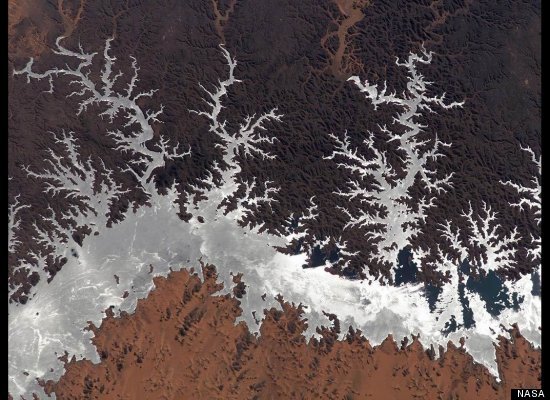
Lake Nasser. Egypt's Lake Nasser was photographed in January 2005 from the International Space Station

Sahara Desert. Tassili n'Ajjer National Park, part of the Sahara Desert, has a bone-dry climate with scant rainfall, yet it doesn't blend in with Saharan dunes. Instead, the rocky plateau rises above the surrounding sand seas. This image from 2000 was made from multiple observations by the Landsat 7 satellite, using a combination of infrared, near-infrared and visible light to better distinguish among the park's various rock types.
Hydrogen Sulfide and Dust Plumes on Namibia's Coast. Cloudless skies allowed a clear view of dust and hydrogen sulfide plumes along the coast of Namibia in early August 2010. Multiple dust plumes blow off the coast toward the ocean, most or all of them probably arising from stream beds. Unlike the reddish-tan sands comprising the dunes directly south of the Kuiseb River, the stream-channel sediments are lighter in color. Wind frequently pushes dust plumes seaward along the Namibian coast.

lunes, 13 de agosto de 2012

Millennium Campus Conference 2012 hear from experts on global change


Join Dr. Jeffrey Sachs and 1000 college students at Millennium Campus Conference 2012, September 14-15 at Northeastern University in Boston! Learn about the cutting edge of international development and how our generation can take thoughtful, innovative action to end global poverty.

Learn more at http://www.mcc2012.org

Other confirmed speakers and guests include:
2011 Nobel Peace Prize winner Leymah Gbowee, USAID Chief Economist Steve Radelet, Oxfam America VP Paul O'Brien, 1000+ college students, 50+ speakers, 20+ national non-profits (Partners in Health, UNICEF, GlobeMed, FACE AIDS, Engineers Without Borders) and many more!

About Dr. Sachs:
Dr. Jeffrey Sachs is Director of The Earth Institute at Columbia University and the Special Advisor to UN Secretary-General Ban Ki-moon on the Millennium Development Goals. Dr. Sachs is also the Director of the Earth Institute at Columbia University. He has twice been named one of TIME Magazine's 100 most influential people, and his books "The End of Poverty" and "Commonwealth" have inspired college students nationwide and worldwide to take action and address extreme poverty.
Event Details


The Millennium Campus Conference (MCC) is a conference focused on student organizing around the UN Millennium Development Goals. The weekend is designed to provide attendees with the knowledge, skills, inspiration and space for critical self-reflection they need as student leaders to effectively execute their on-campus and overseas projects in the coming year. MCC is also a place for those interested in becoming part of the student movement to end global poverty to learn how they can get involved. 

MCC 2012 will be held at Northeastern University, from September 14 to 15, 2012. 

For more details, including the speaker line-up and events, check outwww.mcc2012.org


Your ticket cost covers: 
-Pre and Post Conference Networking Programs 
-Admission to all MCC keynotes, panels, workshops 
-Admission to all MCC facilitated Afterhours sessions 
-Admission to the MCC Career and Internship Fair 
-Breakfast on Saturday

MÁS INFORMACIÓN

martes, 24 de julio de 2012

United Nations project to revive Zambia’s forest

ORIGINAL: Daily Mail-Zambia
By DOREEN NAWA
July 19, 2012

MONITORING forestry losses in Zambia and the effects that the loss has on the environment can be a challenge because of lack of technical know-how.

NURSERY for future forest
Following the effects that deforestation has on the environment in relation to climate change, the situation in Zambia is rather a hopeless case for the lack of expertise in monitoring and managing forestry countrywide.

Environmental advocates say that forests play a critical role in mitigating climate change through the confiscation and storage of carbon in woody perennial biomass and soils.

Unfortunately, deforestation and forest degradation account for approximately 18 percent of annual global carbon dioxide emissions.

But all hope is not lost following the recently held training organised by the forestry department in the Ministry of Lands, Natural Resources and Environmental Protection under the United Nations collaborative programme on Reducing Emissions from Deforestation and forest Degradation (UN-REDD) project and the Food and Agriculture Organisation (FAO).

The training was meant to build capacity of stakeholders in greenhouse gas reporting as well as Monitoring, Reporting and Verification (MRV) system as support to the readiness process of forestry management in Zambia.

The training is critical to the sustainability and successful management of out forests in the country. By the way addressing the driver of deforestation is the cheaper way of addressing climate change,” director in the forestry department, Anne Masinja says.

According to Mrs Masinja, management of the forest has been a challenge following massive deforestation due to charcoal burning, unsustainable agricultural and unsustainable land use practices.
It is a pity that most of the people do not realise the harm they are causing to the environment due to careless cutting of trees. Loss of forests contributes as much as 30 percent of global greenhouse-gas emissions each year and this is very dangerous, we need to do something to stop this,” Mrs Masinja says.

Zambia has approximately 50 million hectares of forest, with an estimated deforestation rate of 250,000 to 300,000 hectares per year.

Zambia is faced with a number of challenges in reducing deforestation and forest degradation caused by various factors like energy requirement, unsustainable agricultural and unsustainable land use practices, timber and non-timber forest products extraction, mining and infrastructure development,” Mrs Masinja said.

Statistics show that between 1990 and 2010, Zambia lost an average of 166,600 hectares or 0.32 per cent per year of its forest mainly due to deforestation resulting from charcoal burning (energy requirements), unsustainable agricultural and land use practices such as mining and infrastructure development, and timber and non-timber forest products extraction.

Indiscriminate charcoal burning is fast destroying Zambia's forest cover. 
Indiscriminate charcoal burning is fast destroying Zambia's forest cover.

With global concern growing over deforestation, loss of carbon stored in forests and the role of forests in climate change, the spotlight has been turned on forest monitoring in a bid to safeguard forests and monitor emissions from deforestation.

In another recent effort in the monitoring and managing of the forest in the country was the handover of Geographical Information System (GIS) equipment to the department.

As part of the mission to monitor the remaining forest in the country, the participants were also trained to undertake a countrywide remote sensing survey of forests.

The survey will substantially improve knowledge on land use including deforestation, reforestation and natural expansion of forests.

It is hoped that the training and the handover of new GIS equipment, the forestry department and other stakeholders will strengthen the capacity of all provinces countrywide to monitor their own forests.

The need to improve national forest monitoring is overwhelming as the demand for information has never been greater even in the face of some challenges. National policy processes are striving to address cross-cutting issues such as poverty alleviation and food security related to forests,Julian Fox, Food and Agriculture Organization UN-REDD MRV facilitator for Zambia says.

FAO supports Zambia’s efforts to close the knowledge gap through field inventories and forest monitoring systems.

Deforestation continues at an alarming rate of about 13 million hectares annually at the global level. By combining remote sensing technology with field data collection, we improve the quality of both methods. This provides more accurate information on forest trends and new information on the drivers of deforestation and forest degradation,” Dr Fox says during his facilitation at the training.

About REDD
In 2005, a group of developing countries launched a new initiative that put forest conversation on the international agenda known as REDD.

While REDD is a new name, the activities to ensure reduced deforestation and forest degradation are well known to Zambians and these include conservation agriculture, community based natural resources management, joint forest management, sustainable energy projects (solar, improved stoves), enhancing policy and legislative frameworks.

REDD therefore calls for an integrated approach to forest management, the main reason for the training.
Land use change and especially deforestation contributes about 20 percent of greenhouse gas emissions.

Under the UN-REDD programme, Zambia is expected to come up with a policy statement to regulate forest and the country is said to have been making steady progress towards the UN-REDD collaborative programme.

The UN-REDD programme assists developing countries to prepare and implement national REDD strategies and mechanisms towards addressing climate change.

Zambia is one of the nine countries piloting the UN-REDD programme that helps countries to get ready for the REDD mechanism in addressing climate change.

The other eight countries include Tanzania, Democratic Republic of Congo, Bolivia, Viet Nam, Paraguay, New Papua Guinea, Panama and Indonesia.

And during the training, UN-REDD national co-ordinator Deuteronomy Kasaro said, “UN-REDD Programme is not a development project as it has been understood by some, but instead it is a process of consultations, strategic planning, creative thinking and seeking realistic solutions to reduce deforestation and forest degradation and make REDD work for Zambia.

In recognition of the role REDD can plan in reducing emissions and facilitating sustainable socio-economic development, the Government of the Republic of Zambia is presently assessing the opportunities that can be potentially delivered through REDD,” Mr Kasaro added.

While the goal of reversing deforestation and achieving sustainable development is clear, the path to reach it can only be paved by Zambia and Zambians themselves.

The growing interest among stakeholders towards REDD is felt not only through the high participation in the training while developing its UN-REDD national programme document, but also through the numerous questions and discussions with people and organisations willing to support the efforts to protect the forests in Zambia.

The questions range from a request to provide seedlings for a tree-planting at a local school for guidance on designing sub-national forest monitoring systems that are aligned to the national measurement, reporting and verification (MRV) framework.

Reducing emissions from deforestation and forest degradation or REDD also mitigates climate change by changing the amount of carbon dioxide emissions to the atmosphere from the existing forest carbon stocks.

Carbon is becoming a commodity which can be managed and traded as a household and community income stream. The involvement in measurement and monitoring of forest carbon by local people can empower them as co-managers of areas under REDD projects.

At international level it has been recognised that addressing the drivers of deforestation is one of the cheaper ways to mitigate against the impact of climate change. Hence the ability of stakeholders to assess and monitor landuse changes aimed at addressing the drivers of deforestation being vital.
It is believed that understanding drivers of deforestation and sources of greenhouse gas emissions in landuse, landuse change and forestry will enhance capacity to effectively monitor the source and potential changes.

In fact poverty plays a major role in deforestation. Just like in any other developing country, in Zambia most people in rural areas have no the options for survival like jobs or reliable businesses and rural people end up in the forest for survival.

The high poverty level costs the entire world through the loss of forests (deforestation). Without finding a lasting solution to poverty, saving the forests providing for these people, rainforests cannot be saved.

Misunderstandings
While there are uncertainties in both the international REDD framework and the national arrangements, it is essential not to let these uncertainties discourage the actors who feel the urgency of acting now to stop deforestation.

To quell misunderstandings about the programme and to reassure the multitude of actors involved, a significant part of the programme funding has been allocated to building the institutional arrangements and stakeholder engagement processes that provide a platform for discussing the issues and finding the answers that work best the Zambian context.