Mostrando entradas con la etiqueta modelo. Mostrar todas las entradas

lunes, 27 de abril de 2015

Las escuelas en Finlandia tuvieron la brillante idea de eliminar las asignaturas para estudiar en base a temas


¡Su sistema educativo es soñado! 

Es el país con el mejor sistema educativo público del mundo, pero quieren seguir innovando.

Ahora buscan implementar un sistema educativo revolucionario que busca que la enseñanza deje de lado el estudio de asignaturas y se enfoquen en temas. En las escuelas finlandesas

  • no se usa uniforme, 
  • no hay exámenes de ingreso, 
  • nunca se les da más de media hora de tareas y 
  • está prohibido que los estudiantes no hablen en clase. 
¡Esto suena genial! 

Y más aún, que todas estas medidas han mostrado su gran efectividad, ya que la educación finlandesa está considerada como una de las mejores del planeta. Este sistema ha funcionado porque los alumnos se demuestran motivados y entusiastas por aprender y participar en las clases debido al ambiente relajado y propicio que entregan estas escuelas. Están interesados en saber más. 

Esta formación los ayuda a estar más preparados para la universidad y a enfrentar un futuro mejor. Pero, para el año 2020, el país planea eliminar de a poco la enseñanza de asignaturas individuales como Historia e Inglés para que el estudio sea en base a temas particulares


Esta radical medida busca eliminar la pregunta que muchos nos hacemos “¿Para qué me sirve aprender esto?”. Por ejemplo, en lugar de estudiar 2 horas Inglés, el profesor le pedirá al alumno que pase adelante y vaya analizando el clima de distintos países. Por lo que la persona no solo aprenderá la gramática del inglés, sino que además estará estudiando Geografía e Historia. Los estudiantes seguirán aprendiendo teorías científicas importantes, pero las conocerán de una forma más programática.

El nuevo sistema también alienta a distintos estilos de aprendizaje, como la solución de problemas interactivos y la colaboración entre grupos pequeños para desarrollar habilidades que cubran las necesidades de la vida moderna. 

En este video podrás saber más información sobre la reforma educativa de Finlandia:


¿Crees que funcionaría este sistema educacional en tu país?


ORIGINAL: UpSocial 

miércoles, 11 de marzo de 2015

Los jesuítas eliminan las asignaturas, exámenes y horarios de sus colegios (en Cataluña)


Imagen de archivo del aula de un colegio. EFE/Archivo

Barcelona, 5 mar (EFE).- Los colegios de jesuitas de Cataluña, en los que estudian más de 13.000 alumnos, han comenzado a implantar un nuevo modelo de enseñanza que ha eliminado asignaturas, exámenes y horarios y ha transformado las aulas en espacios de trabajo donde los niños adquieren los conocimientos haciendo proyectos conjuntos.

Los jesuitas, que en Cataluña cuentan con ocho colegios, han diseñado un nuevo modelo pedagógico en el que han desaparecido las clases magistrales, los pupitres, los deberes y las aulas tradicionales, en un proyecto que ha comenzado en quinto de primaria y primero de ESO en tres de sus escuelas y que se irá ampliando al resto.

"Con el actual modelo de enseñanza tradicional, los alumnos se están aburriendo y están desconectando del sistema, sobre todo a partir de sexto de primaria", ha explicado el director general de la Fundación Jesuitas Educación (FJE) de Cataluña, Xavier Aragay.

El nuevo modelo incluye la creación de una nueva etapa intermedia entre la primaria y la secundaria, que la conforman los cursos quinto y sexto de primaria y primero y segundo de ESO.

Para llevar a cabo el proyecto, que lleva por nombre "Horizonte 2020", los jesuitas han derribado las paredes de sus aulas y las han transformado en grandes espacios para trabajar en equipo, unas ágoras en las que hay sofás, gradas, mucha luz, colores, mesas dispuestas para trabajar en grupo y acceso a las nuevas tecnologías.

En los tres colegios que están experimentando esta novedad han juntado las dos clases de 30 alumnos en una sola de 60, pero, en vez de un profesor por cada 30, tienen tres profesores para 60.

Los tres profesores acompañan todo el día a los alumnos y tutorizan los proyectos en los que trabajan, a través de los cuales adquieren las competencias básicas marcadas en el currículo.

"No hay asignaturas, ni horarios, al patio se sale cuando los alumnos deciden que están cansados", ha explicado Aragay, que, en los seis primeros meses de experimentación, ya ha constatado que "el método funciona" y ha reanimado a los estudiantes.

"Transformar la educación es posible", ha remarcado el director general, que reconoce que el cambio es "radical" y que dos de cada tres de los 1.500 profesores de sus escuelas ha estado a favor.

Según Aragay, "en la escuela es donde más se habla de trabajo en equipo y donde menos se practica", cosa que se soluciona con este método, "que también palía unos currículos excesivos que nunca se imparten completos".

Antes de implementarlo, los jesuitas recogieron 56.000 ideas de alumnos, padres y madres y profesores para mejorar la educación.

"Educar no es sólo transmitir conocimientos", ha señalado el director general adjunto de la FJE, Josep Menéndez.

El proyecto impulsa "las inteligencias múltiple sy sacar todo el potencial" de los alumnos y que hagan las actividades de aprendizaje según sus capacidades.

"Hemos transformado la educación para que el alumno sea el protagonista, para que haya verdadero trabajo en equipo y los estudiantes descubran cuál es su proyecto vital, qué quieren hacer en la vida y enseñarles a reflexionar, porque van a vivir en una época que les va a desconcertar", ha argumentado Aragay.

Los alumnos comienzan la jornada con 20 minutos de introspección y reflexión para plantearse los retos de la jornada y finalizan con otros 20 minutos de discusión sobre si han conseguido los objetivos.

Las asignaturas han sido sustituidas por proyectos. "Por ejemplo, si hacemos un proyecto sobre el imperio romano, pues aprendemos arte, historia, latín, religión y geografía", ha detallado Menéndez, y si hay que aprender raíces cuadradas para llevar a cabo otro proyecto, los alumnos pueden acudir a las unidades didácticas.

"Aprenden mucho mejor si ven que lo que aprenden tiene una aplicación práctica", ha defendido Aragay.

Los proyectos, en los que también se implican padres y madres, se realizan

  • un 33 % en catalán, 
  • un 33 % en castellano y 
  • un 33 % en inglés.
Aunque no hay asignaturas, para cumplir con lo establecido legalmente también ponen notas, pero puntúan primero las competencias de cada alumno y luego, mediante un algoritmo, las transforman en notas por materias para que consten en el expediente.

Según Aragay, en los seis meses de experiencia han encontrado casos de alumnos que "antes se inventaban que tenían fiebre para no acudir a clase y ahora quieren venir aunque tengan fiebre".

Con esta nueva pedagogía, que también aplican a los más pequeños de P3 y P4, "en vez de mirar el BOE (Boletín Estatal de España) o el DOGC (Diario Oficial de la Generalidad de Cataluña) , miramos la cara de los niños y les ayudamos a desarrollar su proyecto vital, a descubrir sus talentos, a encontrar sentido a lo que hacen, a lo que quieren conseguir, a saber interpretar, a reflexionar, a cuestionar. Junto con la familia e internet, intentamos construir personas".

miércoles, 6 de agosto de 2014

Las escuelas más innovadoras del mundo no tienen aulas ni pizarras

Las clases duran dos horas para que al alumno le dé tiempo a arrancar, hacer las tareas y terminarlas

VITTRA

No hay aulas, tal y como se conocen trandicionalmente, ni pizarras ni pupitres. En las escuelas suecas Vittra los alumnos circulan libremente y cualquier lugar del centro es bueno para aprender, con profesores o con otros compañeros. A veces en las escaleras, otras sobre cojines o tumbados en el suelo. Estos centros han revolucionado la forma de educar, aprender y enseñar con nuevos conceptos sobre el espacio y el tiempo. Los estudiantes aprenden a su ritmo en un modelo distinto y profundamente innovador, sin clases y sin rígidos horarios.

Vittra es una empresa que gestiona 27 centros educativos de preescolar (1 a 6 años) y escuelas (de 6 a 16) en Estocolmo y en la zona sur de esta ciudad. Cerca de 8.500 alumnos se benefician gratuitamente de estas enseñanzas. Aunque estos colegios estén gestionados por una empresa privada, son financiados con fondos públicos. Por eso, están sometidos a unas restricciones, por ejemplo, no pueden cobrar ni matrícula ni ninguna cuota a los alumnos que tienen que ser admitidos por riguroso orden de llegada, es decir, sin examenes de acceso.

Los pilares de la innovación
Las escuelas Vittra nacieron hace veinte años planteando ya verdaderos retos educativos. Por ejemplo, en estos centros la tecnología es fundamental para el aprendizaje; el aprendizaje se realiza a través de la propia experiencia y en contacto continuo con la vida cotidiana; el modelo está basado en el bilingüismo y las aulas se suprimen dejando paso a nuevos conceptos del espacio.

«La idea del espacio abierto en lugar del aula cerrada (que también se utiliza cuando se considera apropiado) es dar la posibilidad a profesores y alumnos de cooperar en el trabajo. El aprendizaje es un proceso que suele tener lugar cuando se trabaja, se conversa y se debate con los docentes o con otros compañeros. El propósito es crear un espacio en el que nuestros alumnos estén siempre acompañados por uno o varios profesores», explican desde las escuelas Vittra.

El espacio se organiza alrededor de una plaza central abierta
Ese nuevo concepto de espacios abiertos da pie a una organización escolar muy diferente a la que estamos acostumbrados. Los alumnos se dividen por equipos:
  • preescolar y
  • grupos escolares 
  • de 6 a 9 años, 
  • de 10 a 12 y 
  • de 13 a 16. 
Cada grupo ocupa una parte del edificio. 
El espacio se organiza alrededor de una plaza central abierta rodeada por aulas. Las divisiones entre estos espacios son de vidrio para crear la sensación de apertura y transparencia. Las clases se pueden dar en las aulas, en la plaza central abierta... dependiendo del grupo, del tema o de la asignatura.

El tiempo que se dedica a las clases es otro de los conceptos revolucionarios en las escuelas Vittra. Las clases duran unos 120 minutos para dar tiempo a los alumnos a 
  • arrancar el tema, 
  • realizar las tareas y 
  • terminarlas a su propio ritmo
En ocasiones duran 60 minutos. Todo depende de la materia y la edad del alumno.

Un plan individualizado
Cada alumno posee lo que se ha denominado «libro Vittra», un plan de desarrollo individual donde se evalúa su currículum académico y los logros conseguidos por cada estudiante. A través de internet, padres e hijos conocen y siguen el trabajo del alumno en la escuela, sus evaluaciones, sus ritmos o sus necesidades de apoyo.

El docente tiene la función de guiar al alumno y motivarle
El papel del maestro también da un gran giro en estos colegios. El docente no imparte clases a alumnos sentados en pupitres entre cuatro paredes. Por el contrario, la función del profesor es la de guiar y motivar al alumno. Cada docente es responsable de un grupo de entre 20 y 20 estudiantes e imparte entre una y tres asignaturas.

Cuando concluyen la enseñanza obligatoria hasta los 16 años, los chicos son «responsables de su propio aprendizaje», afirman los responsables de Vittra. «Son capaces de aprender a aprender, de encontrar información, de resolver problemas y de reflexionar sobre su aprendizaje», aseguran. Los grandes pilares para su futuro.

Las seis promesas de Vittra
M. J. P-B. MADRID
  1. Descubrir el método que mejor se ajuste a cada alumno: Los niños juegan y aprenden de la forma más adecuada a sus necesidades, curiosidad e inclinaciones.
  2. Aprender a partir de la experiencia: Así se refuerza su motivación y se inspira su creatividad.
  3. Comprender su propio aprendizaje: Los alumnos disponen de herramientas para adquirir nuevos conocimentos y profundizar en su comprensión de «cómo aprendo», lo que les capacita para aprender de manera más fácil y eficaz en el futuro.
  4. Tener confianza en los alumnos y en sus aptitudes: Los estudiantes adquieren más conciencia de sí mismos, e su potencial y de su fortaleza. De manera que se enfrentan con gusto a los retos.
  5. Desarrollar su capacidad de comunicación y de interactuar con otros: Los alumnos entienden las necesidades e intereses de los demás.
  6. Hacerse con los medios necesarios para estudiar y trabajar en un entorno internacional: Los alumnos desarrollan un verdadero bilingüismo sueco-inglés, experimentando y estableciendo contactos internacionales a través de redes y programas de intercambio con el extranjero.
ORIGINAL: ABC.es
M. J. PÉREZ-BARCO / MADRID
31/01/2014

viernes, 13 de junio de 2014

Mathematical Model Of Consciousness Proves Human Experience Cannot Be Modelled On A Computer


A new mathematical model of consciousness implies that your PC will never be conscious in the way you are

One of the most profound advances in science in recent years is the way researchers from a variety of fields are beginning to think about consciousness. Until now, the c-word was been taboo for most scientists. Any suggestion that a researchers was interested in this area would be tantamount to professional suicide.

That has begun to change thanks to a new theory of consciousness developed in the last ten years or so by Giulio Tononi, a neuroscientist at the University of Wisconsin in Madison, and others. Tononi’s key idea is that consciousness is phenomenon in which information is integrated in the brain in a way that cannot be broken down.

So each instant of consciousness integrates the smells, sounds and sights of that moment of experience. And consciousness is simply the feeling of this integrated information experience.

What makes Tononi’s ideas different from other theories of consciousness is that it can be modelled mathematically using ideas from physics and information theory. That doesn’t mean this theory is correct. But it does mean that, for the first time, neuroscientists, biologists physicists and anybody else can all reason about consciousness using the universal language of science: mathematics.

This has led to an extraordinary blossoming of ideas about consciousness. A few months ago, for example, we looked at how physicists are beginning to formulate the problem consciousness in terms of quantum mechanics and information theory.

Today, Phil Maguire at the National University of Ireland and a few pals take this mathematical description even further. These guys make some reasonable assumptions about the way information can leak out of a consciousness system and show that this implies that consciousness is not computable. In other words, consciousness cannot be modelled on a computer.

Maguire and co begin with a couple of thought experiments that demonstrate the nature of integrated information in Tononi’s theory. They start by imagining the process of identifying chocolate by its smell. For a human, the conscious experience of smelling chocolate is unified with everything else that a person has smelled (or indeed seen, touched, heard and so on).

This is entirely different from the process of automatically identifying chocolate using an electronic nose, which measures many different smells and senses chocolate when it picks out the ones that match some predefined signature.

A key point here is that it would be straightforward to access the memory in an electronic nose and edit the information about its chocolate experience. You could delete this with the press of a button.

But ask a neuroscientist to do the same for your own experience of the smell of chocolate—to somehow delete this—and he or she would be faced with an impossible task since the experience is correlated with many different parts of the brain.

Indeed, the experience will be integrated with all kinds of other experiences. “According to Tononi, the information generated by such [an electronic nose] differs from that generated by a human insofar as it is not integrated,” say Maguire and co.

This process of integration is then crucial and Maguire and co focus on the mathematical properties it must have. For instance, they point out that the process of integrating information, of combining it with many other aspects of experience, can be thought of as a kind of information compression.

This compression allows the original experience to be constructed but does not keep all of the information it originally contained.

To better understand this, they give as an analogy the sequence of numbers: 4, 6, 8, 12, 14, 18, 20, 24…. This is an infinite series defined as: odd primes plus 1. This definition does not contain all the infinite numbers but it does allow it be reproduced. It is clearly a compression of the information in the original series.

The brain, say Maguire and co, must work like this when integrating information from a conscious experience. It must allow the reconstruction of the original experience but without storing all the parts.

That leads to a problem. This kind of compression inevitably discards information. And as more information is compressed, the loss becomes greater.

But if our memories were like that cannot be like that, they would be continually haemorrhaging meaningful content. “Memory functions must be vastly non-lossy, otherwise retrieving them repeatedly would cause them to gradually decay,” say Maguire and co.

The central part of their new work is to describe the mathematical properties of a system that can store integrated information in this way but without it leaking away. And this leads them to their central proof. “The implications of this proof are that we have to abandon either the idea that people enjoy genuinely [integrated] consciousness or that brain processes can be modelled computationally,” say Maguire and co.

Since Tononi’s main assumption is that consciousness is the experience of integrated information, it is the second idea that must be abandoned: brain processes cannot be modelled computationally.

They go on to discuss this in more detail. If a person’s behaviour cannot be analysed independently from the rest of their conscious experience, it implies that something is going on in their brain that is so complex it cannot feasibly be reversed, they say.

In other words, the difference between cognition and computation is that computation is reversible whereas cognition is not. And they say that is reflected in the inability of a neuroscientist to operate and remove a particular memory of the small of chocolate.

That’s an interesting approach but it is one that is likely to be controversial. The laws of physics are computable, as far as we know. So critics might ask how the process of consciousness can take place at all if it is non-computable. Critics might even say this is akin to saying that consciousness is in some way supernatural, like magic.

But Maguire and go counter this by saying that their theory doesn’t imply that consciousness is objectively non-computable only subjectively so. In other words, a God-like observer with perfect knowledge of the brain would not consider it non-computable. But for humans, with their imperfect knowledge of the universe, it is effectively non-computable.

There is something of a card trick about this argument. In mathematics, the idea of non-computability is not observer-dependent so it seems something of a stretch to introduce it as an explanation.

What’s more, critics might point to other weaknesses in the formulation of this problem. For example, the proof that conscious experience is non-computable depends critically on the assumption that our memories are non-lossy.

But everyday experience is surely the opposite—our brains lose most of the information that we experience consciously. And the process of repeatedly accessing memories can cause them to change and degrade. Isn’t the experience of forgetting a face of a known person well documented?

Then again, critics of Maguire and co’s formulation of the problem of consciousness must not lose sight of the bigger picture—that the debate about consciousness can occur on a mathematical footing at all. That’s indicative of a sea change in this most controversial of fields.

Of course, there are important steps ahead. Perhaps the most critical is that the process of mathematical modelling must lead to hypotheses that can be experimentally tested. That’s the process by which science distinguishes between one theory and another. Without a testable hypothesis, a mathematical model is not very useful.

For example, Maguire and co could use their model to make predictions about the limits in the way information can leak from a conscious system. These limits might be testable in experiments focusing on the nature of working memory or long-term memory in humans.

That’s the next challenge for this brave new field of consciousness.

Ref: arxiv.org/abs/1405.0126 : Is Consciousness Computable? Quantifying Integrated Information Using Algorithmic Information Theory


Follow the Physics arXiv Blog on Twitter at @arxivblog, on Facebook and by hitting the Follow button below.

ORIGINAL: Medium

lunes, 28 de abril de 2014

At the origin of cell division


SISSA

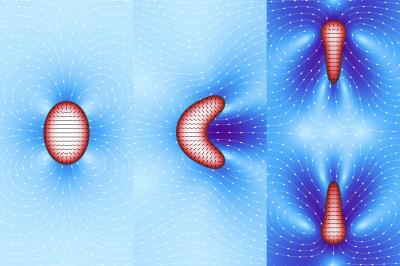
Droplets of filamentous material enclosed in a lipid membrane: these are the models of a "simplified" cell used by the SISSA physicists Luca Giomi and Antonio DeSimone, who simulated the spontaneous emergence of cell motility and division -- that is, features of living material -- in inanimate "objects." The research is one of the cover stories of the April 10th online issue of the journal Physical Review Letters. Giomi and DeSimone's artificial cells are in fact computer models that mimic some of the physical properties of the materials making up the inner content and outer membrane of cells.

The two researchers varied some of the parameters of the materials, recording what happened: "our 'cells' are a 'bare bones' representation of a biological cell, which normally contains microtubules, elongated proteins enclosed in an essentially lipid cell membrane," explains Giomi, first author of the study. "The filaments contained in the 'cytoplasm' of our cells slide over one another exerting a force that we can control."

The force exerted by the filaments is the variable that competes with another force, the surface tension that keeps the membrane surrounding the droplet from collapsing. The generates a flow in the fluid surrounding the droplet, which in turn is propelled by such self-generated flow. When the flow becomes very strong, the droplet deforms to the point of dividing. "When the force of the flow prevails over the force that keeps the membrane together we have cellular division," explains DeSimone, director of the SISSA mathLab, SISSA's mathematical modelling and scientific computing laboratory.

"We showed that by acting on a single physical parameter in a very simple model we can reproduce similar effects to those obtained with experimental observations," continues DeSimone. Empirical observations on microtubule specimens have shown that these also move outside the cell environment, in a manner proportional to the energy they have (derived from ATP, the cell "fuel"). "Similarly, our droplets, fuelled by their 'inner' energy alone -- without forces acting from the outside -- are able to move and even divide."

"Acquiring motility and the ability to divide is a fundamental step for life and, according to our simulations, the laws governing these phenomena could be very simple. Observations like ours can prepare the way for the creation of functioning artificial cells, and not only," comments Giomi. "Our work is also useful for understanding the transition from non-living to living matter on our planet. The development of the early forms of life, in other words."

Chemists and biologists who study the origin of life don't have access to cells that are sufficiently simple to be observed directly. "Even the simplest organism existing today has undergone billions of years of evolution," explains Giomi, "and will always contain fairly complex structures. Starting from schematic organisms as we do is like turning the clock back to when the first rudimentary living beings made their first appearance. We are currently starting studies to understand how cell metabolism emerged."

VIDEO: Artificial cell simulation (courtesy of Physical Review Letters):http://goo.gl/vLDcbB
Source: Sissa Medialab


ORIGINAL: eScienceNews
April 16, 2014 - 20:28 in Physics & Chemistry

martes, 8 de abril de 2014

"Pedagogía de la exigencia": el método que lanza a la fama a un joven profesor

Enseña en un liceo de París a chicos carenciados que la sociedad condena a un fracaso al cual él no se resigna. Su decisión de volver a los métodos tradicionales da resultados y atrae la atención mediática

Jérémie Fontanieu no inventó nada nuevo. Lo suyo es la "vieja escuela": disciplina, esfuerzo, exigencia y evaluaciones periódicas; conceptos que cierta pedagogía moderna ha convertido en malas palabras, con resultados que están a la vista, tanto en Francia como en Argentina, dos de los países que año a año retroceden en las pruebas PISA.

La revista Cahiers Pédagogiques entrevistó a este profesor que, con sólo 25 años de edad y 3 de experiencia docente, no teme ir contra la corriente pedagógica dominante que considera que presionar a los alumnos es autoritarismo.


Fontanieu enseña Ciencias Económicas y Sociales a estudiantes de los últimos años del liceo Eugène Delacroix, en la localidad de Drancy, una zona "desfavorecida" del gran París, de esas a las que las autoridades educativas y políticas suelen abandonar a su suerte por considerarlas inevitablemente condenadas a la marginalidad.

En rebelión abierta contra ese fatalismo, Fontanieu se fijó como meta lograr que todos sus alumnos aprueben el bachillerato, sin excepción. (En Francia, el título secundario no se obtiene por promoción sino a través de un examen al concluir la cursada del último año).

En la universidad, dice este graduado de Ciencias Políticas, "consumió mucho Pierre Bourdieu", el sociólogo que expuso los mecanismos de reproducción de las jerarquías sociales. Pero él decidió luchar para quebrar esa lógica que condena al hijo de pobre al fracaso escolar. "En la facultad descubro el mundo escolar a través de Bourdieu, pero luego me vuelvo profe y veo que tiene razón pero yo me digo: el mundo es como es, ¿lo acepto? Yo quiero una escuela que recupere su rol de ascensor social".

"Por un lado están las desigualdades sociales, el racismo, la discriminación; parte del fracaso escolar se debe a la sociedad, innegablemente –explicó Jérémie en una entrevista radial-. Pero también hay una parte muy importante que es la responsabilidad individual, qué hacemos con nosotros mismos. Yo pongo a mis alumnos a es-tu-diar. Y hay una diferencia colosal entre el momento en que empiezan y cuando le toman el gusto al estudio e interiorizan la ambición. O sea, está el sistema, pero hay espacio para llegar luchando, y cuanto más obstáculos a vencer, más bella es la victoria".

En el liceo de Drancy, constató "mucho abandono y resignación en chicos que sienten que están condenados al fracaso y entonces no estudian". Y acá entra la responsabilidad de la escuela, muchas veces eludida por maestros y autoridades con el argumento de la no coerción y la libertad de los alumnos. Jérémie se coloca en las antípodas de esta actitud.


"Yo quiero torcerles el brazo a los determinismos sociales, dice. Estos chicos no tienen método ni disciplina de estudio, pero no es sorprendente, tampoco yo lo tenía a su edad. Pero yo vengo de un medio burgués, hice Ciencias Políticas porque pude ir a una preparatoria paga. En este barrio, o llegan por la escuela o les será muy difícil".
   
Está convencido de que el bachillerato es accesible a todos, pese al panorama desolador: estudiantes desmotivados, poco dispuestos a trabajar, proclives a la violencia verbal y la falta de respeto. En un distrito que, además, tiene históricamente resultados por debajo del promedio.

No importa: él quiere devolverles el gusto por el estudio, aún apelando a la "mano dura", como dice con ironía. De a poco, se gana la confianza de sus estudiantes. Y la de los padres. Y luego también de sus colegas cuya cooperación considera esencial.

Tolerancia cero
"Constaté la falta de trabajo y mi respuesta fue algo brutal, simple", admite. Ahora bien, si todos los profesores les piden a los alumnos que estudien, ¿cuál es la diferencia en su caso?

No hay magia en su método, ni rebuscadas teorías pedagógicas: se trata de hacerlos "trabajar". Algo nada sencillo en un ambiente como el de Drancy. Pero él apela a métodos de la vieja escuela: tolerancia cero para toda indisciplina, pruebas semanales, nada de regalar nota, más bien al revés. Si un alumno decae en su rendimiento, él envía un mensaje a los padres. Consciente de que el chico que no tiene respaldo familiar no hará los deberes en casa o no los hará bien, y que ésa es otra fuente de inequidad, él controla los avances en el aprendizaje semana a semana.

Toma prueba todos los lunes, justo el día en que suele arrastrarse hasta la escuela el relajamiento del fin de semana. "Soy pragmático, no tengo ideología. Les meto presión a los alumnos, grito, llamo a los padres -dice sin prurito-. Una calificación dura, semanal, un punto descontado por cada respuesta incorrecta: eso funciona como electroshock para alumnos acostumbrados a zafar con una nota media. Al cabo de un tiempo, si no estudian, les pido a los padres que los priven de salida un fin de semana o que les quiten el celular".

Le preguntan si eso no es "infantilizar" a chicos que ya son casi adultos. Él responde, categórico: "Son niños, los tomo como lo que son, no es peyorativo, son irresponsables. ¿Qué hacemos frente a la falta de esfuerzo? ¿Los dejamos librados a su suerte? Me dicen: 'caramba, te comportas como un padre, ya son grandes, tienen 16, 17'. Sí, me gustaría que fuesen grandes e hiciesen las cosas por sí mismos, pero no es el caso. La idea es que, a la larga, sean autónomosAl comienzo, mis clases son la colimba, y yo tengo reputación de nazi, reaccionario, profe horrible... Pero de a poco empiezan a interiorizar la norma y le toman el gusto porque ven que cuando estudian tienen resultados. De a poco se afloja la presión y pueden volar por sí mismos. La autonomía se conquista de a poco".

Los alumnos de Jérémie, que al comienzo protestaron por su rigidez, hoy valoran un sistema que los hace progresar, y son los mejores defensores y propagandistas del sistema de este singular profesor.
Le preguntaron a una de sus estudiantes, Nesrine, si había oído hablar de Bourdieu. "Sí, sí. Pero yo creo que Bourdieu sólo hace una constatación, nosotros queremos cambiar las cosas, salir adelante", respondió mostrando hasta qué punto está compenetrada con los objetivos de su profesor.

Fontanieu les exige porque confía en su capacidad para lograrlo y eso los estudiantes y los padres lo van sintiendo y se convierte en un estímulo adicional.

La disciplina no concierne sólo al estudio: "No tolero clanes ni comentarios negativos, ni llegadas tarde". Tampoco que sean groseros. "La violencia verbal de los alumnos es el síntoma de una relación con el mundo y con los otros particularmente brutal e irrespetuosa, y que me indigna", explica Fontanieu. Además, señala, es un lenguaje que les cierra puertas, que refuerza los clichés que el resto de la sociedad tiene sobre los jóvenes de barrios humildes.

Algunos detractores de esta "pedagogía de la exigencia", que pone tanto el acento en metas y logros, dicen que fomenta el individualismo. Pero en las clases de este profesor sucede todo lo contrario.
"No es individualismo, replicó por ejemplo, Anaïs, tenemos un espíritu colectivo y pensamos mucho en los demás, deseamos realmente que todos lo logren".

"Estamos muy unidos, dice Farah, nos ayudamos unos a otros. Somos solidarios, queremos lograrlo todos, no individualmente".

Aunque no es pedagogo y su método es intuitivo, si le da resultados, a Jérémie le gustaría que se difunda. "A los alumnos del último año les digo que estamos haciendo algo que nos supera, y que si mañana logramos que los 35 aprueben, o sea 100% de eficacia, esta experiencia podrá replicarse". Habrá demostrado que está en lo cierto, que no es inevitable que estos chicos, hijos de obreros poco calificados, de desocupados, de inmigrantes mal integrados, fracasen en la escuela.

Quiere que los investigadores y expertos vengan a ver su clase, y "respalden esta escuela del éxito basado en la certeza de que todos pueden lograrlo negándose a seguir los caminos que la fatalidad les ha trazado".

Polémica pedagógica
Desde que Francia salió mal parada de las últimas pruebas PISA, estalló la polémica. En el banquillo, los cultores del pedagogismo constructivista, que postula que el alumno construye su propio saber y que el maestro no es el dueño del conocimiento, lo que ha redundado en deslegitimación de la función docente y relajamiento de la disciplina. Y hace tiempo también que muchos profesores –y casi todos los padres- desean la vuelta a una mayor sistematización en los estudios, a más contención y exigencia. A una escuela que vuelva a ser poderosa herramienta de igualación social.

"Los estudiantes que apuestan en mayor medida al trabajo que al talento obtienen mejores puntajes en las pruebas de matemática", fue una de las conclusiones de Andrea Schleicher, responsable de Educación en la OCDE, y redactora del último informe PISA.

Es el postulado de Jérémie: el que estudia, obtendrá resultados, sea cual sea su extracción social"La pereza es el núcleo de la reproducción social, dice, parafraseando a Bourdieu. Sin esfuerzo, asistimos a la autodestrucción de sus vidas por parte de pibes de 15 años".

La conclusión de la OCDE es significativa: el éxito es un asunto de creencia de que el trabajo y la perseverancia "pagan" más que la inteligencia o el talento innato.

Otra docente de "zonas difíciles" dejó un mensaje para Fontanieu: "El director de un colegio me dijo una vez: 'usted no va a durar aquí si persiste en querer enseñar a sus alumnos'. Una triste renuncia por parte de algunos responsables de instituciones, enmascarada en un discurso pomposo e inepto. La consigna es 'no hagan olas'... entonces, ¡saludo la energía y el coraje de este profesor que embiste contra ese fatalismo!"

Además de los libros de Bourdieu, fue también el gusto por el hip hop lo que llevó a este joven a los suburbios. Quería conocer de cerca el mundo del que surge esa música, de "dimensión sociológica interesante". Uno de sus temas favoritos es Banlieusards [los que viven en las afueras, algo así como suburbanos] de Kery James, que en una de sus estrofas sintetiza la filosofía que inspira su sistema pedagógico:

Banlieusard y orgulloso de serlo / ¡No estamos condenados al fracaso!
Al contrario, estamos condenados a triunfar / A cruzar las barreras, a construir carreras
Mirá lo que lograron nuestros padres / Lo que soportaron para que tengamos educación
¿Qué sería de sus sacrificios? (...)
Si arruinamos todo, ¿dónde está el respeto? / Si fracasamos, ¿dónde está el progreso?
Cada hijo de inmigrante está en misión / Cada hijo de pobres debe tener ambición
No puedes dejar que se evaporen tus sueños / En un hall lleno de humo
Fumando sustancias que quiebran tu voluntad / Anestesian tus deseos y ahogan tus capacidades
¡Valemos más que eso! / Nada detiene a un banlieusard que lucha...

ORIGINAL:  InfoBAE
 22 de marzo 2014

jueves, 6 de febrero de 2014

Written all over your face: humans express four basic emotions rather than six, says new study


Happiness, sadness, fear, anger, surprise, and disgust might no longer be the simplest six.

Human beings are emotional creatures whose state of mind can usually be observed through their facial expressions.

A commonly-held belief, first proposed by Dr Paul Ekman, posits there are six basic emotions which are universally recognised and easily interpreted through specific facial expressions, regardless of language or culture. These are:
  • happiness, 
  • sadness, 
  • fear, 
  • anger, 
  • surprise and 
  • disgust.

New research published in the journal Current Biology by scientists at the University of Glasgow has challenged this view, and suggested that there are only four basic emotions.

In the news: BBC News Online

Their conclusion was reached by studying the range of different muscles within the face – or Action Units as researchers refer to them – involved in signalling different emotions, as well as the time-frame over which each muscle was activated.

This is the first such study to objectively examine the ‘temporal dynamics’ of facial expressions, made possible by using a unique Generative Face Grammar platform developed at the University of Glasgow.

The team from the Institute of Neuroscience and Psychology claim that while the facial expression signals of happiness and sadness are clearly distinct across time, fear and surprise share a common signal – the wide open eyes – early in the signalling dynamics.
 
Disgust and anger, surprise and fear
Similarly, anger and disgust share the wrinkled nose. It is these early signals that could represent more basic danger signals. Later in the signalling dynamics, facial expressions transmit signals that distinguish all six ‘classic’ facial expressions of emotion.

Lead researcher Dr Rachael Jack said: “Our results are consistent with evolutionary predictions, where signals are designed by both biological and social evolutionary pressures to optimise their function.

First, early danger signals confer the best advantages to others by enabling the fastest escape. Secondly, physiological advantages for the expresser – the wrinkled nose prevents inspiration of potentially harmful particles, whereas widened eyes increases intake of visual information useful for escape – are enhanced when the face movements are made early.

What our research shows is that not all facial muscles appear simultaneously during facial expressions, but rather develop over time supporting a hierarchical biologically-basic to socially-specific information over time.

In compiling their research the team used special techniques and software developed at the University of Glasgow to synthesise all facial expressions.

The Generative Face Grammar – developed by Professor Philippe Schyns, Dr Oliver Garrod and Dr Hui Yu uses cameras to capture a three-dimensional image of faces of individuals specially trained to be able to activate all 42 individual facial muscles independently.

From this a computer can then generate specific or random facial expressions on a 3D model based on the activation of different Actions Units or groups of units to mimic all facial expressions.

By asking volunteers to observe the realistic model as it pulled various expressions – thereby providing a true four-dimensional experience – and state which emotion was being expressed the researchers are able to see which specific Action Units observers associate with particular emotions.

It was through this method they found that the signals for fear/surprise and anger/disgust were confused at the early stage of transmission and only became clearer later when other Action Units were activated.

Dr Jack said: “Our research questions the notion that human emotion communication comprises six basic, psychologically irreducible categories. Instead we suggest there are four basic expressions of emotion.

We show that ‘basic’ facial expression signals are perceptually segmented across time and follow an evolving hierarchy of signals over time – from the biologically-rooted basic signals to more complex socially-specific signals.

Over time, and as humans migrated across the globe, socioecological diversity probably further specialised once-common facial expressions, altering the number, variety and form of signals across cultures.

The researchers intend to develop their study by looking at facial expressions of different cultures, including East Asian populations whom they have already ascertained interpret some of the six classical emotions differently – placing more emphasis on eye signals than mouth movements compared to Westerners.


Related links

Find out more

Further information: Stuart.Forsyth@glasgow.ac.uk / 0141 330 4831
ORIGINAL: U of Glasgow

miércoles, 1 de enero de 2014

3D Brain Maps Guide Doctors — via iPhone


Here, the brain has been neatly sliced in half.
Credit: Albert L. Rhoton Jr., MD, 2007.


Far from the state-of-the-art medical facilities available in the United States, many brain surgeons in developing countries look to their smartphones for guidance. The phones have started to fulfill this role, in part, thanks to the thousands of 3D brain images, produced by Dr. Albert Rhoton at the University of Florida, that are freely available online.

"I've had young surgeons from Africa, Brazil and other countries tell me they're pulling the images into the operating room" and using them during surgery, said Rhoton, head of the Neuro-Microanatomy Lab at the University of Florida's McKnight Brain Institute.

From its beginnings as a training tool for surgical residents, the doctor's image library has grown into the world's largest collection of 3D brain images. Physicians across the globe now use the detailed anatomical images to train residents, prepare for surgeries and even guide them when performing surgery. [Gallery: See the Amazing 3D Images of the Human Brain]

Human Brain
Neural Connections
Brain Atlas
Brain Blueprint
Brain Blocks
Neurocortex

The images are "our small contribution to making what is a delicate, awesome experience for neurosurgery patients more accurate, gentler and safer," Rhoton told LiveScience.

Rhoton has collected images of brain anatomy for as long as he's been teaching surgery — 50 years — and began moving to 3D technology 25 years ago. Only recently, however, did he realize how smartphones and online download venues could expand the reach of his educational tools. Two and a half years ago, Rhoton and his colleagues began working with the American Association of Neurological Surgeons (AANS) to make the brain images and videos available on iTunes University — all at no cost.

Even before the iTunes U venture, Rhoton had shared his brain images with hospitals and universities as a visiting instructor. "I've always given these images to those who wanted to use them," he said, "in the hopes that they would help some patient I'll never know and never meet."

  The big blue structure here (dyed by Rhoton for easy viewing) shows where the great cerebral vein drains blood from the cerebrum. Credit: Albert L. Rhoton Jr., MD, 2007.

The guides show the detailed structures of various sections of the brain, with blood vessels and nerves color-coded in bright red and blue. The colors make the details of neural anatomy much clearer than in the normal, grayish brain matter.

Rhoton and the residents he instructs have built up the library over decades, performing careful dissections and transferring the images they obtain to 3D photography and video. The iTunes U content is engineered to be usable across device platforms, from iPhones to laptops to 3D television.

Having images in 3D provides advantages over 2D images for brain surgeons, Rhoton said. For instance, two-dimensional content tends to flatten brain anatomy, obscuring the way nerves, veins and other structures traverse the brain matter, he said. Surgeons viewing the 3D images, in contrast, can plan a precise surgical path, avoiding delicate structures whose damage would have dire consequences.

With 3D images, "the anatomy is displayed in such a way that you can orient the images to the direction of approach the surgeon is using in the OR [operating room]," Rhoton said. "You can see where the nerves and structures are that need to be protected in that particular area, using that specific approach, in that specific direction."

Rhoton and AANS have formatted the images with a menu, so that users can control the angle and area of the brain they want to view; users can even click links to call up medical literature related to the portion of the brain they're viewing.

Rhoton's work earned him the 2011 Surgeon of the Year award from the journal World Neurosurgery. His images and educational efforts have helped "several thousands of neurosurgeons scattered across the planet to save millions of lives," Dr. Hildo Azevedo-Filho, chairman of neurological surgery at the University of Pernambuco in Brazil, wrote in recognizing the award.

After seeing how surgeons have used his images during actual surgeries, Rhoton and the AANS next hope to feed the brain maps directly into endoscope screens used in surgery. They're developing technology that would split that screen to show Rhoton's images side by side with the live feed from cameras inserted into the patient's brain.

Moreover, Rhoton said the library of images and videos will only continue to grow. "We've just scratched the surface on the number of images," he said.

Follow Michael Dhar @michaeldhar. Follow us @livescience, Facebook& Google+.

ORIGINAL: Live Science
By Michael Dhar, LiveScience Contributor
December 30, 2013

miércoles, 18 de septiembre de 2013

JBEI Technoeconomic Model: The Sequels

ORIGINAL: Berkeley Lab
Lynn Yarris
September 09, 2013
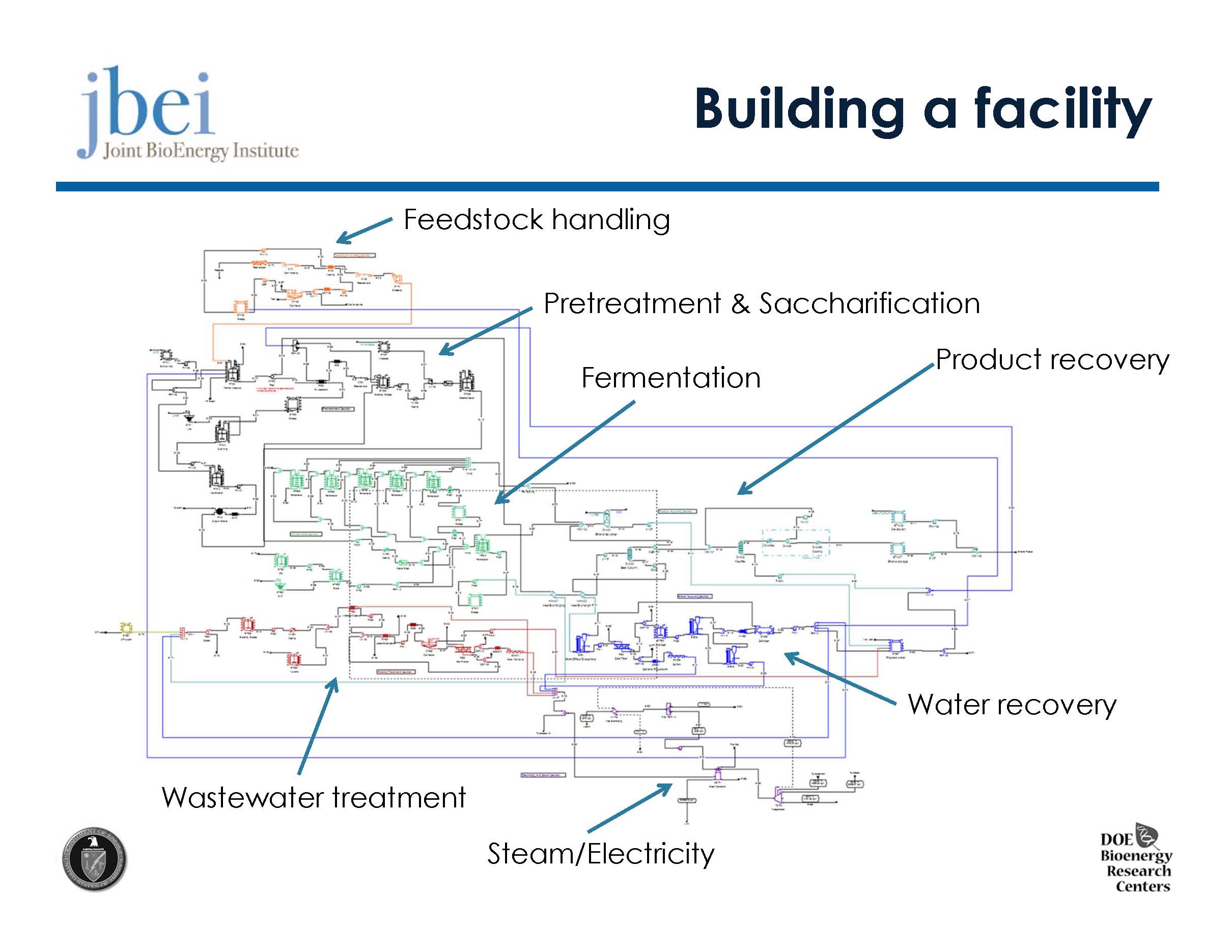
Using JBEI’s technoeconomic models, researchers can provide fuel production input factors to calculate fuel, energy and greenhouse gas output and derive production costs based on different processing strategies.

Now available on-line from the Joint BioEnergy Institute (JBEI) are two new, improved versions of a technoeconomic model created in 2010 to accelerate the development of next generation biofuels that are economically competitive with petroleum-based fuels. Incorporating the latest state-of-the-art technologies relevant to bioethanol production, these new wiki-based models simulate critical factors in the biorefinery process, such as production costs and energy balances, under different scenarios. This enables researchers to concentrate their efforts on the most promising strategies for cost-efficient biorefinery operations. Both new models correspond to refinery process configuration and performance scenarios, with one reflecting the best current technologies and the other reflecting projected technological developments.

Two aspects were improved in the new models, configuration and performance, configuration, which encompasses the chemical engineering steps in the biorefinery process, and performance, which looks at how well each of those steps accomplish their intended purpose,” says Daniel Klein-Marcuschamer, a researcher with JBEI’s Deconstruction Division and one of the creators of both the original and the latest versions of the technoeconomic models. “The configuration is the same for both models, but the models differ in key process performance parameters, such as pretreatment, saccharification, and fermentation.

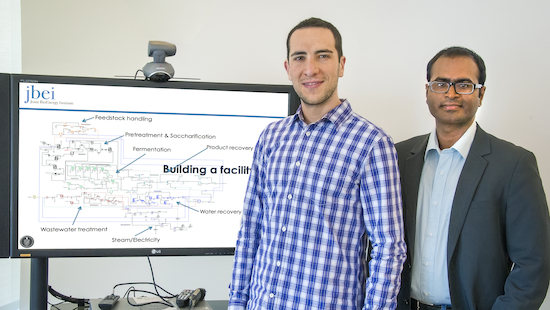
Daniel Klein-Marcuschamer (left) and Murthy Konda at the Joint BioEnergy Institute (JBEI) are developing technoeconomic models for optimizing biorefinery operations. (Photo by Roy Kaltschmidt)

Like their predecessor, the new models are formulated to simulate a lignocellulosic ethanol biorefinery that uses corn stover feedstock. From a comprehensive set of fuel production input factors, users can calculate the resulting ethanol, energy and greenhouse gas output, and can derive production costs, then vary the input values to test the effectiveness of different processing strategies. Murthy Konda, also with JBEI’s Deconstruction Division, working with Klein-Marcuschamer, updated the original technoeconomic model on the basis of research and analytical studies published since 2010.

Over the last few years, there has been a significant research effort globally within the field of biofuels,” Konda says. “Subsequently, there is a need to ensure that the model-based tools such as our techno-economic models are up-to-date. Addressing this need is our current release of updated models. As before, we expect these new models will continue to be useful to biofuel research community. Eventually, we will be modeling scenarios for other types of biofuels using other types of feedstocks. Already we have started modeling biorefineries based on JBEI’s in-house ionic liquid pretreatment of biomass technologies.

The new models have been released in the same wiki as the original along with accompanying notes. The 2010 model is still accessible so that current users can transition to the new models as needed. First-time users are encouraged to use the new models to take advantage of the updated research results and software.

Development of the JBEI technoeconomic models has been supported by Blake Simmons, who heads JBEI’s Deconstruction Division, and Harvey Blanch, JBEI’s Chief Science and Technology Officer. Both hold appointments with Berkeley Lab’s Physical Biosciences Division as do Konda and Klein-Marcuschamer.

JBEI is one of three Bioenergy Research Centers funded by the U.S. Department of Energy to advance the development of the next generation of biofuels. It is a scientific partnership led by Berkeley Lab and including the Sandia National Laboratories, the University of California (UC) campuses of Berkeley and Davis, the Pacific Northwest National Laboratory, the Carnegie Institution for Science, and the Lawrence Livermore National Laboratory.

Additional Information

The JBEI technoeconomic models for biorefinery operations is free and available for downloading here

jueves, 8 de agosto de 2013

IBM Research Creates New Foundation to Program SyNAPSE Chips

ORIGINAL: ZeitNews
August 8, 2013

credit: IBM Research
Scientists from IBM (NYSE: IBM) today unveiled a breakthrough software ecosystem designed for programming silicon chips that have an architecture inspired by the function, low power, and compact volume of the brain. The technology could enable a new generation of intelligent sensor networks that mimic the brain’s abilities for perception, action, and cognition.

Dramatically different from traditional software, IBM’s new programming model breaks the mold of sequential operation underlying today's von Neumann architectures and computers. It is instead tailored for a new class of distributed, highly interconnected, asynchronous, parallel, large-scale cognitive computing architectures.

Architectures and programs are closely intertwined and a new architecture necessitates a new programming paradigm,” said Dr. Dharmendra S. Modha, Principal Investigator and Senior Manager, IBM Research. “We are working to create a FORTRAN for synaptic computing chips. While complementing today’s computers, this will bring forth a fundamentally new technological capability in terms of programming and applying emerging learning systems.

To advance and enable this new ecosystem, IBM researchers developed the following breakthroughs that support all aspects of the programming cycle from design through development, debugging, and deployment:
  • Simulator: A multi-threaded, massively parallel and highly scalable functional software simulator of a cognitive computing architecture comprising a network of neurosynaptic cores.
  • Neuron Model: A simple, digital, highly parameterized spiking neuron model that forms a fundamental information processing unit of brain-like computation and supports a wide range of deterministic and stochastic neural computations, codes, and behaviors. A network of such neurons can sense, remember, and act upon a variety of spatio-temporal, multi-modal environmental stimuli.
  • Programming Model: A high-level description of a “program” that is based on composable, reusable building blocks called “corelets.” Each corelet represents a complete blueprint of a network of neurosynaptic cores that specifies a based-level function. Inner workings of a corelet are hidden so that only its external inputs and outputs are exposed to other programmers, who can concentrate on what the corelet does rather than how it does it. Corelets can be combined to produce new corelets that are larger, more complex, or have added functionality.
  • Library: A cognitive system store containing designs and implementations of consistent, parameterized, large-scale algorithms and applications that link massively parallel, multi-modal, spatio-temporal sensors and actuators together in real-time. In less than a year, the IBM researchers have designed and stored over 150 corelets in the program library.
  • Laboratory: A novel teaching curriculum that spans the architecture, neuron specification, chip simulator, programming language, application library and prototype design models. It also includes an end-to-end software environment that can be used to create corelets, access the library, experiment with a variety of programs on the simulator, connect the simulator inputs/outputs to sensors/actuators, build systems, and visualize/debug the results.
These innovations are being presented at The International Joint Conference on Neural Networks in Dallas, TX.

Paving the Path to SyNAPSE

Modern computing systems were designed decades ago for sequential processing according to a pre-defined program. Although they are fast and precise “number crunchers,” computers of traditional design become constrained by power and size while operating at reduced effectiveness when applied to real-time processing of the noisy, analog, voluminous, Big Data produced by the world around us (ie. DNA). In contrast, the brain—which operates comparatively slowly and at low precision—excels at tasks such as recognizing, interpreting, and acting upon patterns, while consuming the same amount of power as a 20 watt light bulb and occupying the volume of a two-liter bottle.

In August 2011, IBM successfully demonstrated a building block of a novel brain-inspired chip architecture based on a scalable, interconnected, configurable network of “neurosynaptic cores.” Each core brings 
  • memory (“synapses”), 
  • processors (“neurons”), and 
  • communication (“axons”) 
in close proximity, executing activity in an event-driven fashion. These chips serve as a platform for emulating and extending the brain’s ability to respond to biological sensors and analyzing vast amounts of data from many sources at once.

Having completed Phase 0, Phase 1, and Phase 2, IBM and its collaborators (Cornell University and iniLabs, Ltd) have recently been awarded approximately $12 million in new funding from the Defense Advanced Research Projects Agency (DARPA) for Phase 3 of the Systems of Neuromorphic Adaptive Plastic Scalable Electronics (SyNAPSE) project, thus bringing the cumulative funding to approximately $53 million.

Smarter Sensors
IBM’s long-term goal is to build a chip system with ten billion neurons and hundred trillion synapses, while consuming merely one kilowatt of power and occupying less than two liters of volume.

Systems built from these chips could bring the real-time capture and analysis of various types of data closer to the point of collection. They would not only gather symbolic data, which is fixed text or digital information, but also gather sub-symbolic data, which is sensory based and whose values change continuously. This raw data reflects activity in the world of every kind ranging from commerce, social, logistics, location, movement, and environmental conditions.

Take the human eyes, for example. They sift through over a Terabyte of data per day. Emulating the visual cortex, low-power, light-weight eye glasses designed to help the visually impaired could be outfitted with multiple video and auditory sensors that capture and analyze this optical flow of data.

These sensors would gather and interpret large-scale volumes of data to signal how many individuals are ahead of the user, distance to an upcoming curb, number of vehicles in a given intersection, height of a ceiling or length of a crosswalk. Like a guide dog, sub-symbolic data perceived by the glasses would allow them to plot the safest pathway through a room or outdoor setting and help the user navigate the environment via embedded speakers or ear buds. This same technology -- at increasing levels of scale -- can form sensory-based data input capabilities and on-board analytics for automobiles, medical imagers, healthcare devices, smartphones, cameras, and robots.

The views expressed are those of the author and do not reflect the official policy or position of the Department of Defense or the U.S. Government. Approved for Public Release, Distribution Unlimited.