Mostrando entradas con la etiqueta Ecuador. Mostrar todas las entradas

domingo, 24 de abril de 2016

These trees in Ecuador are reportedly 'walking' up to 20 metres per year, (but...)

Ruestz
The Ents are going to war (maybe).

They might lack the ability to launch a war against the forces of Isengard, or converge for a meeting about what to do about some pesky hobbits, but a species of tree in a remote section of Ecuador can, reportedly, walk.

You heard that right, there’s a very real species of palm tree, Socratea exorrhiza, that can grow new roots to 'sidestep' its way to better soil. And not just a little sidestep, either. These mobile trees can travel about 20 metres a year, according to Karl Gruber from the BBC. Or, that's how the legend goes, but is it true?

It seems like a pretty simple question to answer, but it's so much more complicated than you might expect. Some reports, like Gruber’s, claim that the famed trees 'walk' by sprouting new roots, which allows them to sort of sidestep their way very slowly through the forest. 

But according to a 2005 paper by biologist Gerardo Avalos, the trees, which do produce new roots on occasion, stay firmly planted in one space. Just because they sprout new roots, doesn't mean they use them to move around.

"My paper proves that the belief of the walking palm is just a myth," Avalos told Live Science’s Benjamin Radford. "Thinking that a palm tree could actually track canopy light changes by moving slowly over the forest floor … is a myth that tourist guides find amusing to tell visitors to the rainforest."

So why all the confusion? It all seems to stem (sorry) from the tree’s unique root system.

Unlike other trees that have roots fully hidden underground, the walking palm trees have a higher root system that starts near the bottom of their trunks. This leaves the trees looking more like an upright broom than an actual tree. Over time, as soil erodes, some of these roots die off, and new roots form.

So the question is: do these new roots eventually shift the tree’s location? All signs sadly point to no

The walking palm, as cool as it sounds, is probably something cooked up by tour guides to add a bit of spice to their lecturing - a conclusion that is furthered by the fact that, if you do a quick search, there aren’t any time-lapse videos of one of these trees 'walking', but a tonne of videos of people saying they do.

While it's disappointing for those of us who really want to believe in the idea that a tree can have some form of mobility other than growing towards the light, there are plenty of plants that do, in fact, move. Take the flytrap, that eats small insects by chomping down on them, or Mimosa pubica - also known as the 'sensitive plant' - that recoils at a touch.

So until someone can either document the walking trees on the move or publish a paper describing them, we have to follow the evidence that says they stay put.

ORIGINAL: Science Alert
By JOSH HRALA
23 APR 2016

viernes, 27 de diciembre de 2013

New Clues and Some Wild Guesses About Those Strange Spider Towers in the Amazon


Late last week, we revealed that the elaborate, fenced-in spires spotted in the Peruvian Amazon are made by spiders. We were with a team of scientists on the ground in Peru, who watched as three spiderlings hatched from eggs concealed at the base of the towers.

More on the Web Tower Mystery:

We Went to the Amazon to Find Out What Makes These Towers

WTF Is This Weird Web-Tower Thing? No One Knows

But the scientists are still trying to figure out what kind of spider is building these intricate silk structures — a very hard task when you’ve only got photos and video of three, two-day-old spiderlings to go on. Unfortunately, the team had to leave Peru before the spiders grew up, so the spiders’ final adult form remains unknown.

We’ve asked experts in both arachnology and the evolution of spider silk for their opinions on what species those tiny spiderlings could be. We’ve also received reports of these structures appearing in other places; now that people know what to look for, will we find that these silky spires have been hiding in plain sight, all over the world? Can we learn anything from their geographic distribution?


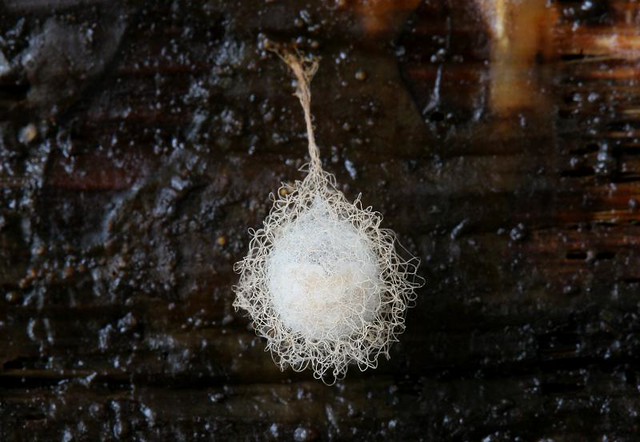
The structure spotted along a riverbank in Ecuador earlier this year. Photo: Courtesy of Brian Lee

So far, we’ve been able to confirm, using photos and descriptions, additional sightings in Ecuador and French Guiana. Both of those structures were seen in neotropical areas similar to the one we visited in Peru, near the Tambopata Research Center. The structure in French Guiana was spotted nearly a decade ago by biologist Julien Grangier, a post-doc at the University of Lyon, in France. Photographer Brian Lee saw the Ecuadorian structure last January, on an island in an Amazon tributary. We’ve also gotten unconfirmed reports of sightings from Brazil, several places in the United States, and Belgium, and are awaiting photos from those locations.

In Peru, we only saw the structures on a small island near the research center, along a stretch of trail running through stands of cecropia and bamboo. Now, what the confirmed South American sightings suggest is that the critter responsible is more widespread that we’d initially thought – but that it might be picky about the kind of habitat it lives in.

Alas, identifying the spider responsible for the structures has proven to be much more difficult than searching for more sightings. What little we know about the spiders themselves comes from the photos and video of the tiny newborns climbing the silk fences. And, it seems, those records aren’t going to be good enough for a specific identification.

There is no way a photo can show me all the info I would need to make an accurate identification,” said Norm Platnick, curator emeritus of spiders at the American Museum of Natural History. “If these specimens exist, they should be examined by a competent arachnologist. If they don’t exist, there is no real knowledge achievable.


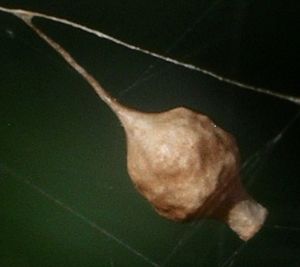
This structure was found in French Guiana in 2004 while biologist Julien Grangier was in the field, studying social structures in ant colonies. Photo: Courtesy of Julien Grangier

It gets worse. Even under the best of circumstances, identifying spiders is hard.

Keying out spiders was the one lab I taught in which I made sure to have chocolate and tissues on hand for the inevitable nervous breakdown by a student,” said Gwen Pearson, entomologist and WIRED bug blogger.

Arachnologists normally rely on mature, adult specimens for identifications. If they have these specimens in hand, they’ll carefully study the spiders’ eyes, front and back legs, claws, and reproductive organs. Of these, the latter bits are the most crucial for identifying a mature spider down to the level of species.

The truly diagnostic characters are all with genitalia,” said Chris Buddle, an entomologist at McGill University. That means adult animals will be necessary to make a definitive ID.

But in the Amazon, researchers only have these freshly hatched spiderlings, which could take weeks or months to mature into their adult forms. As they grow, the features used to identify a spider’s species will begin develop.

Despite the difficulties involved, some brave experts have been willing to speculate about what kind of spider we’re looking at — and what we aren’t looking at.

Less specific identifications – for instance, at the family level – can sometimes be made based on the arrangement of a spiders’ eyes, which vary significantly among families. “Some families can be identified clearly by eye arrangement,” said Joe Lapp, who used to manage the spider collection for the University of Texas in Austin. “Some families sport a variety of not-too-different eye arrangements that overlap with spider of other families.

The eyes seem to rule out Salticidae – jumping spiders. “I think you can rule out some families, including Salticidae, due to the relatively small size of the anterior median eyes, and the positions of the other eyes,” said William Eberhard, a senior scientist at the Smithsonian Tropical Research Institute. In other words, the spiderlings lack adult jumping spiders’ characteristic big-eyed cuteness.

Other clues come from the silky tower itself.

For starters, based on the silk in the structures, it seems likely we’re looking at a spider in the superfamily Orbiculariae, says Leslie Brunetta, who’s studied the evolution of spider silk. This superfamily includes spiders that weave cribellate silk, which is fluffy and frizzy like the silk in the fences, as well as all the spiders that spin orb-shaped webs. Over time, some of these spiders’ descendants have modified their orb webs to the point that they no longer resemble the original orb shape. Brunetta suggests the corral could be one of these modified orbs, with sturdy fence posts connected by fluffy, cribellate silk.

One of the spiderlings that emerged from the mysterious Amazon structures. Photo: Courtesy of Jeff Cremer/PeruNature.com

An alternative idea, suggested by two arachnologists, is that the tower-building spiders belong to the family Mimetidae, which makes cocoons that are similar to the towers. At least superficially. Known colloquially as Pirate Spiders, this is a group that cannibalizes other spiders. Instead of spinning webs of their own, Mimetids crawl into the webs of other spiders and mimic tangled up prey. Then, when the spider approaches, they bite into its foreleg and paralyze it. Then, dinner.

“I think the spiderling is in the vicinity of Mimetidae,” said Jonathan Coddington curator of arachnids at the National Museum of Natural History. But Coddington acknowledges the difficulty in identifying spiders at such an early stage of development. “It is feckless to try to identify second-instar spiderlings,” he said.

“If you look at the cocoon itself, it looks a bit like Mimetidae, or Theridiidae,” said Peter Jaeger, head of arachnology at the Senckenberg Research Institute and Natural History Museum in Frankfurt, Germany. “It is only a superficial similarity, but nevertheless, the silk piles around the egg sac, together with the 3-D threads, is amazing.”

Jaeger suggests these structures don’t appear to be the work of the crazy corpse spiders we found hiding in spooky nests near the structures. These spiders live in nests camouflaged with prey corpses. Scientists have seen them near the tower structures, but Jaeger doesn’t see any reason to think they built the fenced-in spires: Usually, these spiders lay their eggs inside their creepy nests of death.

Alexandre Bonaldo, a curator at the Museu Paraense Emilio Goeldi in Brazil, questions whether the spiders spotted near the towers actually built the corpse-ridden nests at all. “That second spider is a Corinninae,” Bonaldo said. He notes that Corinninae often occupy old retreats made by other spiders, rather than building their own creepy, corpse-covered houses. Moreover, the spiderlings that emerged from the tower don’t look like Corinninae anyway, Bonaldo says. “I can’t give you a positive identification, but it isn’t a Corinninae.”

Another idea, by far the most detailed we’ve heard so far, comes from arachnologist John Kochalka of Paraguay’s National Museum of Natural History. Kochalka suspects the spiderling belongs to an undescribed genus within the subfamily Hadrotarsinae — a group of very tiny spiders whose adults often grow to only several millimeters long.

“The adult spider is not much bigger than the hatchling, which explains why the female can only lay one egg at a time,” Kochalka said, noting that some Hadrotarsinae also make a conical egg sac.

He also considered the location where the structures were spotted — along a trail lined by cecropia trees, which have hollow trunks normally inhabited by ants. The tiny towers were also clustered in areas where tree trunks were covered in lichen. ”My latest thoughts are that the spider in question is a specialist in eating ants, as some — or most — Hadrotarsinae are known to do,” Kochalka said. “The female chooses a site where she knows there will be lots of very small ants to feed her baby. The picket fence is a very specific adaptation to keep ants out, and incidentally also serves as a lichen/fungus mimic for camouflage.”

As Kochalka noted, additional clues to the spider’s identity might come from the fence itself. One possibility is that it’s built simply to deter predators who might fancy a bit of spiderling sashimi. In the Amazon, research assistant Geena M. Hill, from the Florida Museum of Natural History, watched as a large ant crawling down a cecropia tree went out of its way to avoid the woven fence – and towering egg sac — in its path.

But it’s also possible the fences are acting to trap food for the spiderlings, such as mites, which were seen crawling inside and stuck on many of the fences.

Ultimately, we still don’t know what kind of spider is making these strange structures, and if it’s a new species, or a known species doing something that hasn’t yet been formally described.

Have you seen a structure like these? Do you have any ideas about what these spiders could be? Let us know in the comments.

Editor’s Note: This story was updated at 8:45 a.m. Pacific time to include the opinions of arachnologist John Kochalka.


ORIGINAL: Wired
By Nadia Drake
12.24.13

sábado, 21 de septiembre de 2013

sábado, 14 de septiembre de 2013

Google's New 'Street View' Maps Let You Dive in the Galapagos Islands!

ORIGINAL: Inhabitat
by Charley Cameron, 09/13/13


Google has coursed the Amazon, swam the Great Barrier Reef and scaled the Burj Khalifa – and now the tech giant has launched their latest Street View Trekker project with a collection of incredible maps of Ecuador’s Galapagos Islands. Allowing users to become “Darwin for a Day,” the 360-degree street view maps swim with marine life and hike over islands that Darwin likely encountered in his historic venture 178 years ago. Viewers can even help with ongoing conservation in the region by identifying the plants and animals on screen.


Conducted in collaboration with the Galapagos National Park, the Charles Darwin Foundation and the Catlin Seaview Survey, Google collected the images over the course of ten days this May. Taking their distinctive cameras both on backpack treks over the islands and down into the surrounding waters, the mapping expedition provides a thoroughly unique documentation of the region’s unique ecosystem.

As Google highlights, many of the animals one will encounter as one travels through the maps exist only on the Galapagos Archipelago, including the Galapagos region’s own majestic giant tortoises, sea lions and lesser-known marine iguanas. Many of these unique creatures are believed to have inspired Charles Darwin’s Theory of Natural Selection when he studied the area in 1835.

But these incredible animals, as well as marine- and landscapes are under threat from invasive species, and research in the field is costly and time consuming. So in addition to providing awe-inspiring armchair entertainment, the extensive documentation of the islands will assist conservation groups as they study the “environment, conservation, animal migration patterns, and the impact of tourism on the islands.”

Amateur scientists as well as experts in less exotic climes can become involved too. Google has partnered with iNaturalist to create the “Darwin for a Day” program, which enables users to help catalogue the plants and animals shown in the Street View images, further advancing the perhaps unexpected use of Google Street View as a conservation tool.

+ Google Street View Trekker: Galapagos Islands

viernes, 16 de agosto de 2013

Olinguito: 'Overlooked' mammal carnivore is major discovery

ORIGINAL: BBC

By Jane O'Brien BBC News, Washington DC


Scientists in the US have discovered a new animal living in the cloud forests of Colombia and Ecuador.

It has been named olinguito and is the first new species of carnivore to be identified in the Western hemisphere in 35 years.

It has taken more than a decade to identify the mammal, a discovery that scientists say is incredibly rare in the 21st Century.

The credit goes to a team from the Smithsonian Institution.

The trail began when zoologist Kristofer Helgen uncovered some bones and animal skins in storage at a museum in Chicago.

"It stopped me in my tracks," he told BBC News. "The skins were a rich red colour and when I looked at the skulls I didn't recognise the anatomy. It was different to any similar animal I'd seen, and right away I thought it could be a species new to science."

Meet the olinguito and the man who discovered the new mammal species

Dr Helgen is curator of mammals at the National Museum of Natural History in Washington DC, which houses the largest mammal collection in the world.

More than 600,000 specimens are flat-packed in trays to save space, their bones picked clean by specially bred beetles and stored in boxes alongside their skins.


The olinguito (Bassaricyon neblina)
  • Smallest member of the animal family that includes racoons
  • Measures 14 inches in length (35cm), has a tail of 13-17 inches and weighs 2lb (900g)
  • Males and females of the Bassaricyon neblina species are similar in size
  • Eats fruit mainly, but also consumes insects and nectar
  • Solitary and nocturnal animals that spend their time in trees
  • Female olinguitos raise a single baby at a time
  • Found only in cloud forests of northern Andes in Ecuador and Colombia, at high elevations
Source: Smithsonian Institution

Many were collected more than a century ago and were often mislabelled or not properly identified. But recent advances in technology have enabled scientists to extract DNA from even the oldest remains.

The 35cm-long (14in) olinguito is the latest addition to the animal family that includes racoons. By comparing DNA samples with the other five known species, Dr Helgen was able to confirm his discovery.

"It's hard for me to explain how excited I am," he says.

"The olinguito is a carnivore - that group of mammals that includes cats, dogs and bears and their relatives. Many of us believed that list was complete, but this is a new carnivore - the first to be found on the American continent for more than three decades."

Dr Helgen has used such mammal collections to identify many other new species, including the world's biggest bat and the world's smallest bandicoot. But he says the olinguito is his most significant discovery. Its scientific name is Bassaricyon neblina. The last carnivore to be identified in the Americas was the Colombian Weasel.

But even after identifying the olinguito, a crucial question remained: could they be living in the wild?

"We used clues from the specimens about where they might have come from and to predict what kind of forest we might find them in - and we found it!"
The olinguito is now known to inhabit a number of protected areas from Central Colombia to western Ecuador. Although it is a carnivore, it eats mainly fruit, comes out at night and lives by itself, producing just one baby at a time.

And scientists now believe an olinguito was exhibited in several zoos in the US between 1967 and 1976. Its keepers mistook it for an olinga - a close relative - and could not understand why it would not breed. It was sent to a number of different zoos but died without being properly identified.

Washington's National Zoo had an olinguito in the 1960s but never identified it as a separate species

"The vast majority of the discoveries of new species are made in museum collections," says Chris Norris, of the Yale Peabody Museum of Natural History in Connecticut and president of the Society for the Preservation of Natural History Collections.

"Often people working 70 years ago or more had different ideas of what constituted a new species - maybe they didn't recognise things that we would as being distinct, or they might not have had access to technologies, such as being able to extract and sequence DNA."

But there is no central museum database and scientists have little idea of what each collection contains. Many organisations are now putting their inventories online, and Dr Norris says that will make research faster and more accessible.

Another challenge is keeping specimens in good condition. Many are hundreds of years old and are prone to moth and insect infestations.

The oldest surviving collection was assembled in the 17th Century by John Tradescant. Its most famous specimen is a dodo that is now on display at the Oxford University Museum of Natural History in the UK.
Continue reading the main story

Three other new species in 2013


"But not all of it," says Dr Norris. "There's just the head and a foot left because everything else got eaten.

"It's a cautionary tale for anyone working on museum collections today. You get to do exciting science but you have to take care of them or they won't be there for people to use in the future.

"Our economy is in the middle of a rough period and spending on museums sometimes seems difficult to justify when you look for example at some of the more shiny or spectacular scientific tools that are out there. But it's important to think of these things, not as rather bizarre collections of dried skins and pickled bats in jars and drawers full of snails, but as a research tool in the same way that you might think of a new telescope or a Large Hadron Collider."

Scientists have catalogued only a fraction of the planet's lifeforms. New species of insects, parasitic worms, bacteria and viruses are discovered on a regular basis, but new mammals are rare.

"This reminds us that the world is not yet explored and the age of discovery is far from over," says Dr Helgen. "The olinguito makes us think - what else is out there?"

Conozca al olinguito, una nueva especie de mamífero

ORIGINAL: BBC 

Thomas Sparrow BBC Mundo, Washington (@bbc_sparrow)
Jueves, 15 de agosto de 2013
Su nombre es olinguito, vive en los bosques de niebla de Colombia y Ecuador y es el protagonista de un importante descubrimiento científico: es la primera nueva especie de carnívoro que se identifica en el hemisferio occidental en 35 años.

Este nuevo miembro de la familia de los mapaches fue presentado en Washington este jueves por el hombre que lideró la investigación: Kristofer Helgen, un zoólogo del Museo de Historia Natural del Smithsonian, que alberga la colección más grande de mamíferos del mundo.

Tras una década de investigación, expediciones y análisis, Helgen logró el descubrimiento de este carnívoro, un hecho extremadamente raro en el siglo XXI.

Según el Smithsonian, esta es una criatura misteriosa que ha sido víctima de una identidad equivocada por más de 100 años.

El viaje para descubrirlo llevó a los científicos desde las profundidades de un museo en Chicago a los bosques de niebla de Sudamérica y de ahí a laboratorios genéticos de Washington.

"La ciencia no conoce muchas de las especies del mundo. Documentarlas es el primer paso hacia la comprensión de la gran riqueza y diversidad de la vida sobre la Tierra", aseguró Helgen, quien explicó su hallazgo en una conferencia de prensa en la que estuvo presente BBC Mundo.
Buscando pistas
El olinguito. Fuente: Instituto Smithsonian
  •  Es el miembro más pequeño de la familia de los mapaches (racunas).
  • Mide 35,5cm, más una cola de unos 38cm y pesa 900g.
  • Machos y hembras tienen tamaños parecidos.
  • Come principalmente fruta, pero también insectos y néctar.
  • Es un animal nocturno y solitario que vive en los árboles.
  • Las madres crían un solo cachorro por vez.
  • Vive en los bosques tropicales de Ecuador y Colombia, a gran altura.
En los corredores de esta inmensa colección del Smithsonian, que tiene 600.000 especímenes, Helgen tiene la labor de descubrir nuevas especies.

Ya encontró al murciélago más grande del mundo y al mandicut más pequeño -un marsupial australiano- pero no duda en afirmar que el olinguito es su principal descubrimiento.

"Es difícil explicar cuán emocionado estoy", le dice a BBC Mundo.

Y no es para menos: aunque es común encontrar nuevos insectos, es sumamente atípico hallar un animal tan grande y que coma carne.

¿Cómo halló Helgen al olinguito?
Su primera pista llegó cuando estaba revisando una muestra de restos de animales en un museo de Chicago. Allá notó un especimen que no reconocía.

Intrigado, se puso la tarea de comparar el ADN de este animal con el de otras cinco especies conocidas, hasta que encontró que se trataba de algo nuevo.

clic Lea también: Descubren una nueva especie de ave...en la ciudad

Su tarea, sin embargo, no terminó ahí: ahora debía encontrar si la especie podía estar viviendo en algún lugar de la Tierra.

¡Y eureka! Con ayuda de las especies relacionadas, lo halló en los bosques de niebla de Colombia y Ecuador.

Helgen explicó que no quería mostrar simplemente los restos de una nueva especie, sino descubrir si vivía en algún lugar y eso lo llevó a Ecuador. Lo hizo con un equipo de EE.UU. y Ecuador, con ayuda de un científico ecuatoriano llamado Miguel Pinto.

Pinto creía haber visto a un olinguito antes y grabó su imagen en las selvas tropicales de su país con una cámara. Eso llevó a Helgen y su equipo a una expedición de tres semanas para encontrar al animal.

Este es olinguito
Es carnívoro, pero se alimenta principalmente de fruta.

Ahora se sabe que el olinguito vive en varias áreas protegidas que van del centro de Colombia al occidente de Ecuador.

Aunque es un carnívoro, se alimenta principalmente de fruta. Sale de noche y vive solo.

Los científicos ahora creen que entre 1967 y 1976, un olinguito fue exhibido en varios zoológicos del país, sólo que lo confundieron con una especie parecida y no entendían por qué no se podía reproducir.

Fue trasladado de un zoológico a otro, hasta que murió sin ser identificado.

Pero ahora y gracias a esta investigación, ya se conocen los primeros detalles del olinguito.

Y ese es el primer paso: ahora falta determinar, entre otros aspectos, cuántos animales hay, así como averiguar más detalles de su hábitat.

Helgen asegura en la rueda de prensa a la que asistió BBC Mundo que aunque la especie no está en peligro, "hay razones para estar preocupados".

La razón es que, según los científicos del Smithsonian, 42% del hábitat histórico del olinguito ya ha sido convertido a la agricultura o a áreas urbanas.

Pero la preservación del olinguito y su hábitat es un tema para más adelante. Por ahora, la atención está puesta en la novedad de la especie.

"Un animal como el olinguito, descubierto en pleno siglo XXI...esta historia nos recuerda que este mundo no está explorado y que para los mamíferos, la era del descubrimiento está lejos de terminar", asegura Helgen.

"El olinguito nos pone a pensar: ¿Qué más estará allá afuera?".

viernes, 18 de enero de 2013

Protecting global water sources

ORIGINAL: TicoTimes
By Alberto Font
Friday, January 18, 2013 - 

A study by research group Ecosystem Marketplace noted that 80 percent of the world’s countries are facing issues related to threatened water security.
Dave Sherwood
A new study finds that the number of global environmental services programs doubled from 2008-2011.

A report released this week finds that more countries are turning to environmental services programs to protect sensitive water sources.

Facing increasing water scarcity, many countries are turning to environmental service payments to help mitigate the effects of climate change and pollution. 

A study released this week by research group Ecosystem Marketplace, titled “State of Water Resource Protection 2012,” noted that 80 percent of the world’s countries are facing issues related to threatened water security. 

We are witnessing the first stages of a global response that could transform the ways in which we value and manage the world’s hydrologic resources,” said Michael Jenkins, CEO of Forest Trends, a conservation group that manages Ecosystem Marketplace.  (Charting New Waters State of Watershed Payments 2012)

According to Marta Echavarría, a member of Ecosystem Marketplace’s advisory committee, Costa Rica, is a pioneer of environmental service payment programs, established in the 1990s with the creation of the National Forestry Financing Fund, which provides landowners with financial incentives to protect forested areas

Other countries in the region, including Mexico, Ecuador, Brazil and Bolivia, have created similar programs, sometimes offering non-financial incentives. In Bolivia, for example, more than 500 families receive bee farms, fruit trees or other productive input in exchange for efforts to protect water sources. Ecuador pays farmers and indigenous communities to protect their hydrologic resources

From 2008 to 2011, initiatives to protect and restore forests, wetlands and other important ecosystems have doubled in number. The report covers 205 programs around the world, 21 of them in Latin America. Globally, the number of programs has increased by 100 in three years, totaling $8.2 billion in investment, a significantly greater amount than in 2008. 

Ecosystem Marketplace analysts noted that investing in programs to protect water at the source, rather than spending on treatment, could result in considerable savings for governments. It also helps to guarantee water security and provide environmental and social benefits to communities. 

[These programs] definitely curb costs. If we don’t look for natural alternatives, eventually we’re going to have to invest heavily in building large water treatment plants or in transporting potable water long distances,” Echavarría told The Tico Times.

Another problem Latin Americans face is a general lack of water treatment infrastructure. Coupled with the effects of pollution and climate change, the lack of treatment facilities is converting a region rich in hydrologic resources into one that is highly vulnerable to problems with accessing potable water. 

The study notes that China is a global leader in investing in programs to protect hydrologic resources at the source. The Asian giant accounts for 91 percent of global investments in environmental services programs protecting water. Chinese officials, for example, offer new health service benefits for residents in mountainous communities in exchange for better groundwater management, which they say will help improve potable water access.

The lack of secure water sources likely represents the greatest threat for continued economic growth [in China],” the report noted. 

In the United States, officials in New York chose not to invest heavily in new water treatment facilities, opting instead to implement compensation programs for farmers in the Catskills who agreed to work to reduce pollution in regional lakes, rivers and streams that provide New York City with potable water. Thanks to these efforts, New York had enough drinking water to make it through the recent Hurricane Sandy.

The study also notes that 68 other environmental services programs operate in all of North America

The benefits of these hydrologic programs extend well beyond water; they support biodiversity, reduce emissions and provide income to rural families,” said Genevieve Bennett, the report’s lead author.

But private-sector participation in these types of programs remains limited, despite the fact that many companies have reported problems related to water availability. Most of these types of programs are operated by nongovernmental organizations or by governments. 

It could very well be that many companies are taking a wait-and-see approach to see if these programs can be improved upon,” Bennett said. 

But Bennett believes that the market for hydrologic services investment is on the verge of considerable growth, particularly if the global economy begins to improve

The best part of this report is that it tells us that these types of investments are real, they’re growing, and they don’t follow ideological lines. Countries with a neoliberal philosophy are implementing them along with capitalist countries and communist countries like China. We all have to protect our water sources,” Echavarría said.

miércoles, 19 de diciembre de 2012

Islas Galápagos tendrán mañana la primera terminal aérea ecológica del mundo

ORIGINAL: Publimetro

1de3 Imagen digital cedida por Corporación América este 19 de diciembre, del diseño de una zona interior de una terminal aeroportuaria ecológica ubicada en las islas ecuatorianas de Galápagos. EFE
2de3 Imagen digital cedida por Corporación América este 19 de diciembre, de una vista general del diseño de una terminal aeroportuaria ecológica ubicada en las islas ecuatorianas de Galápagos. EFE
3de3. Imagen digital cedida por Corporación América este 19 de diciembre, de una vista general del diseño de una terminal aeroportuaria ecológica ubicada en las islas ecuatorianas de Galápagos. EFE
Quito, 19 dic (EFE).- Con el uso de energía solar, la reutilización del agua y el aprovechamiento de los vientos, entre otras innovaciones ambientales apoyadas en la tecnología, las islas ecuatorianas de Galápagos se convertirá mañana en el primer lugar del mundo donde funciona una terminal aeroportuaria ecológica.

Así lo aseguró a Efe el argentino Ezequiel Barrenechea, presidente del Aeropuerto Ecológico de Galápagos y Director para Latinoamérica y El Caribe de Corporación América, que tiene la concesión del campo de aviación del archipiélago por quince años.

Tras un año de construcción, mañana entrará en operación la terminal del aeropuerto, aunque sus acabados aún no están concluidos, puesto que se realizarán "con la piedra y madera que se saque de la antigua terminal, para de esta forma evitar desperdicios y reutilizar al máximo el material existente", indicó.

El edificio, que usarán entre 800 y 1.000 pasajeros diarios, se inaugurará oficialmente la primera semana de febrero próximo, en tanto que para agosto se prevé que estén listas la pista y la plataforma.

En la construcción del aeropuerto, que toma en cuenta el entorno ambiental y busca un bajo impacto sobre el ecosistema, se invertirán 24 millones de dólares, según Barrenechea.

"Es el primero y el único, por ahora, realmente ecológico y certificado Leed Gold", dijo en referencia al sistema de certificación de edificios sostenibles desarrollado por el Consejo de la Construcción Verde de Estados Unidos.

Decidieron construirlo en Galápagos, a unos 1.000 kilómetros de las costas continentales de Ecuador, "porque es el mejor lugar para dar el ejemplo de que se puede y se debe construir en forma sustentable. Es Patrimonio Natural de la Humanidad e icono en cuanto a cuidado de la naturaleza se refiere", comentó.

Los constructores aseguran que la edificación sustentable apunta a lograr una mayor calidad ambiental con una mínima dependencia energética, apoyándose en la implementación de estrategias bioclimáticas de acondicionamiento natural y el uso de energías renovables.

Por ejemplo, la nueva terminal, de uso solo diurno, cuenta con colores claros en determinadas paredes en búsqueda de luminosidad, así como grandes ventanales para permitir el ingreso de luz natural y que ayudan, además, a la ventilación natural del recinto.

En los pocos espacios donde la brisa natural no es posible, se usan conductos de aire enterrado, con ventilación forzada.

El nuevo edificio está ubicado en dirección de los vientos predominantes para aprovechar "al máximo" la brisa del lugar, que permite bajar la temperatura promedio sin uso del aire acondicionado y permite regular con mayor control la cantidad de luz solar.

Asimismo, la nueva ubicación de la terminal asegura que los gases de las aeronaves estacionadas y en movimiento no ingresen en el edificio y disminuye el ruido percibido por los pasajeros.

El aeropuerto está en la isla Baltra, que no dispone de fuentes de agua dulce y donde el agua de lluvia es limitada.

Una planta de desalinización suministrará el agua para la terminal, donde se la usará en lavabos, mientras que se reciclará la de los inodoros.

Además, un sistema fotovoltaico abastece un 13 % de la demanda total de energía de la instalación y se busca que se eleve al 25 %.

El archipiélago de Galápagos debe su nombre a las grandes tortugas que lo habitan y es, desde 1978, Patrimonio Natural de la Humanidad designado por la Organización de las Naciones Unidas para la Educación, la Ciencia y la Cultura (Unesco).

domingo, 2 de diciembre de 2012

Yuck: Our Seafood Is Loaded with Unspeakably Gross Pollutants

ORIGINAL: AlterNet
November 30, 2012

Some of our most popular seafood treats come to us from filthy operations in other countries.

Photo Credit: © AJP/Shutterstock.com
This article was published in partnership with GlobalPossibilities.org.

When you tuck into a delicious seafood dish, is it possible that the fish you are eating once ate human poop? Surprisingly, that might be the case. A look at the U.S. seafood supply reveals that some of our most popular seafood treats might come to us from unsanitary and disgusting operations in other countries. And the federal government does not necessarily stop it from making its way to your dinner plate, either.

These days, 91 percent of U.S. seafood is imported, and half of that is farmed (the other half is wild-caught). Our top suppliers include China, Thailand, Canada, Chile, Indonesia, Ecuador, and Vietnam. And the production systems some of these countries use would make your stomach turn.

Michael Doyle, regents professor and director at the Center for Food Safety at the University of Georgia, described tilapia production in China, saying, “The farmers there grow the fish in ponds that are maybe one to two acres in size. That's their livelihood. And they use excessive antibiotics.” China is a leading supplier of tilapia to the U.S.

It's not just antibiotic residues on the seafood. It's also antibiotic-resistant microbes that come with the fish or the shrimp,” he continued. “A primary source of salmonella is the raw manure that is used to feed the shrimp and fish. Many of these farmers have poultry -- maybe chickens, maybe geese, maybe ducks. The fecal waste of these animals is fed directly into these ponds, which is the source of nutrients for these fish and shrimp… Poultry can harbor salmonella... that's shed in the feces. And many of these little farms have the family outhouse just feed directly into the ponds."

If that makes you less interested in ordering the tilapia, then you surely don’t want any Vietnamese “catfish” either. U.S. aquaculture produces channel catfish, but these days, American producers compete with a flood of cheap Vietnamese fish that are marketed as catfish. Dr. Carole Engle, chair and director of aquaculture and fisheries at the University of Arkansas at Pine Bluff, says these Vietnamese catfish are not only a different species, it's a different genus and a different family. We call it pangasius.

To understand pangasius farming in Vietnam, one must first know a little bit about life in the Mekong Delta. Engle explains, “What's striking when you first get there is that there's more water than there is land in the Mekong Delta region. There are these large rivers coming through the Mekong Delta… These waters are everything. A lot of the transportation is on the water, and a lot of people live on the water, on houseboats. It's also a disposal system. People live on these rivers and their restrooms are right on these boats and they are discharging right on the rivers. And all the human waste, and all of the waste from cities… it's all going into the river and the river is the source of the water.”

That water is where the fish are raised. “A lot of the fish are raised in cages directly in rivers,” says Engle, but “more and more the pangasius are raised in what the Vietnamese call ponds.” But the ponds are nothing like U.S. aquaculture ponds that are closed systems using clean water. The Vietnamese ponds are regularly flushed with polluted river water. "Upstream a factory or a houseboat might have discharged something into it, and all that human waste is flowing through these ponds because they are flushing it through a few times a day," Engle explains.

Another concern with imported farm-raised seafood is the use of drugs and pesticides that are banned in the United States. A few that show up frequently include the drugs chloramphenicol and nitrofurans, and the fungicide malachite green. Each of these is banned in the United States for a good reason. Chloramphenicol can cause aplastic anemia, a condition in which the bone marrow does not produce enough new blood cells, in humans. Doctors use it as a drug of last resort to treat typhoid fever and meningitis. Nitrofurans and malachite green are potentially carcinogenic in humans.

What happens when a shipment of filthy or toxic seafood shows up in a U.S. port? Most likely, nothing. It enters the U.S. and unwitting Americans eat it. The Food and Drug Administration has an inspection program that is notoriously limited, underfunded and not at all transparent – particularly when compared to its counterparts in Japan, Canada and the EU.

In a study published last year, David Love, science director of the Public Health and Sustainable Aquaculture Project at the Johns Hopkins Center for a Livable Future, found that Japan physically inspected 12 to 21 percent of its seafood imports between 2004 and 2009. The European Union goes even further, physically inspecting either 20 percent or 50 percent of all imported seafood shipments, depending on the risk of each individual product. But the U.S. inspects less than 2 percent of seafood imports.

Since 1997, the U.S. has relied on the Hazard Analysis and Critical Control Points (HACCP) system (which some deride as Have a Cup of Coffee and Pray). The system essentially turns control over to industry, requiring it to identify and control for points in the production chain when food might become contaminated. When done properly, it’s an excellent system. But it’s fair to say that setting your family’s outhouse to flow into your aquaculture pond does not constitute a good HACCP system.

Most of the time, the FDA relies on inspecting documentation to verify that adequate HACCP programs are in place and that they are being followed. (Because, you know, no one would ever falsify paperwork…) For just over 1 percent of imported seafood shipments, the FDA performs sensory examinations, checking for things like color, texture and odor. These exams can easily discover whether the seafood is filthy or rotting, but might not catch residues of veterinary drugs or microscopic pathogens.

Less than 1 percent of U.S. seafood import shipments actually go to a lab for testing. Last year, a GAO report titled “FDA Needs to Improve Oversight of Imported Seafood and Better Leverage Limited Resources” chided the FDA for inadequate oversight and even failing to meet its own inspection goals. According to the report, “FDA”s sampling program is limited in scope, is not effectively implemented, and does not fully use the capabilities of FDA’s laboratories.

For example, in 2009, the FDA tested only 0.1 percent of seafood imports for drug residues. When they do test, they only test for 16 drugs, whereas Canada tests for 40, some European countries test for 50, and Japan tests for 57. In recent years, the U.S. lagged behind other nations in starting to test for drugs. The EU began testing for chloramphenicol and nitrofuran in 2001, but the U.S. did not do so until 2002 and 2004, respectively. In 2003, the EU began testing for malachite green, but the U.S. waited until 2005 to do so.

Once the FDA rejects a shipment of seafood, “they don't destroy the product,” explains Engle. “So it can go out on the ship and come in on another port. And because there is such a small percentage being tested, then when they go to another port like that, it's equally unlikely to be caught. So that's what happens. They call it port swapping.” She concludes, “FDA is just simply not catching things, and the system is not set up to catch it.

The U.S. catfish industry was so fed up with the FDA’s lack of oversight that it lobbied to have catfish inspected by the U.S. Department of Agriculture instead. The USDA requires equivalency, says Engle, meaning that imported catfish (including pangasius) are held to the same standards as domestically raised catfish. “Why should we have different standards for our US growers and... an imported product?” Engle asks.

But even though catfish oversight was transferred to the USDA in the 2008 farm bill, the change was never implemented. Engle calls it a "political battle” between states with many seafood importers and those with a domestic catfish industry. Vietnam joined in the fight too, threatening to boycott U.S. beef. “Why would they be worried about it unless they realized they couldn't meet the US safety standards right now?" Engle points out. “The battle was not about safety for US consumers or even safety for Vietnamese consumers. It's really a shame.

Engle worries most about the veterinary drug residues and the antibiotic-resistant bacteria that have evolved alongside them in foreign aquaculture operations. "It's a long-term kind of a thing -- there aren't bodies for people to look at like an immediate acute kind of disease like salmonella and so people don't worry so much about it,” she says.

Even worse, because other importing nations have stricter regulations than the U.S., “the best quality fish goes to Europe and Japan and Canada, and we get lower quality products here." Engle is outraged by this. “I find it appalling as a U.S. consumer. I just don't think we should have lower standards than other countries in the world for our food safety,” she says. “I still believe this is the greatest nation on this planet, and yet we don't act like it sometimes.

With the FDA asleep at the wheel, what can U.S. consumers do to avoid eating imported farmed fish produced in unsafe conditions? If you are buying unprocessed seafood at a grocery store, the product will be labeled with its country of origin.

Veterinary drug violations are disproportionately from China, Vietnam and Indonesia, and they are disproportionately found in shrimp. (Shrimp is also the cause of a large percent of shipments rejected for filth and salmonella.) Farmed salmon (particularly from Chile) is another product that has been caught with banned veterinary drug residues.

However, 70 percent of seafood consumption takes place in restaurants, which are exempt from country-of-origin labeling. That means that most of the time, U.S. consumers have no idea where their seafood comes from – unless they ask their waiter and receive an answer. Processed seafood is also exempt from country of origin labeling, so you might want to skip on the pre-cooked cocktail shrimp, too.

To truly ensure you are eating safe and sustainable seafood, check out the Monterey Bay Aquarium’s Seafood Watch program, which provides updated guides to buying and eating seafood. Of course, the real solution is improving federal oversight of imported seafood, and that does not seem forthcoming.


Jill Richardson is the founder of the blog La Vida Locavore and a member of the Organic Consumers Association policy advisory board. She is the author of Recipe for America: Why Our Food System Is Broken and What We Can Do to Fix It..

jueves, 22 de noviembre de 2012

Encuentran a los parientes perdidos del Solitario Jorge

ORIGINAL: BBC Mundo
Jueves, 22 de noviembre de 2012


El Solitario Jorge murió este verano en las Islas Galápagos, siendo el último de su especie de tortugas gigantes, la Geochelone nigra abingdoni. O al menos, eso se creía entonces.

Científicos en Galápagos dicen que han encontrado 17 tortugas que tienen material genético similar al de Jorge, que falleció con más de 100 años.

Puede verlo en este video de BBC Mundo.

Galapagos Tortoise Species Can Be Revived, Scientists Say

ORIGINAL: Huffington Post
By FRANK BAJAK 11/22/12 05:15 PM ET EST
Lonesome George, the last known individual of the Pinta Island Tortoise, is pictured at Galapagos National Park's breeding center in Puerto Ayora, Santa Cruz island, Galapagos on March 18, 2009. (RODRIGO BUENDIA/AFP/Getty Images)


LIMA, Peru -- Lonesome George, the late reptile prince of the Galapagos Islands, may be dead, but scientists now say he may not be the last giant tortoise of his species after all.

Researchers say they may be able to resurrect the Pinta Island subspecies by launching a cross-breeding program with 17 other tortoises found to contain genetic material similar to that of Lonesome George, who died June 24 at the Pacific Ocean archipelago off Ecuador's coast after repeated failed efforts to reproduce.

Edwin Naula, director of the Galapagos National Park, said in a telephone interview on Thursday that the probability is high it can be accomplished.

"It would be the first time that a species was recovered after having been declared extinct," Naula said.

But it won't happen overnight.

"This is going to take about 100 to 150 years," Naula added.

Scientists took DNA samples from 1,600 tortoises on Wolf volcano, and found the Pinta variety in 17, though their overall genetic makeup varied.

Through cross-breeding, "100 percent pure species" can be achieved, said Naula, a biologist.

He said the 17 tortoises were being transferred from Isabela island, where the volcano is located, to the park's breeding center at Santa Cruz, the main island on the archipelago whose unique flora and fauna helped inspire Charles Darwin's work on evolution. The results are to be published in the journal Biological Conservation, the park said.


The study on Wolf volcano was conducted by Yale University and the Galapagos park with financial help from the Galapagos Conservancy.

In a news release, the park said scientists speculate that giant tortoises from Pinta island might have arrived at Wolf volcano after being taken off by whaling ships for food and later cast overboard.

At least 14 species of giant tortoise originally inhabited the islands' 620 miles (1,000 kilometers) off Ecuador's coast and 10 survive.

A visit to Lonesome George became de rigueur for celebrities and common folk alike among the 180,000 people who annually visit the Galapagos.

Before humans arrived, the islands were home to tens of thousands of giant tortoises. The number fell to about 3,000 in 1974, but the recovery program run by the national park and the Charles Darwin Foundation has succeeded in increasing the overall population to 20,000.

Lonesome George's age at death was not known, but scientists believed he was about 100, not especially old for a giant tortoise.

lunes, 5 de noviembre de 2012

Payback time for Big Oil?

ORIGINAL: AVAAZ
by Avaaz Team 
11 October 2012 12:59

Maybe oil and justice do mix (George Esiri/EPA)
For decades, Big Oil has ruled supreme in the developing world. When western oil giants like Shell, Chevron and Texaco set up business in Africa, Asia and Latin America, they've throw their money around to get the cheap labour, lax environmental enforcement and legal immunity from local officials and courts.

But now, things may be changing. A pair of groundbreaking legal cases raises hope that the petro barons may at long last be held to account. Added to this: Nigeria's parliament may be about to approve a $5bn fine against serial polluter Shell for a disastrous spill that affected millions.

Game time for Shell
Last month, a court in the Hague heard a case against the oil giant Royal Dutch Shell. It was the first timea major Dutch corporation faced trial in a civil court in the Netherlands for damage caused in another country.

The case was brought by four Nigerian fisherman and farmers, with the support of Friends of the Earth. They are seeking damages for massive pollution caused by spills from Shell oil facilities in Nigeria, which devastated the land and waterways of the Niger Delta and ruined thousands of livelihoods.

Shell had tried to claim that its Nigerian subsidiary is responsible for any claims, so that a lawsuit could be filed only in Nigeria, where Shell's money and political clout could protect the company (although that may be about to change too). But Dutch courts ruled they had jurisdiction and allowed the case to be brought to the Netherlands.

The decision is long overdue. Last year, a damning report from the United Nations Environmental Programme found that over the course of 50 years, oil companies, including Shell, had caused deep environmental damage to the Niger Delta region.

The court isn't expected to rule on the case until next year, but if this case is successful, it could open the door to many others from exploited people all over the world.

Chevron smackdown
Good news, also, from Latin America: after decades of struggle, the people of the Lago Agrio region in Ecuador have just won a huge victory against Chevron, one of the largest oil companies in the world. The US supreme court has decided not to block a judgment from an Ecuadorean court that ordered Chevron to pay $19bn in damages. 


This is the culmination of a 20-year legal battle for justice by the indigenous people of Ecuador who say that from 1964 to 1992, Texaco (recently bought by Chevron) illegally dumped billions of gallons of toxic waste in the Ecuadorean rainforest. In what became known as the "Amazon Chernobyl", the pollution decimated over 1,500 sq miles, triggered a spike in cancer rates and destroyed locals' livelihoods and habitats.

After the group finally won their case in Ecuador, Chevron immediately asked a New York court for an injunction against the decision, which would let them avoid paying any damages. Although initially granted, the injunction was soon overturned by an appeals court.

Chevron, of course, tried to take the case all the way to the US supreme court, hoping that this body would act to protect a US corporation's profits. Turns out they were wrong, leaving Chevron on the hook for the $19bn awarded in damages, one of the most costly rulings against a US company by a foreign court.

Chevron has said it will continue to fight the case. Nonetheless, the supreme court's move is a major blow to Big Oil.

Hope across the world
Real action is also happening outside of the courts. The Nigerian parliament now has a historic opportunity to hold Shell accountable for a massive spill – one of many that happen yearly in the country's once pristine Niger delta. In just days parliament could approve a fine of $5bn for the oil giant.

These are small steps but they are major reasons for hope. Not only will they galvanise the struggle to bring other oil behemoths to account, they should inspire all those fighting against corporate crime around the world.

Sources: BBC, Al Jazeera, UNEP, Democracy Now!, Guardian, Bloomberg, Rainforest Action Network

Make Shell pay
In days, Nigeria's parliament could approve a $5bn fine against giant oil polluter Shell for a spill that devastated the lives of millions of people. This is a watershed moment – but unless we all speak out now, oil giants will crush it. Stand with the people of Nigeria and urge lawmakers to make Shell pay.