Mostrando entradas con la etiqueta Bacteria. Mostrar todas las entradas

miércoles, 3 de enero de 2018

This Living Light is powered by a houseplant

1- The lamp works using photosynthesis. As organic compounds are released in the soil, bacteria generates electrons and protons. Those in turn are used as a battery to power the light.
Imagine a lamp that doesn’t need to be plugged in – and that you have to water once a week. Ermi van Oers is making it happen with this incredible plant-turned-lamp. The Living Light is an off-grid light that’s powered by a houseplant instead of an electrical socket.

2- The healthier your plant is, the more photosynthesis takes place and the more energy you generate, which is a pretty cool way to gauge how happy your plant lamp is.
3- Imagine a lamp that doesn't need to be plugged in and that you have to water once a week. Ermi van Oers is making it happen with this incredible plant-turned-lamp. The Living Light uses a houseplant to generate its energy in a totally self-sufficient, off-grid system that doesn't need an electric socket to power up.
As organic compounds are released into the soil from photosynthesis, bacteria generates electrons and protons. These particles are tapped as an energy source to power the light. The healthier the plant is, the more photosynthesis takes place – and the more energy the system generates. It’s a pretty cool way to gauge how happy your plant lamp is.
4- Living Light produces up to 0.1mW of energy, which isn't enough to light an entire room, but is plenty to act as your evening reading lamp.
5- Living Light produces up to 0.1mW of energy, which isn't enough to light an entire room, but is plenty to act as your evening reading lamp.
6- The plant and the light form a circle of energy that can go off-grid and requires no electric socket to work.
7- The project was featured at this year's Dutch Design Week.
8- Imagine a lamp that doesn't need to be plugged in and that you have to water once a week. Ermi van Oers is making it happen with this incredible plant-turned-lamp. The Living Light uses a houseplant to generate its energy in a totally self-sufficient, off-grid system that doesn't need an electric socket to power up.
The Living Light produces up to 0.1mW of energy, which isn’t enough to light an entire room, but it’s plenty to act as your evening reading lamp.
Van Oers and team aren’t done yet – they’re working on increasing the energy output, and they imagine that entire towns could be powered by forests one day.

Via Dezeen

ORIGINAL: Inhabitat

viernes, 24 de marzo de 2017

Chance find has big implications for water treatment's costs and carbon footprint

Pipeline power. iStockphoto
A type of bacteria accidentally discovered during research supported by the Engineering and Physical Sciences Research Council (EPSRC) could fundamentally re-shape efforts to cut the huge amount of electricity consumed during wastewater clean-up.

The discovery has upended a century of conventional thinking. The microorganisms - 'comammox' (complete ammonia oxidising) bacteria - can completely turn ammonia into nitrates. Traditionally, this vital step in removing nitrogen from wastewater has involved using two different microorganisms in a two-step approach: 

  1. ammonia is oxidised into nitrites that are then oxidised into nitrates, 
  2. which are turned into nitrogen gas and flared off harmlessly.
The outcome could be a big rethink regarding the energy-saving innovations developed over the last two to three decades in the field of nitrogen removal. Wastewater treatment is a huge consumer of electricity, accounting for 2-3 per cent of all power usage in western countries, and no less than 30 per cent of its energy bill results from the need to remove nitrogen. Most of the sector's efforts to reduce its energy use have focused on the two-microorganism approach.

The discovery was made by scientists working on the EPSRC-funded Healthy Drinking Water project, which is being led by the University of Glasgow and is due to publish its core findings later this year.

Dr Ameet Pinto has led the team, which has worked in collaboration with the University of Michigan in the US. He says: This discovery took us completely by surprise. It's a superb example of how EPSRC support provides a secure platform for a can-do environment enabling researchers to achieve important spin-off breakthroughs in addition to the primary goals of their research.

Comammox was found in a drinking water system in the US. Other research groups have also detected it in wastewater treatment plants, in groundwater and even in aquaculture systems.

Dr Pinto says: The discovery of a single microorganism capable of full nitrification will have a significant impact on our understanding of the nitrogen cycle and on efforts to manage nitrogen pollution. The potential is there for the wastewater treatment sector to exploit this breakthrough, which other teams in Europe have made in parallel with us.

That would be an important step towards informing the development of robust approaches in terms of cutting costs and reducing carbon emissions associated with generating the huge amounts of electricity that the sector uses. It's a great story to highlight on World Water Day.

Notes for Editors:
The two-year Healthy Drinking Water project, which began in March 2015, is receiving a total of around £250,000 in EPSRC funding.
Engineering and Physical Sciences Research Council (EPSRC)

As the main funding agency for engineering and physical sciences research, our vision is for the UK to be the best place in the world to Research, Discover and Innovate. By investing £800 million a year in research and postgraduate training, we are building the knowledge and skills base needed to address the scientific and technological challenges facing the nation. Our portfolio covers a vast range of fields from healthcare technologies to structural engineering, manufacturing to mathematics, advanced materials to chemistry. The research we fund has impact across all sectors. It provides a platform for future economic development in the UK and improvements for everyone's health, lifestyle and culture. We work collectively with our partners and other Research Councils on issues of common concern via Research Councils UK.

The University of Glasgow
The University of Glasgow is the fourth oldest university in the English-speaking world and today is in the top 1% of the world's universities. With more than 25,000 undergraduate and postgraduate students, it is ranked 63rd in the world and was the first UK university to be rated as 5 Stars Plus overall. (QS World University Rankings 2016).

Reference: PN 20-17

Contact Details
In the following table, contact information relevant to the page. The first column is for visual reference only. Data is in the right column.
Organisation: Northeastern University, USA
Telephone: (+1) 617 373 5241

ORIGINAL: EPSRC
22 March 2017

martes, 28 de febrero de 2017

Nature’s water purifiers help clean up lakes

(Copyright: Floating Islands International)
More and more of our waterways are being starved of life through pollution. One simple, yet improbable, solution? Cover rafts in plants.

In the shallow waters of Gijon harbour, in northern Spain, swims scientists' latest weapon in the war against pollution.

Just five years ago, Fish Fry Lake was dying. The groundwater flowing into the lake situated 30 miles northeast of Billings, Montana, contained high levels of nitrogen and phosphorous, common ingredients in agricultural fertilisers and animal waste. The nitrogen and phosphorus had fostered an overgrowth of algae, which covered the lake and blocked sunlight from penetrating the surface. The deep water was a dead zone, devoid of oxygen and home to very little aquatic life.

The solution was as simple as it was improbable: cover rafts with plants, and set them afloat in the lake. Within a year-and-a-half, the algal blooms were gone. Water clarity improved. Oxygen levels rose. Today, the lake is home to a thriving community of fish, including black crappie, yellow perch and Yellowstone cutthroat trout.

The story of Fish Fry Lake demonstrates the power of mimicking wetlands to clean up dirty waterways. Wetlands are sometimes called nature’s own water purifiers: as dirty water moves through a sprawling marsh, the bacteria that cling to wetland plants, timber, rocks, and other debris consume and process some common water pollutants. Other contaminants get trapped in the mud and muck. As result of these and other processes, the water that eventually flows out of a wetland is much cleaner than the stream that came trickling in.

By creating floating treatment wetlands out of small, human-engineered rafts of vegetation, researchers and entrepreneurs hope to provide these same ecological services to small, polluted bodies of water that may be far from a natural marsh. “BioHaven floating islands are concentrated wetland systems that are essentially biomimicking nature’s wetland effect,” says Bruce Kania, the founder and research director of Floating Island International, the company behind the Fish Fry Lake rafts.
ORIGINAL: Floating Island International
Cleansing power
To construct a BioHaven island, the company starts with layers of mesh made from recycled plastic. They assemble this mesh into a floating raft – which can be as small as a home aquarium or nearly as large as a football field – and top it with soil and plants. They launch the island into a lake, pond, stream, or lagoon, anchoring it in place. Over time, the plants’ roots grow into and through the raft’s porous matrix, descending into the water below. At the same time, bacteria colonise the island, assembling into sticky, slimy sheets called biofilm that coat the floating matrix and the suspended plant roots.

This bacterial biofilm is the secret to a floating island’s cleansing power. Overgrowth of algae from nitrogen and phosphorus pollution can cause several problems, preventing sunlight from reaching subaquatic plants and starving a body of water of the oxygen needed to sustain fish populations and other animal life. A dead zone, like the one is Fish Fry Lake, is often the ultimate result. The biofilm bacteria consume nitrogen and phosphorous, however, and as polluted water flows through and around a floating island, the bacteria converts these contaminants into less harmful substances. Though the bacteria do the brunt of the work, the plant roots suspended from the floating island also play their part, absorbing some of the nitrogen and phosphorous through their roots.

In Fish Fry Lake, for instance, Floating Island International deployed several islands, which together covered almost 2% of the lake’s 6.5-acre (2.6-hectare) surface area. Over the course of four years, the islands helped reduce nitrogen concentrations by 95% and phosphorus concentrations by nearly 40%. Today, levels of dissolved oxygen are sixty times what they once were.

Clearer, cleaner, healthier
The system also mechanically filters out other pollutants, like metals and particulates. “The sticky biofilm essentially keeps the water clear because all the suspended solids tend to bond to it,” says Kania. Floating Island International, which has deployed more than 4,400 of their artificial wetland systems worldwide, has documented this effect in multiple case studies. For example, the concentrations of suspended solids, copper, lead, zinc, and oil and grease fell dramatically after a floating island was installed in a stormwater pond in Montana. Controlled laboratory studies and research by scientists not affiliated with the company have alsofound that floating treatment wetlands can reduce the levels of many common water pollutants.

Some scientists are now exploring how to optimise the design of floating islands – probing, for instance, which plants do the best job of removing pollutants. Gary Burtle, an aquaculture specialist at the University of Georgia, thinks we can get even more out of these artificial wetlands by seeding the rafts with plants that are of commercial value, such as lettuces and herbs. Burtle is screening a number of potential plant candidates – if he finds one that grows well on a floating island, we may soon see constructed wetland systems that “give us a little bit more return”, he says, producing saleable crops while purifying the water.

Meanwhile, the removal of contaminants not only improves the water itself, but also helps to foster a healthier ecosystem. Clearer water allows light to penetrate deeper, encouraging the growth of various aquatic plants, which produce oxygen and become part of the food chain, supporting larger populations of fish and other animals. “You end up with a waterway that can be abundant,” Kania says, “that can be verdant even at depth.” The organic debris that attaches itself to the underside of a floating island also becomes a source of food for fish and other aquatic organisms, and the island itself provides new habitat for birds.

The concept of how to get back to a healthy waterway,” Kania says, “is very simple: nature’s wetland effect.” All we have to do is simulate it.

ORIGINAL: BBC
Emily Anthes

sábado, 1 de octubre de 2016

The science world is freaking out over this 25-year-old's answer to antibiotic resistance

Could this be the end of superbugs?


A 25-year-old student has just come up with a way to fight drug-resistant superbugs without antibiotics.

The new approach has so far only been tested in the lab and on mice, but it could offer a potential solution to antibiotic resistance, which is now getting so bad that the United Nations recently declared it a "fundamental threat" to global health.

Antibiotic-resistant bacteria already kill around 700,000 people each year, but a recent study suggests that number could rise to around 10 million by 2050.

In addition to common hospital superbug, methicillin-resistant Staphylococcus aureus (MRSA), scientists are now also concerned that gonorrhoea is about to become resistant to all remaining drugs.

But Shu Lam, a 25-year-old PhD student at the University of Melbourne in Australia, has developed a star-shaped polymer that can kill six different superbug strains without antibiotics, simply by ripping apart their cell walls.

"We’ve discovered that [the polymers] actually target the bacteria and kill it in multiple ways," Lam told Nicola Smith from The Telegraph. "One method is by physically disrupting or breaking apart the cell wall of the bacteria. This creates a lot of stress on the bacteria and causes it to start killing itself."

The research has been published in Nature Microbiology, and according to Smith, it's already being hailed by scientists in the field as "a breakthrough that could change the face of modern medicine".

Before we get too carried away, it's still very early days. So far, Lam has only tested her star-shaped polymers on six strains of drug-resistant bacteria in the lab, and on one superbug in live mice.

But in all experiments, they've been able to kill their targeted bacteria - and generation after generation don't seem to develop resistance to the polymers.

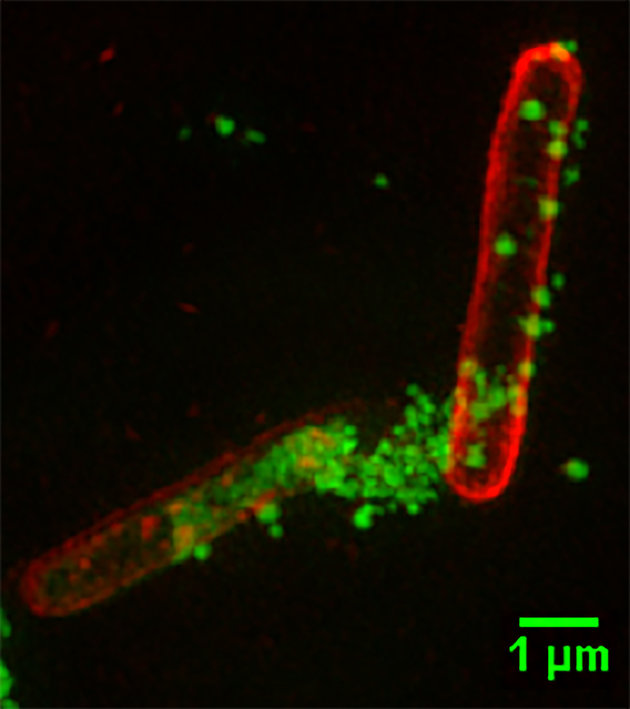
The polymers - which they call SNAPPs, or structurally nanoengineered antimicrobial peptide polymers - work by directly attacking, penetrating, and then destabilising the cell membrane of bacteria.

Unlike antibiotics, which 'poison' bacteria, and can also affect healthy cells in the area, the SNAPPs that Lam has designed are so large that they don't seem to affect healthy cells at all. 

"With this polymerised peptide we are talking the difference in scale between a mouse and an elephant," Lam's supervisor, Greg Qiao, told Marcus Strom from the Sydney Morning Herald. "The large peptide molecules can't enter the [healthy] cells."

You can see the SNAPPs (green) surrounding and ripping apart bacterial cells below:
57d7b2081300002a0039b9da
University of Melbourne
While the results are positive so far, it's too early to get excited about what this could mean for humans, says Cyrille Boyer from the University of New South Wales in Australia, who wasn't involved in the research. 

"The main advantage seems to be they can kill bacteria more effectively and selectively [than other peptides]" Boyer told Strom, before adding that the team is a long way off clinical applications.

But what's awesome about the new project is that, while other teams are looking for new antibiotics, Lam has found a completely different approach. And it could make all the different in the coming 'post-antibiotic world'.

That's what she's hoping, anyway. 

"For a time, I had to come in at 4am in the morning to look after my mice and my cells," she told The Telegraph. "I wanted to be involved in some kind of research that would help solve problems ... I really hope that the polymers we are trying to develop here could eventually be a solution."

ORIGINAL: Science Alert
FIONA MACDONALD
26 SEP 2016

miércoles, 7 de septiembre de 2016

New genus of bacteria found living inside hydraulic fracturing wells

'Frackibacter' one of dozens of microbes forming sustainable ecosystems there, study finds

OHIO STATE UNIVERSITY

Ohio State University researchers and their colleagues have identified a new genus of bacteria living inside hydraulic fracturing wells. These jars contain samples of "produced water fluids" -- the fluid that is collected at the surface of a hydraulic fracturing well after fracturing -- from wells in Marcellus and Utica shale formations. The fluids are orange because they contain large amounts of iron that oxidizes when the fluids are brought to the surface. By analyzing the genomes of microbes in the water, the researchers are piecing together the existence of microbial communities inside the wells. 
CREDIT: Photo by Rebecca Daly, courtesy of The Ohio State University.


COLUMBUS, Ohio--Researchers analyzing the genomes of microorganisms living in shale oil and gas wells have found evidence of sustainable ecosystems taking hold there--populated in part by a never-before-seen genus of bacteria they have dubbed "Frackibacter."

The new genus is one of the 31 microbial members found living inside two separate fracturing wells, Ohio State University researchers and their colleagues report in the Sept. 5 online edition of the journal Nature Microbiology.

Even though the wells were hundreds of miles apart and drilled in different kinds of shale formations, the microbial communities inside them were nearly identical, the researchers discovered.

Almost all the microbes they found had been seen elsewhere before, and many likely came from the surface ponds that energy companies draw on to fill the wells. But that's not the case with the newly identified Candidatus Frackibacter, which may be unique to hydraulic fracturing sites, said Kelly Wrighton, assistant professor of microbiology and biophysics at Ohio State.

In biological nomenclature, "Candidatus" indicates that a new organism is being studied for the first time using a genomic approach, not an isolated organism in a lab culture. The researchers chose to name the genus "Frackibacter" as a play on the word "fracking," shorthand for "hydraulic fracturing."

Candidatus Frackibacter prospered alongside the microbes that came from the surface, forming communities in both wells which so far have lasted for nearly a year.

"We think that the microbes in each well may form a self-sustaining ecosystem where they provide their own food sources," Wrighton explained. "Drilling the well and pumping in fracturing fluid creates the ecosystem, but the microbes adapt to their new environment in a way to sustain the system over long periods."

By sampling fluids taken from the two wells over 328 days, the researchers reconstructed the genomes of bacteria and archaea living in the shale. To the researchers' surprise, both wells--one drilled in Utica shale and the other drilled in Marcellus shale--developed nearly identical microbial communities.

In addition, the two wells are each owned by different energy companies that utilized different fracturing techniques. The two types of shale exist more than a mile and a half below ground, were formed millions of years apart, and contained different forms of fossil fuel. Yet one bacterium, Halanaerobium, emerged to dominate communities in both wells.

"We thought we might get some of the same types of bacteria, but the level of similarity was so high it was striking. That suggests that whatever's happening in these ecosystems is more influenced by the fracturing than the inherent differences in the shale," Wrighton said.

Wrighton and her team are still not 100 percent sure of the microbes' origins. Some almost undoubtedly came from the ponds that provide water to the wells, she said. But other bacteria and archaea could have been living in the rock before drilling began, Candidatus Frackibacter among them.

Shale energy companies typically formulate their own proprietary recipes for the fluid they pump into wells to break up the rock and release oil or gas, explained Rebecca Daly, research associate in microbiology at Ohio State and lead author of the Nature Microbiology paper. They all start with water and add other chemicals. Once the fluid is inside a well, salt within the shale leaches into it, making it briny.

The microorganisms living in the shale must tolerate high temperature, pressure and salinity, but this study suggests that salinity is likely the most important stressor on the microbes' survival. Salinity forces the microbes to synthesize organic compounds called osmoprotectants to keep themselves from bursting. When the cells die, the osmoprotectants are released into the water, where other microbes can use them for protection themselves or eat them as food. In that way, salinity forced the microbes to generate a sustainable food source.

In addition to the physical constraints in the environment, the microbes also must protect themselves from viruses. The researchers reconstructed the genomes of viruses living inside the wells, and found genetic evidence that some bacteria were indeed falling prey to viruses, dying, and releasing osmoprotectants into the water.

By examining the genomes of the different microbes, the researchers found that the osmoprotectants were being eaten by Halanaerobium and Candidatus Frackibacter. In turn, these bacteria provided food for other microbes called methanogens, which ultimately produced methane.

To validate their findings from the field, the researchers grew the same microbes in the lab under similar conditions. The lab-grown microbes also produced osmoprotectants that were converted into methane--a confirmation that the researchers are on the right track to understanding what's happening inside the wells.

One implication of the study is that methane produced by microbes living in shale wells could possibly supplement the wells' energy output.

Wrighton and Daly described the amount of methane produced by the microbes as likely minuscule compared to the amount of oil and gas harvested from the shale even a year after initial fracturing. But, they point out, there is a precedent in a related industry, that of coal-bed methane, to use microbes to greater advantage.

"In coal-bed systems they've shown that they can facilitate microbial life and increase methane yields," Wrighton said. "As the system shifts over time to being less productive, the contribution of biogenic methane could become significantly higher in shale wells. We haven't gotten to that point yet, but it's a possibility."

In the meantime, research led by co-author Michael Wilkins, assistant professor of earth sciences and microbiology, has used genomics information to grow Candidatus Frackibacter in the lab and is further testing its ability to handle high pressure and salinity.

###

This work is funded by the National Science Foundation's Dimensions of Biodiversity program, the Department of Energy and the Deep Carbon Observatory.

Among the study's co-authors from Ohio State is Paula Mouser, principal investigator on the Dimensions of Biodiversity grant. Other co-principal investigators and co-authors include Wrighton; Michael Wilkins, assistant professor of earth sciences and microbiology; and David Cole, professor of earth sciences and Ohio Research Scholar. Co-author David Hoyt of the Environmental Molecular Sciences Laboratory at the Pacific Northwest National Laboratory analyzed the compounds in the fluids that provided evidence of microbial metabolism.

Contact: Kelly Wrighton, 614-688-2189; Wrighton.1@osu.edu

Written by Pam Frost Gorder, 614-292-9475; Gorder.1@osu.edu

Disclaimer: AAAS and EurekAlert! are not responsible for the accuracy of news releases posted to EurekAlert! by contributing institutions or for the use of any information through the EurekAlert system.

ORIGINAL: EurekAlert
by Pam Frost Gorder
 5-SEP-2016

martes, 7 de junio de 2016

A Big Leap for an Artificial Leaf

A new system for making liquid fuel from sunlight, water, and air is a promising step for solar fuels.

The bionic leaf is one step closer to reality.
Daniel Nocera, a professor of energy science at Harvard who pioneered the use of artificial photosynthesis, says that he and his colleague Pamela Silver have devised a system that completes the process of making liquid fuel from sunlight, carbon dioxide, and water. And they’ve done it at an efficiency of 10 percent, using pure carbon dioxidein other words, one-tenth of the energy in sunlight is captured and turned into fuel. That is much higher than natural photosynthesis, which converts about 1 percent of solar energy into the carbohydrates used by plants, and it could be a milestone in the shift away from fossil fuels. The new system is described in a new paper in Science.

Bill Gates has said that to solve our energy problems, someday we need to do what photosynthesis does, and that someday we might be able to do it even more efficiently than plants,” says Nocera. “That someday has arrived.

In nature, plants use sunlight to make carbohydrates from carbon dioxide and water. Artificial photosynthesis seeks to use the same inputs—solar energy, water, and carbon dioxide—to produce energy-dense liquid fuels. Nocera and Silver’s system uses a pair of catalysts to split water into oxygen and hydrogen, and feeds the hydrogen to bacteria along with carbon dioxide. The bacteria, a microörganism that has been bioengineered to specific characteristics, converts the carbon dioxide and hydrogen into liquid fuels.

Several companies, including Joule Unlimited and LanzaTech, are working to produce biofuels from carbon dioxide and hydrogen, but they use bacteria that consume carbon monoxide or carbon dioxide, rather than hydrogen. Nocera’s system, he says, can operate at lower temperatures, higher efficiency, and lower costs.

Nocera’s latest work “is really quite amazing,” says Peidong Yang of the University of California, Berkeley. Yang has developed a similar system with much lower efficiency. “The high performance of this system is unparalleled” in any other artificial photosynthesis system reported to date, he says.

The new system can use pure carbon dioxide in gas form, or carbon dioxide captured from the air—which means it could be carbon-neutral, introducing no additional greenhouse gases into the atmosphere. “The 10 percent number, that’s using pure CO2,” says Nocera. Allowing the bacteria themselves to capture carbon dioxide from the air, he adds, results in an efficiency of 3 to 4 percent—still significantly higher than natural photosynthesis.That’s the power of biology: these bioörganisms have natural CO2 concentration mechanisms.

Nocera’s research is distinct from the work being carried out by the Joint Center for Artificial Photosynthesis, a U.S. its fusing of two usually separate fields:
  • inorganic chemistry (to split water) and 
  • biology (to convert hydrogen and carbon dioxide into fuel). 
What’s really exciting is the hybrid approach” to artificial photosynthesis, says Co. “It’s exciting to see chemists pairing with biologists to advance the field.

Commercializing the technology will likely take years. In any case, the prospect of turning sunlight into liquid fuel suddenly looks a lot closer.


ORIGINAL: Technology Review
by Richard Martin
June 7, 2016

domingo, 5 de junio de 2016

C2c2: We can now 'cut and paste' RNA in addition to DNA, and it could disable viruses

Juan Gaertner/Shutterstock.com
Science gets smarter.
You've probably heard of CRISPR - the gene editing tool that essentially lets scientists cut and paste DNA, removing things like HIV and muscular dystrophyf rom our cells - and now scientists have discovered a way to edit RNA with just as much precision.

RNA is DNA's close biological cousin, responsible for translating messages from the nucleus to the rest of the cell, and being able to change it could open up all-new disease-fighting possibilities.

Just like CRISPR/Cas9 editing, the new procedure selectively cuts up RNA, which gives us microscopic control over genetic information, and the researchers behind it say it could open up the method could be used to block viruses and halt disease in its tracks.

"RNA is the blueprint through which genes regulate cellular processes," biologist Oliver Rackham at the University of Western Australia, who wasn't involved in the study, told Colin Barras from New Scientist. "The exciting thing about this study is that it now opens up the RNA world to the ease of experimental design afforded by CRISPR."

While DNA carries the genetic code for our bodies, RNA carries out those instructions and puts that code to work. Basically, DNA has the recipes but RNA reads that recipe and directs all the cooking.

And while scientists used to think the RNA was just a 'middleman', they've realised over the past few decades that it does so much more than that - it can control which proteins are produced in the cell.

In fact, the original CRISPR/Cas9 method uses a combination of DNA and RNA information to target viruses in the body, and identify genetic code that needs replacing. But right now, it focusses solely on DNA.

Now an international team of scientists, led by Feng Zhang from the Broad Institute of MIT and Harvard, has discovered another version of CRISPR called C2c2, and it can be used to slice up RNA molecules exclusively.


Just like CRISPR/Cas9, the C2c2 system was discovered inside bacteria, where it works like a pair of molecular scissors to 'cut out' any invading pathogen's RNA in order to disable an attack.

But the difference is that C2c2 only targets RNA, not DNA itself, which means scientists can use it to make changes and control what happens within a cell, without changing the genetic code itself.

Zhang's team tested the system by inserting C2c2 into E. coli bacteria, and showed they were able to use it to silence a gene simply by targeting RNA. This is because they attacked the RNA carrying the instructions from the gene, so the gene was effectively turned off, without the DNA being touched.

The researchers say C2c2 should also be able to bind to RNA without cutting it up, which would allow scientists to track the movement of RNA in a cell and monitor the effect that changing genetic information has on a single cell, or throughout the whole body.

Whereas DNA changes are permanent, RNA changes could be tweaked as treatment progresses, which gives a lot more opportunity for fighting disease.

"C2c2 opens the door to an entirely new frontier of powerful CRISPR tools," said Zhang. "There are an immense number of possibilities for C2c2, and we are excited to develop it into a platform for life science research and medicine."

While the technique did produce some collateral damage in this study - some RNA that looked similar to the target molecules was unintentionally attacked - it's still early days, and Rackham told New Scientist that the feature could actually be useful in some treatments.

"In a cancer treatment, for example, wiping out 'bystander' RNA as well as target RNA might offer a more effective way to fight a tumour," reports Barras.

This isn't the first time scientists have been able to target RNA instead of DNA through gene-editing techniques, but the difference is C2c2 uses a more natural and more versatile approach, and potentially has a range of different uses. We can't wait to see what scientists do with it.

The results of the study have been published in Science.

ORIGINAL: Science Alert
DAVID NIELD
3 JUN 2016

lunes, 4 de abril de 2016

Van Gogh's 'Starry Night' was re-created with bacteria. It's as cool as it sounds.

Van Gogh's 'Starry Night' was re-created with bacteria. It's as cool as it sounds.

What do the Chicago skyline, a cat, a subway map, a Van Gogh, and a skull all have in common?

They've all been re-created into beautiful masterpieces using... bacteria.


BOOM is right. And BOOM is bacteria, too.

The American Society for Microbiology just held its first-ever Agar Art contest, challenging microbiologists to mix science with art.

Their main rule: to use
microbes as the paint and agar (a jelly-like substance) as the canvas

Let's just say I'm glad I wasn't a judge — it would have been a tough call. After 85 submissions came rolling in, it's evident that science and art can overlap in a very special way.
Here are the top 3 winners:
1. Neurons
Submitted by Mehmet Berkmen of New England Biolabs, with artist Maria Penil.

2. NYC Biome Map
Submitted by Christine Marizzi, an educator at a community lab. This art piece was created as a collaboration between citizen scientists and artists at Genspace: New York City's Community Biolab.

A subway map! Ahh. I love this description of it:
"Microorganisms reside everywhere, yet they are too small to be seen with the human eye. New York City is a melting pot of cultures - both human and microbial - and every citizen has a personalized microbiome. Collectively, we shape NYC's microbiome by our lifestyle choices, and this unseen microbial world significantly impacts us."
3. Harvest Season
Created by Maria Eugenia Inda, a postdoctoral researcher from Argentina working at Cold Spring Harbor Labs.
People's Choice Winner: Cell to Cell

It had the most Facebook Likes! Created by the group that won first place, Mehmet Berkmen with artist Maria Penil.
When the idea of bacteria goes from "ew" to "interesting!" ... that's awesome.

Bacteria is so normal and EVERYWHERE (you're entirely covered with it, sorry), but it's still often seen as such an icky thing. This is one way to show it in a different light and have a lot of fun doing so. 

There were many submissions that didn't win the art contest but are still a sight to behold — like this version of Van Gogh's "Starry Night." Whaaat!


Or this butterfly that almost looks real.


And then there's St. Louis. Hey there, St. Louis.


Looks like it was picture day for one petri dish.
What a cool competition and a way to show that science and art don't have to be seen as opposites.

Left-brained, right-brained, whatever. We tend to box ourselves in to thinking we're only good at certain things. But ... says who? Just go for it.

You can see the rest of the amazing submissions on Facebook. Feel free to share them too! They worked hard, guys.

ORIGINAL: UpWorthy
By Morgan Shoaff
October 21, 2015


domingo, 13 de marzo de 2016

Glow-in-the-dark bacterial lights could illuminate shop windows

A glow in the night. Glowee
Bacteria may light up the future. Glowee, a start-up company based in Paris, France, is developing bioluminescent lights to illuminate shop fronts and street signs.

After a successful demo in December, Glowee has launched its first product – a bacteria-powered light that glows for three days. The company is now working on lights that will glow for a month or more.

Our goal is to change the way we produce and use light,” says Glowee founder Sandra Rey. “We want to offer a global solution that will reduce the 19 per cent of electricity consumption used to produce light.

The lights are made by filling small transparent cases with a gel that contains bioluminescent bacteria. Glowee uses a bacterium called Aliivibrio fischeri, which gives marine animals such as the Hawaiian bobtail squid the ability to glow with a blue-green light. The gel provides nutrients that keep the bacteria alive.

At first, the lights only worked for a few seconds. But by tweaking the consistency of the gel so it delivers nutrients more efficiently, the team has been able to extend their lifespan to three days.

Bioluminescent lights are not new. But Glowee is one of the first companies to develop a commercial product, which is initially being marketed to shops. In France, retailers are not allowed to light their shop windows between 1 am and 7 am to limit light pollution and energy consumption. The softly glowing bacterial lights – about as bright as night lights – provide a way to get around the ban.

Glowee wants to use them for other purposes too, including decorative lighting, building exteriors and street signs – as well as providing lighting in places with no power cables, such as parks.

ERDF, a largely state-owned utility company that manages 95 per cent of France’s electricity network, is among the backers of Glowee’s recent crowdfunding campaign. “Glowee is not meant to replace electric light; it offers different possibilities,” says Rey.

The business case
But how feasible is the idea in the long run? Edith Widder at the Ocean Research & Conservation Association in Fort Pierce, Florida, thinks that the costs of producing and maintaining large numbers of bioluminescent bacteria in suitable environmental conditions are too high for most commercial lighting needs.

To get the bacteria to continue working for more than a few days requires adding extra nutrients and removing waste products, she says. “If you do the math, it doesn’t make sense, especially when you factor in how incredibly efficient LED lighting has become.

But Glowee is undeterred. Having adjusted the make-up of its gel, it is now genetically engineering the bacteria. Rey says her team is developing a molecular switch that will activate the bioluminescence only at night. This will let the bacteria save energy during the day and make the nutrients last longer.

The team also plans to make the bacteria glow brighter and survive temperature fluctuations of up to 20 °C. Rey says the company will launch a commercial product in 2017 that lasts a month.

Solutions exist in nature, says Rey. “Now that we have the tools to copy them, we can build far more sustainable processes and products.”

ORIGINAL: New Scientist
26 February 2016

viernes, 11 de marzo de 2016

Scientists just discovered plastic-eating bacteria that can break down PET

SeDmi/Shutterstock.com
Bon appétit!
This article was written by Mark Lorch from the University of Hull, and was originally published by The Conversation.

We manufacture over 300 million tonnes of plastics each year for use in everything from packaging to clothing. Their resilience is great when you want a product to last. But once discarded, plastics linger in the environment, littering streets, fields and oceans alike. Every corner of our planet has been blighted by our addiction to plastic. But now we may have some help to clean up the mess in the form of bacteria that have been found slowly munching away on discarded bottles in the sludge of a recycling centre.

Plastics are polymers, long thin molecules made of repeating (monomer) building blocks. These are cross-linked to one another to build a durable, malleable mesh. Most plastics are made from carbon-based monomers, so in theory they are a good source of food for microorganisms.

But unlike natural polymers (such as cellulose in plants) plastics aren’t generally biodegradable. Bacteria and fungi co-evolved with natural materials, all the while coming up with new biochemical methods to harness the resources from dead matter.

But plastics have only been around for about 70 years. So microorganisms simply haven’t had much time to evolve the necessary biochemical tool kit to latch onto the plastic fibres, break them up into the constituent parts and then utilise the resulting chemicals as a source of energy and carbon that they need to grow.
Enzyme innovation

Now a team at Kyoto University has, by rummaging around in piles of waste, found a plastic munching microbe. After five years of searching through 250 samples, they isolated a bacteria that could live on poly(ethylene terephthalate) (PET), a common plastic used in bottles and clothing. They named the new species of bacteria Ideonella sakaiensis.

You may think this is the rerun of an old story, as plastic-eating microbes have already been touted as saviours of the planet. But there are several important differences here.

First, previous reports were of tricky-to-cultivate fungi, where in this case the microbe is easily grown. The researchers more or less left the PET in a warm jar with the bacterial culture and some other nutrients, and a few weeks later all the plastic was gone.
Bottle breakdown. Illustration: P. Huey. Reprinted with permission from U.T. Bornscheuer, Science 351:1154 (2016)
Second - and the real innovation - is that the team has identified the enzymes that Ideonella sakaiensis uses to breakdown the PET. All living things contain enzymes that they use to speed up necessary chemical reactions. Some enzymes help digest our food, dismantling it into useful building blocks. Without the necessary enzymes the body can’t access certain sources of food.

For example, people who are lactose intolerant don’t have the enzyme that breaks down the lactose sugar found in dairy produce. And no human can digest cellulose, while some microbes can. Ideonella sakaiensis seems to have evolved an efficient enzyme that the bacteria produces when it is in an environment that is rich in PET.

The Kyoto researchers identified the gene in the bacteria’s DNA that is responsible for the PET-digesting enzyme. They then were able to manufacture more of the enzyme and then demonstrate that PET could be broken down with the enzyme alone.

First real recycling
This opens a whole new approach to plastic recycling and decontamination. At present, most plastic bottles are not truly recycled. Instead they are melted and reformed into other hard plastic products. Packaging companies typically prefer freshly made 'virgin' plastics that are created from chemical starting materials that are usually derived from oil.

The PET-digesting enzymes offer a way to truly recycle plastic. They could be added to vats of waste, breaking all the bottles or other plastic items down into into easy-to-handle chemicals. These could then be used to make fresh plastics, producing a true recycling system.

Manufactured enzymes are already used to great effect in a wide range of everyday items. Biological washing powders contain enzymes that digest fatty stains. The enzymes known as rennet that are used to harden cheese once came from calfs’ intestines but are now manufactured using genetically engineered bacteria. Maybe we can now use a similar manufacturing method to clean up our mess.

Mark Lorch, Senior Lecturer in Biological Chemistry, Associate Dean for Engagement, University of Hull.

This article was originally published by The Conversation. Read the original article.

ORIGINAL: Science Alert
MARK LORCH, THE CONVERSATION
10 MAR 2016