Mostrando entradas con la etiqueta IoT. Mostrar todas las entradas

sábado, 2 de noviembre de 2019

The scientists who are creating a bio-internet of things

The internet of things connects devices across the globe. Now researchers are considering how bacteria can join the network.
by Emerging Technology from the arXiv


conceptual image of bacterial in a petri dish 
Imagine designing the perfect device for the internet of things. What functions must it have? For a start,  
  • it must be able to communicate, both with other devices and with its human overlords. 
  • It must be able to store and process information. 
  • And it must monitor its environment with a range of sensors. 
  • Finally, it will need some kind of built-in motor.
There is no shortage of devices that have many of these features. Most are based on widely available, low-cost devices such as Raspberry Pis, Arduino boards, and the like.

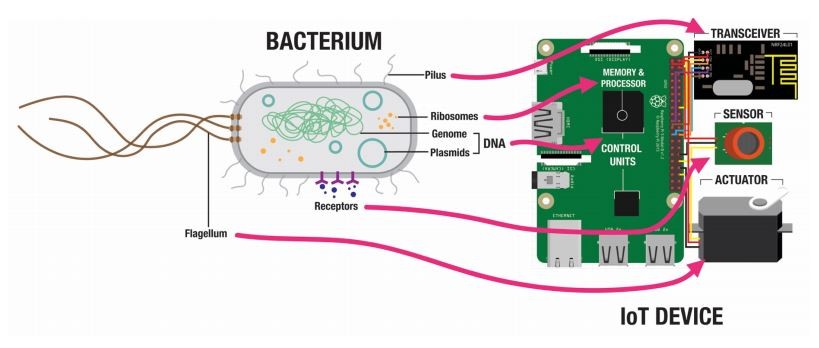
But another set of machines with similar functions is much more plentiful, say Raphael Kim and Stefan Poslad at Queen Mary University of London in the UK. They point out that bacteria communicate effectively and have built-in engines and sensors, as well as powerful information storage and processing architecture.

And that raises an interesting possibility, they say. Why not use bacteria to create a biological version of the internet of things? Today, in a call to action, they lay out some of the thinking and the technologies that could make this possible.

The way bacteria store and process information is an emerging area of research, much of it focused on the bacterial workhorse Escherichia coli. These (and other) bacteria store information in ring-shaped DNA structures called plasmids, which they transmit from one organism to the next in a process called conjugation.
 Bacterial IoT


Last year, Federico Tavella at the University of Padua in Italy and colleagues built a circuit in which one strain of immotile E. coli transmitted a simple “Hello world” message to a motile strain, which carried the information to another location.

This kind of information transmission occurs all the time in the bacterial world, creating a fantastically complex network. But Tavella and co’s proof-of-principle experiment shows how it can be exploited to create a kind of bio-internet, say Kim and Poslad.

E. coli make a perfect medium for this network. They are motile—they have a built-in engine in the form of waving, thread-like appendages called flagella, which generate thrust. They have receptors in their cell walls that sense aspects of their environment—temperature, light, chemicals, etc. They store information in DNA and process it using ribosomes. And they are tiny, allowing them to exist in environments that human-made technologies have trouble accessing.

E. coli are relatively easy to manipulate and engineer as well. The grassroots movement of DIY biology is making biotechnology tools cheaper and more easily available. The Amino Lab, for example, is a genetic engineering kit for schoolchildren, allowing them to reprogram E. coli to glow in the dark, among other things.

This kind of biohacking is becoming relatively common and shows the remarkable potential of a bio-internet of things. Kim and Poslad talk about a wide range of possibilities. “Bacteria could be programmed and deployed in different surroundings, such as the sea and ‘smart cities’, to sense for toxins and pollutants, gather data, and undertake bioremediation processes,” they say.

Bacteria could even be reprogrammed to treat diseases. “Harbouring DNA that encode useful hormones, for instance, the bacteria can swim to a chosen destination within the human body, [and] produce and release the hormones when triggered by the microbe’s internal sensor,” they suggest.

Of course, there are various downsides. While genetic engineering makes possible all kinds of amusing experiments, darker possibilities give biosecurity experts sleepless nights. It’s not hard to imagine bacteria acting as vectors for various nasty diseases, for example.

It’s also easy to lose bacteria. One thing they do not have is the equivalent of GPS. So tracking them is hard. Indeed, it can be almost impossible to track the information they transmit once it is released into the wild.

And therein lies one of the problems with a biological internet of things. The conventional internet is a way of starting with a message at one point in space and re-creating it at another point chosen by the sender. It allows humans, and increasingly devices, to communicate with each other across the planet.

Kim and Poslad’s bio-internet, on the other hand, offers a way of creating and releasing a message but little in the way of controlling where it ends up. The bionetwork created by bacterial conjugation is so mind-bogglingly vast that information can spread more or less anywhere. Biologists have observed the process of conjugation transferring genetic material from bacteria to yeast, to plants, and even to mammalian cells.

Evolution plays a role too.
All living things are subject to its forces. No matter how benign a bacterium might seem, the process of evolution can wreak havoc via mutation and selection, with outcomes that are impossible to predict.

Then there is the problem of bad actors influencing this network. The conventional internet has attracted more than its fair share of individuals who release malware for nefarious purposes. The interest they might have in a biological internet of things is the stuff of nightmares.

Kim and Poslad acknowledge some of these issues, saying that creating a bacteria-based network presents fresh ethical issues. “Such challenges offer a rich area for discussion on the wider implication of bacteria driven Internet of Things systems,” they conclude with some understatement.

That’s a discussion worth having sooner rather than later.
Ref: arxiv.org/abs/1910.01974 : The Thing with E. coli: Highlighting Opportunities and Challenges of Integrating Bacteria in IoT and HCI.
By Michael Schiffer / unsplash
Nov 1, 2019

domingo, 26 de agosto de 2018

Millimeter-Scale Computers: Now With Deep Learning Neural Networks on Board

Photo: University of Michigan and TSMCOne of several varieties of University of Michigan micro motes. This one incorporates 1 megabyte of flash memory.
Computer scientist David Blaauw pulls a small plastic box from his bag. He carefully uses his fingernail to pick up the tiny black speck inside and place it on the hotel café table. At one cubic millimeter, this is one of a line of the world’s smallest computers. I had to be careful not to cough or sneeze lest it blow away and be swept into the trash.

Blaauw and his colleague Dennis Sylvester, both IEEE Fellows and computer scientists at the University of Michigan, were in San Francisco this week to present ten papers related to these “micro mote” computers at the IEEE International Solid-State Circuits Conference (ISSCC). They’ve been presenting different variations on the tiny devices for a few years.

Their broader goal is to make smarter, smaller sensors for medical devices and the internet of things—sensors that can do more with less energy. Many of the microphones, cameras, and other sensors that make up eyes and ears of smart devices are always on alert, and frequently beam personal data into the cloud because they can’t analyze it themselves. Some have predicted that by 2035, there will be 1 trillion such devices. “If you’ve got a trillion devices producing readings constantly, we’re going to drown in data,” says Blaauw. By developing tiny, energy efficient computing sensors that can do analysis on board, Blaauw and Sylvester hope to make these devices more secure, while also saving energy.


Photo: University of Michigan/TSMCMade of multiple layers of computing.

At the conference, they described micro mote designs that use only a few nanowatts of power to perform tasks such as distinguish the sound of a passing car and measuring temperature and light levels. They showed off a compact radio that can send data from the small computers to receivers 20 meters away—a considerable boost compared to the 50 centimeter range they reported last year at ISSCC. They also described their work with TSMC on embedding flash memory into the devices, and a project to bring on board dedicated, low-power hardware for running artificial intelligence algorithms called deep neural networks.

Blaauw and Sylvester say they take a holistic approach to adding new features without ramping up power consumption. “There’s no one answer” to how the group does it, says Sylvester. If anything, it’s “smart circuit design,” Blaauw adds. (They pass ideas back and forth rapidly, not finishing each other’s sentences but something close to it.)

The memory research is a good example of how the right tradeoffs can improve performance, says Sylvester. Previous versions of the micro motes used 8 kilobytes of SRAM, which makes for a pretty low-performance computer. To record video and sound, the tiny computers need more memory. So the group worked with TSMC to bring flash memory on board. Now they can make tiny computers with 1 megabyte of storage.


Flash can store more data in a smaller footprint than SRAM, but it takes a big burst of power to write to the memory. With TSMC, the group designed a new memory array that uses a more efficient charge pump for the writing process. The memory arrays are a bit less dense than TSMC’s commercial products, for example, but still much better than SRAM. “We were able to get huge gains with small trade-offs,” says Sylvester.

Another micro mote they presented at the ISSCC incorporates a deep-learning processor that can operate a neural network while using just 288 microwatts. Neural networks are artificial intelligence algorithms that perform well at tasks such as face and voice recognition. They typically demand both large memory banks and intense processing power, and so they’re usually run on banks of servers often powered by advanced GPUs. Some researchers have been trying to lessen the size and power demands of deep-learning AI with dedicated hardware that’s specially designed to run these algorithms. But even those processors still use over 50 milliwatts of power—far too much for a micro mote. The Michigan group brought down the power requirements by redesigning the chip architecture, for example by situating four processing elements within the memory (in this case, SRAM) to minimize data movement.

The idea is to bring neural networks to the internet of things. “A lot of motion detection cameras take pictures of branches moving in the wind—that’s not very helpful,” says Blaauw. Security cameras and other connected devices are not smart enough to tell the difference between a burglar and a tree, so they waste energy sending uninteresting footage to the cloud for analysis. On-board deep-learning processors could make better decisions, but only if they don’t use too much power. The Michigan group imagine deep-learning processors could be integrated into many other internet-connected things besides security systems. For example, an HVAC systems could decide to turn the air conditioning down if they see multiple people putting on their coats.

After demonstrating many variations on these micro motes in an academic setting, the Michigan group hopes they will be ready for market in a few years. Blaauw and Sylvester say their start-up company CubeWorks is currently prototyping devices and researching markets. The company was quietly incorporated in late 2013. Last October, Intel Capital announced they had invested an undisclosed amount in the tiny computer company. 


Posted 10 Feb 2017


jueves, 2 de marzo de 2017

Future of Farming and Technology Grow Together

In the Salad Bowl, Silicon Prairie and other top producing farmlands of the world, attention is turning to technology and education to bring agriculture into the Digital Age.

California’s first tech pioneers didn’t innovate in a garage. They worked out of a barn. These early risk-takers aggressively developed effective farming tools in the 1800s, turning California into an agricultural powerhouse in a few short decades.

One of the central places of this history, Salinas, CA, is still a hotbed for agriculture technology innovation. It has become a world leader in leveraging
  • cloud computing, 
  • robotics and 
  • the Internet of Things 
into farming practices.
In the 1800s, Salinas residents pushed modernization forward. They mechanized aspects of farming and radically increased yields. During the 1920s, almost overnight they shifted from commodities like wheat to high value vegetables and fruits. This entrepreneurial spirit earned Salinas Valley the nickname, “Salad Bowl of the World.”

Along the way, innovative land owners and hard-working migrants together turned Salinas into one of the world’s top agricultural areas of the world. John Steinbeck immortalized the struggles and triumphs in novels like East of Eden.

Salinas Valley is special for many reasons. The climate is mild and allows crops to grow year-round. Water is especially abundant in the aquifers under the valley. In the 1800s, farmers could ship their goods from a Pacific Ocean port just 12 miles away or send it up and down El Camino Real (now, Highway 101), then the most important road on the west coast. A century and a half later, just 90 miles away from Salinas, sprawling orchards transformed into Silicon Valley, the world’s technology capitol.


The Ag and Tech Worlds Collide
Many farmers are quick to point out they’ve been using laptops and phones just like everyone else, and many of their processes are tracked or managed digitally. Despite the close proximity between Salinas and Silicon Valley, local farmers wonder if agriculture-technology will ever bare big fruit.

A combination of newer technologies, however, just might change all of that, according to Hank Giclas, who oversees technology planning for Western Growers, a trade group representing farmers in California, Arizona and Colorado.

One of the most fundamental shifts has been wireless access to the Internet and the cloud,” he said. “It gives farmers much greater insight into their operations, and they’re able to find efficiencies and optimize like never before.

When Western Growers opened its Center for Innovation and Technology in downtown Salinas in 2015, the organization felt it was the right time to address the needs of its members to help spark ag tech innovation. The center provides support for
  • startups, 
  • investors and 
  • growers 
to develop solutions in areas ranging from 
  • computer vision, 
  • cloud, 
  • robotics, 
  • drones, 
  • automation, 
  • food safety and 
  • plant breeding.
I’m really interested in the rapid shifts in sensing technology,” Glicas added. “There’s a whole new wave of precision farming that’s coming to the fresh produce sector through sensor technology, and we need to sort that out.

Sensors that measure precipitation, soil moisture, temperature, sunshine and wind can, in various ways, can make fertilizing, watering and harvesting more efficient. Farmers and technologists are working together to understand how to use sensors and cloud technologies that leverage real-time and historical data, all to help make decisions at critical times.


Venture capital has been flowing into precision agriculture in areas like drone technology, automation and robotics. Dan Hodgson, a North Dakota venture capitalist who runs the firm Farm Quality Assurance, offered a similar viewpoint about the high-tech initiatives coming down the pike.

One thing we’re interested is machine communication,” he said. “We are working with spectral soil analysis so that we can bring infrared and X-ray images of fields quickly, at a lower cost, to farmers.”

Hodgson explained that information technology has had a limited role in farming, not because innovation wasn’t feasible, but agriculture is a different kind of market.

The cost of market adoption is tremendous in agriculture,” he said. “The distribution system is narrow, and new products have to work well right from the start. There’s not a lot of room for creating products just to see if they sell.

Hodgson pointed out that by using wireless, cloud computing and other technologies, farmers and markets are accessing better information, and this is advancing agriculture.


Hodgson’s company is one of many in Fargo, North Dakota, a city that has emerged as a Silicon Prarie hotspot and hosts Microsoft’s third largest campus. Many in Fargo’s ag tech scene are following in the footsteps of pioneers who established the Great Plains,  including some descendants who are turning to information technology to sustain and even reinvent their family farm.

Ag Solutions for the 21st Century
Ag tech clusters like the ones in Salinas and Fargo have sprung up around the world to figure out how to solve some of farming’s biggest challenges. With a global population expected to reach 8.5 billion by 2030, according to United Nations’ estimates, a vision for Ag 2.0 is required to help feed the world’s people.

In Israel, the Agriculturale Research Organization (ARO), founded in 1921, has been studying how to make the desert bloom.

ARO is significant because its mission is not only scientific and environmental, but also geo-political as food self-sufficiency is an important part of the country’s national security. Today, ARO is focused on 
  • water conservation technology, 
  • climate change, 
  • sustainability and 
  • food safety.
Agriculture technician at Philips HTC City Farm Eindhoven, Netherlands.
Holland, second only to the U.S. in terms of exporting agriculture technology, is a long time ag tech innovator. The Dutch revolutionized the moldboard plow in the 1600s with a feature that turns the soil over. It remains an important design element in modern plows.

Today the country is home to more than 4,000 so-called agrifood companies including major players like Cargill, Monsanto, and ConAgra. Holland recently hosted its 2nd annual platform for innovation, Dutch AgriFood Week. The event includes an Agri Accelerator Seminar for startups as well as TEDx talks on the future of farming and food.

Each ag tech hub has a different disposition, but they share a similar desire for innovation.

Farms in South America, especially here in Argentina, are large operations and aggressively want technology advances” noted Ciro Echesortu, Program Coordinator for the Buenos Aires-based NXTP Labs, an early-stage fund for ag tech companies in Latin America. The company launched its first fund in July of 2016 and plans a 2nd one this summer. The goal is not only to spur development but to keep South American farm technology companies close to home.

What does it take to have an ag tech hub?” asked Dennis Donohue, the former mayor of Salinas.

First, you have to have a culture of innovation already in place,” he explained. “And, you have to have a place to innovate, a place where you can deploy and evaluate new technologies.

Donohue currently heads up initiatives for the Western Growers Center for Innovation and Technology. He said Salinas, with its proximity to Silicon Valley, is attracting entrepreneurs eager to bring transformative technologies to agriculture. 
robotic vegetable picker
Soft robotic vegetable picker.
I may be biased, but I think Salinas is the best ag tech platform on the planet.

The massive farmland, stretching from central California to the interior of Mexico, with its connection to Silicon Valley entrepreneurs positions Salinas well as an agriculture technology leader. While farming-meets-information-technologies is the current zeitgeist, it still needs to be fully developed.

About 25 years ago, I was taking a marketing class in the Silicon Valley area,” said Jeff Lusheg, a produce consultant. On the first day of class, as the students introduced themselves around the room, most identified themselves as engineers or marketing people in high tech.

When I described what I did in the produce industry, everybody just cracked up laughing as if it were the most bizarre thing they’d ever heard.

That’s obviously changed he said.

The culture that you find in Salinas is you never know if the farmer you see wearing jeans and driving a pickup truck is an MBA from Harvard or Stanford,” Lusheg added, “There are some very tech-savvy people here.

Supporting Future Ag Tech Innovators
Excitement about the future of farming isn’t limited to entrepreneurs bringing new technologies to the fields. It’s about educating the next generation of farmers and workers. Maggie Malone, director of the K-12 STEM program at Hartnell College, oversees a project that provides free classes to children, many of which come from farm worker families. These classes include subjects like coding, math and aerospace.


Most of the parents aren’t well-educated and they don’t have the resources to pay for something like what the STEM program offers, but they see the results,” she said. “It’s amazing.

Hartnell’s STEM program started just 5 years ago with a grant from NASA. Malone was the only teacher — a part timer — but since then she has gone full-time and added a staff of 10.

We were mandated to serve 625 students per year with the money that they gave us. But very quickly we doubled and tripled those numbers, so we went out and got extra funding from private sources.

Soon enough, the college started a partnership with Salinas to create a CoderDojo program.

Every time we get a new grant and a new request for the program it makes me shiver,” Malone said, adding that she watches her students take the excitement of technology with them as they go higher in their grade levels.

They are the future of Salinas.


ORIGINAL: IQ Intel
Jason Lopez Writer 
January 24, 2017

jueves, 23 de febrero de 2017

10 Breakthrough Technologies 2017


These technologies all have staying power. They will affect the economy and our politics, improve medicine, or influence our culture. Some are unfolding now; others will take a decade or more to develop. But you should know about all of them right now.
  1. Reversing Paralysis 
    Scientists are making remarkable progress at using brain implants to restore the freedom of movement that spinal cord injuries take away.
  2. Self-Driving Trucks Tractor-trailers without a human at the wheel will soon barrel onto highways near you. What will this mean for the nation’s 1.7 million truck drivers?
  3. Paying with Your Face
    Face-detecting systems in China now authorize payments, provide access to facilities, and track down criminals. Will other countries follow?
  4. Practical Quantum Computing
    Advances at Google, Intel, and several research groups indicate that computers with previously unimaginable power are finally within reach.
     
  5. The 360-Degree Selfie
    Inexpensive cameras that make spherical images are opening a new era in photography and changing the way people share stories.
     
  6. Hot Solar Cells
    By converting heat to focused beams of light, a new solar device could create cheap and continuous power.
     
  7. Gene Therapy 2.0
    Scientists have solved fundamental problems that were holding back cures for rare hereditary disorders. Next we’ll see if the same approach can take on cancer, heart disease, and other common illnesses.
  8. The Cell Atlas
    Biology’s next mega-project will find out what we’re really made of.
  9. Botnets of Things
    The relentless push to add connectivity to home gadgets is creating dangerous side effects that figure to get even worse.
  10. Reinforcement Learning
    By experimenting, computers are figuring out how to do things that no programmer could teach them.

viernes, 17 de junio de 2016

IBM, Local Motors debut Olli, the first Watson-powered self-driving vehicle

Olli hits the road in the Washington, D.C. area and later this year in Miami-Dade County and Las Vegas.

Local Motors CEO and co-founder John B. Rogers, Jr. with "Olli" & IBM, June 15, 2016.Rich Riggins/Feature Photo Service for IBM
IBM, along with the Arizona-based manufacturer Local Motors, debuted the first-ever driverless vehicle to use the Watson cognitive computing platform. Dubbed "Olli," the electric vehicle was unveiled at Local Motors' new facility in National Harbor, Maryland, just outside of Washington, D.C.

Olli, which can carry up to 12 passengers, taps into four Watson APIs (

  • Speech to Text, 
  • Natural Language Classifier, 
  • Entity Extraction and 
  • Text to Speech
) to interact with its riders. It can answer questions like "Can I bring my children on board?" and respond to basic operational commands like, "Take me to the closest Mexican restaurant." Olli can also give vehicle diagnostics, answering questions like, "Why are you stopping?"

Olli learns from data produced by more than 30 sensors embedded throughout the vehicle, which will added and adjusted to meet passenger needs and local preferences.

While Olli is the first self-driving vehicle to use IBM Watson Internet of Things (IoT), this isn't Watson's first foray into the automotive industry. IBM launched its IoT for Automotive unit in September of last year, and in March, IBM and Honda announced a deal for Watson technology and analytics to be used in the automaker's Formula One (F1) cars and pits.

IBM demonstrated its commitment to IoT in March of last year, when it announced it was spending $3B over four years to establish a separate IoT business unit, whch later became the Watson IoT business unit.

IBM says that starting Thursday, Olli will be used on public roads locally in Washington, D.C. and will be used in Miami-Dade County and Las Vegas later this year. Miami-Dade County is exploring a pilot program that would deploy several autonomous vehicles to shuttle people around Miami.

ORIGINAL: ZDnet
By Stephanie Condon for Between the Lines
June 16, 2016

martes, 7 de junio de 2016

Former NASA chief unveils $100 million neural chip maker KnuEdge

Add caption
It’s not all that easy to call KnuEdge a startup. Created a decade ago by Daniel Goldin, the former head of the National Aeronautics and Space Administration, KnuEdge is only now coming out of stealth mode. It has already raised $100 million in funding to build a “neural chip” that Goldin says will make data centers more efficient in a hyperscale age.

Goldin, who founded the San Diego, California-based company with the former chief technology officer of NASA, said he believes the company’s brain-like chip will be far more cost and power efficient than current chips based on the computer design popularized by computer architect John von Neumann. In von Neumann machines, memory and processor are separated and linked via a data pathway known as a bus. Over the years, von Neumann machines have gotten faster by sending more and more data at higher speeds across the bus as processor and memory interact. But the speed of a computer is often limited by the capacity of that bus, leading to what some computer scientists to call the “von Neumann bottleneck.” IBM has seen the same problem, and it has a research team working on brain-like data center chips. Both efforts are part of an attempt to deal with the explosion of data driven by artificial intelligence and machine learning.

Goldin’s company is doing something similar to IBM, but only on the surface. Its approach is much different, and it has been secretly funded by unknown angel investors. And Goldin said in an interview with VentureBeat that the company has already generated $20 million in revenue and is actively engaged in hyperscale computing companies and Fortune 500 companies in the aerospace, banking, health care, hospitality, and insurance industries. The mission is a fundamental transformation of the computing world, Goldin said.

It all started over a mission to Mars,” Goldin said.
Above: KnuEdge’s first chip has 256 cores.Image Credit: KnuEdge
Back in the year 2000, Goldin saw that the time delay for controlling a space vehicle would be too long, so the vehicle would have to operate itself. He calculated that a mission to Mars would take software that would push technology to the limit, with more than tens of millions of lines of code.

Above: Daniel Goldin, CEO of KnuEdge.
Image Credit: KnuEdge
I thought, holy smokes,” he said. “It’s going to be too expensive. It’s not propulsion. It’s not environmental control. It’s not power. This software business is a very big problem, and that nation couldn’t afford it.

So Goldin looked further into the brains of the robotics, and that’s when he started thinking about the computing it would take.

Asked if it was easier to run NASA or a startup, Goldin let out a guffaw.

I love them both, but they’re both very different,” Goldin said. “At NASA, I spent a lot of time on non-technical issues. I had a project every quarter, and I didn’t want to become dull technically. I tried to always take on a technical job doing architecture, working with a design team, and always doing something leading edge. I grew up at a time when you graduated from a university and went to work for someone else. If I ever come back to this earth, I would graduate and become an entrepreneur. This is so wonderful.

Back in 1992, Goldin was planning on starting a wireless company as an entrepreneur. But then he got the call to “go serve the country,” and he did that work for a decade. He started KnuEdge (previously called Intellisis) in 2005, and he got very patient capital.

When I went out to find investors, I knew I couldn’t use the conventional Silicon Valley approach (impatient capital),” he said. “It is a fabulous approach that has generated incredible wealth. But I wanted to undertake revolutionary technology development. To build the future tools for next-generation machine learning, improving the natural interface between humans and machines. So I got patient capital that wanted to see lightning strike. Between all of us, we have a board of directors that can contact almost anyone in the world. They’re fabulous business people and technologists. We knew we had a ten-year run-up.

But he’s not saying who those people are yet.

KnuEdge’s chips are part of a larger platform. KnuEdge is also unveiling KnuVerse, a military-grade voice recognition and authentication technology that unlocks the potential of voice interfaces to power next-generation computing, Goldin said.

While the voice technology market has exploded over the past five years due to the introductions of Siri, Cortana, Google Home, Echo, and ViV, the aspirations of most commercial voice technology teams are still on hold because of security and noise issues. KnuVerse solutions are based on patented authentication techniques using the human voice — even in extremely noisy environments — as one of the most secure forms of biometrics. Secure voice recognition has applications in industries such as banking, entertainment, and hospitality.

KnuEdge says it is now possible to authenticate to computers, web and mobile apps, and Internet of Things devices (or everyday objects that are smart and connected) with only a few words spoken into a microphone — in any language, no matter how loud the background environment or how many other people are talking nearby. In addition to KnuVerse, KnuEdge offers Knurld.io for application developers, a software development kit, and a cloud-based voice recognition and authentication service that can be integrated into an app typically within two hours.

And KnuEdge is announcing KnuPath with LambdaFabric computing. KnuEdge’s first chip, built with an older manufacturing technology, has 256 cores, or neuron-like brain cells, on a single chip. Each core is a tiny digital signal processor. The LambdaFabric makes it possible to instantly connect those cores to each other — a trick that helps overcome one of the major problems of multicore chips, Goldin said. The LambdaFabric is designed to connect up to 512,000 devices, enabling the system to be used in the most demanding computing environments. From rack to rack, the fabric has a latency (or interaction delay) of only 400 nanoseconds. And the whole system is designed to use a low amount of power.

All of the company’s designs are built on biological principles about how the brain gets a lot of computing work done with a small amount of power. The chip is based on what Goldin calls “sparse matrix heterogeneous machine learning algorithms.” And it will run C++ software, something that is already very popular. Programmers can program each one of the cores with a different algorithm to run simultaneously, for the “ultimate in heterogeneity.” It’s multiple input, multiple data, and “that gives us some of our power,” Goldin said.

Above: KnuEdge’s KnuPath chip.
Image Credit: KnuEdge
KnuEdge is emerging out of stealth mode to aim its new Voice and Machine Learning technologies at key challenges in IoT, cloud based machine learning and pattern recognition,” said Paul Teich, principal analyst at Tirias Research, in a statement. “Dan Goldin used his experience in transforming technology to charter KnuEdge with a bold idea, with the patience of longer development timelines and away from typical startup hype and practices. The result is a new and cutting-edge path for neural computing acceleration. There is also a refreshing surprise element to KnuEdge announcing a relevant new architecture that is ready to ship… not just a concept or early prototype.”

Today, Goldin said the company is ready to show off its designs. The first chip was ready last December, and KnuEdge is sharing it with potential customers. That chip was built with a 32-nanometer manufacturing process, and even though that’s an older technology, it is a powerful chip, Goldin said. Even at 32 nanometers, the chip has something like a two-times to six-times performance advantage over similar chips, KnuEdge said.

The human brain has a couple of hundred billion neurons, and each neuron is connected to at least 10,000 to 100,000 neurons,” Goldin said. “And the brain is the most energy efficient and powerful computer in the world. That is the metaphor we are using.”

KnuEdge has a new version of its chip under design. And the company has already generated revenue from sales of the prototype systems. Each board has about four chips.

As for the competition from IBM, Goldin said, “I believe we made the right decision and are going in the right direction. IBM’s approach is very different from what we have. We are not aiming at anyone. We are aiming at the future.

In his NASA days, Goldin had a lot of successes. There, he redesigned and delivered the International Space Station, tripled the number of space flights, and put a record number of people into space, all while reducing the agency’s planned budget by 25 percent. He also spent 25 years at TRW, where he led the development of satellite television services.

KnuEdge has 100 employees, but Goldin said the company outsources almost everything. Goldin said he is planning to raised a round of funding late this year or early next year. The company collaborated with the University of California at San Diego and UCSD’s California Institute for Telecommunications and Information Technology.

With computers that can handle natural language systems, many people in the world who can’t read or write will be able to fend for themselves more easily, Goldin said.

I want to be able to take machine learning and help people communicate and make a living,” he said. “This is just the beginning. This is the Wild West. We are talking to very large companies about this, and they are getting very excited.

A sample application is a home that has much greater self-awareness. If there’s something wrong in the house, the KnuEdge system could analyze it and figure out if it needs to alert the homeowner.

Goldin said it was hard to keep the company secret.

I’ve been biting my lip for ten years,” he said.

As for whether KnuEdge’s technology could be used to send people to Mars, Goldin said. “This is available to whoever is going to Mars. I tried twice. I would love it if they use it to get there.

ORIGINAL: Venture Beat

miércoles, 8 de julio de 2015

IBM Watson Language Translation and Speech Services – General Availability

As part of the Watson development platform’s continued expansion, IBM is today introducing the latest set of cognitive services to move into General Availability (GA) that will drive new Watson powered applications. They include the GA release of IBM Watson Language Translation (a merger of Language Identification and Machine Translation), IBM Speech to Text, and IBM Text to Speech.

These cognitive speech and language services are open to anyone, enabling application developers and IBM’s growing ecosystem to develop and commercialize new cognitive computing solutions that can do the following:
  • Translate news, patents, or conversational documents across several languages (Language Translation)
  • Produce transcripts from speech in multi-media files or conversational streams, capturing vast information for a myriad of business uses. This Watson cognitive service also benefits from a recent IBM conversational speech transcription breakthrough to advance the accuracy of speech recognition (Speech to Text)
  • Make their web, mobile, and Internet of Things applications speak with a consistent voice across all Representational State Transfer (REST) – compatible platforms (Text to Speech)
  • There are already organizations building applications with these services, since IBM opened them up in beta mode over the past year on the Watson Developer Cloud on IBM Bluemix. Developers have used these APIs to quickly build prototype applications in only two days at IBM hack-a-thons, demonstrating the versatility and ease of use of the services.


Supported Capabilities
We have made several updates since the beta releases which was inspired by feedback from our user community.

Language Translation now supports:

  • Language Identification – identifies the textual input of the language if it is one of the 62 supported languages
  • The News domain – targeted at news articles and transcripts, it translates English to and from French, Spanish, Portuguese or Arabic
  • The Conversational domain – targeted at conversational colloquialisms, it translates English to and from French, Spanish, Portuguese, or Arabic
  • The Patent domain – targeted at technical and legal terminology, it translates Spanish, Portuguese, Chinese, or Korean to English
Speech to Text now supports:

  • New wideband and narrowband telephony language support – U.S. English, Spanish, and Japanese
  • Broader vocabulary coverage, and improved accuracy for U.S. English
Text to Speech now supports:

  • U.S. English, UK English, Spanish, French, Italian, and German
  • A subset of SSML (Speech Synthesis Markup Language) for U.S. English, U.K. English, French, and German (see the documentation for more details)
  • Improved programming support for applications stored outside of Bluemix
  • Pricing and Freemium Tiers
Trial Bluemix accounts remain free. Please visit www.bluemix.net to register, and get free instant access to a 30-day trial without a credit card. Use of the Speech to Text, Text to Speech, and Language Translation services are free during this trial period.

After the trial period, pricing for Language Translation will be:

  • $0.02 per thousand characters. The first million characters per month are free.
  • An add-on charge of $3.00 per thousand characters for usage of the Patent model in Language Translation.
After the trial period, pricing for Speech to Text will be:

  • $0.02 per minute. The first thousand minutes per month are free.
  • An add-on charge of $0.02 per minute for usage of narrowband (telephony) models. The first thousand minutes per month are free.
After the trial period, pricing for Text to Speech will be:

  • $0.02 per thousand characters. The first million characters per month are free.
Transition Plan
We look forward to continuing our partnership with the many clients, business partners, and creative developers that have built innovative applications using the beta version of the four services: Speech to Text, Text to Speech, Machine Translation and Language Identification. If you have used these beta services, please migrate your applications to use the GA services by August 10, 2015. After this date the beta plans for these services will no longer be available. For details about upgrading, see:
We’re eager to see the next round of cognitive applications based on the Speech and Translation Services. For questions, join the discussion in our Forum, or send an email to HiWatson@us.ibm.com with “Speech” or “Translation” in your inquiry.

IBM is placing the power of Watson in the hands of developers and an ecosystem of partners, entrepreneurs, tech enthusiasts and students with a growing platform of Watson services (APIs) to create an entirely new class of apps and businesses that make cognitive computing systems the new computing standard.


ORIGINAL: IBM
JULY 6, 2015

martes, 24 de marzo de 2015

Artificial Intelligence Is Almost Ready for Business

Artificial Intelligence Is Almost Ready for Business Artificial Intelligence, Big Data, Sensors, IoT, Analytics, Data Mining, Annotated Data, Machine Learning, IBM, NLP, Financial Services, Health Care,

Artificial Intelligence (AI) is an idea that has oscillated through many hype cycles over many years, as scientists and sci-fi visionaries have declared the imminent arrival of thinking machines. But it seems we’re now at an actual tipping point. AI, expert systems, and business intelligence have been with us for decades, but this time the reality almost matches the rhetoric, driven by
  • the exponential growth in technology capabilities (e.g., Moore’s Law), 
  • smarter analytics engines, and 
  • the surge in data.
Most people know the Big Data story by now: the proliferation of sensors (the “Internet of Things”) is accelerating exponential growth in “structured” data. And now on top of that explosion, we can also analyze “unstructured” data, such as text and video, to pick up information on customer sentiment. Companies have been using analytics to mine insights within this newly available data to drive efficiency and effectiveness. For example, companies can now use analytics to decide
  • which sales representatives should get which leads, 
  • what time of day to contact a customer, and 
  • whether they should e-mail them, text them, or call them.
Such mining of digitized information has become more effective and powerful as more info is “tagged” and as analytics engines have gotten smarter. As Dario Gil, Director of Symbiotic Cognitive Systems at IBM Research, told me:

Data is increasingly tagged and categorized on the Web – as people upload and use data they are also contributing to annotation through their comments and digital footprints. This annotated data is greatly facilitating the training of machine learning algorithms without demanding that the machine-learning experts manually catalogue and index the world. Thanks to computers with massive parallelism, we can use the equivalent of crowdsourcing to learn which algorithms create better answers. For example, when IBM’s Watson computer played ‘Jeopardy!,’ the system used hundreds of scoring engines, and all the hypotheses were fed through the different engines and scored in parallel. It then weighted the algorithms that did a better job to provide a final answer with precision and confidence.”

domingo, 9 de junio de 2013

IBM's Smarter Approach to Contextual Cities

ORIGINAL: Forbes
Shel Israel, Contributor
6/03/2013

NOTE–I am writing a book called Age of Context with Robert Scoble. It is expected to be complete in October. Following is an excerpt from a chapter called Contextual Cities and the New Urbanists.

Herman Hollerith was born in Buffalo in the late 1800s. He studied to be a mining engineer and wound up teaching at MIT. It is said he tinkered a lot, and in 1890, he invented the first electric tabulating machine.

Finding that it could count heads with unprecedented speed, the US Census Bureau became Hollerith’s first customer. He thought the new machine might provide him with a business opportunity, so he founded the Tabulating Machine Company [TMC].

Over the next few years, TMC merged with several other companies, one the maker of a cheese-slicing device. When Thomas J. Watson became president in 1915, he focused on making machines for businesses worldwide. Watson was fond of the literal and straightforward. He renamed the merged entity International Business Machines, or IBM for short.

IBM, the most enduring of all technology companies, has a long history of reinventing itself as times change. It has transcended from tabulating machines to mainframes, to PCs, to providing software and services for large organizations.

IBM does quite well in its current business, but so do several other companies and to outsiders each seems to closely resemble the other.

Perhaps it was with that in mind that in 2006, the company set up a series of meetings with employees, partners and customers called ‘innovation jams.’ To see its own future, IBM stepped back to look at global issues, such as population, pollution, economics and health.

They started examining how their current team of over 425,000 employees in about 200 countries could use their existing skills to make a better world and in so doing, strengthen the company’s software and services position.

Among IBM’s assets is that it understands data and uses it to devise anticipatory systems that predict unforeseen events. IBM has taken that and is applying it to its Smarter Planet initiative, addressing the complex global issues of health, banking and cities.

The Smarter Cities initiative is now a global business for IBM, with projects all over the world. When they examine urban centers, they watch for emerging patterns from which IBM can glean insights for municipal clients. Pattern recognition lets them identify problems sooner, and resolve them faster.

Although the practice is just a few years old, IBM has already accumulated a few impressive accomplishments. While the company is globally focused, we asked them specifically about US-based projects. Here are our favorites of the ones they submitted:
  • Memphis. Police say that IBM’s predictive analytics have helped them identify criminal hot spots that allow them to anticipate where—and when– serious crimes are likely to occur. Based on the data, they reallocated patrol cars and other resources, reducing major and violent crime by as much as 30 percent. Pattern recognition also helps police understand trends that previously went unnoticed. For example, they now know that on rainy nights, car theft rises.
  • San Francisco. IBM’s use of data and embedded sensors has reduced pollution emanating from the city’s thousand miles of sewer lines. Public utilities reports that IBM’s preventive intelligence has helped reduce repair costs by 11 percent.
  • Chattanooga-Hamilton County. The county uses IBM predictive analytics to understand how adverse patterns develop. This allows them to identify at-risk children earlier, so educators can adjust personal attention and curriculum a factor in increasing the graduation rate by eight percent. One facility, the Howard School of Academics and Technology reported a 200 percent increase in the graduation rate over the program’s first six years.
  • Miami-Dade County. IBM has helped the 35 Dade County municipalities to share data, thus making it easier to collaborate in a wide array of areas including water, transportation, and law enforcement. They are also sharing contextual technologies to make government more transparent. A new water project alone is expected to save the county $1 million per year.
Contextual City Startups

IBM has also served as a global recruiter, mentor and partner for startups focused on solving city problems with contextual technology. A few who are associated with IBM to various degrees include:
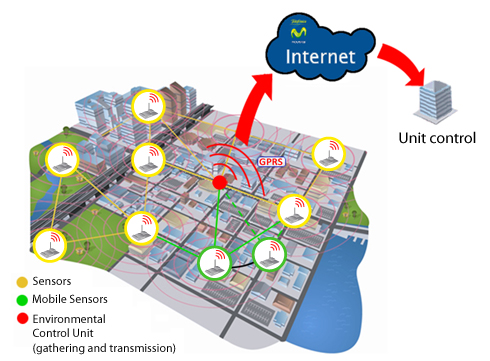
  • Bitcarrier, a Barcelona-based startup has created a contextual traffic platform, comprised of sensors, Wifi, and just a little intelligence,Ricardo Fernandez, the company’s chief operating officer told us. The platform gathers data from up to 20 million points daily across a city’s grid, shown on municipal traffic ‘heat maps.’ Managers use the information to reroute traffic, simultaneously reducing traffic, noise and air pollution. The sensors replace cameras, increasing privacy and reducing costs by up to 90 percent, Fernandez estimated. Traffic administrators can respond quickly to accidents and other surprises. Bitcarrier also improves public transportation systems. City buses adjust so they don’t drive around half-empty, and extra buses can be dispatched more quickly. Most cities cannot adjust traffic signals to accommodate events such as a concert because they run on data that is up to three-years-old and can’t adjust to current information. When we talked in March 2013, Bitcarrier was in use in Panama City, Helsinki, Barcelona, Madrid and Zaragosa, Spain and in late discussions with several additional cities.   
    No video? Get the Adobe Flash Plugin

  • Libelium was also a Spanish-based finalist in IBM SmartCamp, a global series of IBM-sponsored startup competitions. Libelium is Latin for dragonfly. CEO Alicia Asin explained that the company is focused on the Internet of Things that we described in Chapter 1. The company deploys insect-like swarms of tiny sensors called motes, which report on changes in a wide range of activities impacting safety, efficiency, vegetation growth and sustainability. It is an open sensor platform that was being used by over 2000 developers in April 2013. Libelium technology helps vineyards decide on which varietals of grapes to grow based on environmental conditions. Libelium’s main business is creating smart parking systems, mostly in urban areas, all over the world. Magnetic sensors are installed under pavement to determine whether a car is parked in a space or not. The system sees the GPS of a car looking for parking and can direct it to the nearest open spot via a mobile app. According to Asin, the smart parking system is politically popular because it pays for itself by ensuring cars pay to park or get fined. The efficiency reduces air and noise pollution. ibelium’s most dramatic sensor effort was in Fukushima, Japan following the 2011 nuclear disaster. Upon the government’s request, Libelium designed a sensor panel that was installed in and around areas suspected of radiation contamination. Each panel served as an autonomous, wireless Geiger counter, which then broadcasted realtime information into a cloud-based open network. Citizens published radiation readings from their locations to the site, and those measurements appeared on a map alongside values from inside contaminated zones. “After a couple of weeks, we had a radiation map of Japan. It represented a common thought for people to share and be helpful to all,” Asin said. “It’s where I came to understand the power of citizens in a Smart Cities program.” Moving forward, the system will help the country respond faster and more effectively if another tsunami strikes. 
  • Nooly, the Israeli-based hyper-local sensor-based weather detection service we told you about in our contextual car chapter, is another early-phase company working with IBM in various cities. Unlike conventional weather forecasts, Nooly covers small distances and sees weather changes one or two hours before they hit, including hurricanes, snowstorms or flooding. According to CEO Yaron Reich, Nooly can warn cities when weather is about to cause traffic snarls and where accidents are likely to happen. Cities can use the short lead-time to make fast routing adjustments. Reich sees places where Nooly sensors could even save lives. The sensors could detect a flash flood and underground crews could be warned to evacuate to avoid drowning. Likewise, Nooly can serve as a tool for first responders such as firefighters who need to understand wind, rain, and other factors. Less dramatically, Nooly can help cities save money and provide more efficient services. While municipal power consumption is usually predictive along seasonal patterns, they cannot account for heat waves or frost where quick grid adjustments can save energy and costs. Likewise, Nooly can predict evaporation rates in public parks during excessively hot days and can adjust watering systems accordingly. 
  • Waze, the Israeli startup, we talked about in the previous chapter, can help cities get smarter about changing traffic light patterns to reduce traffic. Users help each other route around trouble spots, reducing travel times for people, but also helping urban traffic run more efficiently. By providing realtime data that can help traffic managers reroute traffic around trouble spots and show the best place to find parking, restrooms, or motorist amenities.