Mostrando entradas con la etiqueta IBM. Mostrar todas las entradas

miércoles, 18 de octubre de 2017

Stunning AI Breakthrough Takes Us One Step Closer to the Singularity

As a new Nature paper points out, “There are an astonishing 10 to the power of 170 possible board configurations in Go—more than the number of atoms in the known universe.” (Image: DeepMind)
Remember AlphaGo, the first artificial intelligence to defeat a grandmaster at Go?
Well, the program just got a major upgrade, and it can now teach itself how to dominate the game without any human intervention. But get this: In a tournament that pitted AI against AI, this juiced-up version, called AlphaGo Zero, defeated the regular AlphaGo by a whopping 100 games to 0, signifying a major advance in the field. Hear that? It’s the technological singularity inching ever closer.

A new paper published in Nature today describes how the artificially intelligent system that defeated Go grandmaster Lee Sedol in 2016 got its digital ass kicked by a new-and-improved version of itself. And it didn’t just lose by a little—it couldn’t even muster a single win after playing a hundred games. Incredibly, it took AlphaGo Zero (AGZ) just three days to train itself from scratch and acquire literally thousands of years of human Go knowledge simply by playing itself. The only input it had was what it does to the positions of the black and white pieces on the board.
  • In addition to devising completely new strategies
  • the new system is also considerably leaner and meaner than the original AlphaGo.

Lee Sedol getting crushed by AlphaGo in 2016. (Image: AP)
Now, every once in a while the field of AI experiences a “holy shit” moment, and this would appear to be one of those moments. Looking back, other “holy shit” moments include:
This latest achievement qualifies as a “holy shit” moment for a number of reasons.

First of all, the original AlphaGo had the benefit of learning from literally thousands of previously played Go games, including those played by human amateurs and professionals. AGZ, on the other hand, received no help from its human handlers, and had access to absolutely nothing aside from the rules of the game. Using “reinforcement learning,” AGZ played itself over and over again, “starting from random play, and without any supervision or use of human data,” according to the Google-owned DeepMind researchers in their study. This allowed the system to improve and refine its digital brain, known as a neural network, as it continually learned from experience. This basically means that AlphaGo Zero was its own teacher.

This technique is more powerful than previous versions of AlphaGo because it is no longer constrained by the limits of human knowledge,” notes the DeepMind team in a release. “Instead, it is able to learn tabula rasa [from a clean slate] from the strongest player in the world: AlphaGo itself.

When playing Go, the system considers the most probable next moves (a “policy network”), and then estimates the probability of winning based on those moves (its “value network”). AGZ requires about 0.4 seconds to make these two assessments. The original AlphaGo was equipped with a pair of neural networks to make similar evaluations, but for AGZ, the Deepmind developers merged the policy and value networks into one, allowing the system to learn more efficiently. What’s more, the new system is powered by four tensor processing units (TPUS)—specialized chips for neural network training. Old AlphaGo needed 48 TPUs.

After just three days of self-play training and a total of 4.9 million games played against itself, AGZ acquired the expertise needed to trounce AlphaGo (by comparison, the original AlphaGo had 30 million games for inspiration). After 40 days of self-training, AGZ defeated another, more sophisticated version of AlphaGo called AlphaGo “Master” that defeated the world’s best Go players and the world’s top ranked Go player, Ke Jie. Earlier this year, both the original AlphaGo and AlphaGo Master won a combined 60 games against top professionals. The rise of AGZ, it would now appear, has made these previous versions obsolete.

The time when humans can have a meaningful conversation with an AI has always seemed far off and the stuff of science fiction. But for Go players, that day is here.

This is a major achievement for AI, and the subfield of reinforcement learning in particular. By teaching itself, the system matched and exceeded human knowledge by an order of magnitude in just a few days, while also developing 
  • unconventional strategies and 
  • creative new moves
For Go players, the breakthrough is as sobering as it is exciting; they’re learning things from AI that they could have never learned on their own, or would have needed an inordinate amount of time to figure out.
[AlphaGo Zero’s] games against AlphaGo Master will surely contain gems, especially because its victories seem effortless,” wrote Andy Okun and Andrew Jackson, members of the American Go Association, in a Nature News and Views article. “At each stage of the game, it seems to gain a bit here and lose a bit there, but somehow it ends up slightly ahead, as if by magic... The time when humans can have a meaningful conversation with an AI has always seemed far off and the stuff of science fiction. But for Go players, that day is here.”
No doubt, AGZ represents a disruptive advance in the world of Go, but what about its potential impact on the rest of the world? According to Nick Hynes, a grad student at MIT’s Computer Science and Artificial Intelligence Laboratory (CSAIL), it’ll be a while before a specialized tool like this will have an impact on our daily lives.

So far, the algorithm described only works for problems where there are a countable number of actions you can take, so it would need modification before it could be used for continuous control problems like locomotion [for instance],” Hynes told Gizmodo. “Also, it requires that you have a really good model of the environment. In this case, it literally knows all of the rules. That would be as if you had a robot for which you could exactly predict the outcomes of actions—which is impossible for real, imperfect physical systems.

The nice part, he says, is that there are several other lines of AI research that address both of these issues (e.g. machine learning, evolutionary algorithms, etc.), so it’s really just a matter of integration. “The real key here is the technique,” says Hynes.

It’s like an alien civilization inventing its own mathematics which allows it to do things like time travel...Although we’re still far from ‘The Singularity,’ we’re definitely heading in that direction.
As expected—and desired—we’re moving farther away from the classic pattern of getting a bunch of human-labeled data and training a model to imitate it,” he said. “What we’re seeing here is a model free from human bias and presuppositions: It can learn whatever it determines is optimal, which may indeed be more nuanced that our own conceptions of the same. It’s like an alien civilization inventing its own mathematics which allows it to do things like time travel,” to which he added: “Although we’re still far from ‘The Singularity,’ we’re definitely heading in that direction.

Noam Brown, a Carnegie Mellon University computer scientist who helped to develop the first AI to defeat top humans in no-limit poker, says the DeepMind researchers have achieved an impressive result, and that it could lead to bigger, better things in AI.

While the original AlphaGo managed to defeat top humans, it did so partly by relying on expert human knowledge of the game and human training data,” Brown told Gizmodo. “That led to questions of whether the techniques could extend beyond Go. AlphaGo Zero achieves even better performance without using any expert human knowledge. It seems likely that the same approach could extend to all perfect-information games [such as chess and checkers]. This is a major step toward developing general-purpose AIs.

As both Hynes and Brown admit, this latest breakthrough doesn’t mean the technological singularity—that hypothesized time in the future when greater-than-human machine intelligence achieves explosive growth—is imminent. But it should cause pause for thought. Once 
  • we teach a system the rules of a game or 
  • the constraints of a real-world problem, 
the power of reinforcement learning makes it possible to simply press the start button and let the system do the rest. It will then figure out the best ways to succeed at the task, devising solutions and strategies that are beyond human capacities, and possibly even human comprehension.

As noted, AGZ and the game of Go represent an oversimplified, constrained, and highly predictable picture of the world, but in the future, AI will be tasked with more complex challenges. Eventually, self-teaching systems will be used to solve more pressing problems, such as protein folding to conjure up new medicines and biotechnologies, figuring out ways to reduce energy consumption, or when we need to design new materials. A highly generalized self-learning system could also be tasked with improving itself, leading to artificial general intelligence (i.e. a very human-like intelligence) and even artificial superintelligence.

As the DeepMind researchers conclude in their study, “Our results comprehensively demonstrate that a pure reinforcement learning approach is fully feasible, even in the most challenging of domains: it is possible to train to superhuman level, without human examples or guidance, given no knowledge of the domain beyond basic rules.

And indeed, now that human players are no longer dominant in games like chess and Go, it can be said that we’ve already entered into the era of superintelligence. This latest breakthrough is the tiniest hint of what’s still to come.

[Nature]

ORIGINAL: Gizmodo 
By George Dvorsky 
2017/10/18

jueves, 14 de septiembre de 2017

IBM Makes Breakthrough in Race to Commercialize Quantum Computers


Photographer: David Paul Morris
Researchers at International Business Machines Corp. have developed a new approach for simulating molecules on a quantum computer.

The breakthrough, outlined in a research paper to be published in the scientific journal Nature Thursday, uses a technique that could eventually allow quantum computers to solve difficult problems in chemistry and electro-magnetism that cannot be solved by even the most powerful supercomputers today.

In the experiments described in the paper, IBM researchers used a quantum computer to derive the lowest energy state of a molecule of beryllium hydride. Knowing the energy state of a molecule is a key to understanding chemical reactions.

In the case of beryllium hydride, a supercomputer can solve this problem, but the standard techniques for doing so cannot be used for large molecules because the number of variables exceeds the computational power of even these machines.

The IBM researchers created a new algorithm specifically designed to take advantage of the capabilities of a quantum computer that has the potential to run similar calculations for much larger molecules, the company said.

The problem with existing quantum computers – including the one IBM used for this research -- is that they produce errors and as the size of the molecule being analyzed grows, the calculation strays further and further from chemical accuracy. The inaccuracy in IBM’s experiments varied between 2 and 4 percent, Jerry Chow, the manager of experimental quantum computing for IBM, said in an interview.

Alan Aspuru-Guzik, a professor of chemistry at Harvard University who was not part of the IBM research, said that the Nature paper is an important step. “The IBM team carried out an impressive series of experiments that holds the record as the largest molecule ever simulated on a quantum computer,” he said.

But Aspuru-Guzik said that quantum computers would be of limited value until their calculation errors can be corrected. “When quantum computers are able to carry out chemical simulations in a numerically exact way, most likely when we have error correction in place and a large number of logical qubits, the field will be disrupted,” he said in a statement. He said applying quantum computers in this way could lead to the discovery of new pharmaceuticals or organic materials.

IBM has been pushing to commercialize quantum computers and recently began allowing anyone to experiment with running calculations on a 16-qubit quantum computer it has built to demonstrate the technology.

In a classical computer, information is stored using binary units, or bits. A bit is either a 0 or 1. A quantum computer instead takes advantage of quantum mechanical properties to process information using quantum bits, or qubits. A qubit can be both a 0 or 1 at the same time, or any range of numbers between 0 and 1. Also, in a classical computer, each logic gate functions independently. In a quantum computer, the qubits affect one another. This allows a quantum computer, in theory, to process information far more efficiently than a classical computer.

The machine IBM used for the Nature paper consisted of seven quibits created from supercooled superconducting materials. In the experiment, six of these quibits were used to map the energy states of the six electrons in the beryllium hydride molecule. Rather than providing a single, precise and accurate answer, as a classical computer does, a quantum computer must run a calculation hundreds of times, with an average used to arrive at a final answer.

Chow said his team is currently working to improve the speed of its quantum computer with the aim of reducing the time it takes to run each calculation from seconds to microseconds. He said they were also working on ways to reduce its error rate.

IBM is not the only company working on quantum computing. Alphabet Inc.’s Google is working toward creating a 50 qubit quantum computer. The company has pledged to use this machine to solve a previously unsolvable calculation from chemistry or electro-magnetism by the end of the year. Also competing to commercialize quantum computing is Rigetti Computing, a startup in Berkeley, California, which is building its own machine, and Microsoft Corp. which is working with an unproven quantum computing architecture that is, in theory, inherently error-free. D-Wave Systems Inc., a Canadian company, is currently the only company to sell


ORIGINAL: Bloomberg
By Jeremy Kahn September 13, 2017

martes, 24 de enero de 2017

Artificial Intelligence in the UK: Landscape and learnings from 226 startups

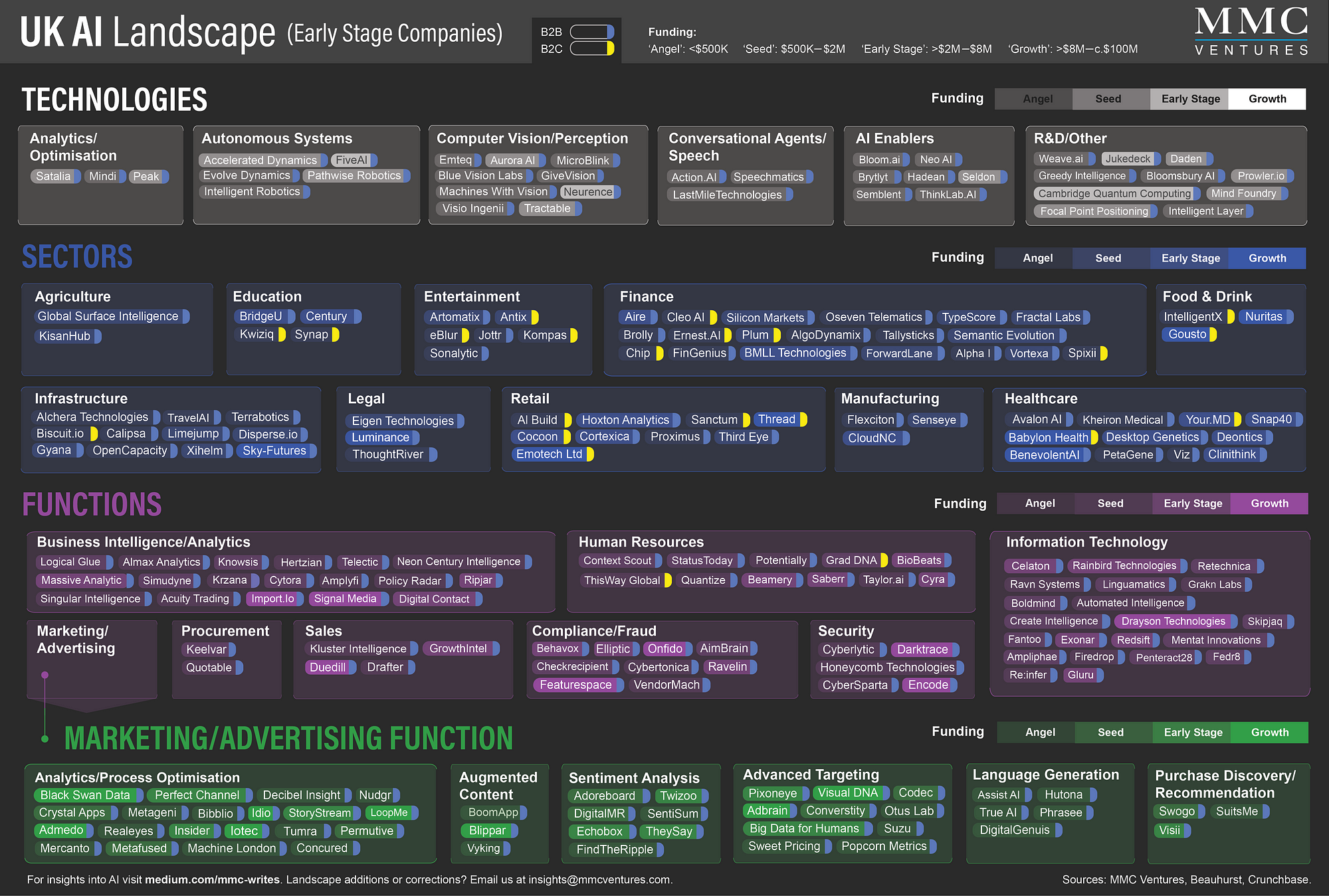
Figure 1 (above): The landscape of early stage UK AI companies.
With every paradigm shift in technology, waves of innovation follow as companies improve and then reimagine processes. Today we are in the early stages of the global artificial intelligence (AI) revolution. Machine learning algorithms, whose results improve with experience, enable us to find patterns in large data sets and make predictions more effectively — about people, equipment, systems and processes. (For an accessible introduction to AI, read our Primer.) But what are the dynamics of AI entrepreneurship in the UK?

We’ve mapped 226 independent, early stage AI software companies based in the UK and met with over 40 of these companies in recent weeks. Below, we share six powerful dynamics we see that are shaping the UK AI market— from changing activity levels and areas of focus, to trends in monetisation and the size and staging of investment.
Interested in more venture capital insights? Sign up for our blog posts.
AI entrepreneur? Get in touch.
The UK AI landscape: 226 companies and counting
Over time, we expect the distinction between ‘AI’ companies and other software providers to blur and then disappear, as machine learning is employed to tackle a wide variety of business processes and sectors. Today, however, it is possible to point to a sub-set of early stage software companies defined by their focus on AI.

We’ve researched 226 early stage AI companies in the UK and met with 40 of them. We’ve developed a map (Figure 1, above) to place the 226 according to their:

  • Purpose: Is the company focused on improving a business function (for example, marketing or human resources) or a sector (healthcare, education, agriculture)? Or does the company develop an AI technology with cross-domain application?
  • Customer Type: Does the company predominantly sell to other businesses (‘B2B’) or to consumers (‘B2C’)?
  • Funding: How much funding has the company received to date? We bracket this from ‘angel’ investment (under $500,000) through to ‘growth’ capital ($8m to ~$100m).
We’ll update our map regularly. We apologise if we’ve omitted or mis-classified your company; we’re aware that many early stage companies may be using, but not presenting, extensive AI. Please get in touch with additions or corrections.

After analysing the market and meeting with 40 companies in recent weeks, we highlight the following six dynamics in the market:

1. A focus on AI for business functions
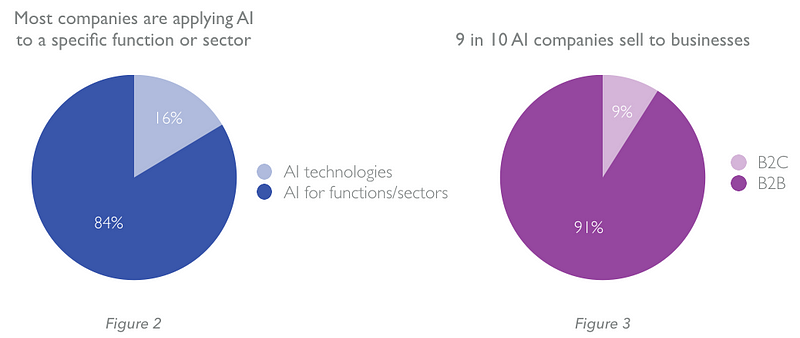
Most early stage UK AI companies — five in every six — are applying machine learning to challenges in specific business functions or sectors (Figure 2, below). Reflecting the nascent stage of the field, however, one in six is developing an AI technology — a capability, platform or set of algorithms — applicable across multiple domains. These companies’ activities range from the development of computer vision solutions to the creation of algorithms for autonomous decision-making.

To whom are AI companies selling? Nine out of 10 AI companies are predominantly ‘B2B’, developing and selling solutions to other businesses (Figure 3, below). Just one in 10 sells directly to consumers (‘B2C’).

Add caption

A ‘cold start’ challenge around data is inhibiting the number of new B2C AI companies. Training machine learning algorithms usually requires large volumes of data. While B2B companies can analyse the varied and extensive data sets of the businesses they serve, in the absence of public or permissioned (e.g. Facebook profile) data, customer-facing companies usually begin without large volumes of consumer data to analyse. Typically, therefore, they deploy machine learning over time as their user bases and data sets grow. Gousto, for example, is an MMC portfolio company that delivers recipes and associated ingredients to consumers for them to cook at home. Today, Gousto’s team of machine learning PhDs, data analysts and engineers leverage AI for warehouse automation and menu design. Since its inception Gousto has had a vision for the use of AI, but the Company has achieved its vision over time.

Given the ‘cold start’ challenge, the reality is that most consumers will first experience machine learning via the world’s most popular consumer applications — Facebook, Google, Amazon, Netflix, Pinterest and others — that leverage vast data sets and machine learning teams to deliver facial recognition, search and entertainment recommendations, translation capabilities and more.

2. AI entrepreneurship is unevenly spread
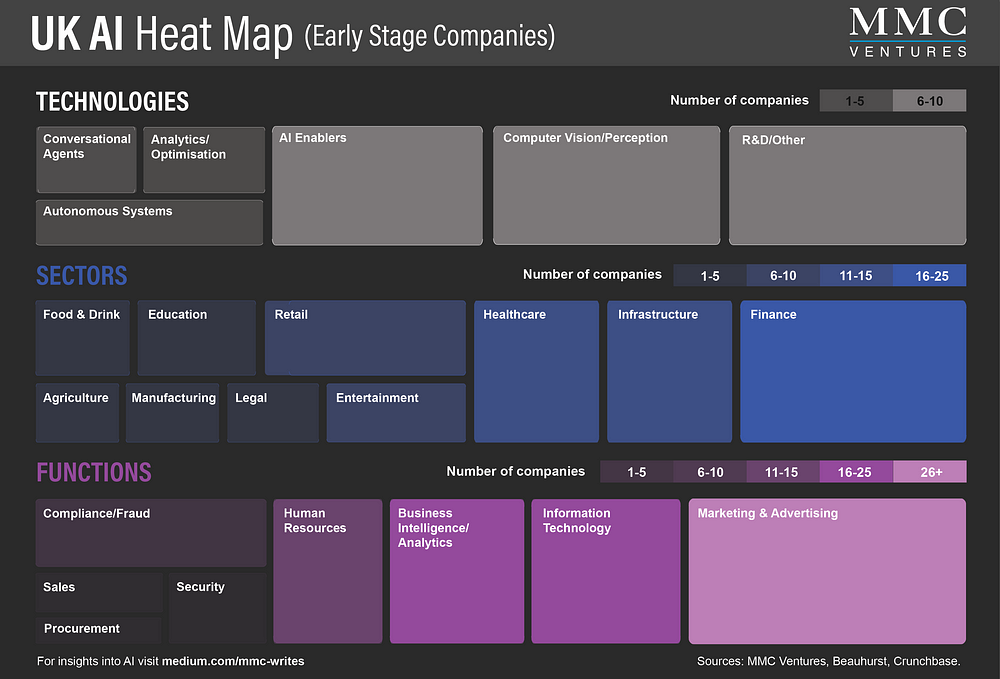
A heat map highlights areas of early stage activity, as measured by the number of companies in each segment (Figure 4, below).

Figure 4: A heat map of early stage AI companies in the UK
Activity is greatest within:
  • The Marketing & Advertising, 
  • Information Technology, and 
  • Business Intelligence & Analytics functions; and
  • The Finance sector.
Activity is extensive within:
  • The Human Resources function; and
  • The Infrastructure, 
  • Healthcare and 
  • Retail sectors.
The sectors above are well suited to the application of AI, explaining the concentration of AI activity within them. The opportunity for value creation within each segment is demonstrable as well as significant. In marketing and in finance, for example, improvements in campaign conversion and financial performance against a benchmark are readily quantifiable. All offer numerous prediction and optimisation challenges well suited to the application of machine learning. All offer large data sets for training and deployment. A path to better-than-human performance is technically achievable. The alternatives are impractical or expensive. And all are specialised verticals, distant from the competitive threat posed by the consumer- and horizontal focus of the AI platform providers Google, Amazon, Microsoft and IBM — with the exception of healthcare where Google and IBM both enable and challenge.

As attractive market fundamentals catalyse activity, the strongest AI companies can develop a competitive moat by:
  • bringing deep domain expertise to bear in a complex domain; 
  • developing proprietary algorithms
  • creating a network effect around data by leveraging non-public data sets; and 
  • by securing adequate capital to build a high quality machine learning team and go-to-market resources.
Activity in Marketing & Advertising dominates; one in five early stage UK AI companies target this function. The fundamentals of modern marketing and advertising represent a sweet-spot for AI. Consumers have billions of touch points with websites and apps, providing a rich seam of available, but complex, data. Further, almost every stage of the marketing and advertising value chain is ripe for optimisation and automation — including
  • content processing, 
  • consumer segmentation, 
  • consumer targeting, 
  • programmatic advertising optimisation, 
  • purchase discovery for consumers and 
  • analysis of consumer sentiment.
Areas of lower activity
In a number of areas, activity appears modest relative to market opportunities. In the Manufacturing sector, for example, there are few startups to address a substantial need.
  • Machine learning has the potential to unlock 20% more production capacity through predictive, optimised maintenance of machines
  • Raw material costs and re-working can be reduced through improved analysis of product quality data
  • Further, ‘buffering’ — storing raw materials and part-developed products to compensate for unforeseen inefficiencies during production — can be reduced by up to 30% given more predictable production capacity. 
  • The proliferation of sensors in the manufacturing industry, including sensor data from the production line, machine tool parameters and environmental data, has also increased significantly the data available for machine learning.
Within the Compliance & Fraud function, there appear few startups capitalising on banks’ ballooning expenditure on compliance.
  • 30,000 people in Citi — 12% of the Bank’s workforce — now work in compliance. In its 1Q15 conference call, Citi highlighted that over 50% of the $3.4B it saved through efficiency initiatives was being consumed by additional investments in regulation and compliance. The dynamics are similar among Citi’s peers. 
  • JP Morgan increased compliance spend 50% between 2011 and 2015, to $9B, while 
  • Goldman Sachs highlighted that its 11% increase in headcount in the last four years has largely been to meet regulatory compliance needs. 
Our discussions with banks highlight particular focus on ‘Know Your Customer’ (KYC) and Anti- Money Laundering (AML) initiatives. Beyond presenting an extensive need, the sector offers large data sets for training, expensive human alternatives and, in some areas at least, an evident ability for machine learning to deliver better-than-human performance given the pragmatic impossibility of humans monitoring the data deluge. There may be few UK compliance companies given in-house efforts by the banks, concern regarding potential client concentration, or competition from US startups — but opportunities appear considerable.

3. AI entrepreneurship has doubled
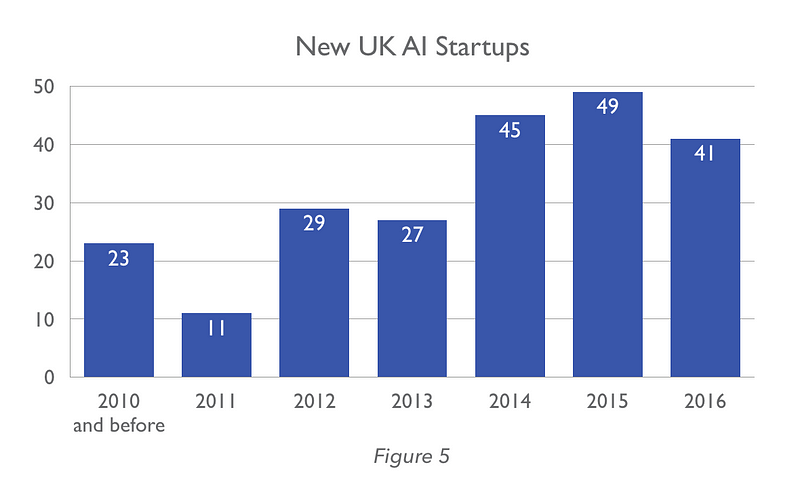
The number of AI companies founded annually in the UK (Figure 5, below) has doubled in recent years (2014–2016) compared with the prior period (2011–2013). Over 60% of all UK AI companies were founded in the last 36 months. During this period, a new AI company has been founded in the UK on almost a weekly basis.
Entrepreneurship in AI is being fuelled by the broader coming of age of AI as well as factors specific to early stage entrepreneurship.

Regarding AI activity generally,
  • seeds planted during the last 20 years of AI research are bearing fruit today. 
  • New algorithms, particularly convolutional and recurrent neural networks, are delivering more effective results. 
  • A logarithmic increase in the availability of training data has made it possible to tune machine learning algorithms to deliver accurate predictions
  • Development of graphical processing units (GPUs) has decreased the time required to train a neural network by 5x-10x. And 
  • a six-fold increase in public awareness of AI during the last five years has increased buyers’ interest in the technology.
Additional factors are fuelling an increase in new AI startups.

  • Venture capital funding of AI companies has increased seven-fold in five years as investors see promise in the sector. 
  • The provision of AI infrastructure and services from industry cloud providers (Google, Amazon, Microsoft and IBM) is reducing the difficulty and cost of deploying machine learning solutions. And 
  • the growth of open source AI software — particularly TensorFlow, a library of components for machine learning — has reduced barriers to involvement
Subject to continued venture capital funding, we expect high levels of AI entrepreneurship in the UK to continue.

Where are new AI companies focusing? 
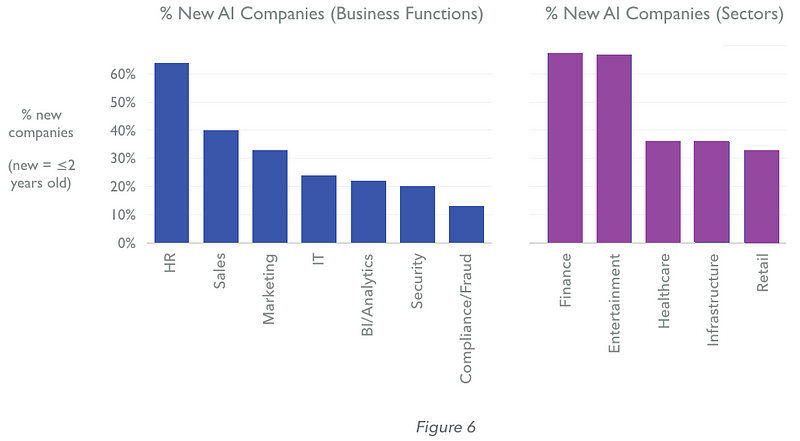
The HR business function and Finance sector have the highest proportion of new AI companies (Figure 6, below). Two thirds of AI HR and Finance companies are less than two years old.


Recent activity in HR stems from a paradigm shift taking place within the function. HR is evolving from an administrative system of record to a predictive driver of growth and efficiency. Business owners are seeking to leverage previously under-utilised data sets to drive utility — ranging from competency-based recruitment to predictive modelling of employee churn.

It is unsurprising that in the business intelligence, security and compliance functions, and in the retail and infrastructure sectors, the proportion of new AI companies is lower. With large data sets ripe for machine learning, these sectors were the first to attract AI entrepreneurs.

4. A nascent sector relative to global peers
The UK AI sector is at a nascent stage in its development relative to global peers, presenting both opportunities and challenges.

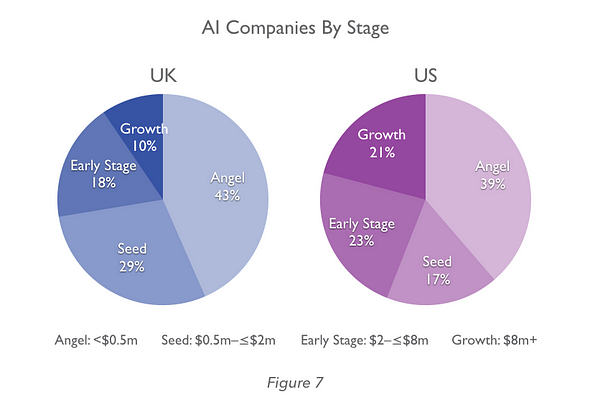
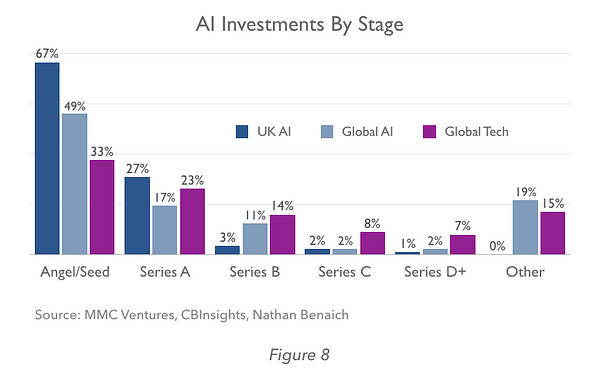
Today, three quarters of UK AI companies are at the earliest stages of their journey, with ‘seed’ or ‘angel’ funding, compared with half of US peers (Figure 7, below). At the other end of the spectrum, just one in 10 UK AI companies is in the late, ‘growth capital’ stage compared with one in five in the US. In 2015, the last full year for which data are available, almost all capital infusions into UK AI companies were at the angel, seed or Series A stage — while among global AI peers a third received later-stage funding (Figure 8, below).


This dynamic presents both opportunities and risks. A vibrant startup scene presents unrivalled opportunities for entrepreneurs, employees and investors in early stage companies. At the same time, more developed and richly funded overseas competitors may increase competitive pressures on UK companies. This effect may be exacerbated by the high proportion of AI companies that sell to enterprises, many of which source providers globally. The UK maintains valuable assets for AI research, including a quarter of the world’s top 25 universities and a growing ecosystem of AI executives and investors following the acquisitions of
5. The journey to monetisation can be longer
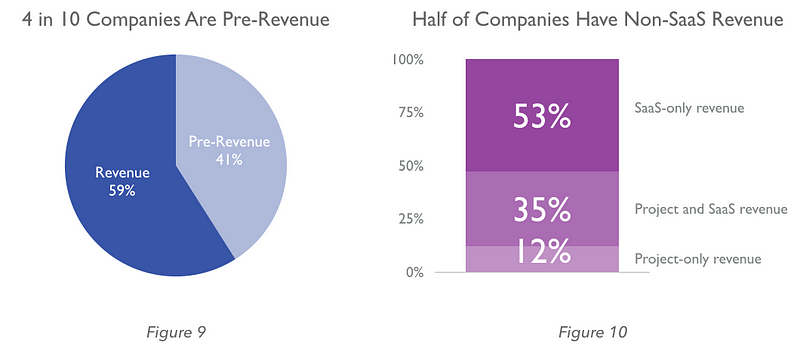
Over 40% of the AI companies we meet are yet to generate revenue (Figure 9, below). This is not an artefact of us meeting ‘early stage’ companies; the median profile of a company we meet is one 
  • founded 2–3 years ago that has 
  • raised £1.3m, has 
  • a team of nine and is 
  • spending £76,000 per month.


The idea that most AI companies — applied AI companies, at least — plan to be acquired pre-revenue instead of selling software and services is a myth. All the companies we met were implementing or developing monetisation plans. Why, then, are some AI companies taking longer to monetise or scale than is usual for early stage companies? We see four reasons:
  • The bar to a minimum viable product (MVP) in this technically challenging field can be higher, requiring longer development periods. 90% of AI companies are B2B. The long sales cycles typical in B2B sales are exacerbated by many AI companies’ focus on sectors, such as finance, with sprawling and sensitive data sets.
  • Deployment periods can be lengthy given
    * extensive per-client data integration,
    * data cleansing and
    * customisation requirements.
    Half the AI companies we meet have a pure software-as-a-service model; as many monetise significant client integration and customisation work in the form of project revenue (Figure 10, above).
  • The limited number of personnel available for implementation in early stage companies is inhibiting many AI companies’ growth. In a sentiment echoed by several companies, one told us “we couldn’t implement more sales even if we had them.” One third of many teams are engaged in deployment support.
  • Exacerbated by cash burn rates increased by the high cost of machine learning talent, a longer path to monetisation can pose a challenge to AI companies. 
We recommend that AI companies raise sufficient capital to last them through this period of risk, to go-to-market and beyond.
6. Investments are larger and staging is atypical
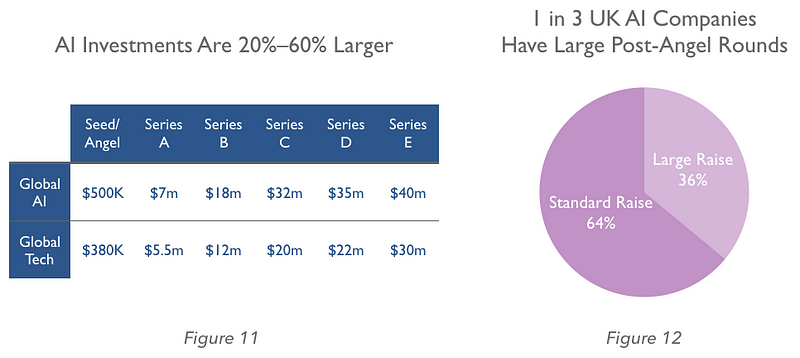
Globally at least, investments into AI firms are typically 20% to 60% larger than average capital infusions (Figure 11, below, shows 2015 data). This reflects company fundamentals and dynamics in the supply and demand of capital. AI companies’ capital requirements can be higher given
  • longer development periods prior to product viability, 
  • the high cost of machine learning talent and 
  • the larger teams required for complex deployments. 
Beyond these fundamentals, however, capital infusions are being inflated by
  • extensive supply (many venture capitalists seek opportunities to invest in artificial intelligence companies) and 
  • limited demand (there are relatively few AI companies in which to invest). 
Venture capital investment in early stage AI companies has increased seven-fold in five years, while the number of investable prospects remains limited.

Further, in the UK a sizeable minority of companies jump from a seed rounds to a much larger raise than is typical for a subsequent round (Figure 12, below). 1 in 3 UK AI companies that raised more than $8m in a funding round raised less than $1m previously. As above, this dynamic is driven in part by AI companies’ capital requirements, but as much by the limited number of attractive investment opportunities in AI. Companies’ valuation expectations, meanwhile, are being supported by ‘acquihire’ offers for nascent teams.


Conclusion: An inflection point in UK AI
The last 36 months have marked an inflection point in early stage UK AI. Entrepreneurship has doubled, as AI technology comes of age and investment has increased. Yet, companies are early in their development relative to global peers, offering entrepreneurs and employees unprecedented opportunity and challenge. Three quarters of UK AI companies are at the earliest stages of their journey and activity remains uneven. Startups have concentrated on readily addressable business functions, where data sets are plentiful and optimisation challenges are pronounced. Today, business processes are being optimised. In the future, they will be re-imagined. Within the last 24 months, additional functions and sectors are starting to be tackled by AI entrepreneurs. The path to monetisation for today’s AI companies can be longer, but effective entrepreneurs are taking advantage of attractive capital dynamics to raise sufficient sums of money earlier in their journey.

As the AI revolution continues, the distinction between ‘AI companies’ and other software providers will further blur. Today, however, we are pleased to highlight the dynamics of a group of companies delivering remarkable benefits. Together, they are shaping the ‘fourth industrial revolution’.

ORIGINAL: Medium
By David Kelnar. Investment Director & Head of Research at MMC Ventures. 2x CEO/CFO. Love tech, venture capital, trends and triathlon. 
Dec 21, 2016

lunes, 3 de octubre de 2016

Partnership on Artificial Intelligence to Benefit People and Society


Established to study and formulate best practices on AI technologies, to advance the public’s understanding of AI, and to serve as an open platform for discussion and engagement about AI and its influences on people and society.

THE LATEST

INDUSTRY LEADERS ESTABLISH PARTNERSHIP ON AI BEST PRACTICES
Press Releases

September 28, 2016 NEW YORK —  IBM, DeepMind,/Google,  Microsoft, Amazon, and Facebook today announced that they will create a non-profit organization that will work to advance public understanding of artificial intelligence technologies (AI) and formulate best practices on the challenges and opportunities within the field. Academics, non-profits, and specialists in policy and ethics will be invited to join the Board of the organization, named the Partnership on Artificial Intelligence to Benefit People and Society (Partnership on AI).

The objective of the Partnership on AI is to address opportunities and challenges with AI technologies to benefit people and society. Together, the organization’s members will conduct research, recommend best practices, and publish research under an open license in areas such as ethics, fairness, and inclusivity; transparency, privacy, and interoperability; collaboration between people and AI systems; and the trustworthiness, reliability, and robustness of the technology. It does not intend to lobby government or other policymaking bodies.

The organization’s founding members will each contribute financial and research resources to the partnership and will share leadership with independent third-parties, including academics, user group advocates, and industry domain experts. There will be equal representation of corporate and non-corporate members on the board of this new organization. The Partnership is in discussions with professional and scientific organizations, such as the Association for the Advancement of Artificial Intelligence (AAAI), as well as non-profit research groups including the Allen Institute for Artificial Intelligence (AI2), and anticipates announcements regarding additional participants in the near future.

AI technologies hold tremendous potential to improve many aspects of life, ranging from healthcare, education, and manufacturing to home automation and transportation. Through rigorous research, the development of best practices, and an open and transparent dialogue, the founding members of the Partnership on AI hope to maximize this potential and ensure it benefits as many people as possible.

viernes, 17 de junio de 2016

IBM, Local Motors debut Olli, the first Watson-powered self-driving vehicle

Olli hits the road in the Washington, D.C. area and later this year in Miami-Dade County and Las Vegas.

Local Motors CEO and co-founder John B. Rogers, Jr. with "Olli" & IBM, June 15, 2016.Rich Riggins/Feature Photo Service for IBM
IBM, along with the Arizona-based manufacturer Local Motors, debuted the first-ever driverless vehicle to use the Watson cognitive computing platform. Dubbed "Olli," the electric vehicle was unveiled at Local Motors' new facility in National Harbor, Maryland, just outside of Washington, D.C.

Olli, which can carry up to 12 passengers, taps into four Watson APIs (

  • Speech to Text, 
  • Natural Language Classifier, 
  • Entity Extraction and 
  • Text to Speech
) to interact with its riders. It can answer questions like "Can I bring my children on board?" and respond to basic operational commands like, "Take me to the closest Mexican restaurant." Olli can also give vehicle diagnostics, answering questions like, "Why are you stopping?"

Olli learns from data produced by more than 30 sensors embedded throughout the vehicle, which will added and adjusted to meet passenger needs and local preferences.

While Olli is the first self-driving vehicle to use IBM Watson Internet of Things (IoT), this isn't Watson's first foray into the automotive industry. IBM launched its IoT for Automotive unit in September of last year, and in March, IBM and Honda announced a deal for Watson technology and analytics to be used in the automaker's Formula One (F1) cars and pits.

IBM demonstrated its commitment to IoT in March of last year, when it announced it was spending $3B over four years to establish a separate IoT business unit, whch later became the Watson IoT business unit.

IBM says that starting Thursday, Olli will be used on public roads locally in Washington, D.C. and will be used in Miami-Dade County and Las Vegas later this year. Miami-Dade County is exploring a pilot program that would deploy several autonomous vehicles to shuttle people around Miami.

ORIGINAL: ZDnet
By Stephanie Condon for Between the Lines
June 16, 2016

martes, 5 de abril de 2016

A Scale-up Synaptic Supercomputer (NS16e): Four Perspectives

Today, Lawrence Livermore National Lab (LLNL) and IBM announce the development of a new Scale-up Synaptic Supercomputer (NS16e) that highly integrates 16 TrueNorth Chips in a 4×4 array to deliver 16 million neurons and 256 million synapses. LLNL will also receive an end-to-end software ecosystem that consists of a simulator; a programming language; an integrated programming environment; a library of algorithms as well as applications; firmware; tools for composing neural networks for deep learning; a teaching curriculum; and cloud enablement. Also, don't miss the story in The Wall Street Journal (sign-in required) and the perspective and a video by LLNL's Brian Van Essen.

To provide insights into what it took to achieve this significant milestone in the history of our project, following are four intertwined perspectives from my colleagues:

  • Filipp Akopyan -- First Steps to an Efficient Scalable NeuroSynaptic Supercomputer.
  • Bill Risk and Ben Shaw -- Creating an Iconic Enclosure for the NS16e.
  • Jun Sawada -- NS16e System as a Neural Network Development Workstation.
  • Brian Taba -- How to Program a Synaptic Supercomputer.
The following timeline provides context for today's milestone in terms of the continued evolution of our project.

Illustration Credit: William Risk

jueves, 10 de diciembre de 2015

Facebook Joins Stampede of Tech Giants Giving Away Artificial Intelligence Technology

Leading computing companies are helping both themselves and others by open-sourcing AI tools.
Facebook designed this server to put new power behind the simulated neurons that enable software to do smart things like recognize speech or the content of photos.
Facebook is releasing for free the designs of a powerful new computer server it crafted to put more power behind artificial-intelligence software. Serkan Piantino, an engineering director in Facebook’s AI Research group, says the new servers are twice as fast as those Facebook used before. “We will discover more things in machine learning and AI as a result,” he says.

The social network’s giveaway is the latest in a recent flurry of announcements by tech giants that are open-sourcing artificial-intelligence technology, which is becoming vital to consumer and business-computing services. Opening up the technology is seen as a way to accelerate progress in the broader field, while also helping tech companies to boost their reputations and make key hires.

In November, Google opened up software called .TensorFlow, used to power the company’s speech recognition and image search (see “.Here’s What Developers Are Doing with Google’s AI Brain”). Just three days later Microsoft released software that distributes machine-learning software across multiple machines to make it more powerful. Not long after, IBM announced the fruition of an earlier promise to open-source SystemML, originally developed to use machine learning to find useful patterns in corporate databanks.

Facebook’s new server design, dubbed Big Sur, was created to power deep-learning software, which processes data using roughly simulated neurons (see “.Teaching Computers to Understand Us”). The invention of ways to put more power behind deep learning, using graphics processors, or GPUs, was crucial to recent leaps in the ability of computers to understand speech, images, and language. Facebook worked closely with Nvidia, a leading manufacturer of GPUs, on its new server designs, which have been stripped down to cram in more of the chips. The hardware can be used to run Google’s TensorFlow software.

Yann LeCun, director of Facebook’s AI Research group, says that one reason to open up the Big Sur designs is that the social network is well placed to slurp up any new ideas it can unlock. “Companies like us actually thrive on fast progress; the faster the progress can be made, the better it is for us,” says LeCun. Facebook open-sourced deep-learning software of its own .in February of this year.

LeCun says that opening up Facebook’s technology also helps attract leading talent. A company can benefit by being seen as benevolent, and also by encouraging people to become familiar with a particular way of working and thinking. As Google, Facebook, and other companies have increased their investments in artificial intelligence, competition to hire experts in the technology has intensified (see “.Is Google Cornering the Market in Deep Learning?”).

Derek Schoettle, general manager of IBM Cloud Data Services unit, which offers tools to help companies analyze data, says that machine-learning technology has to be opened up for it to become widespread. Open-source projects have played a major role in establishing large-scale databases and data analysis as the bedrock of modern computing companies large and small, he says. Real value tends to lie in what companies can do with the tools, not the tools themselves.

What’s going to be interesting and valuable is the data that’s moving in that system and the ways people can find value in that data,” he says. Late last month, IBM transferred its SystemML machine-learning software, designed around techniques other than deep learning, to the Apache Software Foundation, which supports several major open-source projects.

Facebook’s Big Sur server design will be submitted to the Open Compute Project, a group started by the social network through which companies including Apple and Microsoft share designs of computing infrastructure to drive down costs (see “.Inside Facebook’s Not-So-Secret New Data Center”).


ORIGINAL: .Technology Review
December 10, 2015

miércoles, 25 de noviembre de 2015

IBM's SystemML machine learning system becomes Apache Incubator project

There's a race between tech giants to open source machine learning systems and become a dominant platform. Apache SystemML has clear enterprise spin.


IBM on Monday said its machine learning system, dubbed SystemML, has been accepted as an open source project by the Apache Incubator.
SPECIAL FEATURE

Machine learning, task automation and robotics are already widely used in business. These and other AI technologies are about to multiply, and we look at how organizations can best take advantage of them.
The Apache Incubator is an entry to becoming a project of The Apache Software Foundation. The general idea behind the incubator is to ensure code donations adhere to Apache's legal guidelines and communities follow guiding principles.

IBM said it would donate SystemML as an open source project in June.

What's notable about IBM's SystemML milestone is that open sourcing machine learning systems is becoming a trend. To wit:
For enterprises, the upshot is that there will be a bevy of open source machine learning code bases to consider. Google TensorFlow and Facebook Torch are tools to train neural networks. SystemML is aimed a broadening the ecosystem to business use.

Why are tech giants going open source with their machine learning tools? 
The machine learning platform that gets the most data will learn faster and then become more powerful. That cycle will just result in more data to ingest. IBM is looking to work the enterprise angle on machine learning. Microsoft may be another entry on the enterprise side, but may not go the Apache route.

In addition, there are precedents to how open sourcing big analytics ideas can pay off. MapReduce and Hadoop started as open source projects and would be a cousin of whatever Apache machine learning system wins out.

IBM's SystemML, which is now Apache SystemML, is used to create industry specific machine learning algorithms for enterprise data analysis. IBM created SystemML so it could write one codebase that could apply to multiple industries and platforms. If SystemML can scale, IBM's Apache move could provide a gateway to its other analytics wares.

The Apache SystemML project has included more than 320 patches for everything from APIs, data ingestion and documentation, more than 90 contributions to Apache Spark and 15 additional organizations adding to the SystemML engine.

Here's the full definition of the Apache SystemML project:
SystemML provides declarative large-scale machine learning (ML) that aims at flexible specification of ML algorithms and automatic generation of hybrid runtime plans ranging from single node, in-memory computations, to distributed computations on Apache Hadoop and Apache Spark. ML algorithms are expressed in a R or Python syntax, that includes linear algebra primitives, statistical functions, and ML-specific constructs. This high-level language significantly increases the productivity of data scientists as it provides (1) full flexibility in expressing custom analytics, and (2) data independence from the underlying input formats and physical data representations. Automatic optimization according to data characteristics such as distribution on the disk file system, and sparsity as well as processing characteristics in the distributed environment like number of nodes, CPU, memory per node, ensures both efficiency and scalability.

ORIGINAL: ZDNet
November 23, 2015

viernes, 25 de septiembre de 2015

IBM's Watson Personality Insights service

How it works
Personality Insights extracts and analyzes a spectrum of personality attributes to help discover actionable insights about people and entities, and in turn guides end users to highly personalized interactions
The service outputs personality characteristics that are divided into three dimensions: 
While some services are contextually specific depending on the domain model and content, Personality Insights only requires a minimum of 3500+ words of any text.
Intended UsePersonality Insights is great for brand analytics and can help measure a brand's personality and compare/contrast with your customers personalities. It can also help with market segmentation and individualizing marketing campaigns or promotions. Personality Insights can also be used to help recruiters or university admissions match candidates to companies or universities. Overall, Personality Insights individualizes customer care and infers personality traits to drive a more tailored response.

YOU INPUT:JSON, or Text or HTML (such as social media, emails, blogs, or other communication) written by one individual

SERVICE OUTPUT:A tree of cognitive and social characteristics in JSON or CSV format
The IBM Watson™ Personality Insights service provides an Application Programming Interface (API) that enables applications to derive insights from social media, enterprise data, or other digital communications. The service uses linguistic analytics to infer personality and social characteristics, including 
from text. 

These insights help businesses to understand their clients' preferences and improve customer satisfaction by anticipating customer needs and recommending future actions. Businesses can use these insights to improve client acquisition, retention, and engagement, and to strengthen relations with their clients.

You can see a quick demo of the Personality Insights service in action. The demo lets you analyze input text to develop a personality portrait for the author of the text. The applications 
  • Speak Up, 
  • NYC School Finder, and 
  • Your Celebrity Match 
on the Watson Developer Cloud App Gallery also demonstrate the Personality Insights service.

We are always looking to improve and learn from your experience with our services. You can submit comments or ask questions about Personality Insights in the Watson forum. You can also read posts about Watson services that are written by IBM researchers, developers, and other experts on the Watson blog

Specifically, you might want to look at
The Personality Insights service is generally available (GA). For information about the pricing plans available for the service, see thePersonality Insights service in Bluemix.

Developing a Personality Insights application
  • To begin working with the Personality Insights service by creating and running applications that communicate with the service, see the following sections:
  • To create and run an example Node.js application that works with the service from the command line, see Watson Quick Start for Node.js.
  • To create and run a sample Node.js application that works with the service from a web browser, see Developing a Watson application in Node.js. You need the link to the source code for the Node.js application at the personality-insights-nodejs repository in the watson-developer-cloudnamespace on GitHub.
  • To create and run a sample Java application that works with the service from a web browser, see Developing a Watson application in Java. You need the link to the source code for the Java application at thepersonality-insights-java repository in the watson-developer-cloud namespace on GitHub.
  • For the sample applications available from GitHub, you can download a .zipfile that contains the source code or, if you are familiar with Git, fork the repository into your Git namespace or clone it to your local system. To learn about Git or to download Git for your operating system, see git-scm.com/documentation.
  • For a language-independent introduction to working with Watson Developer Cloud services and Bluemix, see Developing Watson applications with Bluemix. That page provides an overview of working with Watson services with the Bluemix web interface, the Eclipse IDE, or the Cloud Foundry command-line tool.

viernes, 21 de agosto de 2015

IBM’S ‘Rodent Brain’ Chip Could Make Our Phones Hyper-Smart


At a lab near San Jose, IBM has built the digital equivalent of a rodent brain---roughly speaking. It spans 48 of the company's experimental TrueNorth chips, a new breed of processor that mimics the brain's biological building blocks. IBM
DHARMENDRA MODHA WALKS me to the front of the room so I can see it up close. About the size of a bathroom medicine cabinet, it rests on a table against the wall, and thanks to the translucent plastic on the outside, I can see the computer chips and the circuit boards and the multi-colored lights on the inside. It looks like a prop from a ’70s sci-fi movie, but Modha describes it differently. “You’re looking at a small rodent,” he says.

He means the brain of a small rodent—or, at least, the digital equivalent. The chips on the inside are designed to behave like neurons—the basic building blocks of biological brains. Modha says the system in front of us spans 48 million of these artificial nerve cells, roughly the number of neurons packed into the head of a rodent.

Modha oversees the cognitive computing group at IBM, the company that created these “neuromorphic” chips. For the first time, he and his team are sharing their unusual creations with the outside world, running a three-week “boot camp” for academics and government researchers at an IBM R&D lab on the far side of Silicon Valley. Plugging their laptops into the digital rodent brain at the front of the room, this eclectic group of computer scientists is exploring the particulars of IBM’s architecture and beginning to build software for the chip dubbed TrueNorth.

'We want to get as close to the brain as possible while maintaining flexibility.'DHARMENDRA MODHA, IBM

Some researchers who got their hands on the chip at an engineering workshop in Colorado the previous month have already fashioned software that can identify images, recognize spoken words, and understand natural language. Basically, they’re using the chip to run “deep learning” algorithms, the same algorithms that drive the internet’s latest AI services, including the face recognition on Facebook and the instant language translation on Microsoft’s Skype. But the promise is that IBM’s chip can run these algorithms in smaller spaces with considerably less electrical power, letting us shoehorn more AI onto phones and other tiny devices, including hearing aids and, well, wristwatches.

What does a neuro-synaptic architecture give us? It lets us do things like image classification at a very, very low power consumption,” says Brian Van Essen, a computer scientist at the Lawrence Livermore National Laboratory who’s exploring how deep learning could be applied to national security. “It lets us tackle new problems in new environments.

The TrueNorth is part of a widespread movement to refine the hardware that drives deep learning and other AI services. Companies like Google and Facebook and Microsoft are now running their algorithms on machines backed with GPUs (chips originally built to render computer graphics), and they’re moving towards FPGAs (chips you can program for particular tasks). For Peter Diehl, a PhD student in the cortical computation group at ETH Zurich and University Zurich, TrueNorth outperforms GPUs and FPGAs in certain situations because it consumes so little power.

The main difference, says Jason Mars, a professor of a computer science at the University of Michigan, is that the TrueNorth dovetails so well with deep-learning algorithms. These algorithms mimic neural networks in much the same way IBM’s chips do, recreating the neurons and synapses in the brain. One maps well onto the other. “The chip gives you a highly efficient way of executing neural networks,” says Mars, who declined an invitation to this month’s boot camp but has closely followed the progress of the chip.

That said, the TrueNorth suits only part of the deep learning process—at least as the chip exists today—and some question how big an impact it will have. Though IBM is now sharing the chips with outside researchers, it’s years away from the market. For Modha, however, this is as it should be. As he puts it: “We’re trying to lay the foundation for significant change.

The Brain on a Phone
Peter Diehl recently took a trip to China, where his smartphone didn’t have access to the `net, an experience that cast the limitations of today’s AI in sharp relief. Without the internet, he couldn’t use a service like Google Now, which applies deep learning to speech recognition and natural language processing, because most the computing takes place not on the phone but on Google’s distant servers. “The whole system breaks down,” he says.

Deep learning, you see, requires enormous amounts of processing power—processing power that’s typically provided by the massive data centers that your phone connects to over the `net rather than locally on an individual device. The idea behind TrueNorth is that it can help move at least some of this processing power onto the phone and other personal devices, something that can significantly expand the AI available to everyday people.

To understand this, you have to understand how deep learning works. It operates in two stages. 
  • First, companies like Google and Facebook must train a neural network to perform a particular task. If they want to automatically identify cat photos, for instance, they must feed the neural net lots and lots of cat photos. 
  • Then, once the model is trained, another neural network must actually execute the task. You provide a photo and the system tells you whether it includes a cat. The TrueNorth, as it exists today, aims to facilitate that second stage.
Once a model is trained in a massive computer data center, the chip helps you execute the model. And because it’s small and uses so little power, it can fit onto a handheld device. This lets you do more at a faster speed, since you don’t have to send data over a network. If it becomes widely used, it could take much of the burden off data centers. “This is the future,” Mars says. “We’re going to see more of the processing on the devices.”

Neurons, Axons, Synapses, Spikes
Google recently discussed its efforts to run neural networks on phones, but for Diehl, the TrueNorth could take this concept several steps further. The difference, he explains, is that the chip dovetails so well with deep learning algorithms. Each chip mimics about a million neurons, and these can communicate with each other via something similar to a synapse, the connections between neurons in the brain.

'Silicon operates in a very different way than the stuff our brains are made of.'

The setup is quite different than what you find in chips on the market today, including GPUs and FPGAs. Whereas these chips are wired to execute particular “instructions,” the TrueNorth juggles “spikes,” much simpler pieces of information analogous to the pulses of electricity in the brain. Spikes, for instance, can show the changes in someone’s voice as they speak—or changes in color from pixel to pixel in a photo. “You can think of it as a one-bit message sent from one neuron to another.” says Rodrigo Alvarez-Icaza, one of the chip’s chief designers.

The upshot is a much simpler architecture that consumes less power. Though the chip contains 5.4 billion transistors, it draws about 70 milliwatts of power. A standard Intel computer processor, by comparison, includes 1.4 billion transistors and consumes about 35 to 140 watts. Even the ARM chips that drive smartphones consume several times more power than the TrueNorth.

Of course, using such a chip also requires a new breed of software. That’s what researchers like Diehl are exploring at the TrueNorth boot camp, which began in early August and runs for another week at IBM’s research lab in San Jose, California. In some cases, researchers are translating existing code into the “spikes” that the chip can read (and back again). But they’re also working to build native code for the chip.

Parting Gift
Like these researchers, Modha discusses the TrueNorth mainly in biological terms. Neurons. Axons. Synapses. Spikes. And certainly, the chip mirrors such wetware in some ways. But the analogy has its limits. “That kind of talk always puts up warning flags,” says Chris Nicholson, the co-founder of deep learning startup Skymind. “Silicon operates in a very different way than the stuff our brains are made of.

Modha admits as much. When he started the project in 2008, backed by $53.5M in funding from Darpa, the research arm for the Department of Defense, the aim was to mimic the brain in a more complete way using an entirely different breed of chip material. But at one point, he realized this wasn’t going to happen anytime soon. “Ambitions must be balanced with reality,” he says.

In 2010, while laid up in bed with the swine flu, he realized that the best way forward was a chip architecture that loosely mimicked the brain—an architecture that could eventually recreate the brain in more complete ways as new hardware materials were developed. “You don’t need to model the fundamental physics and chemistry and biology of the neurons to elicit useful computation,” he says. “We want to get as close to the brain as possible while maintaining flexibility.

This is TrueNorth. It’s not a digital brain. But it is a step toward a digital brain. And with IBM’s boot camp, the project is accelerating. The machine at the front of the room is really 48 separate machines, each built around its own TrueNorth processors. Next week, as the boot camp comes to a close, Modha and his team will separate them and let all those academics and researchers carry them back to their own labs, which span over 30 institutions on five continents. “Humans use technology to transform society,” Modha says, pointing to the room of researchers. “These are the humans..

ORIGINAL: Wired
08.17.15