Mostrando entradas con la etiqueta Planta. Mostrar todas las entradas

viernes, 27 de septiembre de 2013

Colombian Plant Fiber Rids Water of Harmful Textile Dyes in Minutes


Fique. Photo by Wikimedia Commons
Textile dyes and other pollutants can kill waterways. The dyes are not only toxic, but they discolor the water enough to prevent plants and algae from getting enough light, which is needed for photosynthesis. Researchers in Colombia though, are working to come up with a natural and low-cost method to filter these dye-infested waters with a locally sourced plant fiber. After treating the plant fiber with nanoparticles, it can soak up 99% of the dye in the water.

Photo by Zhang Xiaoli for ChinaFotoPress
Waterways near textile plants in South America, India and China are especially threatened because the plants dump their waste, which kills plant and animal life and makes the water undrinkable. Until more non-toxic dyes are used or tighter regulations imposed, the water needs to be filtered and cleaned. Researchers at Colombia’s Universidad Industrial de Santander Chemistry Department have been working on a technique to use natural plant fibers to clean polluted waters from toxic dyes.

The technique involves placing Colombian fique plant fibers, which are often used to make coffee bags, into polluted waters where the fibers soak up the dye. Fibers are specially treated using simple techniques so that their tiny cellulose cavities are filled with manganese oxide molecules, which react with the dye and break them down into non-colored forms. According to their results, the method removes 99 percent of the dye and the fibers can be reused many times.

The researchers published their results in the August issue of the Green Chemistry journal. Next up, they hope to test the fibers with other pollutants and try out other fibers or composite materials. “We are working now on developing a low-cost filtering unit prototype to treat polluted waters,” explains study co-author, Marianny Combariza. “We are not only focused on manganese oxides, we also work on a variety of materials based on transition metal oxides that show exceptional degradation activity.”

ORIGINAL: Ecouterre
09/27/13

miércoles, 29 de mayo de 2013

Glowing Plants: Natural Lighting with no Electricity

ORIGINAL: Kickstarter

Create GLOWING PLANTS using synthetic biology and Genome Compiler's software - the first step in creating sustainable natural lighting

As seen on:
Testimonials

What we are offering:
All backers from the USA who back the project with $40 or more will receive seeds to grow a glowing plant at home. Once we have the plant, it is just a matter of breeding enough offspring to grow seeds for all backers. You can expect around 50-100 small seeds in the packet. 

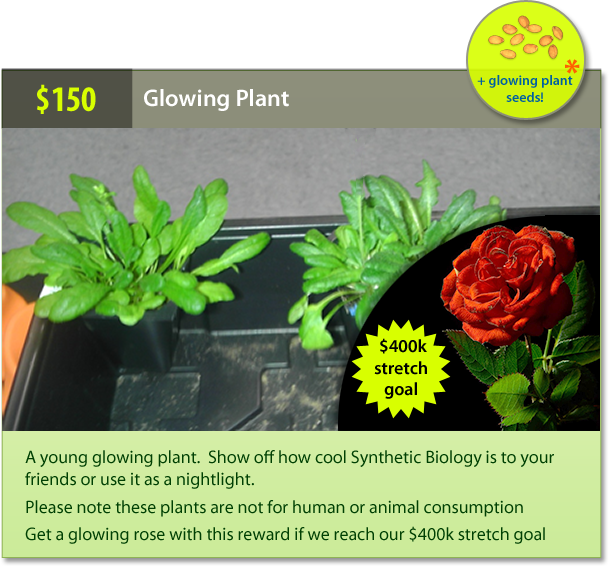
***Update - If you back the project at the $150 and we meet our stretch goal then we will ship you a glowing rose as well when it's completed. Delivery will be 6-12 months after the delivery of the glowing plant***

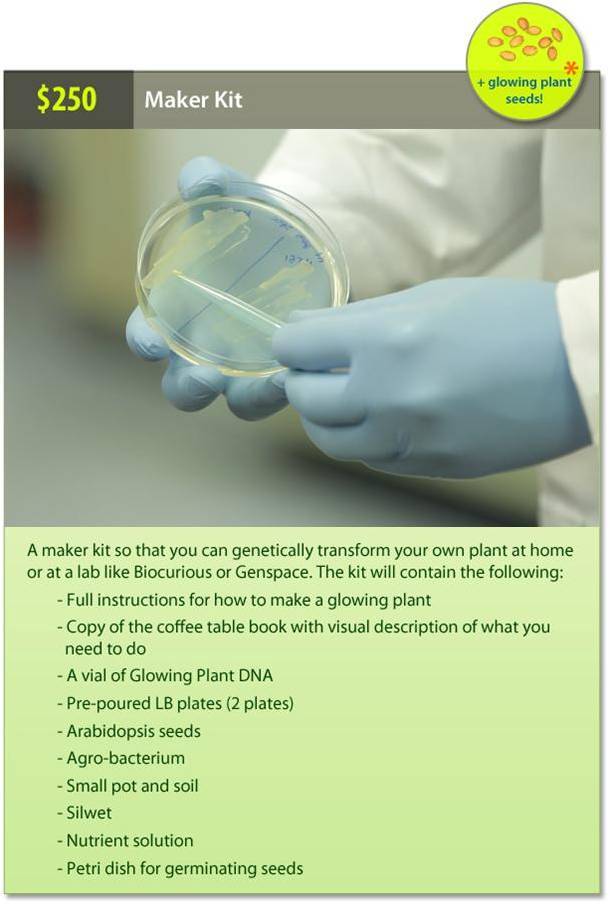
For those outside the USA we are waiving additional international shipping charges to compensate for not being able to send you the seeds. If you get the book and write to us after the project we will also send you a vial of the DNA that way if it's legal in your country (your responsibility to check) and you can source the other ingredients (eg Agrobacterium) you can follow the instructions in the book and make your own plant.

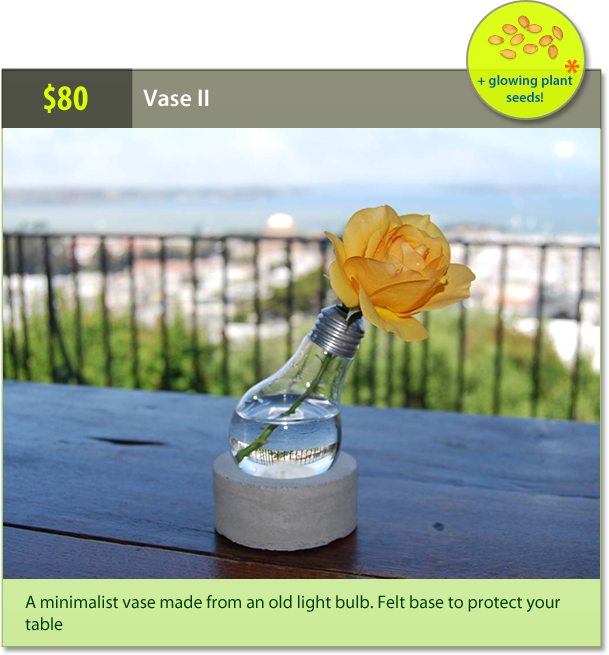
***Update - We've added a new vase, here's a picture, available for a pledge of $80 shipping with glowing plant seeds:

* See Risks and Challenges section regarding release of seeds. 
The team making this happen


Help Spread the Word about the Glowing Plant project: 

·Follow us on twitter (http://twitter.com/glowingplant
·Like us on Facebook (http://facebook.com/glowingplant
·Email your friends our blog (http://www.glowingplant.com
·Tweet about the project - click here for a sample tweet

Please back the project and tell everyone know to help spread the word!
Thank You for Your Support - We Hope You'll Join Us in Making this Project Successful! 
Additional information:

What is Synthetic Biology? 

All living organisms contain an instruction set that determines what they look like and what they do. These instructions are encoded in the organisms’s DNA — long and complex strings of molecules embedded in every living cell. This is an organism’s genetic code (or “genome”).

Humans have been altering the genetic code of plants and animals for millennia, by selectively breeding individuals with desirable features. As biotechnologists have learned more about how to read and manipulate this code, they have begun to take genetic information associated with useful features from one organism, and add it into another one. This is the basis of genetic engineering, and has allowed researchers to speed up the process of developing new breeds of plants and animals.

More recently we have learnt how to make new sequences of DNA from scratch. By combining these techniques with the principles of modern engineering, scientists can now use computers and laboratory chemicals to design organisms that do new things.

This is the essence of synthetic biology and it’s potential is tremendous – we can use it to produce cheaper, more efficient biofuels, to excrete the precursors of medical drugs or create new plants which naturally glow.

Why do we need your help?

We’ve already invested our own time and money into the project developing the DNA designs, finding partners to help execute and investigating the legal ramifications but don’t have the financial resources to print the DNA and complete the transformations ourselves. 

By backing this project you can help create the world’s first naturally glowing plant, inspire others to become interested in synthetic biology and receive some awesome rewards in the process. 

What will you use the funds for?

We are using Synthetic Biology techniques and Genome Compiler’s software to insert bioluminescence genes into Arabidopsis, a small flowering plant and member of the mustard family, to make a plant that visibly glows in the dark (it is inedible).

Funds raised will be used to print the DNA sequences we have designed using Genome Compiler and to transform the plants by inserting these sequences into the plant and then growing the resultant plant in the lab. 

Printing DNA costs a minimum of 25 cents per base pair and our sequences are about 10,000 base pairs long. We plan to print a number of sequences so that we can test the results of trying different promoters – this will allow us to optimize the result. We will be printing our DNA with Cambrian Genomics who have developed a revolutionary laser printing system that massively reduces the cost of DNA synthesis.

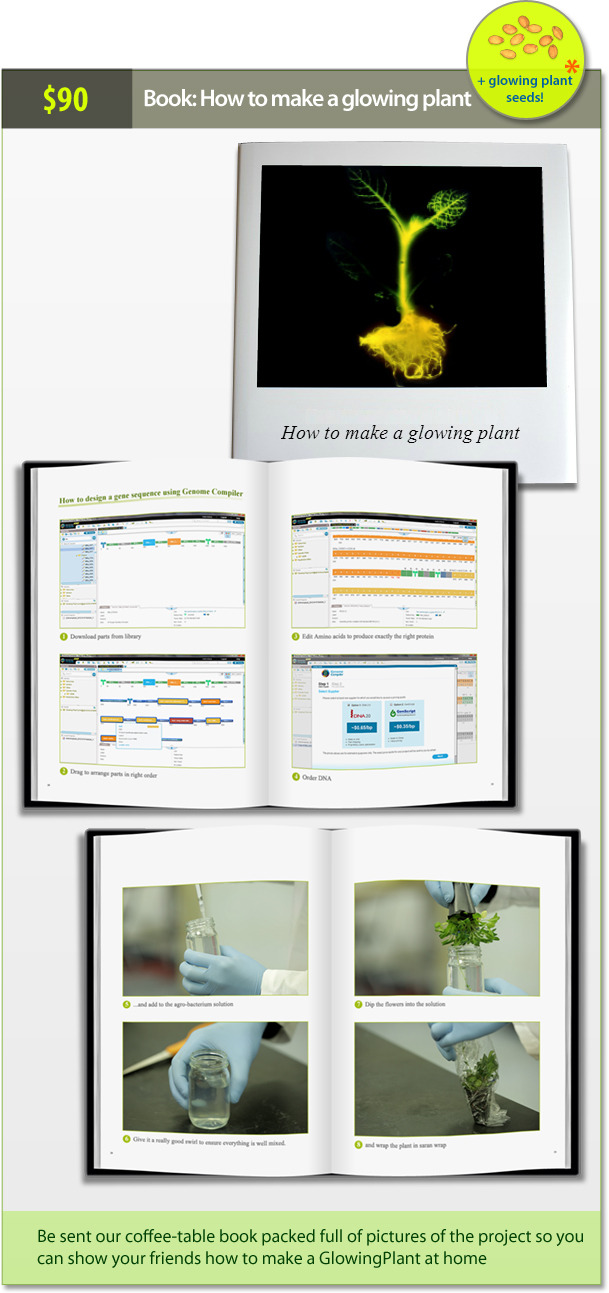
Transforming the plant will initially be done using the Agrobacterium method. Our printed DNA will be inserted into a special type of bacteria which can insert its DNA into the plant. Flowers of the plant are then dipped into a solution containing the transformed bacteria. The bacteria injects our DNA into the cell nucleus of the flowers which pass it onto their seeds which we can grow until they glow! You can see this process in action in our video.

Once we have proven the designs work we will then insert the same gene sequence into the plant using a gene gun. This is more complicated, as there's a risk the gene sequence gets scrambled, but the result will be unregulated by the USDA and thus suitable for release.

Funds raised will also be used to support our work to develop an open policy framework for DIY Bio work involving recombinant DNA. This framework will provide guidelines to help others who are inspired by this project navigate the regulatory and social challenges inherent in community based synthetic biology. The framework will include recommendations for what kinds of projects are safe for DIY Bio enthusiasts and recommendations for the processes which should be put in place (such as getting experts to review the plans).

Why now?

Recent advances in the field of synthetic biology, such as Genome Compiler’s software and Cambrian Genomics DNA printing hardware, have brought the cost and complexity of genetically engineering new organisms within reach of amateurs:
Amazing exponential drop in costs of synthetic biology

As the chart shows, the costs continue to fall, and within a few years thousands of DIY Bio enthusiasts will be using Citizen Science to inspire their own creations. We want to create a signature project which inspires them and demonstrates to the world what’s already possible with a little creativity and imagination. 

Is this legal?

Yes it is! There are three federal agencies which regulate Genetically Modified organisms in the US, each with a different remit for public safety:
USDA regulates plant and agriculture impact through APHIS and are the most relevant for our project. We've been in touch with them to understand and address their main concerns which are mainly related to the introduction of potential plant pests. After more than 15 years working with genetically engineered crops they have established a set of guidelines for what needs additional testing, and what doesn't. So long as we meet all their requirements we can safely release the plant. One of their inputs was that we should use the gene-gun technique to transform our plants, instead of Agrobacterium.
EPA regulates new uses of pesticides - many GMO's introduce pesticide or herbicide resistance to their plants (either as a selection agent or as an intended outcome). We have elected not to do this, as we can use the glowing effect as a marker, so will not need to go through their testing procedures.
FDA regulates food and feedstock implications and requires extensive testing to make sure the product is safe if this is the case. Because our plant is strictly ornamental and not for consumption by animals or humans we do not have to go through this testing.


We will continue to liaise with the federal agencies, especially APHIS, as the project develops to ensure we are compliant with the frameworks they have put in place to protect the public.

Regrettably the European Union has tighter restrictions in place so we can’t send seeds there as a reward.


Is this safe?

The head of Genetics at Harvard Medical School, George Church, who works extensively on engineering biosafety described our project as 'as safe as it gets'. We are introducing non-pathogenic, non-toxic, well categorized genes to a model plant which is well understood by biologists and which will not survive very well in the environment. 

In the lab we will comply with all NIH guidelines on recombinant DNA research. Our work is graded at Biosafety Level 1, which is the lowest level of risk to the external environment.

What is Genome Compiler?

Genome Compiler is software, designed by Omri and his team, which allows a user to easily design genetic sequences and order them online. The software includes a large database of genetic parts and a beautiful interface so you can easily combine them to create your desired results.

What is Cambrian Genomics?

At Cambrian Genomics Austen and his team make the first commercial hardware/systems for laser printing DNA. Presently, researchers in academia and industry order or clone >$1b/year of DNA. Cambrian plans to deliver high quality sequence verified DNA to buyers in this existing/growing worldwide market.

What is Project Cyborg?

Currently being developed by the Bio/Nano/Programmable Group at Autodesk Research, Project Cyborg is a cloud-based meta-platform of design tools for programming matter across domains and scales. Project Cyborg provides elastic cloud-based computation in a web-based CAD shell for services such as modeling, simulation and multi-objective design optimization. Project Cyborg allows individuals or groups to create specialized design platforms specific for their domains, whatever their domains happen to be, from nanoparticle design to tissue engineering, to human-scale self-assembling manufacturing.

Who made your video?

The video was made by Rick Symonds, who is based on San Francisco. You can see more of his work and contact him at www.ricksymonds.com.

Video Music: "The March" by LIGHTS & MOTION Courtesy of Deep Elm Recordswww.deepelm.com/lightsandmotion

Where can I get more information?

Want to know more? Just give us a call +1-415-779-6333 or email antony at glowing plant dot com.


We are confident that we can deliver on the rewards we are offering backers. There are two main risks to the project:

1) Transformation 
We have put every care into the designs of the DNA but we may not get the glowing result we (and you) hope for. Biology is complicated and while we are confident of getting some glowing effect (it's been done before in a research lab) we may not get a strong effect as we (or you) want or it may be unreliable. We hope to have a plant which you can visibly see in the dark (like glow in the dark paint) but don't expect to replace your light bulbs with version 1.0. The more money we raise, the more we can refine our designs and the stronger the effect we will get so please tell all your friends about the project.

2) Emerging regulation 
We have received written indication from USDA/APHIS that our plant will not require a permit. However this is a new field and it is possible that more restrictive regulations are implemented during the project that will require us to get a permit which would delay the release of the seeds or possibly block the release altogether.


FAQ

7,122backers
$406,245pledged of $65,000 goal

8days to go


This project will be funded on Friday Jun 7, 1:00am EDT.


Funding period 
Apr 23, 2013 - Jun 7, 2013

Project by


First created · 4 backed
Antony Evans 1054 friends


Pledge $40 or more

1000 backers All gone!


GLOWING PLANT SEEDS. Grow your own glowing plant at home, includes full instructions for how to tend and care for it
Estimated delivery: May 2014
Ships within the US only


Pledge $65 or more

200 backers All gone!


Recycled light bulb vase that you can show off to your friends BONUS: Glowing plant seeds
Estimated delivery: May 2014


Pledge $120 or more

100 backers All gone!


EARLY BIRD. Be the first to get an actual glowing plant.
Estimated delivery: May 2014
Ships within the US only


lunes, 28 de enero de 2013

Bioinspired Fibers Change Color when Stretched

ORIGINAL: Wyss Institute
January 28, 2013

The so-called "bastard hogberry," shown here floating in water (which changes its apparent color), has inspired a new type of photonic fiber. (Image courtesy of Peter Vukusic.)
Color-tunable photonic fibers mimic the fruit of the "bastard hogberry" plant

A team of materials scientists at Harvard University and the University of Exeter, UK, have invented a new fiber that changes color when stretched. Inspired by nature, the researchers identified and replicated the unique structural elements that create the bright iridescent blue color of a tropical plant's fruit.

The multilayered fiber, described today in the journal Advanced Materials, could lend itself to the creation of smart fabrics that visibly react to heat or pressure.

"Our new fiber is based on a structure we found in nature, and through clever engineering we've taken its capabilities a step further," says lead author Mathias Kolle, a postdoctoral fellow at the Harvard School of Engineering and Applied Sciences (SEAS). "The plant, of course, cannot change color. By combining its structure with an elastic material, however, we've created an artificial version that passes through a full rainbow of colors as it's stretched."
The photonic fibers are made by wrapping multiple layers of polymer around a glass core, which is later etched away. The thickness of the layers determines the apparent color of the fiber, which can range across the entire visible spectrum of light. (Image courtesy of Mathias Kolle.)
Since the evolution of the first eye on Earth more than 500 million years ago, the success of many organisms has relied upon the way they interact with light and color, making them useful models for the creation of new materials. For seeds and fruit in particular, bright color is thought to have evolved to attract the agents of seed dispersal, especially birds.

The fruit of the South American tropical plant, Margaritaria nobilis, commonly called "bastard hogberry," is an intriguing example of this adaptation. The ultra-bright blue fruit, which is low in nutritious content, mimics a more fleshy and nutritious competitor. Deceived birds eat the fruit and ultimately release its seeds over a wide geographic area.
Zooming in on the structure of the hogberry fruit, multiple scales of repeating architecture become clear. (Image courtesy of Mathias Kolle.)
"The fruit of this bastard hogberry plant was scientifically delightful to pick," says principal investigator Peter Vukusic, Associate Professor in Natural Photonics at the University of Exeter. "The light-manipulating architecture its surface layer presents, which has evolved to serve a specific biological function, has inspired an extremely useful and interesting technological design."

Vukusic and his collaborators at Harvard studied the structural origin of the seed's vibrant color. They discovered that the upper cells in the seed's skin contain a curved, repeating pattern, which creates color through the interference of light waves. (A similar mechanism is responsible for the bright colors of soap bubbles.) The team's analysis revealed that multiple layers of cells in the seed coat are each made up of a cylindrically layered architecture with high regularity on the nano- scale.
The researchers at Harvard developed a unique method of producing the photonic fibers; they believe it can be scaled up for industrial fabrication. (Image courtesy of Mathias Kolle.)
The team replicated the key structural elements of the fruit to create flexible, stretchable and color-changing photonic fibers using an innovative roll-up mechanism perfected in the Harvard laboratories.

"For our artificial structure, we cut down the complexity of the fruit to just its key elements," explains Kolle. "We use very thin fibers and wrap a polymer bilayer around them. That gives us the refractive index contrast, the right number of layers, and the curved, cylindrical cross-section that we need to produce these vivid colors."

The researchers say that the process could be scaled up and developed to suit industrial production.

"Our fiber-rolling technique allows the use of a wide range of materials, especially elastic ones, with the color-tuning range exceeding by an order of magnitude anything that has been reported for thermally drawn fibers," says coauthor Joanna Aizenberg, Amy Smith Berylson Professor of Materials Science at Harvard SEAS, and Kolle's adviser. Aizenberg is also Director of the Kavli Institute for Bionano Science and Technology at Harvard and a Core Faculty Member at the Wyss Institute for Biologically Inspired Engineering at Harvard.

The fibers' superior mechanical properties, combined with their demonstrated color brilliance and tunability, make them very versatile. For instance, the fibers can be wound to coat complex shapes. Because the fibers change color under strain, the technology could lend itself to smart sports textiles that change color in areas of muscle tension, or that sense when an object is placed under strain as a result of heat.

Additional coauthors included Alfred Lethbridge at the University of Exeter, Moritz Kreysing at Ludwig Maximilians University (Germany), and Jeremy B. Baumberg, Professor of Nanophotonics at the University of Cambridge (UK).

This research was supported by the U.S. Air Force Office of Scientific Research Multidisciplinary University Research Initiative, by the UK Engineering and Physical Sciences Research Council, and through a postdoctoral research fellowship from the Alexander von Humboldt Foundation. The researchers also benefited from facilities at the Harvard Center for Nanoscale Systems, which is part of the National Nanotechnology Infrastructure Network supported by the U.S. National Science Foundation. The Wyss Institute for Biologically Inspired Engineering at Harvard also contributed to this research.

CONTACT: Caroline Perry, (617) 496-1351

martes, 7 de agosto de 2012

SLIPS liquid repeller is inspired by carnivorous plants, enemy to insects and graffiti artists alike

ORIGINAL: Engadget
Aug 3rd 2012 8:12PM


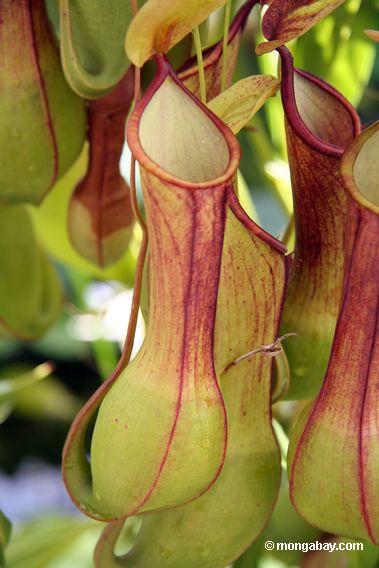
When a team of Harvard researchers wanted to create the ultimate liquid- and solid-repelling surface, they looked toward the Nepenthes pitcher plant, where curious insects check in and never check out, thanks to slippery walls that lead to their tiny, horrific fate. The tropical plant inspired the creation of SLIPS (Self-healing, Slippery Liquid-Infused Porous Surface), a synthetic material that utilizes nano/ microstructured substrates, capable of repelling just about anything you can throw at it. During a visit to the hallowed Crimson halls, the team was kindly enough to show off the material through a series of messy, messy demos, dropping water, motor oil, liquid asphalt and newly-mixed concrete on aluminum and glass. The team even went crazy with a can of black spray paint, comparing the results to a Teflon surface. The outcome was the same in all case -- an amazingly repellent material.

Nepenthes pitcher plant. This photo was taken at the San Francisco Conservatory of Flowers in Golden Gate Park. Mongabay.com ran an article on the Conservatory at Medicinal powers of plants explored at San Francisco Conservatory of Flowers 
The team has published a number of papers on the stuff, including ones that demonstrate its ice- and bacteria-repelling properties. Oh, and like its natural inspiration, SLIPS does a great jobs keeping bugs off its surface. You can check out our demos and one unhappy ant filmed by the SLIPS team. No insects were harmed in the making of our video, at least -- and the lab assures us that ant had a good life before learning the hard way why it shouldn't mess with Harvard scientists.


SLIPS

domingo, 10 de junio de 2012

Plant parasite of plants

ORIGINAL: Phytophactor
By The Phytophactor

"Knowledge is knowing a tomato is a fruit. Wisdom is not putting it in a fruit salad."

Image courtesy of Silvae.
One of our students defended her master's thesis today, and it was a very impressive study designed to see if a plant parasite responds to a host plant under water stress like insect herbivores would respond. The parasite is an amazing organism, dodder, a fully parasitic vine in the morning glory family. It looks like yellow-gold silly string, and it can make some really impressive infestations. One of the hardest problems is keeping a single parasite on a single host, and in nature the vine can sprawl across numerous hosts and make hundreds of connections to the vascular tissues of the host plants. It turns out that dodder doesn't react like aphids or other herbivous insects, but it is a totally amazing organism none-the-less. 

martes, 15 de mayo de 2012

Amazing Singing Plants Phenomenon

ORIGINAL: IN5d

Amazing Singing Plants Phenomenon | in5d.com
MessageToEagle.com - Plants are very much alive. Not only do they dislike human noise but they also posses the capacity to learn and communicate.

Perhaps even more astonishing is that plants can also make music.

Have you ever heard the incredible music of the plants? Plants can actually sing and compose music and listening to it is truly beautiful and relaxing!

Ever since 1975, researchers at Damanhur, in northern Italy have been experimenting with plants, trying to lean more about their unique properties.

Researchers use devices which they have created to measure the re-activity of the plants to their environment. The devices judge the plants' capacity to learn and communicate.

Using a simple principle, the researchers used a variation of the Wheatstone bridge, an electrical circuit used to measure an unknown electrical resistance by balancing two legs of a bridge circuit, one leg of which includes the unknown component.

singing plants - Music of the plants is beautiful and relaxing.
Music of the plants is beautiful and relaxing.
This device has 3 fixed resistances and 1 variable one. Electrical differences between the leaves and the roots of the plant are measured. These differences can then be translated into a variety of effects, including music, turning on lights, movement and many others.

There is no danger to the plants as the researchers use very low intensity electrical currents.

Researchers state that every living creature whether animal or plant, produces variations of electrical potential, depending on the emotions being experienced at the time.

The music starts at around 2:11. Credit: www.damanhur.org


The plant send impulses to the midi-instruments. The midi-signal goes to a midi-thru-box and from there to the software

The device that takes the measurements is a tool from damanhur called U1.

The plants have the most sensitive variations when they signal the arrival of the person who cares for them, when being watered, when spoken to, during the creation of music, etc.

Sensations felt within the plant induce a physiological reaction, which then expresses itself in electrical, conductive and resistance variations.

These variations can be translated in different ways, including into musical scales.

The experiments have shown that plants definitely appear to enjoy learning to use musical scales and also making their own music with the use of a synthesizer.

Although there is currently little scientific research conducted on this subject, one cannot deny that listen to these beautiful plants is a joy for the soul.

sábado, 31 de marzo de 2012

Las abejas se automedican para combatir hongos

ORIGINAL: LiveScience
Jennifer Welsh
31 de marzo 2012 Hora: 9:06 PM ET


Cuando se enfrentamos a los hongos patógenos, las abejas recubren sus colmenas con más propóleo - la sustancia cerosa, de color amarillo que se ve aquí.
Investigadores han encontrado que cuando se enferman, las abejas se apuran a ir a su propio "botiquín". En concreto, cuando están infectadas con hongos, recogen abundantes extractos de plantas antifúngicas y abrigan sus colmenas con ellos.

La mezcla de resinas de las plantas y la cera que las abejas suelen utilizar para llenar sus colmenas, llamados propóleos tiene propiedades antifúngicas.

La nueva investigación podría ayudar a los apicultores evitar infecciones por hongos en sus colonias, Michael Simone-Finstrom de la North Carolina State University, dijo en un comunicado. "Históricamente, los apicultores de Estados Unidos prefieren las colonias que se utilizan menos de esta resina, debido a que es pegajosa y pueden difículta trabajar", dijo. "Ahora sabemos que esta es una característica que vale la pena promover, ya que parece ofrecer a las abejas una defensa natural".

Los investigadores estudiaron a 23 colonias, de las cuales 12 tenían colmenas cubiertas con las cantidades "naturales" de resina, y 11 con las bajas cantidades que normalmente se utilizan en la apicultura. A continuación, desafiaron las colonias con infecciones fúngicas y bacterianas, y analizaron cómo muchas abejas salieron a buscar la resina para el propóleo en cada colmena, para ver si la colmena estaba enviando más recolectores a obtener resina.

Los investigadores encontraron que cuando se enfrentan a una amenaza de hongos. las abejas traen el 45 por ciento más de la creación de cera para llenar sus colmenas, y eliminado físicamente larvas infectadas con hongos de su área. Curiosamente, eso significa que tienen una mejor comprensión de la teoría de los gérmenes de la enfermedad que la que tenían los humanos antes del siglo 19 - las cosas que entran en contacto con los microbios tienden a causar más infecciones, señalaron los investigadores.

"La colonia está dispuesta a gastar la energía y el esfuerzo de sus trabajadores las abejas para recoger estas resinas", dijo Simone-Finstrom en un comunicado. "Es así que, claramente este comportamiento se ha desarrollado debido a que el beneficio para la colonia supera el costo".

Las abejas eran incluso conscientes de qué hongos son perjudiciales y cuáles no lo eran. Cuando se infectan con el hongo que no causa la enfermedad, las abejas inician su proceso de deposición de propóleos como respuesta.

Aunque esta sustancia cerosa también se puede defender la colmena contra bacterias, las abejas no parecen utilizarla para el mismo beneficio. Los investigadores observaron lo que parecía un pequeño aumento en el propóleos en las colmenas infectadas con bacterias causantes de enfermedades, pero el efecto no fue significativo. "Hubo un ligero aumento, pero no fue estadísticamente significativa", dijo Simone-Finstrom. "Eso es algo que va a continuar".

El estudio fue publicado 29 de marzo en la revista PLoS ONE.

You can follow LiveScience staff writer Jennifer Welsh on Twitter @microbelover. Follow LiveScience for the latest in science news and discoveries on Twitter @livescience and on Facebook.