Mostrando entradas con la etiqueta Cambio Climático. Mostrar todas las entradas

lunes, 7 de abril de 2014

A Low-Water Energy Future Isn’t Necessarily Low-Carbon


Planning for a low-carbon energy future is not the same as planning for a low-water energy future, according to new research from Massachusetts Institute of Technology (MIT).

There is a lack of Academic research that compares carbon emissions, water use, and cost, according to lead author Mort Webster, an associate professor of engineering systems at MIT. “When we started this work,” he said in a statement, “we assumed that the basic work had been done, and we were going to do something more sophisticated. But then we realized nobody had done the simple, dumb thing.”

Although there may be a dearth of academic research looking at the exact question Webster was asking, there has been plenty of other research and action that shows governments, utilities and environmental groups are increasingly examining the issue and developing policies that address water, energy and climate change simultaneously.

Three years ago, IEEE Spectrum reported extensively on the water-and-energy crisis. The coverage included models that engineers were developing to look at not just the nexus of water, energy, and carbon, but also air, soil and pollutants. The special issue also looked at how regions as diverse as, say, Australia, Singapore, and California are addressing climate, water, and energy issues.

Last year, the Union of Concerned Scientists (UCS) [PDF] included the issue of water use related to energy production as its own section within UCS’s annual report for the first time. Another report from the International Energy Agency found that about 15 percent of the world’s total water withdrawal goes to energy production, and that figure could increase by about 20 percent between 2010 and 2035.

Webster’s research, which appeared in Nature Climate Change, found what others in the industry already know: limiting carbon dioxide emissions and water usage at the same time requires a different balance of technologies than does just doing one or the other.

  • Nuclear power, for example, is low on the carbon spectrum compared to coal, but uses a lot of water. 
  • Even some more energy-efficient fossil fuel power plants can significantly cut CO2 emissions, but use more water as a result. 
  • Hydropower is low-carbon, but requires a steady supply of water. 
  • Wind and solar photovoltaic are both relatively low-carbon and low-water energy technologies, but concentrating solar power plants use more water than new coal-fired power plants. 
The UCS report found that the increase in water withdrawal by the power industry would be driven by higher-efficiency power plants and expanding biofuels production.

Water concerns are not necessarily taking a backseat to meeting renewable energy portfolio standards and carbon reduction goals. Black & Veatch has found that power utilities identify water supply issues as a bigger concern than nuclear disposal or carbon regulation.

In the Western United States, some power producers are already planning for a low-water future while trying to keep hydropower as a part of the energy mix. For the first time, India, which has growing power needs and water constraints, has identified water as a scarce natural resource in its most recent five-year plan.

But there is a way forward that can take both carbon and water into account. Energy efficiency throughout the entire power sector, from production, to delivery, to end-use, is one way to curb both water and carbon emissions.

As wind and solar PV come down in price, the renewables are also becoming more cost competitive and could displace some of the older, most water- and energy-intensive fossil fuel plants.

Photo: iStockphoto

ORIGINAL: IEEE Spectrum
By Katherine Tweed
Posted 18 Nov 2013 | 21:13 GMT

lunes, 17 de febrero de 2014

Let An MIT Hurricane Expert Explain What All This Extreme Weather Means For The Planet

  [Image: Hurricane via Shutterstock] 

Climate change is perhaps the single most important challenge we'll deal with in the coming centuries. Kerry Emanuel breaks down what's happening now and how science can help us cope.

Kerry Emanuel is one of the world's foremost experts on hurricanes. As a respected scientist at the Massachusetts Institute of Technology, he's published a spate of important, widely cited papers linking climate change to increasingly dangerous weather. But for doing his job, Emanuel's also received emails threatening his family. He continues to do it anyway.

Yesterday, Emanuel hosted a timely Reddit AMA, during which he answered lots of questions about severe weather and climate change. Not everything can be definitively pinned on climate (even though this winter really sucks), nor can we point to one solution (like shooting aerosol into the atmosphere to cool it) to mitigate all the radical changes ahead. At the same time, Emanuel did illuminate critical ways in which science can help us frame our thinking for the future.

Here's what we learned.
THIS IS WHAT THE DATA SAY
Not every single weather event can immediately be attributed to climate change. At the same time, we know that precipitation extremes are likely to increase (and might already have), heat waves will become more common, and "cold waves" less common, Emanuel says. Hurricanes also might become more intense.
A 4 DEGREE CELSIUS RAISE IN AVERAGE TEMPERATURE OVER THE NEXT CENTURY WILL CREATE DIFFERENT RISKS O
ne commenter asked if the next century will result in the end of civilization as we know it. In response, Emanuel says that the most probable outcome is one with "manageable" risks--though we aren't exempt from awful, outlier scenarios either. The cold snaps many of us have been experiencing this winter are extreme only by the standards of the last decade or two.

"But as Marty Weitzman at Harvard has pointed out, we need to pay attention to the tail of the risk distribution, because the economic and societal risks can be very large there," Emanuel says. "Scientists by nature are conservative and do not like to talk about what might happen in the tail, but we do need to think carefully about tail risk as part of our overall assessment of the risk."

Translation: Even if civilization likely won't end, we still need to think about what could go extremely wrong.

THE POLAR VORTEX MAY FEEL EXTREME, BUT THAT FEELING IS RELATIVE

While some disproportionately loud people like to point at the phenomenon of snow during winter, "cold snaps" don't really qualify as historically extreme.

"The cold snaps many of us have been experiencing this winter are extreme only by the standards of the last decade or two; in most places there were worse extremes further back in history," Emanuel says. "I myself have no idea how climate change might affect these, but my intuition (and, I bet, yours!) is that there will be fewer or less extreme cold snaps as the planet warms."

GEO-ENGINEERING COULD WORK, BUT IT PROBABLY WON'T

Remember that guy who dumped 100 tons of iron dust in the Pacific Ocean to try and increase carbon-sucking plankton blooms? That's an example of geo-engineering, processes by which we can try to mitigate climactic change by removing or storing atmospheric carbon. Some pretty radical geo-engineering schemes have been floated in recent years (like that alarming iron seeding scheme, for example, or injecting carbon dioxide underground for long term storage), but the risks of screwing them up are also rather large.

"Whether it is at all advisable, given the associated risks and known side-effects, is another question, and it is probably politically impossible," says Emanuel. "Also, there are strong risks, for example the acidification of the oceans owing to increases in dissolved CO2, that are not addressed by current geo-engineering proposals.

NOT EVERYONE WILL BE EQUALLY IMPACTED BY CLIMATE CHANGE

Some places will actually experience an improvement in climate, says Emanuel. Other regions, however, will be thrown wildly off-kilter. "But I do not think we are far enough along to be able to say just where things will be worst."

CLIMATE SCIENTISTS SHALL NOT BE SILENCED BY DEATH THREATS

Scientific consensus overwhelmingly supports the evidence for man-made climate change, and we may be moving past the era where climate scientists receive death threats just for doing their work. "I think (and hope) that the worst of the threats, etc., are over for climate scientists, and you should not let such threats discourage you from engaging in the very vibrant curiosity-driven research in our field," Emanuel told one aspiring climate scientist.

WE NEED TO THINK ABOUT RISING SEA LEVELS AND EXTREME WEATHER NOW, NOT LATER When the effects of climate change seem so vast and unwieldy, what actions can we take now? Emanuel says we need to consider rising sea levels, which affects the magnitude of storm surges, and thus the damage caused by storms, as well as intense hurricane projections. "These considerations may, for example, enter into calculations of how high and how strongly we need to build sea walls in certain places," he says. Unless we find an economical way to extract CO2 from the atmosphere, we are stuck with human-induced climate change.

BINARY THINKING ABOUT CLIMATE CHANGE DOESN'T HELP ANYONE
Preaching doom isn't constructive. Neither is pointing to one solution and then going for a coffee break. "We have to intelligently weigh climate risks (and possible benefits) against the risks (and possible benefits) of any actions we might contemplate to deal with climate change," Emanuel says. "We have to get away from binary thinking... climate change will be either an apocalypse or nothing to worry about; solutions will either be a complete panacea or not work at all. I do think this is actually the way most people think about the problem of climate change. As usual, the extreme elements are the noisiest, though..."

WE'LL BE STUCK WITH THE DAMAGE FROM MAN-MADE EMISSIONS FOR QUITE A WHILE, BUT IT'LL BE WORSE IF WE DON'T REDUCE THEM One commenter asked what the world might look like if we ended all carbon dioxide emissions immediately. Emanuel wrote that "the concentrations of CO2 would fall of[f] at first fairly rapidly (tens of years) but then much more slowly, taking a thousand years or more to return to pre-industrial levels." Unfortunately, that scenario's unlikely. "So unless we find an economical way to extract CO2 from the atmosphere, we are stuck with human-induced climate change for a long time," Emanuel says.

Last, but not least, being a hurricane expert does have its perks. On flying into a hurricane: "Everyone should experience a flight into the eye of a hurricane," Emanuel writes. "Spectacular views, and not as much turbulence as on many commercial flights..."

To read the full conversation, click here.


ORIGINAL: FastCo Exist

domingo, 16 de febrero de 2014

Arctic melting may help parasites infect new hosts

Grey seals are encountering a killer microbe as they move north


NEW NEIGHBORS As the Arctic emerges from a deep freeze, parasites including Sarcocystis pinnipedi (shown, purple) are able to infect animals that they had never encountered before. M. Grigg

CHICAGO— Along with melting Arctic ice comes an erosion of natural barriers that once separated parasites from hosts.

That erosion has allowed at least two pathogens to infect marine mammals they were previously unknown in, said Michael Grigg, a molecular parasitologist at the National Institutes of Health in Bethesda, Md. He reported the findings February 13 at the annual meeting of the American Association for the Advancement of Science.

A newly identified parasite was once frozen safely away from grey seals (Halichoerus grypus). It has now infected some with disastrous consequences. In 2012, about 20 percent of healthy-looking grey seal pups born on Hay Island in Hudson Bay mysteriously died. The cause turned out to be a parasite that destroyed the livers of 404 pups and two adults, Grigg said.

ORIGINAL:
Science News
by Tina Hesman Saey
February 14, 2014 

jueves, 13 de febrero de 2014

Why Germany's Nuclear Phase Out is Leading to More Coal Burning


In September 2012 Germany's Environment Minister opened a new lignite power plant, arguing the following: “If one builds a new state-of-the-art lignite power plant to replace several older and much less efficient plants, then I feel this should also be acknowledged as a contribution to our climate protection efforts.”

Peter Altmaier is not alone, recently the climate benefits of Germany's new and apparently ultra-efficient coal power plants have been extolled not only by manufacturers such as Siemens and power companies including RWE, but even some of the German nuclear phase out's most vocal proponents.

We are also now seeing increasing numbers of people suddenly noticing an uptick in coal power, and deciding it has little to do with Germany's decision to move away from nuclear energy. These arguments however require both an alternative arithmetic, and an alternative history. Here is why.

In the aftermath of Fukushima, Germany prematurely shut 8 nuclear power plants. Respect for arithmetic and the intelligence of my readers dictates that I do not explain why this should lead to an increase in carbon dioxide emissions. However, the relationship between Germany's nuclear phase out and the construction of new coal power plants deserves an explanation.

Between 2011 and 2015 Germany will open 10.7 GW of new coal fired power stations. This is more new coal coal capacity than was constructed in the entire two decades after the fall of the Berlin Wall. The expected annual electricity production of these power stations will far exceed that of existing solar panels and will be approximately the same as that of Germany's existing solar panels and wind turbines combined.

  • Solar panels and wind turbines however have expected life spans of no more than 25 years. 
  • Coal power plants typically last 50 years or longer. 
At best you could call the recent developments in Germany's electricity sector contradictory.

(Coal production: author's calculation based on 80% load factor projected by Pöyry. Wind and solar production from Fraunhofer ISE. )

These new power plants are sometimes blamed by nuclear proponents on the post-Fukushima decision to shut all nuclear power plants by 2022. This is a myth. Any large piece of infrastructure takes a long time to build, and Germany simply could not respond to Fukushima by building new coal power plants at this scale and speed. Investment decisions for these power plants were made in 2005-2008 (see table 2 here). In response supporters of the nuclear phase out claim this shows that construction of new coal power plants have nothing to do with Germany's decision to phase out nuclear energy. This however is historical revisionism.

A terse history lesson. In the year 2000 the government of Gerhard Schröder announced that all of Germany's nuclear power plants must close by 2022, and this was passed into law in 2002.. This policy was revised by Angela Merkel in September 2010 to extend the lives of nuclear power plants so that the phase out would occur by 2032. Then after Fukushima, Merkel wisely or opportunistically - take your pick - decided to revert largely to the earlier phase out plan, closing eight nuclear power plants immediately and ruling that all would close by 2022.

The policy to phase out nuclear power was vital to the decisions to build new coal power plants. Closing down a quarter of your electricity generation leaves a gap that must be filled by something, and Germany realised it would largely have to be filled by one thing: coal. This is more or less beyond doubt, because Germany's then Environment Minister Sigmar Gabriel said so. Gabriel, now Germany's Minister for Energy and Economics told climate scientist James Hansen that Germany had to build new coal power plants because of its nuclear phase out, and stated elsewhere that Germany would have to build 8 to 12 coal power plants to replace its nuclear fleet.

And this is exactly what he got. In the first half of this decade Germany will open 9 new coal power plants.

By Robert Wilson
Posted January 20, 2014

sábado, 8 de febrero de 2014

The projected timing of climate departure from recent variability

ABSTRACT
Ecological and societal disruptions by modern climate change are critically determined by the time frame over which climates shift beyond historical analogues. Here we present a new index of the year when the projected mean climate of a given location moves to a state continuously outside the bounds of historical variability under alternative greenhouse gas emissions scenarios.

Using 1860 to 2005 as the historical period, this index has a global mean of 2069 (±18 years s.d.) for near-surface air temperature under an emissions stabilization scenario and 2047 (±14 years s.d.) under a ‘business-as-usual’ scenario. Unprecedented climates will occur earliest in the tropics and among low-income countries, highlighting the vulnerability of global biodiversity and the limited governmental capacity to respond to the impacts of climate change. Our findings shed light on the urgency of mitigating greenhouse gas emissions if climates potentially harmful to biodiversity and society are to be prevented.


Figure 1: Estimating the projected timing of climate departure from recent variability.
Estimating the projected timing of climate departure from recent variability.
a, Mean annual temperatures of an example grid cell (small square on map) exceed historical climate bounds (grey area) for three consecutive years starting in 2012 (blue arrow) and for 11 consecutive years after 2023 (green arrow);

Figure 2: The projected timing of climate departure from recent variability.
The projected timing of climate departure from recent variability.
a, b, Projected year when annual (a) or monthly (b) air temperature means move to a state continuously outside annual or monthly historical bounds, respectively. c, Absolute change in mean annual air temperature

Figure 3: The projected timing of climate departure from recent variability in global biodiversity hotspots.
The projected timing of climate departure from recent variability in global biodiversity hotspots.
These plots indicate the difference between the average year in which the climate exceeds bounds of historical variability for each hotspot and the estimated global averages

ORIGINAL: Nature
By Camilo Mora,
Abby G. Frazier,
Ryan J. Longman,
Rachel S. Dacks,
Maya M. Walton,
Eric J. Tong,
Joseph J. Sanchez,
Lauren R. Kaiser,
Yuko O. Stender,
James M. Anderson,
Christine M. Ambrosino,
Iria Fernandez-Silva,
Louise M. Giuseffi
& Thomas W. Giambelluca

Affiliations
Contributions
Corresponding author


Nature 502, 183–187 (10 October 2013)

doi:10.1038/nature12540 Received
25 April 2013 Accepted
06 August 2013 Published online
09 October 2013
Article tools 
 Citation
Reprints
Rights & permissions
Article metrics

Abstract•  
References•
Author information•
Extended data figures and tables

miércoles, 5 de febrero de 2014

Winter Olympics: Downhill forecast


Winter sports face an uncertain future as the planet warms.
Sergei Grits/AP
Snow has been stockpiled for the Olympic Winter Games in Sochi, Russia, for a year.

Skiers, snowboarders and other athletes got a bit of a shock when they arrived in Sochi, Russia, for the 22nd Olympic Winter Games. On the way into town from the airport, competitors passed rows of palm trees that thrive in the breezes blowing off the Black Sea. Forty kilometres away, on the ski slopes of Rosa Khutor, Sochi organizers have spent a year stockpiling manufactured snow as a hedge against the region’s mild climate.

Meteorologists may scoff at the decision to hold a winter sporting event in a city where February averages a balmy 6 °C and temperatures hover just above freezing in the nearby mountains. But Sochi and its massive snow-making operation offer a glimpse of the future of skiing and the pressures that will confront Olympic planners as the world heats up.

Source: Rutgers Univ. Global Snow Lab

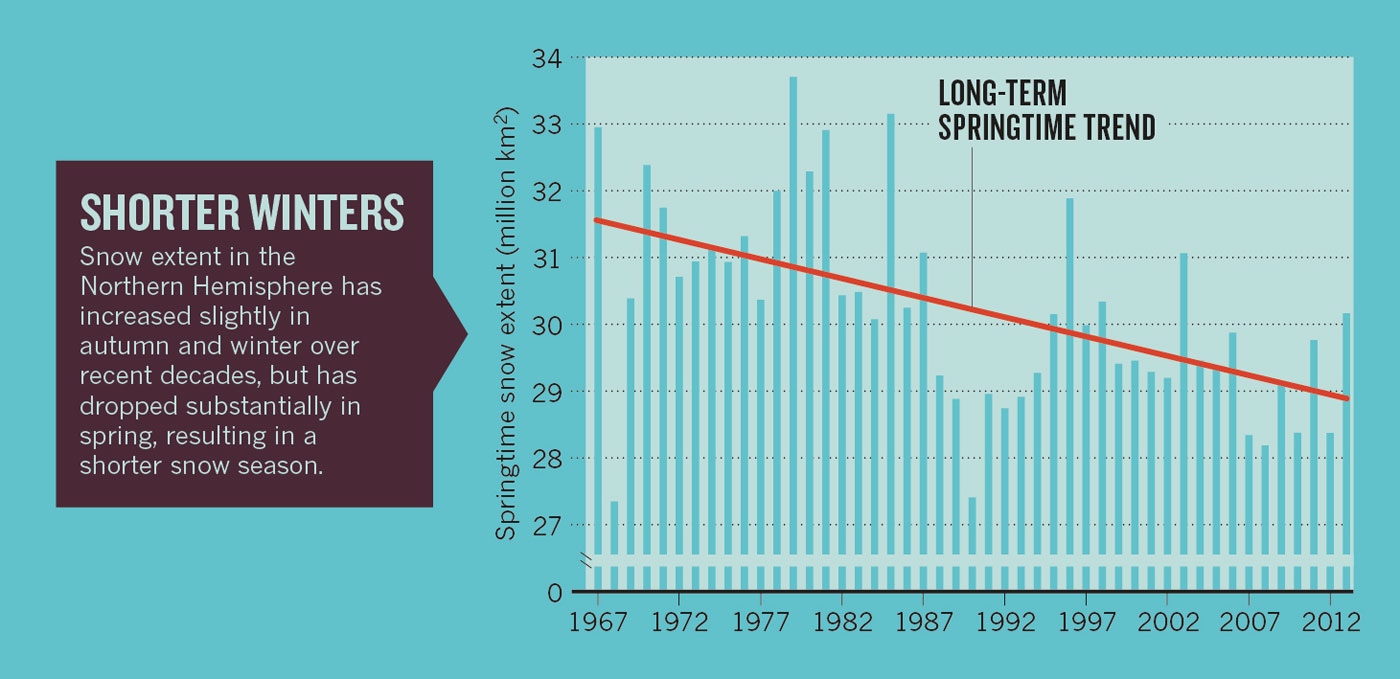
“We know things are going to get warmer, and eventually, when you have temperatures above freezing more commonly than not, you’re going to see less snow,” says David Robinson, a hydro-climatologist who runs the Global Snow Lab at Rutgers University in Piscataway, New Jersey. In the Northern Hemisphere, the snow season has shrunk by about three weeks since the early 1970s (see ‘Shorter winters’), and snow cover is projected to decline substantially by the end of the century, according to a report released in September by the Intergovernmental Panel on Climate Change.

There is considerable uncertainty in regional forecasts for individual skiing regions, but climate researchers say that models agree on broad patterns. “By the second half of the twenty-first century, the models suggest we’ll be seeing really big changes in temperature and precipitation,” says Martin Beniston, a climate physicist at the University of Geneva in Switzerland. Already, signs of an unwelcome thaw have appeared at even the highest elevations. This season, the Verbier 4 Vallées resort in Switzerland eliminated two chair lifts after the lower edge of Tortin Glacier, at 2,800 metres elevation, receded by 40 metres in just 15 years.

Source: J. Hendrikx et al. Clim. Change. 119, 965–978 (2013)

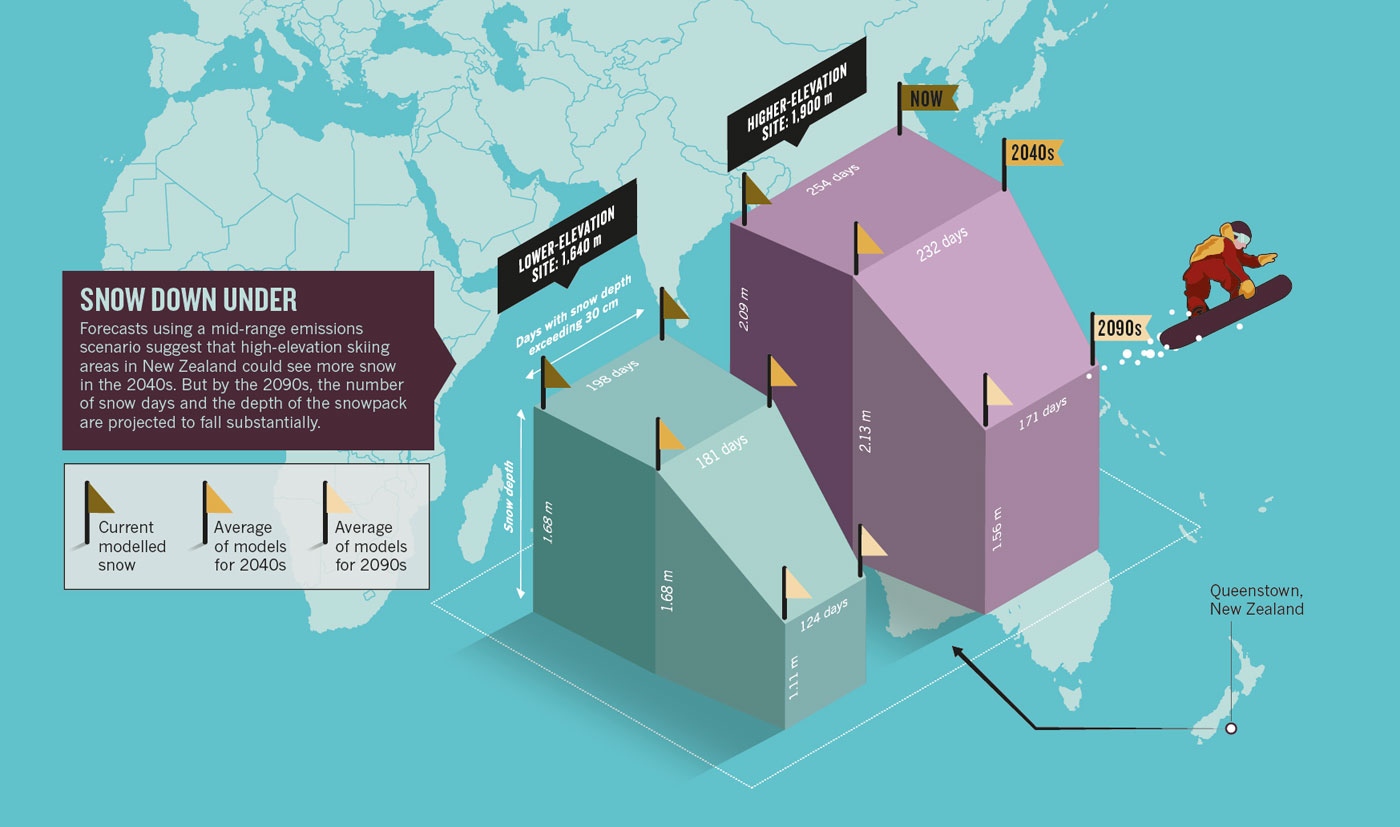
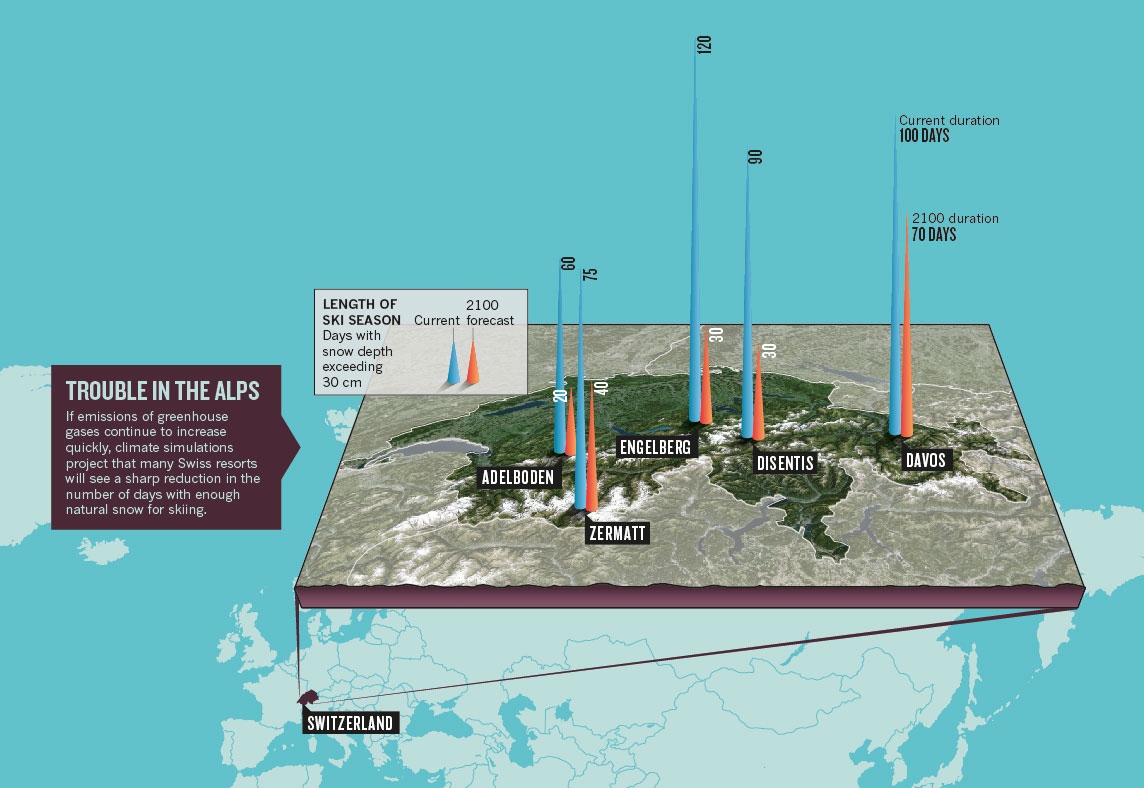
 The outlook is not so gloomy everywhere, at least initially(see ‘Snow down under’). A warmer atmosphere can hold more moisture, so rising temperatures may actually increase snow at some high-elevation sites — such as the peaks of New Zealand and parts of the Swiss Alps — for several decades, until winter temperatures inch above freezing (see ‘Trouble in the Alps’). In fact, average snowfall over the past decade at the Verbier resort has outpaced that in each of the previous three decades. But the area has also had to deal with more variability, warmer summers and a spate of hit-or-miss winters. “The extremes are much higher or much deeper,” says Eric Balet, chief executive of Téléverbier, the company that owns 4 Vallées. That introduces an unwelcome element of unpredictability for resort managers.

Source: M. Beniston WIREs Clim. Change 3, 349–358 (2012)

Skiing areas at low elevations face the worst forecasts. The US states of Connecticut and Massachusetts are home to a combined 17 skiing areas, and a study suggests that by 2039, none will sustain a viable skiing season — defined by industry as 100 days or more — even with artificial snow-making (J. Dawson and D. Scott Tourism Mgmt 35, 244–254; 2013). But at least 94% of the 18 resorts in the more northerly state of Vermont are projected to be viable until 2070 or beyond. A big difference is altitude: all the resorts in Connecticut and Massachusetts have a peak elevation below 750 metres, whereas 16 of those in Vermont exceed that, many by hundreds of metres.

Quality and quantity

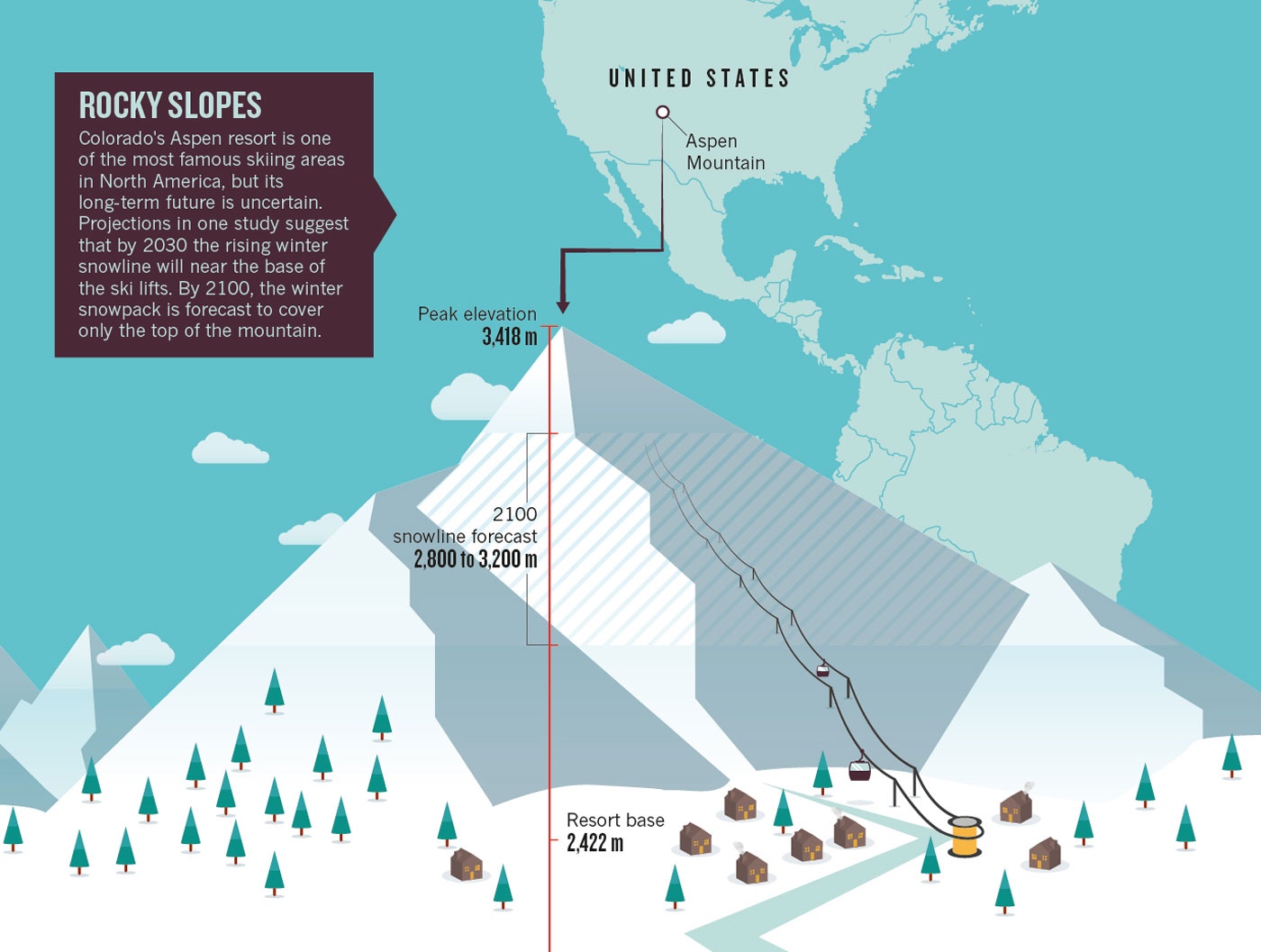
The prospect of losing small skiing areas worries Auden Schendler, vice-president for sustainability at Aspen Skiing Company, which runs the Aspen and Snowmass resorts high in central Colorado (see ‘Rocky slopes’). “We call those feeder resorts,” he says, because their lower prices and gentler slopes attract new skiers to the sport. “It doesn’t serve us for other resorts to go out of business.” And small mountains can produce big stars. The 2010 Olympic downhill champion, Lindsey Vonn, started skiing at Buck Hill, a 364-metre mountain in Burnsville, Minnesota; reigning World Cup slalom champion Mikaela Shiffrin trained as a child at New Hampshire’s Storrs Hill Ski Area, where the peak elevation is just 177 metres.

Source: B. Lazar & M. Williams Proc. Whistler 2008 Int. Snow Sci. Workshop 998–1005 (2008)

It is not only the quantity of snow that is crucial for winter sports such as skiing and snowboarding. Quality matters too, says Anne Nolin, a snow hydrologist at Oregon State University in Corvallis. A warmer, moister atmosphere will produce heavier, wetter snow, not the dry, fluffy ‘champagne powder’ prized by many recreational skiers. Artificial snow created with snow-making cannons is often icy, perfect for laying the base of lightning-fast competition runs but less favourable for the average skier. And temperatures that skirt the freezing mark increase the risk that precipitation will fall as rain, not snow, and will raise the density of the snowpack. “These just aren’t the kind of conditions that people go skiing for,” says Nolin. 
Source: D. Scott et al. The Future of the Winter Olympics in a Warming World (Univ. Waterloo, 2014)

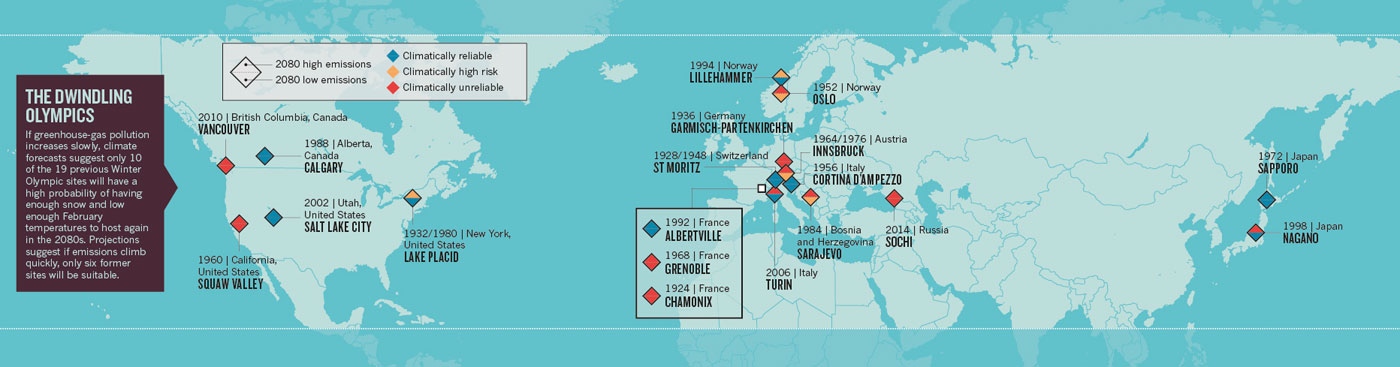
It is not clear what the changing face of winter portends for future Olympic Games (see ‘The dwindling Olympics’). The competition has already been shaped by the vagaries of weather and climate, beginning with the decision decades ago to move figure skating, speed skating, ice hockey and curling indoors, says Daniel Scott, a geographer at the University of Waterloo in Canada. His research suggests that the pool of locations capable of hosting the games will shrink as the climate warms — and the colder mountain cities that may be the best fit may not have the infrastructure to handle a massive influx of athletes, spectators and organizers. That will force some difficult decisions, he says. “It’s an interesting dilemma the International Olympic Committee will be caught in.”


Download the full graphic as an A3 PDF Nature506,20–22(06 February 2014)doi:10.1038/506020a

ORIGINAL:
Nature
Lauren Morello
04 February 2014

viernes, 31 de enero de 2014

Influx of Snowy Owls Thrills and Baffles Birders

Launch media viewer Norman Smith, who runs the Snowy Owl Project for Mass Audubon, released a female snowy owl on a beach in Duxbury, Mass. Gretchen Ertl for The New York Times


DUXBURY, Mass. — The snowy owl seemed almost complacent, showing the confidence of a top predator whose bright yellow eyes suggested she might be sizing you up as a weaker combatant — or perhaps a large snack.

She had been where no bird should safely be — Logan International Airport in Boston — and now, regal and imposing even in brief captivity, she represented the latest of her kind to arrive in a remarkable and growing winter’s wandering to the Lower 48.

Not only is the Boston area seeing the largest number of snowy owls ever recorded, they are popping up in territory far from their usual habitat near the Arctic Circle. Ecstatic bird watchers have spotted them perched atop the Chesapeake Bay Bridge and in Washington (where one made headlines for being struck by a bus) , in Little Rock, Ark., and northern Florida — even in Bermuda.

“This year’s been bizarre,” said Dan Haas, a birder in Maryland. “The numbers have been unprecedented. Historic.”
 Related Coverage


The Lede: Tracking the Snowy Owl Migration in Real TimeDEC. 19, 2013

No one is sure why so many snowies are showing up in so many places — whether it can be attributed to more food in their Arctic habitats than usual, or climate change at the top of the world. “Think about the canary in the coal mine,” said Henry Tepper, the president of Mass Audubon, “you think about the snowy owl in the Arctic.”
Launch media viewer Patrick Castleberry, left, took photos of a snowy owl at Little Talbot Island State Park in Jacksonville, Fla. The very rare sighting of the owl in the area drew birders from miles around. Will Dickey/Florida Times-Union, via Associated Press

The big birds known as Bubo scandiacus reach a height of 20 to 27 inches and have a wingspan of 54 to 66 inches
. They can live more than 30 years in captivity, and have feathers that can range from mottled brown and white to pure white. They have their own movie star – Harry Potter’s Hedwig — and Internet meme, the image of a snowy asking the impertinent question “O RLY?” as in “Oh, really?”

“It’s such a charismatic bird,” said David Sibley, the author and illustrator of a series of birding guides.

Sighting one, especially in an unexpected place, can be thrilling for birders. Georgeta Pourchot was apparently the first person to identify the Florida owl. She and her husband, Eric, were driving in late December from their home in Virginia through Florida on their Christmas vacation when she suggested they pull off at Little Talbot Island, near Jacksonville, to look for unusual birds: snow buntings, she thought, or a long-billed curlew.

Ms. Pourchot said as birders, she and her husband are “just beginners.” They scanned two beaches without seeing anything interesting. They encountered a park ranger, who suggested they look a little farther: “When you get to the other side of that ‘Do Not Enter’ sign, there’s a good view over there.”

So they drove past the sign and parked. And as she got out of the car, Ms. Pourchot told her husband, “Babe, I think we have a snowy owl here!”

“You’re kidding,” he replied, but acknowledged that while they might have been looking for the avian equivalent of a zebra, they had happened on a unicorn.

On Dec. 27, she posted her report to ebird, an online tracking system created by Cornell University’s department of ornithology and the National Audubon Society. The next day, members of the local Audubon chapter were doing their annual Christmas bird count when word spread, said Kevin E. Dailey, the leader of one team. The news was so exciting that volunteers left their assigned zones in search of the truly rare bird. “That’s kind of heresy to leave your count circle area,” he said.

Some people are less happy to encounter snowy owls — particularly, the managers of airports that the birds are drawn to. With wide open spaces and short grass, “the airports, to them, look more like the Arctic tundra than anything else,” said Norman Smith, who runs the Snowy Owl Project for Mass Audubon. The Port Authority of New York and New Jersey took heated criticism in December when it shot three snowy owls. Since then, the authority has tried trapping the birds, with limited success, and harassing them away from the airport by shooting off fireworks, said Ron Marsico, a spokesman for the Port Authority.

Mr. Smith had trapped the female owl at Logan one recent morning and had driven her here to the beach at Duxbury, about 40 miles southeast, for release into the wild, with hopes that she would continue heading south, away from the airport. In most years, Mr. Smith makes a trip from Logan to Duxbury or other release sites a half-dozen times. This year, however, the number has climbed above 75. “And the season is only half over,” he said.

When he released his grip on the owl’s legs, the bird flapped her broad wings and headed to the southwest, toward a small cluster of homes. Suddenly, another snowy owl sailed down from the houses and met the newcomer in midair, their talons locking. An aerial territorial skirmish followed as the two wheeled overhead, with the newcomer finally heading off to the west.

Ornithologists and bird watchers are not sure why the birds have come so far and in such great numbers this year. In decades of study, Mr. Smith said, “what I’ve learned is we know very little about this bird.” He suggests that the large population is the result of a bonanza of lemmings and other small rodents that snowy owls feed on, perhaps a consequence of the milder Arctic weather. That led to larger population of hatchlings that must spread farther and farther out to find territory of their own.

The lemming hypothesis does not satisfy Kevin J. McGowan, an ornithologist at Cornell. He noted that tiny transmitters placed on the owls have shown some of the birds do a surprising thing in winter: Instead of flying to the more temperate south, they fly farther north and scout the Arctic ice pack for pools of open water populated by sea ducks and other waterfowl.

Climate change
, which has been thawing Arctic ice so actively that new shipping routes are opening in the far north, could have disrupted the habitat,
Professor McGowan speculated. “That has to be one of the most vulnerable ecosystems on the planet. That’s going to be one of the first places that falls apart when there is warming in the atmosphere,” he said. This may have driven more of them south instead of north. A big shift in bird movement one year might just be a freak event, he said, or potentially “it’s the beginning of a pattern.”

Whatever the reason for their abundance, the snowy visitors have brought attention beyond the usual core group of birders, said Mr. Sibley, the guide author. Mr. Sibley, who has released a print of one of his snowy owl illustrations to raise money for research, said that while it is good to see such excitement, “it would be great if that kind of attention could extend to less flashy birds, like the red cockaded woodpecker or the Henslow’s sparrow.”

ORIGINAL: NYTimes
JAN. 31, 2014

domingo, 8 de diciembre de 2013

Oxford China Lecture: The Future City


This is the inaugural Oxford China Lecture, it aims to connect the widest possible audience to some of Oxford's ground-breaking research.

It is being presented in association with:


请点击链接往中文版

Date: Tuesday 10 December 2013
The lecture will start at 18.00 (local time)
Title: The Future City
Climate Change, Technology and the New Urbanisation
Speaker:
Professor Steve Rayner
James Martin Professor of Science and Civilization and Co-Director of the Oxford Martin Programme for Future Cities

Venue: Jing An Shangri-la,
1218 Middle Yan'an Road,
Jing An Kerry Centre,
West Nanjing Road,
Shanghai, 200040,
China

This event is open to alumni and invited guests only. Please contact vip@oxfordchina.org for more information.


Synopsis of the 2013 lecture
By the middle of this century 75% of the world’s population will be living in cities. With its new urbanisation agenda China is in the forefront of this trend. Does this present a challenge, or an opportunity for humanity?

Cities can be hubs of innovation and creativity, but they can also lock populations in to certain courses of action. Where cities are located, and their roads and streets often reflect decisions made centuries ago, but continue to dictate our actions to this day. Can we create cities that truly evolve and reflect the needs and demands of the 21st Century? And what can cities deliver in helping to solve the seemingly intractable problems of climate change and resource scarcity?

Listed in 2008 as "one of the 15 people the next US President should listen to" by Wired magazine; Professor Steve Rayner will draw on a range of disciplines to outline why the great cities of the world could very well be the crucibles where the future of humanity will emerge.

Biography of Steve Rayner
Professor Steve Rayner
Professor Steve Rayner is the James Martin Professor of Science and Civilization at the University of Oxford, Director of the Institute for Science, Innovation and Society, Co-Director of the Oxford Programme for the Future of Cities and Co-Director of the Oxford Geoengineering Programme. Trained as a political anthropologist, Professor Rayner is committed to bringing change to the world through social science.

For more than two decades, Professor Rayner has led interdisciplinary research programmes on science, technology and the environment. He is the recipient of numerous awards, including the 25th Homer N. Culver Award from the American Public Health Association, the Pacific Northwest National Laboratory Director’s Award for R&D Excellence and twice the recipient of the Martin Marietta Energy Systems Awards for groundbreaking work in risk analysis and global climate change policy analysis. He was listed in Wired Magazine’s 2008 Smart List as ‘one of the 15 people the next US President should listen to’.

Professor Rayner's website 

ORIGINAL: U of Oxford

lunes, 2 de diciembre de 2013

The amazing miniatures of Isaac Cordal

01
The microcosm of megacities
The Spanish artist Isaac Cordal places concrete miniatures in various cities across Europe. In his recent book Cement Eclipses: Small Interventions in the Big City, the Isaac explores the urban landscape by placing tiny sculptures in unusual locations.
02
In an interview explains: "I find it really interesting to start looking for these signs and through small scale interventions to develop a different way of looking at our behavior as a society."

The Cordal manages to send a lot of emotion with tiny heroes. The viewer feels he sympathizes with them as their notes in different but for the tragic moments A large number of static lives.

03
04-5
06
07
08
IMG 4501
09
6254620463 e643b31147 b
010
012
isaac-cordal105
014
016
017
07-5
0017-5
cordalblk07
ISAAC CORDAL DESORDES CREATIVAS 11
Isaac-Cordal-Follow-the-Leaders-2
0018
0120

01


ORIGINAL: Lamia Magazine
by / the Thanasis Zagkrimanis
09 November 2013

martes, 1 de octubre de 2013

La influencia humana en el clima es clara, según el informe del IPCC


ESTOCOLMO, 27 de septiembre- La influencia humana en el sistema climático es clara. Es evidente en la mayoría de las regiones del planeta, según concluye la nueva evaluación del Grupo Intergubernamental de Expertos sobre el Cambio Climático (IPCC).

Es sumamente probable que la influencia humana haya sido la causa dominante del calentamiento observado desde mediados del siglo XX. Esta evidencia ha ido en aumento gracias a un mayor número de observaciones de mayor calidad, a una mejor comprensión de la respuesta del sistema climático y a unos mejores modelos climáticos.

El calentamiento en el sistema climático es inequívoco y desde 1950 son muchos los cambios observados en todo el sistema climático que no tienen precedentes en los últimos decenios a milenios. Cada uno de los tres últimos decenios ha sido sucesivamente más cálido en la superficie de la Tierra que cualquier decenio anterior desde 1850, según se recoge en el Resumen para responsables de políticas del informe de evaluación Climate Change 2013: the Physical Science Basis ( Cambio climático 2013: Base de ciencia física) del Grupo de trabajo I del IPCC, aprobado el viernes por los gobiernos miembros del IPCC en Estocolmo ( Suecia).
Climate Change 2013: the Physical Science Basis. (Cover). Image: IPCC
El señor Qin Dahe, copresidente del Grupo de trabajo I del IPCC, señala que “las observaciones de los cambios en el sistema climático están basadas en varias líneas de evidencia independiente. La evaluación de la ciencia que hemos realizado concluye que la atmósfera y el océano se han calentado, el volumen de nieve y hielo ha disminuido, el nivel me dio global del mar se ha elevado y la s concentraci ones de gases de efecto invernadero han aumentado”.

El señor Thomas Stocker, el otro copresidente del Grupo de trabajo I del IPCC, afirma que "las emisiones continuas de gases de efecto invernadero causarán un mayor calentamiento y nuevos cambios en todos los componentes del sistema climático. Para contener el cambio climático, será necesario reducir de forma sustancial y sostenible las emisiones de gases de efecto invernadero".

El señor Stocker añade que “las proyecciones apuntan a que para finales del siglo XXI es probable que la temperatura global en superficie sea superior en 1,5ºC a la del período entre 1850 y 1900 en todos los escenarios considerados, excepto en el que comprende los niveles más bajos de gases de efecto invernadero y aerosoles; y es probable que sea superior en 2ºC en los dos escenarios que comprenden los niveles más elevados". Asimismo dice que “es muy probable que las olas de calor ocurran con mayor frecuencia y duren más. Conforme se vaya calentando la Tierra, prevemos que las actuales regiones húmedas recibirán mayores precipitaciones, y las regiones secas, menos, si bien con excepciones”.

Las proyecciones del cambio climático se basan en un nuevo conjunto de cuatro escenarios de concentraciones futuras de aerosoles y gases de efecto invernadero y contemplan un amplio abanico de futuros posibles. El informe d el Grupo de trabajo I evaluó el cambio a escalas global y regional para el principio, la mitad y el final del siglo XXI.

El señor Qin Dahe afirma que “conforme se caliente el océano y se reduzcan los glaciares y los mantos de hielo, el nivel medio global del mar seguirá aumentando, pero a un ritmo más rápido del experimentado en los últimos 40 años”. El informe constata con un nivel de confianza alto que el calentamiento del océano es un factor dominante en la energía almacenada en el sistema climático y representa más del 90% de la energía acumulada entre 1971 y 2010.

El señor Stocker concluye que “como resultado de nuestras emisiones de CO 2 pasadas, presentes y futuras previstas, el cambio climático persistirá inevitablemente y los efectos perdurarán durante muchos siglos, incluso aunque pararan las emisiones de CO2”.

El señor Rajendra Pachauri, Presidente del IPCC, dice que “este Resumen para responsables de políticas del Grupo de trabajo I aporta importantes conocimientos a la base científica del cambio climático. Ofrece un sólido fundamento para las consideraciones de los impactos del cambio climático en los sistemas humanos y naturales así como medios para afrontar el desafío del cambio climático”. Estos y otros son los aspectos evaluados en las contribuciones de los Grupos de trabajo II y III que se publicarán en marzo y abril de 2014. El ciclo del Quinto Informe de Evaluación del IPCC concluirá con la publicación de su Informe de síntesis en octubre de 2014.

El señor Pachauri declara: “Deseo dar las gracias a los copresidentes del Grupo de trabajo I y a los cientos de científicos y expertos que han trabajado como autores y revisores para elaborar un resumen de amplio alcance y científicamente sólido. También quisiera hacer extensivo mi agradecimiento a los más de mil revisores expertos de todo el mundo que han aportado sus conocimientos a la preparación de esta evaluación”.

La contribución del Resumen para responsables de políticas del Grupo de trabajo I al Quinto Informe de Evaluación del IPCC se puede consultar en www.climatechange2013.org o www.ipcc.ch.

Principales conclusiones

Veáse la Ficha informativa sobre las afirmaciones principales del Resumen para responsables de políticas del Quinto Informe de Evaluación del IPCC del Grupo de trabajo I, disponible en la siguiente dirección: www.climatechange2013.org.

Antecedentes
El Grupo de trabajo I está copresidido por el señor Qin Dahe, de la Administración Meteorológica de China, situada en Beijing ( China), y el señor Thomas Stocker, de la Universidad de Berna (Suiza). La Universidad de Berna alberga la Unidad de apoyo técnico del Grupo de trabajo I, que está financiada por el Gobierno de Suiza.

En la 28ª reunión del IPCC celebrada en abril de 2008, los miembros del IPCC decidieron elaborar el Quinto Informe de Evaluación. En julio de 2009 se organizó una reunión exploratoria para determinar el alcance y el esquema de dicho informe. En octubre de 2009, en la 31 ª reunión del IPCC, se aprobaron las grandes líneas resultantes para las tres contribuciones de los Grupos de trabajo al Quinto Informe de Evaluación.

El Resumen para responsables de políticas del Quinto Informe de Evaluación del IPCC del Grupo de trabajo I se aprobó en la 12ª reunión del Grupo de trabajo I del IPCC, celebrada del 23 al 26 de septiembre de 2013 en Estocolmo (Suecia), y se publicó el 27 de septiembre.

El proyecto final del informe del Grupo de trabajo I ( versión distribuida a los gobiernos el 7 de junio de 2013), que contenía el Resumen técnico, 14 capítulos y un A tlas de las proyecciones climáticas mundiales y regionales, se publicará en línea sin revisar el lunes 30 de septiembre. Tras realizar la revisión editorial, la maquetación y las comprobaciones finales para subsanar errores y llevar a  cabo los ajustes para los cambios efectuados en el Resumen para responsables de políticas, el informe completo del Grupo de trabajo I se publicará en línea en enero de 2014 y Cambridge University Press lo publicará en forma de libro unos meses después.

La evaluación del Grupo de trabajo I abarca unas 2.500 páginas de texto y se basa en millones de observaciones y más de 2 millones de gigabytes de datos numéricos extraídos de simulaciones de modelos climáticos. Se citan más de 9.200 publicaciones científicas, de las cuales más de sus tres cuartas partes se han publicado desde la última evaluación del IPCC realizada en 2007.

En este informe de evaluación del IPCC se utilizan términos específicos para indicar la verosimilitud evaluada de un resultado o consecuencia. En relación c on esos términos: prácticamente seguro significa que la probabilidad de ocurrencia es de l 99 – 100%; sumamente probable, del 95 – 100%; muy probable, del 90 – 100%; y probable, del 66 – 100%. Para más información, consulte la nota orientativa del IPCC sobre los va lores de incertidumbre:
https://www.ipcc-wg1.unibe.ch/guidancepaper/ar5_uncertainty-guidance-note.pdf.

Para más información, diríjase a:
Oficina de prensa del IPCC, correo electrónico: ipcc-media@wmo.int
Jonathan Lynn, + 41 22 730 8066 o
Werani Zabula, + 41 22 730 8120
Contacto del Grupo de trabajo I del IPCC para los medios de comunicación,
correo electrónico: media@ipcc.unibe.ch
Pauline Midgley, +41 31 631 5620
Siga al IPCC en Facebook y Twitter

ORIGINAL: IPCC - COMUNICADO DE PRENSA DEL IPCC
IPCC Secretariat
27 de septiembre de 2013

c/o WMO ·
7 bis, Avenue de la Paix ·
C.P: 2300 · CH-1211 
Geneva 2 · Switzerland
telephone +41 22 730 8208 / 54 / 84
· fax +41 22 730 8025 / 13
· email IPCC-Sec@wmo.int
· www.ipcc.ch
OMM PNUMA 2013/20/PR

martes, 10 de septiembre de 2013

Ten Cities Receive Inaugural C40 and Siemens City Climate Leadership Awards

ORIGINAL: NatGeo
Posted by C40 News Team in City Solutions
September 4, 2013 


Today, ten winning cities were announced for the C40 and Siemens City Climate Leadership Awards. The inaugural event took place this evening in London at The Crystal, the home of Siemens sustainable cities initiative. The cities represent the strongest project entries in each of ten sustainability and leadership categories. Projects for consideration were culled from both the C40 members and the 120 cities profiled in the “Green City Index.” The 29 finalists were announced earlier this month.
Winning Cities

The independent, seven-member judging panel — consisting of former city Mayors, architects and representatives of the World Bank, C40 and Siemens – had difficult choices to make but agreed on the ten winning city projects in the following categories:
  • Bogota (Urban Transportation)
  • Copenhagen (Carbon Measurement & Planning)
  • Melbourne (Energy Efficient Built Environment)
  • Mexico City (Air Quality)
  • Munich (Green Energy)
  • New York City (Adaptation & Resilience)
  • Rio de Janeiro (Sustainable Communities)
  • San Francisco (Waste Management)
  • Singapore (Intelligent City Infrastructure)
  • Tokyo (Finance & Economic Development)

Citizen’s Choice Award
The good news for the other finalist cities is that the awards process for 2013 doesn’t end here. C40 and Siemens announced the “Citizen’s Choice Award” that will allow the general public to vote for the project they believe should have won an award. The votes will be tallied at the City Climate Leadership Awards website and a winner will be announced in November. Voting starts today at www.cityclimateleadershipawards.com.

For more details on the winning projects in each city, see the full release here.

viernes, 2 de agosto de 2013

Woolly mammoth DNA may lead to a resurrection of the ancient beast

31 July 2013

Technical and ethical challenges abound after first hurdle of taking cells from millennia-old bodies is cleared


Even a well-preserved carcass like this baby woolly mammoth is unlikely to provide viable cells for cloning, as used to create Dolly. Photograph: Aaron Tam/Getty

The pioneering scientist who created Dolly the sheep has outlined how cells plucked from frozen woolly mammoth carcasses might one day help resurrect the ancient beasts.

The notional procedure – bringing with it echoes of the Jurassic Park films – was spelled out by Sir Ian Wilmut, the Edinburgh-based stem-cell scientist, whose team unveiled Dolly as the world's first cloned mammal in 1996.

Though it is unlikely that a mammoth could be cloned in the same way as Dolly, more modern techniques that convert tissue cells into stem cells could potentially achieve the feat, Wilmut says in an article today for the academic journalism website, The Conversation.

"I've always been very sceptical about the whole idea, but it dawned on me that if you could clear the first hurdle of getting viable cells from mammoths, you might be able to do something useful and interesting," Wilmut told the Guardian.

"I think it should be done as long as we can provide great care for the animal. If there are reasonable prospects of them being healthy, we should do it. We can learn a lot about them," he added.

Woolly mammoths roamed the Earth tens of thousands of years ago in a period called the late Pleistocene. Their numbers began to fall in North America and on mainland Eurasia about 10,000 years ago. Some lived on for a further 6,000 years. Their demise was likely the result of hunting and environmental change.

The prospect of raising woolly mammoths from the dead has gathered pace in recent years as the number of frozen bodies recovered from the Siberian permafrost has soared. The rise comes because the ice is melting, but also because of awareness in the region that there is money in the ancient remains.

Earlier this month, the most complete woolly mammoth carcass ever recovered from Russia was unveiled at an exhibition in Yokohama, Japan. The baby female, nicknamed Yuka, lived about 39,000 years ago, and is remarkable for the preservation of her fur and soft tissues, such as muscle.

Samples from Yuka have been sent to the laboratory of Hwang Woo-suk, the disgraced South Korean stem cell scientist, who, with Russian researchers, hopes to clone the mammoth.

Though Wilmut does not doubt the sincerity of the scientists hoping to clone woolly mammoths with the Dolly technique, he said the idea was "wildly optimistic" because the technical challenges were so tough.

In his article for The Conversation, Wilmut explains the formidable hurdles that stand in the way of scientists who want to clone the beasts. The technique requires scores of healthy mammoth cells and hundreds or thousands of eggs from a closely related species, such as the Asian elephant.

The most immediate problem is that mammoth cells must survive with their DNA intact. In practice, they degenerate quickly at the temperature of melting snow and ice, when most remains are found.

"By the time you've got a bone sticking up in the sunshine, it's effectively too late. You need to get it straight out of the deep freeze, as it were," Wilmut said.

Another problem is that cloning needs a female of a closely related species to provide eggs and to carry the pregnancy achieved with any cloned embryo. The closest living relatives to mammoths are elephants, but these are not plentiful enough to collect eggs from.

"Because there is a danger of elephants becoming extinct, it is clearly not appropriate to try to obtain 500 eggs from elephants," Wilmut writes.

There is an alternative, though. If good-quality cells can be extracted from mammoth remains – and that is a big if – they could be reprogrammed into stem cells using modern procedures. These could then be turned into other kinds of cell, including sperm and eggs. Mice have already been born from sperm and eggs made from stem cells.

"If the cells were from a female, this might provide an alternative source of eggs for use in research, and perhaps in breeding, including the cloning of mammoths.

"From a male they would be sperm, and they might be able to fertilise eggs to produce a new mammoth embryo," Wilmut writes.

But the scientist, who in many peers' eyes should have shared the Nobel prize in physiology or medicine with Sir John Gurdon and Shinya Yamanaka last year, said it could be 50 years before the techniques for resurrecting the woolly mammoth were perfected. There will be no Pleistocene Park soon.

That gives time for scientists to work out some of other problems that would arise if a mammoth were ever born again.

One concern is that the mammoth would be adapted to frigid conditions while its mother would be used to a hot, dry climate.

Another problem is that one will not be enough. "Ideally, and before too long, you need to provide them with friends and neighbours to interact with," Wilmut said. "The whole issue is what are the effects on the animal's welfare."

None of it will happen unless scientists can pluck good-quality cells from carcasses that have lain in the ice for thousands of years. Will it ever happen? "I would say it's fairly unlikely, but the world is full of surprises," Wilmut said.