Mostrando entradas con la etiqueta Material. Mostrar todas las entradas

viernes, 22 de diciembre de 2017

Electric eel inspires bio-friendly power source, what happens next may shock you

Could a device inspired by the electric eel offer a safer way to power medical implants?
Scientists are always on the lookout for safer, more natural ways to power devices that go into our bodies. After all, who really needs toxic battery elements and replacement surgery?

One organism that is pretty good at generating biocompatible power (for itself, at least) is the electric eel, and scientists have now used the high-voltage species as a blueprint for a promising new self-charging device that could one day power things like pacemakers, prosthetics and even augmented reality contact lenses.

Electric eels generate voltage through long stacks of thin cells that run end-on-end through their bodies. Called electrocytes, these cells create electricity by allowing sodium ions to rush into one end and potassium ions out the other, all at the same time. The voltage created by each cell is small, but together, the stacks within a single eel can generate as many as 600 V.

To recreate this effect, researchers from the University of Fribourg, the University of Michigan and the University of California San Diego turned to the difference in salinity between fresh and saltwater. They deposited hydrogel, ion-conducting blobs onto clear plastic sheets and separated them with ion-selective membranes.

Hundreds of blobs containing salt and freshwater were arranged in an alternating pattern. When the team had all these gel compartments make contact with one another, they were able to generate 100 V through what is known as reverse electrodialysis, where energy is generated through differing salt concentrations in the water.

While the eel triggers the simultaneous contact of its electrocytes using a neurotransmitter called acetylcholine as the command signal, the team achieved this by carefully working a special origami pattern – called a Miura-ori fold – into the plastic sheet. This meant that when pressure was applied to the sheet, it quickly snapped together and the cells shifted into exactly the right positions to create the electricity.

The device, which the team calls an artificial electric organ, isn't in the same ball park as an eel in terms of output, but the researchers do have some ideas around how to boost its efficiency. It points to the metabolic energy created by ion differences in the eel's stomach, or the mechanical muscle energy, as some of the possibilities, but does note that recreating these would be a major challenge.

"The electric organs in eels are incredibly sophisticated, they're far better at generating power than we are," Mayer said. "But the important thing for us was to replicate the basics of what's happening."

The research was published in the journal Nature. You can hear from Mayer in the video below.


Source: University of Fribourg, University of Michigan

ORIGINAL: NewAtlas
Nick Lavars
December 14th, 2017

miércoles, 15 de marzo de 2017

New Materials Could Turn Water into the Fuel of the Future

High-throughput materials discovery approach puts solar fuels on the fast track to commercial viability

Scientists at the Department of Energy’s Lawrence Berkeley National Laboratory (Berkeley Lab) and the California Institute of Technology (Caltech) have—in just two years—nearly doubled the number of materials known to have potential for use in solar fuels.

They did so by developing a process that promises to speed the discovery of commercially viable generation of solar fuels that could replace coal, oil, and other fossil fuels.
Researchers are using a new high-throughput method of identifying new materials. (Photo Credit: Caltech)
Solar fuels, a dream of clean-energy research, are created using only sunlight, water, and carbon dioxide. Researchers are exploring a range of possible target fuels, but one possibility is to produce hydrogen by splitting water.

Each water molecule is comprised of an oxygen atom and two hydrogen atoms. Pure hydrogen is highly flammable, making it an ideal fuel. If you could find a way to extract that hydrogen from water using sunlight, then, you would have a plentiful and renewable energy source. The problem, however, is that water molecules do not simply break down when sunlight shines on them—if they did, the oceans would not cover three-fourths of the planet. Instead, they need a little help from a solar-powered catalyst.

To create practical solar fuels, scientists have been trying to develop low-cost and efficient materials that perform the necessary chemistry using only visible light as an energy source.

Over the past four decades, researchers identified only 16 of these “photoanode” materials. Now, using a new high-throughput method of identifying new materials, a team of researchers led by Caltech’s John Gregoire and Berkeley Lab’s Jeffrey Neaton, Kristin Persson, and Qimin Yan have found 12 promising new photoanodes.

A paper about the method and the new photoanodes appears the week of March 6 in the online edition of the Proceedings of the National Academy of Sciences.


The new method was developed through a partnership between the Joint Center for Artificial Photosynthesis (JCAP) and Berkeley Lab’s Materials Project, using resources at the Molecular Foundry and the National Energy Research Scientific Computing Center (NERSC). JCAP is a DOE Energy Innovation Hub focused on developing a cost-effective method of turning sunlight, water, and carbon dioxide into fuel. It is led by Caltech with Berkeley Lab as a major partner. The Materials Project is a DOE program based at Berkeley Lab that aims to remove the guesswork from materials design in a variety of applications. The Molecular Foundry and NERSC are both DOE Office of Science User Facilities located at Berkeley Lab.
The Molecular Foundry at Berkeley Lab 
(Photo by Roy Kaltschmidt, Berkeley Lab)


What is particularly significant about this study, which combines experiment and theory, is that in addition to identifying several new compounds for solar fuel applications, we were also able to learn something new about the underlying electronic structure of the materials themselves,” says Neaton, the director of the Molecular Foundry.

Gregoire, JCAP coordinator for Photoelectrocatalysis and leader of the High Throughput Experimentation group, adds “It’s exciting to find 12 new potential photoanodes for making solar fuels, but even more so to have a new materials discovery pipeline going forward.

Previous materials discovery processes relied on cumbersome testing of individual compounds to assess their potential for use in specific applications. Instead, the scientists combined computational and experimental approaches by first mining a materials database for potentially useful compounds, and then rapidly test the most promising candidates using high-throughput experimentation.

In the work described in the PNAS paper, they explored 174 metal vanadates—compounds containing the elements vanadium and oxygen along with one other element from the periodic table. The research reveals how different choices for this third element can produce materials with different properties, and reveals how to “tune” those properties to make a better photoanode.

Computational resources at NERSC performed hundreds of comprehensive high-throughput theoretical calculations, and software and expertise at the Molecular Foundry enabled the scientists to analyze and understand the most promising photoanode materials candidates.

Through analysis of nearly 200 compounds in the Materials Project database, the scientists found that compounds composed of vanadium, oxygen, and a third element possess a highly tunable electronic structure with band gaps in the visible light range that is uniquely favorable for water oxidation.

Importantly, we were able to explain the origin of their tunability, and identify several promising vanadate photoanode compounds,” says Neaton.

Added Gregoire, “The key advance made by the team was to combine the best capabilities enabled by theory and supercomputers with novel high throughput experiments to generate scientific knowledge at an unprecedented rate.

The study is titled “Solar fuels photoanode materials discovery by integrating high-throughput theory and experiment.” This research was funded by the Department of Energy’s Office of Science.

###

Lawrence Berkeley National Laboratory addresses the world’s most urgent scientific challenges by advancing sustainable energy, protecting human health, creating new materials, and revealing the origin and fate of the universe. Founded in 1931, Berkeley Lab’s scientific expertise has been recognized with 13 Nobel Prizes. The University of California manages Berkeley Lab for the U.S. Department of Energy’s Office of Science. For more, visit www.lbl.gov.

DOE’s Office of Science is the single largest supporter of basic research in the physical sciences in the United States, and is working to address some of the most pressing challenges of our time. For more information, please visit science.energy.gov.

ORIGINAL: Berkeley Lab
By Dan Krotz 510-486-4019
MARCH 6, 2017

martes, 1 de noviembre de 2016

How to Keep Buildings From Killing Hundreds of Millions of Birds a Year

Metallic screens on the facade of Ennead’s Bridge for Laboratory Sciences at Vassar College warn birds of danger.RICHARD BARNES

ARCHITECTS’ GROWING AFFINITY for glassy buildings has given the world better views, more natural light, sexier skylines—and a lot of dead birds. The US Fish and Wildlife Service estimates about 750 million birds perish annually flying into glass façades, which can be hard to distinguish from open airspace. The problem is so bad in some places that skyscraper owners hire workers to remove expired birds from the bottoms of their buildings.

Guy Maxwell, an architect at New York-based Ennead Architects, is on a mission to mitigate this fowl holocaust. A bird lover his entire life, he first became aware of architecture’s deadly impact on avifauna 15 years ago, shortly after the completion of his firm’s Rose Center for Earth and Space at NYC’s American Museum of Natural History. The enormous glass cube afforded unimpeded views of the spherical Hayden Planetarium within, but was a deadly invisible barrier to birds. Maxwell has been working to protect feathered species ever since.

Working with him is an informal circle of anti-collision advocates that includes members of the 
  • American Bird Conservancy, 
  • New York City Audubon, 
  • New Jersey Audubon, and the 
  • Bird Safe Glass Foundation. 
(“It really takes a gang of merry pranksters to pull this off,” says Maxwell.) Together, they’ve made progress on 
  • bird-safe research, 
  • bird-safe building regulations, 
  • bird-safe glass, and 
  • bird-safety awareness, 
spurring changes that have already had a large, ahem, impact.

Among their recent accomplishments is the American Bird Conservancy’s creation of two avian research facilities—one at the Powdermill Nature Reserve, about an hour outside of Pittsburgh, the other inside a modified shipping container at the Bronx Zoo. (The Bronx tunnel’s design was overseen, in part, by Maxwell and his colleagues at Ennead’s research-intensive division, Ennead Lab.) Spearheaded by American Bird Conservancy Bird Collisions Campaign Manager Christine Sheppard, these testing tunnels are the only ones of their kind in the US, and allow researchers to investigate which glass treatments and lighting conditions birds will fly toward or avoid. They’ve learned, for instance, that birds won’t try to fly through vertical line patterns that are less than four inches apart, and that line patterns tend to be more effective at preventing collisions than dotted ones.

Bird testing tunnel at the Powdermill Nature Reserve outside PittsburghPAMELA CURTIN

Using this knowledge, Maxwell, Sheppard, and their confederates have consulted with glass manufacturers like 
  • Viracon, 
  • Guardian, 
  • Bendheim, and 
  • Arnold Glas 
to help produce products like ceramic frit patterns and UV coatings—treatments that are visible to birds and can alert them to the presence of dangerous physical barriers.

The group’s biggest policy achievement came in 2011, when it partnered with the US Green Building Council to launch a LEED pilot credit #55 for incorporating “bird collision deterrence” into new buildings. The goal: Make buildings as visible to birds as possible, through glass technologies, exterior building treatments like screens and louvers, and decreased night lighting levels. Maxwell says it has since become LEED’s most popular pilot credit. Other victories include legislation (initiated by Golden Gate Audubon) in San Francisco, Oakland, and other Bay Area cities establishing citywide bird safe building standards. Mandatory and voluntary ordinances have been passed in New York, Minnesota, and Toronto, as well.

Related Galleries


SLIDE:1 / OF7 .Caption:Caption:The fractured facade of the Tracy Aviary Visitors Center in Salt Lake City was designed to keep birds away.ALAN BLAKELY

SLIDE:2 / OF7 .Caption:Caption:Solid screens keep birds from flying into the building’s windows at Ennead's Bridge for Laboratory Sciences at Vassar College.RICHARD BARNES

SLIDE:3 / OF7 .Caption:Caption:Bird-friendly glass inside Ennead's Bridge for Laboratory Sciences at Vassar College.ENNEAD ARCHITECTS

SLIDE:4 / OF7 .Caption:Caption:Frosted glass at Ennead’s Lycée Francais is another example of bird-safe design.RICHARD BARNES
SLIDE:5 / OF7 .Caption:Caption:A bird-friendly metallic screen at Ennead’s Smith College Brown Fine Arts Center.JEFF GOLDBERG-ESTO

SLIDE:6 / OF7 .Caption:Caption:Bird-friendly glass at the National Museum of American Jewish History.AISLINN WEIDELE/ENNEAD ARCHITECTSAdvertisement
SLIDE:7 / OF7 .Caption:Caption:Weiss Manfredi’s Brooklyn Botanical Garden Visitors Center employs large overhangs and striped glass to protect birds.CHRISTINE SHEPPARD
Much of the team’s research is embodied in Ennead’s Bridge for Laboratory Sciences at Vassar College. The bridge-like classroom-cum-laboratory is a case study in bird-safe architecture. Vertical metal sunscreens cover its long, curving façade. Its windows are coated in Arnold Glas’s Ornilux, a UV coating visible only to birds, and various hues of ceramic fritting (the range of colors ensures that the lines are visible to birds from a variety of species).

The concept of bird safety is changing architecture, Maxwell says. Exceptional bird-friendly designs have been completed across the country, from the fritted glass windows of Weiss Manfredi Architects’ Brooklyn Botanic Garden Visitor Center, to AJC Architects’ Tracy Aviary Visitor Center in Salt Lake City, which is fronted by fractured metal screens that keep birds from flying into its windows. “There’s generally an awareness of this problem now,” says Maxwell. “You see architects considering this when before they had no idea it was even a problem.” The public is becoming more aware of the problem, too. New York City Audubon has even created an online portal, called D-Bird, where people can report building-related bird mortalities.

Meanwhile, Maxwell and his band of bird advocates are seeking funding to ramp up their research and advocacy. They would like to build several more labs along the east coast, fight for more bird-safety legislation, and see bird-friendliness become an automatic consideration for architects.

I’m amazed that there are still many people who don’t realize the enormity of the problem,” Maxwell says.

ORIGINAL: Wired
By SAM LUBELL
11.01.16

miércoles, 7 de septiembre de 2016

Carbon Nanotube Transistors Finally Outperform Silicon

Photo: Stephanie Precourt/UW-Madison College of Engineering
Back in the 1990s, observers predicted that the single-walled carbon nanotube (SWCNT) would be the nanomaterial that pushed silicon aside and created a post-CMOS world where Moore’s Law could continue its march towards ever=smaller chip dimensions. All of that hope was swallowed up by inconsistencies between semiconducting and metallic SWCNTs and the vexing issue of trying to get them all to align on a wafer.

The introduction of graphene seemed to take the final bit of luster off of carbon nanotubes’ shine, but the material, which researchers have been using to make transistors for over 20 years, has experienced a renaissance of late.

Now, researchers at the University of Wisconsin-Madison (UW-Madison) have given SWCNTs a new boost in their resurgence by using them to make a transistor that outperforms state-of-the-art silicon transistors.

This achievement has been a dream of nanotechnology for the last 20 years,” said Michael Arnold, a professor at UW-Madison, in a press release. “Making carbon nanotube transistors that are better than silicon transistors is a big milestone,” Arnold added. “[It’s] a critical advance toward exploiting carbon nanotubes in logic, high-speed communications, and other semiconductor electronics technologies.

In research described in the journal Science Advances, the UW-Madison researchers were able to achieve a current that is 1.9 times as fast as that seen in silicon transistors. The measure of how rapidly the current that can travel through the channel between a transistor’s source and drain determines how fast the circuit is. The more current there is, the more quickly the gate of the next device in the circuit can be charged .

The key to getting the nanotubes to create such a fast transistor was a new process that employs polymers to sort between the metallic and semiconducting SWCNTs to create an ultra-high purity of solution.

We’ve identified specific conditions in which you can get rid of nearly all metallic nanotubes, [leaving] less than 0.01 percent metallic nanotubes [in a sample],” said Arnold.

The researchers had already tackled the problem of aligning and placing the nanotubes on a wafer two years ago when they developed a process they dubbed “floating evaporative self-assembly.” That technique uses a hydrophobic substrate and partially submerges it in water. Then the SWCNTs are deposited on its surface and the substrate removed vertically from the water.

In our research, we’ve shown that we can simultaneously overcome all of these challenges of working with nanotubes, and that has allowed us to create these groundbreaking carbon nanotube transistors that surpass silicon and gallium arsenide transistors,” said Arnold.

In the video below, Arnold provides a little primer on SWCNTs and what his group’s research with them could mean to the future of electronics.


In continuing research, the UW-Madison team will be aiming to replicate the manufacturability of silicon transistors. To date, they have managed to scale their alignment and deposition process to 1-inch-by-1-inch wafers; the longer-term goal is to bring this up to commercial scales.

Arnold added: “There has been a lot of hype about carbon nanotubes that hasn’t been realized, and that has kind of soured many people’s outlook. But we think the hype is deserved. It has just taken decades of work for the materials science to catch up and allow us to effectively harness these materials.

ORIGINAL: IEEE
By Dexter Johnson
6 Sep 2016

sábado, 20 de agosto de 2016

This tiny device makes dirty water drinkable in just 20 minutes

Jin Xie/Stanford University
Genius.

Scientists have developed a tiny device the size of a postage stamp that can kill 99.99 percent of bacteria in water in just 20 minutes.

Exposing contaminated water to sunlight can naturally clean it up – because UV rays blitz germs – but this distillation process usually takes up to 48 hours to complete. Instead, this new gadget harnesses a broader spectrum of the Sun's rays to speed everything up.


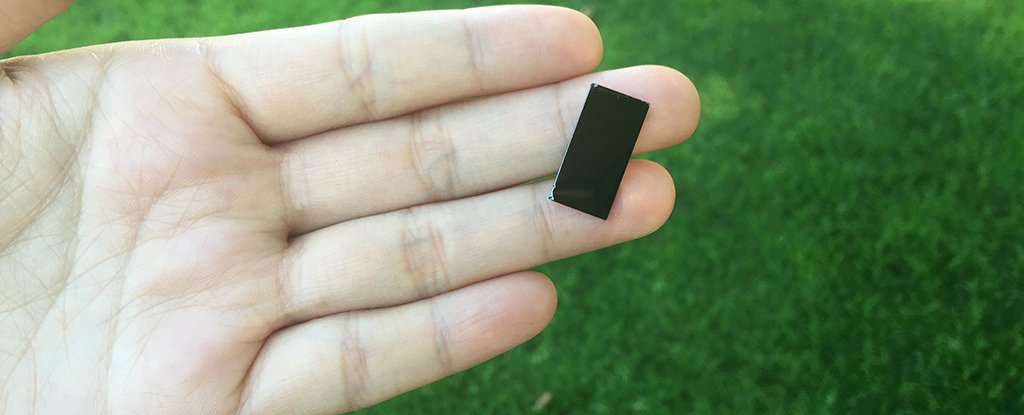
"Our device looks like a little rectangle of black glass," explains lead researcher Chong Liu from Stanford University. "We just dropped it into the water and put everything under the Sun, and the Sun did all the work."

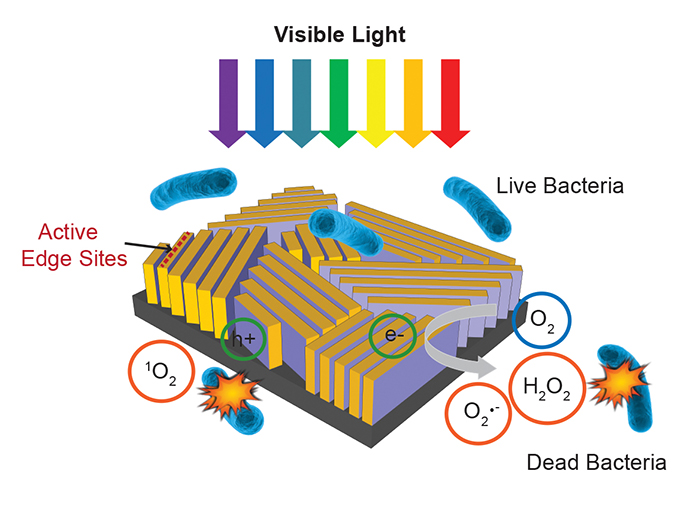
It's the visible part of the solar spectrum, rather than UV rays, that contains most of the Sun's energy – around 50 percent for visible sunlight, compared with 4 percent for UV rays.

This visible sunlight attracts electrons in the device's coating of molybdenum disulfide (often used as an industrial lubricant), which sparks chemical reactions in the water.

Hydrogen peroxide and other disinfectants are generated from these reactions, which set about clearing the germs from the water.

Viewed under a microscope, the material is made up of many miniature walls of molybdenum disulfide, closely stacked together like a labyrinth on top of a rectangle of glass. From further out, it resembles a fingerprint.

A close-up look showing the molybdenum disulfide in purple and the copper in yellow. Credit: C. Liu et al., Nature Nanotechnology
"It's very exciting to see that by just designing a material you can achieve a good performance," says Liu. "It really works. Our intention is to solve environmental pollution problems so people can live better."

One important factor that could make the technology viable for the market is that molybdenum disulfide is cheap to produce. On top of that, money is also saved on fuel used in other purification methods, because the new device doesn't require the water to be boiled first.

The technique joins a number of other research efforts that are looking to purify water affordably for those in need. Earlier this year, we saw the cleaning properties of thin graphene sheets laid on water, and a biomaterial that pulls condensation from the air.

There's more work for the Stanford team to do before the device is ready for public use - only three strains of bacteria have been tested so far, and the coating isn't currently effective against chemical pollutants.

But while fresh and clean drinking water is something many of us take for granted, that's not the case for some 650 million people across the world –and that's something that has to change.

The research has been published in Nature Nanotechnology.

ORIGINAL: Science Alert
DAVID NIELD
19 AUG 2016

lunes, 11 de julio de 2016

Meet the First Artificial Animal

Scientists genetically engineered and 3-D-printed a biohybrid being, opening the door further for lifelike robots and artificial intelligence.

CREDIT: Getty Images
If you met this lab-created critter over your beach vacation, you'd swear you saw a baby ray. In fact, the tiny, flexible swimmer is the product of a team of diverse scientists. They have built the most successful artificial animal yet. This disruptive technology opens the door much wider for lifelike robots and artificial intelligence.

Like most disruption, it started with a simple idea. Kit Kevin Parker, PhD, a Harvard professor researching how to build a human heart, saw his daughter entranced by watching stingrays at the New England Aquarium in Boston. He wondered if he could engineer a muscle that could move in the same sinuous, undulating fashion. The quest for a material led to creating an artificial ray with a 3-D-printed rubber body at the School of Engineering and Applied Sciences at Harvard. Scientists from the University of Illinois at Urbana-Champaign, the University of Michigan, and Stanford University's Medical Center joined the team.

They reinforced the soft rubber body with a 3-D-printed gold skeleton so thin it functions like cartilage. Geneticists adapted rat heart cells so they could respond to light by contracting. Then, they were grown in a carefully arranged pattern on the rubber and around the gold skeleton.

The muscular circuitry is one of the most interesting parts of the research, and there's more about it in this video:


The birth of biohybrid beings
The new engineered animal responds to light so well scientists were able to guide it through an obstacle course 15 times its length using strong and weak light pulses.

The study authors write, "Our ray outperformed existing locomotive biohybrid systems in terms of speed, distance traveled, and durability (six days), demonstrating the potential of self-propelled, phototactically activated tissue-engineered robots."

What biohybrid mean for robots and artificial intelligence
Science of this type is fundamental for engineering special-purpose creations such as artificial worms that sniff out and eat cancer. Or bionic body parts for those who have suffered accidents or disease. Imagine having little swimmers in your system that rush to the site of a medical emergency such as a stroke. The promise of sensor-rich soft tissue frees robots to move more easily and yet not be cut off from needed input. Sensitized robot soft tissue could perform without the energy-sucking heaviness of metal or the artificial barrier of hard-plastic exoskeletons.

Thanks to disruptive, cross-disciplinary applied science like this, entrepreneurs in the next few years will be able to play on the border of what life is, what alive means, and what life can be. Expect to see companies use biohybrid beings to commercialize applications that solve some of the largest, and most lucrative, challenges we face today.

ORIGINAL: INC
BY LISA CALHOUN General partner, Valor Ventures@Lisa_Calhoun

lunes, 11 de abril de 2016

Scientists have figured out how to make their own molecules from scratch

ETH Zurich/Lucio Isa
And the possibilities are huge.
A new technique for making artificial molecules in the lab has been developed by researchers in Switzerland, and it opens up the possibility of new micro-robots and other microscopic structures being produced for a specific task - such as delivering medicine into targeted areas in the body - in a way that closely mimics the body's natural processes.

"So far, no scientist has succeeded in fully controlling the sequence of individual components when producing artificial molecules on the micro-scale," said lead researcher, Lucio Isa from ETH Zurich.

The process to create these artificial molecules starts with microspheres made of polymer or silica - 1 micrometre in diameter - which are placed side-by-side in tiny indentations and engraved in polymer templates. The indentations set the form of the finished object and heat is then used to bond the spheres together.

The team says this new procedure is more effective than other micro-3D printing technologies because it enables scientists to build single micro-structures from multiple materials. This means they can arrange artificial molecules in the sequence and with the geometry of their choosing.


It also enables them to precisely define magnetic, non-magnetic, and differently charged areas. Small rods, tiny triangles, and basic 3D objects can be created, though the research team wants to expand the capabilities of the process further.

The researchers say the practical benefits of the process could range from
  • self-propelled micro-carriers that move in an external electric field and micro-mixers for lab-on-a-chip applications, to (eventually) 
  • micro-robots for biomedical applications which are able to grab, transport, and release other specific micro-objects.
They also think their new technique could be used to assemble larger 'superstructures' for use in areas such as photonics (light-based signal processing).

Thanks to the level of control the team has managed to develop, the process is extremely versatile. "In principle, our method can be adapted to any material, even metals," said Isa.

"The full programmability of our approach opens up new directions not only for assembling and studying complex materials with single-particle-level control but also for fabricating new microscale devices for sensing, patterning, and delivery applications," concludes the study, which has been published in the journal Science Advances.

ORIGINAL: Science Alert
DAVID NIELD
8 APR 2016

lunes, 7 de marzo de 2016

This new material pulls clean drinking water straight out of the air

Daniel Taeger/Shutterstock.com
This could solve a lot of problems.
One of the ways of sourcing drinking water in areas afflicted by drought is by harvesting it from the air, and now a new material developed by scientists in the US could make this tricky feat easier than ever.

Researchers at Harvard University have taken inspiration from a variety of water-collecting traits in different natural species to develop what could be an unrivalled composite system for harvesting and transporting atmospheric H20.

"Everybody is excited about bio-inspired materials research," said chemical biologist Joanna Aizenberg from Harvard's Wyss Institute for Biologically Inspired Engineering. "However, so far, we tend to mimic one inspirational natural system at a time."

Instead, the team's system combines elements from three distinct plant and animal species to create a material that they claim outperforms other synthetic surfaces designed to trap condensation.

According to the researchers, the major challenges in harvesting water from the air lie in controlling the size, speed, and direction of water droplets as they form and flow on a surface. At the core of their solution to this problem, the researchers copy the external bumps of Namib desert beetles, which help the insect to collect water droplets on its shell.

Aizenberg Lab/Harvard SEAS
Scientists already knew that the bumps' hydrophilic (water-attracting) tops and hydrophobic (water-repelling) surroundings helped them collect water, but Aizenberg's team realised that the convex shape of the protrusions themselves might also be able to harvest water too.

Using modelling, the team found that this natural water-trapping mechanism could be enhanced by mimicking the geometry and slopes of cactus spines, which help drive collected droplets down the slopes.

By combining this further with a nano-coating designed to emulate the slippery surfaces of pitcher plants, the material facilitates greater droplet formation as the water beads downwards.

"We experimentally found that the geometry of bumps alone could facilitate condensation," said one of the researchers, Kyoo-Chul Park. "By 
  • optimising that bump shape through detailed theoretical modelling and 
  • combining it with the asymmetry of cactus spines and 
  • the nearly friction-free coatings of pitcher plants, 
we were able to design a material that can collect and transport a greater volume of water in a short time compared to other surfaces."

The tandem effect of the system – together with a technology developed by the researchers called Slippery Liquid-Infused Porous Surfaces – helps the material collect water in ways that could otherwise prove impossible.

"Bumps that are rationally designed to integrate these mechanisms are able to grow and transport large droplets even against gravity and overcome the effect of an unfavourable temperature gradient," the authors write in their paper, published in Nature.

Not only could this technique help to harvest water from the air in areas affected by water shortages, but it could also be of use to enhance condensation in industrial machinery.

"Thermal power plants, for example, rely on condensers to quickly convert steam to liquid water," said one of the team, Philseok Kim. "This design could help speed up that process and even allow for operation at a higher temperature, significantly improving the overall energy efficiency."

With about 1.2 billion people around the world living with water scarcity and two-thirds of the global population experiencing water shortages on a monthly basis, the potential of technology like this could make a huge difference to so many lives.

ORIGINAL: Science Alert
PETER DOCKRILL
7 MAR 2016

http://www.seas.harvard.edu/news/2016/02/pulling-water-from-thin-air

Pulling water from thin air

INSPIRED BY A DESERT BEETLE, CACTUS AND PITCHER PLANT, RESEARCHERS DESIGN A NEW MATERIAL TO COLLECT WATER DROPLETS


February 24, 2016


An array of slippery asymmetric bumps shows a significantly greater volume of water collected at the bottom of the surface compared to the flat slippery surfaces. (Courtesy of the Aizenberg Lab/Harvard SEAS)
Organisms such as cacti and desert beetles can survive in arid environments because they’ve evolved mechanisms to collect water from thin air. The Namib desert beetle, for example, collects water droplets on the bumps of its shell while V-shaped cactus spines guide droplets to the plant’s body.  
As the planet grows drier, researchers are looking to nature for more effective ways to pull water from air. Now, a team of researchers from the Harvard John A. Paulson School of Engineering and Applied Sciences (SEAS) and the Wyss Institute for Biologically Inspired Engineering at Harvard University have drawn inspiration from these organisms to develop a better way to promote and transport condensed water droplets.
Everybody is excited about bioinspired materials research,” said Joanna Aizenberg, the Amy Smith Berylson Professor of Materials Science at SEAS and core faculty member of the Wyss Institute. “However, so far, we tend to mimic one inspirational natural system at a time. Our research shows that a complex bio-inspired approach, in which we marry multiple biological species to come up with non-trivial designs for highly efficient materials with unprecedented properties, is a new, promising direction in biomimetics.
The new system, described in Natureis inspired by 
  • the bumpy shell of desert beetles, 
  • the asymmetric structure of cactus spines and 
  • slippery surfaces of pitcher plants. 


The material harnesses the power of these natural systems, plus Slippery Liquid-Infused Porous Surfaces technology (SLIPS) developed in Aizenberg’s lab, to collect and direct the flow of condensed water droplets.
This approach is promising not only for harvesting water but also for industrial heat exchangers.
Thermal power plants, for example, rely on condensers to quickly convert steam to liquid water,” said Philseok Kim, co-author of the paper and co-founder and vice president of technology at SEAS spin-off SLIPS Technologies, Inc. “This design could help speed up that process and even allow for operation at a higher temperature, significantly improving the overall energy efficiency.”   
The major challenges in harvesting atmospheric water are controlling the size of the droplets, speed in which they form and the direction in which they flow.  
For years, researchers focused on the hybrid chemistry of the beetle’s bumps — a hydrophilic top with hydrophobic surroundings — to explain how the beetle attracted water.  However, Aizenberg and her team took inspiration from a different possibility – that convex bumps themselves also might be able to harvest water.
Time lapse of droplets growing faster on the apex of the bumps compared to a flat region with the same height. (Courtesy of the Aizenberg Lab/Harvard SEAS)
We experimentally found that the geometry of bumps alone could facilitate condensation,” said Kyoo-Chul Park, a postdoctoral researcher and the first author of the paper.  “By optimizing that bump shape through detailed theoretical modeling and combining it with the asymmetry of cactus spines and the nearly friction-free coatings of pitcher plants, we were able to design a material that can collect and transport a greater volume of water in a short time compared to other surfaces.
 
Inspired by a cactus spine, asymmetric topography guides the droplet off the bump. (Courtesy of the Aizenberg Lab/Harvard SEAS)
Without one of those parameters, the whole system would not work synergistically to promote both the growth and accelerated directional transport of even small, fast condensing droplets,” said Park.
This research is an exciting first step towards developing a passive system that can efficiently collect water and guide it to a reservoir,” said Kim.
This research was supported by the Department of Energy.