Mostrando entradas con la etiqueta Fauna. Mostrar todas las entradas

martes, 6 de enero de 2015

En La Romera, a 20 minutos del parque de Sabaneta, viven pumas


Los pumas permanecieron varios minutos ante las cámaras automáticas de Rastreo Colombia, lo que permitió imágenes nítidas. FOTOS Cortesía de Rastreo Colombia

 
El registro de Rastreo Colombia se destaca porque fueron grabados tres ejemplares y de día.


Panorámica que se contempla desde el alto La Romera, área protegida de Sabaneta.

 
 José F. Navarro con Negra, la perra que lo apoya en el rastreo.


Los pumas permanecieron varios minutos ante las cámaras automáticas de Rastreo Colombia, lo que permitió imágenes nítidas. FOTOS Cortesía de Rastreo Colombia

95 a 160 centímetros es la longitud de un puma. La de un perro pastor alemán ronda los 100 centímetros.

en definitiva
Ya son varios los registros de pumas en las laderas del Aburrá, lo que demuestra la gran biodiversidad que hay en estas montañas y la necesidad de conservar los bosques para protegerla.

Parece increíble que en el mismo territorio que viven tres millones y medio de personas, en el valle donde está Medellín, la segunda urbe de Colombia, habiten pumas (puma concolor) y estén por ahí, moviéndose, con pasos sigilosos ante la inmensa ciudad.

Y no se han visto una sino varias veces. La última la registró Rastreo Colombia, un grupo de biólogos y ecólogos de la Universidad de Antioquia que, con cámaras trampa, logró captar a una hembra y dos ejemplares juveniles en el alto La Romera, a solo 20 minutos del parque de Sabaneta, en el sur del Aburrá.

Los expertos vienen trabajando en la zona desde hace un año, monitoreando fauna con estas cámaras que se activan con calor y con el movimiento de los animales.

De ahí su alegría cuando el pasado 13 de diciembre, tras revisar los videos, el biólogo José Fernando Navarro Peláez, integrante del colectivo, vio los pumas en la grabación que se logró el 24 de noviembre pasadas las cinco de la tarde.

El felino más grande del país, después del jaguar, ya había sido registrado en las montañas de este valle en un amanecer de agosto de 2012 y a principios de abril de 2013; ambas, en cámaras automáticas del grupo Aburrá Natural.

“La sorpresa fue gigante; no esperábamos que hubiera pumas tan cerca”, expresó en 2013 el biólogo Juan David Sánchez, miembro de ese equipo.

Conservación


El de 2012 fue de los hallazgos más importantes de fauna silvestre del área metropolitana de los últimos tiempos. Y el de ahora sí que lo es, porque se dio en un sector mucho más cercano a la zona urbana y en las imágenes se observa cómo los ejemplares estuvieron varios minutos ante la cámara en la claridad del día.

Por eso Corantioquia, autoridad ambiental en el Aburrá rural, destacó el hecho. Luisa Fernanda Jaramillo, subdirectora de Ecosistemas de la entidad, indicó que es muy importante, porque muestra ecosistemas bien conservados en un territorio tan cercano al área metropolitana.

“Se logra la presencia de estos grandes felinos porque existen varias áreas muy bien conservadas en los alrededores, como el alto de San Miguel y las áreas boscosas entre Envigado y El Retiro”, explicó la funcionaria y les hizo un llamado a la comunidad y a los propietarios de predios para que conserven los bosques.

José Fernando Navarro contó que haciendo un trabajo en La Romera identificó excrementos de puma en marzo de 2013. “A partir de ese hallazgo puse más cámaras, desde 2.300 a 2.600 metros sobre el nivel del mar. El trabajo fue desde diciembre de 2013. Es algo de muchas horas. No se creía de estas especies de mamíferos allí; a 200 metros hay casas con perros grandes”, expresó.

Para Navarro, los pumas están dentro de “la fauna invisible del valle”, pero, sostuvo, “toda la vida han estado”.

En su criterio, la importancia del hallazgo radica en detectar que se trata de una población de pumas establecida que come lo que encuentra en el bosque. “Muy pocas ciudades del mundo tienen pumas tan cerca”, aseguró y mencionó, como ejemplo, a Los Ángeles, Estados Unidos.

En su lista roja de especies amenazadas, la Unión Internacional para la Conservación de la Naturaleza sitúa al puma en la categoría de preocupación menor. En Antioquia están los seis felinos que habitan en Colombia: jaguar, puma, tres especies de tigrillos y el yaguarundi.

El grupo Rastreo Colombia también lo integran el biólogo zoólogo Andrés Arias Alzate y los ecólogos Juan Pablo Quintero y Paula Andrea Hurtado Parra. Ah, y muy importante, Negra, una perra con cruce de pastor belga, recogida en la calle, que les ayuda en las labores de rastreo.

“Solo usamos esta perra, la idea es entrenar más. Trabajó en rescate de fauna de Porce III, no ladra para no ahuyentar la fauna - un cazador sí lo hace - y no es agresiva. La idea es mirar quién nos financia y entrenar perros para otros proyectos”, indicó Navarro.

Según explicó, un proyecto para rastrear jaguares con personas podría costar 500 millones de pesos, pero “en Brasil entrenaron perros para encontrar excretas de jaguar y, con dos perros, en 10 días hallaron más de 300 excretas. Con ellas se pueden ver ADN, ácidos biliares, feromonas, presas de las que se alimentan, y no costó nada”.

Evitan a la gente

Tras conocer el registro de Rastreo Colombia, Juan David Sánchez, de Aburrá Natural, afirmó que varios de los pumas que se han registrado son residentes e incluso dijo que algunos han nacido en estas laderas. “Ellos establecen un territorio y los territorios son decenas de kilómetros cuadrados”, apuntó.

Explicó que los pumas se distribuyen en América, desde el nivel del mar hasta los 4.000 metros de altitud, y en el norte del continente se han documentado ataques de estos animales, pero en Colombia no se tiene conocimiento de alguno.

“Ellos tratan de evitar al máximo a la gente, las luces, el ruido y a los animales domésticos”, comentó Sánchez e invitó a quienes habitan en fincas de estos sectores del Aburrá a que caminen con perros con correa y, en caso de encontrarse con uno de estos felinos, no salir corriendo sino retroceder lentamente sin perderlo de vista, pues este tiende a hacer lo mismo y a escapar. También sugirió no dejar animales domésticos sueltos para evitar depredación.

Este biólogo estimó que cada vez estaremos más en contacto con estos animales, debido al aumento de construcciones en laderas y en zonas como el Oriente cercano. Indicó que el registro de Rastreo Colombia debe motivar la gestión de entidades ambientales para prevenir conflictos como ataques, atropellamientos y la caza por considerar al puma una amenaza per se.

La Alcaldía de Sabaneta reportó que estaba enterada del trabajo con cámaras trampa, pero no del hallazgo de estos pumas. Sergio Montoya Montoya, funcionario de la Secretaría de Medio Ambiente, confesó que no imaginaban que en el municipio hubiera de estos felinos.

Informó que en el Plan de Ordenamiento Territorial (POT) de la localidad, La Romera figura como parque ecológico y recreativo. “Allá no se puede construir; de la cota 1.800 hacia arriba es área de protección”, añadió y especificó que el parque está entre las cotas 1.900 y 2.650.

Parque de borde

Sergio Montoya agregó que La Romera se convertirá en parque de borde, como una de las estrategias del Cinturón Verde Metropolitano. La primera etapa de este proyecto del Municipio, el Área Metropolitana y Corantioquia consiste en el mejoramiento de la vía de acceso con obras de cunetas y recolección de aguas lluvias, lo que cuesta cerca de 1.300 millones de pesos.

La intervención empezó el pasado 10 de noviembre y va hasta finales de marzo del presente año. Etapas posteriores estiman adecuación de senderos y aulas ambientales. Esto se haría en unas cuatro hectáreas que serían el área de acceso para el público en general.

Contexto de la Noticia

INFORME 
Inversiones para proteger la riqueza ambiental de La Romera
  • Según información de Rastreo Colombia, en las 184 hectáreas de La Romera “encontramos más de 150 especies de aves, ocho de anfibios y reptiles y en sus quebradas han sido reportadas cinco especies de peces. El área cuenta además con 28 especies de mamíferos (entre murciélagos, roedores, perezosos, zorros, armadillos y tigrillos)”. Para este grupo, el Valle de Aburrá debe ser considerado territorio felino.
  • Corantioquia reportó que La Romera es área protegida local. La entidad tiene un convenio con el Área Metropolitana para reforestar predios públicos. Detalló que en 2014 se reforestaron 8,5 hectáreas con especies nativas y se aisló con 4.500 metros de cercos para una inversión de 79’312.541 pesos.
  • Para 2015 se tiene proyectado enriquecer 12 hectáreas con especies nativas y aislar 5.000 metros lineales de bosques con una inversión estimada de $96’833.714. “Lo anterior se realiza con la unión de esfuerzos técnicos, administrativos y financieros entre Corantioquia y el Área Metropolitana del Valle de Aburrá”, puntualizó Corantioquia.
ORIGINAL: El Colombiano
Por Juan Carlos Valencia Gil
04 de enero de 2015

lunes, 9 de septiembre de 2013

Simulating the Big Bang and Ugly Animal Society Takes a Stand! - IFLScience


ORIGINAL: IFLScience
By Elise Andrew 
Sep 6, 2013

This week on IFLS, evidence that life may have come from Mars, a building that melts cars and enough with saving pandas, ugly animals need some love too! All that and more on this week of IFLS!


Read More About This Week's Stories:

Mars: http://www.theguardian.com/science/20...

Ovarian tissue transplant: http://www.theage.com.au/national/hea...

Ugly animals society: http://uglyanimalsoc.com/

Trojan: http://www.space.com/22590-uranus-tro...

Big bang simulation: http://www.universetoday.com/104479/b...

Scientist survey: http://www.huffingtonpost.com/2013/08...

Microbes: http://www.bbc.co.uk/news/science-env...

Fastest spinning man made object: http://www.independent.co.uk/news/sci...

Building melts cars: http://www.bbc.co.uk/news/uk-england-...

====================
Join Elise each week to see the all the latest and greatest stories from the lighter side of science, including popular science, space, biology, nature, and more. Subscribe now!

http://facebook.com/ifeakinglovescience

http://twitter.com/elise_andrew

https://twitter.com/iflscience

Absurd Creature of the Week: 10-Foot Bobbit Worm Is the Ocean’s Most Disturbing Predator

ORIGINAL: Wired
By Matt Simon
09.06.13


Image: Wikimedia


If I could go back to my childhood I would have never waited for rainstorms to flush out all of the earthworms for me to grab, place on leaves, and send down the flooded gutters into the sewers. I thought it was a funny race. But now I wish I could take it all back. Because in tropical oceans there exists a worm that could violently avenge its relatives.

This is Eunice aphroditois, also known as the bobbit worm, a mix between the Mongolian death worm, the Graboids from Tremors, the Bugs from Starship Troopers, and a rainbow — but it’s a really dangerous rainbow, like in Mario Kart. And it hunts in pretty much the most nightmarish way imaginable, digging itself into the sea floor, exposing a few inches of its body — which can grow to 10 feet long — and waiting.

Using five antennae, the bobbit worm senses passing prey, snapping down on them with supremely muscled mouth parts, called a pharynx. It does this with such speed and strength that it can split a fish in two. And that, quite frankly, would be a merciful exit. If you survive initially, you get to find out what it’s like to be yanked into the worm’s burrow and into untold nightmares.

A mix between the Mongolian death worm, the Graboids from Tremors, the Bugs from Starship Troopers, and a rainbow.

“What happens next is rather unknown, especially because they have not been observed directly,” Luis F. Carrera-Parra and Sergio I. Salazar-Vallejo, ecologists specializing in annelid polychaetes at El Colegio de la Frontera Sur (ECOSUR) in Campeche, Mexico, wrote in a joint email to WIRED. “We think that the eunicid injects some narcotizing or killing toxin in their prey animal, such that it can be safely ingested — especially if they are larger than the worm — and then digested through the gut.”

Before we go any further, let’s just go ahead and get this out of the way. The bobbit worm may or may not be named after John Bobbitt, whose misadventures won’t be elaborated on here. The story goes that an underwater photographer saw the worm’s powers of … amputation as being analogous to those of John’s wife Lorena. But according to Anja Schulze, a marine biologist at Texas A&M University at Galveston, the origin of the name is far from clear.

In fact, scientists can’t seem to agree on how to even classify the thing. “We might actually have not just different species, but different genera of these worms,” Schulze said. “The color patterns can vary quite a bit, and we really don’t know how many species it refers to.” Complicating matters is the preservation process. According to Schulze, pickled specimens available to scientists have been soaking in formalin or ethanol, which leaches out their gorgeous iridescent color.

And marine biologists don’t come across bobbit worms too often in the wild, Schulze says. But every once in a while one just appears in an aquarium, like a kraken, ready to make a mess of things, as if Liam Neeson himself ordered it into existence. Indeed, it has become the bane of many an aquarist. When folks introduce live rocks — which are actually skeletons of dead coral — into their saltwater aquariums, a teeny-tiny bobbit worm can come along for the ride. But they don’t stay small for long.

Bobbit worms can tuck themselves away among coral and decimate an aquarium, picking off fish one by one, which you can imagine is quite confusing for the owner, since contrary to the events in Finding Nemo, fish typically don’t just disappear. And they can even take the pros by surprise. When a public aquarium in England was having a problem with mysteriously maimed fish and even corals, they set out bait night after night, which disappeared, hooks and all. Staffers eventually had to dismantle the exhibit, finding a 4-foot bobbit worm named Barry (presumably they gave him this name — he probably hadn’t always gone by Barry).

A Daily Mail story about Barry suggested that the bobbit worm can permanently paralyze human appendages with its bristles, though Carrera-Parra and Salazar-Vallejo question this. They say a different family of worms, the fireworms, have harpoon-shaped chaetae — bristles of sorts — that release a toxin that can cause severe skin irritation, but bobbit worms “do not have abundant chaetae and their chaetae are not used for defensive purposes, but for improving traction for crawling over the sediment or inside their galleries or tubes.”

And as for reproduction, the bobbit worm’s habits remain a mystery. But Carrera-Parra and Salazar-Vallejo look to the somewhat troubling rituals of its relatives for insight into what could be going on. Gentlemen, take it away.

“Some eunicid polychaetes have an impressive transformation of their body for reproduction. The posterior part of their bodies are modified to contain sperm or oocytes and often have a large eyespot. During a very short period of time, depending on the season and under the influence of a certain phase of the moon, these posterior regions, or even the whole body, leave their shelter and swim en masse to the surface of the sea. This swarming behavior concludes with the massive release of sperm and eggs such that fecundation can be done.”

Hate to leave you with the image of a beautiful tropical ocean swarming with sex-crazed 10-foot-long worms with hair-trigger jaws, but that’s totally happening now.

miércoles, 28 de agosto de 2013

La gran Titanoboa recorre el mundo

ORIGINAL: El Colombiano
Por Ramiro Velázquez Gómez
4 de abril de 2012

Una réplica, película y videojuegos reconstruyen la mayor serpiente del planeta que habitó en Colombia.
A 60 millones de años de haber desaparecido asombra al mundo. Lo hizo ya en Nueva York, sigue en Washington y se paseará por otras regiones. Hasta a Colombia, su casa, vendrá.

Se tragaba cocodrilos, enormes tortugas, lo que encontrara a su paso en ese antiguo y tupido bosque sudamericano: La Guajira.

Titanoboa cerrejonensis cobró vida. Esta serpiente, la más grande que jamás existió sobre la Tierra, de casi 15 metros y 1.250 kilos, se paseó por la Gran Estación Central en Nueva York, donde sorprendió a los visitantes. "¿Era un animal, un animal real? ¡Es enorme!" balbuceó Chris Wood citado por Jennifer Welsh en LiveScience.

Sí, esta enorme serpiente volvió a la vida. Hallada por un grupo de científicos del Smithsonian Tropical Research Institute en la mina de El Cerrejón, equipo encabezado por el colombiano Carlos Jaramillo , fue mostrada al mundo en un artículo en la revista Nature en febrero de 2009.

En ese rico yacimiento fosilífero donde se han encontrado otras enormes criaturas que vivieron en el Paleoceno medio a tardío, se halló una vértebra cloacal casi completa y decenas de otras vértebras y costillas de la enorme criatura.

Ahora, el Museo Smithsonian de Historia Natural la recreó. No solo mediante descomunales modelos, uno de ellos tragándose un cocodrilo, sino que produjo una película que es presentada en el canal del Smithsonian.

El trabajo continúa
"Todo esto es parte de nuestro trabajo", dijo Jaramillo al periódico. "El Smithsonian hizo una película cuya premiere fue el miércoles 28, junto con una exhibición de Titanoboa que estará en el Museo de Historia Natural en Washington por varios meses, y luego viajará a varios museos en el mundo".

La serpiente de El Cerrejón va más allá. También se publicó un extenso artículo en el Smithsonian Magazine sobre la manera como se hallaron los restos, se creó un videojuego para iphone y ipad (se llama Titanoboa) y juguetes y hasta dulces con su forma, dijo Jaramillo, geólogo de la Nacional y doctor de la Universidad de Florida.

La película, Titanoboa Monster Snake, también será presentada en Colombia, en unión con Maloka y el Instituto Von Humboldt. Se está subtitulando en español para que pueda ser proyectada en aquel auditorio. "Espero que en algún momento en abril".

Entre la bruma de una selva muy húmeda, Titanoboa se mueve con rapidez para sumergirse en el agua, donde quieta detrás de la flora marina espera. Un enorme cocodrilo se acerca y el movimiento ágil de la serpiente no le permite escapar. Una escena de la película que recrea esos ambientes cálidos de hace 58 a 60 millones de años en una Tierra en la que las concentraciones de dióxido de carbono eran cinco o seis veces mayores que las actuales, calentando el aire de tal manera que esta serpiente, de sangre fría, pudo encontrar las condiciones adecuadas para alcanzar semejante tamaño.

Titanoboa, la serpiente monstruo, la antigua habitante de El Cerrejón y La Guajira, camina de nuevo.

lunes, 5 de noviembre de 2012

Cinco gomosos revelan magia de nuestra fauna

ORIGINAL: El Colombiano
POR JUAN CARLOS VALENCIA GIL
4 de noviembre de 2012

Juan Sánchez fotografió los halcones que sobrevolaron la reserva San Sebastián La Castellana esta semana. FOTOS DONALDO ZULUAGA

En Envigado, Aburrá Natural registró tigrillos lanudos y hasta un ocelote. Juan Sánchez habló del inventario que, por pasión, viene haciendo este grupo de amigos.


Tras recorrer miles de kilómetros, la bandada de más de 500 halcones migratorios sobrevoló la reserva San Sebastián La Castellana, en límites de Envigado con El Retiro, y se fue hacia el Valle de San Nicolás. Una prueba más de que la zona, a media hora de Medellín, es santuario de fauna y flora silvestres.

En los últimos días se hizo más visible, en parte por el trabajo de Aburrá Natural, un grupo de enamorados de la naturaleza que, por iniciativa del biólogo Carlos Andrés Delgado Vélez, desde 2010 viene inventariando la fauna diversa que rodea a Medellín. Descubrió un ocelote y tigrillos lanudos, entre otras rarezas.

Al líder se unieron sus amigos Juan David Sánchez, Sebastián Botero y Andrés Arias, también biólogos de la Universidad de Antioquia, y su hermano Juan David. Además, primos y conocidos que registran nuestra biodiversidad.

Mientras Carlos estudia un doctorado en Australia, sus compañeros exploran y le envían información para publicarla en www.aburranatural.org.

Emocionado por los halcones que llegaron de Norteamérica a refugiarse del invierno, Juan David Sánchez habló sobre su aventura.

¿Para qué sirve esta labor?
"Para conocer el entorno y la biodiversidad y apropiarse de ellos, así como lo hacemos con la cultura y el conocimiento tradicional. Son implicaciones de estar en un país megadiverso: no solo es aprovechar el recurso natural sino conocerlo, administrarlo y conservarlo hasta donde sea posible. También sirve para educación y recreo".

¿Solo visitan esta reserva?
"Para muestreo, sí, pero hemos ido a más sitios del Aburrá. Estuve en el alto San Miguel (Caldas), donde nace el río Medellín, y encontré especies interesantes. Trabajamos sobre todo fauna silvestre y nuestro fuerte es el estudio de los mamíferos".

¿Qué especies han registrado?
"Unas que creíamos extintas localmente, por urbanización y tráfico motorizado: guaguas de montaña, carnívoros como tairas, zorros, varias especies de tigrillos que indican que puede haber poblaciones en estos bosques. Nos sorprendió registrarlos vivos, porque había registros de atropellamientos. Y hay gran riqueza de aves: tucanes, cacique candela y gran cantidad de colibríes y gralarias".

¿Cuál los sorprendió más?
"Encontramos caca y huellas de ocelote, el tigrillo más grande de Colombia. La cámara automática cogió parte de su lomo y cola. Sorprende más que el tigrillo lanudo porque es más grande, requiere más territorio y no se tenían evidencias recientes en el Aburrá. Podría haber felinos no solo en la reserva, sino en La Romera y el alto de San Miguel (sur del Aburrá), lo que hace el complejo más grande que las 280 hectáreas de San Sebastián. El Romeral (San Antonio de Prado), que conecta con Padre Amaya y con la serranía Las Baldías (San Félix), contiene varias especies, sin descartar unas más grandes que eventualmente lleguen, como pumas o venados".

¿Qué quieren encontrar?
"Yaguarundi, comadreja, que algunos han filmado en El Poblado y Robledo, y un primate al que le llaman marteja o mono nocturno. En la U. de A. y El Poblado hay otros primates, como el tití gris, que vivía en el cañón del río Porce y podía llegar al Aburrá. Pero los que resultan, así como guacamayas, pueden ser de liberaciones o que se vuelan por tráfico ilegal".

¿Las cámaras no transgreden los hábitats?
"No, porque es método indirecto, no invasivo. No hay que capturar individuos. Cámaras no les molestan. Esta reserva está diseñada para que la gente venga".

¿Cuál es el mayor logro de Aburrá Natural?
"Recopilamos información y hemos publicado notas científicas. Adicionalmente, la gente visita Aburrá Natural y comenta, lo que es un logro en divulgación y apropiación de la biodiversidad".

40 notas han publicado estos apasionados por la biodiversidad en www.aburranatural.org.

PARA SABER MÁS

UNA TAREA NO DEL TODO TRANQUILA
En la reserva San Sebastián, los miembros de Aburrá Natural no han tenido problemas. 

Sin embargo, en otras regiones de Antioquia sí han corrido riesgos, incluso con grupos armados ilegales. 

En su labor es importante el respaldo académico del Grupo de Mastozoología (que estudia los mamíferos) de la Universidad de Antioquia, dirigido por el peruano Sergio Solari, quien los ha asesorado en la escritura de artículos.

¿QUÉ SIGUE?

LE PRESENTARON UN PROYECTO AL ÁREA
Juan David y sus amigos biólogos le presentaron un proyecto al Área Metropolitana para inventariar los mamíferos de varias zonas del Aburrá, incluso dentro de Medellín, como el cerro El Volador. 

Harían muestreos espaciales y temporales con el objetivo de que la investigación motive educación y conservación. 

El plan es seguir con la exploración de la ladera occidental, desde San Antonio de Prado hasta conectar con San Félix. Hasta el momento, la financiación del trabajo ha corrido por cuenta de ellos.

EN DEFINITIVA
Aburrá Natural es un grupo de amigos que, por gusto, documenta la biodiversidad que rodea a Medellín y su área metropolitana. Tigrillos, tairas y hasta frailejones están entre rus registros.

lunes, 15 de octubre de 2012

Más de 9 mil mariposas murieron para la última instalación de Damien Hirst

ORIGINAL: PijamaSurf
Autor: pijamasurf
14/10/2012

El reconocido artista inglés Damien Hirst vuelve a generar polémica, esta vez por dejar que 9 mil mariposas murieran como parte de su más reciente instalación exhibida en el Tate Modern.


Dos habitaciones sin ventanas en donde se ven colgados de un lienzo blanco algunos capullos de mariposa, mientras otras, ya adultas, revolotean, alimentándose de agua azucarada, fruta y flores puestas en el lugar para tal propósito, a la vista del nutrido grupo de espectadores que acude a un prestigioso museo como el Tate Modern de Londres cuando, además, este presenta la obra de un artista igualmente prestigiado y reconocido.


Grosso modo, en eso consistía una de la instalaciones más recientes del siempre polémico Damien Hirst, denominada “In and Out of Love”, “Dentro y fuera del amor” y en la cual, según la descripción del museo, “se destacan los temas de la vida y la muerte, así como la belleza y el horror, dualidades que prevalecen en buena parte de la obra del artista”.

Sin embargo, en tanto se trata de seres vivos, la controversia fue inevitable. En particular la Royal Society for the Prevention of Cruelty to Animals (RSPCA), organización sin fines de lucro que vela en el Reino Unido por los derechos de los animales, denuncia que durante las 23 semanas que la instalación se exhibió murieron más de 9 mil mariposas.

Según las estimaciones de la RSPCA, cada semana al menos 400 especímenes sustituían a todos los que morían aplastados o heridos por la interacción con los visitantes del Tate o por las condiciones extrañas a su medio en el que eran forzados a vivir. En su hábitat natural, las mariposas de los géneros Caligoy Heliconius, propias de climas tropicales, sobreviven en promedio 9 meses; en la instalación esta esperanza de vida osciló entre unas cuantas horas o varios días.

“Habría un lamento nacional si la exhibición involucrara cualquier otro animal, como un perro. Solo porque son mariposas no significa que no merezcan ser tratadas con bondad”, declaró al respecto un vocero de la RSPCA.

La directiva del museo, por su parte, asegura que las mariposas cumplieron con su ciclo de vida normalmente dentro de las habitaciones, incluso un poco mejor, pues “la alta calidad de este entorno” extendió su vida de una manera que en la vida salvaje no sería posible.

Con “Mother and Child Divided”, “Madre e hijo divididos”, Hirst ganó en 1995 el Premio Turner: una vaca y un ternero cortados por mitad y conservados en tanques transparentes llenos de formaldehído. Igualmente célebre es “The Physical Impossibility of Death in the Mind of Someone Living”, “La imposibilidad física de la muerte en la mente de alguien vivo”, en la cual el protagonista es un enorme tiburón, también suspendido en formaldehído.


Estas y otras instalaciones se mostraron en la que fue la primera gran retrospectiva que el Tate Modern dedica al artista, una de las exhibiciones más concurridas del museo, con un promedio de 3 mil visitantes por día.


lunes, 18 de junio de 2012

The vanishing North

ORIGINAL: The Economist

There are benefits in the melting of the Arctic, but the risks are much greater

Jun 16th 2012


NOW that summer is here, the Arctic is crowded with life. Phytoplankton are blooming in its chilly seas. Fish, birds and whales are gorging on them. Millions of migratory geese are in their northern breeding grounds. And the area is teeming with scientists, performing a new Arctic ritual.

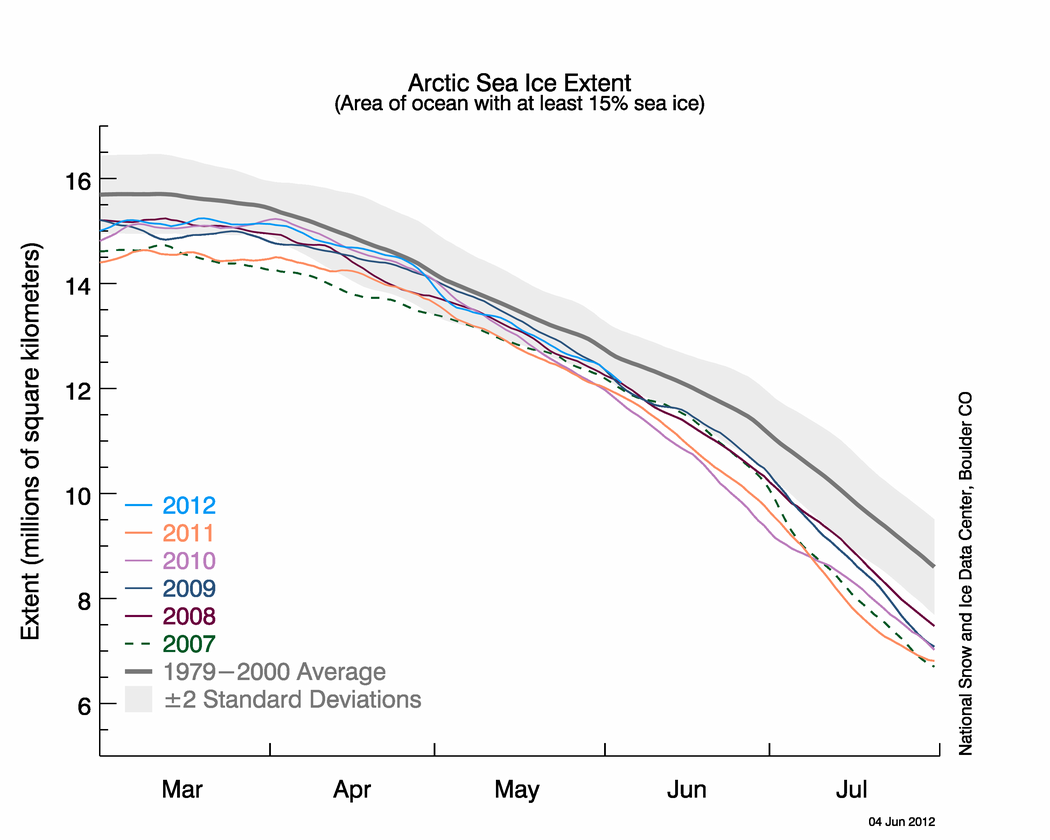
Between now and early September, when the polar pack ice shrivels to its summer minimum, they will pore over the daily sea ice reports of America’s National Snow and Ice Data Centre (NSIDC). Its satellite data will show that the ice has shrunk far below the long-term average. This is no anomaly: since the 1970s the sea ice has retreated by around 12% each decade. Last year the summer minimum was 4.33m square km (1.67m square miles)—almost half the average for the 1960s.
Graph: NSIDC
The Arctic’s glaciers, including those of Greenland’s vast ice cap, are retreating. The land is thawing: the area covered by snow in June is roughly a fifth less than in the 1960s. The permafrost is shrinking. Alien plants, birds, fish and animals are creeping north: Atlantic mackerel, haddock and cod are coming up in Arctic nets. Some Arctic species will probably die out.

Perhaps not since the 19th-century clearance of America’s forests has the world seen such a spectacular environmental change. It is a stunning illustration of global warming, the cause of the melt. It also contains grave warnings of its dangers. The world would be mad to ignore them.

As our special report shows in detail, the Arctic is warming roughly twice as fast as the rest of the planet. Since the 1950s the lower atmosphere has warmed by a global average of 0.7 degrees Celsius; Greenland’s air has warmed by 1.5 degrees. The main reason appears to be a catalytic warming effect, triggered by global warming. When snow or ice melt, they are replaced by darker melt-water pools, land or sea. As a result, the Arctic surface absorbs more solar heat. This causes local warming, therefore more melting, which causes more warming, and so on. This positive feedback shows how even a small change to the Earth’s systems can trigger much greater ones.

Photo: NSIDC

domingo, 25 de marzo de 2012

Deepest Solo Dive Makes History! (Updated)

ORIGINAL: Deepsea Challenge, Paul Allen
MARCH 25, 2012

The explorer-filmmaker emerges from his sub after returning from Challenger Deep.
Photograph by Mark Thiessen, National Geographic


Foto: PaulGAllen Paul Allen. #Deepseachallenge surfacing
Foto PaulGAllen Paul Allen. #DeepSeaChallenge sub comes out of the water picture  


At noon, local time (10 p.m. ET), James Cameron's "vertical torpedo" sub broke the surface of the western Pacific, carrying the National Geographic explorer and filmmaker back from the Mariana Trench's Challenger Deep—Earth's deepest, and perhaps most alien, realm.

The first human to reach the 6.8-mile-deep (11-kilometer-deep) undersea valley solo, Cameron arrived at the bottom with the tech to collect scientific data, specimens, and visions unthinkable in 1960, when the only other manned Challenger Deep dive took place, according to members of the National Geographic expedition.


National Geographic and Rolex congratulate James Cameron and the DEEPSEA CHALLENGE team on a successful and historic expedition to the Challenger Deep in the Mariana Trench.


With this achievement, Cameron becomes the first person to make a solo dive to the deepest place on Earth. The endeavor was one of scientific discovery in a new age of exploration, and its success will give us a better understanding of this least explored environment and the secrets and lessons it holds.

Breaking: James Cameron Completes Record-Breaking Mariana Trench Dive

Ker Than


Published 10:02 p.m. ET, March 25, 2012

After a faster-than-expected 70-minute ascent, James Cameron's "vertical torpedo" sub exploded up through the surface of the western Pacific minutes ago, carrying the National Geographic explorer and filmmaker back from the Mariana Trench's Challenger Deep—Earth's deepest, and perhaps most alien, realm.

The first human to reach the 6.8-mile-deep (11-kilometer-deep) undersea valley solo, Cameron arrived at the bottom with the tech to collect scientific data, specimens, and visions unthinkable in 1960, when the only other manned Challenger Deep dive took place, according to members of the National Geographic expedition.

Before surfacing about 300 miles (500 kilometers) southwest of Guam—where an expedition ship's crane plucked his sub from the sea—Cameron spent hours hovering over Challenger Deep's desert-like seafloor and gliding along its cliff walls, the whole time collecting samples and video.

Among the 2.5-story-tall DEEPSEA CHALLENGER sub's tools are a sediment sampler, a robotic claw, a "slurp gun" for sucking up small sea creatures for study at the surface, and temperature, salinity, and pressure gauges. (See pictures of Cameron's sub.)

Cameron—best known for creating fictional worlds on film (Avatar, Titanic, The Abyss)—is expected to announce his initial findings later today. After analysis, full results are to be published in a future edition of National Geographic magazine.


Science in Three Dimensions

Throughout the Mariana Trench dive, 3-D video cameras were kept whirring, and not just for the benefit of future audiences of planned documentaries.

"There is scientific value in getting stereo images because ... you can determine the scale and distance of objects from stereo pairs that you can't from 2-D images," Cameron told National Geographic News before the dive.

But "it's not just the video. The sub's lighting of deepwater scenes—mainly by an 8-foot (2.5-meter) tower of LEDs—is "so, so beautiful," said Doug Bartlett, a marine biologist at the Scripps Institution of Oceanography in San Diego, California.

"It's unlike anything that you'll have seen from other subs or other remotely operated vehicles," said Bartlett, chief scientist for the DEEPSEA CHALLENGE project, a partnership with the National Geographic Society and Rolex. (The Society owns National Geographic News.)


Medical, Psychological Rigors

As the 57-year-old explorer emerged from the sub's coffin—tight 43-inch-wide (109-centimeter-wide) cockpit, a medical team stood at the ready.

But if recent test dives—including one to more than five miles (eight kilometers meters) down—are any indication, Cameron should be physically fine, despite having been unable to extend his arms and legs for hours, expedition physician Joe MacInnis told National Geographic News before the dive.

"Jim is going to be a little bit stiff and sore from the cramped position, but he's in really good shape for his age, so I don't expect any problems at all," said MacInnis, a long-time Cameron friend.

In addition, the sub's "pilot sphere" has a handlebar, which Cameron could use to pull himself occasionally up during the dive. "Usually, shifting position is all that's required to buy yourself another few hours," he said.


Because Cameron had prepared extensively for the dive, he should be psychologically fine as well, said Walter Sipes, an aeronautics psychologist at NASA's Johnson Space Center.

"He's got prior experience doing this, not just in the simulator but also training dives ... and he's an adventurer, so I really don't think they'll have any issues to worry about," said Sipes, who is not part of the expedition.

Still, if Cameron plans to conduct more dives—which the team has indicated he will—Sipes recommends he get plenty of rest in-between or risk mental fatigue.

"When you start to get fatigued, you start making mistakes," he added. "And since he's down there solo, he can't afford that. He's a [potential] single-point failure."

It should be at least a few weeks before any further DEEPSEA CHALLENGE dives, as the director's next breakneck mission will take him from the middle of the Pacific to London, where he's due at a premiere of his Titanic 3-D Wednesday.


"A Turning Point"

By returning humans to the so-called hadal zone—the ocean's deepest level, below 20,000 feet (6,000 meters)—the Challenger Deep expedition may represent a renaissance in deep-sea exploration.

While remotely operated vehicles, or ROVs, are much less expensive than manned subs, "the critical thing is to be able to take the human mind down into that environment," expedition member Patricia Fryer said, "to be able to turn your head and look around to see what the relationships are between organisms in a community and to see how they're behaving—to turn off all the lights and just sit there and watch and not frighten the animals, so that they behave normally.

"That is almost impossible to do with an ROV," said Fryer, a marine geologist at the Hawai'i Institute of Geophysics & Planetology.

Andy Bowen, project manager and principal developer of the Nereus, an ROV that explored Challenger Deep in 2009, said a manned mission also has the potential to inspire public imagination in a way a robot can't.

"It's difficult to anthropomorphize machines in a way that engages everyone's imagination—not in the same way that having boots on the ground, so to speak, can do," said Bowen, who's not an expedition member.

Biological oceanographer Lisa Levin, also at Scripps, said that the DEEPSEA CHALLENGE program's potential for generating public interest in deep-ocean science is as important as any new species Cameron might have discovered.

"I consider Cameron to be doing for the trenches what Jacques Cousteau did for the ocean many decades ago," said Levin, who's part of the team but did not participate in the seagoing expedition.

At a time of fast-shrinking funds for undersea research, "what scientists need is the public support to be able to continue exploration and research of the deep ocean," Levin said.


For his part, Cameron seems sure that the DEEPSEA CHALLENGER will be exploring the depths for a long time to come. In fact, he's so confident in his star vehicle, he started mulling sequels even before today's trench dive.

Phase two might include adding a thin fiber-optic tether to the ship, which "would allow science observers at the surface to see the images in real time," said Cameron, a National Geographic Society explorer-in-residence.

"And phase three might be taking this vehicle and creating a second-generation vehicle."


DEEPSEA CHALLENGE, then, may be anything but a one-hit wonder. To expedition chief scientistBartlett, the Mariana Trench dive could "represent a turning point in how we approach ocean science.

"I absolutely think that what you're seeing is the start of a program, not just one grand expedition."


Rachael Jackson of National Geographic Channels International contributed reporting to this story.

.@JimCameron has surfaced! Congrats to him on his historic solo dive to the ocean's deepest point #deepseachallenge


.@JimCameron has surfaced! Congrats to him on his historic solo dive to the ocean's deepest point#deepseachallenge

#deepseachallenge sub started return to the surface after a successfull dive welcome back to sea level soon!

ORIGINAL: @PaulGAllen
(Paul Allen, was original founder of MS, it's involved in the DeepSea Challenge Project)


#deepseachallenge sub started return to the surface after a successfull dive welcome back to sea level soon! (Exploration time was about 3 hours)

#DeepseaChallenge Pressure at bottom is 16,285 Pounds per square inch at that depth. Design pressure was 16,500 ...Yikes/Amazing!


EXPEDITION RISKS AND DANGERS 


“Worry is a good thing when you’re an explorer. It’s when you’re cavalier, when you take risk for granted, that’s when you’re gonna get bit.” —James Cameron

Exploration is inherently dangerous. The DEEPSEA CHALLENGE team is cognizant of the risk of traveling to the ocean’s deepest point and does everything possible to mitigate the many hazards. Under the leadership of James Cameron and Ron Allum, each and every member of the team is encouraged, even required, to be explicit about the risks that are simply part of their work. The expedition philosophy follows the thinking that the only way to protect against risk is by anticipating, understanding, and addressing it outright. There is a great deal to be gained if DEEPSEA CHALLENGE is successful, but all members of the expedition acknowledge that lives are at stake and that, as Cameron himself has written, “there are a lot of ways to die.”

Cameron outlines some of these ways, in his own words, below.

IMPLOSION
The obvious one. You’ve miscalculated the design of your sphere. As you approach the bottom, with barely a warning groan, the sphere buckles suddenly. Faster than you can scream, you’re smashed into jam.

PENETRATOR FAILURE
There’s a dead short someplace and one of the pins in your electrical penetrator—the device that feeds power and control signals through the sphere wall—melts, causing the penetrator to fail. The water jet erodes the interior of the penetrator, allowing seawater to blast inside, at 16,000 psi.

FREEZING
If you get stuck on the bottom your weights don’t drop, and it’s a race between your life support running out and freezing to death. But you’ve got 60 hours of scrubber and O2, so freezing wins. Because the water outside is just above 0°C … icewater.

FIRE
Electrical fires can break out among all of the sub’s gadgets, and with O2 pumping into the pilot sphere, fires can grow quickly. Although a fire extinguisher is stored in the sphere, it may not be enough to extinguish a sizable fire.

VIEWPORT FAILURE
You’re looking out the viewport when suddenly you see cracks developing. The cracks quickly web throughout the thick volume of the acrylic, and it starts to give way. Then BANG! The cork pops and the sea hammers in like a supersonic piston.

ADRIFT
Only one ascent weight drops instead of both. So you ascend close to the surface but not all the way. Over the next ten hours a two-knot midwater current takes you 20 miles away, and the surface crew has no idea where you are, because you’re not at the surface.

Three Unexpected Dangers of Deep-Ocean Exploration

The “behind the scenes” information posted on the DEEPSEA CHALLENGE website provides incredible insight into the types of challenges—and logistics—that go into planning and executing an expedition of this size and scope. There are surprises everywhere—things one might never have thought to consider on their own and the planning for which there are few, if any, precedents. The work of the DEEPSEA CHALLENGE is an exercise for mystery- and puzzle-loving minds. Three expedition risks that the DEEPSEA CHALLENGE team has anticipated and addressed that might take nondivers by surprise are listed below.

HYDROTHERMAL VENT-INDUCED MELTDOWN
As first reported in expedition blogger Dr. Joe MacInnis’s March 18 entry, several of the expedition’s members, including the legendary Captain Don Walsh, one of two people ever to have been to the Challenger Deep prior to this expedition, discussed the risks of “flying a research sub too close to a hydrothermal vent,” where they “casually mention[ed]” that the water temperature approached 700 degrees and would melt a sub’s viewport.

SEAFLOOR COMMUNICATIONS CABLE ENTANGLEMENT
Submarine communications cables are cables that traverse the seafloor between land-based stations to extend telecommunication signals across stretches of ocean. Were the sub to become entangled in these cables, it might prevent it from returning to the surface.

HYPOTHERMIA AND HYPERTHERMIA
The DEEPSEA CHALLENGER submersible is a state-of-the-art vehicle—but it is not equipped with a thermostat that can adjust internal temperatures for comfort. The temperature range for a dive borders on the extreme. As the National Geographic expedition website reports, “the temperature will drop from sauna-like at the surface to meat-locker cold at the bottom.” Cameron will dive wearing many layers but the risk of overheating or freezing is significant. In a personal communication to his team, Cameron described a recent experience with heatstroke-like symptoms as he waited inside the sub’s unventilated pilot sphere to be launched into the ocean:

“Hyperthermia early in the dive (and throughout shallow test dives) is a hazard in this vehicle, at least as much as hypothermia late in a deep dive. I found my mental performance slipping after two hours at 102 degrees/100% humidity [while piloting the sub for a test dive]. It doesn’t sound that hot but with zero evaporative cooling available in such a tiny airspace, I’m sure my core temp was going up to match air temp. I got sub internal temp back down to 97 degrees. But by then I was trashed, and had lost several pounds in water.”

@JimCameron is the first person in history to solo dive to the deepest place on Earth, a record 35,756ft/10,898m #deepseachallenge (Updated)

ORIGINAL: DeepSea Challenge


. is the first person in history to solo dive to the deepest place on Earth, a record 35,756ft/10,898m 

ORIGINAL: DeepSeaChallenge
As of 5:52 p.m. ET (7:52 a.m. on Monday, local time), James Cameron has arrived at the Mariana Trench‘s Challenger Deep, members of the National Geographic expedition have confirmed.

His depth on arrival: 35,756 feet (10,898 meters)—a figure unattainable anywhere else in the ocean.

Reaching bottom, the National Geographic explorer and filmmaker typed out welcome words for the cheering support crew waiting at the surface: “All systems OK.”