Mostrando entradas con la etiqueta Especie en vía de Extinción. Mostrar todas las entradas

sábado, 1 de junio de 2013

En el último año, 100 especies de ranas se extinguieron en el mundo

ORIGINAL: El Colombiano
Por LILLIANA VÉLEZ DE RESTREPO
1 de junio de 2013

Usted puede ayudar. Visite el sitio savethefrogs.com/colombia. FOTO MANUEL SALDARRIAGA

El biólogo Kerry Kriger habla de las amenazas y de la fundación que creó para salvarlas.
Las cifras son alarmantes: 100 especies de ranas desaparecieron en el mundo en el último año y 100 millones de estos anfibios son transportados cada año como mascotas, para ser consumidas, para zoológicos y para laboratorios.

Las cifras las citó Kerry Kriger, biólogo norteamericano doctorado en Ciencias Ambientales, durante su visita a Medellín invitado por Parque Explora.

Kerry es además el fundador y director ejecutivo de la organización Save the frogs (Salvemos las ranas). Una entidad sin ánimo de lucro que promueve el cuidado y protección de estos anfibios. "Decidí fundarla porque vi que no había organizaciones dedicadas exclusivamente a protegerlas. Las ranas están desapareciendo muy rápido en muchas partes del mundo, se están extinguiendo y faltan políticas y voluntarios", precisó Kerry.

Explicó que son varias las amenazas. La primera y peor es la destrucción del hábitat, precisa el biólogo.

Otro peligro al que están expuestas las ranas es a una enfermedad, la quitridiomitosis, producida por el hongo quitridio, "un microorganismo que está en el agua, en los riachuelos y se transporta intercontinentalmente". Solo en Australia, después de que se extinguieron siete especies por el hongo, existen regulaciones de control.

El consumo de ranas por parte de los humanos, sobre todo las ancas, es otra amenaza. Dice el experto que en el mundo se comen alrededor de 2.000 millones de ranas al año, especialmente en países como Indonesia, Francia, Bélgica y Estados Unidos.

Las truchas y las mismas ranas, en este caso la especie toro, también influyen en la supervivencia de estos anfibios. "Hay especies no nativas, como truchas introducidas por pescadores, que se comen los huevos de las ranas y los renacuajos", anota Kerry Kriger.

Los pesticidas son otro factor de riesgo. "En Estados Unidos hay 18.000 pesticidas registrados, y en todo el mundo son un billón de pesticidas usados al año, que generalmente van al agua donde las ranas se reproducen. Estos anfibios tienen la piel permeable, los pesticidas les entran y les destruyen su sistema endocrino e inmunosupresor. Hay que salvar las ranas", concluyo Kerry Kriger.

domingo, 20 de enero de 2013

Anti-poaching drones to take off in Africa

ORIGINAL: Al Jazzera
20 Jan 2013

Conservationists seek out new technologies as illegal animal killings threaten endangered populations.

Kenya reportedly lost 360 elephants last year to poaching [James Pope/Save the Elephants]
Nairobi, Kenya - The discovery was gruesome. A family of 12 dead elephants rotting in the midday heat of south-eastern Kenya, their faces hacked apart by poachers as they removed the animals' ivory tusks.

The massacre this month in Tsavo East National Park highlighted a surge in poaching in Africa that has pushed conservationists to embrace new technologies in an effort to save threatened elephants and rhinos.

Now, rangers plan to deploy remotely controlled drone aircrafts above three African parks this year.

Elsewhere, elephant collars fitted with iPhone-style technology are being developed to alert wardens when animals are hunted.

"Many nearby conservancies have lost animals. We recently took in a rhino calf which had been shot, but sadly did not survive," said Rob Breare, from central Kenya's Ol Pejeta Conservancy.

"It's a pretty desperate situation right now, and anything that halts this poaching scourge is a necessity," he noted.

Ol Pejeta employs 160 armed guards across 90,000 acres (360 km2) to protect its prized assets: four of the world's last remaining seven northern white rhinos. In March, it plans to test-fly a $75,000 drone to place eyes in the sky.

Launched either by hand or catapult, the aircraft can cover 10,000 acres on each flight, relaying a live-stream camera feed to rangers on the ground. Thermal imaging means it can also patrol by night.

The World Wildlife Fund (WWF) also plans to deploy drones above two African and two Asian reserves, while tagging and monitoring animals in a $5m scheme that is being funded by Google, the environmental group's anti-trafficking expert Crawford Allan said.

"This isn't just about using aerial surveillance systems. This is about understanding where the animals are on the ground, using low-cost technology to electronically tag animals," he said. "It's a new approach that could change the game and really deter poaching."

Hi-tech collars
WWF describes a soaring trade in ivory and rhino horn to provide trinkets, aphrodisiacs and medicine to the burgeoning nouveau riche of China and other parts of Asia.

"Agitated animals act differently, allowing the collar to send out an alert and our team can get there before the elephant is killed. "

- Frank Pope

Prime Minister Raila Odinga said Kenya lost 360 elephants last year in a "global surge in poaching, fuelled by high demand for ivory in Asian countries". Ivory costs $1,000 per pound in the Far East, while rhino horn fetches up to $30,000 per pound.

After two decades of conservation gains and growing elephant and rhino numbers, much of Africa is witnessing a return to the bad old days and record highs of poaching. Wardens fear the thick-skinned beasts could be wiped out altogether.

The Kenya-based group, Save the Elephants, uses hi-tech collars fitted around animals' necks, which emit mobile phone and satellite signals, allowing rangers to monitor scores of animals via Google Earth, spokesman Frank Pope told Al Jazeera.

When an elephant ceases moving, the collar sends out an alert signal and rangers rush to investigate the scene.

"We find either that the elephant has been injured or, more often, sadly, it's been killed," Pope noted.

Tracking the killers after a carcass discovery can be effective. This month, Kenya Wildlife Service (KWS) rangers in Isiolo County, in central Kenya, hunted down a poaching gang and killed two poachers in the ensuing shoot-out.

Engineers are currently upgrading the collars so they can raise the alarm even before an elephant has been gunned down, said Pope, effectively turning the heavyweight herbivores "into their own threat-detectors".

Using accelerometer technology found in iPhones, which gauge movement and gravitational pull, improved collars will also track an elephant's movement patterns and breathing, thus indicating if the animal is distressed.

"In the bush, elephants detect poachers before the poachers detect elephants. They have exquisitely good senses of hearing and smell," Pope said. "Agitated animals act differently, allowing the collar to send out an alert and our team can get there before the elephant is killed."

Conservation drones 
While tracking gadgets are widely welcomed by conservationists, the value of "eco-drones" remains hotly debated and has been dismissed as a gimmick, the brainchild of marketing executives in aerospace firms more usually associated with creating weapons of war.

"We need them to understand they are being conned by snake-oil salesmen. Often sick people who cannot afford to waste their money on fakes."

- Crawan Allan. analyst 

Unlike the high-altitude killers deployed above Afghanistan and Pakistan, however, conservation drones look more like model aircraft and have a smaller field of vision. Poachers already bury animal carcasses to avoid detection by ranger aeroplanes.

"We need to see results before we allocate resources," said KWS spokesman Paul Mbugua. "We need to know whether poachers are capable of bringing drones down, just like they can bring down other aircraft."

Ian Saunders, the former military co-founder of the Tsavo Trust, described a battle against Mafia-like gangs toting Kalashnikovs and rifle-fired grenades, comparable to "low-level counter-insurgency" operations.

"UAVs [Unmanned Aerial Vehicles] have a role to play, but they are no silver bullet," he said. "Deterring poachers involves well-trained and well-equipped people on the ground. It's not about Special Forces and drones; it's about doing the basics well."

Ecologists now warn that many of Africa's "rebel militias" have joined the poaching spree for quick cash, with analysts pointing the finger at Somalia's hard-line al-Shabaab fighters and the quasi-religious Lord's Resistance Army of central Africa.

"As much as blood diamonds were fuelling conflict in Africa, we are now seeing blood ivory fuelling conflict and instability on the continent," said Pope, from Save the Elephants.

While conservationists disagree on the merits of eco-drones, there is consensus on the need to quash the demand for tusks and horns in Asia, as well as running intelligence-led anti-poaching efforts in sub-Saharan savannah.

An International Fund for Animal Welfare study revealed that 70 percent of Chinese consumers were not aware that elephants were killed for ivory, often believing that it compares to losing a tooth. Rhino horn is mistakenly believed to cure cancer and boost sexual potency.

"We need them to understand they are being conned by snake-oil salesmen. Often sick people who cannot afford to waste their money on fakes," said Allan from WWF.

"With time, people will come to understand that it isn't morally acceptable to wipe out a species at the whim of wealthy people."

Follow James Reinl on Twitter: @jamesreinl

viernes, 30 de noviembre de 2012

A New, Genetically Distinct Lion Population is Found

ORIGINAL: NatGEo
November 30, 2012

Photo courtesy of Joerg Junhold and Klaus Eulenberger, Leipzig Zoo.
In a twist on the Lion King’s “Circle of Life,” a group of researchers identified a population of genetically distinct lions—in a zoo. The finding came after an Addis Ababa zoo asked researchers in its sister city of Leipzig to help prove that their lions not only looked unusual, but were genetically unique. The finding would help the struggling zoo to obtain funding to continue breeding the lions and to improve their living conditions.

The Addis Ababa zoo lions have dark manes and small bodies, unlike other African lions. But life in captivity can sometimes influence appearance. A team of researchers, led by the Max Planck Institute for Evolutionary Anthropology in Germany and the University of York in the UK, checked to see if the lions really are different by comparing DNA samples of 15 lions from the zoo to six populations of wild lions.

Their genetic analysis revealed that the gene sequence of all fifteen lions were unique and showed little sign of inbreeding. The study was recently published in the European Journal of Wildlife Research (http://link.springer.com/article/10.1007/s10344-012-0668-5).

The zoo’s lions belonged to Ethiopia’s deceased emperor, Haile Selassie, who established the zoo in 1948. But their origins are unknown. One theory is that the seven founder lions—five males and two females—came from southwestern Ethiopia. Wild lions that look like this may no longer live there because their strikingly dark mane proved too alluring to hunters.

Since the wild source population is unknown, we cannot be sure whether it still exists,” says lead author Susann Bruche. http://www1.imperial.ac.uk/medicine/people/susann.bruche09/ “Lions with similar appearance have been largely diminished mainly due to hunting for their mane.

Bruche says that according to the Ethiopian authorities, lions that resemble the zoo lions still exist in the east and northeast of the country, in the Babille Elephant Sanctuary and in a wildlife rescue facility in Ensessakotteh.(http://www.bornfree.org.uk/campaigns/wildlife-rescue-centres/ethiopia/.

This isn’t the first lion population to survive only in zoos. Two significant lion populations, the North African Barbary lions and the South African Cape lions, have already become extinct in the wild. As Ethiopia’s population of lions declines, “Every effort should be made to maintain this population to keep the genetic heritage alive,” says Bruche.

Construction work is currently underway in the Addis Ababa zoo to create a facility modeled on the lions’ natural environment. The zoo will continue to breed the lions to keep the population alive.


martes, 23 de octubre de 2012

How does climate change cause extinction?

ORIGINAL: Royal Society
17 October 2012
Authors:Abigail E. Cahill, Matthew E. Aiello-Lammens, M. Caitlin Fisher-Reid, Xia Hua, Caitlin J. Karanewsky, Hae Yeong Ryu, Gena C. Sbeglia, Fabrizio Spagnolo, John B. Waldron, Omar Warsi and John J. Wiens


Climate change causes extinctions not only as a result of species intolerance to high temperature, but more commonly via a variety of related factors that alter a species’ interactions with other species, according to a new review published in Proceedings of the Royal Society B today.

An Ecuadorian harlequin frog (Atelopus onorei): a species thought to have recently gone extinct from causes related to climate change. Photo by Luis Coloma


Contrary to expectations given global warming, researchers from Stony Brook University found little evidence that many species have gone locally extinct or declined due to direct effects of higher temperatures. Instead, climate change was found to typically lead to local extinctions and declines by influencing interactions between species, such as reducing prey populations for predators.

Researchers reviewed 136 studies that suggested that climate change was associated with local extinctions or declines and found just seven for which the primary cause (“proximate cause”) of extinction could be identified. Of these, none of the seven showed a straightforward relationship between a local extinction and limited tolerances to high temperature, and most implicated species interactions, such as declines in prey species or increased disease spread, as the proximate cause. Additionally, seven studies of population declines related to recent climate change showed a very similar pattern, as did four studies of declines related to natural climatic oscillations.

Author, Professor John J. Wiens, said: “Dozens of studies have shown local extinctions and declines that appear to be associated with recent, human-related climate change. For most of these cases, the primary cause of the declines has not been identified, highlighting our worryingly limited knowledge of this crucial issue. However, where causes have been identified, changing species interactions have been found to be key in the majority of cases. Because many of these impacts have already happened and climate has changed only a little so far relative to the predicted changes in the next 100 years, our results suggest that these shifting interactions may make even small climatic changes dangerous for the survival of populations and species.”

The researchers identified a number of factors (“proximate causes”) hypothesised to lead to extinction from climate change, principally:
Impacts of limited physiological tolerance to changes in temperature, with specific proximate causes including decreased activity time and increased energy maintenance costs leading to starvation, or reduced oxygenation of water
Impacts of limited physiological tolerance to changes in precipitation, with species proximate causes including loss of habitat for freshwater species or life stages and water stress and death in terrestrial species
Climate-related impacts on beneficial species, for example extinction or declines of prey species, pollinators or host species
Climate-related impacts on harmful species, for example increases in predators, competitors and pathogens
Changes to activity times of interacting species due to changes in different cues such as temperature and photoperiods

Following this, they identified seven studies in which a specific proximate cause could be attributed to a local extinction associated with climate change. Four of these involved changes in species interactions, including climate-related reductions in food species for a planarian worm and a bighorn sheep, mismatched timing in a butterfly and its host plant, and climate-related loss of coral habitat for a fish species. Other causes included loss of aquatic habitat for African fish species due to drought, both high and low temperatures in an American mammal (pika), and reduced surface activity during the breeding season due to high temperatures in Mexican lizard species.

They then identified seven studies of population declines associated with climate change (given that these declines can lead to extinction). They found similar patterns, with species interactions being the most frequent proximate cause of declines, including climate-related reductions in food for three bird species (a plover, a jay, and an auklet), and declines due to climate-related spread of a fungus in dozens of species in a genus of tropical frogs (Atelopus). Declines were also related to limited precipitation (in an African aloe tree and four North American amphibians) and oxygen limitation at higher temperatures in a fish (eelpout).

Finally, they found that local extinctions and declines due to climatic oscillations (rather than long-term trends) were also due primarily to species interactions, including climate-related loss of figs for fig wasps, loss of symbiotic algae for corals, loss of coral used for food by a butterfly fish, and disease spread in a toad.

Professor Wiens added: “Currently our knowledge of the ways in which climate change can lead to species extinctions is extremely limited. Understanding the proximate causes of extinction from climate change should be an urgent priority for future research if we are to develop effective conservation strategies to ameliorate their effects.”

martes, 10 de julio de 2012

Estas son las especies amenazadas de extinción según la WWF

ORIGINAL: Diario ADN

LA CACERÍA, LA PESCA, LA DEFORESTACIÓN Y LA CONTAMINACIÓN PONEN EN PELIGRO A ESTOS ANIMALES 
Del rinoceronte de Java solo quedan 60 ejemplares en todo el mundo
Quedan solo 5000 ejemplares del leopardo de las nieves.
El 40% de los tigres del mundo han desaparacido, solo quedan 3200 ejemplares en su hábitat natural
Del Delfín del Irrawaddy existen solo 85 ejemplares en estado salvaje
La tortuga baula o Laud no posee caparazón duro y está altamente amenazada.
El gorila de montaña se ve altamente afectado por la densidad poblacional cercana a su hábitat
El orangután de sumatra se ve en peligro por la desnutrición de su hábitat

Al ser un ingrdiente muy solicitado en la gastronomía, el atún rojo es víctima de pescas masivas

El elefante asiático es codiciado por los cazadores quienes buscan sus colmillos para el comercio. Foto: petfriends.com.br

miércoles, 4 de julio de 2012

THE END OF THE LINE - UN MUNDO SIN PECES


Sinopsis:
¿Qué está pasado con los peces de todo el mundo? ¿De dónde viene el atún que comes? ¿Y cómo fue capturado? ¿Es el mar una fuente inagotable de recursos? La fundación MarViva y Greenpeace presentan "THE END OF THE LINE - UN MUNDO SIN PECES" , el primer documental riguroso sobre la desaparición de las especies marinas y la seguridad alimentaria.

"The End of the Line - Un mundo sin peces" se basa en un libro del periodista de investigación Charles Clover, y cuenta con el apoyo, además de MarViva, de las fundaciones Waitt Family y Channel 4 Britdoc.

La película ha sido producida por Arcane Pictures, Calm Productions y Darmouth Films
La versión original de "THE END OF THE LINE - UN MUNDO SIN PECES" narrada por el actor Ted Danson (Cheers, Damages) — se presentó en el Festival de Cine Sundance 2009. Su promoción ha sido apoyada por cientos de organizaciones medioambientales, oceanográficas y de conservación marina , incluidos el Consejo para la Defensa de los Recursos Naturales (NRDC), National Geographic, Greenpeace y WWF.
La versión doblada al castellano y que veremos en Argentina, está a cargo de Miguel Bosé.

Si bien esta película no se estrenará comercialmente (la idea no es lucrar con el film), estamos haciendo a través de la Fundación de MarViva, España, con el apoyo local de Greenpeace, una campaña de concientización sobre la extinción de peces a mediano plazo. Posiblemente haya funciones gratuitas que avisaremos luego.

Pero es por esta causa que necesitamos la mayor colaboración posible de los comunicadores.
No nos interesa hacer una crítica de espectáculos hacia film sino tratar de difundir en la más amplia forma posible las ideas, conclusiones y reflexiones que se muestran en esta película.

Ficha Técnica:
Dirección: Rupert Murray
Productores Ejecutivos:
Christopher Hird y Jess Search, Ted Waitt y Erica Knie (MarViva)
Productores: Claire Lewis y George Duffield
Montaje: Claire Ferguson
Narración: Miguel Bosé (castellano)

Datos Técnicos:  82 min.

País: UK 


Documental que denuncia, a través de impactantes imágenes, el daño que la sobrepesca está haciendo a los océanos y las consecuencias globales que puede tener en la biodiversidad marina y en nuestra propia vida.

Filmado durante más de dos años siguiendo las investigaciones de Charles Clover, periodista del Daily Telegraph, el documental examina la inminente extinción del atún rojo, fundamentalmente producida por el aumento de la demanda occidental de sushi, y revela que si el sector de la pesca no se regula, en el año 2048 podrían haber desaparecido de nuestros mares todos los peces comestibles, lo que provocaría una hambruna que afectaría a millones de personas y dejaría en paro a todo el sector pesquero mundial.

jueves, 21 de junio de 2012

Protect big cats from cruelty

ORIGINAL: IFAW

Urge your Member of Congress to support legislation that would protect big cats from cruelty and neglect, and help keep communities safe from captive big cats.


Take Action

We have prepared a template email for you to send to your Member of Congress. We encourage you to personalize the letter to make it more effective by telling them why you care about big cats like lions, tigers, and cheetahs, as well as the safety of your community.

"I am a constituent of yours who cares about the protection of animals in captivity and about public safety. I am writing to urge you to cosponsor H.R. 4122, the Big Cats and Public Safety Protection Act, which was introduced by Rep. “Buck” McKeon and Rep. Loretta Sanchez. The bill would prohibit the private possession of big cats unless they are being kept at accredited zoos and lifetime wildlife sanctuaries.

We were all horrified on October 18, 2011, when the owner of a backyard menagerie opened the cages of his tigers, leopards, lions, wolves, bears and monkeys before killing himself, giving police no choice but to shoot and kill nearly 50 animals – 38 of them big cats – near Zanesville, OH. Imagine what could have happened if those starving, dangerous wild animals had reached more populated areas of the community?

In the past 21 years, 21 people, including 5 children, have been by killed by captive big cats in the U.S. Other incidents include 246 maulings, 254 escapes, 143 big cats deaths, and 128 confiscations. The U.S. is home to roughly 5,000 captive tigers – more than are found in the wild. Since 1990, captive tigers have killed at least 12 people in the U.S. and mauled about 75 more.

Big cats in captivity are often neglected and abused – owners and exhibitors are frequently cited by authorities for cruelty and other animal welfare abuses. Most wildlife sanctuaries for mistreated or unwanted big cats are at or nearing capacity, and many lack financial reserves for more than a few months operating expenses. Congress passed the Captive Wildlife Safety Act in 2003 prohibiting interstate trade of big cats, but given the growth in the number of captive big cats in private possession nationwide, it is clear that more stringent action is necessary.

Again, please become a cosponsor of H.R.4122 and help protect both public safety and the welfare of big cats in captivity. Thank you for considering my comments, and I look forward to your reply."

lunes, 18 de junio de 2012

The vanishing North

ORIGINAL: The Economist

There are benefits in the melting of the Arctic, but the risks are much greater

Jun 16th 2012


NOW that summer is here, the Arctic is crowded with life. Phytoplankton are blooming in its chilly seas. Fish, birds and whales are gorging on them. Millions of migratory geese are in their northern breeding grounds. And the area is teeming with scientists, performing a new Arctic ritual.

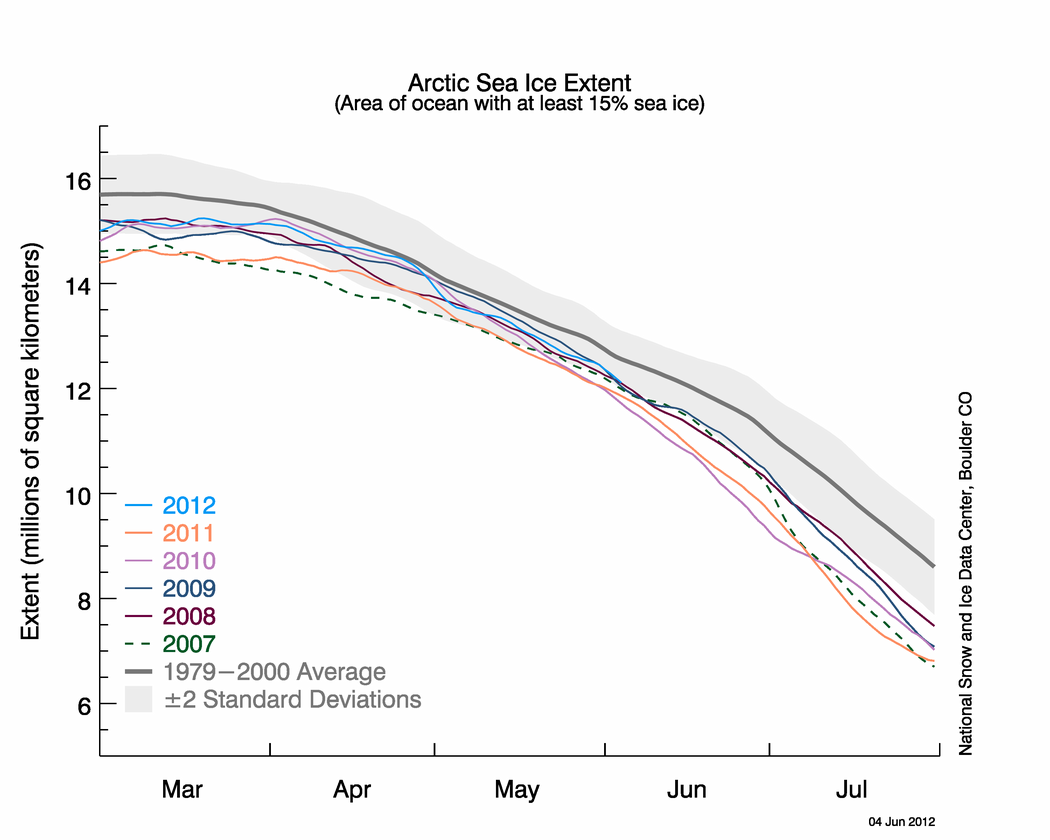
Between now and early September, when the polar pack ice shrivels to its summer minimum, they will pore over the daily sea ice reports of America’s National Snow and Ice Data Centre (NSIDC). Its satellite data will show that the ice has shrunk far below the long-term average. This is no anomaly: since the 1970s the sea ice has retreated by around 12% each decade. Last year the summer minimum was 4.33m square km (1.67m square miles)—almost half the average for the 1960s.
Graph: NSIDC
The Arctic’s glaciers, including those of Greenland’s vast ice cap, are retreating. The land is thawing: the area covered by snow in June is roughly a fifth less than in the 1960s. The permafrost is shrinking. Alien plants, birds, fish and animals are creeping north: Atlantic mackerel, haddock and cod are coming up in Arctic nets. Some Arctic species will probably die out.

Perhaps not since the 19th-century clearance of America’s forests has the world seen such a spectacular environmental change. It is a stunning illustration of global warming, the cause of the melt. It also contains grave warnings of its dangers. The world would be mad to ignore them.

As our special report shows in detail, the Arctic is warming roughly twice as fast as the rest of the planet. Since the 1950s the lower atmosphere has warmed by a global average of 0.7 degrees Celsius; Greenland’s air has warmed by 1.5 degrees. The main reason appears to be a catalytic warming effect, triggered by global warming. When snow or ice melt, they are replaced by darker melt-water pools, land or sea. As a result, the Arctic surface absorbs more solar heat. This causes local warming, therefore more melting, which causes more warming, and so on. This positive feedback shows how even a small change to the Earth’s systems can trigger much greater ones.

Photo: NSIDC

martes, 15 de mayo de 2012

ARTIMALIA

ORIGINAL: Artimalia


Dibujando especies para que no se borren.
Una web dedicada a todos los animales a los que ya se les acabó el tiempo.
Artimalia es un espacio para ver, leer y reflexionar.

Este proyecto surge de una mezcla afortunada, nace, sencillamente, de combinar nuestras dos pasiones: el arte y el reino animal. Motivados por las ganas de “querer hacer” y tras un largo periodo de preparativos, nos ilusiona poder lanzar, por fin, esta web en la que podréis descubrir animales que no conocíais y reflexionar sobre la situación real de muchas de las especies del planeta. Desde artimalia queremos fomentar el respeto por la fauna en un formato serio, comprometido y participativo.

Lápiz, grafito y rotulador.
Nos hemos esforzado en construir un espacio interesante e ilustrativo donde el arte ha sido nuestra herramienta principal. Esperamos que las imágenes que mostramos en esta web sean, en un mismo tiempo, homenaje y representación de cada especie y os ayuden a conocer un poco mejor a estos animales que lamentablemente ya no están presentes.

Especies especiales.
Artimalia es un encuentro con la realidad cercana. La gran mayoría de los animales que mostramos han desaparecido de forma silenciosa, desde los que sucumbieron hace poco más de doscientos años hasta los que no han conseguido sobrevivir nuestros días. Los contenidos están centrados en las causas de cada extinción... estamos seguros de que podréis sacar unas cuantas conclusiones.

Para que no se borren... del planeta.
Los apartados que seguirán posteriormente, dedicarán su espacio a intentar recoger y plasmar la desorbitada lista de animales en peligro. Lo señaló claramente Ricardo Natalichio en 2010 “un tercio de todas las especies del planeta están amenazadas de extinción”. En algunos casos, todavía no es irreversible.

Nuestro cometido.
Hemos creado un espacio no lucrativo capaz de recaudar fondos para fines visibles relacionados con el mundo animal.

Entregaremos las ayudas a otras asociaciones cuya labor actual sea la de la recuperación y conservación de animales amenazados.

Este es sólo el principio.
Conforme vayamos avanzando en las diferentes fases podremos reunir a más artistas; organizar exposiciones; publicar libros educativos; ofrecer más enlaces interesantes; traducir los contenidos a otros idiomas... Por el momento, esperamos haceos experimentar esta necesaria aventura por el recuerdo y la prevención de todas las especies.

Los animales forman una parte inalienable de la naturaleza y si nosotros provocamos la desaparición de una sola especie, disminuimos nuestro mundo y nuestro lugar en él” James Michener (novelista, Pulitzer 1947).

En acción.
No podemos parar quietos y de eso se trata. En este apartado os contamos lo que nos traemos entre manos.


Ya tenemos fecha y lugar
El próximo 21 de abril de 2012 inauguraremos y presentaremos artimalia en Madrid. Los dibujos mostrarán a muchos de los animales que ya no habitan nuestro planeta. La expo continuará hasta el 26 de mayo.

Horarios: de lunes a viernes: de 10h a 14h. Martes y jueves: de 10h a 14h y tardes de 17h a 19:30h.
Lugar: sala de exposiciones de La Bóveda. Madrid.
C/ San Felipe Neri, 4 bajo. Metros: Ópera o Sol.


Casitas de madera para pájaros
Estamos construyendo casitas de madera respetando las medidas homologadas y características según la especie de pájaro para colocarlas en puntos estratégicos donde sean necesarias. Te contaremos cómo puedes acompañarnos el día de su colocación.

Apartado donativos
Pronto estará disponible en esta web, una sección dedicada a las donaciones. En este apartado, vuestras aportaciones se convertirán en ayudas directas para la protección de especies animales.

nº de cuenta artimalia: 1465 0100 93 1711921297
Muchas gracias por tu aportación!

Bienvenidas sean las colaboraciones!
Nos gustan los espacios participativos que se nutren de gente diferente.
Crearemos formas variadas de colaboración que iremos ampliando a través de nuestras actualizaciones.

Buzón de sugerencias.
Aquí podrás dejar cualquier tipo de sugerencia, opinión o propuesta que te haya inspirado artimalia. Las buenas ideas siempre son bien recibidas así que si se te ha ocurrido cómo podemos enriquecer nuestros apartados o si tienes nuevas iniciativas, somos todo oídos. Te animamos a que te hagas partícipe de este proyecto.

Escríbenos a colabora@artimalia.org
No olvides poner en el asunto: “Buzón de sugerencias”.

1| Colaboración sencilla. 
Si te gusta esta web, por favor, Feisbukeanos, Tuiteanos, Flickeanos... compártenos.
2| Colaborar con nuevos contenidos. 
¿Conoces alguna especie que no hayamos incluido?.

Si conoces algún animal que no esté en nuestra lista; quieres añadir información documentada en la ficha de alguna especie o si has detectado algún error en los contenidos... no lo dudes, escríbenos. Recuerda que los datos que aportes tendrán que venir acompañados por su correspondiente bibliografía o fuentes de información.

Escríbenos a colabora@artimalia.org
No olvides poner en el asunto: “Contenidos”.

3| Multilingüe. 
Presentarnos en muchos idiomas.

Por ahora estamos utilizando Google traductor... pero bueno, como es lógico, preferiríamos traductores de carne y hueso. Nos gustaría presentarnos en varios idiomas aunque, de momento, empezaremos por el inglés. Si te apetece ayudarnos, ponte en contacto y te facilitaremos un pedacito de artimalia para que lo traduzcas.

Escríbenos a colabora@artimalia.org
No olvides poner en el asunto: “Idiomas / inglés”.

Carteles: Amaya Oyón


Prox| Proyecto “Animal Poster”
Estamos preparando un proyecto gráfico y participativo que consistirá en la creación de carteles y donde los animales serán el núcleo temático. Podrás interpretar una noticia actual, hacer una crítica constructiva o denunciar algún hecho, pero siempre, a través del filtro poético e inteligente del arte.

Este apartado se abrirá y detallará un poco más adelante, os mantendremos informados.

Quiénes somos.

Fundadores:

Amaya Oyón Pequeño animal gráfico capaz de enfrentarse a todo tipo de retos.


Sergio Navarro El que hace que todo funcione (pero si no funciona no es culpa suya).


Iñigo Mateo El que nos sabe organizar con ideas constructivas y nos cuenta los chistes.


mosiq (Raúl Rodríguez) Roedor callejero e independiente. Menos mal que nos salió artista!.


Javi Maen Log Una auténtica máquina del pirograbado. Él trabaja fino, fino.


Rafa Garabal Nuestro enfermero/tatuador favorito y un genio de las texturas.


Diana Sobrado Nuestra ilustradora de los Bosques. Buena dibujante y siempre dispuesta.


Colaboradores:
  • Jesús Navarro
  • Jesús Ramírez de Ocáriz
  • Jorge Ochagavía
  • Roberto Gutiérrez (Verbum)
  • Soraia Ochagavía
  • Toni Pirata
Agradecimientos:
  • Arturo Purroy
  • Esther, Lluís y Bran
  • Javier Conti
  • Marta Fantova
Y a todos aquellos que, comprometidos con la causa, han hecho posible este proyecto.

Enlaces amigos:
Ubicada en el espectacular paisaje montañoso del corazón de los Andes colombianos, la Reserva Natural Sacha Mama ofrece sus instalaciones, construidas artística y bioclimáticamente, para que experimentes la 'Madre Montaña' en un contexto ecológico y como una oportunidad para la conciencia. Como parte del plan de Restauración Ecológica, Sacha Mama vela por la conservación de especies que se encuentran actualmente en peligro de extinción. En este espacio natural también podrás degustar una cocina local orgánica a base de ingredientes frescos, talleres de intercambio de saberes y experiencias, pintura, retiros privados, recorridos por el bosque tropical...

Se constituye para formar un frente común, una fuerza coherente por la defensa conjunta de nuestras creencias, nuestros ritos y nuestros Lugares Sagrados. Nuestras acciones pretenden ir encaminadas a manifestar la existencia del Druidismo en nuestro País y a la vez, hacer honor al compromiso al que nos obliga la Ética Druídica.

En este aspecto, consideramos prioritaria la participación en campañas y movimientos propios o planteados por terceros que vayan en consonancia con dicha Ética, especialmente las basadas en la protección de la naturaleza, sus criaturas y sus entornos, materia que para los Druidas es extremadamente Sagrada.

Asociación cultural: circulodruidicoiberico.com

Enlaces para ver:
Comunidad de personas y organizaciones que unen fuerzas para luchar contra las injusticias: actuable.es
Por los derechos de los animales: igualdadanimal.org
Activistas en defensa de los animales: equanimal.org
Animales de España y Portugal: faunaiberica.org
Programa de conservación del Lince Ibérico: lynxexsitu.es
Programa de conservación del Águila Imperial Ibérica:aguilaimperial.org
Fundación Oso Pardo: fundacionosopardo.org
Fundación para la conservación y recuperación de animales marinos:cram.org
Fundación Félix Rodríguez de la Fuente:felixrodriguezdelafuente.com
Animales en peligro de extinción: animalesenextincion.info
Asociación Defensa Derechos Animales: addaong.org
Coordinadora española de protección animal: proteccionanimal.org
Puntos de interés en la naturaleza: naturatlas.com
Ecología y medio ambiente: lareserva.com
Esta no es mi fiesta nacional: FB