Mostrando entradas con la etiqueta Fósiles. Mostrar todas las entradas

miércoles, 4 de diciembre de 2013

Scientists Just Sequenced the DNA From A 400,000-Year-Old Early Human

DNA from a group of ancient human fossils found in Spain (above), has been mysteriously related to an ancient lineage called the Denisovans, previously found only in Siberia. Photo by Javier Trueba, Madrid Scientific Films
Since its discovery in 1990, La Sima de los Huesos, an underground cave in Northern Spain’s Atapuerca Mountains, has yielded more than 6,000 fossils from 28 individual ancient human ancestors, making it Europe’s most significant site for the study of ancient humans. But despite years of analysis, the exact age and even the species to which these individuals belonged has been in doubt.

Now, though, an international group of scientists has extracted and sequenced DNA from the fossilized femur of one of these individuals for the first time. The resulting data—which represent the oldest genetic material ever sequenced from a hominin, or ancient human ancestor—finally give us an idea of the age and lineage of these mysterious individuals, and it’s not what many scientists expected.

The fossilized bone tested, a femur, is roughly 400,000 years old. But the big surprise is that, although scientists had previously believed the fossils belonged to Neanderthals because of their anatomical appearance, the DNA analysis actually shows they’re more closely related to Denisovans, a recently-discovered third lineage of human ancestors known only from DNA isolated from a few fossils found in Siberia in 2010. The findings, published today in Nature, will force anthropologists to further reconsider how the Denisovans, Neanderthals and the direct ancestors of modern-day humans fit together in a complicated family tree.
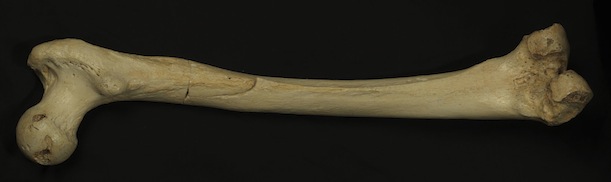
The femur from which DNA was extracted for analysis. Photo by Javier Trueba, Madrid Scientific Films
The analysis was enabled by recent advances in methods for recovering ancient DNA fragments developed at the Max Planck Institute for Evolutionary Anthropology in Germany, previously used to analyze the DNA of a cave bear fossil found in the same cave. “This wouldn’t have been possible just two years ago,” says Juan Luis Arsuaga, a paleontologist at the University of Madrid who led the initial excavations of the cave and collaborated on the new study. “And even given these new methods, we still didn’t expect these bones to preserve DNA, because they’re so old—ten times older than some of the oldest Neanderthals from whom we’ve taken DNA.”

After extracting a two grams of crushed bone from the femur, a group of scientists led by Matthias Meyer isolated the mitochondrial DNA (mtDNA), a pool of genetic material that’s distinct from the DNA in the chromosomes located in our cells’ nuclei. Instead, this mtDNA lives in our cells’ mitochondria—microscopic organelles responsible for cellular respiration—and is much shorter in length than nuclear DNA.

There’s another quirk of mtDNA that makes it especially valuable as a means of studying the evolution of ancient humans: Unlike your nuclear DNA, which is a mix of DNA from both your parents, your mtDNA comes solely from your mother, because most of a sperm’s mitochondria are found in its tail, which it sheds after fertilization. As a result, mtDNA is nearly identical from generation to generation, and a limited number of distinct sequences of mtDNA (called haplogroups) have been observed in both modern humans and ancient human ancestors. Unlike anatomical characteristics and nuclear DNA, which can vary within a group and make it difficult to confidently distinguish one from another, mtDNA is generally consistent, making it easier to link a particular specimen with a lineage.

Which is why, when the researchers compared the femur’s mtDNA to previously sequenced samples from Neanderthals, from a Denisovan finger bone and tooth found in Siberia and from many different modern humans, they found it so surprising that it more closely resembled the Denisovans. “This was really unexpected,” Arsuaga says. “We had to think really hard to come up with a few scenarios that could potentially explain this.”

Anthropologists had already known that all three lineages (humans, Neanderthals and Denisovans) shared a common ancestor, but it’s far from clear how all three groups fit together, and the picture is further clouded by the fact that interbreeding may have occurred between them after they diverged. Helpfully, comparing the femur’s mtDNA to the Neanderthal, Denisovan and modern human samples allowed the researchers to estimate its age—based upon known rates of mtDNA mutation, the previously established ages of the other samples, and the degree of difference between them—leading to the 400,000 year figure.

To explain how a Neanderthal-looking individual could come to have Denisovan mtDNA during this time period, the scientists present several different hypothetical scenarios. It’s possible, for instance, that
  • the fossil in question belongs to a lineage that served as ancestors of both Neanderthals and Denisovans, or more likely, one that came after the split between the two groups (estimated to be around 1 million years ago) and was closely related to the latter but not the former. 
  • It’s also a possibility that the femur belongs to a third, different group, and that its similarities to Denisovan mtDNA are explained by either interbreeding with the Denisovans or the existence of yet another hominin lineage that bred with both Denisovans and the La Sima de los Huesos population and introduced the same mtDNA to both groups.
If this sounds like a complicated family tree to you, you’re not alone. This analysis, along with earlier work, adds further mystery to an already puzzling situation. Initial testing on the Denisovan finger bone found in Siberia, for instance, found that it shared mtDNA with modern humans living in New Guinea, but nowhere else. Meanwhile, it was previously thought that Neanderthals had settled in Europe and Denisovans further east, on the other side of the Ural Mountains. The new analysis complicates that idea.

For now, the researchers believe the most plausible scenario (illustrated below) is the femur belongs to a lineage that split off from Denisovans sometime after they diverged from the common ancestor of both Neanderthals and modern humans. But perhaps the most exciting conclusion to come out of this work is that it proves that genetic material can survive for at least 400,000 years, and can be analyzed even after that amount of degradation. Armed with this knowledge and the new techniques, anthropologists can now attempt to genetically survey many other ancient specimens in hopes of better understanding our family tree.
Image via Nature/Meyer et. al.
December 4, 2013

miércoles, 28 de agosto de 2013

La gran Titanoboa recorre el mundo

ORIGINAL: El Colombiano
Por Ramiro Velázquez Gómez
4 de abril de 2012

Una réplica, película y videojuegos reconstruyen la mayor serpiente del planeta que habitó en Colombia.
A 60 millones de años de haber desaparecido asombra al mundo. Lo hizo ya en Nueva York, sigue en Washington y se paseará por otras regiones. Hasta a Colombia, su casa, vendrá.

Se tragaba cocodrilos, enormes tortugas, lo que encontrara a su paso en ese antiguo y tupido bosque sudamericano: La Guajira.

Titanoboa cerrejonensis cobró vida. Esta serpiente, la más grande que jamás existió sobre la Tierra, de casi 15 metros y 1.250 kilos, se paseó por la Gran Estación Central en Nueva York, donde sorprendió a los visitantes. "¿Era un animal, un animal real? ¡Es enorme!" balbuceó Chris Wood citado por Jennifer Welsh en LiveScience.

Sí, esta enorme serpiente volvió a la vida. Hallada por un grupo de científicos del Smithsonian Tropical Research Institute en la mina de El Cerrejón, equipo encabezado por el colombiano Carlos Jaramillo , fue mostrada al mundo en un artículo en la revista Nature en febrero de 2009.

En ese rico yacimiento fosilífero donde se han encontrado otras enormes criaturas que vivieron en el Paleoceno medio a tardío, se halló una vértebra cloacal casi completa y decenas de otras vértebras y costillas de la enorme criatura.

Ahora, el Museo Smithsonian de Historia Natural la recreó. No solo mediante descomunales modelos, uno de ellos tragándose un cocodrilo, sino que produjo una película que es presentada en el canal del Smithsonian.

El trabajo continúa
"Todo esto es parte de nuestro trabajo", dijo Jaramillo al periódico. "El Smithsonian hizo una película cuya premiere fue el miércoles 28, junto con una exhibición de Titanoboa que estará en el Museo de Historia Natural en Washington por varios meses, y luego viajará a varios museos en el mundo".

La serpiente de El Cerrejón va más allá. También se publicó un extenso artículo en el Smithsonian Magazine sobre la manera como se hallaron los restos, se creó un videojuego para iphone y ipad (se llama Titanoboa) y juguetes y hasta dulces con su forma, dijo Jaramillo, geólogo de la Nacional y doctor de la Universidad de Florida.

La película, Titanoboa Monster Snake, también será presentada en Colombia, en unión con Maloka y el Instituto Von Humboldt. Se está subtitulando en español para que pueda ser proyectada en aquel auditorio. "Espero que en algún momento en abril".

Entre la bruma de una selva muy húmeda, Titanoboa se mueve con rapidez para sumergirse en el agua, donde quieta detrás de la flora marina espera. Un enorme cocodrilo se acerca y el movimiento ágil de la serpiente no le permite escapar. Una escena de la película que recrea esos ambientes cálidos de hace 58 a 60 millones de años en una Tierra en la que las concentraciones de dióxido de carbono eran cinco o seis veces mayores que las actuales, calentando el aire de tal manera que esta serpiente, de sangre fría, pudo encontrar las condiciones adecuadas para alcanzar semejante tamaño.

Titanoboa, la serpiente monstruo, la antigua habitante de El Cerrejón y La Guajira, camina de nuevo.

miércoles, 29 de agosto de 2012

Oldest mites in amber discovered

ORIGINAL: Science News
August 27th, 2012
230-million-year-old fossils push back date of resin-preserved arthropods

ANCIENT MITES The new mite speciesTriasacarus fedelei (top) and Ampezzoa triassica (bottom) were found in 230-million-year-old amber. The find pushes back the record of oldest arthropods preserved in amber by about 100 million years. A. Schmidt/University of Göttingen

Mites could give competitors on Survivor a run for their game-show money.

Two of the tiny creatures, trapped in fossilized tree resin, smash the record for ancient amber-preserved arthropods, a group of critters that includes beetles, butterflies, spiders and shrimp. At 230 million years old, the mite fossils are about 100 million years older than previous finds, and suggest that mites’ basic body blueprint may be built to outwit, outplay and outlast.

“Dinosaurs have come and gone, but mites have hardly changed,” says David Grimaldi of the American Museum of Natural History in New York City. “Their body form is quite similar to what we see in gall mites today.”

CAPTURED IN TIME Amber droplets are remnants of resin that oozed out of an ancient conifer tree and hardened, trapping tiny animals inside. Scientists discovered new species of mites in 230-million-year-old droplets.S. Castelli/University of Padova

That similarity is somewhat surprising considering that the Earth was profoundly different 230 million years ago, when most plants were ferns, the Atlantic Ocean didn’t exist and pterosaurs cruised the skies. The Triassic-period mites, however, look just like their present-day relatives: They have segmented bodies, piercing mouthparts and legs bristling with “featherclaws,” Grimaldi and his colleagues report online August 27 in the Proceedings of the National Academy of Sciences.  

Mites seem to have made major adaptations, however, to their food supply. Unlike modern gall mites, which feast mostly on flowering plants (sometimes forming bumpy growths on the leaves), the Triassic ones chowed on a more primitive type of greenery: conifers. Grimaldi’s team discovered the two new species of mites, one Triasacarus fedelei and the other Ampezzoa triassica, smothered in droplets of amber from a now-extinct species of cone-bearing tree. The amber also held the remnants of a fly. 

The golden globules are about the size of a grain of rice. The creatures are visible only through a microscope as tiny flecks that mar the fossilized resin’s clarity. “You can see these little critters in all their lifelike glory — it’s really quite amazing,” says paleoentomologist Michael Engel of the University of Kansas in Lawrence.

Limestone and shale can also hold arthropod fossils, but amber allows researchers to take a more intimate look. “The detail preservation in these mites is leaps better than other Triassic arthropods,” Engel says. “Actually, leaps is an understatement. The difference in preservation is a massive chasm.”

The team picked through ancient sediments in the Dolomite Alps of northeastern Italy in search of resin dollops, then took two years to examine 70,000 amber droplets, shards and fragments. Only three housed arthropods. “With this discovery, we’re obviously all hot and ready to go back and screen through lots more,” Grimaldi says. Arthropods are the most diverse group of creatures on Earth, making up more than 50 percent of all known species. They’re one of the key lineages of life, says Engel. “Anything we can do to better understand what led to their successes and failures can tell us how they shaped the planet in the past and how they’re shaping the planet today,” he says. 

lunes, 11 de junio de 2012

Jewel Of The Earth (NOVA Documentary)

ORIGINAL: Nova

Broadcast (2007) Forty million years ago a diverse community of insects living at the bottom of a tree in a temperate forest chanced into a sticky pool of pine resin. Then a mere 67 years ago a young boy named David Attenborough was given the amber stone containing the entombed bugs. "Jewel of the Earth" explores the remarkable time capsule of ancient life preserved in this and countless other samples of fossilized tree resin, or amber.

Sir David Attenborough, now grown up and a celebrated naturalist and TV personality, hosts the program. As he makes abundantly clear in the show, he is still entranced with the amber specimen from his youth and the seemingly magical quality of the material to serve as a crystal-clear window to an age before humans walked the Earth. Coincidentally, David's brother Richard starred in the movie that made amber famous: Jurassic Park, in which Richard plays a billionaire entrepreneur who extracts DNA from amber-entombed mosquitoes in order to clone living replicas of their prey—dinosaurs. While such a scenario is probably unlikely, amber can resurrect prehistoric life in a quite different way, as NOVA demonstrates by probing the amber-encased clues that paint a fascinating picture of ancient biomes.


For example, most of the world's amber comes from the Baltic region of northern Europe, where, on the ample evidence of insects, plant fragments, and other trapped material, a vast temperate forest flourished about 40 million years ago. Sir Attenborough's boyhood keepsake is a piece of Baltic amber, which he investigates through a microscope with the help of biologist Elzbieta Sontag of the University of Gdansk, finding a long-legged fly, a fungus gnat, an aphid, an ant, and a mite—all denizens of the lower forest floor. By contrast, much of the amber found in the Dominican Republic—the second most significant source studied so far—is about 20 million years old and hails from an ancient rain forest. George and Roberta Poinar of Oregon State University have reconstructed this vanished ecosystem in spectacular detail, based on such clues as a tadpole that probably resided in a water-filled tropical bromeliad before being upended, along with a marsh beetle, into a patch of tree resin that eventually turned into amber.

An even more ancient Dominican sample, from 150 million years ago, contains a honeypot ant. Since this ant is now found only in Australia, the specimen is evidence for a conjectured super-continent that once comprised most of Earth's landmasses. High-tech medical scanners have shed light on many other amber inclusions, diagnosing a broken back on a gecko, for instance, which suggests the lizard was a bird's prey before being accidentally dropped into resin. The most controversial research on amber, however, is the effort to extract DNA from trapped creatures, just like in Jurassic Park. So far, two teams, including the Poinars, have announced success. However, follow-up studies indicate the DNA found by both groups was a contaminant, not the real, ancient stuff. Setbacks aside, scientists have only just begun to reveal the secrets to be discovered in the warm, glowing, glassy world of amber.

viernes, 1 de julio de 2011

Devolver a la vida colores prehistóricos

ORIGINAL: ScienceMag
versión en Español por Ciencia en Canoa

por Michael Balter el 30 de junio de 2011, 14:03 

Aves iniciales. Una exploración química de la Confuciusornis de 125 millones de años (la concepción del artista) revela las huellas de sus pigmentos antiguos.Crédito: R. A. Wogelius et al, Science.
¿De qué colores eran las primeras aves? Nuestros amigos aviares aparecieron hace unos 150 millones de años, y algunos fósiles de aves prehistóricas se han encontrado con sus plumas casi intactas. Pero los colores se desvanecieron hace mucho tiempo, dejando a los paleontólogos en la oscuridad acerca de los colores originales. Ahora, un equipo de investigación que emplean el estado de la técnica de imagen química ha encontrado restos de pigmentos en plumas antiguas. Las nuevas técnicas podrían eventualmente dar a los científicos no sólo los colores que lucían las aves prehistóricas, sino también en primer lugar porqué desarrollaron plumaje altamente pigmentado.

Las aves de hoy en día muestran un abanico de colores: Algunos tienen pecho naranja, los canarios son generalmente de color amarillo, y los mirlos, bueno, a pesar del nombre, suelen mezclar el negro básico con tonos brillantes de amarillo y rojo. Los ornitólogos opinan que las aves evolucionaron a estos colores para atraer a su pareja, camuflarse de sus depredadores, y reconocer los demás miembros de su especie en el cielo lleno de gente. Muy recientemente, los científicos han sido capaces de detectar pigmentos que contienen gránulos llamados melanosomas, en algunos fósiles de aves muy antiguos, así como en sus antecesores inmediatos, los dinosaurios. Y han hecho conjeturas sobre el color de los pigmentos en los melanosomas basados en el tamaño de los gránulos y las formas.

Sin embargo, los melanosomas se pueden detectar sólo en los fósiles mejor preservados, que son muy raros. Por lo que un equipo dirigido por el geoquímico Wogelius Roy de la Universidad de Manchester en el Reino Unido se dedicó a pasar por alto los melanosomas y mirar directamente a los rastros de los mismos pigmentos, que a menudo bien se unen a elementos como el cobre, cobalto, zinc y calcio. Usando una variedad de técnicas, incluyendo el Sincrotrón de exploración rápida de fluorescencia de rayos X, un método de imagen química desarrollada en la Universidad de Stanford que permite la detección de bajos niveles de elementos a través de grandes superficies, el equipo fue capaz de visualizar los restos de pigmentos en aves fósiles de varios , incluyendo el Archaeopteryx de 150 millones de años, y el Confuciusornis 125 millones de años.

Wogelius y sus colegas, cuya investigación se publicó en línea en la revista Science, también fueron capaces de detectar los pigmentos en los ojos de fósiles de peces y calamares. Por otra parte, en el caso de las aves prehistóricas, la imagen química revela claramente el contorno de las plumas, lo que sugiere que los investigadores estaban recogiendo restos de pigmento de estas plumas. Para reforzar su caso aún más, los investigadores informan de que en algunos de los ejemplares, fueron capaces de visualizar no sólo los contornos macroscópicos de las plumas, sino también las formas microscópicas de los melanosomas que hacía mucho tiempo que se desintegró.

Sin embargo, todavía es pronto en esta investigación: Aunque los investigadores fueron capaces de determinar, por la concentración de cobre y otros elementos, que las plumas de las aves fósiles, como el Confuciusornis había zonas claras y oscuras, aún no son capaces de decir los colores que representan. Sin embargo, Wogelius dice que él y sus compañeros de trabajo se están acercando a numerosos museos y otras instituciones en un intento por ampliar su base de datos de fósiles, y también comparar los patrones de pigmentación de las muestras antiguas con las de los animales que viven en la esperanza de finalmente descifrar los antiguos colores.

El estudio "se compromete a desarrollar un cuadro de colores de la vida antigua", dice Luis Chiappe, paleontólogo y experto en aves temprano en el Museo de Historia Natural de Los Angeles en California. "Los autores han presentado un caso muy sólido de cómo las trazas de metales pueden servir como sustitutos de la pigmentación en los animales extintos." Mateo Shawkey, un biólogo de la Universidad de Akron en Ohio que ha estado trabajando con los investigadores de dinosaurios para averiguar los colores de las bestias prehistóricas, añade que el estudio debería ayudar a influir en los escépticos que piensan que los melanosomas detectado en algunos ejemplares de fósiles son realmente las bacterias y no gránulos de pigmento.

Chiappe señala que "estas técnicas hasta el momento nos dicen poco acerca de cómo estos animales utilizaban sus colores", como para el cortejo o camuflaje. Pero, dice, "cuando nos reunimos cada vez más información sobre sus patrones de color, que puede ser capaz de hacer algunos descubrimientos muy interesantes sobre la biología de las aves a principios y sus antecesores dinosaurios".