Mostrando entradas con la etiqueta Radiación. Mostrar todas las entradas

domingo, 17 de noviembre de 2013

The Fukushima Radiation Leak Is Equal To 76 Million Bananas (per hour)


There’s much screaming and shouting from the usual suspects about the new radiation leak discovered at Fukushima, the stricken nuclear power plants in Japan. What they’re not telling you is that the radiation leakage is around the same as 76 million bananas. A fact which should help to put it all into some perspective. Here’s Greenpeace:

Environmental group Greenpeace said Tepco had “anxiously hid the leaks” and urged Japan to seek international expertise.

Greenpeace calls for the Japanese authorities to do all in their power to solve this situation, and that includes increased transparancy…and getting international expertise in to help find solutions,” Dr Rianne Teule of Greenpeace International said in an e-mailed statement.

Not that Greenpeace is ever going to say anything other than that nuclear power is the work of the very devil of course. And the headlines do indeed seem alarming:

Radioactive Fukushima groundwater rises above barrier – Up to 40 trillion becquerels released into Pacific ocean so far – Storage for radioactive water running out.

Or:

Tepco admitted on Friday that a cumulative 20 trillion to 40 trillion becquerels of radioactive tritium may have leaked into the sea since the disaster.

Most of us haven’t a clue what that means of course. We don’t instinctively understand what a becquerel is in the same way that we do pound, pint or gallons, and certainly trillions of anything sounds hideous. But don’t forget that trillions of picogrammes of dihydrogen monoxide is also the major ingredient in a glass of beer. So what we really want to know is whether 20 trillion becquerels of radiation is actually an important number. To which the answer is no, it isn’t. This is actually around and about (perhaps a little over) the amount of radiation the plant was allowed to dump into the environment before the disaster. Now there are indeed those who insist that any amount of radiation kills us all stone dead while we sleep in our beds but I’m afraid that this is incorrect. We’re all exposed to radiation all the time and we all seem to survive long enough to be killed by something else so radiation isn’t as dangerous as all that.

At which point we can offer a comparison. Something to try and give us a sense of perspective about whether 20 trillion nasties of radiation is something to get all concerned about or not. That comparison being that the radiation leakage from Fukushima appears to be about the same as that from 76 million bananas. Which is a lot of bananas I agree, but again we can put that into some sort of perspective.

Let’s start from the beginning with the banana equivalent dose, the BED. Bananas contain potassium, some portion of potassium is always radioactive, thus bananas contain some radioactivity. This gets into the human body as we digest the lovely fruit (OK, bananas are an herb but still…):

Since a typical banana contains about half a gram of potassium, it will have an activity of roughly 15 Bq.

Excellent, we now have a unit that we can grasp, one that the human mind can use to give a sense of proportion to these claims about radioactivity. We know that bananas are good for us on balance, thus this amount of radioactivity isn’t all that much of a burden on us.

We also have that claim of 20 trillion becquerels of radiation having been dumped into the Pacific Ocean in the past couple of years. 20 trillion divided by two years by 365 days by 24 hours gives us an hourly rate of 1,141,552,511 becquerels per hour. Divide that by our 15 Bq per banana and we can see that the radiation spillage from Fukushima is running at 76 million bananas per hour.

Which is, as I say above, a lot of bananas. But it’s not actually that many bananas. World production of them is some 145 million tonnes a year. There’s a thousand kilos in a tonne, say a banana is 100 grammes (sounds about right, four bananas to the pound, ten to the kilo) or 1.45 trillion bananas a year eaten around the world. Divide again by 365 and 24 to get the hourly consumption rate and we get 165 million bananas consumed per hour.

We can do this slightly differently and say that the 1.45 trillion bananas consumed each year have those 15 Bq giving us around 22 trillion Bq each year. The Fukushima leak is 20 trillion Bq over two years: thus our two calculations agree. The current leak is just under half that exposure that we all get from the global consumption of bananas.

Except even that’s overstating it. For the banana consumption does indeed get into our bodies: the Fukushima leak is getting into the Pacific Ocean where it’s obviously far less dangerous. And don’t forget that all that radiation in the bananas ends up in the oceans as well, given that we do in fact urinate it out and no, it’s not something that the sewage treatment plants particularly keep out of the rivers.

There are some who are viewing this radiation leak very differently:


Arnold Gundersen, Fairewinds Associates: [...] we are contaminating the Pacific Ocean which is extraordinarily serious.

Evgeny Sukhoi: Is there anything that can be done with that, I mean with the ocean?

Gundersen: Frankly, I don’t believe so. I think we will continue to release radioactive material into the ocean for 20 or 30 years at least. They have to pump the water out of the areas surrounding the nuclear reactor. But frankly, this water is the most radioactive water I’ve ever experienced.

I have to admit that I simply don’t agree. I’m not actually arguing that radiation is good for us but I really don’t think that half the radiation of the world’s banana crop being diluted into the Pacific Ocean is all that much to worry about.

And why we really shouldn’t worry about it all that much. The radiation that fossil fuel plants spew into the environment each year is around 0.1 EBq. That’s ExaBecquerel, or 10 to the power of 18. Fukushima is pumping out 10 trillion becquerels a year at present. Or 10 TBq, or 10 of 10 to the power of 12. Or, if you prefer, one ten thousandth of the amount that the world’s coal plants are doing. Or even, given that there are only about 2,500 coal plants in the world, Fukushima is, in this disaster, pumping out around one quarter of the radiation that a coal plant does in normal operation.

You can worry about it if you want but it’s not something that’s likely to have any real measurable effect on anyone or anything.

ORIGINAL: Forbes
By Tim Worstall, Contributor
8/10/2013

lunes, 2 de septiembre de 2013

Fukushima radiation levels '18 times higher' than thought

ORIGINAL: BBC 
1 September 2013
Japanese Economy Minister Toshimitsu Motegi inspected the site on Monday

Related Stories At the source of Fukushima's water Watch
Fukushima 'much worse' than reported
Q&A: Fukushima leak problems

Radiation levels around Japan's Fukushima nuclear plant are 18 times higher than previously thought, Japanese authorities have warned.

Last week the plant's operator reported radioactive water had leaked from a storage tank into the ground.

It now says readings taken near the leaking tank on Saturday showed radiation was high enough to prove lethal within four hours of exposure.

The plant was crippled by the 2011 earthquake and tsunami.

The Tokyo Electric Power Company (Tepco) had originally said the radiation emitted by the leaking water was around 100 millisieverts an hour.

However, the company said the equipment used to make that recording could only read measurements of up to 100 millisieverts.

The new recording, using a more sensitive device, showed a level of 1,800 millisieverts an hour.

The new reading will have direct implications for radiation doses received by workers who spent several days trying to stop the leak last week, the BBC's Rupert Wingfield-Hayes reports from Tokyo.

In addition, Tepco says it has discovered a leak on another pipe emitting radiation levels of 230 millisieverts an hour.

The plant has seen a series of water leaks and power failures.

The 2011 tsunami knocked out cooling systems to the reactors, three of which melted down.

The damage from the tsunami has necessitated the constant pumping of water to cool the reactors.

This is believed to be the fourth major leak from storage tanks at Fukushima since 2011 and the worst so far in terms of volume.

After the latest leak, Japan's nuclear-energy watchdog raised the incident level from one to three on the international scale measuring the severity of atomic accidents, which has a maximum of seven.

Experts have said the scale of water leakage may be worse than officials have admitted.


martes, 14 de agosto de 2012

Japón: Exposición a radiación pudo generar mutaciones en mariposas

ORIGINAL: Más Verde


Un equipo de científicos japoneses vinculó mutaciones en mariposas con la exposición a la radiación de la central nuclear de Fukushima Daichii.

Cambios en las antenas, patas y forma de las alas fueron observados por investigadores de la Universidad de Ryukyus, Okinawa, en esos insectos tras el desastre nuclear en esa región, sacudida por un fuerte sismo del 11 de marzo del 2011.


Transcurridos dos meses del accidente nuclear en la planta de energía, los científicos recogieron 144 ejemplares de la especie Zizeeria maha en 10 lugares de Japón, que incluía la región de Fukushima.

Mediante la comparación de las mutaciones encontradas en las mariposas seleccionadas en los diferentes sitios, el equipo halló que las áreas con mayores cantidades de radiación eran el hogar de las mariposas con alas mucho más pequeñas y los ojos irregularmente desarrollados.

Se ha creído que los insectos son muy resistentes a la radiación, en ese sentido nuestros resultados fueron inesperados”, indicó el autor principal del estudio, Joji Otaki. Su equipo realizó un experimento en laboratorio con ejemplares que vivían a mil 750 kilómetros de donde ocurrió el accidente.


Fue por la cría de estas mariposas que se comenzó a notar una serie de anomalías que no se habían visto en la anterior generación recogida de Fukushima tales como antenas con malformaciones.

Investigadores que no participaron en el estudio opinaron que estos resultados son importantes para las personas y las comunidades biológicas que viven en Fukushima y sus alrededores.

Fuente: Prensa Latina, Agencias

viernes, 18 de mayo de 2012

El pingüino fugitivo de Tokio, ha sido encontrado vivo y bien

ORIGINAL: The Guardian
Reuters in Tokyo
17 May 2012

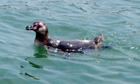
El pingüino Número 337 , que escapó del acuario hace dos meses , ha sido filmado retozando en la Bahía de Tokio.

Luego que el Pingüino Número 337 hizo un intento audaz por su libertad de un acuario de Tokio, y desapareció en las aguas de la bahía de Tokio hace dos meses, muchos temían lo peor para el fugitivo aventurero emplumado.

Sin embargo, el Pingüino de Humboldt de un año de edad ya ha aparecido en grabaciones de vídeo en una parte diferente de la bahía, retozando en el agua y aparentemente sano.


El pingüino, todavía demasiado joven para determinar si es macho o hembra y por lo tanto sólo conocido por un número, escaló una pared de roca de 4 metros (13 pies) de altura y pasó a través de una cerca de alambre de púas para escapar de su acuario junto al puerto en marzo.

"Se puede ver que tiene los mismos anillos alrededor de su aleta e idénticos patrones faciales", dijo Kazuhiro Sakamoto, director adjunto del Parque de Vida Marítima de Tokio, cuando mostraba imágenes del fugitivo logradas por los guardacostas de Japón.

"No se veía como si hubiera adelgazado en los últimos dos meses, o hubiera estado sin comida. No parece estar débil. Mas bien parece como si hubiera estado viviendo felizmente en el centro de la bahía de Tokio. "

El pingüino 337 fue filmado a principios de este mes cerca del Puente Rainbow de Tokio.

En los días siguientes a la fuga del pingüino, el acuario hizo un llamamiento en toda la ciudad para lograr mensajes sobre su paradero y se envían a diario a algunos de los cuidaparques en búsqueda del pingüinoen todo el área de la bahía.

Recibieron cientos de informes de avistamientos, algunos de lugares tan lejanos como el oeste de Japón, pero Sakamoto dijo que la mayoría se habían equivocado, probablemente con cormoranes en vez del pingüino escapado. Sólo alrededor del 30 de los informes se pensaba era genuino.

La bahía de Tokio es un barrio popular y concurrido de agua que bordea la ciudad densamente poblada, y el área alrededor del acuario se compone de edificios de apartamentos de gran altura y de hormigón.

Mucha gente se había preocupado de que el agua estaría demasiada sucia para que el ave pudiera mantenerse saludable. Más recientemente, los informes sobre el aumento de los niveles de radiación en la bahía han suscitado preocupación.

"Ellos dicen que no hay radiación en allí, así que tengo mis dedos cruzados para que se pueda vivir en la bahía de Tokio con seguridad", dijo el residente local Tateki Futagami.

El ave probablemente se ha saciado con pequeños peces en la bahía durante el día y regresa a la orilla en la noche para descansar,, dijeron los cuidadores.

El pingüino, nacido en 2011, había compartido la vida en un recinto rocosa al aire libre en el acuario con otros 135 Humboldt y un número de otros pingüinos antes de su fuga. Sakamoto atribuyó su vuelo con destino a un sentido de aventura.

martes, 22 de marzo de 2011

Se han hallado niveles de radiación elevados en vegetales en Japón

ORIGINAL: Ashahi Shimbun


La espinaca es sustituido por daikon en el stand de Japón Cooperativas Agrícolas de granja en Hitachi, prefectura de Ibaraki, porque los niveles de radiación supera los estándares del gobierno. (Naoya Kon)
Los niveles de radiación superiores a los estándares del gobierno se detectaron el domingo en la espinaca y otras verduras cultivadas en las prefecturas de Tochigi y Gunma.

El desarrollo se ha sumado a las preocupaciones sobre el impacto ambiental de la planta de energía nuclear Fukushima Nº1 afectada por el terremoto.


"Shungiku", una verdura de hoja verde, de la prefectura de Chiba se encontró que tenía trazas de radiactividad que superaban el límite permitido, según el gobierno metropolitano de Tokio.


El descubrimiento de productos contaminados en cinco prefecturas más, después de que se han detectado altos niveles en la leche en la Prefectura de Fukushima y las espinacas en la prefectura de Ibaraki.


Tres prefecturas, incluida la de Fukushima y el área metropolitana de Tokio, pidieron a los productores detener todos los envíos de estos productos.


Preocupado ante la escasez posible de vegetales, el Ministerio de Agricultura pidió a la Federación Nacional de Asociaciones Cooperativas Agrícolas compensar el déficit de vegetales contaminados.


El gobierno se espera que decidirá el lunes la posibilidad de limitar o suspender el envío de algunos alimentos procedentes de determinadas zonas.


El secretario del gabinete Yukio Edano destacó en una conferencia de prensa el domingo, "No creo que (estos productos) tendrán ningún efecto inmediato sobre la salud humana."


Sin embargo, el Ministerio de Salud, Trabajo y Bienestar Social ha solicitado a la Comisión de Seguridad Alimentaria evaluar las implicaciones potenciales para la salud del consumo de verduras tales.

En la Prefectura de Tochigi, los niveles de yodo radiactivo y cesio, que supera los estándares del gobierno, se han detectado en la espinaca. El nivel de radiactividad en "Kakina," otra verdura de hoja verde, emparejado el límite superior de las normas del gobierno.

El gobierno de la prefectura pidió al Japón Cooperativas Agrícolas (JA), que se encarga de la distribución, para detener el envío de espinacas y Kakina y la expedición de un retiro de elementos ya enviados. No se han detectado rastros de radiactividad en la leche producida en la prefectura.

En la prefectura de Gunma, los niveles de yodo y cesio que supera el estándar del gobierno se han detectado en las espinacas y Kakina, respectivamente. La prefectura también pidió a JA para detener el envío de dichos productos.

Los altos niveles de yodo que se detectaron en shungiku en Asahi, Prefectura de Chiba, hizo que el gobierno de Tokio suspendiera las ventas de 90 kilogramos del vegetal ya en el mercado. El organismo gubernamental se detendrá todas las entregas de productos agrícolas y animales de Asahi.

En la prefectura de Fukushima, la leche con un máximo de 17 veces el nivel normal de yodo radiactivo se encuentra en cuatro lugares. La leche todavía no ha salido a la venta, y el gobierno de la prefectura ha pedido a todos los productores de leche detener los envíos hasta que los niveles de radiación están dentro de los límites normales y la leche se considera como seguro para el consumo humano.

La prefectura también pidió a la JA a abstenerse de enviar cualquier verduras cultivadas al aire libre en la prefectura.

Espinacas con hasta 27 veces el límite de yodo radiactivo y hasta cuatro veces el nivel de cesio se han detectado en la prefectura de Ibaraki. Sin embargo, los niveles de radiación eran bajos en muchos otros productos de la prefectura, como tomates, fresas, pepinos, "nira" (cebollino chino), "mizuna", "chingensai", raíz de loto, repollos, puerros, pimientos verdes y la lechuga.

En la prefectura de Niigata también probó los niveles de radiación en los productos agrícolas vendidos en la prefectura, pero que se encuentran todos los productos para estar dentro del nivel estándar establecido por el gobierno.