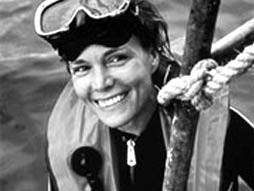
She's best known for her pioneering work with chimpanzees, but Goodall is also a keen conservationist

John Seigenthaler: Your latest project is a book about plants. Can you draw the line for us between plants and chimpanzees?
Jane Goodall: Without plants, none of us would be here, chimpanzees, people or anything else, because everything either lives on plant food or lives on creatures that live on plant food.
One of the things you also discuss in this book is the challenges facing forests around the world. What do you think are the biggest challenges?
Human greed and human need. I mean, on the one hand, you've got desperately poor people, and they've got to try and feed their family. They don't have money to buy food, so they're cutting down trees to grow crops or to make charcoal so that they can get a bit of money and buy a bit of food. Then on the other hand, you've got the big timber companies coming in, some of them still clear-cutting and paying lots of money for a forest concession to the government. Then the people living in the forest suffer, as well as everything else.
In fact, in your book — I just want to read a couple of lines that you write — you say, "The truth is that when corporate greed and public demand for a better and better lifestyle are pitted against the health of the environment and the health of people, for that matter, it is the bottom line that wins …" You sound like an environmental activist, an angry environmental activist here.
Well, I do get angry when I think of the unsustainable lifestyle of so many about this materialistic, Western-based culture. How many of us have so much more than we need? I mean, we need money to live, and what goes wrong is when we live for money. That's happening more and more often. And as a result, I think, it's a very empty kind of society, and people, when you live and money is your goal and your god, then I think people lose a lot of sensitivity and human values and love and compassion.
You have great hope for nature, and hope is a theme through much of your writing. I was touched by the stories at the end of the book that talk about a couple of trees — Survivor, in particular. Could you tell that story?
Yes, Survivor is very dear to me because I was in New York at 9/11, and they found the one piece of tree that was still alive out of all the trees that were around those Twin Towers. It looked like a dead stump, blackened with fire and everything. But some people took it and nurtured it. This tree now is back at Ground Zero, and it's a beautiful pear. I've seen it in blossom. But that tree somehow epitomizes the resilience of nature and the passion of people because so many people said, "Oh, throw it away. You'll never get this tree to grow." But they didn't give up.
I do get angry when I think of the unsustainable lifestyle of so many about this materialistic, Western-based culture. How many of us have so much more than we need?
It was also damaged by a storm, wasn't it?
Yes, it had just begun to recover, and I think it was Hurricane Sandy that tore it down, and they rushed out and desperately propped it up. It's had a very dramatic life.
You speak of another tree, a cherry tree at Fukushima, another example of a tree surviving. But, you know, in that example, I really wonder about our world and where we're headed and whether or not there is hope when you see a disaster like that. Fukushima?
Fukushima. Yes. As I said, it's a hope based on the fact that we can do it, but in order to change the world and make it start moving in a better direction — instead of heading downhill, just start leveling it off, and then eventually coming up. We have to change attitudes. That's the thing. When people lose hope, as many people do — because many biologists point out that there isn't any hope — if everybody loses hope, what happens? You fall into apathy. There's no point doing anything. It doesn't matter. But how can we be bringing our children into a world and telling them there's no hope? That's cruel.
There's a saying about inheriting the earth from our parents. But you say in some ways, we've stolen …
We have. We have stolen their future. I began the youth program because I met so many young people who had lost hope, who said, "Well, you compromised our future, and there's nothing we can do about it." We have, but there is something we can do about it. At least I shall die fighting for that.
What's the most interesting thing you've learned about chimpanzees over the years?
How like us they are or how like them we are. I think the most shocking but very fascinating thing is when I realized that, like us, they have a dark side. That made them sadly seem more like us than I had thought before. But they are capable of violence, brutality and a kind of primitive war.

Can you take me back to the beginning? You were a secretary for anthropologist Louis Leakey. That's where you got your start, right?
That's where I got my start.
How did that happen?
When I was a tiny little girl, I wanted to go and study animals in Africa because I fell in love with Tarzan. And silly man married the wrong Jane, didn't he? But anyway, I was very jealous of her. But I decided I wanted to go to Africa and live with animals and write books about them. Everybody laughed except my amazing mother, who just said, "Well, if you really want something, you'll just have to work hard and take advantage of opportunity, and you'll get there in the end." I got invited by school friends, saved up my money working as a waitress, got out to Africa, heard about Louis Leakey, went to see him at the museum. I wasn't asking for a job. But he took me around. He asked me hundreds of questions, and because I had gone on learning about Africa and animals and spent hours in the Natural History Museum in London, I could answer many of his questions, and he just offered me a job as his secretary.
When was your first attempt to observe the chimpanzees?
It was 1960 he finally got the money for me to go, and the biggest problem to start with was that they all ran away. You know, they're very conservative. Never seen a white ape before. So they ran away. But eventually one of them, whom I named David Greybeard, with his nice, white beard, began to lose his fear, and that really opened a door for me.
How did you gain their trust?
Patience, wearing the same colored clothes all the time, pretending I wasn't interested in them.
How did your family see the work that you did? What did they have to say about it when you first started going into the jungle and hanging out with chimps?
My mother came. I wasn't allowed to be alone by the British authorities. It was Tanganyika then. And they said, "No, no, no," and they said, "Oh, but she must come with a companion." So my amazing mother volunteered for four months. I mean, how many mothers would? You know, we had this old, secondhand army tent, no sewn-in ground sheet — so, piece of canvas on the ground, roll up the sides to let in the air, and you let in the spiders and the snakes and the scorpions as well, which I didn't mind, but poor Mum.
You just turned 80 years old.
People are making a big deal of it, but, you know, well ...
Well, in some ways, you're a timeless figure in the study of nature and chimpanzees. Tell me what your life is like now at 80.
Well, it's ridiculous, really, because it's literally going from one continent to another. It's airplanes and hotels and interviews and lectures.
You said you're on the road some 300 days a year.
Yes. It's absurd, isn't it?
And you like it?
I hate the travel.
You do?
I hate it. Who could like going through airports today? I mean, it's really horrible. Then of course it's a carbon footprint, all this flying, but nobody's given me a magic carpet yet. And we do have, I would say, millions of young people planting trees now, so I hope it makes up.
Who could like going through airports today? I mean, it’s really horrible. Then of course it’s a carbon footprint, all this flying, but nobody’s given me a magic carpet yet.
Well, you've started this organization called Roots & Shoots. Tell us about it.
It began with 12 high school students, and it was about, actually, empowering young people to roll up their sleeves and make a difference. So once they understand the problems, they get to choose. We don't tell them what to do. But between them, they must choose a project to help people, a project to help animals, a project to help the environment. And woven in it is, "Let's learn to live in peace and harmony between religions and cultures." We have so far to go between us and the natural world.
You've spent your life protecting animals, but recently you've been involved in trying to help save elephants. Can you talk a little bit about that effort?
The poaching of elephants and rhinos and some other animals, too, have increased so dramatically. And it's become such a money earner. So you get criminal cartels coming in, and the money from slaughtering elephants and selling the ivory is actually supporting some of these terrorist groups. And of course it's the demand in Asia. And so we're using our Roots & Shoots groups in China — I would say we're using them because they want to do it. The slogan is, "If the buying stops, the killing stops." And a lot of the Chinese honestly believe that elephants shed their tusks, like deer. So they don't understand the horrible slaughter and suffering of individual animals, whether it's elephants, rhino, tigers, apes being shot for bush meat. You know, the slaughter is going on, and it's going on very fast. But once people understand and get a feeling for these animals, then they're more prepared to go out and do something about it.
You've also fought to protect animals from experimentation for medicine. Where does that stand today?
I first began talking to NIH [the National Institutes of Health] in 1986, and just last year the new director, Francis Collins, had — well, actually three years ago he had a committee put together to investigate what tests were being done on the over 300 NIH chimpanzees, and found none of them, nothing, was beneficial to humans. So he said, "Fine, they can go into sanctuary, into retirement." We have to raise the money now to get them all — but a lot of them are already in Chimp Haven Sanctuary. More and more chimps are coming out of medical research. There's very few left.
What do you think of zoos?
Zoos and zoos and zoos. Some zoos shouldn't be. The change in zoos over my life has been just incredible. Yes, there's an idea that wild animals and freedom — it's the best thing, but in so many cases they're under threat, their habitats being destroyed. There's hunters out there. Then you look at a group in a really good zoo, which has the right kind of environment. Then you think, "Well, let me be a chimp. Where would I rather be?" In the really well-protected places, obviously you want wild animals.
How has technology changed the study of animals and plants over your life?
It's completely changed. I started with a notebook and a pencil and a pair of secondhand binoculars, which was all we could afford. Now, we have a GIS, GPS satellite imagery mapping, and we have ways of measuring stress levels by collecting fecal samples. We hope to do a lot of conservation with working with Google Earth, Esri, DigitalGlobe, and getting software that enable us to, you know, get much more accurate pictures of where the trees are. But the most key thing is that we've actually trained the local people to use these Android tablets. So they're restoring the forest now, letting it regenerate. It's because in early '91, I flew over the whole area around Gombe, and I was so shocked because I knew there was deforestation — I hadn't realized it was total. It was pretty clear that we can't even try and save the chimps if the people are just struggling to survive because they're going to come into this last, lush, tiny island forest. We began improving their lives. As a result, they're now our partners in protecting the chimp habitat, but also restoring the habitat around their own villages. All those bales are now sprinkled with green, and the chimps have three times more forest than they had 10 years ago.
I think some people might be surprised to learn that the chimpanzee is not your favorite animal. Is that right?
Well, I just love dogs. I mean, I just love dogs. You know, when I got to Cambridge and was told I shouldn't have given the chimps names, they should have been numbered, and, you know, I couldn't talk about them having a personality, mind or emotion, I knew from the childhood teacher, my dog Rusty, that that couldn't be true. Animals — of course they have personality. Of course they can feel happy and sad and afraid, just like us.
Clearly, at 80 years old, you have no intention of slowing down.
Well, I suppose my body will slow me down at some point, but, you know, I'm lucky, and I got my father's genes. In fact, all my family lived long. So as long as I can, I shall go on doing this.
This interview has been condensed and edited.
ORIGINAL: Al Jazeera
April 17, 2014