Mostrando entradas con la etiqueta Gorila. Mostrar todas las entradas

viernes, 20 de julio de 2012

Gorilla Youngsters Seen Dismantling Poachers' Traps—A First

Ker Than
Published July 19, 2012

"Very confident" four-year-olds outsmart hunters and protect their clan.

Wild gorillas Rwema and Dukore destroy a primitive snare in Rwanda earlier this week. Photograph courtesy Dian Fossey Gorilla Fund
Just days after a poacher's snare had killed one of their own, two young mountain gorillas worked together Tuesday to find and destroy traps in their Rwandan forest home, according to conservationists on the scene.

"This is absolutely the first time that we've seen juveniles doing that ... I don't know of any other reports in the world of juveniles destroying snares," said Veronica Vecellio, gorilla program coordinator at the Dian Fossey Gorilla Fund's Karisoke Research Center, located in the reserve where the event took place.

"We are the largest database and observer of wild gorillas ... so I would be very surprised if somebody else has seen that," Vecellio added.


Bush-meat hunters set thousands of rope-and-branch snares in Rwanda's Volcanoes National Park, where the mountain gorillas live. The traps are intended for antelope and other species but sometimes capture the apes.

Adults are generally strong enough to free themselves. Youngsters aren't always so lucky.

Just last week an ensnared infant named Ngwino, found too late by workers from Karisoke, died of snare-related wounds. Her shoulder had been dislocated during escape attempts, and gangrene had set in after the ropes cut deep into her leg.

The hunters, Vecellio said, seem to have no interest in the gorillas. Even small apes, which would be relatively easy to carry away for sale, are left to die.


Rube Goldberg, Minus the Complexity

Poachers build the snares by tying a noose to a branch or a bamboo stalk, Vecellio explained.

Using the rope, they pull the branch downward, bending it. They then use a bent stick or rock to hold the noose to the ground, keeping the branch tense. A sprinkling of vegetation camouflages the noose.

When an animal budges the stick or rock, the branch springs upward, closing the noose around the prey. If the creature is light enough, it will actually be hoisted into the air.

(See National Geographic magazine mountain gorilla pictures.)

Rwema and Dukore Save the Day

Every day trackers from the Karisoke center comb the forest for snares, dismantling them to protect the endangered mountain gorillas, which the International Fund for Nature (IUCN) says face "a very high risk of extinction in the wild."


On Tuesday tracker John Ndayambaje spotted a trap very close to the Kuryama gorilla clan. He moved in to deactivate the snare, but a silverback named Vubu grunted, cautioning Ndayambaje to stay away, Vecellio said.

Suddenly two juveniles—Rwema, a male; and Dukore, a female; both about four years old—ran toward the trap.

As Ndayambaje and a few tourists watched, Rwema jumped on the bent tree branch and broke it, while Dukore freed the noose.

The pair then spied another snare nearby—one the tracker himself had missed—and raced for it. Joined by a third gorilla, a teenager named Tetero, Rwema and Dukore destroyed that trap as well.

Gorilla Tactics

The speed with which everything happened makes Vecellio, the gorilla program coordinator, think this wasn't the first time the young gorillas had outsmarted trappers.

"They were very confident," she said. "They saw what they had to do, they did it, and then they left."

Silverbacks in the Kuryama group have occasionally been caught in the snares, so Vecellio thinks the juveniles would have known the traps are dangerous.

"That's why they destroyed them," Vecellio said.


"Quite Ingenious"

Despite the unprecedented nature of the event, Vecellio said she wasn't surprised by the reports. "But," she said, "I'm always amazed and very proud when we can confirm that they are smart."

Veterinarian Mike Cranfield, executive director of the Mountain Gorilla Veterinary Project, also said he wasn't shocked by the news.

"Chimpanzees are always quoted as being the tool users, but I think, when the situation provides itself, gorillas are quite ingenious," he said.

Cranfield speculated that the gorillas may have learned how to destroy traps by watching the Karisoke center's trackers.

"If we could get more of them doing it, it would be great," he joked.

Karisoke's Vecellio, though, said actively instructing the apes would be against the center's ethos.

"No we can't teach them," she said. "We try as much as we can to not interfere with the gorillas. We don't want to affect their natural behavior."


viernes, 13 de julio de 2012

Medical Intervention Team Strives to Save Severely Wounded Juvenile

ORIGINAL: Gorilla Fund
Friday, July 13, 2012

The intervention team at work
Today was a very intense day in the forest for our field staff. An intervention in Inshuti’s group was organized to help juvenile female Ngwino, who had been reported to be very weak and suffering from a several-days-old snare injury. Silverack Inshuti’s aggressive and unpredictable temperament made the decision to intervene very difficult, as somebody could have been seriously hurt.

The Fossey Fund's Karisoke Director Felix Ndagijimana went up together with veterinarians from the Mountain Gorilla Veterinary Project (MGVP) and the Rwandan Development Board (RDB) to coordinate the operation. They were supported by our staff from the Karisoke Research Center and RDB trackers, making a team of 17 people.

When they reached the the gorilla group, the trackers accompanied the MGVP vets for a first assessment. It was clear from first sight that the infant needed an immediate intervention. The decision was made to sedate Inshuti first, to allow the vets to operate on Ngwino safely. Inshuti was sedated, and after a few weak pig grunts he fell asleep in a few seconds.

Ngwino and her mother Shangaza moved away to avoid the people. The field staff found them 30 minutes later and the vets soon darted Ngwino. The infant screamed and immediately Shangaza came close to try to rescue her. Trackers formed a line to keep Shangaza away, and it worked.

Ngwino's wound
It was soon clear that Ngwino’s health was critical and hopes of a recovery were few. The snare was very tight on her leg, which had caused advanced gangrene in the foot. In addition to that, she had a deep, severe injury on her shoulder, with a completely dislocated bone. Very likely this second injury was caused by the other gorillas’ attempts to free the juvenile from the snare. Even worse, the advanced infection and gangrene had also spread to Ngwino’s arm and thorax. The injury is very serious, and vets and the field staff consider it a miracle that she made it up to now. All of the field staff reported that they have never seen a gorilla with such a severe injury.

The veterinarians gave her a dose of fluids and antibiotics and cleaned the infected parts very well. They also stitched up the shoulder wound. They considered the option of amputating both her right arm and left foot, but after a consultation with the park authority they decided not to do it.

After the surgery, the juvenile was placed close to silverback Inshuti so they would wake up on the same spot. Inshuti was just starting to wake up and was trying to react with pig grunting to the people around him. Soon Ngwino was darted again with a drug that reverses the anesthesia, in order to speed the waking up process. After that, most of the field team left, to avoid further stressing the gorillas while they were waking up. Just a few trackers from Inshuti’s group remained and could report that mother Shangaza went up close to Ngwino, grooming her for several minutes. All members of the gorilla group then started resting close together.

Despite the still critical situation, the intervention went very well. The vets did everything possible to save Ngwino’s life. It was a very delicate situation and all of the participants did an extremely good job. We are keeping all our hopes up for her to recover.

Inshuti anesthetized
Ndagijimana said: “It was extremely sad to see Ngwino suffering from such a huge wound. She must have been in horrible pain over the past 10 days and maybe more. I have never seen anything like that, and I wish I could have done something before to prevent the pain. It was an unfortunate sequence of events that prevented us from seeing her for many days. I still hope we did save her life today. The next couple of days will be critical for her recovery. In a situation such as today’s I feel extremely proud to be part of this dedicated team which included all the different partner organizations that put our strengths together to save the gorillas with incredible expertise and passion."

We are waiting for the full medical report from Dr. Dawn Zimmerman of MGVP for more specific details about Ngwino's health. The other infant of the group, Akarusho, is still missing. The anti-poaching team went to look for him but were unsuccessful.

We want to credit the full team that performed the intervention today: Felix Ndagijimana (Dian Fossey Gorilla Fund), Dr. Dawn Zimmerman (MGVP), Jean Bosco Noeri (MGVP), Dr. Eddi (MGVP), Dr. Elisabeth Nyirakaragire (RDB), five Fossey Fund trackers from Karisoke including John Ndajambaye and Fundi Hategekimana, and two RDB trackers.

Veronica

viernes, 6 de julio de 2012

A Birth in Isabukuru's Group

Friday, July 06, 2012


Isaro and her newborn. Photo by Keiko Mori
This week in the field was particularly dense with events involving the gorillas monitored by the Dian Fossey Gorilla Fund’s Karisoke Research Center. One of those events was the happy news reported by the trackers for Isabukuru’s group on Tuesday, July 3 when they saw female Isaro with a newborn.

The birth was a surprise, as Isaro’s previous infant, Keza, is just 3.2 years old, which is a pretty short inter-birth interval, considering that the average is 3.5 years. Isaro is doing very well, carefully carrying her new infant, who seems to be healthy and of good appetite.

Isaro is a young female, 13 years old. She lost her first infant in 2008 on the day it was born. One year later, she give birth to Keza, a sweet infant female. Since the birth of her new sibling, Keza has spent all her time close to mother Isaro and the infant, suspending, for the moment, all her play activities with other youngsters.

Isabukuru’s group has increased to 12 gorillas. The dominant silverback can be very proud of his growing group, which now includes four infants and six females. Isabukuru has demonstrated a strong paternal instinct with all his offspring, spending considerably more time playing with them than has ever been observed in the silverbacks in other groups.

Veronica


lunes, 2 de julio de 2012

Danger Listing Denied Four Natural World Heritage Sites


ST. PETERSBURG, Russia, June 30, 2012 (ENS) - None of the four natural World Heritage sites recommended for inclusion on the World Heritage Danger List by the official advisory body on nature have been added by the World Heritage Committee.

As the committee's advisory body, the International Union for the Conservation of Nature, IUCN, had recommended that
  • Lake Turkana National Parks in Kenya
  • the Dja Faunal Reserve in Cameroon
  • the Virgin Komi Forests in Russia, and 
  • the Pitons Management Area in the Caribbean island nation of Saint Lucia 
be added to the List of World Heritage in Danger.
Lake Turkana in Kenya (Photo by International Rivers) 
The committee, meeting in St. Petersburg until July 6, has rejected all four recommendations.

A UNESCO agency, the World Heritage Committee identifies cultural and natural properties of Outstanding Universal Value that are to be protected under the treaty protecting World Cultural and Natural Heritage and inscribes those properties on the World Heritage List and the List of World Heritage in Danger.

"We are disappointed that the committee has not inscribed any of these threatened sites on the List of World Heritage in Danger this year," said Tim Badman, director of IUCN's World Heritage Programme.

"These four sites face significant threats to their values, from threats including major infrastructure projects, the extractive industry and property speculation," said Badman.

The proposal to include Kenya's Lake Turkana on the Danger List was made due to construction of Gibe III dam in Ethiopia, a transboundary issue between Kenya and Ethiopia.
The Dja River in the Cameroon's Dja Faunal Reserve (Photo by Cameroon Travel ) 
An IUCN assessment shows that dam construction will result in a steep reduction in the water level of the world's largest desert lake, increased salinity and a decline in fish stocks and wildlife. It will also affect local communities who depend on the lake for their livelihoods. Local communities have been demonstrating against the dam for years.

Oil exploration and poaching pose additional threats to the area. Flagship species such as the reticulated giraffe and Grevy's zebra seem to have disappeared.

Cameroon's Dja Faunal Reserve is one of the largest and best preserved rainforests in Africa, surrounded by the Dja River and inhabited by a wide variety of primates, including the Critically Endangered western lowland gorilla and the Endangered chimpanzee.

Mining activities in the vicinity of the reserve as well as wildlife poaching and ongoing dam construction on the river Dja were the main reasons for the site's danger listing proposal, the IUCN said.
Russia's Virgin Komi Forests (Photo by MerJade )
For the second year in a row, IUCN's recommendation to include Russia's Virgin Komi Forests on the Danger List has not been followed. Preparation works for a gold mine inside the site and national level boundary changes, which led to the loss of legal protection for parts of the site, are both clear criteria for a site to be declared in danger, warned the IUCN.

In the Northern Ural mountains of Russia's Komi Republic, the Virgin Komi Forests cover 3.28 million hectares of tundra and mountain tundra, as well as one of the most extensive areas of virgin boreal forest remaining in Europe. Both European and Asiatic species inhabit the site with some 43 mammal, 204 bird and 16 fish species recorded. Threatened mammal species include wolf, otter, beaver, sable, wolverine and lynx.

The Pitons Management Area in Saint Lucia has been subjected to significant development since its inscription on the World Heritage List in 2004, and development threats risk irreversible loss of its outstanding universal value.

Recognizable for its two eroded remnants of lava domes rising from the sea to heights greater than 700 meters, Pitons Management Area includes a geothermal field with sulphurous fumeroles and hot springs. The forested spires contain eight rare tree species. The larger one is inhabited by some 27 bird species, five of them found nowhere else on Earth.
Pitons Management Area in the Caribbean island nation of Saint Lucia (Photo by Michael Blanding ) 
Coral reefs cover almost 60 percent of the site's marine area, which is inhabited by 168 species of finfish.

Badman said, "Inscription on the Danger List is not a black mark for countries, but a way of drawing attention and providing support to the sites that need it the most."

The World Heritage Fund provides about US$4 million annually to support activities requested by governments in need of international assistance. The World Heritage Committee allocates funds according to the urgency of requests, priority being given to the most threatened sites.

The committee is composed of representatives from 21 governments that are Parties to the Convention Concerning the Protection of the World Cultural and Natural Heritage, adopted by UNESCO in 1972.

At the 2012 meeting they are: Algeria, Cambodia, Colombia, Estonia, Ethiopia, France, Germany, India, Iraq, Japan, Malaysia, Mali, Mexico, Qatar, Russia, Senegal, Serbia, South Africa, Switzerland, Thailand and United Arab Emirates.

On Tuesday, the IUCN released a new independent review of World Heritage and extractive industries, published in response to growing concerns over the rapidly increasing number of World Heritage Sites threatened by planned mining or oil and gas projects.

Threats to natural World Heritage sites from mining activities are growing, especially in Africa, where one out of four iconic natural areas is negatively affected.

The outcome of a joint project by IUCN, the International Council on Mining and Metals, JP Morgan Bank, Shell International and UNESCO, the report proposes practical ways of strengthening the role of the World Heritage Convention in safeguarding these areas of outstanding value.

"These exceptional places, which cover less than one percent of the Earth's surface, have been included on the World Heritage List because they are of outstanding value to all of humanity. It's the duty of every one of us to cooperate in their protection and conservation," said Badman.

Companies such as Shell and the financial services firm JP Morgan, as well as ICMM, which brings together many of the world's major mining companies, have recognized the importance of conserving World Heritage Sites and have committed not to undertake activities that would damage them.

Yet other companies and some countries still profit from resource exploration in these sensitive areas.

"It is clear that the desired conservation outcomes will not be achieved through individual corporate commitments alone," Badman said. The task of ensuring World Heritage Sites are not impacted by extractive industries cannot be effective if it is a commitment of only a few responsible companies."

"Mining and energy companies' ability to fund substantial environmental programmes in the vicinity of their operations should not be viewed as adequate recompense for negative impacts on natural World Heritage properties. Nor are offsets an admissible strategy to compensate for such impacts," the report states.

"Nevertheless, the extractive industries should not automatically be seen as a threat to these properties. Instead, there may be opportunities, within broader planning and management frameworks, to identify mutually beneficial strategies for company support to environmental initiatives and capacity development that directly or indirectly benefit them," according to the report, which points out, "In the 21st century, a positive environmental profile is an increasingly valuable asset for the private sector."

After more than 10 years of dicussion on this issue, the World Heritage Committee has decided to develop formal policy guidelines governing extractive industries affecting natural World Heritage sites.

The joint industry-UNESCO-IUCN review proposes wording for the policy guidelines that would prohibit extractive industry operations in natural World Heritage sites. The proposed wording would provide for the committee to encourage and assist governments in ending any existing concessions or operations. And it proposes that governments take legislative and planning measures to prevent negative impacts on natural World Heritage sites by extractive industry operations beyond their boundaries.

The World Heritage List includes 951 properties forming part of the cultural and natural heritage which the World Heritage Committee considers to have outstanding universal value.

These include 739 cultural sites, 183 natural sites and 29 mixed cultural-natural properties in 155 countries. As of March 2012, 189 of the world's 193 governments had ratified the World Heritage Convention.

martes, 15 de mayo de 2012

Los gorilas más raros del mundo, al descubierto gracias a una cámara trampa

ORIGINAL: RTVE

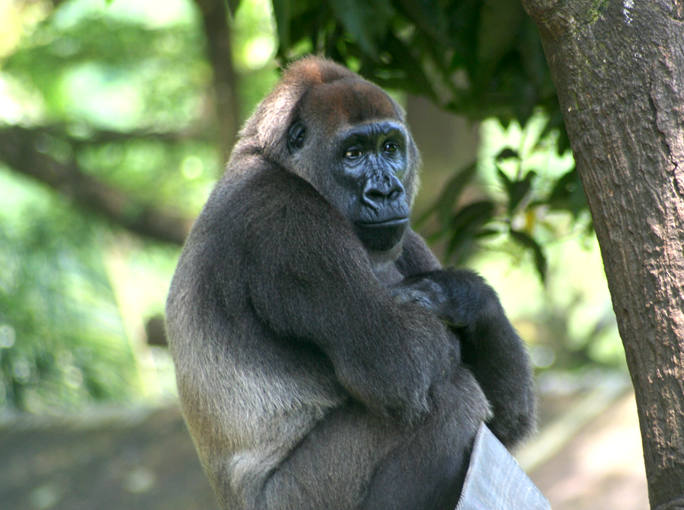
Gorila del Río Cross. Foto: Julielangford (Wikimedia Commons)
  • Es el gorila occidental del río Cross, del que solo quedan unos 250 ejemplares
  • Están considerados como 'especie en peligro crítico de extinción'
  • La cámara ha grabado una comunidad de ocho individuos en Camerún

Los gorilas del río Cross (Gorilla gorilla diehli) son los más raros y desconocidos de los grandes primates. Quedan menos de 250 ejemplares en todo el mundo y es una de las especies más difíciles de estudiar, porque casi nunca han podido ser observados directamente por investigadores de campo, ya que suelen ser animales tímidos que huyen ante el menor indicio de presencia humana.

Para poder conocer algo más sobre su comportamiento, los técnicos de la Sociedad para la Conservación de la Vida Salvaje (Wildlife Conservation Society) colocaron cuatro cámaras trampa en los bosques donde habitan, en las regiones montañosas de la frontera entre Nigeria y Camerún, según informa el diario británico The Telegraph.

Una de las cámaras pudo grabar una comunidad de ocho individuos mientras caminaban por un sendero del bosque, "un vídeo que ofrece una perspectiva espectacular del mundo oculto de uno de nuestros parientes más cercanos", explica Steve Sanderson, presidente de WCS.

El vídeo representa las mejores imágenes obtenidas hasta la fecha de los gorilas del río Cross. En él se puede ver a ocho individuos comportarse con total normalidad en su entorno, mientras caminan por el bosque.

"El vídeo representa las mejores imágenes obtenidas hasta la fecha de los gorilas del río Cross"

En un momento de la grabación, se puede ver al espalda plateada del grupo corriendo entre los miembros de la comunidad mientras se golpea vigorosamente el pecho cuando pasa a escasos centímetros de la cámara.

Otra de las tomas revela un individuo que parece haber perdido una mano, un incidente que -según los ecologistas- se podría haber producido como consecuencia de alguna trampa colocada por los furtivos y que debería servir como recordatorio para realizar esfuerzos que ayuden a proteger a los gorilas.

En este sentido, el Gobierno de Camerún estableció el Santuario de Gorilas Kagwene en 2008, con el único propósito de proteger a los gorilas del río Cross e incluso han fomentado una comunidad protectora de gorilas para mejorar las perspetivas de estos primates en las zonas boscosas más desprotegidas.

jueves, 10 de mayo de 2012

EcoHack II: More Projects Of Computational Sustainability

ORIGINAL: FastCoexist

Combining programming know-how with environmental problems at this hackathon leads to fascinating and important projects, from collective monitoring of air pollution to graphing the species that are slowly going extinct.

We wrote before about EcoHack, a event bringing together coders, designers, and hobbyists to work on environmental problems. Last November, the participants collaborated on everything from visualizing deforestation, to tracking sewage overflows in New York harbor. And many of the same faces were back for the most recent Ecohack, with a fresh set of projects, and a new focus on hardware hacking, to go alongside code and data.

The democratic idea of Ecohack is that participants pitch ideas they’re working on, asking the rest of the group for input and collaborative time; the ideas that seize the collective imagination get taken forward, while the rest are set aside for another time. Here are a few projects that were presented:

AIRCASTING
Michael Heimbinder talked about his AirCasting platform, which allows people to send in local noise-quality data from a cell phone, building up detailed maps of noise levels. He’s hoping to add pollution monitoring soon, and eventually all kinds of "bionsense" data. Heimbinder wants to improve understanding of the relationship between environmental and human health, and to take the conjecture out of people’s complaints about things like unsociable neighbors. As the site says: "When you share your AirCasting data with other AirCasters, your data and notes become a social statement, linking your experiences to the community’s observations."

AIR COLUMN MONITOR
Shannon Dosemagen, of the Public Laboratory for Open Technology and Science (PLOTS), is working on hardware. The Air Column Monitor is a "balloon-mounted air quality sensor" that helps communities understand what the local power plant is spewing out, or whether "CO2 domes" are building in the atmosphere. The project is closely related to the Air Quality Egg, which we featured here recently. The potential of such projects is huge: thousands of devices, all connected together, delivering real-time information, and much greater transparency.


WHERE DID THE GORILLAS GO?
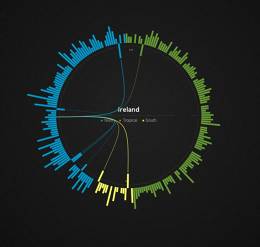
Craig Mills is looking at ways of analyzing and visualizing data on animal movements. The UNEP World Conservation Monitoring Centre, where Mills works, holds more than 12 million records from the last 50 years. Mills talked about international trade in gorilla feet, and how he wants to dig into the data to build up an historical timeline. The end-result is that you get nice-looking, and interactive, visualizations like this one.


TRACKING BIODIVERSITY


Tim Robertson, a Brit, works for the Global Biodiversity Information Facility, an open-access repository of more than 300 million biodiversity records (including citizen-science observations, and natural history specimen inventories). Robertson spoke about the possibility of digitizing books, and then extracting species observations for further analysis. The video above, showing how the European sparrow "invaded" North America, is an example of the sort of visualization that becomes possible once you have data in a standardized, usable form.

BEN SCHILLER


Ben Schiller is a freelance journalist based in New York, writing regularly for Co.Exist, the FT and Yale e360. Continued

miércoles, 7 de marzo de 2012

El gorila y el hombre tienen más en común de lo que se creía

ORIGINAL: ElTiempo - AFP
Fotografía de un gorila facilitada por el zoológico de Barcelona. EFE
Así lo reveló la secuenciación de su genoma, que permitirá entender la evolución de los primates.

Humanos, chimpancés y orangutanes... Sólo faltaban los gorilas para que los biólogos pudieran comparar los genomas de los cuatro "grandes monos" modernos, supervivientes de la gran familia de los homínidos.

Ahora ya se logró, gracias a un equipo internacional de varias decenas de investigadores, que publicaron sus resultados en la revista británica 'Nature'.

"Gracias al ADN de Kamilah, una hembra de gorila de las llanuras occidentales, ensamblamos una secuencia genética del gorila y la comparamos con los genomas de los otros grandes monos", teniendo en cuenta unos 11.000 genes, resumió el responsable del estudio, Aylwyn Scally, del Wellcome Trust Sanger Institute.

Los biólogos consideran tradicionalmente que, en el árbol de evolución de los primates, el chimpancé y el hombre tienen un ancestro común más reciente que el que los une respectivamente al gorila.

En consecuencia, en cualquier secuencia genética humana, la secuencia más cercana debería encontrarse entre su "primo" el chimpancé. Según los análisis efectuados por el equipo de Scally, esto se verifica, pero sólo en un 70% de los casos.

En realidad, un 15% del genoma humano está más cerca del gorila que del chimpancé. Y un 15% del genoma del chimpancé está, a su vez, más cerca del gorila que del hombre, revela el estudio.

"Hemos descubierto que los gorilas comparten con los humanos numerosas modificaciones genéticas paralelas, en particular la evolución de nuestro oído",subrayó el doctor Chris Tyler-Smith, del mismo instituto.

"Los científicos sugirieron que la rápida evolución de los genes auditivos en el hombre estaba ligada a la evolución del lenguaje. Nuestros resultados lo ponen en duda, porque los genes auditivos evolucionaron entre los gorilas a una velocidad más o menos equivalente a la de los humanos", estimó.

Según los cálculos de los investigadores, los gorilas divergieron de los humanos y chimpancés hace unos 10 millones de años, mientras que la separación entre el hombre y el chimpancé se remonta a 6 millones de años.

En cambio, la separación entre el gorila occidental y el gorila oriental parece más reciente, de hace 1,75 millones de años, y además fue progresiva.

"Estos datos cuestionan la idea según la cual la diversidad de las especies de primates siempre aumenta cuando una especie se divide rápida e irreversiblemente en dos especies 'hijas' aisladas", destacan, en un comentario separado publicado por 'Nature', los genetistas Richard Gibbs y Jeffrey Rogers.

También pueden influir otros factores, como un flujo de genes entre especies tras su divergencia inicial, subrayan, citando por ejemplo "pruebas de tales flujos de genes entre los neandertales y el linaje genético que desembocó en el hombre moderno".

LONDRES
AFP

viernes, 30 de diciembre de 2011

Tocado por el gorila "salvaje" de la montaña

En su habitat natural en el Parque Natural Bwindi en Uganda, una manada con gorilas de todas las edades, que marchan ordenadamente bajo la dirección de su líder y protector el macho alfa de lomo plateado, se cruzan amistosamente con un grupo de humanos que pasan con curiosidad frente a ellos. Los observadores terminan observados.

Es bien claro quién está en casa cumpliendo funciones vitales  y quién es visitante.