Mostrando entradas con la etiqueta Stanford. Mostrar todas las entradas

sábado, 21 de octubre de 2017

Miniature water droplets could solve an origin-of-life riddle, Stanford researchers find

Before life could begin, something had to kickstart the production of critical molecules. That something may have been as simple as a mist made up of tiny drops of water.

It is one of the great ironies of biochemistry:  life on Earth could not have begun without water; yet water stymies some chemical reactions necessary for life itself.
Chemistry Professor Richard Zare(Image credit: L.A. Cicero)
Now, researchers report today in Proceedings of the National Academy of Sciences, they have found a novel, even poetic solution to the so-called “water problem” in the form of miniature droplets of water, formed perhaps in the mist of a crashing ocean wave or the clouds in the sky.

The water problem relates primarily to the element phosphorous, which is attached to a variety of life’s molecules through a process called phosphorylation. “You and I are alive because of phosphorus and phosphorylation,” said Richard Zare, a professor of chemistry and one of the paper’s senior authors. “You can’t have life without phosphorous.”

The water problem
Phosphorous is a necessary ingredient in many molecules critical for life, 
  • including our DNA, 
  • it’s relative RNA and 
  • in the molecule that makes up our body’s energy storage system, called ATP. 
But ordinarily water gets in the way of producing those chemicals. Modern life has evolved ways of sidestepping that problem in the form of enzymes that help phosphorylation along. But how primitive components of these molecules formed before the workarounds evolved remains a controversial and at times slightly oddball subject. Among the proposed solutions are highly reactive forms of extraterrestrial phosphorous and heating powered by naturally occurring nuclear reactions.

Microdroplets solve the phosphorylation problem in a relatively elegant way, in large part because they have geometry on their side. It turns out that water is mostly a problem when the phosphate is floating around inside a pool of water or a primitive ocean, rather than on its surface.

Microdroplets are mostly surface. They perfectly optimize the need for life to form in and around water, but with enough surface area for phosphorylation and other reactions to occur.

In fact, the large amount of surface area provided by microdroplets is already known to be a great place for chemistry. Previous experiments suggest microdroplets can increase reaction rates for other processes by a thousand or even a million times, depending on the details of the reaction being studied.

Spontaneous molecules
Microdroplets seemed like a possible solution to the water problem. But to show that they really work, Zare and his colleagues sprayed tiny droplets of water, laced with phosphorous and other chemicals, into a chamber where the resulting compounds could be analyzed. They found several phosphate-containing molecules occurred spontaneously on these lab-made microdroplets without any catalyst to get them started. Those molecules included sugar phosphates, which are a step in how our cells create energy, and one of the molecules that make up RNA, a DNA relative that primitive organisms use to carry their genetic code. Both reactions are rare at best in larger volumes of water.

That observation, joined with the fact that microdroplets are ubiquitous – from clouds in the sky to the mist created by a crashing ocean wave – suggests that they could have played a role in fostering life on Earth. In the future, Zare hopes to look for phosphates that make up proteins and other molecules.

Even if he can produce those compounds, however, Zare does not believe he and his colleagues will have found the one true solution to the origin of life. “I don’t think we’re going to understand exactly how life began on Earth,” said Zare, who is also the Marguerite Blake Wilbur Professor in Natural Science. Essentially, he said, that is because no one can go back in time to watch what happened as life emerged and there is no good fossil record for the formation of biomolecules. “But we could understand some of the possibilities,” he added.

Zare is also a member of the Stanford Cardiovascular Institute, the Stanford Cancer Institute, the Stanford Neurosciences Institute and the Stanford Woods Institute for the Environment. Additional Stanford authors are postdoctoral fellows Inho Nam and Jae Kyoo Lee. Hong Gil Nam of DGIST in South Korea is co-senior author with Zare. The work was supported by the Institute for Basic Science (South Korea) and the U. S. Air Force Office of Scientific Research through a Basic Research Initiative grant.


ORIGINAL: Stanford News
BY NATHAN COLLINS
OCTOBER 20, 2017

sábado, 20 de agosto de 2016

This tiny device makes dirty water drinkable in just 20 minutes

Jin Xie/Stanford University
Genius.

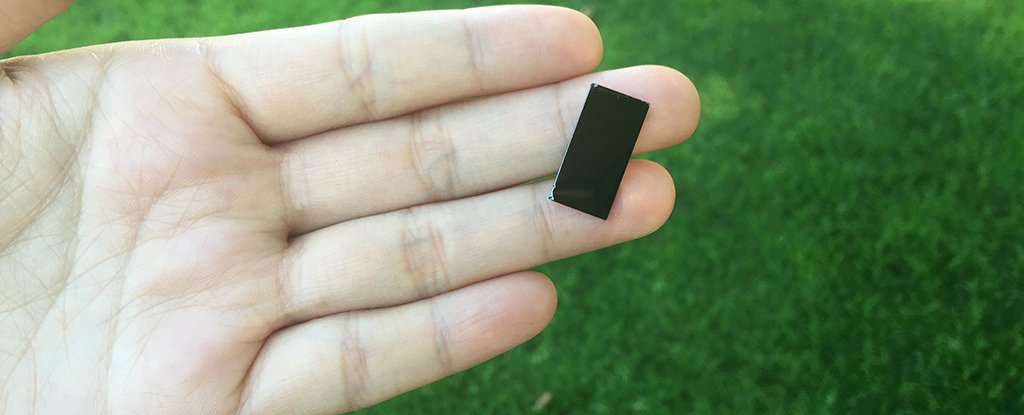
Scientists have developed a tiny device the size of a postage stamp that can kill 99.99 percent of bacteria in water in just 20 minutes.

Exposing contaminated water to sunlight can naturally clean it up – because UV rays blitz germs – but this distillation process usually takes up to 48 hours to complete. Instead, this new gadget harnesses a broader spectrum of the Sun's rays to speed everything up.


"Our device looks like a little rectangle of black glass," explains lead researcher Chong Liu from Stanford University. "We just dropped it into the water and put everything under the Sun, and the Sun did all the work."

It's the visible part of the solar spectrum, rather than UV rays, that contains most of the Sun's energy – around 50 percent for visible sunlight, compared with 4 percent for UV rays.

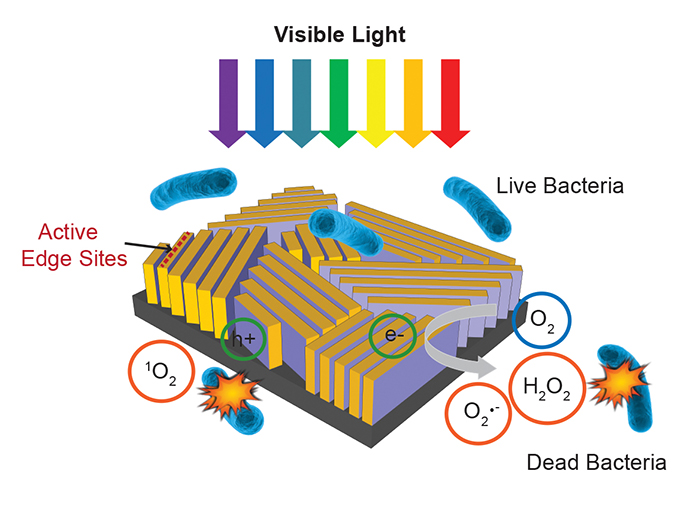
This visible sunlight attracts electrons in the device's coating of molybdenum disulfide (often used as an industrial lubricant), which sparks chemical reactions in the water.

Hydrogen peroxide and other disinfectants are generated from these reactions, which set about clearing the germs from the water.

Viewed under a microscope, the material is made up of many miniature walls of molybdenum disulfide, closely stacked together like a labyrinth on top of a rectangle of glass. From further out, it resembles a fingerprint.

A close-up look showing the molybdenum disulfide in purple and the copper in yellow. Credit: C. Liu et al., Nature Nanotechnology
"It's very exciting to see that by just designing a material you can achieve a good performance," says Liu. "It really works. Our intention is to solve environmental pollution problems so people can live better."

One important factor that could make the technology viable for the market is that molybdenum disulfide is cheap to produce. On top of that, money is also saved on fuel used in other purification methods, because the new device doesn't require the water to be boiled first.

The technique joins a number of other research efforts that are looking to purify water affordably for those in need. Earlier this year, we saw the cleaning properties of thin graphene sheets laid on water, and a biomaterial that pulls condensation from the air.

There's more work for the Stanford team to do before the device is ready for public use - only three strains of bacteria have been tested so far, and the coating isn't currently effective against chemical pollutants.

But while fresh and clean drinking water is something many of us take for granted, that's not the case for some 650 million people across the world –and that's something that has to change.

The research has been published in Nature Nanotechnology.

ORIGINAL: Science Alert
DAVID NIELD
19 AUG 2016

lunes, 11 de julio de 2016

Meet the First Artificial Animal

Scientists genetically engineered and 3-D-printed a biohybrid being, opening the door further for lifelike robots and artificial intelligence.

CREDIT: Getty Images
If you met this lab-created critter over your beach vacation, you'd swear you saw a baby ray. In fact, the tiny, flexible swimmer is the product of a team of diverse scientists. They have built the most successful artificial animal yet. This disruptive technology opens the door much wider for lifelike robots and artificial intelligence.

Like most disruption, it started with a simple idea. Kit Kevin Parker, PhD, a Harvard professor researching how to build a human heart, saw his daughter entranced by watching stingrays at the New England Aquarium in Boston. He wondered if he could engineer a muscle that could move in the same sinuous, undulating fashion. The quest for a material led to creating an artificial ray with a 3-D-printed rubber body at the School of Engineering and Applied Sciences at Harvard. Scientists from the University of Illinois at Urbana-Champaign, the University of Michigan, and Stanford University's Medical Center joined the team.

They reinforced the soft rubber body with a 3-D-printed gold skeleton so thin it functions like cartilage. Geneticists adapted rat heart cells so they could respond to light by contracting. Then, they were grown in a carefully arranged pattern on the rubber and around the gold skeleton.

The muscular circuitry is one of the most interesting parts of the research, and there's more about it in this video:


The birth of biohybrid beings
The new engineered animal responds to light so well scientists were able to guide it through an obstacle course 15 times its length using strong and weak light pulses.

The study authors write, "Our ray outperformed existing locomotive biohybrid systems in terms of speed, distance traveled, and durability (six days), demonstrating the potential of self-propelled, phototactically activated tissue-engineered robots."

What biohybrid mean for robots and artificial intelligence
Science of this type is fundamental for engineering special-purpose creations such as artificial worms that sniff out and eat cancer. Or bionic body parts for those who have suffered accidents or disease. Imagine having little swimmers in your system that rush to the site of a medical emergency such as a stroke. The promise of sensor-rich soft tissue frees robots to move more easily and yet not be cut off from needed input. Sensitized robot soft tissue could perform without the energy-sucking heaviness of metal or the artificial barrier of hard-plastic exoskeletons.

Thanks to disruptive, cross-disciplinary applied science like this, entrepreneurs in the next few years will be able to play on the border of what life is, what alive means, and what life can be. Expect to see companies use biohybrid beings to commercialize applications that solve some of the largest, and most lucrative, challenges we face today.

ORIGINAL: INC
BY LISA CALHOUN General partner, Valor Ventures@Lisa_Calhoun

jueves, 23 de junio de 2016

Ten institutions that dominated science in 2015

Getty Images/iStockphoto/Thinkstock
The University of Oxford is the top research UK university in the Nature Index for the first time.

The top 10 institutions in the Nature Index are the largest contributors to papers published in 68 leading journals in 2015.


Weighted fractional count (WFC): 1357.82

Established in 1949 in Beijing, the Chinese Academy of Sciences (CAS) is the world’s largest scientific organisation, comprising 114 institutes and 48,500 researchers. In 2015 its scientists made the largest contribution to high-quality research included in the index, a contribution that’s grown by a compound annual growth rate of 6.8% since 2012. Last year, one of the oldest CAS research centres, the Institute of Chemistry, founded in 1956, was also one of the largest contributing departments to the institute’s weighted fractional count. Lei Jiang, from the Institute of Chemistry, says: “Chemistry and materials science are currently strong in China because they were relatively easy subjects to start researching back in the 1980s. They didn’t need expensive equipment. If you look at nanoscience as an example, around half of the top scientists in global nanoscience are Chinese scientists who were educated during this period.

2. Harvard University, United States

WFC: 772.33

As the second most prolific institution in the Index, and the most prolific university, Harvard University owes two-thirds of its research output to contributions made in the life sciences. Recognising the growth of interdisciplinary research areas such as translational medicine in the life sciences, Harvard has responded by developing an integrated PhD programme that facilitates cross-disciplinary academic and research collaboration. The Harvard Medical School (HMS), established in 1782, is one of the discipline’s high-fliers. Since the 1930s, fifteen researchers from HMS have shared in nine Nobel Prizes. For the most recent of them, in 2009, Jack Szostak discovered how telomeres cap the ends of chromosomes and protect them from degradation, opening up new lines of enquiry into ageing and cancer research. While last year, a popular piece of research from Harvard’s sleep medicine department highlighted the negative effects of light-emitting e-readers on sleep quality.


WFC: 699.45

The French National Centre for Scientific Research (CNRS) is the largest fundamental research organisation in Europe, comprising ten institutions with more than 32,000 researchers, engineers and technicians. The physical sciences made up more than a third of the contributions to the Index in 2015. In recent years the CNRS has become a key player in planetary science. CNRS engineers have been remotely operating and maintaining instruments on board NASA’s Curiosity Rover, which has been exploring Mars since 2012. The mission lead to the confirmation late last year that liquid water currently flows on the planet. This year CNRS researcher Franck Montmessin is leading the European Space Agency’s mission ExoMars 2016 to investigate the planet’s atmosphere and find evidence of past life beneath its surface.

4. Max Planck Society, Germany

WFC: 655.67

Ranked fourth in the Nature Index, the Max Planck Society has the physical sciences to thank for its high position. Since 1914, physics researchers at Max Planck, a government-funded association of research institute, have won nine Nobel Prizes. The society is named after the quantum theorist, Max Planck, the institute’s second Nobel recipient in 1918, four years after Max von Laue won for his pioneering work in X-ray crystallography. During the Second World War, Laue’s gold medal was dissolved in acid to prevent discovery by the Nazis, and then recast by the Nobel Society after the war. Today, two institutes stand out in terms of research output in the index: the polymer and solid state research units. Last year, nanochemistry scientists focusing on solid-state research published a paper in Advanced Materials that explored moisture-sensitive technology and its potential use in touchless screens.

5. Stanford University, United States

WFC: 530.83

When Stanford University opened its doors to students in 1891, it became one of America’s first non-sectarian, co-educational private colleges. Stanford’s first president, David Starr Jordan, said: “Work in applied science is to be carried out side-by-side with the pure sciences and humanities, and to be equally fostered.” This attitude remains true today as research output is equally balanced between all the disciplines. The university is also credited for its entrepreneurial spirit. During the 1950s, the University leased land to a new industrial park that went on to become Silicon Valley. To this day, Stanford researchers continue this legacy of real-world influence. Howard Rose, a Stanford residential fellow and CEO of Deep Stream VR, is currently developing a virtual reality app called Cool! that is designed to immerse patients in a world that enables them to manage chronic pain without drugs.


WFC: 487.03

Last year’s Nobel Prize for Physics went to Takaaki Kajita, the director of the University of Tokyo’s Institute for Cosmic Ray Research. But UTokyo is not resting on its laurels. The university is focused on opening its doors to the outside world by welcoming international collaborations, foreign staff and students, and closer relationships with business. The institute’s latest high-profile research reflects this gearshift. UTokyo’s Graduate School of Frontier Sciences was involved in a decade-long project with four countries to establish the presence of a giant ocean that wraps Saturn’s moon, Encheladus, beneath its crust.


WFC: 483.62

This year marks a hundred years since the Massachusetts Institute of Technology (MIT) moved from Boston to Cambridge in the US. The move ushered in an age of achievement, from the first chemical synthesis of penicillin to building the magnetic core memory that made digital computers possible. The university’s is known for its hands-on approach to teaching and research - students are given a practical-based education in science, technology and related areas of scholarship - appears to be on the money. A 2015 report suggested that 30,000 companies founded by MIT alumni were active as of 2014, employing 4.6 million people and producing annual revenues of $1.9 trillion, equivalent to the world’s 10th largest economy. Eighty-five present and former members of the MIT community have won the Nobel Prize, including nine current faculty members.


WFC: 413.71

The Helmholtz Association of German Research Centres is the country’s largest scientific organisation with almost 38,000 employees and an annual budget of nearly €4 billion. Their research output is dominated by the physical sciences, and last year the Karlsruhe Institute of Technology (KIT) had the biggest impact on the association’s overall ranking in the index. KIT was officially founded in 2009 when the Karlsruhe Research Center and University of Karlsruhe merged. In a recent paper in Nature Photonics, KIT researchers demonstrated a way to store optical information that could dramatically reduce the power consumption and increase the speed of optical communication networks.

9. University of Oxford, United Kingdom

WFC: 398.38

Having produced 16 Nobel Laureates in medicine since 1932, the University of Oxford has a long pedigree in the life sciences. More than 30% of contributions to the most recent Nature Index come from this discipline. In the 21st century, the university focuses on a wide range of fascinating aspects of the life sciences from clinical practice in modern medicine to epidemiological and genetic studies. For example, researchers are currently exploring the negative effects of loud noise in an intensive care unit. Another group of scientists whose research is soon to published, have recently sequenced seven genomes of the Brazilian Zika virus taken from seven different individuals infected with the virus to determine when and where it entered the Americas.

10. University of Cambridge, United Kingdom

WFC: 390.54

A strong showing in the physical sciences has helped put the University of Cambridge in the Nature Index top ten. One of the key contributors to the university’s research output is the Cavendish Laboratory, which is the largest physics department in the UK and birthplace of ground-breaking discoveries such as the structure of DNA, and the splitting the atom. According to Professor Andy Parker, head of the Cavendish Laboratory: “The laboratory’s strength comes from the very wide range of research performed, from cosmology, through solid state and nanoscience, to the physics of medicine, backed up by world-class facilities, and the freedom given to its staff to pursue their own directions. This bottom-up approach to research strategy has proved its worth over many decades.

How the Nature Index works
Since 2012, every paper published in 68 top-tier journals has been included in the Nature Index database. The index ranks the contribution of research institutions to these articles, by a metric called weighted fractional count (WFC), which divides credit for each article by the affiliations of contributing authors. This measure is weighted to account for the disproportionate number of astronomy articles in the index.

ORIGINAL: Nature Index
By Sarah O'Meara
20 April 2016

domingo, 15 de mayo de 2016

Should we synthesise a human genome?

As specialists gather in private to discuss a grand plan for constructing a human genome, Drew Endy and Laurie Zoloth argue that such an enormous moral gesture should not be discussed behind closed doors.
CREDIT: MARIO TAMA/GETTY IMAGES
At Harvard today, an invitation-only group of about 150 scientists, lawyers, and entrepreneurs, met to discuss if and how to construct from scratch an entire human genome – the heritable genetic material that in nature is transferred from parents to children.

The meeting was originally organised to focus on “deliverables and industry involvement” with the primary goal of the project being “to synthesise a complete human genome in a cell line within a period of 10 years”.

Such a synthetic genome could then be tested in a laboratory by replacing the existing genome within a human cell. All this would still be far removed from making a synthetic human.

However, the possibility of making a human cell, whose genome is realised from only digital information and raw materials, should trigger broader considerations. 

For context, total synthesis of a human genome is becoming plausible at an accelerating rate. Thanks to new production techniques developed since 2003 the cost of assembling the genetic material encoding genes, the “building blocks” of life, has decreased from $4.00 to just three cents per individual letter, or “base pair” of deoxyribonucleic acid (DNA). 

As a result, the estimated initial cost of printing the DNA fragments encoding a three billion base pair human genome has dropped from $12 billion to $90 million

If cost reductions continue in the way they have been, then this price would approach $100,000 within 20 years. However, such dramatic additional cost reductions might never be realised without an overwhelming demand.

Advocates of synthetising a human genome, therefore argue that some open, collaborative “grand challenge” is needed to drive development of such technologies. 

While we strongly agree that sustained improvements in DNA construction tools are essential for advancing basic biological science and improving public health we are sceptical that synthesising a human genome is an appropriate demand driver.

We recall how controversies associated with many of the earliest genome synthesis projects delivered unintended consequences. 

For example, a project that made polio virus from scratch in 2002 generated such fear that public funding for improving DNA synthesis tools was cancelled, unwittingly harming research across diverse and unrelated fields while policy makers struggled to imagine how such tools could ever be controlled.

We argue that the synthesis of less controversial and more immediately useful genomes along with greatly improved sub-genomic synthesis capacities (for example, the real-time printing of plasmids the casettes that transfer genes between cells) should be pursued instead.
"In a world where human reproduction has already become a competitive marketplace...
it is easy to make up far stranger uses of human genome synthesis."
These are alternatives that would deliver broad and diverse public benefits.

Other topics on today’s agenda included changing the human genome itself. For example, could scientists synthetise a modified human genome that is resistant to all natural viruses? 

They likely could, for purely beneficial purposes, but what if others then sought to synthesise modified viruses that overcame such resistance? Might doing so start a genome-engineering arms race? 

And, what of even greater changes that can be imagined?

In a world where human reproduction has already become a competitive marketplace, with eggs, sperm and embryos carrying a price, it is easy to make up far stranger uses of human genome synthesis capacities. 

Would it be OK, for example, to sequence and then synthesise Einstein’s genome? If so how many Einstein genomes should be made and installed in cells, and who would get to make them? 

Taking a step back, just because something becomes possible, how should we approach determining if it is ethical to pursue?

Given that human genome synthesis is a technology that can completely redefine the core of what now joins all of humanity together as a species, we argue that discussions of making such capacities real, like today’s Harvard conference, should not take place without open and advance consideration of whether it is morally right to proceed.

When the first people at the table mostly have significant and direct material interests in proceeding, everyone, not just those in the room, risk out-of-control competition between public and private interests, ethical conflicts of interest, and temptations to manipulate human subject consent.

Pluralistic, public, and deliberative discussions are instead the best appropriate way to frame paths forward.

We note that the narrative of creation of the human is the central narrative for many religious communities.

To create a human genome from scratch would be an enormous moral gesture whose consequences should not be framed initially on the advice of lawyers and regulators alone.

The perspectives of others including self-identified theologians, philosophers, and ethicists from a variety of traditions should be sought out from the very beginning.

Critical voices representing civil society, who have long been sceptical of synthetic biology’s claims, should also be included. 

The creation of new human life is one of the last human-associated processes that has not yet been industrialised or fully commodified. It remains an act of faith, joy, and hope. 

Discussions to synthetise, for the first time, a human genome should not occur in closed rooms. 

Drew Endy is Associate Professor of Bioengineering at Stanford University.
Laurie Zoloth is a professor of medical ethics and humanities at Northwestern University, Chicago.

ORIGINAL: Cosmos Magazine

lunes, 16 de noviembre de 2015

Scientists develop ‘nanopores’ that inexpensively filter the salt out of seawater

Mohammad Heiranian/University of Illinois
Just think what this could mean.
There’s filtration and then there’s filtration. Engineers in the US have been working on the latter, coming up with a new markedly more energy-efficient way of taking the salt out of seawater, which could deliver huge advantages in terms of providing people with access to drinking water and help combat problems like drought.

The researchers have developed a material that allows high volumes of water to pass through extremely tiny holes called ‘nanoporeswhile blocking salt and other contaminants. The material they’re using – a nanometre-thick sheet of molybdenum disulphide (MoS2) riddled with these nanopore holes – is the most efficient of a number of thin-film membranes that the engineers modelled, filtering up to 70 percent more water than graphene.

Even though we have a lot of water on this planet, there is very little that is drinkable,said Narayana Aluru, a professor of mechanical science and engineering at the University of Illinois and leader of the study. “If we could find a low-cost, efficient way to purify sea water, we would be making good strides in solving the water crisis."

Molybdenum disulphide coupled with nanopores could be that solution. While desalination isn’t a new concept, the efficiency gains with this kind of new material – both in terms of the energy required to make the filtration work, and also the cost of keeping a desalination system running – could make a world of difference when it comes to processing large amounts of seawater.

Finding materials for efficient desalination has been a big issue, and I think this work lays the foundation for next-generation materials,said Aluru. “These materials are efficient in terms of energy usage and fouling, which are issues that have plagued desalination technology for a long time.

Conventional desalination relies on reverse osmosis to channel seawater through a thin plastic membrane, but the process suffers from a number of bottlenecks. While the membrane appears thin to the eye, from a microscopic perspective it’s more tube- or tunnel-like than a sheet that’s only a nanometre in thickness, which means it requires more pressure (and thus energy) to operate. They’re also susceptible to more clogging, which ramps up operational costs.

In comparison, the extreme thinness of the molybdenum disulphide membrane allows water to pass through with much less resistance, lessening or negating many of the above drawbacks. But the ingenuity behind the system isn’t just in its engineering.

MoS2 has inherent advantages in that the molybdenum in the centre attracts water, then the sulphur on the other side pushes it away, so we have much higher rate of water going through the pore,said Mohammad Heiranian, first author of the study. “It’s inherent in the chemistry of MoS2 and the geometry of the pore, so we don’t have to functionalise the pore, which is a very complex process with graphene.

There you have it, folks – the world’s first thirsty water filter. We love it! The next steps for the researchers are partnering with manufacturers who can bring their modelled desalination technique to life. The first step will be testing, but they’re confident their findings – which are published in Nature Communications – could be applied on an industrial scale for everybody’s benefit.

I’m in California now, and there’s a lot of talk about the drought and how to tackle it,“ said Amir Barati Farimani, a postdoctoral fellow at Stanford University who worked on the research at Illinois as a graduate student. ”I’m very hopeful that this work can help the designers of desalination plants."

ORIGINAL: Science Alert
PETER DOCKRILL
12 NOV 2015

domingo, 18 de octubre de 2015

Stanford engineers create artificial skin that can send pressure sensation to brain cell

Stanford engineers have created a plastic skin-like material that can detect pressure and deliver a Morse code-like signal directly to a living brain cell. The work takes a big step toward adding a sense of touch to prosthetic limbs.

Stanford chemical engineering Professor Zhenan Bao and her team have created a skin-like material that can tell the difference between a soft touch and a firm handshake. The device on the golden “fingertip” is the skin-like sensor developed by Stanford engineers. (Bao Lab)


Stanford engineers have created a plastic "skin" that can detect how hard it is being pressed and generate an electric signal to deliver this sensory input directly to a living brain cell.

Zhenan Bao, a professor of chemical engineering at Stanford, has spent a decade trying to develop a material that mimics skin's ability to flex and heal, while also serving as the sensor net that sends touch, temperature and pain signals to the brain. Ultimately she wants to create a flexible electronic fabric embedded with sensors that could cover a prosthetic limb and replicate some of skin's sensory functions.

Bao's work, reported today in Science, takes another step toward her goal by replicating one aspect of touch, the sensory mechanism that enables us to distinguish the pressure difference between a limp handshake and a firm grip.

"This is the first time a flexible, skin-like material has been able to detect pressure and also transmit a signal to a component of the nervous system," said Bao, who led the 17-person research team responsible for the achievement.

Benjamin Tee, a recent doctoral graduate in electrical engineering; Alex Chortos, a doctoral candidate in materials science and engineering; and Andre Berndt, a postdoctoral scholar in bioengineering, were the lead authors on the Science paper.

DIGITIZING TOUCH
The heart of the technique is a two-ply plastic construct: the top layer creates a sensing mechanism and the bottom layer acts as the circuit to transport electrical signals and translate them into biochemical stimuli compatible with nerve cells. The top layer in the new work featured a sensor that can detect pressure over the same range as human skin, from a light finger tap to a firm handshake.

Five years ago, Bao's team members first described how to use plastics and rubbers as pressure sensors by measuring the natural springiness of their molecular structures. They then increased this natural pressure sensitivity by indenting a waffle pattern into the thin plastic, which further compresses the plastic's molecular springs.

To exploit this pressure-sensing capability electronically, the team scattered billions of carbon nanotubes through the waffled plastic. Putting pressure on the plastic squeezes the nanotubes closer together and enables them to conduct electricity.

This allowed the plastic sensor to mimic human skin, which transmits pressure information to the brain as short pulses of electricity, similar to Morse code. Increasing pressure on the waffled nanotubes squeezes them even closer together, allowing more electricity to flow through the sensor, and those varied impulses are sent as short pulses to the sensing mechanism. Remove pressure, and the flow of pulses relaxes, indicating light touch. Remove all pressure and the pulses cease entirely.

The team then hooked this pressure-sensing mechanism to the second ply of their artificial skin, a flexible electronic circuit that could carry pulses of electricity to nerve cells.

IMPORTING THE SIGNAL
Bao's team has been developing flexible electronics that can bend without breaking. For this project, team members worked with researchers from PARC, a Xerox company, which has a technology that uses an inkjet printer to deposit flexible circuits onto plastic. Covering a large surface is important to making artificial skin practical, and the PARC collaboration offered that prospect.

Finally the team had to prove that the electronic signal could be recognized by a biological neuron. It did this by adapting a technique developed by Karl Deisseroth, a fellow professor of bioengineering at Stanford who pioneered a field that combines genetics and optics, called optogenetics. Researchers bioengineer cells to make them sensitive to specific frequencies of light, then use light pulses to switch cells, or the processes being carried on inside them, on and off.

For this experiment the team members engineered a line of neurons to simulate a portion of the human nervous system. They translated the electronic pressure signals from the artificial skin into light pulses, which activated the neurons, proving that the artificial skin could generate a sensory output compatible with nerve cells.

Optogenetics was only used as an experimental proof of concept, Bao said, and other methods of stimulating nerves are likely to be used in real prosthetic devices. Bao's team has already worked with Bianxiao Cui, an associate professor of chemistry at Stanford, to show that direct stimulation of neurons with electrical pulses is possible.

Bao's team envisions developing different sensors to replicate, for instance, the ability to distinguish corduroy versus silk, or a cold glass of water from a hot cup of coffee. This will take time. There are six types of biological sensing mechanisms in the human hand, and the experiment described in Science reports success in just one of them.

But the current two-ply approach means the team can add sensations as it develops new mechanisms. And the inkjet printing fabrication process suggests how a network of sensors could be deposited over a flexible layer and folded over a prosthetic hand.

"We have a lot of work to take this from experimental to practical applications," Bao said. "But after spending many years in this work, I now see a clear path where we can take our artificial skin."

ORIGINAL: Stanford
By Tom Abate

martes, 29 de septiembre de 2015

Plastic-eating worms may offer solution to mounting waste, Stanford researchers discover

An ongoing study by Stanford engineers, in collaboration with researchers in China, shows that common mealworms can safely biodegrade various types of plastic.

Mealworms munch on Styrofoam, a hopeful sign that solutions to plastics pollution exist. Wei-Min Wu, a senior research engineer in the Department of Civil and Environmental Engineering, discovered the larvae can live on polystyrene. (Photo: Yu Yang)
Consider the plastic foam cup. Every year, Americans throw away 2.5 billion of them. And yet, that waste is just a fraction of the 33 million tons of plastic Americans discard every year. Less than 10 percent of that total gets recycled, and the remainder presents challenges ranging from water contamination to animal poisoning.

Enter the mighty mealworm. The tiny worm, which is the larvae form of the darkling beetle, can subsist on a diet of Styrofoam and other forms of polystyrene, according to two companion studies co-authored by Wei-Min Wu, a senior research engineer in the Department of Civil and Environmental Engineering at Stanford. Microorganisms in the worms' guts biodegrade the plastic in the process – a surprising and hopeful finding.

"Our findings have opened a new door to solve the global plastic pollution problem," Wu said.

The papers, published in Environmental Science and Technology, are the first to provide detailed evidence of bacterial degradation of plastic in an animal's gut. Understanding how bacteria within mealworms carry out this feat could potentially enable new options for safe management of plastic waste.

"There's a possibility of really important research coming out of bizarre places," said Craig Criddle, a professor of civil and environmental engineering who supervises plastics research by Wu and others at Stanford. "Sometimes, science surprises us. This is a shock."

Plastic for dinner
In the lab, 100 mealworms ate between 34 and 39 milligrams of Styrofoam – about the weight of a small pill – per day. The worms converted about half of the Styrofoam into carbon dioxide, as they would with any food source.

Within 24 hours, they excreted the bulk of the remaining plastic as biodegraded fragments that look similar to tiny rabbit droppings. Mealworms fed a steady diet of Styrofoam were as healthy as those eating a normal diet, Wu said, and their waste appeared to be safe to use as soil for crops.

Researchers, including Wu, have shown in earlier research that waxworms, the larvae of Indian mealmoths, have microorganisms in their guts that can biodegrade polyethylene, a plastic used in filmy products such as trash bags. The new research on mealworms is significant, however, because Styrofoam was thought to have been non-biodegradable and more problematic for the environment.

Researchers led by Criddle, a senior fellow at the Stanford Woods Institute for the Environment, are collaborating on ongoing studies with the project leader and papers' lead author, Jun Yang of Beihang University in China, and other Chinese researchers. Together, they plan to study whether microorganisms within mealworms and other insects can biodegrade plastics such as polypropylene (used in products ranging from textiles to automotive components), microbeads (tiny bits used as exfoliants) and bioplastics (derived from renewable biomass sources such as corn or biogas methane).

As part of a "cradle-to-cradle" approach, the researchers will explore the fate of these materials when consumed by small animals, which are, in turn, consumed by other animals.

Marine diners sought
Another area of research could involve searching for a marine equivalent of the mealworm to digest plastics, Criddle said. Plastic waste is a particular concern in the ocean, where it fouls habitat and kills countless seabirds, fish, turtles and other marine life.

More research is needed, however, to understand conditions favorable to plastic degradation and the enzymes that break down polymers. This, in turn, could help scientists engineer more powerful enzymes for plastic degradation, and guide manufacturers in the design of polymers that do not accumulate in the environment or in food chains.

Criddle's plastics research was originally inspired by a 2004 project to evaluate the feasibility of biodegradable building materials. That investigation was funded by the Stanford Woods Institute's Environmental Venture Projects seed grant program. It led to the launch of a company that is developing economically competitive, nontoxic bioplastics.

Co-authors of the papers, "Biodegradation and Mineralization of Polystyrene by Plastic-Eating Mealworms. 1. Chemical and Physical Characterization and Isotopic Tests" and "Biodegradation and Mineralization of Polystyrene by Plastic-Eating Mealworms. 2. Role of Gut Microorganisms," include Yu Yang, Jun Yang, Lei Jian, Yiling Song and Longcheng Gao of Beihang University, and Jiao Zhao and Ruifu Yang of BGI-Shenzhen.

For more Stanford experts on engineering and other topics, visit Stanford Experts.

ORIGINAL: Stanford
BY ROB JORDAN
September 29, 2015

miércoles, 23 de septiembre de 2015

Jeremy England, The Man Who May One-Up Darwin

Source: Rachel Tine for OZY
On a sunny afternoon, at a bustling cafe less than a mile from Stanford University’s Palo Alto campus and more than 5,000 miles from his home, an assistant professor from MIT is telling me about science. Very advanced science. His name is Jeremy England, and at 33, he’s already being called the next Charles Darwin.

Say what?In town to give a lecture, the Harvard grad and Rhodes scholar speaks quickly, his voice rising a few pitches in tone, his long-fingered hands making sudden jerks when he’s excited. He’s skinny, with a long face, scraggly beard and carelessly groomed mop of sandy brown hair — what you might expect from a theoretical physicist. But then there’s the street-style Adidas on his feet and the kippah atop his head. And the fact that this scientist also talks a lot about God.

Every 30 years or so we experience these gigantic steps forward. …And this might be it.
Carl Franck, a Cornell physics professor

The 101 version of his big idea is this: Under the right conditions, a random group of atoms will self-organize, unbidden, to more effectively use energy. Over time and with just the right amount of, say, sunlight, a cluster of atoms could come remarkably close to what we call life. In fact, here’s a thought: Some things we consider inanimate actually may already be “alive.” It all depends on how we define life, something England’s work might prompt us to reconsider. “People think of the origin of life as being a rare process,” says Vijay Pande, a Stanford chemistry professor. “Jeremy’s proposal makes life a consequence of physical laws, not something random.

England’s idea may sound strange, even incredible, but it’s drawn the attention of an impressive posse of high-level academics. After all, while Darwinism may explain evolution and the complex world we live in today, it doesn’t account for the onset of intelligent beings. England’s insistence on probing for the step that preceded all of our current assumptions about life is what makes him stand out, says Carl Franck, a Cornell physics professor, who’s been following England’s work closely. “Every 30 years or so we experience these gigantic steps forward,” Franck says. “We’re due for one. And this might be it.

And all from a modern Orthodox Jew with fancy sneakers.

****

Before England became a religious man — he prays three times a day — he was a scientist. From the time he could read, he devoured books on subjects from philosophy to music to fantasy. By 9 he was plowing his way through Stephen Hawking’s opus, A Brief History of Time . “He couldn’t comprehend it, but he tried really hard,” says his father, Richard England, an economics professor at the University of New Hampshire. Yes, Dad is an economics professor and Mom a public school teacher, and the couple took their two children to museums and to visit the Harvard campus, just a few hours from their small seacoast town. But the elder England contends his son’s upbringing doesn’t begin to explain his intellectual curiosity.

Or England’s long timeline of asking big questions. Over drinks some years ago, a childhood friend reminded him of a time that young Jeremy turned to him out of nowhere and reflected: “You know, Adam, if the dinosaurs can go extinct, then so can we.” England was 3 then. For his part, England says it wasn’t until he hit about 7 that he felt a sense of anxiety about “not knowing enough.” That anxiety would compel him through an almost comical list of academic bastions — Harvard, Oxford, Stanford and Princeton, and now, a 3-year-old teaching gig at MIT.

Photography by Rachel Tine and Nervous System for OZY
Still, God wasn’t a big player for England during most of his early life. While his mom is Jewish — his dad was raised Lutheran but never felt strongly about passing on his Protestant ties — there wasn’t a lot of religious talk while he was growing up. The Englands would share a festive meal for Passover and light candles for Hanukkah, but the family didn’t keep a Bible in the home. His mother, England says, was born in Poland in 1947 to a family ravaged by the Holocaust. Much of her extended family — including her grandparents — were killed by the Nazis, and in the wake of such destruction, England says, Judaism brought up negative, painful feelings for her; she distanced herself.

It seems ironic, then, that anti-Semitism would eventually push England to the faith he says his mother spurned. While studying at Oxford in the early 2000s, he faced his first anti-Israel sentiment from classmates — which got him, in expected fashion, reading books and picking people’s brains to figure out where he stood on the issue. And in 2005, he visited Israel for the first time — where he “fell in love.” Studying the Torah provided an opportunity for intellectual engagement that he says was “unlike anything I had ever experienced in terms of subtlety and grandeur of scope.

****

Back in Palo Alto, between meeting with Berkeley professors and Stanford students, England reboots his computer to show me a simulation he’s been working on, meanwhile explaining that his lab is less test tubes and white coats than blackboards and computers screens. Jet-setting across the country to talk about his theories isn’t England’s usual routine. That, he says, looks more like dirty diapers, brainstorming atop a yoga ball with his infant son, working with students and plugging data into formulas.

England didn’t begin with number-crunching, though. During his postdoc research on embryonic development, he kept coming back to the question: What qualifies something as alive or not? He later superimposed an analytical rigor to that question, publishing an equation in 2013 about how much energy is required for self-replication to take place. For England, that investigation was only the beginning. “I couldn’t stop thinking about it,” he says, his normally deep voice rising until eventually cracking. “It was so frustrating.” Over the next year, he worked on a second paper, which is under peer review now. This one took his past findings and used them to explain theoretically how, under certain physical circumstances, life could emerge from nonlife.

In the most basic terms, Darwinism and the idea of natural selection tell us that well-adapted organisms evolve in order to survive and better reproduce in their environment. England doesn’t dispute this reasoning, but he argues that it’s too vague. For instance, he says, blue whales and phytoplankton thrive in the same environmental conditions — the ocean — but they do so by vastly different means. That’s because that while they’re both made of the same basic building blocks, strings of DNA are arranged differently in each organism.

Now take England’s simulation of an opera singer who holds a crystal glass and sings at a certain pitch. Instead of shattering, England predicts that over time, the atoms will rearrange themselves to better absorb the energy the singer’s voice projects, essentially protecting the glass’s livelihood. So how’s a glass distinct from, say, a plankton-type organism that rearranges it self over several generations? Does that make glass a living organism?

These are pretty things to ponder. Unfortunately, England’s work hasn’t yet provided any answers, leaving the professor in a kind of speculative state as he doggedly tries to put numbers to it all. “He hasn’t put enough cards on the table yet,” Franck says. “He’ll need to make more testable predictions.” So it remains to be seen where England will land in the end. Other scientists have made similar claims about energy dissipation in the context of non-equilibrium thermodynamics, but none has found a definitive means for applying this science to the origin of life.

****

So what does God have to do with all this? In his quest for answers, England, of course, finds himself at the center of the classic struggle between science and spirituality. While Christianity and Darwinism are generally opposed, Judaism doesn’t take issue with the science of life. The Rabbinical Council of America even takes the stance that “evolutionary theory, properly understood, is not incompatible with belief in a Divine Creator.

For his part, England believes science can give us explanations and predictions, but it can never tell us what we should do with that information. That’s where, he says, the religious teachings come in. Indeed, the man who’s one-upping Darwin has spent the past 10 years painstakingly combing through the Torah, interpreting it word by word much the way he ponders the meaning of life. His conclusion? Common translations are lacking. Take the term “creation.” England suggests we understand it not as the literal making of the Earth but rather as giving Earth a name. All throughout the Bible, he says, there are examples of terms that could be interpreted differently from what we’ve come to accept as standard.

That even applies to some of the good book’s most famous players, like Joseph, the ancient biblical interpreter of dreams, who rose to become the most powerful man in Egypt after the pharaoh. Maybe, England suggests, he wasn’t a fortune-teller. Maybe he was a scientist.

Correction: This story has been revised to reflect the correct date that England first visited Israel.

ORIGINAL: OZY
BY MEGHAN WALSH
APR 20, 2015