Mostrando entradas con la etiqueta BBC. Mostrar todas las entradas

viernes, 13 de marzo de 2015

BBC to give out one million 'Micro Bit' computers to get kids coding


It's the first year of a major new coding curriculum in the UK, and now the BBC wants to play its part in training the next generation of star programmers. The broadcaster is developing a spiritual successor to the BBC Micro, called the Micro Bit, which will give students a physical companion in their path to coding competence. It's going to be a small, standalone device with an LED display that children can carry around with them and plug into a computer to continue their work. The hardware will be basic, as the BBC calls it a "starting point" for "more complex" devices such as the Raspberry Pi and Kickstarter-funded Kano kits. The project is still in a prototype phase, but the BBC claims it'll be ready to give away one million of the new microcomputers to year 7 students this autumn.

The Micro Bit is just the tip of the BBC's new initiative, however. The organisation is developing classroom resources under its Bitesize and School Report brands, as well as a slate of events to inspire would-be coders. Under a new 'Make it Digital' campaign, the BBC is also pulling on some of its biggest TV shows, including Doctor Who, EastEnders and The One Show, to create new programming that will promote technology-fuelled creativity. BBC Three will be launching a talent show called 'Girls Can Code' and there will even be a drama about the making of Grand Theft Auto. Yes, you read that correctly. Grand Theft Auto. While some of this content will be available straight away, the BBC says it's working towards a "big audience moment" in September, when the kids go back to school.

The BBC has teamed up with a ton of companies to make all of this happen, including Google, Microsoft and Samsung, as well as Code Club, the British Computing Society and Tech City UK. At a time when the licence fee is being scrutinised yet again, such an ambitious project is a timely reminder of the BBC's public service contributions.
SOURCE: BBC
ORIGINAL: Engadget

sábado, 10 de agosto de 2013

World first

ORIGINAL: Durrell

Incredible, never-seen-before footage of the "miracle birth" of a Sumatran orangutan has been caught on video by Durrell Staff. See an exclusive video below and find out more information on this amazing story.

Click here to adopt baby Kea


The back story... 


“ Dana and her new baby girl are now thriving at Durrell Wildlife Park! ”
Our amazing team of Keepers, Vets and even some of Jersey General Hospital’s Obstetric staff, are proud to be part of the safe arrival of Dana's new baby girl.

This is especially remarkable because Dana's previous pregnancy in 2009 suffered terrible complications that endangered her health sadly resulting in in a stillborn infant.

Dana was left with blocked fallopian tubes, leaving her infertile. However, expert intervention by Jersey General Hospital’s Head Obstetrician, Neil MacLachlan, allowed Dana and 28 year-old dominant male ‘Dagu’ to conceive again against all the odds, in late 2012.

Neil visited Dana throughout her pregnancy working with our team who, using trained behaviour techniques, carried out ultrasound scanning of Dana’s bump. This gave us the best possible chance of a healthy mother and baby.

Our team also worked hard at capturing the events leading up to and during the birth, that led to a BBC documentary to highlight our work with Critically Endangered animals globally and how we continue to save species from extinction.


Earlier this year 30 year-old female ‘Anette’s’ son ‘Jantho’ was born. Jantho is named after the release site for rehabilitated orangutans in Sumatra, where individuals rescued from deforested areas or from the pet trade are reintroduced to relative safety.


The Sumatran orangutan population, classified as Critically Endangered (IUCN Red list of threatened species), is thought to number a mere 6,600 individuals, and reportedly loses 10 to 15% of forest habitat to logging and palm oil plantations every year. Durrell maintain close ties, and share funds collected at the orangutan exhibit with the highly active Sumatran Orangutan Conservation Project (SOCP) which is headed by former Durrell keeper Dr. Ian Singleton.

For media enquires click here

Watch the BBC documentary 'Refugees of the Lost Rainforest' on iPlayer


The orangutan population in Sumatra is spiraling towards the unthinkable - the loss of this species forever.

With your kind help, we can make sure that Dana’s baby and her cousins in the wild have a future... please consider donating any amount you can spare, and in turn we will spare no effort in keeping our friends from the forest from disappearing forever.

Donate

martes, 25 de diciembre de 2012

What A Wonderful World With David Attenborough -- BBC One

ORIGINAL: BBC ONE


Originally uploaded by the BBC on Dec 7, 2011 on their youtube channel: youtube.com/bbc re uploaded for everyone thats not located in the UK and can't view it there. So, here you go:

Original description
http://www.bbc.co.uk/bbcone/ A celebration of Natural History on BBC One with David Attenborough.


viernes, 3 de agosto de 2012

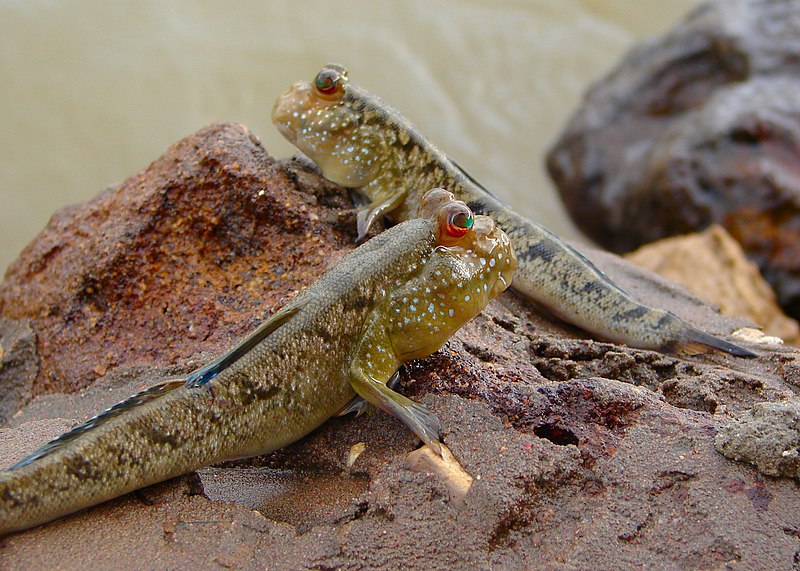
Mudskipper: a fish that lives on land

ORIGINAL: BBC-YouTube / Wkipedia

Excerpt from BBC's Life series

Just an example how fish can evolve to live on land.

Mudskippers are members of the subfamily Oxudercinae (tribePeriophthalmini),[1] within the family Gobiidae (Gobies). They are completely amphibious fish, fish that can use their pectoral fins to walk on land.[2][3] Being amphibious, they are uniquely adapted tointertidal habitats, unlike most fish in such habitats which survive the retreat of the tide by hiding under wet seaweed or in tidal pools.[4] Mudskippers are quite active when out of water, feeding and interacting with one another, for example to defend theirterritories. They are found in tropical, subtropical and temperateregions, including the Indo-Pacific and the Atlantic coast of Africa.

domingo, 27 de mayo de 2012

Origins Of Us (BBC Documentary)

ORIGINAL: Origins Of Us (BBC Documentary)

Broadcast (2011) Dr Alice Roberts reveals how your body tells the story of human evolution. The way you look, think and behave is a product of a 6 million year struggle for survival. We have uncovered the secrets of the atom and travelled to the moon. But how did humans come to be so successful? This series explores the anatomical changes that have given us, and our ancestors, the edge. Everything from the way that we walk, to the shape of our jaw and even the way our thumbs move connects us intimately to the struggles and triumphs of our ancestors. Yet many of those changes have come at a surprising cost and the problems we face now are a direct consequence of our evolutionary journey. As much about our bodies today as about our bodies 6 million years ago, Origins of Us will change the way you see yourself.

Origins Of Us 13/3 Bones (BBC Documentary)


Origins Of Us 2/3 Guts (BBC Documentary)

Origins Of Us 3/3 Brains (BBC Documentary)

miércoles, 11 de abril de 2012

Human 2.0: Scientifics claim we are on the verge of creating a new type of human

ORIGINAL: BBC (Horizon)


Broadcast (2006) Meet the scientific prophets who claim we are on the verge of creating a new type of human - a human v2.0. It's predicted that by 2029 computer intelligence will equal the power of the human brain. Some believe this will revolutionise humanity - we will be able to download our minds to computers extending our lives indefinitely. Others fear this will lead to oblivion by giving rise to destructive ultra intelligent machines. One thing they all agree on is that the coming of this moment - and whatever it brings - is inevitable.

jueves, 5 de abril de 2012

The Ape That Took Over The World (BBC)

ORIGINAL: BBC

Broadcast (2001) Scientists announced an amazing discovery: the oldest skull of a human ancestor ever found. The 3,5 million year old fossil was remarkably complete, and unlike any previous fossil find. Its discovery - by a team led by Meave Leakey of the famous Leakey fossil-hunting family - has revolutionised our understanding of how humans evolved.


The great mystery of our evolution is how an ape could have evolved into the extraordinary creature that is a human being. There has never been another animal like us on the planet. And yet ten million years ago there was no sign that humans would take over the world. Instead the Earth was dominated by the apes. More than 50 different species of ape roamed the world - ten million years ago Earth really was the planet of the apes. Three million years later, most had vanished. In their place came something clearly related to the apes, but also completely different: human beings!

Brainy or bipedal?

For years scientists searched for the first key characteristic which had allowed us to make the huge leap from ape to amazing human. At first they thought the development of our big brains was decisive. They even found the fossil that seemed to prove it, until along came the famous three million year old fossilised skeleton Lucy. This quashed the big brain theory, because here was a human ancestor which clearly walked on two legs, just as we do, but had the tiny brain of an ape. It seemed that the development of walking on two legs (bipedalism) was the first key human characteristic, the thing that set us on the road to becoming human.

Lucy soon became even more important. She seemed to defy the laws of evolution. Normally a major evolutionary adaptation like walking on two legs is followed by what scientists call an adaptive radiation. Many related species quickly evolve from an initial evolutionary innovation. It gives a very bushy evolutionary family tree, with many different but related species. Scientists knew that the human branch of the family tree had begun about six or seven million years ago, when the planet of the apes ended. And yet there was no sign of an adaptive radiation. The family tree showed just a straight line leading from the planet of the apes through to Lucy.

Evidence for evolution

All that has changed with Meave Leakey's spectacular new discovery, named Kenyanthropus platyops or, less formally, Flat-faced Man. Her find is the same age as Lucy's species, but also completely different. It's proof that there were two different bipedal human ancestors living at the same time, more than three million years ago. And it's the first sign of the adaptive radiation that the theory of evolution says should have followed the planet of the apes.