Mostrando entradas con la etiqueta Mar. Mostrar todas las entradas

lunes, 15 de diciembre de 2014

Este es el auto que revolucionará la industria automotriz: funciona con agua de mar


Este es el alucinante vehículo que revolucionará la industria automotriz y que ya ha llamado la atención de la industria del petróleo y creadores de autos eléctricos. Se trata del Quant e-Sportlimousine, el auto que funciona con agua de mar. El Quant, de la empresa Nano Flow Cell, fue presentado por primera vez en el Salón de Ginebra en 2014 donde estará nuevamente para la versión 2015 que se realizará en marzo y donde se presentará también una nueva versión del vehículo, el Quant F.

Aún no se ha confirmado el precio ni la fecha en la que el Quant estará disponible para el mercado, pero ya se ha adelantado que ya lo han aprobado en Europa donde está certificado para ser utilizado en las calles. La revolucionaria tecnología del coche funciona así: el auto se mueve gracias a baterías de flujo (o Flow Cell), las cuales dependen de la reacción de óxido-reducción clásica (redox). Es ahí donde entra en juego el océano y su inmensa cuota de sal.


El auto cuenta con dos depósitos con sales metálicas que contienen electrolitos ionizados. Los dos depósitos están separados por una membrana semipermeable que permite el intercambio de protones de un depósito a otro y en este intercambio, se produce la energía eléctrica que luego mueve al bólido.

Según explicó Nunzio La Vecchia, director técnico de nanoFlowCell AG, las ventajas del Quant incluyen “

  • su densidad de carga elevada
  • densidad de alto rendimiento, además de 
  • su peso ligero frente a los sistemas de almacenamiento de las energías convencionales. 
  • También en que no contiene sustancias dañinas
  • es muy eficiente“.
La tecnología que lo hace funcionar se empezó a desarrollar en la década de 1970 y en 1976 fue patentada por la NASA para mejorar el almacenamiento de energía en vuelos espaciales.


ORIGINAL: UpSocl
Por Romina Bevilacqua

miércoles, 20 de febrero de 2013

Jean Fréchet (UC Berkeley) wins 2013 Japan Prize

ORIGINAL: Berkeley
January 30, 2013

Jean Fréchet
Emeritus chemistry and CBE professor Jean Fréchet, a Professor of the Graduate School, has received a 2013 Japan Prize, one of the most prestigious international awards in science and technology.

Fréchet won the Japan Prize in Materials and Production jointly with UT Austin chemistry professor C. Grant Willson for their development of chemically amplified resist polymer materials for semiconductor manufacturing. Fréchet and Willson were honored for their work, which has significantly contributed to the development of our modern information society.

A second Japan Prize, in Biological Production and Biological Environment, was awarded to Rutgers University emeritus professor John Frederick Grassle for his contribution to marine environmental conservation.

These prizes reward those who have made a substantial contribution to the advancement of science and technology as well as to peace and prosperity of mankind. The award includes a certificate of recognition and a commemorative gold medal. A cash award of 50 million Japanese yen (approximately $560,000) is also given in each field.

Fréchet was born in France and received his first university degree at the Institut de Chimie et Physique Industrielles (now CPE) in Lyon, before coming to the United States for graduate studies in organic and polymer chemistry at the State University of New York, College of Forestry, and at Syracuse University.

He joined the chemistry faculty at the University of Ottawa in Canada in 1973 and remained there until 1987 when he became IBM Professor of Polymer Chemistry at Cornell University. In 1995 he was named to the Peter J. Debye Chair of Chemistry at Cornell University. In 1997, he joined the chemistry faculty at Berkeley and was named the Henry Rapoport Chair of Organic Chemistry in 2003 and Professor of Chemical Engineering in 2005.

While at Berkeley, Fréchet was also a senior scientist at the Lawrence Berkeley National Laboratory and served as a scientific director at LBNL’s Molecular Foundry.

In 2010 Fréchet became the vice president for research at King Abdullah University of Science and Technology (KAUST), Saudi Arabia. As a Berkeley emeritus professor and Professor of the Graduate School, he maintains an active research lab in Latimer Hall.

Fréchet and Willson began working together at the IBM San Jose Research Center in 1979, when Fréchet was a visiting scientist on a sabbatical leave from the University of Ottawa and Willson was a manager at the San Jose center.

At the time, semiconductor manufacturers were approaching the limits of the existing lithography processes and resist materials. Together with the late Hiroshi Ito, Fréchet and Willson invented chemically amplified resists that helped the fabrication of even smaller microstructures. These materials are now used to manufacture nearly all of the microprocessors and memory chips that are the heart of personal computers, mobile phones and many other electronic devices.

More Information


martes, 19 de febrero de 2013

Saving sea turtles from extinction

ORIGINAL: ScienceAlert
ARC CENTRE OF EXCELLENCE FOR CORAL REEF STUDIES 
TUESDAY, 19 FEBRUARY 2013

Climate change and coastal development are a threat to marine turtle populations worldwide, but researchers are developing different strategies to make sure they don't become extinct as a result of our actions. Image: Rich Carey/Shutterstock
International marine scientists warned it will be vital to protect key marine turtle nesting grounds, and areas that may be suitable for turtle nesting in the future, to ensure that the marine reptiles have a better chance of withstanding climate change.

A new study reveals that some turtle populations in the West Indian Ocean, Northeast Indian Ocean, North Pacific Ocean, East Atlantic Ocean and the East Pacific Ocean are among the least likely to recover from the impacts of climate change.

To give marine turtles a better chance of coping with climate change, we have to protect their nesting sites and to address threats such as bycatch and coastal development,” says Dr Mariana Fuentes from the ARC Centre of Excellence for Coral Reef Studies (CoECRS) and James Cook University.

We have seen sea turtle populations decline dramatically in recent decades, and it is likely to get worse due to climate change, as they’re particularly vulnerable to it.

Climate change can affect their nesting beaches through sea level rise, stronger cyclones and storms; high temperatures can cause their eggs to die before they hatch, or produce an unnatural sex ratio and adversely affect their food sources.

At present there are three ways we can tackle climate-related threats,” Dr Fuentes says. “We can reduce global greenhouse emissions, actively manage for direct impacts from climate change by manipulating the nesting thermal environment with shade, for example, and build the turtles’ resilience, that is, their ability to recover from the negative impacts.

Reducing emissions is perhaps the biggest challenge, but even if we were able to cut greenhouse emissions immediately, it will not stop the already apparent and unavoidable impacts of climate change on turtles.

Also, we don’t know the risks of implementing actions, such as relocating, manipulating or managing turtle populations, or how effective these strategies are,” she says. “So until we understand more about the risks and effects of active strategies, we should focus on increasing the turtles’ resilience.

This means that we must better understand what factors influence their ability to recover from the negative effects of climate change.

Together with sea turtle specialists from around the world, the CoECRS researchers identified that nesting ground vulnerability and non-climate threats, including coastal development and fishery bycatch, as the greatest influences on resilience of marine turtles to climate change.

The researchers also pinpointed the world’s 13 turtle regional management units – large scale conservation areas – that are the least resilient to climate change. These are distributed across three major ocean basins and are important breeding grounds for six of the world’s seven species of sea turtle – flatbacks, loggerheads, green turtles, leatherbacks, hawksbills, olive ridleys and Kemp’s ridleys.

Eleven of the least resilient conservation areas that we identified are the ones most likely to lose their turtle rookeries,” Dr Fuentes says. “This highlights the particular importance of protecting key regional nesting beaches and to legally protect areas that may be suitable for turtle nesting in the future.

Turtles have existed for millions of years and were here long before humans. It would be a complete tragedy if they were to become extinct as a result of our actions and our lack of care.

The study “Resilience of marine turtle regional management units to climate change” by Fuentes MMPB, Pike DA, Dimattero A and Wallace BP is published in Global Change Biology.


domingo, 7 de octubre de 2012

The Science of Stowaways

ORIGINAL: The Scientist
By Hayley Dunning
October 1, 2012

A dock dislodged by 2011's Japanese tsunami washes ashore in Oregon, posing an invasive species threat, but also serving as an unprecedented natural experiment in open-ocean dispersal.

EXOTIC MUSSELS: Mytilus edulis and M. galloprovincialismussels cling to the derelict dock among unidentified barnacles. Oregon Parks and Recreation department

This June a dock weighing more than 180 tons washed up on the Oregon coast, about a year after being dislodged from Japan’s seashore during the devastating earthquake and tsunami that struck there in March 2011. The dock is one of the largest pieces of debris to wash up on the opposite side of the Pacific, and it arrived earlier than anyone expected. But a bigger surprise for researchers and natural-resource managers dealing with the debris was the profusion of marine organisms clinging to the dock, many of which have already been pegged as potentially aggressive invasive species.We have already identified very bad things on this debris,” says John Chapman, an expert on marine invasive species at Oregon State University. “We can already see things that we definitely do not want.

One species clinging to the dock that is causing concern to Chapman and his colleagues is wakame (Undaria pinnatifida), a brown alga that can suffocate entire ecosystems when its natural predators are not around to keep it in check. Chapman likens the alga’s rapacious effect to “cutting down the whole forest,” and warns that the consequences of an invasion by such a prolific species might not be known for years to come. And there were many more invasive organisms present, including a thriving population of Mytilus galloprovincialis, a blue mussel that was itself introduced to Asia from the Mediterranean.

Pre-tsunami, the mussels only covered the part of the dock that was below the water’s surface. But when the structure was ripped from its pilings, it sank a little and dipped a fresh surface into the ocean. This previously high-and-dry surface was also covered in mussels by the time the dock reached Oregon, making M. galloprovincialis the dominant species on the structure.

There were very few small mussels on the dock. Did the entire population grow rapidly in Japanese waters as the dock bobbed just offshore before setting off on its open ocean journey? Or did the mussels continue to grow, encountering nutrients along the way? To try to answer these questions, marine ecologist Jessica Miller, also at Oregon State University, is working to unravel growth patterns from the creatures’ shells.


DOCK WORKERS: Oregon Department of Fish and Wildlife staff and volunteers remove marine organisms from the wayward dock, which landed at Agate Beach.
CREDIT: OREGON PARKS AND RECREATION DEPARTMENT

Much as trees’ yearly rings record environmental changes, hard-shelled marine organisms lay down annual layers of shell—slower growth and unfavorable seasons corresponding to thinner lines. The age and nutritional history of any mussel can therefore be determined, but chemical analyses of changes in elements across growth lines can also tell Miller something about the proximity to shore and the temperature at which the organism grew, allowing her to reconstruct the colonization history of the dock.This chance natural experiment gives a better opportunity to understand transoceanic dispersal,” she says.

Many of the dock organisms were collected and await analysis in freezers and labs across North America; much of the remaining biomass has been obliterated in an effort to restrict the spread of invasive species. Scientists recovered around 23–27 kg of organisms for research, but local responders scraped off and disposed of another 2 tons of material. Miller says that 92 species have already been identified from what was saved, and the team is confident they destroyed a large percentage of the total species present.

But when Chapman and his team looked for organisms that might have made landfall as the dock crashed into the Oregon coast, they found a large debris field of non-native mussels stretching down the beach. Chapman says they’ll try to determine what proportion of organisms was pulverized as the dock came to shore and what was washed up on the beach. “The remainder is what we’re afraid of—what’s offshore and didn’t get crushed, and could still be alive,” he says.

Invasive species expert Rick Boatner of the Oregon Department of Fish and Wildlife says it could be a while before we really know which, if any, species have managed to take hold on the Oregon coastline. He says that the clean-up operation on the dock was largely successful and the department is ready for another invasion, noting that at least one other Japanese dock is known to be adrift, along with ships and other large debris. However, he says, removing the first dock cost almost $100,000, and further funding is an issue, even in the face of the severe economic havoc invasive species can wreak. “If [an invasive species] got into the oyster aquaculture, it could devastate that,” Boatner says.

Among the fears, though, Chapman sees the silver lining: an experiment that could never have been simulated. Many invasive species travel in ship ballast water, but these are typically discovered only after they have become established, with researchers left trying to reconstruct when and how they arrived.

This is the first time in history that a dispersal event could be really watched,” Chapman says. Boatner agrees: “As a biologist, it’s kind of a cool thing. As an invasive species person, I don’t care for it.

lunes, 2 de julio de 2012

After Rio+20, developing countries must take the lead

ORIGINAL: SciDev
David Dickson
29 June 2012

Shutterstock
Leadership from developing countries will be key to global sustainable development

Last week's summit has confirmed that sustainable development will only be achieved through the political leadership of developing countries.

Two and a half years ago, the Copenhagen climate change conference (COP15) ended in rancorous and highly public disagreement between developed and developing nations on what was needed to prevent further global warming .

The outcome proved an intense embarrassment to the host nation, Denmark.

From the beginning of negotiations over the UN Conference on Sustainable Development (dubbed Rio+20 ), which took place in Rio de Janeiro, Brazil, last week, it was widely reported that the Brazilian government was desperate to avoid the same fate.

This article is part of our coverage of Rio+20 — the UN Conference on Sustainable Development — which took place on 20-22 June 2012. For other articles, go to Science at Rio+20

Although Brazil's determination was only one contributory factor, the result was the agreement, by all 188 participating nations, on an outcome document that was filled with aspirations and exhortations about the need for the world to move to a more sustainable path of economic and social development, but lacking any firm commitment to the more painful steps needed to achieve this goal.

Inevitably, this outcome has satisfied virtually no-one engaged in the process (apart from the host country).

But the increased focus that it provided on the political realities on which the Copenhagen meeting foundered — and which Rio+20 ducked — has itself been a significant step forward.


Taking the lead

What became clearer than ever at Rio was that the key to global sustainable development does not lie in the logical arguments coming from proponents in the developed world, including its scientific communities, however passionately they are delivered.

Rather, it now lies in the combination of political muscle and imaginative thinking in the developing world, particularly the so-called "emerging economies" of countries such as Brazil, China and India.

In Rio, these countries insisted, quite legitimately, that a global commitment to making the transition to "green economies" is only valid if it includes atransfer of significant financial and technical resources from the North to the South.

Their argument was that such a transfer would compensate for the fact that this transition is necessary because of the consumption patterns of the North.

Furthermore, the emerging economies — and China in particular — are coming to realise that sustainable development is in their own interest.

Their own internal environmental problems, from air pollution to an increase in flooding related to climate change , need to be addressed urgently as the unacceptable by-products of economic growth.

At the same time, a combination of technical ingenuity and low labour costs makes them well placed to become the leading producers of sustainable technologies for the rest of the world­ — as China has already shown in exporting solar energy technologies to Africa, for example.

Galvanising the grassroots

The organisers of Rio+20 were keen to emphasise that even as the formal proceedings turned out to be disappointing, this had been partially compensated for by the enormous networking opportunities the meeting provided for sustainable development stakeholders .

In particular, by the end of the meeting, more than 700 pledges — valued at over US$500 billionhad been registered for concrete actions through, for example, individual institutional commitments or partnership agreements.

Each of these was required to commit to quantifiable outcomes within a fixed timeframe. Together they show that a massive global commitment to sustainable development already exists, even without promises of resource transfers from political leaders.

Indeed, this outcome appears to confirm what many have been arguing: that truly sustainable economies can only be built from the grassroots, and with the full inclusion of community groups and other interested stakeholders.

Reigning in corporate power

But even if grassroots or voluntary initiatives are a necessary condition for sustainable development, they are not sufficient.

In particular, it ignores the extent to which the key directions and components of economic growth — such as a continued reliance on non-renewable energy sources supported by generous subsidies — are inevitably set at the top, rather than the bottom, of the political pyramid.

Furthermore, without an all-embracing political framework to ensure coherence between individual actions, each stakeholder remains — equally inevitably — motivated primarily by their own self-interest (or that of their stakeholders or shareholders), rather than a commitment to a common good. 

For example, many of the 700 individual pledges registered at Rio involved individual commitments from corporations keen to be seen to be "going green".

Ironically, however, former Norwegian Prime Minister Gro Harlem Brundlandt, head of the Brundlandt Commission, which first coined the phrase "sustainable development" in the 1980s, accused corporate lobbyists of being partly responsible for the disappointing outcome of the formal negotiations. [1]


Paving the future

The scientific meetings held in the run-up to Rio+20 — including both the Planet Under Pressure meeting in London in April, and the International Council for Science and UN Educational, Scientific and Cultural Organization's Forum on Science, Technology and Innovation for Sustainable Development , held two weeks ago in Rio itself — both underlined the urgency of taking action on many fronts.

Rio+20 opened the door for action on some of these, such as protecting the marine environment or mountain ecosystems . It also endorsed closer interaction between scientific communities and policymakers — another essential element of any future strategy.

But the meeting also highlighted the political challenge of changing the course of a global economy still wedded largely to fossil fuels and non-sustainable patterns of consumption.

It also showed that the developed world lacks the commitment to make the necessary changes and accept the painful consequences, pursuing the familiar maxim that "turkeys don't vote for Christmas".

It is now up to the developing world and its emerging economies to show that they can do better — for example, by taking on a key role in defining the forthcoming Sustainable Development Goals — and providing the political muscle to make this happen.

Concerns about embarrassment over possible failure should not stop them from taking the necessary political risks.

David Dickson 
Editor, SciDev.Net

This article is part of our coverage on Science at Rio+20 . Read more in our blog .

REFERENCES

domingo, 27 de mayo de 2012

ACUARIO VALDIVIA - Liberacion de tortugas carey

ORIGINAL: Rolando Reyes

Por celebrarse el dia mundial de las tortugas el Acuario Valdivia realizo la reinsercion en el islote "El Pelado" de 2 tortugas carey.

jueves, 26 de abril de 2012

My secret life as plankton

ORIGINAL: TEDEducation

"...a tea spoon of sea water can contain more than a million living creatures..."

New videography techniques have opened up the oceans' microscopic ecosystem, revealing it to be both mesmerizingly beautiful and astoundingly complex. Marine biologist Tierney Thys teamed with Christian Sardet (CNRS/Tara Oceans), Noé Sardet and Sharif Mirshak to use footage from the Plankton Chronicles project to create a film designed to ignite wonder and curiosity about this hidden world that underpins our own food chain.

Check out "My secret life as plankton" for a fish-eye look at the unseen life teeming within each drop of the ocean's water. We spoke with producer and marine biologist Tierney Thys to get an inside perspective on creating the film. 


What inspired you to make this video?

I've been in natural history filmmaking for many years and have a deep love and respect for the ocean. I also believe strongly in the power of film to raise awareness and educate. The idea for an ocean series for TED Ed was originally suggested to me by Chris Anderson, curator of TED. We brainstormed on possible topics and it grew out from there.

Where did you get the idea to cast a fish as the narrator?

As a group, our little production team all brainstormed on how best to tell the story of plankton. We knew we wanted to start topside and then dive in to the strange world of plankton. We brainstormed up all sorts of places, and with Noé Sardet and Sharif Mirshak we agreed that we should start in a fish market and see where that took us. When I went to write the script, it was the fish that started speaking—I listened and wrote down what that lovely snapper said.

What message do you hope to convey to viewers with this video?

As we all know many of our food fishes are suffering greatly due to global overfishing, perverse subsidies and piracy on the high seas. We've lost 90 percent of our big fishes since the 1950s and the majority of our fisheries are over-exploited. I hope dearly to highlight in a fun and engaging way that every fish is much more than a simple slab of protein. Marine fishes lead amazing life in that wildest of places, our beautiful, fragile ocean. Food fishes have a huge diversity of life histories—I show only one—but there are literally thousands of amazing fish tales that could and hopefully will be told. I hope to put a face on the fishes so we are more conscious and respectful of what it is we are consuming and overexploiting at such breakneck speed.

Do you recall the first time you saw plankton under a microscope?

I first saw plankton under a scope when I was very little—perhaps age 4 or 5 or so. My parents had a lovely microscope when I was growing up. (Incidentally that is a great item to have in any house!) Swimming at the other end of that microscope's ocular I saw a whole spectacular world that was so unlike anything I'd ever seen on land. And when I could get that darn focus knob to work, I was hooked!

What’s your favorite species of plankton and why?

Oh, that is a tough one. I just adore all of them. The ctenophores are gorgeous. The pteropods and heteropods are supremely graceful. The phytoplankton are luminous and so vital to our survival. I must say I am utterly enchanted by diatoms—they never cease to amaze me. All the mind-blowing larvae that populate the seas are spectacular—in particular the urchin pluteus—what a rocket ship! The jellies—their diversity, size and beauty astound me. Phronima and its crazy maternal antics rivet me... In truth I can't choose a favorite! I love them all.

What are the Plankton Chronicles? 

The Plankton Chronicles project combines art and science, revealing the beauty and diversity of planktonic organisms. Plankton samples are collected and filmed at the Villefranche-sur-Mer Marine Station and on board the schooner, Tara, using dark field optics and macro lenses or microscopes equipped with HD SLR cameras. Christian Sardet from the Centre National de la Recherche Scientifique and Noe Sardet and Sharif Mirshak from Parafilms in Montreal initiated the project in the context of the Tara Oceans expedition. The Plankton Chronicles are sponsored by the Centre National de la Recherche Scientifique, the Pierre et Marie Curie University in Paris and the Groupement d'Interet Scientifique IBISA.

Thumbnail Image Credit: idua_japan, Flickr 

viernes, 6 de abril de 2012

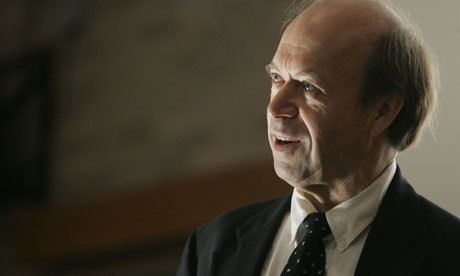
Según Jim Hansen, científico de la NASA: "el cambio climático es un problema moral a la par de la esclavitud"

ORIGINAL: The Guardian


El profesor Jim Hansen usa conferencia en Edimburgo, el Festival Internacional de Ciencia, para solicitar un impuesto en todo el mundo a todas las emisiones de carbono

viernes 06 de abril 2012 11.00 BST

El profesor Jim Hansen: "Estamos entregando a las futuras generaciones un sistema climático que está potencialmente fuera de su control". Fotografía: Melanie Patterson / AP
Evitar consecuencias peores del cambio climático inducido por el hombre es un "gran problema moral" a la par de la esclavitud, de acuerdo con el líder de la NASA el científico el profesor Jim Hansen.

Argumenta que diciendo que las consecuencias costosas y destructivas para la sociedad en el futuro son una "injusticia de una generación a otra".

Hansen, que el próximo Martes será galardonado con la prestigiosa Medalla Edimburgo por su contribución a la ciencia, también solicitará en su discurso de aceptación un impuesto mundial sobre las emisiones de carbono.

En su conferencia, Hansen sostiene que el desafío que enfrentan las generaciones futuras del cambio climático es tan urgente que  es necesario un impuesto global con tarifa plana para forzar recortes inmediatos en el uso de combustibles fósiles. Antes de recibir el premio - que ya ha sido dado a Sir David Attenborough, el ecologista James Lovelock, y la economista Amartya Sen - Hansen dijo a The Guardian que los últimos modelos calimáticos han demostrado que el planeta estaba al borde de una emergencia. Él dijo que la humanidad se enfrenta a repetidas catástrofes naturales debid los fenómenos climáticos extremos que afectan a grandes áreas del planeta.

"La situación que estamos creando para los jóvenes y las generaciones futuras es que les estamos entregando un sistema climático que está potencialmente fuera de su control", dijo. "Estamos en una situación de emergencia: se puede ver lo que hay en el horizonte durante las próximas décadas, con los efectos que tendrá sobre los ecosistemas, el nivel del mar y extinción de especies."


El calentamiento global está producciendo en toda la superfice de la tierra incluyendo el fondo del océano un desbalance térmico "... equivalente a explotar 400.000 bombas atómicas como la de Hiroshima diariamente y continuamente todos los días del año..." (Charla en TED 2012)

jueves, 15 de marzo de 2012

Stories from the grid: the cone snail and the search for powerful new anaesthetics

ORIGINAL: EuropeanGrid  WE-NMR

Episode 1: a short film about how a component of the venom used by the marine cone snail to hunt for food can help to create new painkillers. Researchers are using grid computing to digitally modify molecules found in the venom. The grid allows them to run a lot of trial and error tests extremely quickly to look for the right molecular shape that will be the perfect fit for the pain receptors in humans.

'Stories from the Grid' is a series of three short films which explore how researchers from different scientific disciplines are using cutting edge grid computing technology to advance their work.


The WeNMR web Portals for Structural Biology
Submitted by Chris Spronk on Wed, 2011-07-20 12:03

The web portals developed within WeNMR are among the most important elements of the project, as these form the points of entry for the end users.

The ultimate goal is to offer to users registered with the eNMR/WeNMR Virtual Organization (VO) complete online protocols for processing NMR data, including all the steps depicted in Figure 1.
Fig. 1 NMR data processing from signal to 3D structure  
After acquisition of the primary NMR data, these are Fourier transformed to obtain spectra in which the individual frequency contributions or resonances of spin systems, and their relations, are revealed.

The resonances subsequently have to be assigned to individual atoms. If sufficient resonances have been assigned, restraints can be inferred from the data, pertaining to distances between atoms, dihedral angles, domain orientations, etc. When an adequate number of restraints is available, these can be used to calculate a set of three-dimensional structures optimally satisfying these restraints.

The resulting structures represent the structure of the protein in solution, which is validated against the available experimental data. Although the process is here depicted linearly, intermediate stages may involve iterative cycles of refinement.

In addition, each of these steps, and every program involved has value by itself as web based service. For this reason, a piece-wise implementation has been adopted and programs that are ported to the Grid are simultaneously being made available as a web portal. Currently, 12 portals are operational and can be accessed through http://www.wenmr.eu/wenmr/nmr-services. These provide access, among other services, to

  • HADDOCK for the prediction of biomolecular complexes
  • XPLOR-NIH
  • CYANA and CS-ROSETTA for calculating structures from NMR data
  • AMBER for structure refinement and molecular dynamics (MD) simulations
  • CcpNmr for data conversion
  • MARS for backbone assignment
  • TALOS+ for torsion angle prediction
  • MDDNMR for NUS spectral processing

Next to these available portals, several new ones are in development for various NMR applications, including the UNIO program that provides computational routines for each individual step depicted in Figure 1.

Sea of Love

ORIGINAL: TONMO
Feb 07


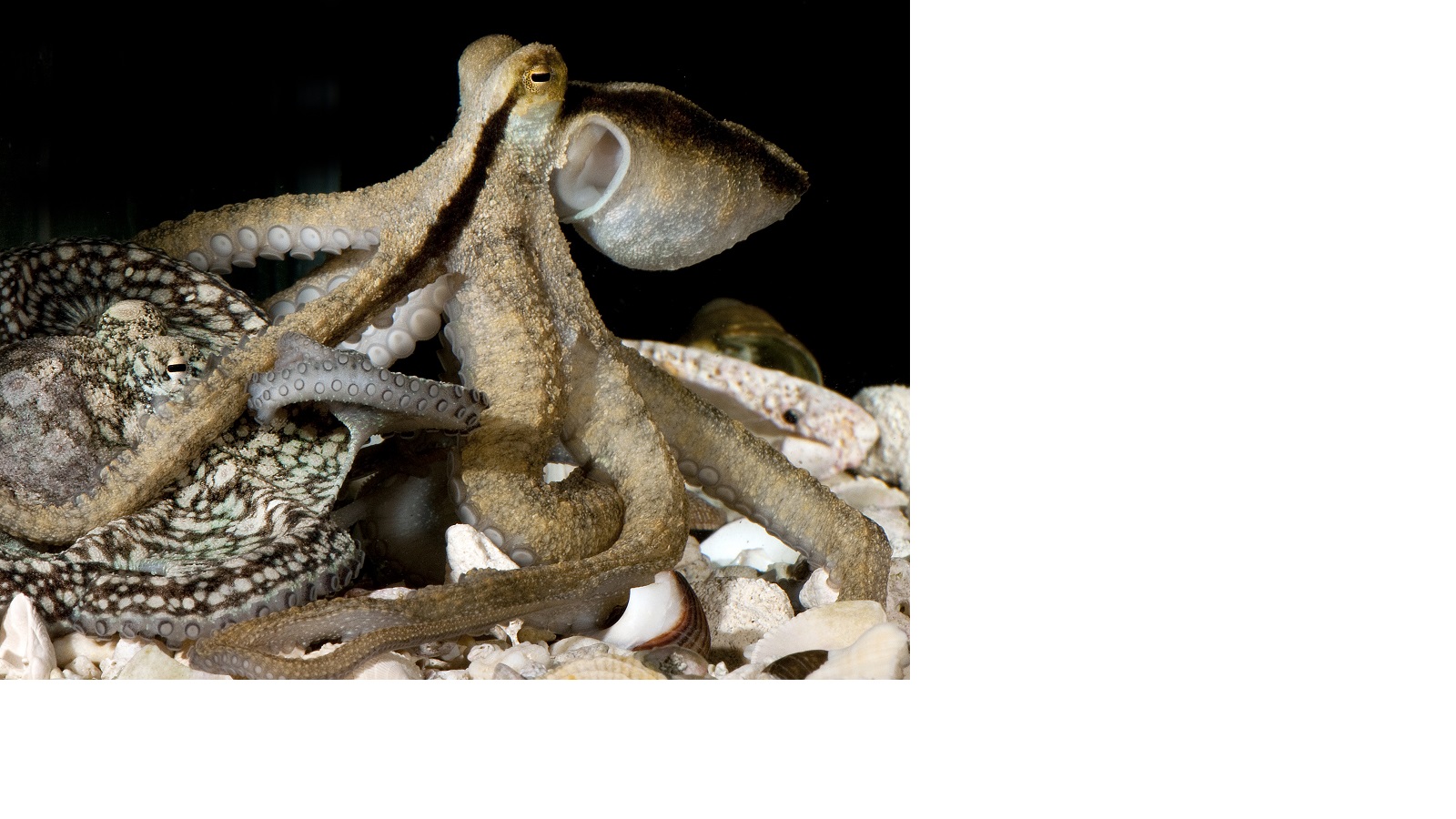
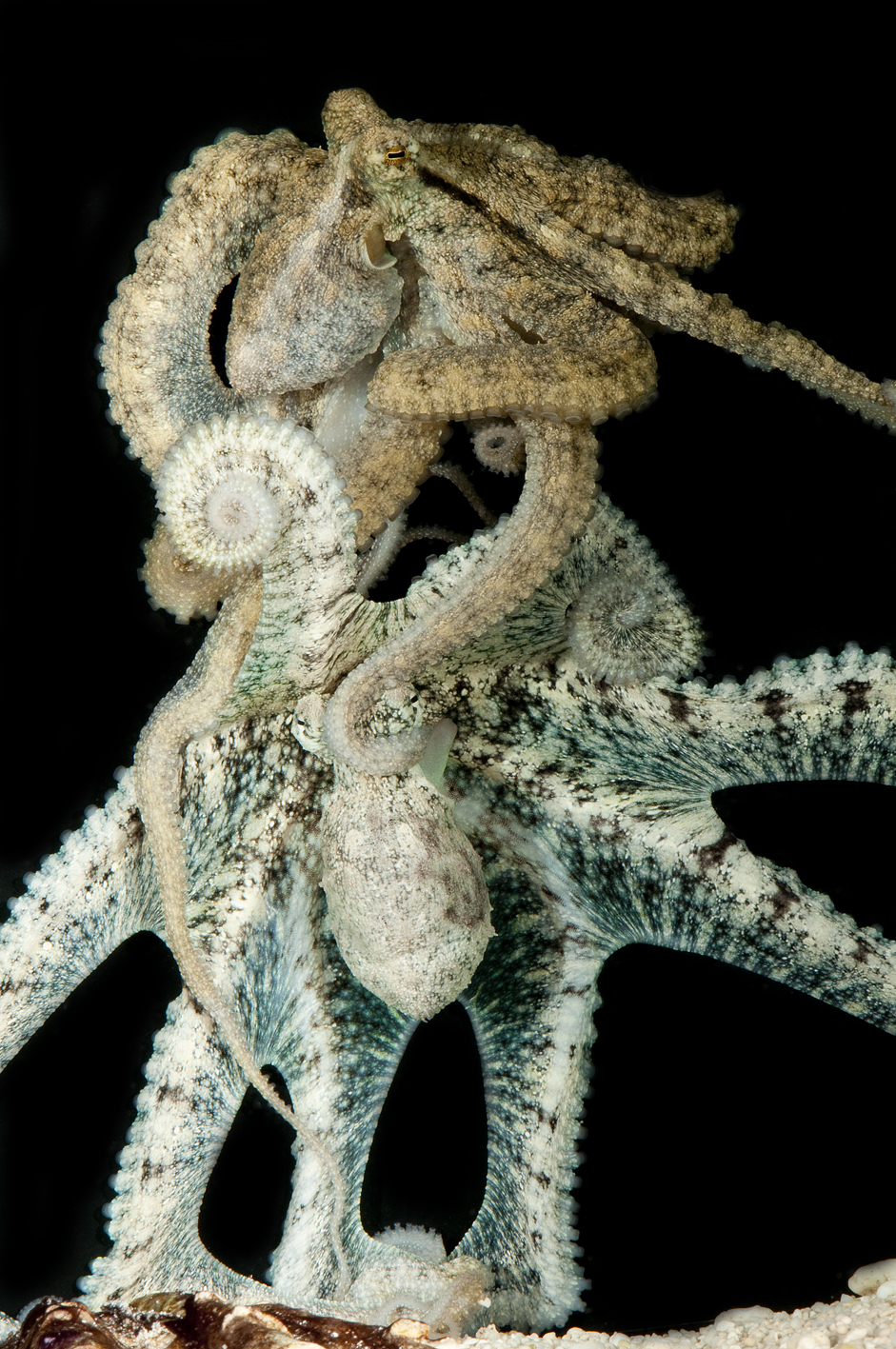
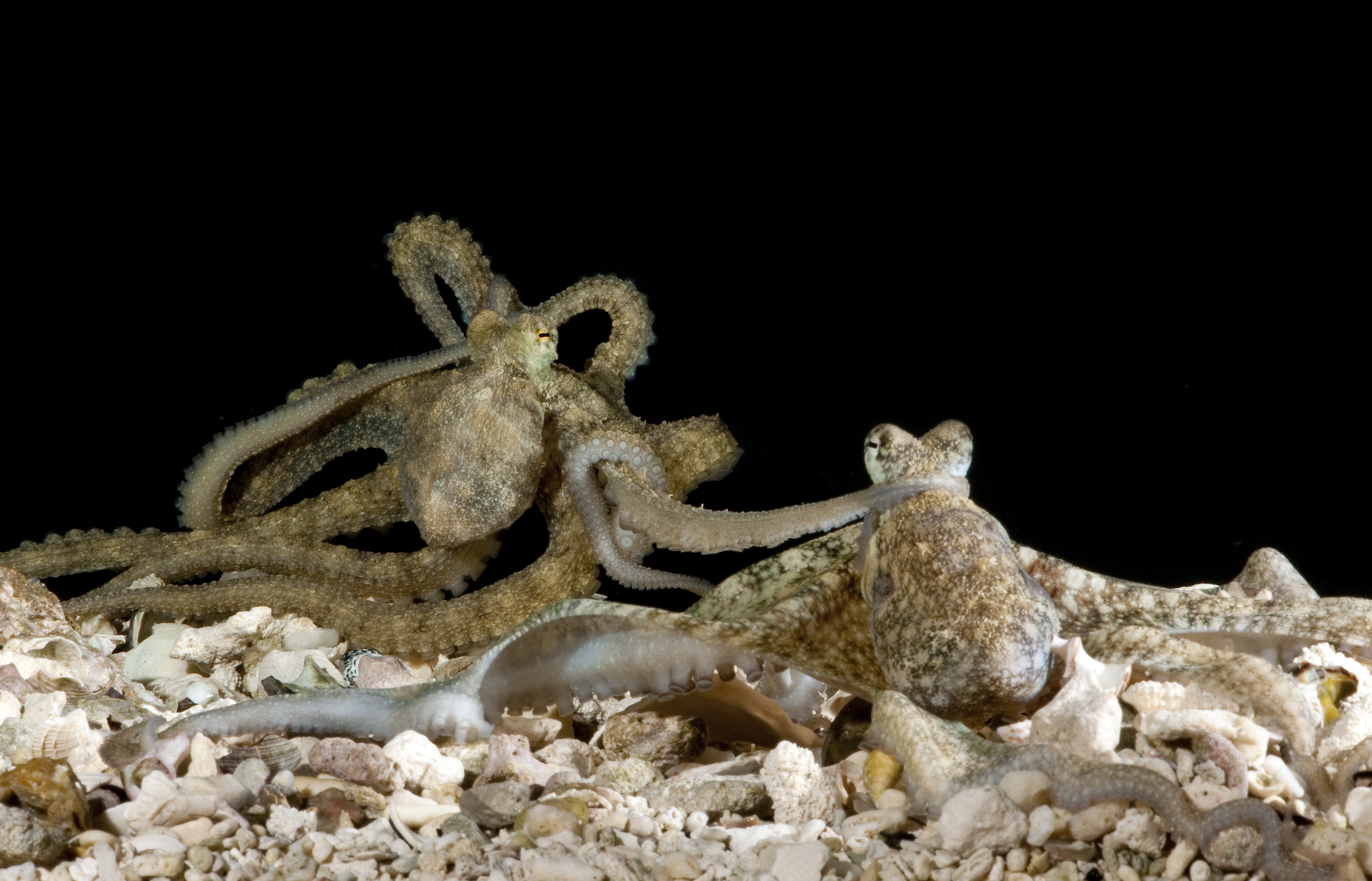
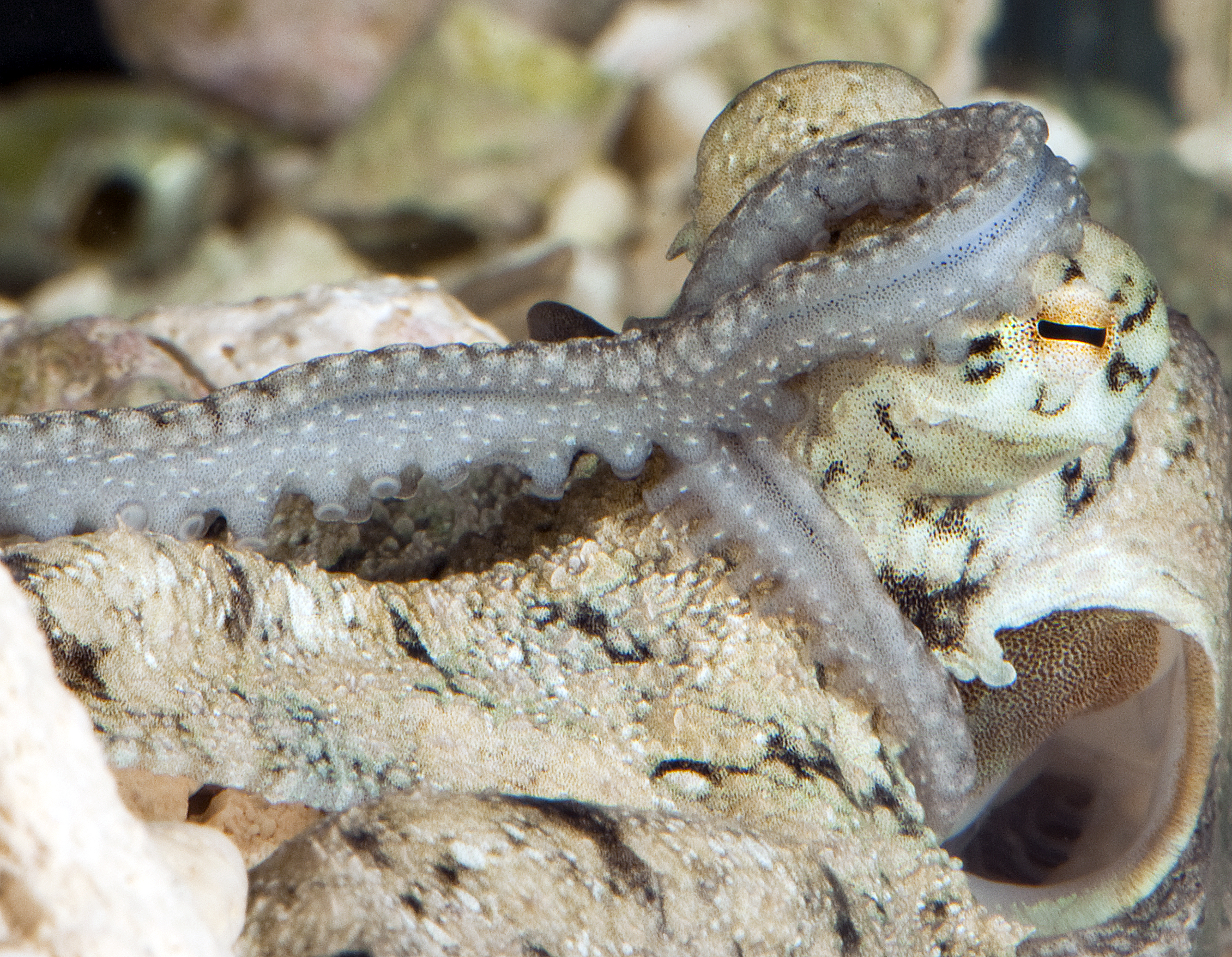
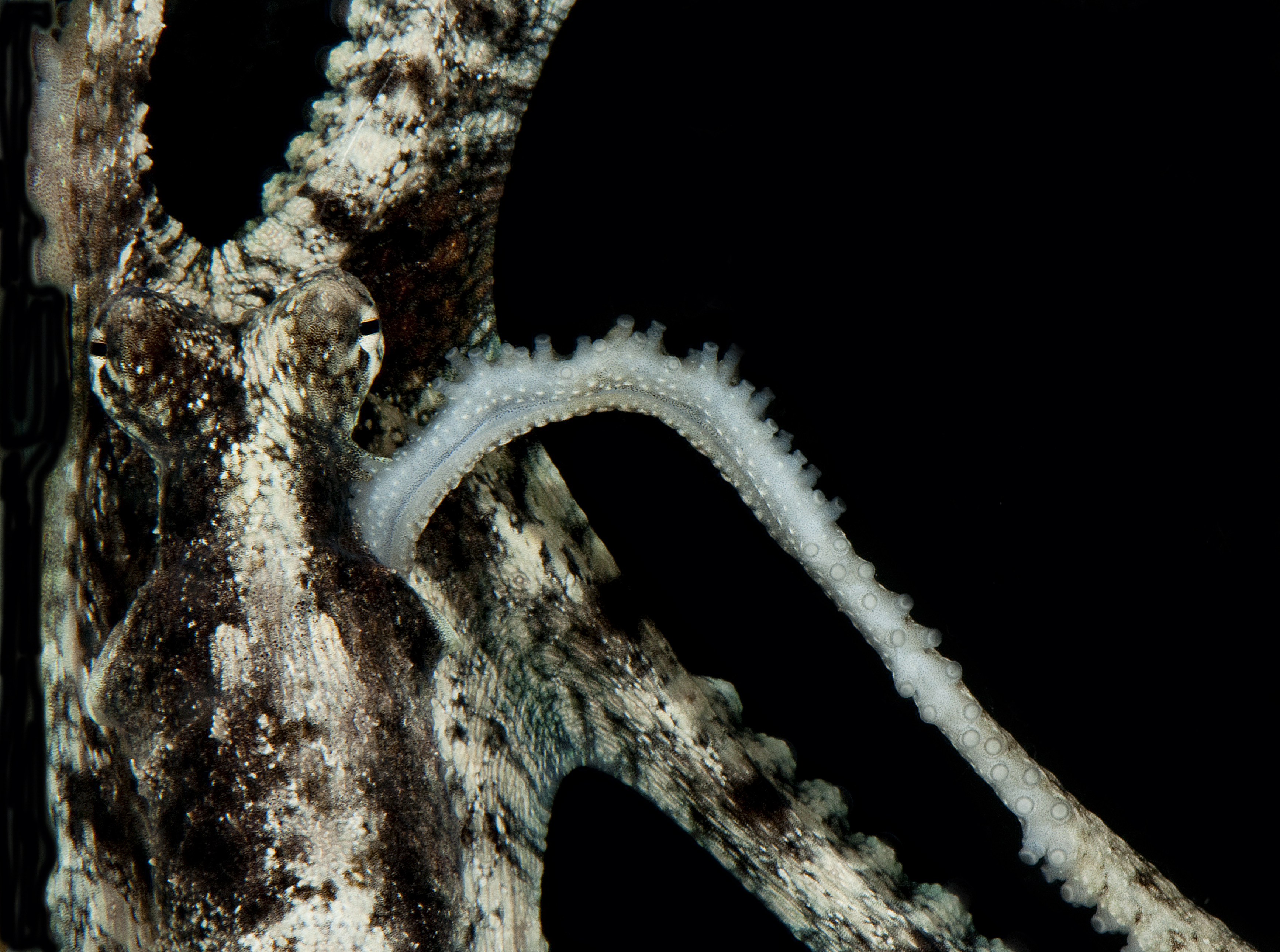
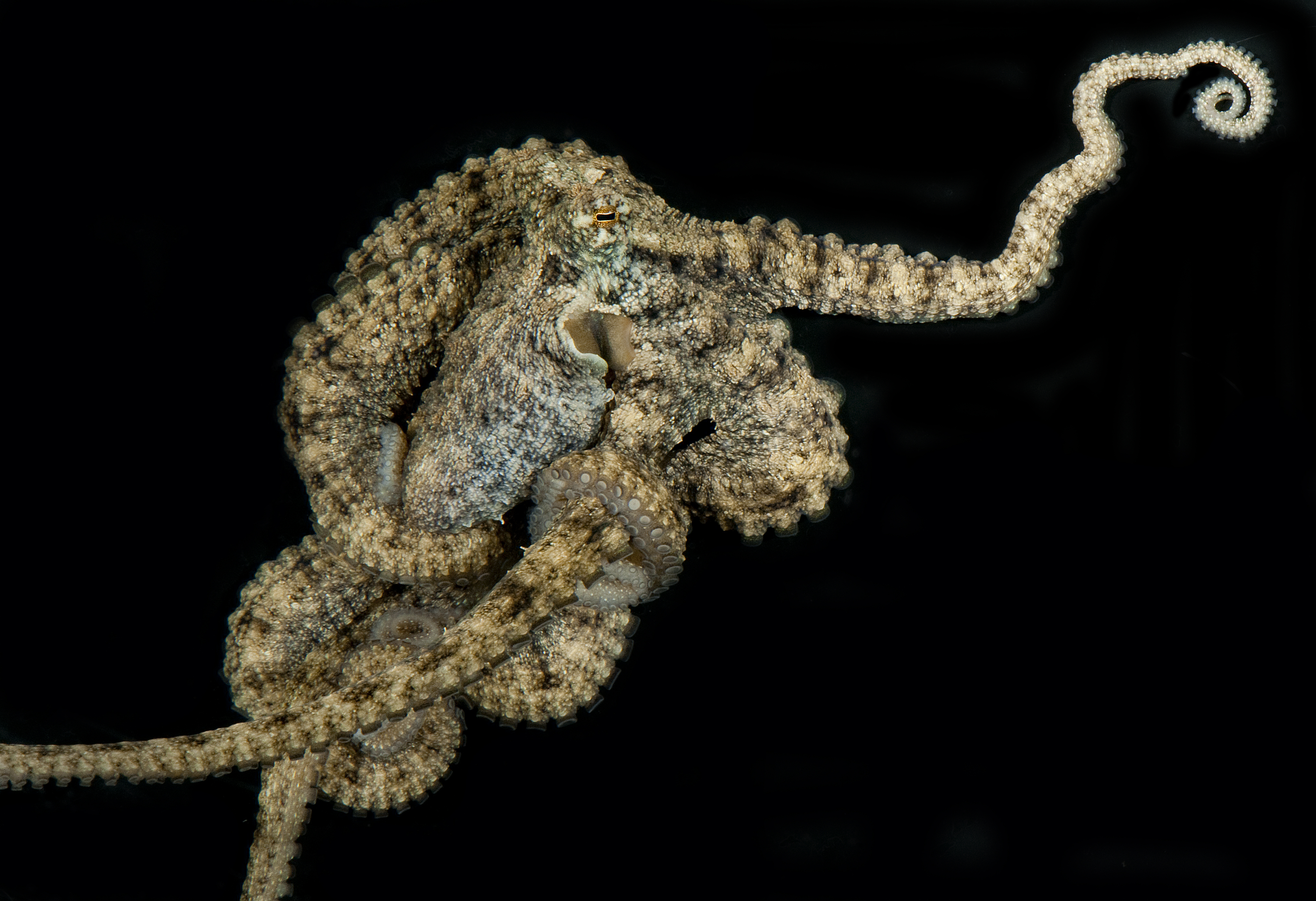
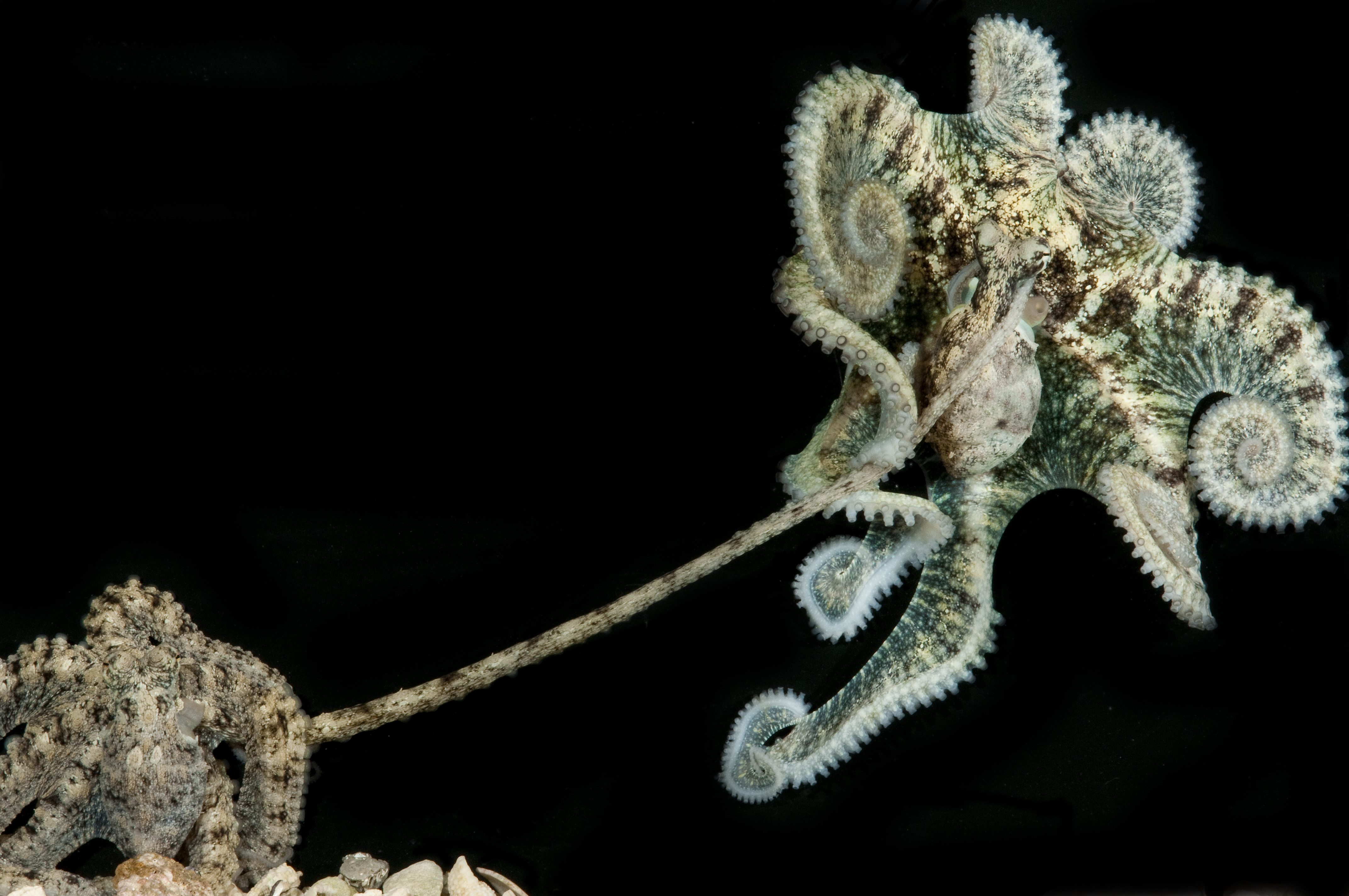
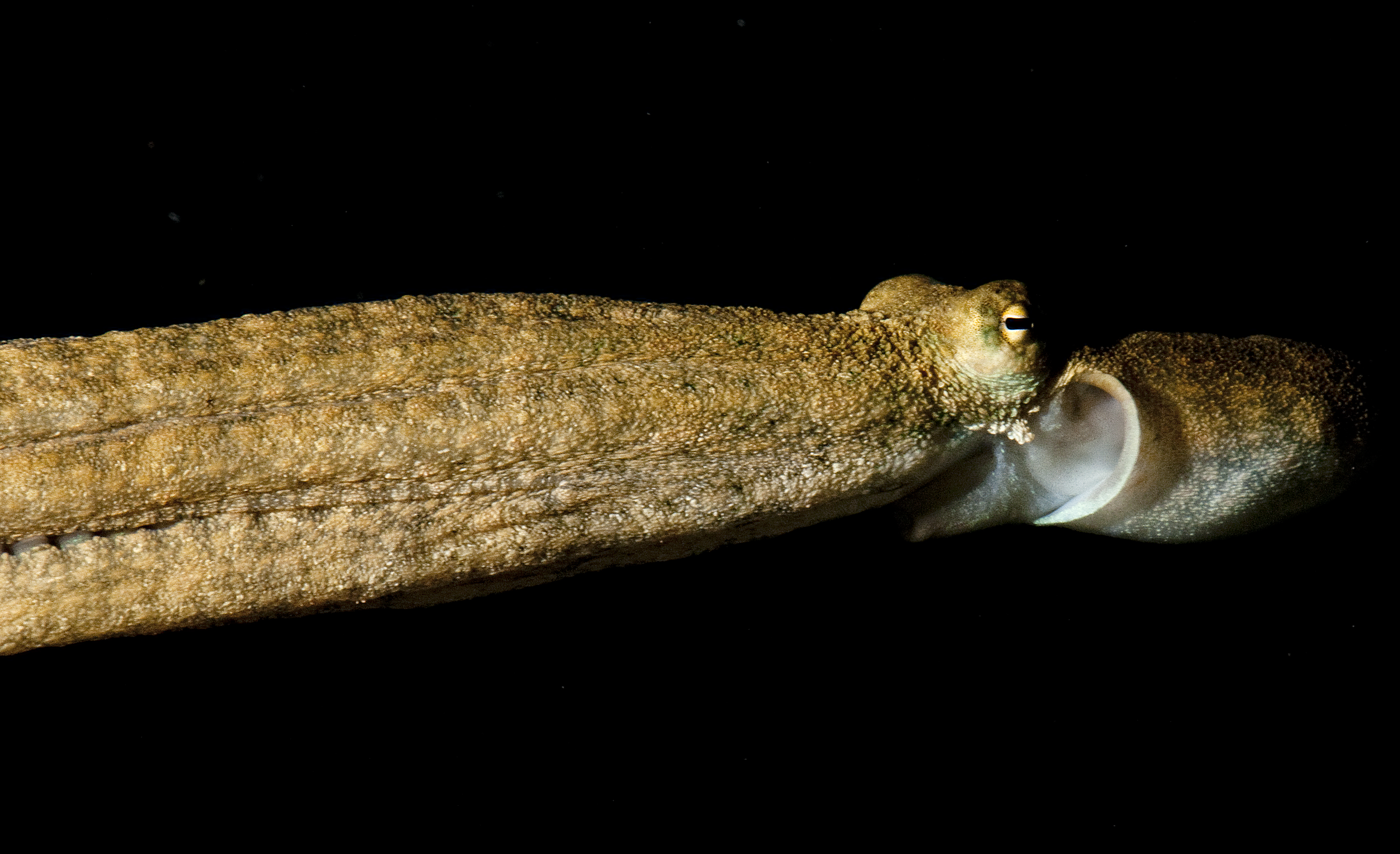
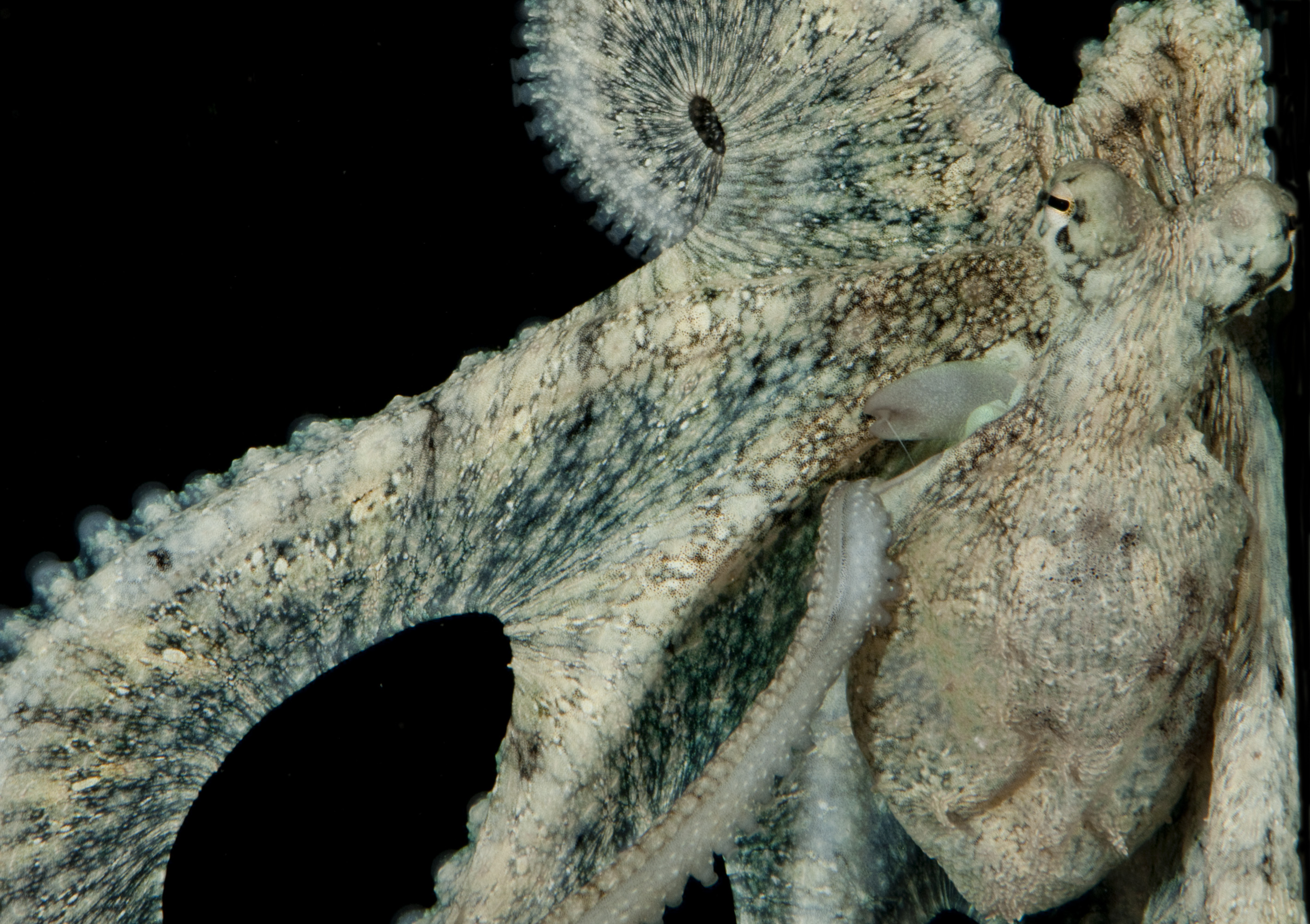
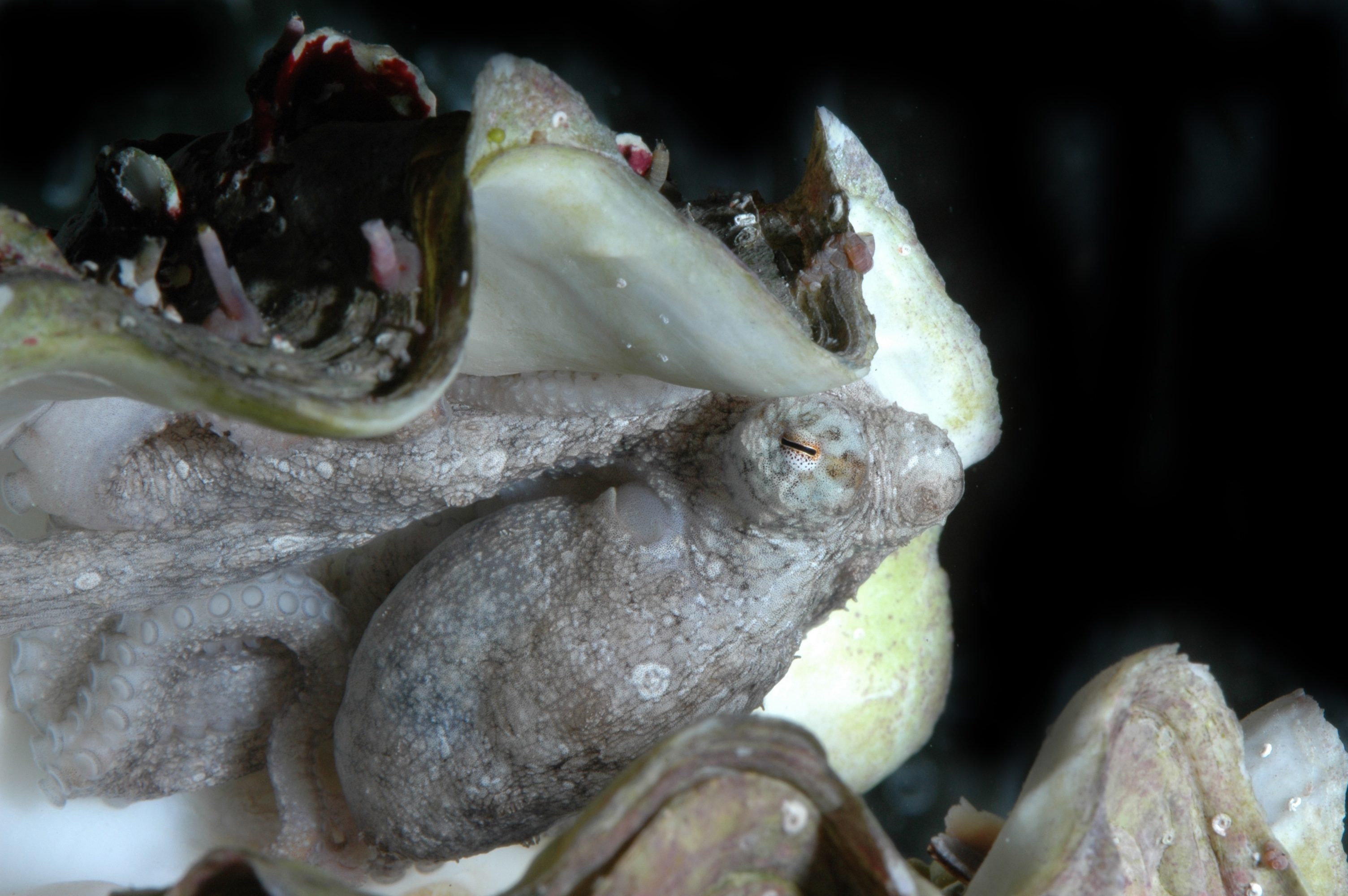
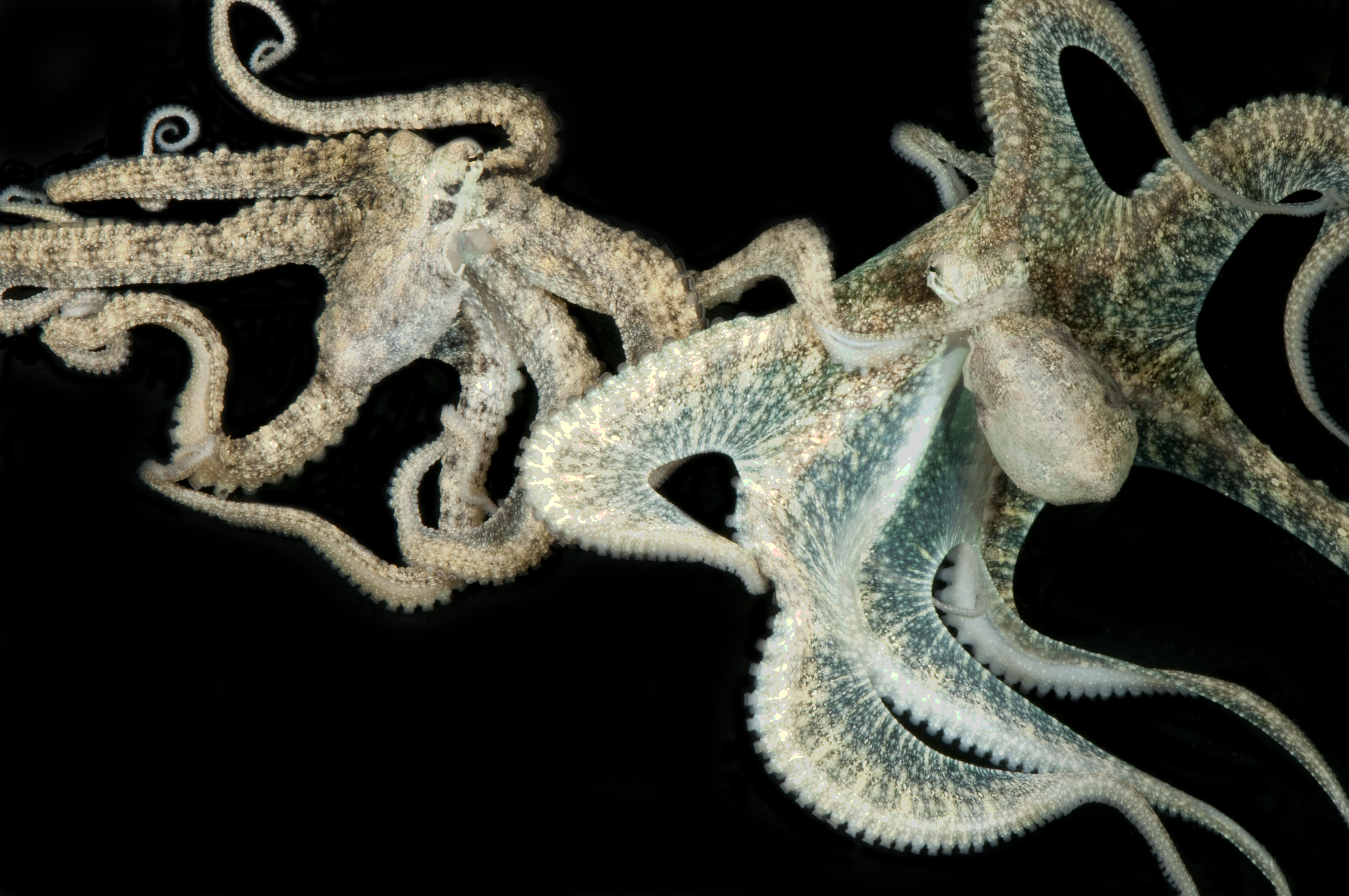
Dr. Roy Caldwell has shared some astonishing photos of two mating A. aculeatus. Note that these images are very rare and the quality is high.


Sea of Love

An Abdopus aculeatus male perches on a rock keeping an eye out for a passing female. He displays his dark, enlarged suckers signaling that he is a male and flashes a characteristic brown stripe that says he is ready for action.


Cue the burlesque music

A sharp-eyed female spots him and starts to approach. She knows what she wants and knows how to get it...


So do you come here often?
The male moves in and reaches out to make contact. The female flashes a web display in response. This is going well!

Enough of the small talk...
Here we see the smaller male engaging with the larger female. Roy observed the female's "passing cloud displays" during the process. Could such a display be a depiction of physical pleasure, like waves of excitement? Hmm, this is getting voyeuristic... Let's just observe in the name of science and not go too deep into their sexual psyche...

The male makes his move.
In order to place a packet of sperm into the female, the male uses his modified third right arm called the hectocotylus. Here we see him feeling for the genital opening located inside her mantle cavity to insert the tip of the hectocotylus.

ZOMG, they're totally doin' it!
OK, now it's definitely voyeuristic. Here we see the male leveraging his hectocotylized arm to insert its spermatophore into the female. From this angle, along the center of the inserting arm, you can see the "spermatophoral groove" which carries the spermatophore to its destination.

The "O" face... and I don't mean "octopus"
In this photo, we see the contorted male in the process of transfering his spermatophore down to the left through the hectocotylized arm.

Hey, um... I'm not done!
Males can remain inserted into females for hours, repeatedly passing spermatophores down the hectocotylus. When the female moves, the male is often dragged along by his hectocotylus. This depicts his attempt to remain inserted and in effect, he's guarding his mate from other males. Mate-guarding has rarely been reported in octopus. Dr. Crissy Huffard has reported seeing it in the field; Roy was amazed to see it (and capture it on camera) in the lab.

So, right, I'll call you this weekend, OK?
His job done, the male withdraws his hectocotylus from the female and jets away into the abyss.

Yeah, I'm busy this weekend... and the next.
Quite interestingly, here we see the female ejecting a spermatophore from her funnel. (So much for romance.)

The amazing result...
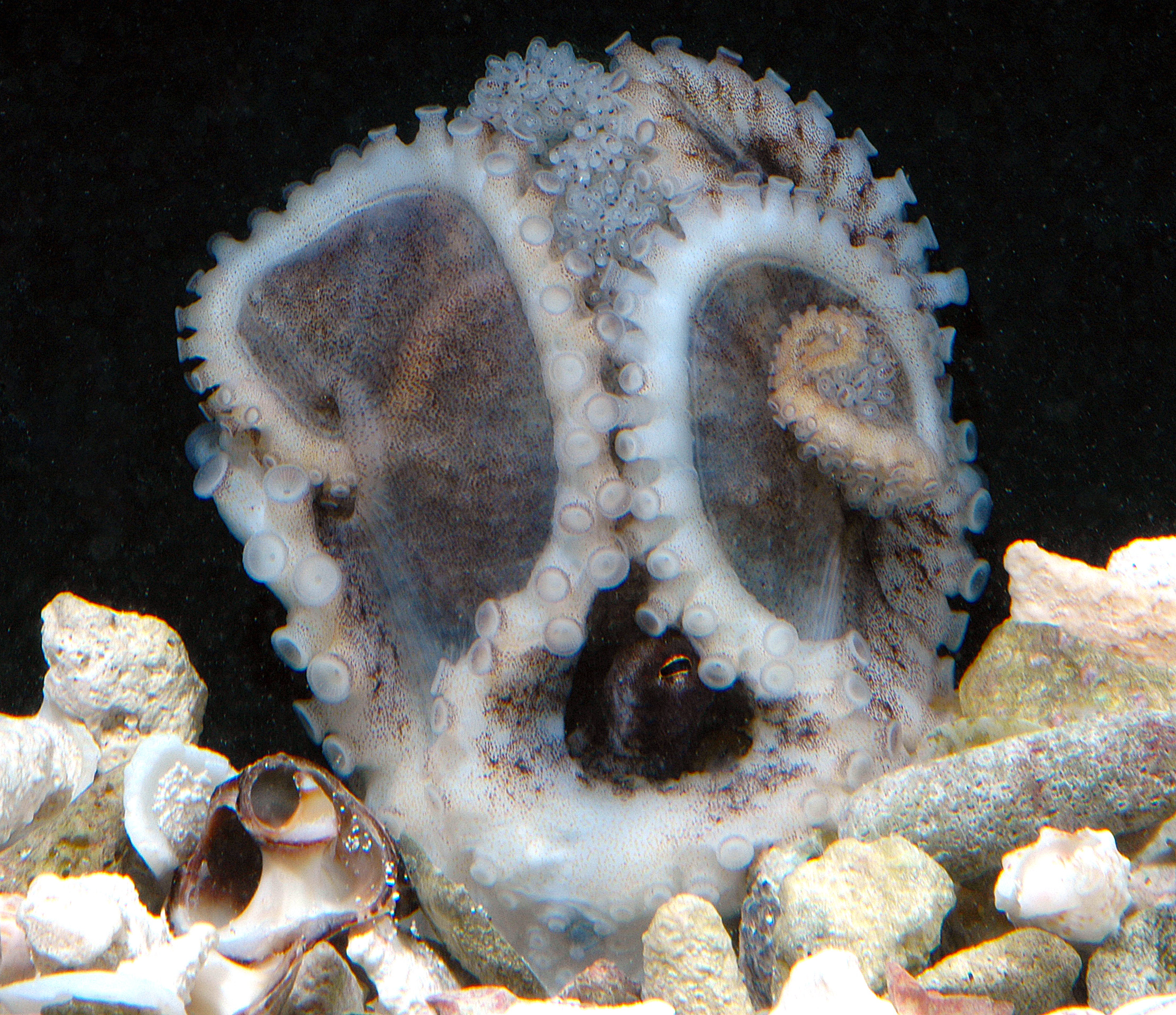
Females, when ready to lay and brood their eggs, burrow into the reef flat and lay hundreds of garlands of eggs. She encompasses the eggs in her web. The gravel was removed from around this brooding female so that she can brood the pouch that she forms with her arms and web.

Life!
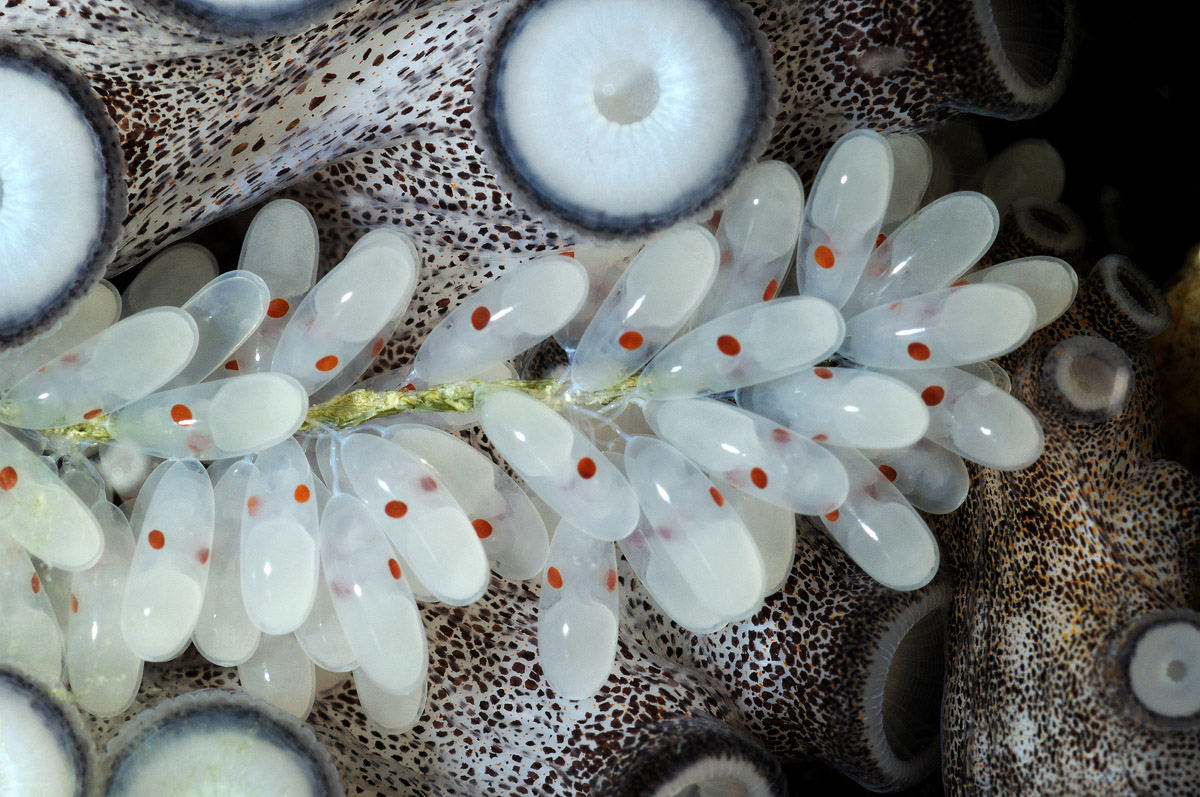
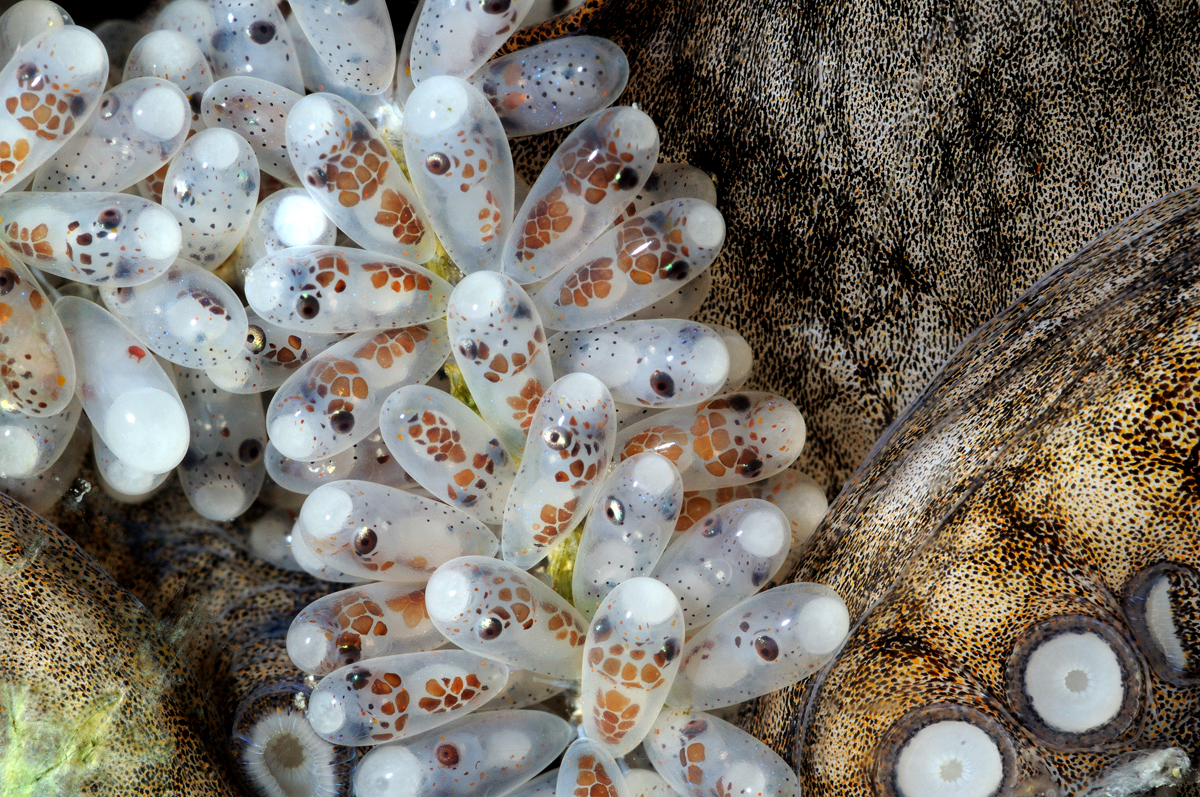
The female broods her eggs for about a month. During this time she tends and aerates them, not moving from the burrow. She does not feed. About two weeks into development, we can see red eyespots forming. A week later, chromatophores in the skin of the larvae are visible.

Sad End
As the female broods her eggs, she begins to senesce living off of her energy stores. The wear and tear on her body is clearly seen in the loss of color and texture. Within days after the eggs hatch and the paralarvae swim up into the plankton, the female dies; her job is complete.

So there you have it. Thanks again to Roy for sharing these amazing photos and providing descriptions of what we're seeing here. If you'd like to discuss this article with him and the rest of the TONMO staff and community, join us in this discussion thread.


lunes, 5 de marzo de 2012

The Big Lie: One Year After Fukushima, Nuclear Cover Up Revealed

ORIGINAL: CommonDreams
March 5, 2012 by Common Dreams


As the first anniversary of the Fukushima Daiichi nuclear disaster arrives, the cover-up involving nuclear power is more extensive than ever.

The Big Lie was integral to the nuclear push from its start.

Monitoring radioactivity levels in Fukushima (Photo: Christian Slund/Reuters)Promoters of nuclear power discounted the seriousness of nuclear plant accidents, although government documents acknowledged the vast scale of catastrophe. As the Atomic Energy Commission’s “WASH-740 update,” done at Brookhaven National Laboratory in the 1960s, repeatedly states about a major nuclear plant accident: “The possible size of the area of such a disaster might be equal to that of the State of Pennsylvania.”
They pushed the “peaceful atom” although knowing that any nation with a nuclear plant would have the materiel from it (the plutonium produced as a byproduct) and trained personnel to make atomic weapons.

They downplayed the effects of radioactivity claiming it needed to reach a “threshold” to cause harm even as it became clear that any amount of radioactivity can injure and kill.

And nuclear power would be “too cheap to meter,” they insisted.

And on and on…

The realities of nuclear power have become ever more evident acutely so because of the disasters at Chernobyl and Fukushima.

But the Nuclear Big Lie continues bigger than ever.

In recent weeks, for example, there’s been the move to negate what has been the U.S. government’s benchmark analysis on the impacts of nuclear plant accidents. “Calculation Reactor Accident Consequences 2” (CRAC-2) was done for the U.S. Nuclear Regulatory Commission by the U.S. Department of Energy’s Sandia National Laboratories in 1982. It catalogues the impacts from a meltdown with a breach of containment at every nuclear plant in the U.S.

It divides the consequences into “Peak Early Fatalities,” “Peak Early Injuries,” “Peak Cancer Deaths” and “Scaled Costs” for property damage and the numbers are chilling.

For the Indian Point 3 nuclear plant north of New York City, for instance, it projects “Peak Early Fatalities” at 50,000, “Peak Early Injuries” at 167,000, “Peak Cancer Deaths” at 14,000 and “Scaled Costs” at $314 billion (in 1980 dollars).

The estimates turn out to be low considering the toll of the 1986 Chernobyl nuclear plant accident.

But in January, the NRC put out a report that it intends to replace CRAC-2 with that it titles the “State-of-the-Art Reactor Consequences Analyses” or SOARCA. SOARCA flatly dismisses the high casualty and damage figures of CRAC-2 (and the WASH-740 update before it). Using as models the Surry nuclear station in Virginia and the Peach Bottom facility in Pennsylvania, each with two nuclear plants, the NRC declared that the “risks of public health consequences from severe accidents” at a nuclear plant “are very small.

The “long-term risk” of a person dying from cancer from a nuclear plant accident is less than one-in-a billion, says SOARCA. This is because “successful implementation of existing mitigation measures can prevent reactor core damage or delay or reduce offsite releases of radioactive material.

Tell that to the people impacted by Chernobyl and Fukushima.

Cindy Folkers of the organization Beyond Nuclear declares that the “NRC should immediately withdraw its absurd SOARCA report and get about the business of protecting the public health, safety, and the environment its mandate rather than doing the nuclear power industry’s bidding.


Then there’s the attempt to cover up Fuksushima impacts.


"Health impacts from the radioactive materials released in the Fukushima Daiichi meltdowns will probably be too small to be easily measured,” began a New York Times piece by Matthew Wald last week. That was based on a Health Physics Society program at the National Press Club.


jueves, 1 de marzo de 2012

¿Quién posee el mar?

ORIGINAL: Yoroboku


El futuro no es invisible. Pero solo algunos lo pueden ver. Solo algunos lo pueden contar. El investigador del CSIC Antonio Lafuente lleva años estudiando la ciencia y lo que habita después del presente. Un día, en sus estudios, se encontró con los bienes comunes. Esos que pertenecen a todos los individuos y a nadie en particular. Esos que no pertenecen ni al estado ni a un terrateniente ni a una multinacional.
  • El aire, por ejemplo. 
  • El genoma humano. 
  • El folclore. 
  • Las semillas. 
  • La naturaleza. 
  • La gastronomía. 
  • La artesanía. 
  • El conocimiento primitivo.
  • Las ideas. 
  • La cultura. 
  • El habla.

¿Quién inventó la rosa?”, pregunta el investigador. “¿Quién inventó el arroz basmati?”. Esos bienes son comunes. Pertenecen a la humanidad. Pertenecen a las comunidades. Son el procomún. Lo que es de todos y lo que es de nadie al mismo tiempo”, dice Antonio Lafuente. “Son bienes que no se agotan aunque sí se pueden agraviar. El daño se produce cuando aparecen barreras a su uso o alguien los degrada”.

Un río pertenece al procomún. Pero un día llega una empresa y vierte sustancias tóxicas en sus aguas. Eso convierte un bien de todos en algo sin calidad”, explica el granadino. “Todos los días surgen cientos de bienes comunes que tenemos que preservar”.

Los bienes comunes no hacen ruido. En esencia se gestionan por sí mismos. El sol está ahí para dar calor a todos. La lengua está ahí para que todo el mundo hable. Pero cuando se hacen más patentes es cuando resultan amenazados. “El día que lo pierdes es el día que vas a saber que lo tenías”, comenta Lafuenta. “El aire siempre ha estado ahí pero hemos empezado a plantearnos su existencia cuando han surgido los problemas. Todos los días hay miles de aviones en el cielo y millones de fábricas echando humo. Esto genera problemas respiratorios a muchas personas y esas comunidades se organizan para empezar a reclamar la preservación de ese bien común”.

El pensador Iván Illich intentó llamar la atención sobre las amenazas que sufren los bienes comunes en un artículo escrito en los años 80, llamado El silencio es un bien comunal.

Relataba el austriaco que en la aldea de la costa dálmata a la que llegó en un barco, recién nacido, nunca habían visto un altavoz. Muy pocos habitantes habían escuchado el sonido amplificado que salía de su interior. Pero el mismo barco que llevó Illich a aquel lugar viajaba un megáfono.

Hasta aquel día, hombres y mujeres hablaban con voces más o menos igualmente potentes. Todo eso cambiaría. El acceso al micrófono determinaría qué voces se amplificarían. El silencio dejó de ser un bien común. Se tornó un recurso por el que habrían de competir los altavoces. El lenguaje en sí pasó de ser un bien común local a un recurso nacional para la comunicación”, dice el ensayo. “La usurpación provocada por los altavoces destruye ese silencio que durante toda la historia le otorgara a cada hombre y mujer su propia voz. A menos que tengamos acceso a un altavoz, estamos silenciados”.

El procomún no tiene amo ni señor. Un estado y una empresa no son más jefes de la biodiversidad que una niña del desierto. “Hace unos años, unos científicos estadounidenses plantearon cambiar el eje del giro de la Tierra para controlar el cambio climático. Pero ante esta propuesta surge una pregunta. ¿El eje sobre el que gira el planeta es de unos estadounidenses o es de la población mundial? ¿Qué consecuencias podría acarrear a todo el ecosistema?”, cuestiona el investigador. “Las consecuencias de estos proyectos de geoingeniería son imprevisibles”.

El desarrollo de la tecnología ha planteado un nuevo escenario a los bienes comunes. “Las nuevas tecnologías hacen accesibles cosas que son de todos y de nadie. Por ejemplo, la biodiversidad. Los esquimales que vivían en los polos se han tenido que trasladar a otros lugares por el deshielo. El calentamiento global no lo han provocado ellos. Culpan a los países que más gases de efecto invernadero están emitiendo y, por eso, han llevado a juicio a EEUU”, explica Lafuente.

La tecnología está haciendo también que “bienes comunes como los fondos marinos se estén convirtiendo en algo privado con lo que muchas empresas están haciendo negocio”. Perdemos suelo. Y perdemos cielo. “Muchas personas reclaman los cielos perdidos. Antes se podía ver el firmamento lleno de estrellas. Ahora la luz de las ciudades esconde la galaxia. Las ciudades iluminan hacia el cielo y no hacia el suelo”.

Los bienes comunes nacieron con la propia historia de la humanidad. “Siempre ha habido comunidades y minorías que han defendido sus legítimos derechos”, dice el autor de El carnaval de la tecnociencia. Pero la idea del procomún sufrió un serio revés con la aparición de un ensayo en la revista Science en 1968. El título era La tragedia de los comunes (The tragedy of the Commons) y su autor, Garrett Hardin. El biólogo estadounidense describió un escenario imaginario de un pastizal. Lo dibujó como un espacio compartido por un determinado número de personas. Cada pastor tenía un número limitado de animales. Un día, los granjeros vieron que había más pasto del que los animales necesitaban. Cada pastor decidió, por su cuenta, llevar algún animal más. El alimento del ganado empezó a escasear. Habían sobreexplotado esa tierra y los animales murieron.

Hardin creó el mito de que los individuos no saben gestionar los bienes comunes y que solo los estados o los organismos privados pueden hacerlo.El pensamiento neoliberal ha tomado el ensayo de Hardin para justificar su idea de que los bienes comunes no funcionan por sí solos y que para que un proyecto salga adelante es necesario privatizarlo”, comenta Lafuente.


Esta idea fue ganando terreno durante las últimas décadas del siglo XX. Pero en 2009 fue seriamente cuestionada. La Premio Nobel de Economía de ese año, Elinor Ostrom, llevaba años estudiando modelos de gestión de recursos comunes en todo el planeta. Lo contaba en su obra El gobierno de los bienes comunes. La economista californiana analizó los casos de éxito y fracaso de la administración de recursos de uso común y descubrió que el compromiso de todos y la capacidad de supervisión son fundamentales para el éxito de la gestión colectiva.

Para que una comunidad funcione”, asevera Lafuente;
 “tienen que darse dos condiciones.
  • No se puede confundir el bien común con el libre acceso
  • hay que conceder un reconocimiento a los que más trabajan por ellos
La propia gestión de estos recursos tiene que evitar que aparezcan personas que se aprovechen del trabajo de los demás”.

El procomún empieza a recuperar su prestigio. Y lo hace sobre tierra fértil. El viejo mundo se cae a trozos. La desconfianza en el sistema y la desesperanza frente a los modelos políticos y económicos campan por las calles de miles de ciudades del planeta. Las corporaciones han mostrado sus limitaciones. Los estados también. “Antes decíamos: ‘Hagamos que el sistema funcione’. Ahora sabemos que una parte de los problemas que tenemos no los puede resolver. ¿Qué hace, por ejemplo, un estado-nación gestionando el aire de la Tierra?”.

Muchos individuos no piden al estado o a una compañía que solucione sus problemas. Lo hacen ellos. Se organizan y luchan por sus intereses. “El caso del sida ha sido una escuela de colaboración global. Nos ha demostrado que otro mundo es posible”, enfatiza Lafuente.

Al principio, esta enfermedad era una sentencia de muerte. En un primer momento esperaban a que la OMS aprobara los tratamientos que se les podía administrar. Pero los procesos eran lentos y empezaron a pensar: ‘Si me estoy muriendo, ¿por qué tengo que esperar?’. Comenzaron a cuestionarse si las organizaciones protegían realmente los intereses de los enfermos o protegían sus propios intereses y los de la industria farmacéutica. Los afectados se organizaron, intercambiaron sus experiencias, exigieron precios asequibles para sus medicinas… y en muy poco tiempo consiguieron avances muy importantes”, relata el investigador.

La colaboración y la organización de los individuos ha cobrado un impulso “casi milagroso”, según Lafuente, “con las nuevas tecnologías”. “Han conseguido reunir a cientos de personas a coste cero. Hoy miles de individuos pueden comunicarse por chat, foros u otros medios y transformar su conocimiento experiencial en conocimiento contrastado. Antes era necesario más tiempo para llegar a una conclusión. Ahora se consigue a la velocidad de la luz. Y esto ha originado nuevas formas de organización entre las personas”.

Los individuos empiezan a tomar consciencia de su poder. El día que descubren que no necesitan líderes, ni profetas, ni a papá-estado para resolver sus asuntos se produce, en palabras de Lafuente, ‘el proceso de rebelión de legos’. “En vez de lloriquear y tirar piedras a la policía, se levantan y hacen cosas. Se produce el fenómeno que denomino autoridad expandida. La ciencia y la tecnología han empoderado a las personas y las han convertido en tecnociudadanos”.

Lo ha demostrado el 15-M, la primavera árabe, Occupy Wall Street y muchos otros movimientos. “La gente está luchando por otras formas de presencia en el espacio público”, dice el estudioso de la ciencia y la tecnología. Y esto desembocará en una sociedad formada por la suma de tres espacios. “Lo nuevo es pensar el mundo en tres sectores:  
  • el público, 
  • el privado y 
  • el procomún
El sistema público tiene que encargarse de la regulación y la redistribución. 

El sector procomún está formado por todos los individuos y a ellos deberían pertenecer las leyes. El procomún se autorregula por la colaboración de las personas. A ellos pertenece el lenguaje, las iniciativas sociales, la riqueza oculta de las naciones, el voluntariado, el conocimiento tácito que tienen todas las comunidades y que aflora en los desastres naturales”.

El estado es eficiente cuando todo está en orden”, continúa Lafuente. “Cuando se produce un desastre como el huracán Katrina o el accidente de la central nuclear de Fukushima el estado colapsa. Entonces aflora el conocimiento humano, aflora el procomún. La gente se organiza sola. Ese es uno de los valores más importantes que tenemos en el mundo: el capital relacional. Aunque nuestros modelos econométricos no lo miden y lo hacen invisible. Solo dan importancia a los mercados monetarios y financieros”.

Los sectores privado y público han mostrado sus limitaciones. “El sistema público está cada vez más acorralado por las organizaciones empresariales. Es cada vez más prisionero de sus pánicos”, asegura Lafuente. Aun así, los tres sectores son necesarios. Cada uno tiene su función y están obligados a convivir. “La relación será tensa. Unas veces dos sectores serán aliados y otras veces estarán enfrentados”.

El procomún está surgiendo desde las entrañas del planeta. “Es puro empoderamiento. No surge por buenismo (acciones y políticas de ayuda a los desfavorecidos). Es una cuestión de saber gestionarse”, indica el investigador. “En cada lugar el procomún tendrá que encontrar su propio estilo. Ese patrón organizativo tendrá que ser abierto y horizontal. No necesita jefes, pero necesita organización. Las comunidades tienen la palabra. Son las que tienen que dar respuestas. Tienen que expresarse por sí mismas, empoderarse por sí mismas”.


Ilustración: Luis B

Este artículo fue publicado en el número de marzo de Yorokobu