Mostrando entradas con la etiqueta Simulación. Mostrar todas las entradas

jueves, 10 de julio de 2014

Can The Human Brain Project Succeed?


Image: Getty Images

An ambitious effort to build human brain simulation capability is meeting with some very human resistance. On Monday, a group of researchers sent an open letter to the European Commission protesting the management of the Human Brain Project, one of two Flagship initiatives selected last year to receive as much as €1 billion over the course of 10 years (the other award went to a far less controversy-courting project devoted to graphene).

The letter, which now has more than 450 signatories, questions the direction of the project and calls for a careful, unbiased review. Although he’s not mentioned by name in the letter, news reports cited resistance to the path chosen by project leader Henry Markram of the Swiss Federal Institute of Technology in Lausanne. One particularly polarizing change was the recent elimination of a subproject, called Cognitive Architectures, as the project made its bid for the next round of funding.

According to Markram, the fuss all comes down to differences in scientific culture. He has described the project, which aims to build six different computing platforms for use by researchers, as an attempt to build a kind of CERN for brain research, a means by which disparate disciplines and vast amounts of data can be brought together. This is a "methodological paradigm shift" for neuroscientists accustomed to individual research grants, Markram told Science, and that's what he says the letter signers are having trouble with.

But some question the main goals of the project, and whether we're actually capable of achieving them at this point. The program's Brain Simulation Platform aims to build the technology needed to reconstruct the mouse brain and eventually the human brain in a supercomputer. Part of the challenge there is technological. Markram has said that an exascale-level machine (one capable of executing 1000 or more petaflops) would be needed to "get a first draft of the human brain", and the energy requirements of such machines are daunting.

Crucially, some experts say that even if we had the computational might to simulate the brain, we're not ready to. "The main apparent goal of building the capacity to construct a larger-scale simulation of the human brain is radically premature," signatory Peter Dayan, who directs a computational neuroscience department at University College London, told the Guardian. He called the project a "waste of money" that "can't but fail from a scientific perspective". To Science, he said "the notion that we know enough about the brain to know what we should simulate is crazy, quite frankly.”

This last comment resonated with me, as it reminded me of a feature that Steve Furber of the University of Manchester wrote for IEEE Spectrum a few years ago. Furber, one of the co-founders of the mobile chip design powerhouse ARM, is now in the process of stringing a million or so of the low-power processors together to build a massively parallel computer capable of simulating 1 billion neurons, about 1% as many as are contained in the human brain.

Furber and his collaborators designed their computing architecture quite carefully in order to take into account the fact that there are still a host of open questions when it comes to basic brain operation. General-purpose computers are power-hungry and slow when it comes to brain simulation. Analog circuitry, which is also on the Human Brain Project's list, might better mimic the way neurons actually operate, but, he wrote,

as speedy and efficient as analog circuits are, they’re not very flexible; their basic behavior is pretty much baked right into them. And that’s unfortunate, because neuroscientists still don’t know for sure which biological details are crucial to the brain’s ability to process information and which can safely be abstracted away

The Human Brain Project's website admits that exascale computing will be hard to reach: "even in 2020, we expect that supercomputers will have no more than 200 petabytes." To make up for the shortfall, it says, "what we plan to do is build fast storage random-access storage systems next to the supercomputer, store the complete detailed model there, and then allow our multi-scale simulation software to call in a mix of detailed or simplified models (models of neurons, synapses, circuits, and brain regions) that matches the needs of the research and the available computing power. This is a pragmatic strategy that allows us to keep build ever more detailed models, while keeping our simulations to the level of detail we can support with our current supercomputers."

This does sound like a flexible approach. But, as is par for the course with any ambitious research project, particularly one that involves a great amount of synthesis of disparate fields, it's not yet clear whether it will pay off.

And any big changes in direction may take a while. Although the proposal for the second round of funding will be reviewed this year, according to Science, which reached out to the European Commission, the first review of the project itself won't begin until January 2015.

Rachel Courtland can be found on Twitter at @rcourt.

ORIGINAL: Spectrum
By Rachel Courtland
Posted 9 Jul 2014 | 17:00 GMT

martes, 29 de abril de 2014

Stanford bioengineers create circuit board modeled on the human brain

Stanford bioengineers have developed faster, more energy-efficient microchips based on the human brain – 9,000 times faster and using significantly less power than a typical PC. This offers greater possibilities for advances in robotics and a new way of understanding the brain. For instance, a chip as fast and efficient as the human brain could drive prosthetic limbs with the speed and complexity of our own actions.


The Neurogrid circuit board can simulate orders of magnitude more neurons and synapses than other brain mimics on the power it takes to run a tablet computer.

Stanford bioengineers have developed a new circuit board modeled on the human brain, possibly opening up new frontiers in robotics and computing.

For all their sophistication, computers pale in comparison to the brain. The modest cortex of the mouse, for instance, operates 9,000 times faster than a personal computer simulation of its functions.

Not only is the PC slower, it takes 40,000 times more power to run, writes Kwabena Boahen, associate professor of bioengineering at Stanford, in an article for the Proceedings of the IEEE.

"From a pure energy perspective, the brain is hard to match," says Boahen, whose article surveys how "neuromorphic" researchers in the United States and Europe are using silicon and software to build electronic systems that mimic neurons and synapses.

Boahen and his team have developed Neurogrid, a circuit board consisting of 16 custom-designed "Neurocore" chips. Together these 16 chips can simulate 1 million neurons and billions of synaptic connections. The team designed these chips with power efficiency in mind. Their strategy was to enable certain synapses to share hardware circuits. The result was Neurogrid – a device about the size of an iPad that can simulate orders of magnitude more neurons and synapses than other brain mimics on the power it takes to run a tablet computer.

The National Institutes of Health funded development of this million-neuron prototype with a five-year Pioneer Award. Now Boahen stands ready for the next steps – lowering costs and creating compiler software that would enable engineers and computer scientists with no knowledge of neuroscience to solve problems – such as controlling a humanoid robot – using Neurogrid.

Its speed and low power characteristics make Neurogrid ideal for more than just modeling the human brain. Boahen is working with other Stanford scientists to develop prosthetic limbs for paralyzed people that would be controlled by a Neurocore-like chip.

"Right now, you have to know how the brain works to program one of these," said Boahen, gesturing at the $40,000 prototype board on the desk of his Stanford office. "We want to create a neurocompiler so that you would not need to know anything about synapses and neurons to able to use one of these."
Brain ferment

In his article, Boahen notes the larger context of neuromorphic research, including the European Union's Human Brain Project, which aims to simulate a human brain on a supercomputer. By contrast, the U.S. BRAIN Project – short for Brain Research through Advancing Innovative Neurotechnologies – has taken a tool-building approach by challenging scientists, including many at Stanford, to develop new kinds of tools that can read out the activity of thousands or even millions of neurons in the brain as well as write in complex patterns of activity.

Zooming from the big picture, Boahen's article focuses on two projects comparable to Neurogrid that attempt to model brain functions in silicon and/or software.

One of these efforts is IBM's SyNAPSE Project – short for Systems of Neuromorphic Adaptive Plastic Scalable Electronics. As the name implies, SyNAPSE involves a bid to redesign chips, code-named Golden Gate, to emulate the ability of neurons to make a great many synaptic connections – a feature that helps the brain solve problems on the fly. At present a Golden Gate chip consists of 256 digital neurons each equipped with 1,024 digital synaptic circuits, with IBM on track to greatly increase the numbers of neurons in the system.

Heidelberg University's BrainScales project has the ambitious goal of developing analog chips to mimic the behaviors of neurons and synapses. Their HICANN chip – short for High Input Count Analog Neural Network – would be the core of a system designed to accelerate brain simulations, to enable researchers to model drug interactions that might take months to play out in a compressed time frame. At present, the HICANN system can emulate 512 neurons each equipped with 224 synaptic circuits, with a roadmap to greatly expand that hardware base.

Each of these research teams has made different technical choices, such as whether to dedicate each hardware circuit to modeling a single neural element (e.g., a single synapse) or several (e.g., by activating the hardware circuit twice to model the effect of two active synapses). These choices have resulted in different trade-offs in terms of capability and performance.

In his analysis, Boahen creates a single metric to account for total system cost – including the size of the chip, how many neurons it simulates and the power it consumes.

Neurogrid was by far the most cost-effective way to simulate neurons, in keeping with Boahen's goal of creating a system affordable enough to be widely used in research.

Speed and efficiency
But much work lies ahead. Each of the current million-neuron Neurogrid circuit boards cost about $40,000. Boahen believes dramatic cost reductions are possible. Neurogrid is based on 16 Neurocores, each of which supports 65,536 neurons. Those chips were made using 15-year-old fabrication technologies.

By switching to modern manufacturing processes and fabricating the chips in large volumes, he could cut a Neurocore's cost 100-fold – suggesting a million-neuron board for $400 a copy. With that cheaper hardware and compiler software to make it easy to configure, these neuromorphic systems could find numerous applications.

For instance, a chip as fast and efficient as the human brain could drive prosthetic limbs with the speed and complexity of our own actions – but without being tethered to a power source. Krishna Shenoy, an electrical engineering professor at Stanford and Boahen's neighbor at the interdisciplinary Bio-X center, is developing ways of reading brain signals to understand movement. Boahen envisions a Neurocore-like chip that could be implanted in a paralyzed person's brain, interpreting those intended movements and translating them to commands for prosthetic limbs without overheating the brain.

A small prosthetic arm in Boahen's lab is currently controlled by Neurogrid to execute movement commands in real time. For now it doesn't look like much, but its simple levers and joints hold hope for robotic limbs of the future.

Of course, all of these neuromorphic efforts are beggared by the complexity and efficiency of the human brain.

In his article, Boahen notes that Neurogrid is about 100,000 times more energy efficient than a personal computer simulation of 1 million neurons. Yet it is an energy hog compared to our biological CPU.

"The human brain, with 80,000 times more neurons than Neurogrid, consumes only three times as much power," Boahen writes. "Achieving this level of energy efficiency while offering greater configurability and scale is the ultimate challenge neuromorphic engineers face."

Tom Abate writes about the students, faculty and research of the School of Engineering. Amy Adams of Stanford University Communications contributed to this report.

For more Stanford experts in bioengineering and other topics, visit Stanford Experts.


ORIGINAL: Stanford
BY TOM ABATE
April 28, 2014

domingo, 6 de abril de 2014

At the origin of cell division


SISSA

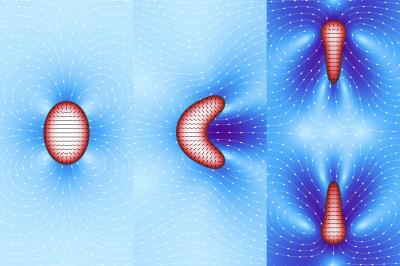
Droplets of filamentous material enclosed in a lipid membrane: these are the models of a "simplified" cell used by the SISSA physicists Luca Giomi and Antonio DeSimone, who simulated the spontaneous emergence of cell motility and division -- that is, features of living material -- in inanimate "objects." The research is one of the cover stories of the April 10th online issue of the journal Physical Review Letters. Giomi and DeSimone's artificial cells are in fact computer models that mimic some of the physical properties of the materials making up the inner content and outer membrane of cells.

The two researchers varied some of the parameters of the materials, recording what happened: "our 'cells' are a 'bare bones' representation of a biological cell, which normally contains microtubules, elongated proteins enclosed in an essentially lipid cell membrane," explains Giomi, first author of the study. "The filaments contained in the 'cytoplasm' of our cells slide over one another exerting a force that we can control."

The force exerted by the filaments is the variable that competes with another force, the surface tension that keeps the membrane surrounding the droplet from collapsing. The generates a flow in the fluid surrounding the droplet, which in turn is propelled by such self-generated flow. When the flow becomes very strong, the droplet deforms to the point of dividing. "When the force of the flow prevails over the force that keeps the membrane together we have cellular division," explains DeSimone, director of the SISSA mathLab, SISSA's mathematical modelling and scientific computing laboratory.

"We showed that by acting on a single physical parameter in a very simple model we can reproduce similar effects to those obtained with experimental observations," continues DeSimone. Empirical observations on microtubule specimens have shown that these also move outside the cell environment, in a manner proportional to the energy they have (derived from ATP, the cell "fuel"). "Similarly, our droplets, fuelled by their 'inner' energy alone -- without forces acting from the outside -- are able to move and even divide."

"Acquiring motility and the ability to divide is a fundamental step for life and, according to our simulations, the laws governing these phenomena could be very simple. Observations like ours can prepare the way for the creation of functioning artificial cells, and not only," comments Giomi. "Our work is also useful for understanding the transition from non-living to living matter on our planet. The development of the early forms of life, in other words."

Chemists and biologists who study the origin of life don't have access to cells that are sufficiently simple to be observed directly. "Even the simplest organism existing today has undergone billions of years of evolution," explains Giomi, "and will always contain fairly complex structures. Starting from schematic organisms as we do is like turning the clock back to when the first rudimentary living beings made their first appearance. We are currently starting studies to understand how cell metabolism emerged."

VIDEO: Artificial cell simulation (courtesy of Physical Review Letters):
http://goo.gl/vLDcbB
Source: Sissa Medialab


ORIGINAL: eScienceNews
April 16, 2014 - 20:28 in Physics & Chemistry

viernes, 28 de marzo de 2014

Is the Oculus Rift sexist?


Just remember to use parallax and everything will be fine. AP Photo/Jeff Chiu

In the fall of 1997, my university built a CAVE (Cave Automatic Virtual Environment) to help scientists, artists, and archeologists embrace 3D immersion to advance the state of those fields. Ecstatic at seeing a real-life instantiation of the Metaverse, the virtual world imagined in Neal Stephenson’s Snow Crash, I donned a set of goggles and jumped inside. And then I promptly vomited.

I never managed to overcome my nausea. I couldn’t last more than a minute in that CAVE and I still can’t watch an IMAX movie. Looking around me, I started to notice something. By and large, my male friends and colleagues had no problem with these systems. My female peers, on the other hand, turned green.

What made this peculiar was that we were all computer graphics programmers. We could all render a 3D scene with ease. But when asked to do basic tasks like jump from Point A to Point B in a Nintendo 64 game, I watched my female friends fall short. What could explain this?

At the time any notion that there might be biological differences underpinning computing systems was deemed heretical. Discussions of gender and computing centered around services like Purple Moon, a software company trying to entice girls into gaming and computing. And yet, what I was seeing gnawed at me.

That’s when a friend of mine stumbled over a footnote in an esoteric army report about simulator sickness in virtual environments. Sure enough, military researchers had noticed that women seemed to get sick at higher rates in simulators than men. While they seemed to be able to eventually adjust to the simulator, they would then get sick again when switching back into reality.

Being an activist and a troublemaker, I walked straight into the office of the head CAVE researcher and declared the CAVE sexist. He turned to me and said: “Prove it.

The gender mystery
Over the next few years, I embarked on one of the strangest cross-disciplinary projects I’ve ever worked on. I ended up in a gender clinic in Utrecht, in the Netherlands, interviewing both male-to-female and female-to-male transsexuals as they began hormone therapy. Many reported experiencing strange visual side effects. Like adolescents going through puberty, they’d reach for doors—only to miss the door knob. But unlike adolescents, the length of their arms wasn’t changing—only their hormonal composition.

Scholars in the gender clinic were doing fascinating research on tasks like spatial rotation skills. They found that people taking androgens (a steroid hormone similar to testosterone) improved at tasks that required them to rotate Tetris-like shapes in their mind to determine if one shape was simply a rotation of another shape. Meanwhile, male-to-female transsexuals saw a decline in performance during their hormone replacement therapy.

Along the way, I also learned that there are more sex hormones on the retina than in anywhere else in the body except for the gonads. Studies on macular degeneration showed that hormone levels mattered for the retina. But why? And why would people undergoing hormonal transitions struggle with basic depth-based tasks?

Two kinds of depth perception
Back in the US, I started running visual psychology experiments. I created artificial situations where different basic depth cues—the kinds of information we pick up that tell us how far away an object is—could be put into conflict. As the work proceeded, I narrowed in on two key depth cues – “motion parallax” and “shape-from-shading.

Motion parallax has to do with the apparent size of an object. If you put a soda can in front of you and then move it closer, it will get bigger in your visual field. Your brain assumes that the can didn’t suddenly grow and concludes that it’s just got closer to you.

Shape-from-shading is a bit trickier. If you stare at a point on an object in front of you and then move your head around, you’ll notice that the shading of that point changes ever so slightly depending on the lighting around you. The funny thing is that your eyes actually flicker constantly, recalculating the tiny differences in shading, and your brain uses that information to judge how far away the object is.

In the real world, both these cues work together to give you a sense of depth. But in virtual reality systems, they’re not treated equally.

The virtual-reality shortcut
When you enter a 3D immersive environment, the computer tries to calculate where your eyes are at in order to show you how the scene should look from that position. Binocular systems calculate slightly different images for your right and left eyes. And really good systems, like good glasses, will assess not just where your eye is, but where your retina is, and make the computation more precise.

It’s super easy—if you determine the focal point and do your linear matrix transformations accurately, which for a computer is a piece of cake—to render motion parallax properly. Shape-from-shading is a different beast. Although techniques for shading 3D models have greatly improved over the last two decades—a computer can now render an object as if it were lit by a complex collection of light sources of all shapes and colors—what they they can’t do is simulate how that tiny, constant flickering of your eyes affects the shading you perceive. As a result, 3D graphics does a terrible job of truly emulating shape-from-shading.

Tricks of the light
In my experiment, I tried to trick people’s brains. I created scenarios in which motion parallax suggested an object was at one distance, and shape-from-shading suggested it was further away or closer. The idea was to see which of these conflicting depth cues the brain would prioritize. (The brain prioritizes between conflicting cues all the time; for example, if you hold out your finger and stare at it through one eye and then the other, it will appear to be in different positions, but if you look at it through both eyes, it will be on the side of your “dominant” eye.)

What I found was startling (pdf). Although there was variability across the board, biological men were significantly more likely to prioritize motion parallax. Biological women relied more heavily on shape-from-shading. In other words, men are more likely to use the cues that 3D virtual reality systems relied on.

This, if broadly true, would explain why I, being a woman, vomited in the CAVE: My brain simply wasn’t picking up on signals the system was trying to send me about where objects were, and this made me disoriented.

My guess is that this has to do with the level of hormones in my system. If that’s true, someone undergoing hormone replacement therapy, like the people in the Utrecht gender clinic, would start to prioritize a different cue as their therapy progressed.

We need more research
However, I never did go back to the clinic to find out. The problem with this type of research is that you’re never really sure of your findings until they can be reproduced. A lot more work is needed to understand what I saw in those experiments. It’s quite possible that I wasn’t accounting for other variables that could explain the differences I was seeing. And there are certainly limitations to doing vision experiments with college-aged students in a field whose foundational studies are based almost exclusively on doing studies solely with college-age males. But what I saw among my friends, what I heard from transsexual individuals, and what I observed in my simple experiment led me to believe that we need to know more about this.

I’m excited to see Facebook invest in Oculus, the maker of the Rift headset. No one is better poised to implement Stephenson’s vision. But if we’re going to see serious investments in building the Metaverse, there are questions to be asked. I’d posit that the problems of nausea and simulator sickness that many people report when using VR headsets go deeper than pixel persistence and latency rates.

What I want to know, and what I hope someone will help me discover, is whether or not biology plays a fundamental role in shaping people’s experience with immersive virtual reality. In other words, are systems like Oculus fundamentally (if inadvertently) sexist in their design?


ORIGINAL: Quartz
By danah boyd
March 28, 2014

danah boyd is a principal researcher at Microsoft Research, a research assistant professor at New York University, and a fellow at Harvard's Berkman Center

domingo, 16 de febrero de 2014

Robots with insect brains

(Credit: Freie Universität Berlin)

German researchers have developed a robot that mimics the simple nervous system used for olfactory learning in the honeybee, using color instead of odors.

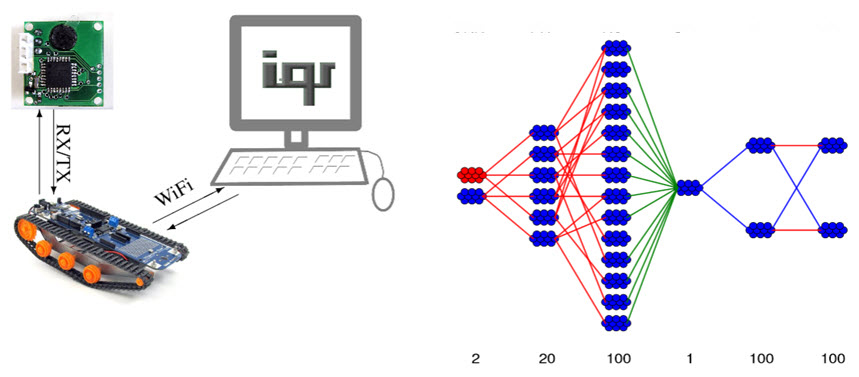
The researchers have installed a camera on a small robotic vehicle connected to a computer. The computer program replicates, in a simplified way, the sensorimotor neural network of the insect brain and operates the motors of the robot wheels to control its motion and direction based on the colors.

The network-controlled robot is able to link certain external stimuli with behavioral rules,” said Professor Martin Paul Nawrot, head of the research team and professor of neuroscience at Freie Universität Berlin. “Much like honeybees learn to associate certain flower colors with tasty nectar, the robot learns to approach certain colored objects and to avoid others.

The learning experiment

The scientists located the network-controlled robot in the center of a small arena with red and blue objects on the walls. Once the robot’s camera focused on an object with the desired color, the scientists triggered a light flash. This signal activated a “reward sensor nerve cell in the spiking neural network. The simultaneous processing of red and the reward caused the robot to move toward the object; blue made it move backwards.

Left: robot hardware. The camera output is processed on the Arduino board and is sent to the open-source iqr spiking neural network simulator software as a 1 or 0, depending on whether or not a colored region was found, and is translated into spike trains.
Right: neural network architecture from sensory input to motor output. Red or blue connections indicate excitatory or inhibitory synapses. Green connections indicate modulatory synapses that are adjusted during reinforcement. Numbers under each group indicate the number of artificial neurons (credit: L. I. Helgadóttir et al.).

“Within seconds, the robot accomplishes the task to find an object in the desired color and to approach it,” explained Nawrot. “Only a single learning trial is needed, similar to experimental observations in honeybees.

The scientists are planning to expand their neural network by adding more learning principles.

Future real-world applications
Our work and the paper focus on basic science,Tim Landgraf, head of the Biorobotics Lab at Freie Universität Berlin, explained to KurzweilAI in an email interview. “We first want to understand how fundamental processes like learning and memory enable the animal (many of our studies use the honeybee as a model) to accomplish complex tasks.

Ultimately, this will improve our understanding of the function of our own human brain. And once we understood how we can employ realistic, brain-like processing structures to solve real-world problems, this will have an impact on how robots or artificial systems in general are being programmed.

Rather than writing millions of lines of code for solving problems, we will lean back and watch adaptive, neural systems learn the structure of their environments. First as virtual brains in a simulation of the world and then, once they have sufficiently matured, in the real world.

As far as we know, we were the first to show that robots can be conditioned in a one-shot learning experiment with spiking neural networks.” However, he admits that the biggest unknown is the neuromorphic (spiking) hardware. “Currently, researchers are using simulations on big computing machines, nothing that would fit on a robot. Neuromorphic chips emulate neuronal activity in small analog circuits. They might be available commercially within the next ten years or so. I can’t say whether they will be powerful enough (number of neurons, synaptic plasticity, etc.) to be applicable in complex real-world scenarios by then.

Funding for the research is provided by the National Bernstein Network Computational Neuroscience in Germany and the German Federal Ministry of Education and Research.


Abstract of 6th International IEEE/EMBS Conference on Neural Engineering (NER) paper
Insects show a rich repertoire of goal-directed and adaptive behaviors that are still beyond the capabilities of today’s artificial systems. Fast progress in our comprehension of the underlying neural computations make the insect a favorable model system for neurally inspired computing paradigms in autonomous robots. Here, we present a robotic platform designed for implementing and testing spiking neural network control architectures. We demonstrate a neuromorphic realtime approach to sensory processing, reward-based associative plasticity and behavioral control. This is inspired by the biological mechanisms underlying rapid associative learning and the formation of distributed memories in the insect.

References:
L. I. Helgadóttir, J. Haenicke, T. Landgraf, R. Rojas, M. P. Nawrot, Conditioned behavior in a robot controlled by a spiking neural network, 6th International IEEE/EMBS Conference on Neural Engineering (NER), 2013, DOI: 10.1109/NER.2013.6696078

Related:
Robots with Insect Brains

ORIGINAL: KurzweilAI

February 14, 2014

lunes, 3 de febrero de 2014

Mass unemployment fears over Google artificial intelligence plans

The development of artificial intelligence - thrown into spotlight this week after Google spent hundreds of millions on new technology - could mean computers take over human jobs at a faster rate than new roles can be created, experts have warned


DeepMind was founded two years ago by 37-year-old neuroscientist and former teenage chess prodigy Demis Hassabis, along with Shane Legg and Mustafa Suleyman Photo: AP

Artificial intelligence could lead to mass unemployment if computers develop the capacity to take over human work, experts warned days after it emerged that Google had beat competitors to buy a firm specialising in this kind of technology.

Dr Stuart Armstrong, from the Future of Humanity Institute at the University of Oxford, gave the stark warning after it emerged that Google had paid £400m for the British artificial intelligence firm DeepMind.

He welcomed the web giant’s decision to set up an ethics board to safely develop and use artificial intelligence claiming the advances in technology carried a number of risks.

Mr Armstrong said computers had the potential to take over people’s jobs at a faster rate than new roles could be created.

He cited logistics, administration and insurance underwriting as professions that were particularly vulnerable to the development of artificial intelligence.

Related Articles
Google snaps up British start-up for £400m 27 Jan 2014
Google buys UK artificial intelligence firm DeepMind 27 Jan 2014
Google wants an Android in every Audi and Honda 06 Jan 2014

He also warned about the implications for uncontrolled mass surveillance if computers were taught to recognise human faces.

Speaking on Radio 4’s Today programme, he said: “There’s a variety of short term risks for artificial intelligence, everyone knows about the autonomous drones.

But there’s also the potential for mass surveillance, you don’t just have to recognise cat images, you could also recognise human faces and also mass unemployment in a variety of professions.”

He added: “We have some studies looking into which jobs are the most vulnerable and there’s quite a lot of them in logistics, administration, insurance underwriting but ultimately a huge swathe of jobs are potentially vulnerable to improved artificial intelligence.

His concerns were backed up by Murray Shanahan, professor of cognitive robotics at Imperial College London, who said: “I think it is a very good thing that Google has set up this ethics board and I think there certainly are some short term issues that we all need to be talking about.

It’s very difficult to predict and that is of course a concern but in the past when we’ve developed new kinds of technologies then often they have created jobs at the same time as taking them over but it certainly is something we ought to be discussing.

DeepMind was founded two years ago by 37-year-old neuroscientist and former teenage chess prodigy Demis Hassabis, along with Shane Legg and Mustafa Suleyman.

The company specialises in algorithms and machine learning for simulation, e-commerce and games.

It is also working in an area called Deep Learning in which machines are taught to see patterns from large quantities of data so computers could start to recognise objects from daily life such as cars or food products and even human faces.

It is believed Google will use DeepMind’s expertise to improve the functions of its current products such as the Google Glass and extend its current artificial intelligence work such as the development of self-driving cars.

Mr Shanahan said: “We all know that Google have got an interest in wearable computing with their Google glass and you can imagine them and other companies using this technology to build some kind of assistant that for example could help you to make a lasagne in your kitchen and to tell you what ingredients you needed and where to find them.

Not necessarily a robot assistant but something wearable such as your Google glass or some other maker might make a similar thing so you can carry it around with you.

ORIGINAL: The Telegraph
By Miranda Prynne, News Reporter
29 Jan 2014

viernes, 24 de enero de 2014

Imagining a world with wind turbines in every neighborhood

When Professor Richard McMahon, a senior lecturer in the University of Cambridge Department of Engineering, closes his eyes, he sees a future powered by the wind. He envisions a day when wind turbines are as common as trees in the courtyards on his campus. He sees small generators built to be aesthetically pleasing as well as energy efficient. While thousands of massive wind turbines now dot the countryside of England, producing renewable energy with impressive results, small wind turbines in more urban settings are costly, noisy, complex systems that aren’t very reliable.

So, Richard, doctoral students from the University of Cambridge and experts from Texas Instruments have teamed up to make small scale wind turbines a viable energy option.

Before they could get started with their research, they had to solve one big problem – creating a system to simulate the wind. Without a wind emulator, the team could not conduct any sort of testing and would be forced to rely on the ups and downs of Mother Nature. So, the team decided to build their own wind emulator to mimic wind speeds and direction.

In order to test systems, we need reproducible conditions. It is very hard to go outside and get reproducible wind conditions. You might be waiting a very long time,” said Richard.

With the wind emulator in place, the team looked at opportunities to optimize how the energy is transferred from the turbine to the generator and then onto the electrical grid. While engineers can control a lot of these factors, the challenge for the team came in the lack of control over wind speed or direction.

How do you get the maximum power from the wind and put it on the grid when the wind can quickly change in different ways?” said Dave Freeman, TI (Texas Instruments) Fellow and chief technologist for TI’s Power Management business.

 
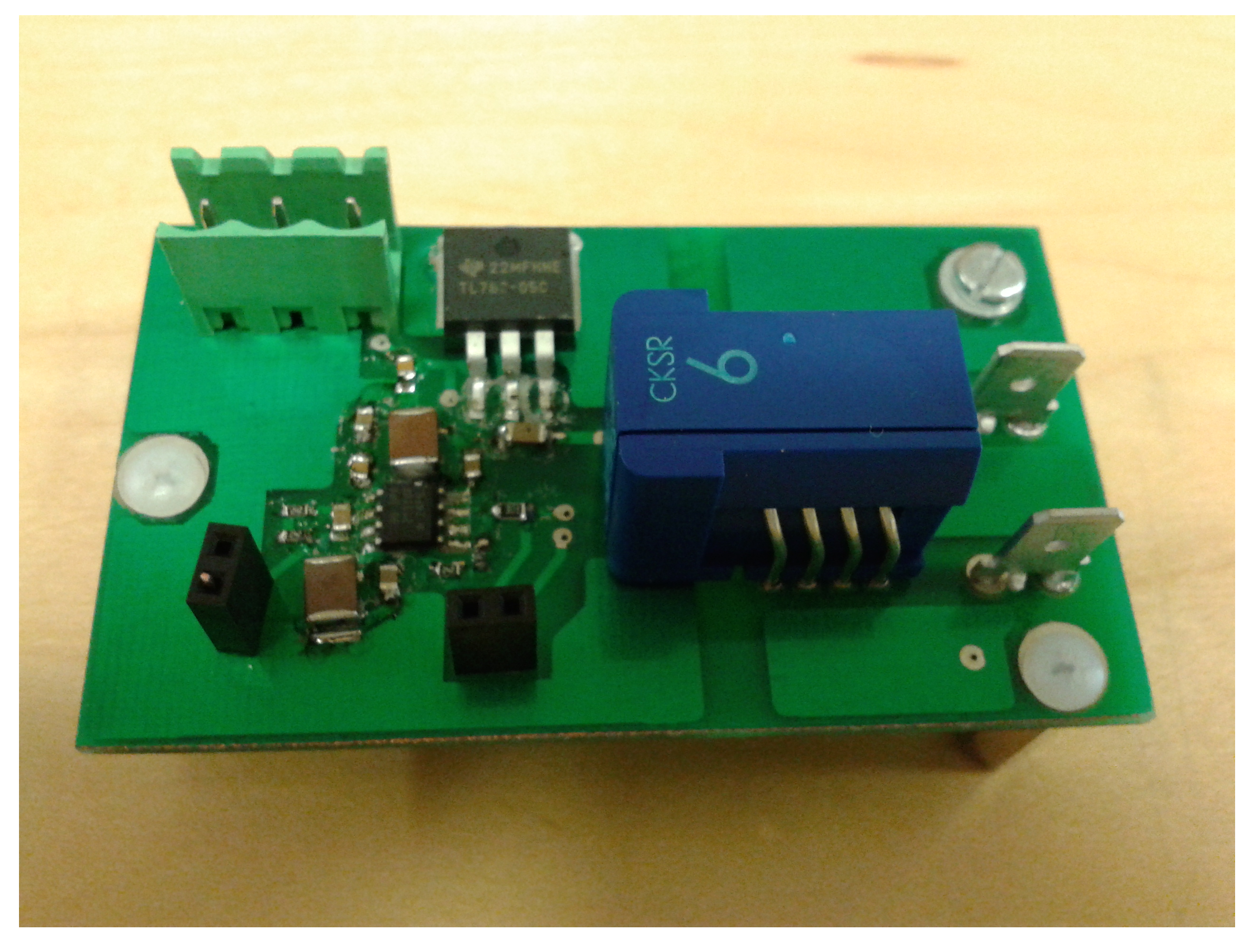
The team narrowed their focus on sensors in the wind turbine, finding many sensors involving turbine and generator speed add unnecessary cost and unreliable mechanics. To resolve this issue, the team has been experimenting with a third-party real time operating system controlling the generator, with the end-goal of putting the system onto a TI microcontroller or digital signal processor.

After more extensive testing with their newly built wind emulator, the team hopes to take their innovation into the real world and possibly make small scale wind turbines a commercially attractive option.

Let’s test it out with the wind emulator, and then, with TI, we can put forward an offering to companies making small wind turbines,” said Richard.

Dave said the collaboration with the University of Cambridge has been a big win for everyone involved. TI provided funding and know-how with the chips and control systems while the University of Cambridge offered wind energy expertise and access to students with bright engineering minds.He said the research could be done in Kilby Labs, but it was a much better use of resources to work with a university that already had experience and expertise in the wind energy field.

Because of the research done by TI and the University of Cambridge, small scale wind turbines may no longer be labeled costly, noisy, complex systems that aren’t very reliable. Soon, Richard might not have to close his eyes to see wind turbines in his neighborhood.

ORIGINAL: TI
Around TI
Jan 23 2014

Older Brains Know More and Use it Better as We Age

As we age, our brains go into a steady decline--at least according to previous research. Now, though, scientists have found that this isn't the case. Instead, the human brain works slower in old age because we have more stored information over time. (Photo : Flickr/DJ)

As we age, our brains go into a steady decline--at least according to previous research. Now, though, scientists have found that this isn't the case. Instead, the human brain works slower in old age because we have more stored information over time. The findings reveal a bit more about the human brain and the impacts of aging.

In order to learn a bit more why age affects the way we think, the researchers trained computers to read a certain amount each day and to learn new things. When the scientists allowed a computer to "read" only so much, its performance on cognitive tests resembled that of a young adult. Yet if the same computer was exposed to the experiences we might encounter over a lifetime, its performance looked like that of an older adult.

Yet the "older" computer wasn't slower because of its processing capacity. Instead, its increased "experience" caused the computer's database to grow and gave it more data to process. Needless to say, this processing took more time.

"Imagine someone who knows two people's birthdays and can recall them almost perfectly," said Michael Ramscar, one of the researchers, in a news release. "Would you really want to say that person has a better memory than a person who knows the birthdays of 2,000 people, but can 'only' match the right person to the right birthday nine times out of ten?"

The findings reveal that studies of the problems that older people have when it comes to recalling names may suffer from an unusual blind spot; there is a far greater variety that older people have to "sort" through, which makes recollection slower.

"Forget about forgetting," said Peter Hendrix, one of the researchers, in a news release. "If I wanted to get the computer to look like an older adult, I had to keep all the words it learned in memory and let them compete for attention."

The findings are published in the journal Topics in Cognitive Science.

ORIGINAL: Science World Report
Catherine Griffin
Jan 20, 2014

lunes, 25 de noviembre de 2013

Gordon Bell Prize Bubbles from Sequoia


Each year at SC, the ACM hands out one of the most coveted awards, the Gordon Bell Prize. The award, which became a regular feature of SC, began in 1987 and now carries a $10,000 prize sponsored by parallel computing luminary, Gordon Bell. Winners demonstrate high peak performance figures on real world applications or demonstrate other performance-geared achievements, including incredible advances in scaling, time to solution of scientific applications or other feats of HPC might.

This year the Gordon Bell award, chosen because of its demonstration of a high performance application went to “11 PFLOP/s Simulations of Cloud Cavitation Collapse,” by Diego Rossinelli, Babak Hejazialhosseini, Panagiotis Hadjidoukas and Petros Koumoutsakos, all of ETH Zurich, Costas Bekas and Alessandro Curioni of IBM Zurich Research Laboratory, and Steffen Schmidt and Nikolaus Adams of Technical University Munich.

The researchers, in collaboration with the Technical University of Munich and LLNL broke some serious computational fluid dynamics ground in their simulation, which maneuvered 6.4 million threads on the IBM Sequoia system. The simulation, according to IBM, stands as the “largest simulation ever in fluid dynamics by employing 13 trillion cells and reaching an unprecedented, for flow simulations, 14.4 petaflop sustained performance on Sequoia—73% of the supercomputer’s theoretical peak.


The bubble bursting exercises are more than just interesting to watch in action. These simulations model complex events related to clouds of collapsing bubbles, which can yield new insight in manufacturing, medicine and beyond as scientists seek to understand how they might “shatter” tumors, kidney stones or even fuel injection fluid interactions.

The researchers described their award-winning effort by pointing to how the “destructive power of cavitation reduces the lifetime of energy critical systems such as internal combustion engines and hydraulic turbines, yet it has been harnessed for water purification and kidney lithotripsy.” They go on to note that they were able to “advance by one order of magnitude the current state-of-the-art in terms of time to solution, and by two orders the geometrical complexity of the flow. The software successfully addresses the challenges that hinder the effective solution of complex flows on contemporary supercomputers, such as limited memory bandwidth, I/O bandwidth and storage capacity.

We were able to accomplish this using an array of pioneering hardware and software features within the IBM BlueGene/Q platform that allowed the fast development of ultra-scalable code which achieves an order of magnitude better performance than previous state-of-the-art,” said Alessandro Curioni, head of mathematical and computational sciences department at IBM Research – Zurich. “While the Top500 list will continue to generate global interest, the applications of these machines and how they are used to tackle some of the world’s most pressing human and business issues more accurately quantifies the evolution of supercomputing.

As IBM noted, These simulations are one to two orders of magnitude faster than any previously reported flow simulation. The last major achievement was earlier this year by a team at Stanford University which broke the one million core barrier, also on Sequoia.

This year the prize committee clarified their description of what it takes to render a winner, including the following criteria:

The prize winner is not selected simply on raw performance numbers. Rather, the Prize Committee seeks:
  • evidence of important algorithmic and/or implementation innovations
  • clear improvement over the previous state-of-the-art
  • solutions that don’t depend on one-of-a-kind architectures (systems that can only be used to address a narrow range of problems, or that can’t be replicated by others)
  • performance measurements that have been characterized in terms of scalability (strong as well as weak scaling), time to solution, efficiency (in using bottleneck resources, such as memory size or bandwidth, communications bandwidth, I/O), and/or peak performance
  • achievements that are generalizable, in the sense that other people can learn and benefit from the innovations
Solving an important scientific or engineering problem is important to demonstrate/justify the work, but scientific outcomes alone are not sufficient for this prize.

ORIGINAL: HPC Wire
Nicole Hemsoth
November 22, 2013

martes, 1 de octubre de 2013

Gamers design swarms of nanoparticles for cancer research [with video]

NanoDoc (http://nanodoc.org) is a new online game to crowdsource the design of nanomedicine. It allows bioengineers and the general public to imagine nanoparticle strategies towards the treatment of cancer and test them on a virtual tumor. The challenge is to design nanoparticles that interact with each other and their environment in a way that leads to better treatment outcomes. The ultimate goal is to design nanoparticles that swarm like self-organized systems in nature. Best strategies will be tested using cancer-on-a-chip devices and large robotic swarms.

HFSP Cross-Disciplinary Fellow Sabine Hauert and colleagues authored on Thu, 26 September 2013

Cancer is the leading cause of death worldwide according to the WHO. To treat cancer, bioengineers are designing nanoparticles that can deliver drugs and therapeutics directly to tumors. Nanoparticles come in different sizes, shapes and materials. They can be loaded with drugs that are released in a controlled fashion, and coated with molecules that allow them to interact with their environment. Some of these molecules can serve as a signature to uniquely identify cancer cells.

As a result, there are many ways to design a nanoparticle. Depending on its design, the nanoparticle will move, sense and act in different ways in the tumor; changing the body of the nanoparticle will change its behavior. The challenge is to understand which nanoparticle designs will improve treatment outcome. This is a difficult problem because trillions of nanoparticles typically interact in a tumor with millions of cells. Predicting and optimizing the emergent behavior of all these nanoparticles is guess work at best.

To address this challenge, the Laboratory of Sangeeta Bhatia at MIT recently released an online game called NanoDoc (http://nanodoc.org) that allows bioengineers and the general public to imagine new nanoparticle strategies towards the treatment of cancer. It uses a realistic simulator developed at the laboratory to model how nanoparticles interact with each other and the tumor environment. The first levels of the game are used to train new NanoDocs; licensed NanoDocs are then given challenges to solve. Since its launch two weeks ago, the game has seen 10,000 visitors, 1750 players and over 40,000 simulations.

Figure: NanoDoc game to crowdsource the design of nanomedicine. The crowd designs nanoparticles and combines them into treatments (left). Treatments are then injected into a virtual tumor scenario designed by bioengineers (right). The goal is to discover ways in which nanoparticles can cooperate.
The longterm goal is to discover ways in which nanoparticles can cooperate, or swarm, like self-organized systems in nature. Select nanotreatments discovered using NanoDoc will be validated using
  1. in vitro tissue-on-a-chip constructs designed to emulate the extravasation of functionalized nanoparticles from artificial vessels into a compartment containing tumor cells and 
  2. robotic swarm systems in collaboration with Radhika Nagpal’s lab from the Wyss Institute at Harvard University.


http://nanodoc.org

Link to article in New Scientist

Link to article in Guardian

sábado, 21 de septiembre de 2013

Lying Around

ORIGINAL: NASA
09.23.08
Heather Archuletta recently participated in a NASA bed rest study. Participants' general health and fitness are evaluated prior to the 90-day test period. Image Credit: Heather Archuletta


Earlier this year Heather Archuletta experienced what it's like to be in space -- well, sort of.

Archuletta lay in bed for nearly two months as part of NASA's bed rest study. The study simulates the effects of long-duration spaceflight by having test subjects lie in beds for 90 days. (Archuletta's study was cut short by Hurricane Ike.) The beds are tilted head-down at a six-degree angle. This tilt causes body fluids to shift to the upper part of the body much like they do in space.
"I don't think I could ever do what a real astronaut does, but I am happy to mimic their journey for the sake of keeping future ones more healthy," Archuletta said.

Through bed rest studies, NASA scientists develop new ways to keep astronauts healthier when they spend a long time in the microgravity of space. NASA calls these methods countermeasures. NASA uses countermeasures to minimize the changes that occur to the body during spaceflight and to enable the return of normal body functions once back on Earth.

The studies are conducted at the University of Texas Medical Branch in Galveston, Texas, as part of the Flight Analog Project at NASA's Johnson Space Center in Houston. The facility opened in 2005, but project manager Joe Neigut said the concept of bed rest studies has been around for a long time.

"What we're trying to do with bed rest is enable researchers to be able to perform science and different areas of research on these subjects," Neigut said. "We're really about countermeasures and trying to use our facility to test countermeasures that may end up in flight."

While in space, astronauts are limited in the amount of time they spend conducting research. So, scientists have to be selective about what new countermeasures are submitted for in-flight testing. Being able to test new ideas on Earth saves invaluable flight time, Neigut said.

So just what exactly goes on while people are lying in bed for a 90-day bed rest study?
During the 90-day bed rest study, participants do everything in bed, from showering to eating to socializing with other participants. Image Credit: NASA

 "They do basically everything in bed, and they're not allowed to get up until the 90 days is over," said Ronita Cromwell, the Flight Analogs Project scientist. "They are allowed to move in bed. We encourage them to use their upper bodies, which mimics the astronauts who rely more on their upper bodies for mobility while in space."
Archuletta said the hardest adjustment for her was not being able to get out of bed and exercise every day. "I always get out of bed and either run, go rollerblading or to the gym," she said. "That's a big change, and I have bottled-up energy in place of all the calories I'm not burning."

Another recent participant, 27-year-old Devin Juel, related the feeling of lying in bed to that of a baby who can't walk. An electrical engineer and machinist from Iowa, Juel said his biggest challenge during the study was depending on someone else and asking for help for nearly everything. 

"At first it felt like my head and upper torso was underwater, like under pressure," Juel said. "But after a few days it went away (and felt) normal."

Related Resources
Johnson Space Center

NASA Education Web Site →


Study participants have access to television, movies, video games, computers and the Internet to help them occupy their time during bed rest studies. Image Credit: NASA
 Neigut said the most common misconception is that a bed rest study is a sleep study. It is not a sleep study, and in fact participants are not allowed to sleep during the day. "If you walk though our unit, you will not see people lying around bored," Neigut said. "They're very busy. Their phones are ringing. They're usually enjoying themselves. Sometimes they'll bring musical instruments. ... After a few days it feels very normal to them."

Participants also interact with each other, have televisions in their rooms, and have access to board games, video games, computers and the Internet. Cromwell said the project encourages people to have a goal, such as learning a language or taking an online course.

During Archuletta's bed rest study, the 38-year-old learned sign language and studied for graduate school. "It's all about putting the free time to good use when you can't move around much," she said.
The San Francisco native said the study gave her a good break from her work routine as an information technology specialist and gave her a chance to catch up on her reading. She initially applied for the study just to see what questions were asked on the application.

"When screeners contacted me, I considered it carefully, due to the risks, but finally felt I couldn’t pass up the opportunity!" Archuletta said. "I've always been fascinated by space exploration, launches, NASA artifacts and so on."

She said it was a privilege to help NASA achieve its space goals to go to the moon and beyond. A mission to Mars, for example, would take at least six months just to reach the planet. Astronauts may then live on the surface for 18 months. "When we land on the Red Planet, we need people healthy enough to walk about! ... I imagine what it would be like to see on the news that a manned trip to Mars was successful, and I will get to say, 'When I was young, I was a small part of helping to make that happen.'"

Astronaut Peggy Whitson has spent a total of 377 days in space and currently holds the U.S. record for the most days in space. Image Credit: NASA
Born in 1969 -- the same year as the first moon landing -- Archuletta said she is in awe of how far spaceflight has come and also where it's headed just in her own lifetime.

"When I was a child, going into space for three days was amazing. This last astronaut who stayed in the space station long-term, Garrett Reisman of STS-124, was there for nearly 96 days, and another will soon be going to the ISS (International Space Station) for six months. Two of my 'heroes' are the first female shuttle commander Eileen Collins and also astronaut Peggy Whitson, who holds the American record for spending more than a year of her life (377 days) in space!

"I think sometimes people forget to pause and ponder how truly incredible that is and the dedication it takes. Humans have made such remarkable efforts in terms of exploration, and maybe sometimes we forget how special it is to even have the capability to leave the planet."

sábado, 14 de septiembre de 2013

A Musical Petri Dish

ORIGINAL: ScienceSunday


Warning: you could spend way too much time on this site.


Seaquence
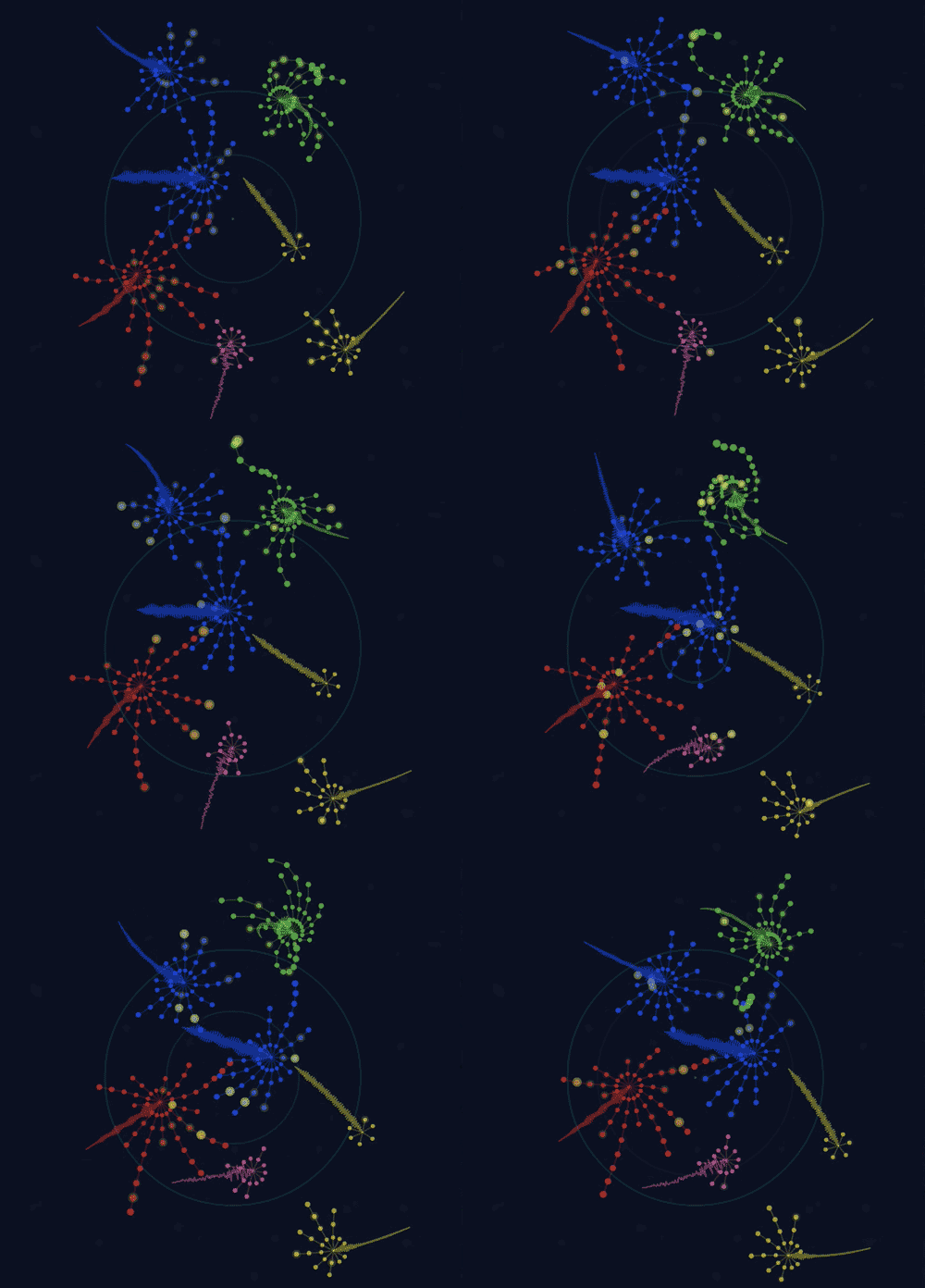
Seaquence is an experiment in musical composition. Adopting a biological metaphor, Seaquence allows you to create and combine musical lifeforms into dynamic compositions.

Go!
How to play The way each creatures looks and sounds is determined by the step-sequencer pattern, and other parameters you can tweak including their audio waveform, octave, scale, melody, envelope, and volume.

You can add multiple creatures to your dish by clicking the 'add' button at the top right of the screen. The combination of different creatures results in unique compositions that always change due to the creatures movement. You can click and drag on the world to move around your composition.

Compositions can be saved by clicking 'share', which can then be sent to others allowing them to hear what you've made. This demo video gives you a feel for how to create your own Seaquence composition:


Notes:
The 12 blocks under the sequencer represent the scale. Play with different combinations to modify the tonality of your melody.
  • The + and - next to the scale represent the octave of the waveform.
  • The waveform control points that modify the envelope can result in some very unique sound qualities.
  • Click+Drag on the number underneath the waveform to change the waveform length.
  • Mouse-wheel up and down on a creature to change its volume.
Seaquence is an original Gray Area Labs project created by Ryan Alexander, Gabriel Dunne, and Daniel Massey, with support from Gray Area Foundation for the Arts.

Give us feedback
Twitter @seaquence
Email ping@seaquence.org

jueves, 1 de agosto de 2013

Modeling the human brain: Are we more than the sum of our parts?

ORIGINAL: Research At Google


How does the human brain work? What is happening when the brain generates cognitions? One way to think of the brain is as a series of connected systems, with brain function emerging from the various “network” connections that exist between neurons. During the last several decades, there has been an explosion of methods one can use to measure and quantify network operations in the human brain, and yet how the brain and its structure uniquely allows an individual to sleep, generate emotions, and create innovative ideas, remains an open area of research with many unanswered questions.

Recently, University of Toronto Psychology Professor Rotman Research Institute (http://goo.gl/UtX6QF) Director Randy McIntosh (http://goo.gl/oW2rnB) spoke at Google about The Virtual Brain (TVB, http://goo.gl/ghluhB),


an international project that uses real neuroimaging data to construct a simulation of the human brain, with the goal of regenerating via simulation the data that is measured when an actual human being is thinking. By doing so, TVB aims to provide a means to merge available neurophysical data with the goal of understanding what it is about the “function-structure confluence” in a brain that forms the basis of cognitive architectures.

Watch a brief synopsis of TVB below as well as the longer talk given at Google at http://goo.gl/DyohPh, which includes a peak at a side project called My Virtual Dream, in which small groups of people interact with TVB through wireless EEG headsets, modifying an immersive audiovisual environment that mimics a dream and augmenting the group experience.

lunes, 11 de marzo de 2013

Scientists to simulate human brain inside a supercomputer

ORIGINAL: CNN
By Barry Neild, CNN 
October 12, 2012 -- Updated 1313 GMT (2113 HKT) | 

Researchers say building a computer simulation could improve understanding and treatments of brain diseases like Alzheimer's. 
STORY HIGHLIGHTS 
  • Human Brain Project will use supercomputers to mimic tangle of neurons and synapses that power our thoughts 
  • Scientists say the simulator could offer new insight into the treatment of brain disease like Parkinson's and Alzheimer's 
  • "Brain in a box" is unlikely to transform into sci-fi-style computer bent on world domination, scientists say 

(CNN) -- There's no escaping the fact that the Human Brain Project, with its billion-dollar plan to recreate the human mind inside a supercomputer, sounds like a science fiction nightmare. 

But those involved hope their ambitious goal of simulating the tangle of neurons and synapses that power our thought processes could offer solutions to tackling conditions such as depression, Parkinson's disease and Alzheimer's. 

The Human Brain venture is the next step in a long-running program that has already succeeded in using computers to create a virtual replica of part of a rat's neocortex -- a section of the brain believed to control higher functions such as conscious thought, movement and reasoning. 

Scientists at its forerunner, the Switzerland-based Blue Brain Project, have been working since 2005 to feed a computer with vast quantities of data and algorithms produced from studying tiny slivers of rodent gray matter. 

"This is a tool for research, not a giant simulated brain that is going to rule the world
Sean Hill, neuroscientist 

Last month they announced a significant advancement when they were able to use their simulator to accurately predict the location of synapses in the neocortex, effectively mapping out the complex electrical brain circuitry through which thoughts travel. 

Henry Markram, the South African-born neuroscientist who heads the project, said the breakthrough would have taken "decades, if not centuries" to chart using a real neocortex. He said it was proof their concept, dubbed "brain in a box" by Nature magazine, would work. 


Now the team are joining forces with other scientists to create the Human Brain Project. As its name suggests, they aim to scale up their model to recreate an entire human brain. 

It is a step that will need both a huge increase in funding and access to computers so advanced that they have yet to be built. 

If their current bid for €1 billion ($1.3 billion) of European Commission funding over the next 10 years is successful, Markram predicts that his computer neuroscientists are a decade away from producing a synthetic mind that could, in theory, talk and interact in the same way humans do. 

His bold claims have inevitably fueled comparisons to doom-laden popular fiction in which conscious machines turn on their creators and wreak havoc. 

The project's scientists have been referred to as "team Frankenstein" and their computer likened to "Skynet," the virtual intelligence that unleashes a robot war on humanity in the "Terminator" films. 

Sean Hill, a senior computational neuroscientist on the project, laughs at such comparisons. 

He says the computer will primarily become a repository for knowledge about the brain that will allow scientists to conduct experiments without the need to probe inside people's skulls


"This is a tool for research, not a giant simulated brain that is going to rule the world," he said. 

"Right now, we're in a crisis in neuroscience. There's a lot of wonderful data being gathered but we don't have a place where we can put those experimental results together and understand their implications. 

"We are just beginning to appreciate how complex our brains are, far beyond any other device in the known universe
Terry Sejnowski, Salk Institute for Biological Studies 

"The benefit of having this facility is you have a place to integrate the data into a model where you can test predictions and start to learn principles of how the brain operates.

The computing power needed to build the model is phenomenal. Simply to replicate one of the 10,000 neuron brain cells involved in the rat experiment took the processing capacity usually found in a single laptop. To simulate a fully functioning human brain, it would take billions. 

Hill says that such computational power -- known as exascale -- will be available by the end of the decade. The Human Brain Project's scientists are hoping to work with supercomputer developers to ensure future machines match their requirements. 

But, even as the team touts its experiments as a possible solution to the brain diseases that affect about two billion people worldwide, they have attracted critics who say their work is far too broad in scope to achieve usable results. 

Professor Terry Sejnowski, head of the Computational Neurobiology Laboratory at the Salk Institute for Biological Studies in San Diego, has been quoted as saying the Blue Brain project is "bound to fail." 


He told CNN via email that "progress is being made but there is still a long way to go before we will understand the computational capabilities of cortical circuits." 

He added: "We are just beginning to appreciate how complex our brains are, far beyond any other device in the known universe." 

Sean Hill said the team hoped it was answering skeptics with its achievements so far. 

"It's just a matter of keeping on doing it. Let's keep improving these tools and open them up so that many scientists are engaged and collaborating and using it as common point to bring the data together," he said. 

"The only way to address the critics is to keep working, showing the positive results and do the best we can -- and that is starting to happen."