Mostrando entradas con la etiqueta Sensores. Mostrar todas las entradas

miércoles, 19 de noviembre de 2014

A Worm's Mind In A Lego Body

Take the connectome of a worm and transplant it as software in a Lego Mindstorms EV3 robot - what happens next?

It is a deep and long standing philosophical question. Are we just the sum of our neural networks. Of course, if you work in AI you take the answer mostly for granted, but until someone builds a human brain and switches it on we really don't have a concrete example of the principle in action. 

KDS444, modified by Nnemo

The nematode worm Caenorhabditis elegans (C. elegans) is tiny and only has 302 neurons. These have been completely mapped and the OpenWorm project is working to build a complete simulation of the worm in software. One of the founders of the OpenWorm project, Timothy Busbice, has taken the connectome and implemented an object oriented neuron program.

The model is accurate in its connections and makes use of UDP packets to fire neurons. If two neurons have three synaptic connections then when the first neuron fires a UDP packet is sent to the second neuron with the payload "3". The neurons are addressed by IP and port number. The system uses an integrate and fire algorithm. Each neuron sums the weights and fires if it exceeds a threshold. The accumulator is zeroed if no message arrives in a 200ms window or if the neuron fires. This is similar to what happens in the real neural network, but not exact.

The software works with sensors and effectors provided by a simple LEGO robot. The sensors are sampled every 100ms. For example, the sonar sensor on the robot is wired as the worm's nose. If anything comes within 20cm of the "nose" then UDP packets are sent to the sensory neurons in the network.

The same idea is applied to the 95 motor neurons but these are mapped from the two rows of muscles on the left and right to the left and right motors on the robot. The motor signals are accumulated and applied to control the speed of each motor. The motor neurons can be excitatory or inhibitory and positive and negative weights are used. 


And the result?
It is claimed that the robot behaved in ways that are similar to observed C. elegans. Stimulation of the nose stopped forward motion. Touching the anterior and posterior touch sensors made the robot move forward and back accordingly. Stimulating the food sensor made the robot move forward.

Watch the video to see it in action. 


The key point is that there was no programming or learning involved to create the behaviors. The connectome of the worm was mapped and implemented as a software system and the behaviors emerge.

The conectome may only consist of 302 neurons but it is self-stimulating and it is difficult to understand how it works - but it does.


Currently the connectome model is being transferred to a Raspberry Pi and a self-contained Pi robot is being constructed. It is suggested that it might have practical application as some sort of mobile sensor - exploring its environment and reporting back results. Given its limited range of behaviors, it seems unlikely to be of practical value, but given more neurons this might change. 


  • Is the robot a C. elegans in a different body or is it something quite new? 
  • Is it alive?

These are questions for philosophers, but it does suggest that the ghost in the machine is just the machine.


For us AI researchers, we still need to know if the principle of implementing a connectome scales. 

More Information


Related Articles

To be informed about new articles on I Programmer, install the I Programmer Toolbar, subscribe to the RSS feed, follow us on, Twitter, Facebook, Google+ or Linkedin, or sign up for our weekly newsletter.


ORIGINAL: i-Programmer
Written by Lucy Black 
16 November 2014

viernes, 15 de agosto de 2014

IBM Chip Processes Data Similar to the Way Your Brain Does

A chip that uses a million digital neurons and 256 million synapses may signal the beginning of a new era of more intelligent computers.

WHY IT MATTERS
Computers that can comprehend messy data such as images could revolutionize what technology can do for us.

New thinking: IBM has built a processor designed using principles at work in your brain.

A new kind of computer chip, unveiled by IBM today, takes design cues from the wrinkled outer layer of the human brain. Though it is no match for a conventional microprocessor at crunching numbers, the chip consumes significantly less power, and is vastly better suited to processing images, sound, and other sensory data.

IBM’s SyNapse chip, as it is called, processes information using a network of just over one million “neurons,” which communicate with one another using electrical spikes—as actual neurons do. The chip uses the same basic components as today’s commercial chips—silicon transistors. But its transistors are configured to mimic the behavior of both neurons and the connections—synapses—between them.

The SyNapse chip breaks with a design known as the Von Neuman architecture that has underpinned computer chips for decades. Although researchers have been experimenting with chips modeled on brains—known as neuromorphic chips—since the late 1980s, until now all have been many times less complex, and not powerful enough to be practical (see “Thinking in Silicon”). Details of the chip were published today in the journal Science.

The new chip is not yet a product, but it is powerful enough to work on real-world problems. In a demonstration at IBM’s Almaden research center, MIT Technology Review saw one recognize cars, people, and bicycles in video of a road intersection. A nearby laptop that had been programed to do the same task processed the footage 100 times slower than real time, and it consumed 100,000 times as much power as the IBM chip. IBM researchers are now experimenting with connecting multiple SyNapse chips together, and they hope to build a supercomputer using thousands.

When data is fed into a SyNapse chip it causes a stream of spikes, and its neurons react with a storm of further spikes. The just over one million neurons on the chip are organized into 4,096 identical blocks of 250, an arrangement inspired by the structure of mammalian brains, which appear to be built out of repeating circuits of 100 to 250 neurons, says Dharmendra Modha, chief scientist for brain-inspired computing at IBM. Programming the chip involves choosing which neurons are connected, and how strongly they influence one another. To recognize cars in video, for example, a programmer would work out the necessary settings on a simulated version of the chip, which would then be transferred over to the real thing.

In recent years, major breakthroughs in image analysis and speech recognition have come from using large, simulated neural networks to work on data (see “Deep Learning”). But those networks require giant clusters of conventional computers. As an example, Google’s famous neural network capable of recognizing cat and human faces required 1,000 computers with 16 processors apiece (see “Self-Taught Software”).

Although the new SyNapse chip has more transistors than most desktop processors, or any chip IBM has ever made, with over five billion, it consumes strikingly little power. When running the traffic video recognition demo, it consumed just 63 milliwatts of power. Server chips with similar numbers of transistors consume tens of watts of power—around 10,000 times more.

The efficiency of conventional computers is limited because they store data and program instructions in a block of memory that’s separate from the processor that carries out instructions. As the processor works through its instructions in a linear sequence, it has to constantly shuttle information back and forth from the memory store—a bottleneck that slows things down and wastes energy.

IBM’s new chip doesn’t have separate memory and processing blocks, because its neurons and synapses intertwine the two functions. And it doesn’t work on data in a linear sequence of operations; individual neurons simply fire when the spikes they receive from other neurons cause them to.

Horst Simon, the deputy director of Lawrence Berkeley National Lab and an expert in supercomputing, says that until now the industry has focused on tinkering with the Von Neuman approach rather than replacing it, for example by using multiple processors in parallel, or using graphics processors to speed up certain types of calculations. The new chip “may be a historic development,” he says. “The very low power consumption and scalability of this architecture are really unique.”

One downside is that IBM’s chip requires an entirely new approach to programming. Although the company announced a suite of tools geared toward writing code for its forthcoming chip last year (see “IBM Scientists Show Blueprints for Brainlike Computing”), even the best programmers find learning to work with the chip bruising, says Modha: “It’s almost always a frustrating experience.” His team is working to create a library of ready-made blocks of code to make the process easier.

Asking the industry to adopt an entirely new kind of chip and way of coding may seem audacious. But IBM may find a receptive audience because it is becoming clear that current computers won’t be able to deliver much more in the way of performance gains. “This chip is coming at the right time,” says Simon.

ORIGINAL: Tech Review
August 7, 2014

viernes, 8 de agosto de 2014

IBM's Brain-Inspired Computer Chip Comes from the Future

Illustration: IBM

Brain-inspired computers have tickled the public imagination ever since Arnold Schwarzenegger's character in “Terminator 2: Judgment Day” uttered: “My CPU is a neural net processor; a learning computer.” Today, IBM researchers backed by U.S. military funding unveiled a new computer chip that they say could revolutionize everything from smartphones to smart cars—and perhaps pave the way for neural networks to someday approach the computing capabilities of the human brain.

The IBM neurosynaptic computer chip consists of one million programmable neurons and 256 million programmable synapses conveying signals between the digital neurons. Each of chip’s 4,096 neurosynaptic cores includes the entire computing package—memory, computation, and communication. They all operate in parallel based on “event-driven” computing, similar to the signal spikes and cascades of activity when human brain cells work in concert. Such architecture helps to bypass the bottleneck in traditional computing where program instructions and operation data cannot pass through the same route simultaneously.

“We have not built a brain,” says Dharmendra Modha, chief scientist and founder of IBM’s Cognitive Computing group at IBM Research-Almaden. “But we have come the closest to creating learning function and capturing it in silicon in a scalable way to provide new computing capability that was not possible before.”

Such capability could enable new mobile device applications that emulate the human brain’s capability to swiftly process information about new events or other changes in real-world environments, whether that involves recognizing familiar sounds or a certain face in a moving crowd. IBM envisions its new chips working together with traditional computing devices as hybrid machines—providing an added dose of brain-like intelligence for smart car sensors, cloud computing applications or mobile devices such as smartphones. The chip's architecture was detailed in a new paper published in the 7 August online issue of the journal Science.

Add caption
With a total of 5.4 billion transistors the computer chip, named TrueNorth, is one of the largest CMOS chips ever built. Yet the chip uses just 70 milliwatts while running and has a power density of 20 milliwatts per square centimeter— almost 1/10,000th the power of most modern microprocessors. That brings the new chip's efficiency much closer to the human brain’s astounding power consumption of just 20 watts, or less than the average incandescent light bulb.

“This is literally a supercomputer the size of a postage stamp, light like a feather, and low power like a hearing aid,” Modha says.

One reason IBM was able to minimize power usage is that its chip's computation only triggers when needed. Traditional computer chips have a clock that uses power to trigger and coordinate all the computational processes. But the IBM chip's digital neurons can work together asynchronously when triggered by the signal spikes. IBM also designed its chip to have low power consumption by creating an on-chip network to interconnect all the neurosynaptic cores and building the chip with a low-power process technology used for making mobile devices.

It’s also a supercomputer that can easily scale up in size. IBM designed its computer chip architecture so that it could simply add new neurosynatpic cores within the chip. The chips themselves can be arranged in a repeatable 2-D tile pattern to create bigger machines—IBM has already tested that idea with a 16-chip configuration. That’s the “blueprint of a scalable supercomputer,” Modha says.

Past brain-inspired neural networks have used a combination of both analog and digital to represent the individual neurons. IBM chose to represent the neurons in digital form, which provided several advantages. (At least one other project, SpiNNaker also depends on digital.)

First, the choice allowed IBM engineers to avoid the physical problems of dealing with differences in the manufacturing process or temperature fluctuations. Second, it provided a “one to one equivalence with software and hardware” that allowed the IBM software team to build applications on a simulator even before the physical chip had been designed and tested—applications that ran without problems on the finished chip. Third, the lack of analog circuitry allowed the IBM team to dramatically shrink the size of its circuits. (IBM fabricated its chip using Samsung’s 28-nm process technology—typical for manufacturing chips for mobile devices.)


IBM’s new chip represents the culmination of a decade of Modha’s personal research and almost six years of funding from the U.S. Defense Advanced Research Projects Agency (DARPA). Modha currently heads DARPA’s SyNAPSE project, a global effort that has committed US $53 million to making learning computers since 2008.

Now IBM has built an entire ecosystem around its new chip hardware and software, including a new programming language and a curriculum to teach coders everything they need to know. And the company is reaching out to potential customers, universities, government agencies, and IBM employees to fully explore the commercial applications of its chip technology.

“Our long-term end goal is to build a ‘brain in a box’ with 100 billion synapses consuming 1 kilowatt of power,” Modha says. “In the near future, we’ll be looking at multiple things for empowering smartphones, mobile devices and cloud services with this technology.”


ORIGINAL: IEEE Spectrum
By Jeremy Hsu
Posted 7 Aug 2014 | 18:00 GMT

martes, 18 de marzo de 2014

How Smart Dust Could Spy On Your Brain

Intelligent dust particles embedded in the brain could form an entirely new form of brain-machine interface, say engineers
The real time monitoring of brain function has advanced in leaps and bounds in recent years. That’s largely thanks to various new technologies that can monitor the collective behaviour of groups of neurons, such as functional magnetic resonance imaging, magnetoencephalopathy and positron emission tomography.

This work is revolutionising our understanding of the way the brain is structured and behaves. It has also lead to a new engineering discipline of brain-machine interfaces, which allows people to control machines by thought alone.

Impressive though these techniques are, they all suffer from inherent limitations such as limited spatial resolution, a lack of portability and extreme invasiveness.

Today, Dongjin Seo and pals at the University of California Berkeley reveal an entirely new way to study and interact with the brain. Their idea is to sprinkle electronic sensors the size of dust particles into the cortex and to interrogate them remotely using ultrasound. The ultrasound also powers this so-called neural dust.

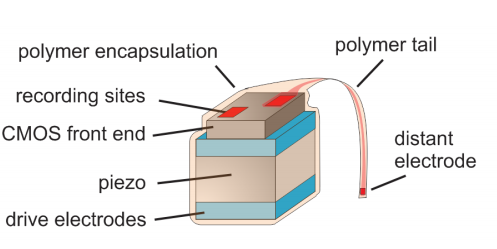
Each particle of neural dust consists of standard CMOS circuits and sensors that measure the electrical activity in neurons nearby. This is coupled to a piezoelectric material that converts ultra-high-frequency sound waves into electrical signals and vice versa.

The neural dust is interrogated by another component placed beneath the scale but powered from outside the body. This generates the ultrasound that powers the neural dust and sensors that listen out for their response, rather like an RFID system.

The system is also tetherless–the data is collected and stored outside the body for later analysis.

That gets around many of the limitations. The system
  • is lower power, 
  • can have a high spatial resolution, and 
  • it is easily portable. 
  • It is also rugged and 
  • can potentially provides a link over long periods of time. 
“A major hurdle in brain-machine interfaces (BMI) is the lack of an implantable neural interface system that remains viable for a lifetime,” say Seo and co.

The difficulty is in designing and building such a system and today’s paper is a theoretical study of these challenges. First is the problem of designing and building neural dust particles on a scale of roughly 100 micrometres that can send and receive signals in the harsh, warm and noisy environment within the body.

That’s why Seo and co have chosen ultrasound to send and receive data. They calculate that the power required to use electromagnetic waves on the scale would generate a damaging amount of heat because of the amount of energy the body absorbs and the troubling signal-to-noise ratios at this scale.

By contrast, ultrasound is a much more efficient and should allow the transmission of at least 10 million times more power than electromagnetic waves at the same scale.

Next is the problem of linking the electronics to the piezoelectric system that converts ultrasound to electronic signals and vice versa. Ensuring that the system works efficiently will be tricky given that it has to be packaged in an inert polymer or insulator film (which must also expose the recording electrodes to nearby neurons).

Finally, there is the challenge of designing and building the interrogation system that generates the ultrasound to power the entire array but at a low enough power to avoid heating skull and the brain.

On top of all this is the additional challenge of implanting the neural dust particles in the cortex. Seo and co say this can probably be done by fabricating the dust particles on the tips of a fine wire array, held in place by surface tension, for example. This array would be dipped into the cortex where the dust particles become embedded.

That’s an ambitious vision that is littered with challenges beyond the state-of-the-art. However, the team has a strong background in nanoelectromechanical systems and in the interface between electronic systems and cells.

Indeed, one of the authors, Michel Maharbiz, developed the world’s first remotely controlled beetle a few years ago, a development that was named one of the top 10 emerging technologies of 2009 by Technology Review.

These guys are clearly not afraid to take on big challenges. It’ll be interesting to see how they fare.

Ref: arxiv.org/abs/1307.2196: Neural Dust: An Ultrasonic, Low Power Solution for Chronic Brain-Machine Interfaces


ORIGINAL: Technology Review
July 16, 2013

domingo, 23 de febrero de 2014

Revolution in Artificial Limbs Brings Feeling Back to Amputees

A new generation of prosthetic devices allows patients to control them with their thoughts.


Dennis Aabo Sørensen tests a prosthetic arm with sensory feedback in a laboratory in Rome in March 2013. PHOTOGRAPH BY PATRIZIA TOCCI, LIFEHAND 2

Something is missing. Every amputee knows it, and it is more than the arm or leg they have lost. They can get replacements for those limbs: substitutes made from metal and plastic, controlled by advanced computer chips, with the ability to grip, to turn, to step. On the outside the limbs can appear lifelike, and on the inside they are amazing machines.

But they are tools, not part of the patients themselves. They have no sensitivity, and no instant response to a patient's intentions.

Because of that lack of feeling and control, says Dennis Aabo Sørensen, a 36-year-old from Denmark who lost his left hand in a fireworks explosion nearly a decade ago, he could tell what he was touching with his prosthetic hand only by looking at it.

Now, for Sørensen and other amputees, all that is changing. Earlier this month, scientists announced they had wired pressure sensors in the fingers of an artificial hand to sensory nerves in Sørensen's upper arm. He grabbed a block, and his nerves tingled. "I could feel round things and soft things and hard things," he says. "It's so amazing to feel something that you haven't been able to feel for so many years." (See "Boston Bombing Amputees Face Lengthy Recovery.")

This is more than a psychological boost; experiments show that sensory feedback vastly improves a patient's ability to control a prosthetic, even to the point of picking stems off of fruit.


PHOTOGRAPH BY BRAIN KERSEY, AP Zac Vawter, shown here at the Willis Tower in Chicago in October 2012, was the first person to climb 103 flights of stairs wearing a prosthesis controlled with his mind.

Giant Steps

Sørensen's case is just one of several efforts under way to endow artificial limbs with real feeling. Researchers at Case Western Reserve University in Cleveland, Ohio, have also restored sensation through an artificial hand, transmitting differences not just of pressure but of texture, too.


At the Rehabilitation Institute of Chicago, scientists last fall breached one of the biggest barriers in prosthetics, creating a thought-controlled leg that can climb stairs and go from sitting to standing in response to signals from nerves in a patient's stump. Researchers have also developed something called pattern recognition, in which the prosthetics can "learn" to interpret nerve signals from patients in real time, responding directly to intentions.


"We can get people to view the limb as if it actually belongs to them," says Paul Marasco, a neuroscientist at the Cleveland Clinic's Lerner Research Institute, who works on sensation and prosthetics. "We're getting a critical mass of research, not just results here and there, so I think this is really going to happen in five to ten years."

The work is still experimental, the scientists hasten to emphasize, and other advances need to occur before these prosthetics are ready for daily use. For one thing, the connections need to become wireless instead of wired, because nobody is going home with wires sticking through their skin. "But when this becomes perfected, it will be huge," says Robert Lipschutz, a prosthetist at the Rehabilitation Institute of Chicago.

PHOTOGRAPH BY BRIAN KERSEY, AP Zac Vawter practices walking with his experimental "bionic" leg at the Rehabilitation Institute of Chicago in October 2012.

Sensation's Gauntlet

Sørensen already had an artificial hand that opened and closed in response to muscle contractions in his stump. To add sensory feedback, Silvestro Micera and colleagues at the Scuola Superiore Sant'Anna in Italy and the École Polytechnique Fédérale de Lausanne in Switzerland added sensors to mechanical tendons in the prosthetic's fingers. The sensors generated electrical signals as the tendons pushed on an object. Those signals were fed to a computer that relayed them through wires that went into Sørensen's skin. The wires led to electrodes on the sensory nerves in his stump that formerly ended in his hand.

For a month, Sørensen went through a gauntlet of tasks designed to simulate the challenges of daily living—reaching, turning, squeezing, pinching—things that two-handed people do without much thought, but Sorensen hadn't done in nine years. In response, he felt different tingling sensations, depending on the amount of pressure he needed to apply to hold the object. In this way, he gradually came to associate the tingles with different qualities, such as hardness, softness, and roundness.


At the same time that Micera and his colleagues were working with Sørensen, Dustin Tyler, of Case Western Reserve and the Cleveland VA Medical Center, and his team were developing a similar system. At a scientific meeting in November 2013, Tyler reported success in two patients. And not for a month, but for a year.


"The longevity proves this system is really stable," he says. "And we've placed electrodes at eight different places on the patients' nerves. One patient can feel sensation from eight distinct places on the hand: the thumb, some fingers, the back of the hand, and the palm. We can adjust the size of these spots by adjusting the signal. So we pretty much have restoration over the entire hand."

Receiving sensory feedback from an object is a game-changer in the patient's relationship to the world. Without such touch, for example, amputees have to watch their prosthetic hands to see if they are gripping a paper cup too hard—often too late to prevent a spill. Some can gain modest control by listening to the sound of the motors in the prosthetic, which changes as they encounter resistance.

But with direct sensory feedback, Tyler found, "our patients can twist stems off of cherries. That was really something to see. If we turned off the touch, they would grasp too hard and crush the fruit. Or they would grip too softly and the stems would slip through their fingers."


Tyler's group is currently working on altering the electrical signals generated by the finger sensors to allow patients to experience different textures, like rough and smooth, in addition to pressure. "We think we can get a whole suite of sensation," Tyler says. "The brain wants that. It's looking for it."


Eventually, he thinks the system will be fully implanted under the skin and will communicate with the artificial limb wirelessly, like a Bluetooth headset for your cell phone.

Thought Amplifiers

To further enhance the sense of a prosthetic as an organic part of its wearer, doctors and engineers at the Rehabilitation Institute of Chicago have developed artificial limbs that respond seamlessly to the patient's own thoughts.


Computer chips inside the prosthetic are connected to sensors that pick up motor signals from nerves in a patient's stump that formerly commanded a hand to open, for instance, or a wrist to twist. No wires penetrate the skin. Using a method called targeted muscle reinnervation, the nerves have first been rerouted by a surgeon into large muscles at the end of the stump. Muscles are electrically active: They act as amplifiers for the nerve signals, strengthening them enough for the prosthetic sensors to pick them up and send them on to motors that move the hand. 

Until recently, these signals have been interpreted one at a time—turn wrist, then open hand—resulting in motions lacking the fluid, connected motion of a real arm. Now, more refined computer algorithms in the chips recognize patterns, linking one movement to the next. The results are smoother and require less conscious planning; a patient merely has to think, and the limb moves.


PHOTOGRAPH BY MARK THIESSEN, NATIONAL GEOGRAPHIC
Amanda Kitts' arm is inked with target points where wires will be attached; the wires will detect her nerve signals and map them to a computer so she can control the prosthetic with her brain..

Amanda Kitts, an arm amputee who lives in Florida (and who was featured in a January 2010 National Geographic cover story on bionics), simply slips on her arm in the morning. "I do a wrist flexion, a rotation, a few other things, and I'm good to go," she says. "I used to have to think much more about what I am doing."

This technology has now been extended to one of the thorniest problems in prosthetics: getting a leg to stand up. The position of the knee and ankle when a person is sitting, and the loads the joints bear, is radically different from the position and load when walking. Artificial leg makers have resorted to putting a manual switch onto their prosthetics that users have to hit to shift between sitting and upright positions—a long way from motion controlled by thought.

Last fall, however, Levi Hargrove, director of neural engineering at the Rehabilitation Institute of Chicago, gave amputees a thinking leg to stand on —and even climb stairs. Robotic sensors detect speed changes, orientation, and weight and feed the information to onboard computer chips, helping the leg respond to differences in terrain. To avoid the awkward mechanical switch and allow the limb to respond instead to the user's intent, motor nerves formerly controlling ankle movements have been rerouted into thigh muscles, taking advantage of the fact that thigh muscles fire during normal walking when ankle muscles move.

"We're able to make use of those patterns, so the thigh muscle signals predict what the ankle muscle will do," Hargrove says. Tension at the thigh, for instance, sends a signal for the knee to straighten and the ankle to move the foot perpendicular to the leg: in other words, to stand up. Pattern recognition software smooths the motions so the patient doesn't fall down. A different degree of tension in the thigh flexes the leg to step up a stair.

Prosthetics are taking a huge step forward. This time, with feeling.

ORIGINAL: NatGeo
Josh Fischmann for National Geographic
February 22, 2014

viernes, 21 de febrero de 2014

The Challenge at Hand

Brawny robots are nice; brainy ones would be better. Stanford engineers are on the case.


Images by Morgan Rockhill

Consider for a moment the complexities involved in buying a cup of coffee. It's the type of errand most people do on autopilot. But for a robot—or, at least, for the engineer designing one—it presents a multitude of hardware and software challenges.
  • First the robot must visually identify the door. 
  • Then locate the handle and grasp it. 
  • Next pull the door open and maneuver through it. 
  • Then navigate a path to the cafe, scanning for obstacles along the way (particularly humans) and avoiding collisions. 
  • Finally, the bot must give its beverage order to a barista who has no experience or training with its ilk.
The deceptively simple task requires coordination of multiple sensory, navigation, motion and communication systems. And there are countless ways it can go utterly wrong. Which means not only does the machine have to know how to perform all the steps correctly, it has to detect when it has failed.

Last spring, researchers working in Ken Salisbury's lab at Stanford sent a stocky, wheeled robot known as the PR2 on such a coffee run. The PR2's success in fetching a cup of joe from the Peet's on the third floor of the Clark Center was a demonstration of more than a decade of work involving at least a dozen collaborators on and off campus. Salisbury, '74, MS '78, PhD '82, a professor of computer science and of surgery, started the University's personal robotics program. He initiated development of the PR1 prototype with Keenan Wyrobek, MS '05, and Eric Berger, '04, MS '05, who went on to continue the work at Willow Garage.

With 
  • a telescoping spine, 
  • articulated arms with swappable attachments, 
  • omnidirectional rolling base and 
  • sensors from head to toe, 
the PR2 is pretty advanced. Still, it's hardly the shiny metal sidekick science fiction has conditioned us to expect. (Think: less ILM, more MST3K.) What those creators of futuristic fantasies didn't quite appreciate—and any roboticist will tell you—is that getting a machine to perform even the most rudimentary of skills involves years, sometimes decades, of false starts and setbacks. The highest of high-tech bots are only now mastering 
  • how to move through the world without bumping into things, 
  • manipulate or retrieve objects and 
  • work near humans without endangering them.

The level of difficulty only underscores the elegance of biology's solutions to the same problems. "We have a lot of things to learn from nature about how to make structures that are compliant, inherently stable and relatively easy to control, so they can deal with what the real world throws at them," says Mark Cutkosky, a professor in the mechanical engineering design group.

Take locomotion, for example. Getting around on wheels, as the PR2 does, is fine so long as the ground is fairly smooth and even. Walking—either upright or on all fours—is more versatile, and there are research groups perfecting bi- and quadrupedal robots that can clamber over tricky terrain.
But why remain earthbound at all when you could fly?

Assistant professor David Lentink is a bit unusual in his field. As both a biologist and an engineer, he is interested in applying insights gained from observing avian flight to building more efficient flying robots. In his lab, trained hummingbirds and parrotlets flit from point A to point B as members of Lentink's team film them with a high-speed camera at up to 3,000 frames per second. Additionally, they use a pair of lasers that emit 10,000 flashes per second to image how air moves around the birds' wings.

"They move their wings really fast," explains Lentink. "To see how they manipulate the air we need to have many recordings within a single wingbeat. With this system we can easily make 50 recordings within one wingbeat." Thus far, their observations have inspired a prototype, morphing wing that will mimic the overlapping feathers of bird wings, which can change shape during flight. Currently, they are testing the dynamics of how it will fold in the air.

Next, Lentink plans to investigate how birds use their eyes to navigate in order to improve visual guidance systems for robots. By studying optical flow, or the way images move across the retina, his team is hoping to determine how different image intensities aid birds in deciding which direction to go. "It's fundamental research," he says, "but it's essential if we want to fly robots like birds can"—in turbulent conditions, for example, or through narrow gaps.

Landing is also a challenge. "Small, unmanned flying vehicles have become increasingly popular for applications such as surveillance or environmental monitoring," notes Cutkosky. "But they don't interact physically with the world. They're all about flying and not bumping into anything." Keeping the machines aloft is also a huge power suck. "If instead you have these things that can perch like a bird or bat or insect and land on walls or ceilings, then you can shut down the propeller and they can hang out there for days gathering info."

The trick is getting them to alight securely, while still being able to detach easily. Cutkosky's team looked to the gecko for a biological template. The properties of the lizard's grip have long been targeted for replication in the lab. In 2010, Cutkosky used a scanning electron microscope to visualize how nanoscale structures on the gecko's toes deform so they can reversibly adhere to virtually any surface.

His team was able to create a synthetic material with similar properties, albeit on a larger scale. Since then, Cutkosky has attached that adhesive material to a flying robot, which can now perch on the sides of buildings or even upside down. The UAV isn't "sticky" until it lands, because the momentum is what creates the suction. When it's ready to take off, it releases a latch, which relaxes the internal forces and causes it to pop off.

Another theme driving robotics research is improving human-robot collaboration. Since the first industrial robot, the Unimate arm, was put into service at a General Motors plant in New Jersey in the 1960s, machines have largely supplanted people on production lines. They can be programmed to perform the same task, with precision, over and over again. They never get tired or bored, or develop repetitive strain injuries. But they can't think on their feet, make decisions or learn from mistakes.

Courtesy University of California Berkeley NO R2-D2: The state-of-the-art PR2 can perform simple tasks such as buying coffee, folding laundry and tying knots.

On average, there are now about 58 robots operating for every 10,000 human employees in the manufacturing sector worldwide, according to the International Federation of Robotics. Technological improvements aside, though, they're still mindless automatons with no sense of what's going on around them. "On a current line, all robots are in cages," a safety measure to prevent them from injuring people working in their vicinity, notes Aaron Edsinger.

With a couple robotics startups already under his belt, Edsinger, '94, aims to change that through his latest venture, Redwood Robotics(Acquried by Google). Still somewhat in stealth mode, Redwood is working on a lower-cost, roughly human-sized replacement for the "dumb" arms that exist now. Equipped with sensors and software, "our new robot can detect when it makes contact with a person and react—so you can put it shoulder to shoulder with a human," Edsinger says.

In addition to reducing the robots' physical footprint and overhead costs, the developers want to make it safe for people to work in close proximity to, and perhaps even collaborate with, these new, smarter arms. "Manufacturers want to have people do more interesting work that takes advantage of their skills rather than just pulling something off a line to inspect it."

Medicine also stands to benefit from improved integration between robotic arms and the physicians who operate them. According to the Wall Street Journal, 450,000 robot-assisted surgeries were performed in 2012—a 450-fold increase from the year 2000, when the FDA approved the da Vinci Surgical System.
For patients, the upsides can include
  • smaller incisions, 
  • less blood loss and 
  • shorter recovery time. 
For doctors, there's 
  • better visualization of the surgical field, 
  • finer control over instruments and 
  • less fatigue.

Unfortunately, these machines aren't yet as good as they might be. As the same WSJ article points out, injuries and deaths resulting from robotic surgeries occurred at a rate of 50 per 100,000 procedures in 2012. (It's unclear how that figure compares to the rate of adverse events resulting from standard surgeries.) "It's a bit of a mystery" why that number is as high as it is, says associate professor of mechanical engineering Allison Okamura, MS '96, PhD '00. "We think it might have to do with humans learning to use the robot."

There is no universal training protocol or agreed upon criteria for determining when a doctor is ready to use a robotic surgical device on a patient. One of the projects Okamura is pursuing looks at how people adapt their movements when watching a surgical robot react to their commands. A better understanding of how doctors learn to work with the machines could lead to better training methods or even improved designs that make surgical robots more user-friendly.

A second avenue of inquiry Okamura is exploring has to do with giving the physician operating the robot near-real-time haptic feedback—whether he or she is sitting in the OR with the patient or controlling the device remotely. Her team is developing interfaces that simulate kinesthetic (force, position) and cutaneous (tactile) sensations. When you hold a pencil, for example, you feel the force feedback of the solid, cylindrical object and the tactile feedback of your skin stretching over its smooth surface. And when you press down, the changes in these sensations tell you whether the surface is hard or soft.

For doctors controlling surgical robots, such feedback would allow them to use touch as well as visual information to differentiate among tissue textures. "We want to make it feel like their hands are actually inside the [person's] body," Okamura says.

There may be a ways to go yet before we have fully autonomous, general-purpose robots walking (or rolling, or flying) among us. But across the Bay, Pieter Abbeel, MS '02, PhD '08, is taking another big step in the right direction. An assistant professor of electrical engineering and computer sciences at UC-Berkeley, he is teaching the PR2 to adapt to unexpected situations.

"Applications well beyond the reach of current capabilities are our target," he says. "We pick things that are pretty far out and see what happens if we use current techniques to see how far we can get." The goal is to create a robot that won't have to be told how to buy a latte, but will learn how to do so on its own, either by trial and error, or by watching someone first.

In Abbeel's Robot Learning Lab, the PR2 watches a human demonstrate how to tie a knot, and then replicates the sequence of movements on its own. At the moment, the bot can successfully perform the task when the rope has been moved up to two inches outside of its original position. However incremental, such advances are far from trivial. They are essential if we ever want robots to fight our wars, protect and serve our cities, tend to our housework or care for our infirm.

After all, R2-D2 wasn't built in a day.


ORIGINAL: Stanford
By Erin Biba
January/February 2014
Erin Biba is a Wired magazine correspondent and Popular Science columnist.  

miércoles, 19 de febrero de 2014

Single-Molecule Bioelectronics

Over the past several decades, a variety of imaging techniques have enabled a wide range of studies of the structure, function, and dynamics of molecules at the single-molecule level. However, popular fluorescent single-molecule techniques generally cannot directly resolve temporal changes that occur on sub-millisecond timescales, as imaging times must accommodate the relatively slow rate of photon emission from single fluorophores.

In contrast, non-optical techniques that offer direct transduction to ion or electron flux can enable studies of dynamic single-molecule processes on microsecond or nanosecond timescales. Although electronic single-molecule sensors produce larger signals than fluorescent techniques, they are still weak signals, and it is critical to minimize any measurement noise. Towards this end we are designing compact, low-noise, highly parallel, high-speed sensing platforms which combine new direct electronic single-molecule sensors with state-of-the-art semiconductor systems.

For example, a nanopore sensor is a single nanoscale hole in a thin insulating membrane which separates two aqueous solutions. When a target molecule (such as a strand of DNA) passes through a nanopore, it changes the ionic conductance of the pore, which can be measured as an electrical current. Due to the much higher mobility of small dissolved ions compared to larger analyte molecules, nanopores can produce millions of output ions for each individual molecule measured. 
We recently designed a high-speed nanopore sensing system which combines thin solid-state nanopores with custom low-noise CMOS preamplifiers in a millimeter-scale platform. The low parasitic capacitance of this system allowed us to measure nanopore signals as brief as 1 microsecond, more than 10 times faster than common arrangements based on commercial patch clamp amplifiers.

In addition, we are developing high-speed single-molecule sensors based on chemically functionalized carbon nanotube field-effect transistors. We electrochemically oxidize a carbon nanotube, creating a single point defect which dominates its electronic transport. A probe molecule can be covalently attached to this defect, and the binding of a target molecule to the probe modulates the electron transport through the nanotube. By electrically monitoring the conductance of the nanotube, we can observe single-molecule binding kinetics at very high bandwidth.


Related Publications


ORIGINAL: Columbia University

jueves, 6 de febrero de 2014

This Bionic Hand Allows Amputee to 'Feel' Again

Image credit: alexpb

It seems like every other day we read about some far-out, new technology that makes us scratch our heads and say, "What the heck?" In this series, we'll take a look at all types of crazy new gadgets, apps and other technologies -- and the entrepreneurs dreaming them up.

One thing's for sure: no "bionic man" has ever been able to do this before.

In 2004, Dennis Aabo Sørensen lost his left hand after a firework exploded during a New Year's Eve celebration.

Little did he know that, in order to 'feel' again, all he had to do was wait for prosthetic technology to advance to the stage where electrodes could be surgically implanted in his nerves and connected to a bionic hand.

Nine years later, that day has arrived.

With the help of a high profile team of international robotic experts, Sørensen received said bionic hand, which allowed him to tell the shape and stiffness of objects while blindfolded.

Scientists have been working on the project of touch sensitive prosthetics for years now, but this is said to be the first time that an amputee has experienced real-time touch sensations through a bionic hand. Silvestro Micera -- a researcher who has worked on the project for the past 15 years -- and his team added sensors to the artificial hand, which could detect and measure information about touch, the BBC reported. Using computer algorithms, the researchers converted the electrical signals they emitted into an impulse that sensory nerves could read.

Sørensen, for his part, was in complete awe: "Suddenly you could see my left hand was talking to my brain again and it was magic," he told USA Today, when asked to describe the first moment he could 'feel' again after nine years. "It was surreal. I grabbed the object in my hand and knew it was round. It was a baseball."


Unfortunately, due to safety restrictions (the bionic hand is still a prototype) the sensors were removed from Sørensen's hand after the experiment was completed. But the project's success points to amazing capabilities for prosthetics devices of the future: one day, scientists predict, bionic hands will not only be able to feel, but also detect texture and temperature.

Imagine the ability to feel a previously missing hand closing around an object. And sensory capable bionic arms could also allow amputees to grab things in the dark, as well as perform more nuanced tasks like cracking an egg.

While it could be up to 10 years before sensory-enabled bionic hands like Sørensen's are commercially available, the bionic future looks bright: "These results show the possibilities for amputees," Micera told USA Today, before predicting that the same technology could also be used for prosthetic legs.


ORIGINAL: Entrepreneur
February 6, 2014

viernes, 24 de enero de 2014

Imagining a world with wind turbines in every neighborhood

When Professor Richard McMahon, a senior lecturer in the University of Cambridge Department of Engineering, closes his eyes, he sees a future powered by the wind. He envisions a day when wind turbines are as common as trees in the courtyards on his campus. He sees small generators built to be aesthetically pleasing as well as energy efficient. While thousands of massive wind turbines now dot the countryside of England, producing renewable energy with impressive results, small wind turbines in more urban settings are costly, noisy, complex systems that aren’t very reliable.

So, Richard, doctoral students from the University of Cambridge and experts from Texas Instruments have teamed up to make small scale wind turbines a viable energy option.

Before they could get started with their research, they had to solve one big problem – creating a system to simulate the wind. Without a wind emulator, the team could not conduct any sort of testing and would be forced to rely on the ups and downs of Mother Nature. So, the team decided to build their own wind emulator to mimic wind speeds and direction.

“In order to test systems, we need reproducible conditions. It is very hard to go outside and get reproducible wind conditions. You might be waiting a very long time,” said Richard.

With the wind emulator in place, the team looked at opportunities to optimize how the energy is transferred from the turbine to the generator and then onto the electrical grid. While engineers can control a lot of these factors, the challenge for the team came in the lack of control over wind speed or direction.

“How do you get the maximum power from the wind and put it on the grid when the wind can quickly change in different ways?” said Dave Freeman, TI (Texas Instruments) Fellow and chief technologist for TI’s Power Management business.

 
The team narrowed their focus on sensors in the wind turbine, finding many sensors involving turbine and generator speed add unnecessary cost and unreliable mechanics. To resolve this issue, the team has been experimenting with a third-party real time operating system controlling the generator, with the end-goal of putting the system onto a TI microcontroller or digital signal processor.

After more extensive testing with their newly built wind emulator, the team hopes to take their innovation into the real world and possibly make small scale wind turbines a commercially attractive option.

“Let’s test it out with the wind emulator, and then, with TI, we can put forward an offering to companies making small wind turbines,” said Richard.

Dave said the collaboration with the University of Cambridge has been a big win for everyone involved. TI provided funding and know-how with the chips and control systems while the University of Cambridge offered wind energy expertise and access to students with bright engineering minds.He said the research could be done in Kilby Labs, but it was a much better use of resources to work with a university that already had experience and expertise in the wind energy field.

Because of the research done by TI and the University of Cambridge, small scale wind turbines may no longer be labeled costly, noisy, complex systems that aren’t very reliable. Soon, Richard might not have to close his eyes to see wind turbines in his neighborhood.

ORIGINAL: TI
Around TI
Jan 23 2014

martes, 3 de diciembre de 2013

Introducing Qualcomm Zeroth Processors: Brain-Inspired Computing


Add caption
Qualcomm’s technologies are designed from the ground-up with speed and power efficiency in mind. This way, devices that use our products can run smoothly and maximize battery life driven experiences. As mobile computing becomes increasingly pervasive, so do our expectations of the devices we use and interact with in our everyday lives. We want these devices to be smarter, anticipate our needs, and share our perception of the world so we can interact with them more naturally. The computational complexity of achieving these goals using traditional computing architectures is quite challenging, particularly in a power- and size-constrained environment vs. in the cloud and using supercomputers.

For the past few years our Research and Development teams have been working on a new computer architecture that breaks the traditional mold. We wanted to create a new computer processor that mimics the human brain and nervous system so devices can have embedded cognition driven by brain inspired computing—this is Qualcomm Zeroth processing.

We have three main goals for Qualcomm Zeroth processors:

1. Biologically Inspired Learning
We want Qualcomm Zeroth products to not only mimic human-like perception but also have the ability to learn how biological brains do. Instead of preprogramming behaviors and outcomes with a lot of code, we’ve developed a suite of software tools that enable devices to learn as they go and get feedback from their environment.

In the video below, we outfitted a robot with a Qualcomm Zeroth processor and placed it in an environment with colored boxes. We were then able to teach it to visit white boxes only. We did this through dopaminergic-based learning, a.k.a. positive reinforcement—not by programming lines of code.


2. Enable Devices To See and Perceive the World as Humans Do
Another major pillar of Zeroth processor function is striving to replicate the efficiency with which our senses and our brain communicate information. Neuroscientists have created mathematical models that accurately characterize biological neuron behavior when they are sending, receiving or processing information. Neurons send precisely timed electrical pulses referred to as “spikes” only when a certain voltage threshold in a biological cell’s membrane is reached. These spiking neural networks (SNN) encode and transmit data very efficiently in both how our senses gather information from the environment and then how our brain processes and fuses all of it together.


3. Creation and definition of an Neural Processing Unit—NPU
The final goal of Qualcomm Zeroth is to create, define and standardize this new processing architecture—we call it a Neural Processing Unit (NPU.) We envision NPU’s in a variety of different devices, but also able to live side-by-side in future system-on-chips. This way you can develop programs using traditional programing languages, or tap into the NPU to train the device for human-like interaction and behavior.


We’re looking forward on sharing more information; check back here for more developments on Qualcomm Zeroth processors.

Topics: Qualcomm Zeroth, Qualcomm Neo, Neural Processing Unit

ORIGINAL: Qualcomm
October 10, 2013


Samir Kumar
Director, Business Development
BiographyMore from this author

domingo, 17 de noviembre de 2013

Qualcomm's brain chip could turn your phone into a robot butler


If a cell phone can essentially see, hear, and detect movement like a person, shouldn't it start to think like a person, too? That's the basis of Qualcomm's Zeroth processor, designed to emulate millions of the billions of neurons within the human brain.

A version of the Zeroth has already been built into a robotic platform that learns by being encouraged--quite literally, "good robot"--rather than being traditionally programmed, Qualcomm executives said.

For years, technologists have talked about personal assistants, pieces of code that pull in data and try to coalesce them into information that's relevant and useful. Qualcomm's Zeroth could form the hardware foundation upon which future personal assistants are built."Wouldn't it be swell to have a device that you could train?" said M. Anthony Lewis, the senior director and the project engineer responsible for the Zeroth, in an interview. "It leads to the possibility of a customized user experience for each individual cellphone user, to be more like the phone that they want rather than the phone that they get." In a few years, Qualcomm envisions the Zeroth sitting alongside a future Qualcomm Snapdragon, Lewis said. Snapdragon chips power a number of high-end smartphones and tablets, including the Samsung Galaxy S4, the Galaxy Note 3, the Google/Asus Nexus 7, and the HTC One mini, among others.

Conventional microprocessors were originally designed serially: to execute one instruction, than the next, than the next. That led to ever-increasing clock speeds, to execute those instructions as fast as possible. Then other improvements were introduced: wider bus speeds, allowing the processor to chew on more data at any given time, and finally parallelism, which gave rise to the multicore chips that are now common today. The latter technology allows a microprocessor to process an instruction on one core while another processes a separate task simultaneously.

Cognitive computing
Massively parallel processors are seen as the future, if only because they can work on a multitiude of tasks at once. That's how the human brain operates: processing the vast amount of data our eyes, ears, skin, nose, and mouth produce, building the sensory experience of a morning brunch on the patio of a mountain cabin, for example. 

Instead of transistors and circuits, however, the brain uses a series of neurons to pass information. So-called cognitive computing is being worked on by IBM and Google, as well as national initiatives both within the United States, and separately within the European Union. Measuring the power of a neural network is usually dependent on the parameters or connection forged between the individual components; Lewis said that Zeroth was scalable to 10 million neurons and beyond--still a fraction of the hundreds of billions of neurons within the brain itself. Qualcomm's neural-processing units pass data in very small "spikes" of information, Lewis said, rather than the 32- or 64-bit chunks most processors are used to. But run in parallel, these small spikes of data can transmit large amounts of information--and, Qualcomm hopes, run cool enough to serve as a coprocessor of a phone or a data center. The problem with dealing with parallel processors is that the notion of programming them is relatively new, while programming in a serial fashion is well understood.

To help solve this problem, Qualcomm plans to release a tool chain next year. "The quick-start guide shouldn't say, step one--earn a degree in neuroscience. Step two, program the chip," Lewis said. Qualcomm also built a version of the Zeroth chip into a small wheeled robot that the company trained to move around a small play 

ORIGINAL: PCWorld 
Mark Hachman@markhachman 
Oct 11, 2013