Mostrando entradas con la etiqueta Envejecimiento. Mostrar todas las entradas

viernes, 24 de enero de 2014

Older Brains Know More and Use it Better as We Age

As we age, our brains go into a steady decline--at least according to previous research. Now, though, scientists have found that this isn't the case. Instead, the human brain works slower in old age because we have more stored information over time. (Photo : Flickr/DJ)

As we age, our brains go into a steady decline--at least according to previous research. Now, though, scientists have found that this isn't the case. Instead, the human brain works slower in old age because we have more stored information over time. The findings reveal a bit more about the human brain and the impacts of aging.

In order to learn a bit more why age affects the way we think, the researchers trained computers to read a certain amount each day and to learn new things. When the scientists allowed a computer to "read" only so much, its performance on cognitive tests resembled that of a young adult. Yet if the same computer was exposed to the experiences we might encounter over a lifetime, its performance looked like that of an older adult.

Yet the "older" computer wasn't slower because of its processing capacity. Instead, its increased "experience" caused the computer's database to grow and gave it more data to process. Needless to say, this processing took more time.

"Imagine someone who knows two people's birthdays and can recall them almost perfectly," said Michael Ramscar, one of the researchers, in a news release. "Would you really want to say that person has a better memory than a person who knows the birthdays of 2,000 people, but can 'only' match the right person to the right birthday nine times out of ten?"

The findings reveal that studies of the problems that older people have when it comes to recalling names may suffer from an unusual blind spot; there is a far greater variety that older people have to "sort" through, which makes recollection slower.

"Forget about forgetting," said Peter Hendrix, one of the researchers, in a news release. "If I wanted to get the computer to look like an older adult, I had to keep all the words it learned in memory and let them compete for attention."

The findings are published in the journal Topics in Cognitive Science.

ORIGINAL: Science World Report
Catherine Griffin
Jan 20, 2014

miércoles, 26 de diciembre de 2012

In the Flesh: The Embedded Dangers of Untested Stem Cell Cosmetics

Unapproved procedures and skin care products endanger consumers and clinical research

Image: Credit: Nissim Benvenisty, via Wikimedia Commons
When cosmetic surgeon Allan Wu first heard the woman's complaint, he wondered if she was imagining things or making it up. A resident of Los Angeles in her late sixties, she explained that she could not open her right eye without considerable pain and that every time she forced it open, she heard a strange click—a sharp sound, like a tiny castanet snapping shut. After examining her in person at The Morrow Institute in Rancho Mirage, Calif., Wu could see that something was wrong: Her eyelid drooped stubbornly, and the area around her eye was somewhat swollen. Six and a half hours of surgery later, he and his colleagues had dug out small chunks of bone from the woman's eyelid and tissue surrounding her eye, which was scratched but largely intact. The clicks she heard were the bone fragments grinding against one another.

About three months earlier the woman had opted for a relatively new kind of cosmetic procedure at a different clinic in Beverly Hills—a face-lift that made use of her own adult stem cells. First, cosmetic surgeons had removed some the woman's abdominal fat with liposuction and isolated the adult stem cells within—a family of cells that can make many copies of themselves in an immature state and can develop into several different kinds of mature tissue. In this case the doctors extracted mesenchymal stem cells—which can turn into bone, cartilage or fat, among other tissues—and injected those cells back into her face, especially around her eyes. The procedure cost her more than $20,000, Wu recollects. Such face-lifts supposedly rejuvenate the skin because stem cells turn into brand-new tissue and release chemicals that help heal aging cells and stimulate nearby cells to proliferate.

During the face-lift her clinicians had also injected some dermal filler, which plastic surgeons have safely used for more than 20 years to reduce the appearance of wrinkles. The principal component of such fillers is calcium hydroxylapatite, a mineral with which cell biologists encourage mesenchymal stem cells to turn into bone—a fact that escaped the woman's clinicians. Wu thinks this unanticipated interaction explains her predicament. He successfully removed the pieces of bone from her eyelid in 2009 and says she is doing well today, but some living stem cells may linger in her face. These cells could turn into bone or other out-of-place tissues once again.

Dozens, perhaps hundreds, of clinics across the country offer a variety of similar, untested stem cell treatments for both cosmetic and medical purposes. Costing between $3,000 and $30,000, the treatments promise to alleviate everything from wrinkles to joint pain to autism. The U.S. Food and Drug Administration (FDA) has not approved any of these treatments and, with a limited budget, is struggling to keep track of all the unapproved therapies on the market. At the same time, pills, oils, creams and moisturizers that allegedly contain the right combination of ingredients to mobilize the body's resident stem cells, or contain chemicals extracted from the stem cells in plants and animals, are popping up in pharmacies and online. There's Stem Cell 100, for example, MEGA STEM and Apple Stem Cell Cloud Cream. Few of these cosmetics have been properly tested in published experiments, yet the companies that manufacture them say they may heal damaged organs, slow or reverse natural aging, restore youthful energy and revitalize the skin. Whether such cosmetics may also produce unintended and potentially harmful effects remains largely unexamined. The increasing number of untested and unauthorized stem cell treatments threaten both people who buy them and researchers hoping to conduct clinical trials for promising stem cell medicine.

When is a skin cream a drug?
So far, the FDA has only approved one stem cell treatment: a transplant of bone marrow stem cells for people with the blood cancer leukemia. Among the increasing number of unapproved stem cell treatments, some clearly violate the FDA's regulations whereas others may technically be legal without its approval. In July 2012, for example, the U.S. District Court upheld an injunction brought by the FDA against Colorado-based Regenerative Sciences to regulate just one of the company's several stem cell treatments for various joint injuries as an "unapproved biological drug product." The decision hinged on what constitutes "minimal manipulation" of cells in the lab before they are injected into patients. In the treatment that the FDA won the right to regulate, stem cells are grown and modified in the lab for several weeks before they are returned to patients; in Regenerative Sciences's other treatments, patients' stem cells are extracted and injected within a day or two. Regenerative Sciences now offers the legally problematic treatment at a Cayman Island facility.

Many stem cell cosmetics reside in a legal gray area. Unlike drugs and "biologics" made from living cells and tissues, cosmetics do not require premarket approval from the FDA. But stem cell cosmetics often satisfy the FDA's definitions for both cosmetics and drugs. In September 2012 the FDA posted a letter on its Web site warning Lancôme, a division of L'Oréal, that the way it describes its Genifique skin care products qualify the creams and serums as unapproved drugs: they are supposed to "boost the activity of genes," for example, and "improve the condition of stem cells." Other times the difference between needing or not needing FDA approval comes down to linguistic nuance—the difference between claiming that a product does something or appears to do something.

Personal Cell Sciences, in Eatontown, N.J., sells some of the more sophisticated stem cell–based cosmetics: an eye cream, moisturizer and serum infused with chemicals derived from a consumer's own stem cells. According to its website and marketing materials, these products help "make skin more supple and radiant," "reduce the appearance of fine lines and wrinkles around the eyes and lips," "improve cellular renewal" and "stimulate cell turnover for renewed texture and tone." In exchange for $3,000, Personal Cell Sciences will arrange for a participating physician to vacuum about 60 cubic centimeters (one quarter cup) of a customer's fat from beneath his or her skin and ship it on ice to American CryoStem Corp. in Red Bank, N.J., where laboratory technicians isolate and grow the customer's mesenchymal stem cells to around 30 million strong. Half these cells are frozen for storage; from the other half, technicians harvest hundreds of different kinds of exuded growth factors and cytokines—molecules that help heal damaged cells and encourage cells to divide, among other functions. These molecules are mixed with many other ingredients—including green tea extract, caffeine and vitamins—to create the company's various "U Autologous" skin care products, which are then sold back to the consumer for between $400 and $800. When the customer wants a refill, technicians thaw some of the frozen cells, collect more cytokines and produce new bottles of cream.

In an unpublished safety trial sponsored by Personal Cell Sciences, Frederic Stern of the Stern Center for Aesthetic Surgery in Bellevue, Wash., and his colleagues monitored 19 patients for eight weeks as they used the U Autologous products on the left sides of their faces. A computer program meant to objectively analyze photos of the volunteers' faces measured an average of 25.6 percent reduction in the volume of wrinkles on the treated side of the face. Analysis of tissue biopsies revealed increased levels of the protein elastin, which helps keep skin taut, and no signs of unusual or cancerous cell growth.

Only skin deep?
Supposedly, the primary active ingredients in the U Autologous skin care products are the hundreds of different kinds of cytokines they contain. Cytokines are a large and diverse family of proteins that cells release to communicate with and influence one another. Cytokines can stimulate cell division or halt it; they can suppress the immune system or provoke it; they can also change a cell's shape, modulate its metabolism and force it to migrate from one location to another like a cowboy corralling cattle. Researchers have only named and characterized some of the many cytokines that stem cells secrete. Some of these molecules certainly help repair damaged cells and promote cell survival. Others seem to be involved in the development of tumors. In fact, some recent evidence suggests that the cytokines released by mesenchymal stem cells can trigger tumors by accelerating the growth of dormant cancer cells. Personal Cell Sciences does not pick and choose among the cytokines exuded by its customers' stem cells—instead, it dumps them all into its skin care products.

Based on the available evidence so far, topical creams containing cytokines from stem cells pose far less risk of cancer than living stem cells injected beneath the skin. But scientists do not yet know enough about stem cell cytokines to reliably predict everything they will do when rubbed into the skin; they could interact with healthy skin cells in a completely unexpected way, just as the unintended interplay between calcium hydroxylapatite and stem cells produced bones in the Los Angeles woman's eye. Stern acknowledges that unusual tissue growth is a concern for any treatment based on stem cells and the chemicals they release. "Down the line, we want to continue watching that," he says. Unlike many other clinics, he and his colleagues have been keeping tabs on their patients through regular follow-ups. John Arnone, CEO of American CryoStem and founder of Personal Cell Sciences, says the fact that U Autologous skin care products contain such a diversity of cytokines does not bother him: "I've seen worse things out there. I've been putting this formulation for almost a year on myself prior to the study. I'm the best guinea pig here."

Beyond the considerable risks to consumers, unapproved stem cell treatments also threaten the progress of basic research and clinical trials needed to establish safe stem cell therapies for serious illnesses. By harvesting stem cells, subsequently nourishing them in the lab and transplanting them back inside the human body, scientists hope to improve treatment for a variety of medical conditions, including heart failure, neurodegenerative disorders like Parkinson's, and spinal cord injuries—essentially any condition in which the body needs new cells and tissues. Researchers are investigating many stem cell therapies in ongoing, carefully controlled clinical trials. Some of the principal questions entail which of the many kinds of stem cells to use; how to safely deliver stem cells to patients without stimulating tumors or the growth of unwanted tissues; and how to prevent the immune system from attacking stem cells provided by a donor. Securing funding for such research becomes all the more difficult if shortcuts taken by private clinics and cosmetic manufacturers—and the subsequent botched procedures and unanticipated consequences—imprint a stigma on stem cells.

"Many of us are super excited about stem cells, but at same time we have to be really careful," says Paul Knoepfler, a cell biologist at the University of California, Davis, who regularly blogs about the regulation of stem cell treatments. "These aren't your typical drugs. You can stop taking a pill and the chemicals go away. But if you get stem cells, most likely you will have some of those cells or their effects for the rest of your life. And we simply don't know everything they are going to do."

lunes, 8 de octubre de 2012

Google Wants to Fund Radical Life Extension Startups

ORIGINAL: Maria Konovalenko


I think you’ve all read the news that Google is to fund radical life extension, cryogenics and nanotechnology. My thoughts about it:

  1. I love the sound of it, obviously “We look for entrepreneurs with a healthy disregard for the impossible.” Ah, it’s it beautiful? However, I don’t want to be too happy too prematurely. Even though Google Ventures invests in 23andme and Foundation Medicine, which is not a bad start in the right direction, but we’ll see how it goes and what companies they will choose to support in the future.
  2. How do they make sure they won’t invest in the swindlers that crowded the anti-aging field? I wonder how the choosing and verification process is organized and who the experts in radical life extension field are.
  3. Why cryogenics, but not cryonics or cryopreservation? Or do they seriously mean freezing metals and other materials? How is that going to save billions of lives?
  4. And my major concern – what about basic science? I do realize I writing about a venture fund. However, I believe without investing in the fundamental science behind radical life extension, there will be no radical life extension, but only the frauds who offer snake oil and claim that it heals all diseases including aging. Investors love simple solutions. There can be no simple solution in radical life extension. We know quite a few examples when investors got severely disappointed when they fell under the spell of simplicity and gave money for a pill to stop aging. Obviously, there can be no single pill, so the investors fell like fools and shut the door of opportunity for good projects. I am very concerned that something similar might happen to Google Ventures. In order to prevent this situation Google Ventures should pay a lot of attention to basic research into the mechanisms of aging and have a well educated and experienced team of experts who can distinguish bad projects from the good ones.
  5. Google Ventures has a great potential to improve the attitude to radical life extension and cryonics. By choosing these fields Google sets a terrific example for other companies and agencies, as well as for the public, to pay attention to these topics. This can very quite helpful in creating the positive image of life extension, because everyone knows that Google is no fool and won’t invest in useless things.

miércoles, 12 de septiembre de 2012

Mapping The Next Three Decades of Health Technology

ORIGINAL: FastCO

Find out when cryogenics, robot healthcare, and 3D-printed synthetic organs will be hitting your doctor’s office.


When science fiction films depict the future, the best writers and directors are often less concerned with accurately prediction how specific technologies might reshape the world than they are with confronting the moral or philosophical quandaries of present day. It’s what makes those stories compelling--and relatable. When futurists attempt to tell us how (and when) technology leaps will occur, they’re not only speculating about what we’re capable of achieving in the coming decades but also imploring us to prepare--scientifically and psychologically--for those events.

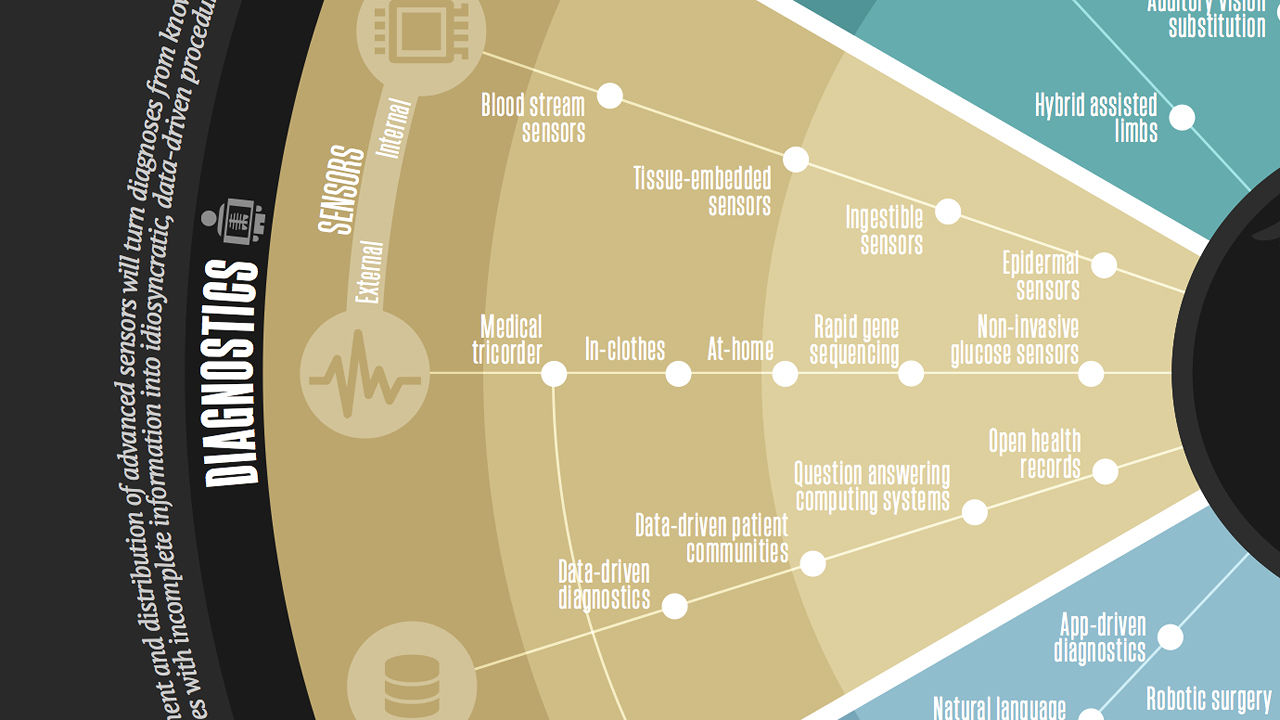
Envisioning Technology, the firm behind the massive infographic explorations of the future of emerging technology and the future of education technology, is, as you might guess, run by a futurist: Michell Zappa. His most recent visualization maps the next three decades of health technology, charting how regeneration, augmentation, diagnostics, treatments, biogerontology, and telemedicine will change over time. According to ET, the stuff of science fiction--from cryogenics to all-out life extension, from robot healthcare to 3D-printed synthetic organs--will be very real before too long.


"I’m a technology futurist because I care a great deal about where humanity is heading," says Zappa. "I have a firm belief in technology being inseparable from human evolution, but unlike biology, we actually have a degree of control in where technology is going. The sand is shifting underneath our feet, and the safest way to ensure that we end up in a desirable future is by creating it."

So, how does one go about predicting what the future holds?

Zappa acknowledges that the "actual forecast of when certain technologies are likely to reach maturity [or the] mainstream is very subjective." He explains that he and his firm derives its visions of the future from the following factors: reliance on and "general indicators of accelerating change"; relative dependencies ("the more preceding technologies are being worked on, the larger the likelihood an individual technology has to become mainstream"), which he likens to a qualitative version of Google’s PageRank; and from synthesizing and assessing what’s in cultural tech magazines, gadget blogs, scientific journals, and the writings of other futurists.

The health infographic, designed by Zappa and Patrick Schlafer and with help from Colin Popell of Prokalkeo, is built on the belief that "technology is the ultimate democratizing force of society" and highlights the trend of "previously siloed repositories of information and expensive diagnostic methods … rapidly finding a global reach and enabling both patients and practitioners to make better use of information."

Take a look at the full size version of the new infographic new infographic below or download it here:


Patrick James
Patrick James is the managing editor of Very Short List. He has written about culture for Good, Filter, and Bullett. Continued Twitter Website Blog

lunes, 10 de septiembre de 2012

Expanding Database Enables Discoveries in Emerging Field of Metabolomics


LA JOLLA, CA – September 10, 2012 – Over the last decade, metabolomics has emerged as the newest of the “omic” sciences (following genomics and proteomics) to provide comprehensive biochemical information about cellular metabolism. This new field has revealed that many of the chemicals involved in or produced through metabolism are currently unknown, but may play vital and previously unappreciated roles in human health and disease.

A major hurdle in profiling both unknown and known metabolic compounds (“metabolites”) has been the scarce amount of reference data. But a team from  The Scripps Research Institute  has developed a massive, searchable online metabolite database that is transforming the field and being widely used in research on countless conditions including cancer and chronic pain.

The researchers describe the newly expanded database, called METLIN, and its potential benefits in the September issue of the journal Nature Biotechnology.

Getting Off the Beaten Path

Scientists once focused on only the major metabolic highways, well-known pathways such as glycolysis and the Krebs Cycle. New metabolomic studies have shown that other pathways and metabolites, however, also play critical roles in fundamental biological processes and the progression of disease.

For decades biochemical studies have targeted only a handful of canonical metabolites, and comprehensive profiling has been mostly limited to genes and proteins,” said Gary Patti, a former postdoctoral fellow at Scripps Research now an assistant professor at Washington University in St. Louis who helped develop the database. But now he says the new field of metabolomics has emerged with huge promise for medical and other advancements. “I think it’s a really exciting time because the insights being provided by metabolomics are in some cases affecting the way in which we think about fundamental biochemistry,” he said.

The sheer number and complexity of metabolites offer scientists a colossal challenge. While DNA studies of genes that code for proteins offer clues about how many proteins there are and their functions, there’s no such map for metabolites—which include a huge range of chemical types, from amino acids, carbohydrates, and steroids to large, complex fatty acids. No one knows how many metabolites there are in humans, though the number may well be over 100,000, and other organisms may have their own unique arrays.

Digging In

Metabolites can be isolated and analyzed from almost any biological specimen, including tissues, blood, urine, and tumors. The most sensitive technique for analyzing metabolites is mass spectrometry. By using cutting-edge mass spectrometric technologies, the molecular weight of thousands of metabolites can be measured within a few minutes. Previously, researchers might spend days combing databases and other sources of information to identify just one metabolite of interest.

If you don’t have a database like METLIN, the value of metabomic data would be very limited because each study would require manual searches and ultimately fail to culminate in enough reference data to arrive at conclusive metabolite identifications,” said team leader Gary Siuzdak, a metabolomics expert at Scripps Research.

It was against this landscape that Siuzdak’s group recognized the need for a consolidated and expanded metabolite database to meet the group’s own needs as it struggled to understand key metabolic processes. Efforts to build such a resource began in 2004 and the database they dubbed METLIN was initially built upon slowly. Information was scarce and entered manually, sometimes after curating chemistry books manually for new structural information. Researchers in the lab would compete to see who could add the most in a week. Simultaneously, the lab also began cataloging experimental tandem mass spectrometry data on these compounds and established the first of such resources to provide structural information on metabolites that can be used to identify metabolites. 

Over the past few years, determined to accelerate their work, group members gained major momentum largely by partnering with companies like Sigma, Cayman, ChromaDex, as well as labs at Scripps Research (Boger), University of California, San Diego (Gerwick), the Joint BioEnergy Institute (Berkeley), and now Washington University (Patti) to facilitate acquisition of more molecules on which to generate tandem mass spectrometry data.

More than 10,000 Metabolites

Now METLIN includes more than 60,000 compounds with detailed, high-resolution tandem mass spectrometry information on more than 10,000 metabolites, by far the largest in the world. And the Siuzdak group is far from done. “METLIN is still growing as we speak,” said Ralf Tautenhahn, a senior research associate in Siuzdak’s lab and first author of the paper. “It’s a key tool for all our projects.” Once a metabolite is identified, researchers can begin working out how it functions in the body and in disease.

A key benefit of the database is that it goes beyond basic molecular weight—which might be the same for a range of different compounds. The tandem mass spectrometry data allows for a higher level of confidence in identifying these molecules from biological systems. This involves bombarding individual compounds with gas molecules, which causes them to break apart in unique ways. The weights of the resulting molecular fragments offer a sort of chemical signature for each metabolite that researchers can use to match unknowns more precisely.

Though you can search METLIN manually, the Scripps Research team has also developed software called XCMS Online that performs detailed automated searches. Users can input their own data and the coupled XCMS-METLIN system will come back with precise matches, or if there’s no direct match, it will identify structurally similar metabolites. “It really does accelerate the whole process of discovering new molecules associated with diseases and research in many different areas,” said Siuzdak.

domingo, 10 de junio de 2012

Desarrollan un chocolate que retrasa la vejez


Expertos británicos de la Universidad de Cambridge llegaron a una conclusión unánime: el chocolate sí puede ser un medio perfecto para retrasar el proceso del envejecimiento humano.

Los científicos de la empresa Lycotec’ elaboraron una tecnología que ayuda al cuerpo a absorber de una manera mucho más rápida los compuestos orgánicos, llamados flavonoides que contiene el cacao. Estas moléculas mejoran la saturación de oxígeno en la piel, necesario para reducir la velocidad del proceso responsable del envejecimiento.


Así, los expertos cambiaron la composición del chocolate con un solo ingrediente, conocido como Coco-Lycosome’ que aumenta el poder de los flavonoides hasta 20 veces.

Ya se conocía que el chocolate goza de este efecto milagroso, aunque la noticia podía consolar tan solo a los verdaderos amantes del producto, capaces de devorar al menos dos barras enteras diarias, necesarias, según los especialistas, para alcanzar el resultado prometedor.

Ahora los expertos aseguran que un pequeño trozo del nuevo producto es equivalente a la norma, ‘prescrita’ anteriormente. “Dos barras diarias pueden ser una buena noticia para los aficionados, pero no a todo el mundo le encanta el chocolate en estas cantidades”, sostiene el fundador de la compañía, Iván Petyaev.


De acuerdo con el experto, la pequeña transformación en la composición del chocolate no afecta de ningún modo al sabor o la textura del producto, mientras que la seguridad del ingrediente añadido está demostrada por los médicos. Por lo tanto, el nuevo producto está listo para entrar en el mercado mundial.

Sin embargo, la nutricionista Dra. Carrie Rakston expresó sus dudas sobre que se trate de un producto totalmente sano. “Los flavonoides se absorben mal por el organismo. Pese a que la idea es interesante, se necesita obtener la confirmación específica de la eficacia del desarrollo”, destacó la dietista.

Fuente: RT, Agencias