Mostrando entradas con la etiqueta Diseño. Mostrar todas las entradas

martes, 26 de agosto de 2014

Biomimicry Chair Could Change Furniture as we Know It


A common complaint about 3D printing is that it is not capable of producing things in a wide range of materials. Industrial printers can currently print items from wood, metal, plastics, and… thats basically it. If you aren’t the owner of a successful manufacturing firm and you’re just an average consumer or hobbyist looking to try your hand at 3D printing, then the only available options for you come in the form of cheap, hard plastics like ABS and PLA. This would be great if you wanted to make figurines, jewelry for little girls or even handy devices, parts and gadgets. But if you wanted to print something bigger or softer, you simply couldn’t. Until now.

The Royal Academy of Art, The Hague graduate student Lilian van Daal has created a 3D printed chair out of a single recyclable material influenced by plant materials. The chair was made as an alternative to traditional furniture that is usually upholstered and glued together from many different materials, which makes it difficult to recycle.
Source: Dezeen

“A lot of materials are used in normal furniture production, including several types of foam, and it’s very difficult to recycle because everything is glued together,” Van Daal told Dezeen.

Van Daal, a design student, decided to experiment with various materials and design methods to see if it would be possible to create environmentally-friendly furniture. By using 3D printing technology and mimicking plant cell structures, van Daal was able to produce the ‘Biomimicry’ chair.

Unlike most 3D printed objects, the biomimicry chair is not entirely hard. Van Daal mimicked plant cells by distributing the material differently at different parts of the chair. She decreased the density of the material in certain places and increased it in others. This enabled some sections of the chair to be soft and some to be hard – yet the entire chair was made from just one material.

Source: Dezeen

“I was testing the flexibility and the stiffness you can get from one material by 3D printing various structures,” said Van Daal. “I did lots of experiments with different structures to identify the kind of properties each structure has. When you adjust the structure a little bit you immediately get a different function. In the strong parts I used as little material as possible but enough to still have the good stiffness.”

According to Dezeen, Van Daal is currently in talks with furniture companies to discuss developing the project further. Not only is her concept much more environmentally-friendly than traditional furniture, but it also saves costs associated with purchasing multiple materials and having to transport them all separately to a factory. The ability to 3D print a soft, recyclable chair is a big step both for furniture and also for 3D printing technology, as the stigma of being able to print only rock hard objects is slowly diminishing.

ORIGINAL: Inside 3DP
15Aug 2014

jueves, 21 de agosto de 2014

Joi Ito: Want to innovate? Become a "now-ist"

“Remember before the internet?” asks Joi Ito. “Remember when people used to try to predict the future?” In this engaging talk, the head of the MIT Media Lab skips the future predictions and instead shares a new approach to creating in the moment: building quickly and improving constantly, without waiting for permission or for proof that you have the right idea. This kind of bottom-up innovation is seen in the most fascinating, futuristic projects emerging today, and it starts, he says, with being open and alert to what’s going on around you right now. Don’t be a futurist, he suggests: be a now-ist.

sábado, 12 de julio de 2014

How D-Wave Built Quantum Computing Hardware for the Next Generation


Photo: D-Wave Systems

One second is here and gone before most of us can think about it. But a delay of one second can seem like an eternity in a quantum computer capable of running calculations in millionths of a second. That's why engineers at D-Wave Systems worked hard to eliminate the one-second computing delay that existed in the D-Wave One—the first-generation version of what the company describes as the world's first commercial quantum computer.

Such lessons learned from operating D-Wave One helped shape the hardware design of D-Wave Two, a second-generation machine that has already been leased by customers such as Google, NASA, and Lockheed Martin. Such machines have not yet proven that they can definitely outperform classical computers in a way that would support D-Wave's particular approach to building quantum computers. But the hardware design philosophy behind D-Wave's quantum computing architecture points to how researchers could build increasingly more powerful quantum computers in the future.

"We have room for increasing the complexity of the D-Wave chip," says Jeremy Hilton, vice president of processor development at D-Wave Systems. "If we can fix the number of control lines per processor regardless of size, we can call it truly scalable quantum computing technology."

D-Wave recently explained the hardware design choices it made in going from D-Wave One to D-Wave Two in the June 2014 issue of the journal IEEE Transactions on Applied Superconductivity. Such details illustrate the engineering challenges that researchers still face in building a practical quantum computer capable of surpassing classical computers. (See IEEE Spectrum's overview of the D-Wave machines' performance from the December 2013 issue.)
  
Photo: D-Wave SystemsD-Wave's Year of Computing Dangerously

Quantum computing holds the promise of speedily solving tough problems that ordinary computers would take practically forever to crack. Unlike classical computing that represents information as bits of either a 1 or 0, quantum computers take advantage of quantum bits (qubits) that can exist as both a 1 and 0 at the same time, enabling them to perform many simultaneous calculations.

Classical computer hardware has relied upon silicon transistors that can switch between "on" and "off" to represent the 1 or 0 in digital information. By comparison, D-Wave's quantum computing hardware relies on metal loops of niobium that have tiny electrical currents running through them. A current running counterclockwise through the loop creates a tiny magnetic field pointing up, whereas a clockwise current leads to a magnetic field pointing down. Those two magnetic field states represent the equivalent of 1 or 0.

The niobium loops become superconductors when chilled to frigid temperatures of 20 millikelvin (-273 degrees C). At such low temperatures, the currents and magnetic fields can enter the strange quantum state known as "superposition" that allows them to represent both 1 and 0 states simultaneously. That allows D-Wave to use these "superconducting qubits" as the building blocks for making a quantum computing machine. Each loop also contains a number of Josephson junctions—two layers of superconductor separated by a thin insulating layer—that act as a framework of switches for routing magnetic pulses to the correct locations.

But a bunch of superconducting qubits and their connecting couplers—separate superconducting loops that allow qubits to exchange information—won't do any computing all by themselves. D-Wave initially thought it would rely on analog control lines that could apply a magnetic field to the superconducting qubits and control their quantum states in that manner. However, the company realized early on in development that it would need at least six or seven control lines per qubit, for a programmable computer. The dream of eventually building more powerful machines with thousands of qubits would become an "impossible engineering challenge" with such design requirements, Hilton says.

The solution came in the form of digital-to-analog flux converters (DAC)—each about the size of a human red blood cell at 10 micrometers in width— that act as control devices and sit directly on the quantum computer chip. Such devices can replace control lines by acting as a form of programmable magnetic memory that produces a static magnetic field to affect nearby qubits. D-Wave can reprogram the DACs digitally to change the "bias" of their magnetic fields, which in turn affects the quantum computing operations.

Most researchers have focused on building quantum computers using the traditional logic-gate model of computing. But D-Wave has focused on a more specialized approach known as "quantum annealing" —a method of tackling optimization problems. Solving optimization problems means finding the lowest "valley" that represents the best solution in a problem "landscape" with peaks and valleys. In practical terms, D-Wave starts a group of qubits in their lowest energy state and then gradually turns on interactions between the qubits, which encodes a quantum algorithm. When the qubits settle back down in their new lowest-energy state, D-Wave can read out the qubits to get the results.

Both the D-Wave One (128 qubits) and D-Wave Two (512 qubits) processors have DACs. But the circuitry setup of D-Wave One created some problems between the programming DAC phase and the quantum annealing operations phase. Specifically, the D-Wave One programming phase temporarily raised the temperature to as much as 500 millikelvin, which only dropped back down to the 20 millikelvin temperature necessary for quantum annealing after one second. That's a significant delay for a machine that can perform quantum annealing in just 20 microseconds (20 millionths of a second).

By simplifying the hardware architecture and adding some more control lines, D-Wave managed to largely eliminate the temperature rise. That in turn reduced the post-programming delay to about 10 milliseconds (10 thousandths of a second)— a "factor of 100 improvement achieved within one processor generation," Hilton says. D-Wave also managed to reduce the physical size of the DAC "footprint" by about 50 percent in D-Wave Two.

Building ever-larger arrays of qubits continues to challenge D-Wave's engineers. They must always be aware of how their hardware design—packed with many classical computing components—can affect the fragile quantum states and lead to errors or noise that overwhelms the quantum annealing operations.

"We were nervous about going down this path," Hilton says. "This architecture requires the qubits and the quantum devices to be intermingled with all these big classical objects. The threat you worry about is noise and impact of all this stuff hanging around the qubits. Traditional experiments in quantum computing have qubits in almost perfect isolation. But if you want quantum computing to be scalable, it will have to be immersed in a sea of computing complexity."

Still, D-Wave's current hardware architecture, code-named "Chimera," should be capable of building quantum computing machines of up to 8000 qubits, Hilton says. The company is also working on building a larger processor containing 1000 qubits.

"The architecture isn’t necessarily going to stay the same, because we're constantly learning about performance and other factors," Hilton says. "But each time we implement a generation, we try to give it some legs so we know it’s extendable."

ORIGINAL: IEEE Spectrum
By Jeremy Hsu
11 Jul 2014

sábado, 10 de mayo de 2014

Google Ventures: Your Design Team Needs A War Room. Here's How To Set One Up


WANT TO FOSTER CREATIVITY? SKIP THE FOOSBALL TABLE AND OPT FOR A WAR ROOM INSTEAD. GOOGLE VENTURES'S JAKE KNAPP SHOWS YOU HOW. PLUS: A PEEK INSIDE GOOGLE VENTURES'S OWN WAR ROOM

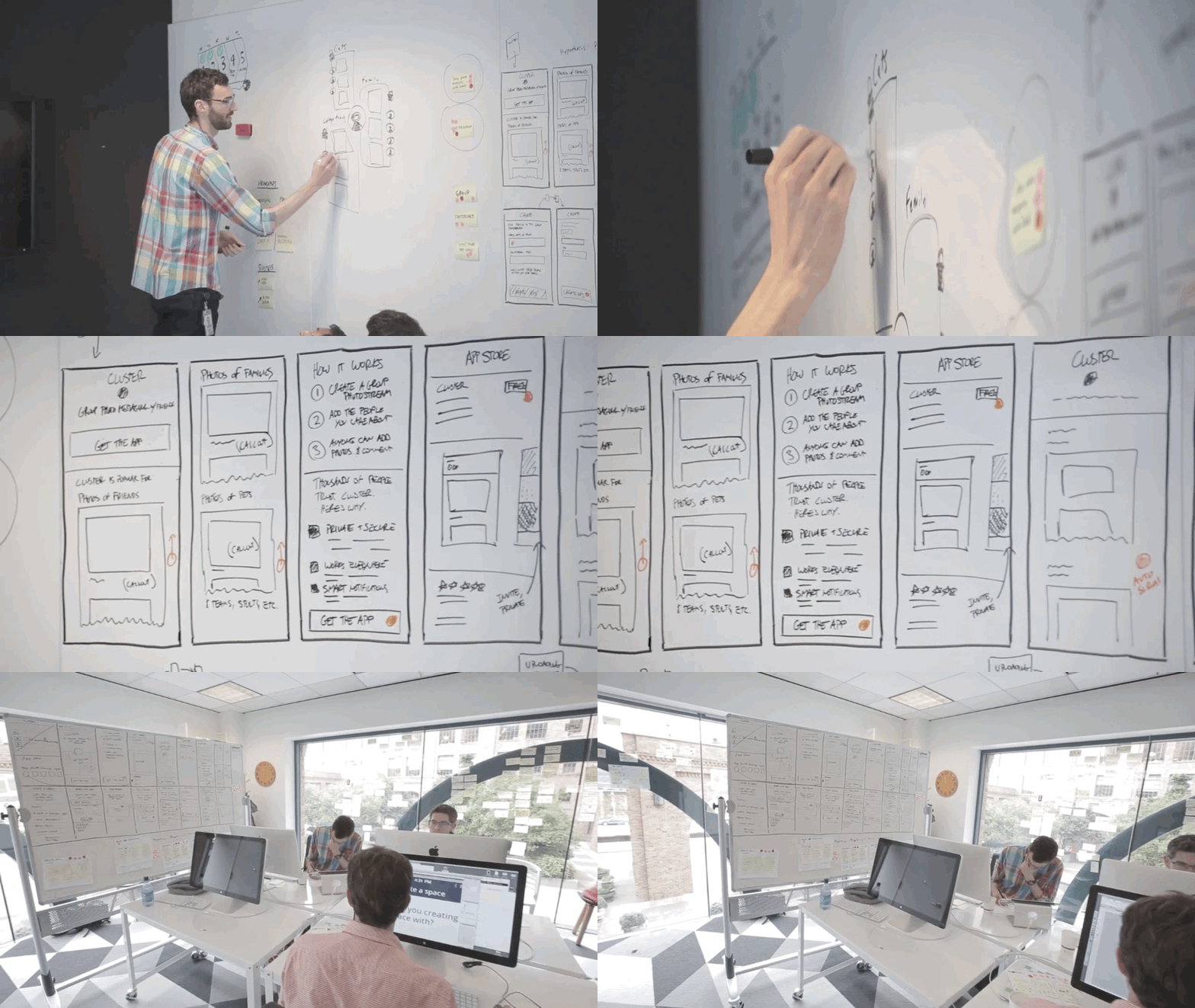
In the last two years at Google Ventures, I’ve done design sprints with more than 80 startups. One of the simplest tricks I’ve learned is that a dedicated space with walls--a war room--always helps us do better work. The walls of a war room can
  • extend a team’s memory, 
  • provide a canvas for shared note-taking, and 
  • act as long-term storage for works in progress.
Unfortunately, war rooms are few and far between. I’m surprised by how many tech companies make space for a foosball table (fun but seldom used), yet don't dedicate a room to their most important project.

If your team doesn’t have a war room, don’t worry. In this post, I’ll explain how to put one together on almost any budget. Spoiler: while a dedicated physical space is great to have, it’s not an absolute necessity. But first, here’s a bit more on why war rooms work so well.

The Innovation by Design Awardscelebrates the controversial ideas, new products, business ventures, and wild ideas highlighted every day on Co.Design. Winners and finalists are featured in a special design issue of Fast Companymagazine. Enter today.
SPATIAL MEMORY > SHORT-TERM MEMORY

To solve a complex design problem, you need to track lots of moving parts. As humans, our short-term memory is not all that good--but our spatial memory is awesome. Plaster a room with notes and you take advantage of that spatial memory. You begin to know where information is, which extends your ability to remember things.

PHYSICAL IDEAS ARE EASIER TO MANIPULATE
We all know it’s better to re-order a prioritized list of sticky notes or re-draw a diagram than to make the same decisions verbally. That’s why there are whiteboards in meeting rooms and why people love agile trackers with sticky notes. War rooms take those tools to the next level.

WAR ROOMS BUILD SHARED UNDERSTANDING
War rooms help your team work better together. When you capture every decision and put it on the wall, you don’t have to wonder if everyone is on the same page. The room is the page. The more you put on the walls, the more shared understanding you build. As a bonus, you spend less time revisiting already-discussed issues. A war room works great for long-term projects of a few days or a few weeks--and it also works great for one-off meetings.

INGREDIENTS OF A GREAT WAR ROOM

LOTS OF SURFACE AREA
In a Google Ventures design sprint, it’s common to have many things on the walls at once: user story diagrams, research notes, printouts of the existing UI, sketches of possible solutions, a detailed storyboard, and sometimes more. To accommodate all that stuff, you need a lot of space. That means whiteboards, windows, and empty walls where you can stick stuff.

Every bit of window, wall, and whiteboard is useful.

DEDICATED TO PROJECTS (NOT MEETINGS)
You don’t want your war room turning into just another conference room. For best results, remove your war room from your company’s room-scheduling calendar.

AS MANY WHITEBOARDS AS YOU CAN FIT
Whiteboards come in a lot of styles, so choose wisely.

  • Floor-to-ceiling wall-mounted--The best. I like to use every square inch of available space, and with these babies, that’s a lot of space.
  • IdeaPaint--Great stuff (unless your walls have a funky texture). And for goodness sake, paint all the walls, otherwise, get ready to have somebody write “Not a whiteboard!” in whiteboard marker on the unpainted walls.
  • Normal wall-mounted--These are okay if you get more than one.
  • D.I.Y. shower board whiteboards--Much cheaper than real whiteboards, these require more elbow grease to install (you may spill Liquid Nails on your designer-y plaid shirt). The surface isn’t quite as good, so expect to clean it more often.
  • Rolling--These come in small and giant sizes. The small ones have a lot of unusable space down by the floor, and they shake when you draw on them. The giant ones cost a lot more, but they’re actually usable.
FLEXIBLE FURNITURE
In our design sprints, we go through a lot of different work modes. Sometimes we need to talk a lot, and we want chairs and open space. Other times, we’re drawing on paper and we want desks. The ideal war room has furniture that’s lightweight or on wheels, so it’s easy to move.
Everything is lightweight, on wheels, or both.

You should always have at least one person wearing plaid--three or more if possible.

THREE WAR ROOM RECIPES

1. GOOGLE VENTURES DESIGN WAR ROOM
We took over a conference room and removed the big table in the middle. Next, we installed as many whiteboards as we could. We couldn’t do floor-to-ceiling, but we got close.

Finally we ordered a bunch of flexible furniture--some of it fancy-pants (like Modernica chairs) and some utilitarian (like clipboards and a coat hanger). Here’s the complete shopping list hand-picked by Google Ventures’ Daniel Burka. Some highlights:


2. RECONFIGURABLE CONFERENCE ROOM
It may be impossible to completely take over a room. If you have to share your war room, get some portable wall space that you can assemble and disassemble quickly. Your options:

  • Sticky flip charts--Blank sheets of this stuff make a reusable, moveable backdrop for sticky notes and printouts.
  • Giant foam core--Foam core comes in 96”x48” but it’s expensive and tricky to find, not to mention cumbersome. Which is why I prefer...
  • Rolling whiteboards--see above for our favorite.

3. NO-ROOM WAR ROOM
Sometimes you don’t even have a conference room to commandeer. I’ve seen this challenge at startups in incubators or shared offices. Don’t freak out. You can still make a war room by hacking the space around your desk. Use rolling whiteboards as partitions. It’s just like you’re a kid again, building a fort out of chairs and blankets! But don’t actually use blankets, because your co-workers might get creeped out.

TELL ME ABOUT YOUR WORKSPACE
We’re still experimenting and learning with our own war room, as well as those at our companies. How have you set up project spaces for your team?


ORIGINAL: FastCo Design
By Jake Knapp
May 1, 2014

jueves, 17 de abril de 2014

Five Tech Trends That Can Drive Company Success

The ability to innovate is a driver of productivity, competitiveness and prosperity. Innovation requires entrepreneurs to rethink and adopt new approaches to their businesses, and embracing new technologies and manufacturing opportunities can distinguish you from your competitors.

But what are some powerful tech trends that can drive company success? What should you pay attention to?

Here are five trends that, if you haven’t embraced them yet, have the potential to transform your business.

1- Biomimicry: Innovation Inspired By Nature
Biomimicry is the design and production of materials, structures and systems that are modeled after biological organisms and processes.

“It’s not really technology or biology; it’s the technology of biology. It’s making a fiber like a spider, or lassoing the sun’s energy like a leaf,” Janine Benyus co-founder of the international organization Biomimicry 3.8, writes.

Companies are increasingly looking at ways to incorporate biologically inspired design into their products, and organizations like Biomimicry 3.8 are helping them redesign carpets, furniture, airplanes and even entire manufacturing processes.

In Northeast Ohio, Great Lakes Biomimicry, a founding affiliate partner of Biomimicry 3.8, is working with schools, companies and economic development organizations to engage students, entrepreneurs and funders to advance the field.

The University of Akron has committed $4.25 million to biomimicry research and innovation, and companies like Parker Hannifin and Sherwin-Williams are getting involved. They realize biomimicry has many applications, particularly when it comes to creating sustainable technologies.

“Biomimicry represents the possibility of a revolutionary change in our economy, transforming many of the ways we think about designing, producing, transporting and distributing goods and services,” Tom Tyrrell, founder and CEO of Great Lakes Biomimicry, says. “This field is just emerging. Nazarene University’s Fermanian Institute estimates, by 2025, biomimicry could represent $300 billion of the annual U.S. GDP, account for 1.6 million U.S. jobs and represent $1 trillion of global GDP.”

2- Additive Manufacturing: Innovation From A Printer
Additive manufacturing is becoming a viable manufacturing alternative, particularly for makers of highly customized products. The technology can significantly reduce the time and cost it takes to design and produce prototypes. Thus, additive manufacturing is particularly well suited for R&D.

But additive manufacturing has evolved to a point where it now also makes sense for volume production. Combining the technology with printed electronics, for example, could create the next generation of embedded electronics.

Printed electronics can be directly applied to 3D surfaces to advance integration, size and weight reduction, durability and performance. This provides new opportunities for electronic device manufacturers, who want to pack more functionality into less space.

Youngstown, Ohio, is the center of additive manufacturing at the moment. The region is home to America Makes, also known as the National Additive Manufacturing Innovation Institute. Its goal is to elevate additive manufacturing into mainstream manufacturing.

3- The Internet of Things: A Web Of Innovation
There’s lots of talk about “the Internet of Things.” But what exactly does it mean?

“It’s the marriage of minds and machines,” Marco Annunziata, chief economist at General Electric, said in a TED talk on the topic. “This is a transformation as powerful as the industrial revolution.”


Simply, the Internet of Things refers to a network of physical objects with embedded technology that is connected (either wired or wirelessly) for communication, remote control, data transfer or some other function. Sensors, radio-frequency identification (RFID) technology and microelectronics are critical components of the Internet of Things.

Connecting products, machines or entire factories to the Internet can increase efficiency and reduce the loss of information. This potentially has far-reaching implications and impact across many industries. Already, coffee shops, airports and major corporations like Rockwell Automation have embraced the Internet of Things. Cisco Systems CSCO +0.44% CEO John Chambers calls it the “fourth wave of the Internet.”

“We believe we’re at an inflection point, driven by the convergence of integrated control and information technologies, and accelerated by the arrival of the Internet of Things,” Rockwell Chairman and CEO Keith Nosbusch said. “We call this vision ‘The Connected Enterprise.’ It involves industrial operations that are more productive, more agile and more sustainable.”

4- Software: Transforming Traditional Industries
“Today’s manufacturing is really one of the most sophisticated industries in the world,” Siemens USA CEO Eric Spiegel said recently. “That’s mainly because software has really transformed the whole manufacturing process.”

Spiegel made his remarks at the “Building the Future: Manufacturing’s Software Revolution” event in Norwood, Ohio, where Siemens announced a $66.8 million in-kind software grant to Cincinnati State Technical and Community College. It gave additional grants to Mott Community College ($55.8 million) and Youngstown State University ($440 million) to train students how to use its product lifecycle management software in careers like robotics design and computer-aided engineering.

But software is not only impacting the manufacturing industry. Tech and non-tech businesses large and small are in need of software solutions to respond to customer demands and process large amounts of data. It’s no surprise the demand for software engineers is higher than ever and many businesses can’t find enough people to fill open positions, according to Today’s Engineer.

5- Big Data: Understanding Your Customers
The ability to collect, process and interpret large and complex data sets, known as Big Data, is at the core of many business operations. It allows you to more effectively communicate with consumers, perform risk-analyses and create new revenue streams, among other things.

“The ability to evaluate and apply data has always been an integral part of an organization’s success. But the unprecedented amount of information available today demands far more sophisticated approaches to analysis and execution,” said former Microsoft MSFT COO Bob Herbold, who recently donated $2.6 million to launch a data science program at Case Western Reserve University.

Big data increases the efficiency of shipping companies and retailers, for example, and makes manufacturers more efficient and responsive to clients’ needs.

“The potential that exists today to enhance operations and outcomes is nearly limitless,” Herbold said. “Those who understand how data works and what it can yield will carry enormous advantage in the new economy.”

How have you embraced any of these trends? What are some other innovations that have taken your business to the next level?

Share your insights by commenting below or send me a tweet at @NorTech!

ORIGINAL: Forbes
Rebecca O. BagleyContributor
4/01/2014

viernes, 24 de enero de 2014

Imagining a world with wind turbines in every neighborhood

When Professor Richard McMahon, a senior lecturer in the University of Cambridge Department of Engineering, closes his eyes, he sees a future powered by the wind. He envisions a day when wind turbines are as common as trees in the courtyards on his campus. He sees small generators built to be aesthetically pleasing as well as energy efficient. While thousands of massive wind turbines now dot the countryside of England, producing renewable energy with impressive results, small wind turbines in more urban settings are costly, noisy, complex systems that aren’t very reliable.

So, Richard, doctoral students from the University of Cambridge and experts from Texas Instruments have teamed up to make small scale wind turbines a viable energy option.

Before they could get started with their research, they had to solve one big problem – creating a system to simulate the wind. Without a wind emulator, the team could not conduct any sort of testing and would be forced to rely on the ups and downs of Mother Nature. So, the team decided to build their own wind emulator to mimic wind speeds and direction.

“In order to test systems, we need reproducible conditions. It is very hard to go outside and get reproducible wind conditions. You might be waiting a very long time,” said Richard.

With the wind emulator in place, the team looked at opportunities to optimize how the energy is transferred from the turbine to the generator and then onto the electrical grid. While engineers can control a lot of these factors, the challenge for the team came in the lack of control over wind speed or direction.

“How do you get the maximum power from the wind and put it on the grid when the wind can quickly change in different ways?” said Dave Freeman, TI (Texas Instruments) Fellow and chief technologist for TI’s Power Management business.

 
The team narrowed their focus on sensors in the wind turbine, finding many sensors involving turbine and generator speed add unnecessary cost and unreliable mechanics. To resolve this issue, the team has been experimenting with a third-party real time operating system controlling the generator, with the end-goal of putting the system onto a TI microcontroller or digital signal processor.

After more extensive testing with their newly built wind emulator, the team hopes to take their innovation into the real world and possibly make small scale wind turbines a commercially attractive option.

“Let’s test it out with the wind emulator, and then, with TI, we can put forward an offering to companies making small wind turbines,” said Richard.

Dave said the collaboration with the University of Cambridge has been a big win for everyone involved. TI provided funding and know-how with the chips and control systems while the University of Cambridge offered wind energy expertise and access to students with bright engineering minds.He said the research could be done in Kilby Labs, but it was a much better use of resources to work with a university that already had experience and expertise in the wind energy field.

Because of the research done by TI and the University of Cambridge, small scale wind turbines may no longer be labeled costly, noisy, complex systems that aren’t very reliable. Soon, Richard might not have to close his eyes to see wind turbines in his neighborhood.

ORIGINAL: TI
Around TI
Jan 23 2014

lunes, 16 de diciembre de 2013

Fuel Cells and Solar Photovoltaics: Working Together to Bury Coal


Fuel Cells and Solar Photovoltaics: Working Together to Bury Coal
Joshua M. Pearce Department of Mechanical & Materials Engineering
Applied Sustainability Research Group
Outline
  • Motivation 
  • Introduction To Photovoltaic Technology 
  • PV Penetration Levels 
  • Why PV needs Fuel Cells 
  • Photovoltaic + Combined Heat and Power Home Design 
  • Beating Clouds 
  • PV+CCHP – Optimization Simulation 
  • Results, Going Big, Future Work
Motivation
J. Pearce and A. Lau, “Net Energy Analysis For Sustainable Energy Production From Silicon Based Solar Cells”, Proceedings of American Society of Mechanical Engineers Solar 2002: Sunrise on the Reliable Energy Economy, editor R. Cambell-Howe, 2002.
Sustainable Electricity: Solar Photovoltaic Technology
PV represents one of the most promising means of maintaining our energy intensive standard of living while not contributing to global warming and pollution.


Residential Rooftops
Built in PV


Solar Shingles
Roof Tiles in Japan
Carports

martes, 1 de octubre de 2013

Gamers design swarms of nanoparticles for cancer research [with video]

NanoDoc (http://nanodoc.org) is a new online game to crowdsource the design of nanomedicine. It allows bioengineers and the general public to imagine nanoparticle strategies towards the treatment of cancer and test them on a virtual tumor. The challenge is to design nanoparticles that interact with each other and their environment in a way that leads to better treatment outcomes. The ultimate goal is to design nanoparticles that swarm like self-organized systems in nature. Best strategies will be tested using cancer-on-a-chip devices and large robotic swarms.

HFSP Cross-Disciplinary Fellow Sabine Hauert and colleagues authored on Thu, 26 September 2013

Cancer is the leading cause of death worldwide according to the WHO. To treat cancer, bioengineers are designing nanoparticles that can deliver drugs and therapeutics directly to tumors. Nanoparticles come in different sizes, shapes and materials. They can be loaded with drugs that are released in a controlled fashion, and coated with molecules that allow them to interact with their environment. Some of these molecules can serve as a signature to uniquely identify cancer cells.

As a result, there are many ways to design a nanoparticle. Depending on its design, the nanoparticle will move, sense and act in different ways in the tumor; changing the body of the nanoparticle will change its behavior. The challenge is to understand which nanoparticle designs will improve treatment outcome. This is a difficult problem because trillions of nanoparticles typically interact in a tumor with millions of cells. Predicting and optimizing the emergent behavior of all these nanoparticles is guess work at best.

To address this challenge, the Laboratory of Sangeeta Bhatia at MIT recently released an online game called NanoDoc (http://nanodoc.org) that allows bioengineers and the general public to imagine new nanoparticle strategies towards the treatment of cancer. It uses a realistic simulator developed at the laboratory to model how nanoparticles interact with each other and the tumor environment. The first levels of the game are used to train new NanoDocs; licensed NanoDocs are then given challenges to solve. Since its launch two weeks ago, the game has seen 10,000 visitors, 1750 players and over 40,000 simulations.

Figure: NanoDoc game to crowdsource the design of nanomedicine. The crowd designs nanoparticles and combines them into treatments (left). Treatments are then injected into a virtual tumor scenario designed by bioengineers (right). The goal is to discover ways in which nanoparticles can cooperate.
The longterm goal is to discover ways in which nanoparticles can cooperate, or swarm, like self-organized systems in nature. Select nanotreatments discovered using NanoDoc will be validated using
  1. in vitro tissue-on-a-chip constructs designed to emulate the extravasation of functionalized nanoparticles from artificial vessels into a compartment containing tumor cells and 
  2. robotic swarm systems in collaboration with Radhika Nagpal’s lab from the Wyss Institute at Harvard University.


http://nanodoc.org

Link to article in New Scientist

Link to article in Guardian

sábado, 14 de septiembre de 2013

David Benjamin and the future of architecture

March 11, 2011

This creation of a new system of biofuel – with 80% less carbon emissions than petroleum fuel – involves design at multiple scales simultaneously, from DNA with a radius of about a billionth of a meter to the planet with a circumference of 40 million meters. (Nathan Smith, Bio Oil Workshop, Columbia GSAPP. Images are from Columbia’s Architecture Bio-Synthesis Project and Bio Oil Workshop
As biological technologies become more available, Do-It-Yourself inventors may engineer algae to create car grilles and catalytic converters that suck carbon from the air as you drive. (Nathan Smith, Bio Oil Workshop, Columbia GSAPP). Images are from Columbia’s Architecture Bio-Synthesis Project and Bio Oil Workshop


As it becomes possible to design cells as tiny, self-replicating computers, new forms of data processing and storage may emerge, such as embedding computing invisibly in our lakes and reservoirs. Cloud computing will become river computing. (Mike Robitz, Architecture Bio-Synthesis Class, Columbia GSAPP). Images are from Columbia’s Architecture Bio-Synthesis Project and Bio Oil Workshop

The co-founder of The Living, David Benjamin is blazing a trail in bringing synthetic biology to architecture.

Along with his partner at The Living, architect Soo-in Yang, Benjamin has already created paradigm-shifting projects, such as
Living Light, an interactive canopy in Seoul that reacts to air quality; and

Living Light (Seoul, 2009) from D B on Vimeo.

Amphibious Architecture, which communicates the level of pollution in New York’s Hudson River.

Amphibious Architecture (New York, 2009) from David Benjamin on Vimeo.

These projects entice people to participate in their environments in new ways, while making them aware of how they’re constantly changing.

At the Conversations in Design symposium hosted by the Interior Design Show in January, Benjamin spoke on the theme of crowd-sourcing as it applies to his firm’s projects as well as those by his students at Columbia University. Benjamin and his colleagues at Columbia developed a framework for students to share architectural tools, and he’s also created a new class exploring synthetic biology in architecture – a subject he’s been immersed in since participating in the National Science Foundation–funded Synthetics Aesthetics Project.

Azure sat down with Benjamin to discuss the brave new future of green architecture.

Why architecture needs to go beyond the blank page

In my teaching at Columbia Graduate School of Architecture, Planning and Preservation, I emphasize collaboration and open source design. This challenges the model of the architect as solitary genius and also the notion that each building has to be a one-off.

In the C-BIP [Columbia Building Intelligence Project] Studio that I teach with Scott Marble and Laura Kurgan, we created a framework for students to work individually to design a database of small-scale building elements, and then work in teams to combine a selection of elements into larger building designs. The teams start with modules of re-usable design intelligence rather than with a blank page, and they pick up where previous studios left off, rather than re-creating everything.

How synthetic biology can solve many persistent problems

Synthetic biology is a radical form of genetic modification. It is a new approach to designing new biological systems not found in nature. And some people say that in the near future, this technology will be the way we make everything, from medicines to fuels to buildings.

One example that is now being commercialized is a new anti-malaria drug. Synthetic biologists designed a way to combine 12 sequences of DNA never found together before and to create a new strain of yeast that could essentially churn out the anti-malaria medicine in a laboratory – without the use of the rare sweet wormwood plant. The new medicine is more pure and ten times cheaper than the old medicine, which means it could save millions of lives.

From the beginning, synthetic biology has been based on a framework from the field of electrical engineering. The idea is that if synthetic biology can develop a catalog of standardized biological parts – like transistors and capacitors in electrical engineering – then there can be a division of labor. Some people will be able to work on making new parts while other people will be able to work on combining the parts into devices and systems. This will allow for the creation of new medicines or new fuels or new building materials without starting from scratch.

This has some clear similarities with our database of building elements, but it potentially involves a wider spectrum of participants. The framework of synthetic biology may allow non-specialists – like architects, artists, computer scientists – to design new biological systems without learning all the details of molecular behavior. Just as non-specialists now combine electrical parts to make electrical circuits, soon they might be able to combine biological parts to make new organisms that perform specific functions. As biological technologies become less expensive and more domesticated, this may lead to an explosion of innovation similar to advances in computers after the domestication of digital technologies in the ‘70s and ‘80s. We may be at a transformative moment now, like the days of Apple Computer tinkering in the garage.

How synthetic biology can inform architecture

But so far, very few architects are working in this area. I am the only architect among six pairs of scientist-designer collaborators in the Synthetic Aesthetics Project, which involves conducting joint research (with funding from the National Science Foundation in the U.S. and the Engineering and Physical Science Research Council in the U.K.) with plant biologist Fernan Federici in the Jim Haseloff Lab at the University of Cambridge, U.K. We are experimenting with synthetic biology and architecture in a real lab with all of the standard safety protocols.

Then at Columbia, we are creating an advanced architecture design studio to teach architecture students to conduct experiments and design with biology. This is part of a new lab I am starting at the School which will conduct long-term research on the intersection of architecture, synthetic biology, and computation. We have just started to work with a software company to develop new computational tools for architecture and synthetic biology.

Why we need to re-think “nature”

We definitely have to be careful with this technology for designing new living systems, but it’s not unprecedented from a philosophical view. First, people have been manipulating nature for thousands of years. Second, the technology’s already out there and the best way to deal with the risks is probably to increase awareness and knowledge, rather than outlawing it, which would just push malicious projects underground. Third, what’s most crucial for me – and this relates to Amphibious Architecture [developed by Benjamin and Yang at the Living Architecture Lab at Columbia, in collaboration with Natalie Jeremijenko] – is that the “do nothing” approach is not always the safest approach. In New York, the rivers have been damaged by years of pollution and development, and some public agencies say it’s best to do nothing at this point. But it’s actually better to remediate and experiment in order to re-engineer a viable eco-system, to re-introduce species, to build special reefs and piles so mussels and oysters can grow. In the case of synthetic biology, there are many urgent problems that the new science might be able to address. I’m not blindly faithful in technology, but I think at this point the benefits of synthetic biology far outweigh the risks.

How we will one day grow our buildings

Some of the first applications of synthetic biology and architecture may involve high-performance materials like carbon-sequestering concrete and self-healing silicone. But in the future, architects may be able to program the DNA of a seed so that it grows into a building. Then, instead of architects designing plans and sections, instead of bringing all of the construction materials from the factory to the site, architects might be able to design rules for growth and differentiation and material performance. And the new biological machine – the living building – might be able to use the nutrients of the land and the natural ecosystem to do both the factory manufacturing and the site construction.

In some ways, it’s tempting to wait until the technology becomes more advanced before we get involved as architects. But if we wait too long, there’s a risk in that too. Architects should help think about the frameworks and the protocols and the potential applications of synthetic biology. Architects should engage in the discussion about risks and utopian visions and design tools before these things get frozen and the design palette gets limited.

The thing that ties it all together for me is this sinking feeling I have that we’re at this crucial moment where we know what the stakes are, and what we need to do, but we aren’t acting. We’re still not acting intelligently about the crisis of climate change. Of course, a large part of our response as architects must be to aggressively use all of our known and existing strategies to increase the environmental performance of buildings. But I also think some architects should be searching for radical new strategies that might change our idea of what’s possible. Some experiments may fail, but some crazy ideas – like combining architecture and synthetic biology and growing buildings – may eventually change how we think about architecture, and how we live, work, and come together in cities.

miércoles, 12 de junio de 2013

Intention

ORIGINAL: Apple

Here, simple phrases paired with elegant visuals describe the thoughts and emotions that go into creating each Apple product


viernes, 19 de abril de 2013

Skylar Tibbits: The emergence of "4D printing"

ORIGINAL: TED
TED2013
Apr 2013

3D printing has grown in sophistication since the late 1970s; TED Fellow Skylar Tibbits is shaping the next development, which he calls 4D printing, where the fourth dimension is time. This emerging technology will allow us to print objects that then reshape themselves or self-assemble over time. Think: a printed cube that folds before your eyes, or a printed pipe able to sense the need to expand or contract.


Skylar Tibbits, a TED Fellow, is an artist and computational architect working on "smart" components that can assemble themselves.  

Skylar Tibbits
Skylar Tibbits, a TED Fellow, is an artist and computational architect working on "smart" components that can assemble themselves.

Why you should listen to him:

Can we create objects that assemble themselves -- that zip together like a strand of DNA or that have the ability for transformation embedded into them? These are the questions that Skylar Tibbits investigates in his Self-Assembly Lab at MIT, a cross-disciplinary research space where designers, scientists and engineers come together to find ways for disordered parts to become ordered structures.

A trained architect, designer and computer scientist, Tibbits teaches design studios at MIT’s Department of Architecture and co-teaches the seminar “How to Make (Almost) Anything” at MIT’s Media Lab. Before that, he worked at a number of design offices including Zaha Hadid Architects, Asymptote Architecture, SKIII Space Variations and Point b Design. His work has been shown at the Guggenheim Museum and the Beijing Biennale.

Tibbits has collaborated with a number of influential people over the years, including Neil Gershenfeld and The Center for Bits and Atoms, Erik and Marty Demaine at MIT, Adam Bly at SEED Media Group and Marc Fornes of THEVERYMANY. In 2007, he and Marc Fornes co-curated Scriptedbypurpose, the first exhibition focused exclusively on scripted processes within design. Also in 2007, he founded SJET, a multifaceted practice and research platform for experimental computation and design. SJET crosses disciplines from architecture and design, fabrication, computer science and robotics.

"The big idea is to create objects that can change after they are printed, making them self-adapting. The act of printing is no longer the end of the creative process but merely a waypoint."


Quotes by Skylar Tibbits
“There’s new possibilities for self-assembly, replication, repair in our physical structures, our buildings, machines. … Imagine if our buildings, our bridges, machines, all of our bricks could actually compute.” Watch this talk »

sábado, 15 de diciembre de 2012

7 Young Entrepreneurs Changing The World With Their Businesses

ORIGINAL: FastCo

These companies’ founders are all members of a new generation of entrepreneurs who are looking to find disruptive ways of making money while also giving back.

The world of business is changing, and new companies are finding ways to create value both for their bottom line and the communities they work in. We’ve profiled several of these new businesses--all run by entrepreneurs under the age of 35--in our series called Change Generation. Here are some of the most exciting young businesses out there, led by young people who will be instrumental in shaping the future:
Anand Shah’s company Sarvajal is working to bring clean water to India.

Anand Shah’s company Sarvajal is working to bring clean water to India. But it’s not just giving it away. Instead, it’s creating a network of water entrepreneurs, giving each a clean water franchise to run. Each of these franchisees sets up "water ATMs," where rural Indians can go and see their water being purified and bottled.
Engineers at Cal Tech, including Asghar Aryanfar, created a new toilet for the developing world 

Engineers at Cal Tech, including Asghar Aryanfar, have--at the urging of the Gates Foundation--created a new toilet for the developing world that will help stop disease and also generate power, even in the most remote locations.
Sebastian Lindstrom’s What Took You So Long is a “disruptive filmmaking lab
Sebastian Lindstrom’s What Took You So Long is a “disruptive filmmaking lab,"dedicated to traveling to the most remote corners of the globe to document people who are doing good things (and making money making ads for companies doing good things, too, of course).
Maria Rodriguez is fixing her country’s economy from the ground up, by investing heavily in worms with her company ByoEarth.
Guatemalan native Maria Rodriguez is fixing her country’s economy from the ground up, by investing heavily in worms with her company ByoEarth. The worms eat trash (solving a persistent problem of how to dispose of waste) and the resulting worm waste can be sold to farmers as a powerful fertilizer.

Kavita Shukla’s project is making sure we don’t waste so much food, using age-old natural methods. Her company Fenugreen Freshpaper makes a product that looks like a dryer sheet, is powered by the spice fenugreek (whose properties she learned about from her grandmother), and which miraculously keeps produce fresh much longer.

Simon Griffiths, Jehan Ratnatunga, and Danny Alexander make toilet paper. But it’s toilet paper with a mission. Who Gives A Crap TP is a buy-one, give-one form of bathroom hygiene. Buy their product--funded on Indiegogo with a stunt where Griffiths sat on a toilet until the company reached its goal--and money goes toward helping clean up sanitation in the developing world.

The shoes you find in the shoe store are so boring. The designs on Aaron Firestein and Raaja Nemani’s Bucketfeet canvas sneakers come from street artists all over the world, giving those artists a reliable source of income and giving you unique stylish kicks that everyone will ask about.


miércoles, 17 de octubre de 2012

Diseño, eslabón perdido de la innovación en Colombia

Por: Sandra Uribe Pérez, Unimedios
Oct. 13 de 2012
Foto: Andrés Felipe Castaño/Unimedios
Cifras de innovación en Colombia, según el índice global de competitividad

Para posicionarse en el mercado, las empresas se centran en aspectos científicos, tecnológicos y organizacionales, y descuidan el diseño. Sin embargo, tener en cuenta la relación del producto con el usuario, en términos estéticos, podría introducir una ventaja competitiva.

La palabra innovación aparece cada vez más en el panorama. Sin embargo, en el país, esta “locomotora” no arranca. Según cifras oficiales, solo el 12% de las empresas colombianas innovan. Esto preocupa en un contexto en el que los tratados de libre comercio amenazan con convertirnos en consumidores de lo foráneo sin que, a la vista, haya acciones concretas para que los productores respondan a esta avalancha y sean competitivos.

Un análisis más detallado del asunto lo evidencia el índice global de competitividad (IGC), presentado en el Foro Económico Mundial: entre 144 países, Colombia se sitúa en el puesto 66 en capacidad de innovación (véase el recuadro).

Según el profesor Álvaro Zerda, de la Facultad de Ciencias Económicas de la Universidad Nacional de Colombia y uno de los editores del libro Innovación, desafío para el desarrollo en el siglo XXI, otros estudios indican que, en las empresas del país, no hay una cultura de la innovación como estrategia.

Como telón de fondo se encuentran las altas sumas invertidas en investigación que se pierden, por miedo al riesgo, por falta de alianzas estratégicas entre instituciones de educación superior e industria (que permitan articular el conocimiento derivado de la academia con la tecnología para desarrollar los artículos) o por la falta de visión para llevar los productos al mercado.

De este último proceso se ocupa, precisamente, el diseño. Según los investigadores del Observatorio de Diseño Aplicado (ODA) de la UN en Bogotá, se trata de una forma de innovación diferente de la que procede de la ciencia y la tecnología que, si bien se puede apoyar en ellas, impulsa desarrollos tecnológicos centrados en lo estético, lo emocional y el usuario; de los cuales cada día se encuentran más ejemplos.

Por eso, resulta ser un buen enlace entre la tecnología, la producción empresarial y el mercado. De hecho, según el profesor Miguel Rolando Ruiz, investigador del ODA, es a través del diseño como se pueden integrar función y emoción para innovar.

El papel de la estética

El diseño crea valor desde la concepción misma del artículo, al ofrecer nuevas e incluso inesperadas experiencias de uso, más prácticas, amigables y placenteras en términos estéticos.

Hoy no basta con que un producto funcione. Es preciso que guste, que sorprenda, que enamore. La escritora Virginia Postrel, en su libro The Substance of Style, insiste repetidamente en los aspectos emocionales y de “contenido sensorial” propios del diseño, los cuales resultan determinantes para lograr la aceptación de los productos en el mercado.

Si se revisa, por ejemplo, el caso de la “guerra de patentes” por la que, según el primer veredicto, Samsung Electronics Co. deberá pagar 1.050 millones de dólares a Apple Inc., se observa que, más allá de la feroz competencia tecnológica, hay una disputa por el diseño tanto de las aplicaciones gráficas interactivas como de la forma y apariencia de los dispositivos móviles (smartphones).

The Wall Street Journal Americas reporta que “los miembros del jurado enviaron una señal a las empresas de que tienen que ser mucho más cuidadosas a la hora de incorporar elementos básicos de diseño en sus aparatos electrónicos, especialmente aquellos que afectan la forma como se ven y se sienten”.

Por ejemplo, entre los detalles destacados en el fallo, que reafirman que se trata de un asunto de diseño, Guillermo Santos Calderón menciona en El Tiempo: “la forma de la pantalla de su iPhone, con las esquinas redondeadas; el sitio en el que se puso el parlante y la distribución de los íconos en su pantalla [...], la manera en que rebota una pantalla cuando se ha llegado al final del contenido, el uso de los dedos cuando se pincha y se agranda la pantalla y cuando se golpea suavemente para hacerle zoom al contenido”.

Y es que cómo se ve y se siente (look and feel) un artefacto hace la diferencia para el usuario y puede llevar a un artículo al éxito o al fracaso, pues, en esta “sociedad del hiperconsumo”, es él quien le otorga sentido a partir de su experiencia de uso y sus emociones.

Entonces, como propone el experto en Estética de la UN Raúl Domínguez Rendón, en su libro El diseño industrial en la sociedad de consumo, hay que pensar en “cómo pueden ser mejoradas las estrategias de posicionamiento y competencia de productos, en cómo se transfieren las necesidades [y deseos] del usuario a especificaciones técnicas y formas estéticas”.

Hacia una cultura del diseño

En este sentido, el profesor Ruiz propone verlo como una alternativa significativa y diferenciada para innovar, dado que este puede enriquecer el nivel de la producción y proporcionar, además del valor agregado, una amplia ventaja competitiva.

Justamente, el Observatorio ha querido incidir en políticas públicas relacionadas, a fin de crear una cultura del diseño en el país entendida como “la incorporación de preocupaciones por la innovación, la estética y la calidad, así como de referentes de usabilidad, funcionalidad y sostenibilidad ambiental y cultural, en los modos de pensar, percibir y obrar de productores, consumidores y otros agentes”.

Lo cierto es que, si el país no quiere quedarse rezagado en esta materia, es imprescindible tejer hilos entre la universidad y las empresas, de tal modo que se abra un espacio a estas preocupaciones.

El diseño tiene mucho por hacer: puede ayudarnos a llevar una vida más cómoda y placentera, a disfrutar de un entorno rico estéticamente y a facilitar nuestras relaciones con los productos y aparatos. En este mundo global, eso es lo que están esperando los usuarios y consumidores.

Edición: