Mostrando entradas con la etiqueta Interdisciplinariedad. Mostrar todas las entradas

jueves, 10 de julio de 2014

Can The Human Brain Project Succeed?


Image: Getty Images

An ambitious effort to build human brain simulation capability is meeting with some very human resistance. On Monday, a group of researchers sent an open letter to the European Commission protesting the management of the Human Brain Project, one of two Flagship initiatives selected last year to receive as much as €1 billion over the course of 10 years (the other award went to a far less controversy-courting project devoted to graphene).

The letter, which now has more than 450 signatories, questions the direction of the project and calls for a careful, unbiased review. Although he’s not mentioned by name in the letter, news reports cited resistance to the path chosen by project leader Henry Markram of the Swiss Federal Institute of Technology in Lausanne. One particularly polarizing change was the recent elimination of a subproject, called Cognitive Architectures, as the project made its bid for the next round of funding.

According to Markram, the fuss all comes down to differences in scientific culture. He has described the project, which aims to build six different computing platforms for use by researchers, as an attempt to build a kind of CERN for brain research, a means by which disparate disciplines and vast amounts of data can be brought together. This is a "methodological paradigm shift" for neuroscientists accustomed to individual research grants, Markram told Science, and that's what he says the letter signers are having trouble with.

But some question the main goals of the project, and whether we're actually capable of achieving them at this point. The program's Brain Simulation Platform aims to build the technology needed to reconstruct the mouse brain and eventually the human brain in a supercomputer. Part of the challenge there is technological. Markram has said that an exascale-level machine (one capable of executing 1000 or more petaflops) would be needed to "get a first draft of the human brain", and the energy requirements of such machines are daunting.

Crucially, some experts say that even if we had the computational might to simulate the brain, we're not ready to. "The main apparent goal of building the capacity to construct a larger-scale simulation of the human brain is radically premature," signatory Peter Dayan, who directs a computational neuroscience department at University College London, told the Guardian. He called the project a "waste of money" that "can't but fail from a scientific perspective". To Science, he said "the notion that we know enough about the brain to know what we should simulate is crazy, quite frankly.”

This last comment resonated with me, as it reminded me of a feature that Steve Furber of the University of Manchester wrote for IEEE Spectrum a few years ago. Furber, one of the co-founders of the mobile chip design powerhouse ARM, is now in the process of stringing a million or so of the low-power processors together to build a massively parallel computer capable of simulating 1 billion neurons, about 1% as many as are contained in the human brain.

Furber and his collaborators designed their computing architecture quite carefully in order to take into account the fact that there are still a host of open questions when it comes to basic brain operation. General-purpose computers are power-hungry and slow when it comes to brain simulation. Analog circuitry, which is also on the Human Brain Project's list, might better mimic the way neurons actually operate, but, he wrote,

“as speedy and efficient as analog circuits are, they’re not very flexible; their basic behavior is pretty much baked right into them. And that’s unfortunate, because neuroscientists still don’t know for sure which biological details are crucial to the brain’s ability to process information and which can safely be abstracted away”

The Human Brain Project's website admits that exascale computing will be hard to reach: "even in 2020, we expect that supercomputers will have no more than 200 petabytes." To make up for the shortfall, it says, "what we plan to do is build fast storage random-access storage systems next to the supercomputer, store the complete detailed model there, and then allow our multi-scale simulation software to call in a mix of detailed or simplified models (models of neurons, synapses, circuits, and brain regions) that matches the needs of the research and the available computing power. This is a pragmatic strategy that allows us to keep build ever more detailed models, while keeping our simulations to the level of detail we can support with our current supercomputers."

This does sound like a flexible approach. But, as is par for the course with any ambitious research project, particularly one that involves a great amount of synthesis of disparate fields, it's not yet clear whether it will pay off.

And any big changes in direction may take a while. Although the proposal for the second round of funding will be reviewed this year, according to Science, which reached out to the European Commission, the first review of the project itself won't begin until January 2015.

Rachel Courtland can be found on Twitter at @rcourt.

ORIGINAL: Spectrum
By Rachel Courtland
Posted 9 Jul 2014 | 17:00 GMT

lunes, 14 de abril de 2014

The Global Search for Education: Education and Jobs


"The Future of Employment study makes clear that what matters most today is what you can do with what you know, rather than how much you know."
- Dr. Tony Wagner

What does today's technology mean for tomorrow's jobs and how can we better structure our education system to ensure that the future working population can prosper in the labor market?
A large range of 20th century jobs are endangered by the machine age. A recent Oxford Martin School study by Dr. Carl Benedikt Frey (Oxford Martin School) and Dr. Michael A. Osborne (Department of Engineering Science, University of Oxford) found that 47% of current US jobs are at risk of automation within the next twenty years. Further, despite recent job growth in the service industry sector, occupations within this industry are highly susceptible. Frey and Osborne assessed the degree to which 702 specific jobs are vulnerable to computerization, distinguishing these occupations into categories of high, medium and low risk.
Job Automation May Threaten Half of U.S. Workforce (Bloomberg)
Mobile robots and ‘smart’ computers — that learn on the job — make it likely that occupations employing about half of today's U.S. workers could be possible to automate in the next decade or two, according to an Oxford University study that estimated the probability of computerization of more than 700 occupations. Published March 12, 2014


Sources: University of Oxford, Carl Benedikt Frey and Michael A. Osborne
GRAPHIC: AKI ITO / BLOOMBERG NEWS & DAVE MERRILL / BLOOMBERG VISUAL DATA

One of the main ways governments have helped people during previous waves of technological progress is through education system reform. What should government be doing now to make the changes that are necessary?

To discuss these issues further, I am joined today in The Global Search for Education by Dr. Carl Frey and Dr. Michael Osborne, authors of The Future of Employment: How Susceptible are Jobs to Computerization, and Dr. Tony Wagner, Expert in Residence at Harvard University's Innovation Lab. Tony will be leading a presentation on Education for Innovation at last week's OPPI Festival in Helsinki, Finland.


"I can only recommend that young people continue to gain the kind of cognitive and creative skills that give them a competitive edge over machines." Dr. Michael A. Osborne

Gentlemen, could you please summarize what you believe were your most important findings in your study?

Michael: We found that a substantial fraction (47%) of current US employment is at risk of automation within the next twenty years. While some of these occupations are in categories previously thought unthreatened by automation, such as logistics and services, we expect automation to continue to predominately threaten low-skilled workers. In fact, we found a strong negative relationship between the average degree of education within an occupation and its susceptibility to computerization. In a similar way, this was true for the average wage: the better-paid jobs, featuring largely better-educated workers, are unlikely to be automated in the near future. Quantitatively, we found that if only a quarter of people within an occupation have a bachelor's degree or better, the occupation would likely have a fifty-fifty chance of being automatable within the foreseeable future. If half of workers within an occupation have at least a bachelor's degree, its probability of automation is close to zero. It seems clear that education is a crucial issue in considering future jobs.

Can you speak a little about the range of 20th century jobs that are endangered by the machine age?  

Michael: We firstly expect that existing trends of automation in production will continue: robots, with ever improving sensors and manipulators, will continue to replace factory workers. We further predict that  
many sales jobs are vulnerable: online shopping and self-checkouts will only continue to become more popular at the expense of human salespeople and cashiers. In fact,  
telemarketers were rated as one of the most computerizable occupations; to the dismay, no doubt, of anyone who is sick of speaking to robots on the phone. Perhaps more surprisingly,
we expect transportation and clerical jobs to be at risk from new technologies. Autonomous vehicles threaten many logistics occupations, such as drivers of forklifts or mine vehicles, while
big data analytics place occupations reliant on storing or accessing information at risk, such as tax preparers.
As evidence for the latter: we're already seeing paralegal jobs replaced by algorithms, so this is not an unreasonable prediction.
We finally suspect that many jobs in the service sector will be increasingly at risk, with the growth of service robotics and sophisticated algorithms.
As examples, court reporters may have their jobs threatened by transcription software, and
electronics repair jobs are already being affected by the declining costs of increasingly complex electronic items. This is particularly alarming given the recently high fraction of workers undertaking service work.
Nonetheless, many other service sector jobs are likely to remain unautomatable; as an example, human housekeepers are still much better at their jobs than robots.

Carl: To expand a bit on that, what we are saying is that service occupations that do not require much creative and social intelligence are likely to be automated. Some personal service jobs, however, do require especially some social intelligence. These, we think, will not be automated.


"In the short run, the government could support employment by stimulating the demand for personal services. In the long run, I do not believe there is much of a substitute for training workers to work with computers." - Dr. Carl Benedikt Frey

Please discuss some of the characteristics of occupations not at risk of computerization. 

Michael: These jobs involve tasks at which machines are relatively poor: tasks involving creativity or social intelligence. As examples, I think
  • recreational therapists, 
  • mental health counselors and 
  • primary school teachers are relatively safe for the foreseeable future. 
  • Many people may also be surprised to learn that occupations requiring work in very cluttered environments are also relatively safe. For example, the perceptual capacity of a human housekeeper, able to distinguish unwanted dirt from a pot plant, is unlikely to be matched by a robot cleaner for many decades.
Tony, why does this evolutionary phase require more revolutionary changes in education versus the gradual changes we have seen in previous generations?

The Future of Employment study makes clear that what matters most today is what you can do with what you know, rather than how much you know. Many recent college graduates find themselves unemployed or underemployed because they lack the skills needed in an increasingly innovation-driven economy. With academic content knowledge having become a commodity that's available on every internet-connected device, the ability to 
  • initiate, 
  • discern, 
  • persevere, 
  • collaborate, and 
  • to solve problems creatively 
are the qualities most in demand today and will be increasingly important in the future. The problem is that our education system was designed, primarily, to teach the three R's and to transmit content knowledge. We need to create schools that coach students for skill and will, in addition to teaching content. If we don't make this transition quickly, a growing number of our youth will be unemployable at the same time that employers complain that they cannot find new hires that have the skills they need.

"We need to create schools that coach students for skill and will, in addition to teaching content. If we don't make this transition quickly, a growing number of our youth will be unemployable at the same time that employers complain that they cannot find new hires who have the skills they need." - Dr. Tony Wagner

What recommendations would you make to governments about retraining workers who are now or will be unemployed as a result of this evolution? 

Tony: I wish I had an intelligent answer to this important question, but I'm a "recovering" high school English teacher, not an economist. My hunch is that it will take a generation to better prepare young people for the new economy. Meanwhile, perhaps we'll need to put people to work repairing our crumbling infrastructure, helping out in preschools and assisted living homes, and so on. There is a lot to be done to make our country a better and more humane place to live. The question is: are we willing to pay people to do this work?

Carl: In the short run, the government could support employment by stimulating the demand for personal services. In the long run, I do not believe there is much of a substitute for training workers to work with computers.

If you were speaking to a group of high school students today, what fields and disciplines would you encourage them to explore to ensure success in the job market?

 Tony: First, I would encourage them to pursue their real interests. Curiosity and intrinsic interest trump mere academic achievement today. Secondly, I'd suggest they consider designing an interdisciplinary major in college around a problem of interest to them. Innovation increasingly happens at the intersections of academic disciplines, not within them.

Michael: One thing that came out very clearly from our analysis was the continuing importance of education. In particular, we found a strong negative trend between an occupation's average level of education and its probability of computerization. As such, I can only recommend that young people continue to gain the kind of cognitive and creative skills that give them a competitive edge over machines. In particular, and I may be biased, but occupations revolving around creative uses of data are likely to be resistant to automation for some time. Further, people skills: the ability to negotiate, or persuade, are likely to become increasingly important for human work, due to their resistance to automation. Finally, manual work in unstructured environments is probably a fairly safe bet: gardeners are unlikely to have to worry about their jobs for a good long while.


C. M. Rubin, Dr. Tony Wagner, Dr. Carl Benedikt Frey, Dr. Michael A. Osborne
Photos are courtesy of the Oxford Martin School and Tony Wagner.

For more information on the Oxford Martin School Study:
http://www.futuretech.ox.ac.uk/sites/futuretech.ox.ac.uk/files/The_Future_of_Employment_OMS_Working_Paper_1.pdf

For more information on Education for Innovation at the OPPI Festival: http://oppifestival.com/

In The Global Search for Education, join me and globally renowned thought leaders including Sir Michael Barber (UK), Dr. Michael Block (U.S.), Dr. Leon Botstein (U.S.), Professor Clay Christensen (U.S.), Dr. Linda Darling-Hammond (U.S.), Dr. Madhav Chavan (India), Professor Michael Fullan (Canada), Professor Howard Gardner (U.S.), Professor Andy Hargreaves (U.S.), Professor Yvonne Hellman (The Netherlands), Professor Kristin Helstad (Norway), Jean Hendrickson (U.S.), Professor Rose Hipkins (New Zealand), Professor Cornelia Hoogland (Canada), Honourable Jeff Johnson (Canada), Mme. Chantal Kaufmann (Belgium), Dr. Eija Kauppinen (Finland), State Secretary Tapio Kosunen (Finland), Professor Dominique Lafontaine (Belgium), Professor Hugh Lauder (UK), Professor Ben Levin (Canada), Lord Ken Macdonald (UK), Professor Barry McGaw (Australia), Shiv Nadar (India), Professor R. Natarajan (India), Dr. Pak Tee Ng (Singapore), Dr. Denise Pope (US), Sridhar Rajagopalan (India), Dr. Diane Ravitch (U.S.), Richard Wilson Riley (U.S.), Sir Ken Robinson (UK), Professor Pasi Sahlberg (Finland), Professor Manabu Sato (Japan), Andreas Schleicher (PISA, OECD), Dr. Anthony Seldon (UK), Dr. David Shaffer (U.S.), Dr. Kirsten Sivesind (Norway), Chancellor Stephen Spahn (U.S.), Yves Theze (Lycee Francais U.S.), Professor Charles Ungerleider (Canada), Professor Tony Wagner (U.S.), Sir David Watson (UK), Professor Dylan Wiliam (UK), Dr. Mark Wormald (UK), Professor Theo Wubbels (The Netherlands), Professor Michael Young (UK), and Professor Minxuan Zhang (China) as they explore the big picture education questions that all nations face today.

The Global Search for Education Community Page

C. M. Rubin is the author of two widely read online series for which she received a 2011 Upton Sinclair award, "The Global Search for Education" and "How Will We Read?" She is also the author of three bestselling books, including The Real Alice in Wonderland, and is the publisher of CMRubinWorld.

Follow C. M. Rubin on Twitter: www.twitter.com/@cmrubinworld

TAGS: Education Technology Future of Employment Carl Benedikt Frey Michael A. Osborne Automation of Production Tony Wagner The Global Search for Education Computerizable Occupations Job Automation Oxford Martin School 20th Century Job Market C. M. Rubin Education for Innovation OPPI Festival Education Reform Occupation Computerization

sábado, 15 de marzo de 2014

Health Food for Foodies

Chefs and doctors are teaming up to create healthy dishes you might actually crave

Chef and restaurateur David Bouley harnesses his French culinary background combined with the wisdom of naturopathy and medicine to create dishes infused with nutrient-rich plants grown at his restaurant Bouley Botanical.

THIS WEEKEND, David Eisenberg, a physician, will talk shop with some 450 colleagues, from ophthalmologists to endocrinologists. Instead of wearing a white coat in a medical lab at the Harvard School of Public Health, however, he'll don a white apron in a teaching kitchen at the Culinary Institute of America (CIA) in Napa Valley, Calif.

A Delicious Prescription F. Martin Ramin/The Wall Street Journal, Styling by Anne Cardenas

They're coming together for the 10th meeting of the Healthy Kitchens/Healthy Lives conference. It's a joint project of the CIA, Harvard School of Public Health and Samueli Institute, a non-profit dedicated to investigating healing practices. The conference brings doctors, registered dietitians and nutritionists, educators, sustainability experts and healthcare professionals together with chefs, such as Mollie Katzen and Michelin-starred Suvir Saran.

Dr. Eisenberg co-founded the program as "a place where nutrition scientists could teach medical providers what they need to know about which foods we should eat more of, or less of, and why," he said. "And, based on scientific evidence, chefs [translate] that into demonstrations on how to prepare healthy, delicious, affordable, easy-to-make dishes." For him, the continuity between food and medicine is obvious and practical. "It is not my view that the right question is 'How do we replace drugs with foods?' The premise of this conference is 'How do we help people move in the direction of a healthier lifestyle and diet, to prevent illness or manage illness that's already occurred?'"

Though connecting food and health has a long history, this collaboration between doctors and chefs represents a newer approach—studying and sharing how certain foods can prevent diseases or help manage them. In May, the Goldring Center for Culinary Medicine at Tulane University will debut the nation's first teaching kitchen affiliated with a medical school. Located in New Orleans, it will be a place for students, doctors, chefs and the local community to investigate the role food can play in managing obesity and related diseases.

Interactive: Culinary Rx

F. Martin Ramin/ The Wall Street Journal, Styling by Anne Cardenas

View Graphics

The Goldring Center's Executive Director and Assistant Dean for Clinical Services, Timothy Harlan, is both a chef and a doctor, having owned restaurants before attending medical school. He said the program's goal is to school doctors-in-training in "some very simple techniques they can use to change the dialogue with their patients, change the way their patients think about food and nutrition." Classes integrate nutrition with biochemistry, physiology and anatomy. The program also encompasses a food-research branch and has licensed its curriculum to two other medical schools. Dr. Harlan added, "Make no mistake, I am an allopathic physician. I do not believe in anything other than evidence-based medicine. As an internist, I prescribe statins and beta-blockers and ACE inhibitors and aspirin. I believe in them and they have a role. Diet alone is very good. Medication alone is very good. But diet plus medication is synergistic. It's another tool in the box that physicians should have available to them."


Danny Kim for The Wall Street Journal

Culinary Rx

Both the Harvard/CIA partnership and the Goldring Center's programming rely heavily on the principles of the Mediterranean diet, which emphasizes fruits and vegetables, whole grains, legumes, healthy fats, certain fish and a minimal quantity of good-quality meat and cultured dairy. The results of a recent study by the Harvard School of Public Health and Cambridge Health Alliance link the diet with lower risk of heart disease. A previous study, published by the Journal of the American College of Cardiology, shows that the Mediterranean diet is linked with lower risk of obesity, diabetes and cancer.

The chefs involved are eager to demonstrate that eating for wellness needn't mean dull "health food." David Bouley, for one, grew up in a French family "where the pantry and medicine cabinet always seemed to overlap," he said. He recently opened Bouley Botanical, an event space and "living pantry" growing 400 plant species to provision Mr. Bouley's Manhattan restaurants.

Plants growing by the window at Bouley Botanical Danny Kim for The Wall Street Journal

A continuing interest in the healing properties of food had caused Mr. Bouley to seek the advice of nutritionists in the past. "All they ever told me was what not to put in food," Mr. Bouley said. "They never told me what I should cook." It wasn't until he began to collaborate with a medical doctor, Mark Hyman, that the chef found what he was looking for.

During last fall's New York City Wine & Food Festival, Dr. Hyman, author of "The Blood Sugar Solution" (Little, Brown), teamed up with Mr. Bouley for a dinner called "The Chef and the Doctor." Over the meal, the two discussed the healing properties of ingredients such as mushrooms (full of polysaccharides, said to battle tumors) and sardines (omega-3s, believed to protect against heart disease and stroke). Some dishes they collaborated on

  • a creamy almond soup sharpened by glazed scallions; 
  • wild mushrooms with white truffle, sweet garlic, grilled toro and 
  • coconut foam—are now staples on the menu at Bouley restaurant.
“'All they ever told me was what not to put in food. They never told me what I should cook.'”

Another high-profile New York chef, Seamus Mullen, has been working in an idiom he calls "Hero Food," in a cookbook of the same name and at his acclaimed restaurant Tertulia. Mr. Mullen has seen for himself what diet can do: According to his doctor, Frank Lipman, he has reversed the effects of rheumatoid arthritis by eating the right foods. Mr. Mullen's pain was debilitating; he endured multiple hospitalizations. "I knew there was a direct correlation between food and my body's ability to deal with inflammation," he said. "But I wasn't sure how to put that into practice." It took months, but when Mr. Mullen woke up one morning last May without chronic pain, his life changed. He started cycling again (he was once semi-pro). Last October, he said, for the first time his blood-test results showed no sign of rheumatoid arthritis.

Mr. Mullen believes eliminating gluten was a major factor, in addition to sticking to "hero foods" like leafy greens, grass-fed meat and eggs. (For more on the benefits associated with these foods, see "Culinary Rx.") "The fundamental part of the equation is that it needs to be delicious, that the ingredients are well sourced," he said. "I take it one step further by increasing the good fats and cutting back on some of the carbohydrates and sugar." Take a recipe from Mr. Mullen's book, tosta matrimonio: grilled flatbread topped with tomatoes and anchovies, their briny tang tempered by fresh ricotta and a drizzle of saba, a naturally sweet grape-juice reduction. The dish packs a big dose of heart-disease-fighting omega-3s from the fish; cancer-battling folate and sulfur from garlic; and anti-inflammatory olive oil. Mr. Mullen hopes to collaborate further with Dr. Lipman on a restaurant concept.

GREEN SPACE | Planters at Bouley Botanical supply produce to chef David Bouley's Manhattan restaurants. Danny Kim for The Wall Street Journal

Beyond the rise in, and growing concern about, rates of heart disease, obesity and diabetes, the conversation around the Affordable Care Act is shaping thinking about food as prevention. "It's pretty clear that if we can reduce the burden of disease, we can reduce the burden of the cost of disease," said Dr. Harlan of the Goldring Center. "Farm before pharm" is the mantra of a number of programs designed to provide assistance to children at risk of developing diet-related diseases. In this vein, Wholesome Wave, a non-profit whose mission is to make locally grown produce available to people at all income levels, launched its Fruit and Vegetable Prescription Program (FVRx) in 2010.

Now available in six states, FVRx prescriptions are dispensed by primary care providers and redeemed at farmers' markets. According to a 2012 study by the program's healthcare partners, 37.8% of participants decreased their BMI (body mass index, a weight-to-height calculation used to predict health problems) over one year. Wholesome Wave President and CEO Michel Nischan—a chef, restaurateur and cookbook author—points to affordable local food access as a platform for policy change. "If large employers could see an investment in providing minimum-wage employees a connection with a company doctor and an opportunity to increase fruit and vegetable consumption, their premiums are going to go down pretty significantly on the back end," he said.

It is the goal of Mr. Nischan and other chefs collaborating with doctors and farmers to advocate for the role that nutrition can play in overall wellness by gathering and offering up data that supports their claims. Encouraging people to eat more of these foods—by showing how delicious they can be—is the first step.

By KATHLEEN SQUIRES
March 14, 2014

viernes, 14 de marzo de 2014

The DNA of materials

Angela Belcher is a materials scientist who makes things with viruses. She is now using them to attack cancer

“IT’S getting a little challenging,” says Angela Belcher. “I feel I am having to make choices now, which I never really wanted to.” But there are only so many hours in the day and she already combines multiple academic disciplines into a repertoire of research that spans an ambition to drive an electric car powered by a virus battery to building better touch-screens for digital devices and lately to giving surgeons new tools to detect and potentially treat minute traces of cancer.

There is more, but as eclectic as her work seems, it is united by a single intriguing idea. Evolution is a great problem solver and over millions of years has produced creatures of incredible breadth and complexity that can survive in the changing world around them. So why not copy the way nature innovates, speed it up and use it to help solve some of the problems researchers are presently working on. And that, in essence, is what Dr Belcher and her colleagues at the Massachusetts Institute of Technology (MIT) do. They rapidly evolve genetically engineered organisms to manufacture new materials and devices.

From the ocean
It began in the 1990s with an abalone shell, the sturdy home of a mollusc with a beautifully decorated mother-of-pearl interior. Dr Belcher was researching her PhD at the University of California, Santa Barbara, and was studying how abalones build their shells. The molluscs produce proteins which combine with ions of calcium and carbonate in seawater. This provides the material for them to make two types of crystals, which they assemble into layers to create an immensely strong composite structure.


Angela Belcher, 2013 winner of the Lemelson-MIT Prize Video: Lemelson-MIT

As she looked out of the window one day while wondering about this, her gaze drifted to a periodic table of elements stuck on the wall. If an abalone has within its DNA the ability to code for the proteins needed to gather the materials to construct a shell, would it be possible to tinker with the DNA sequences in other creatures to gather some of the elements on the periodic table? In particular, Dr Belcher asked herself, could creatures build semiconductors like those used in electronic circuits?

The idea might seem far fetched, but Dr Belcher thought that the reason it had not happened before could be that nature had never been given the opportunity to try. Sea creatures once had soft bodies but started to build shells and bones 500m years ago in a geological period known as the Cambrian. That could have been in response to increasing levels of minerals in the ocean. “It took them 50m years to get good at it,” says Dr Belcher. “Students in a research lab are not that patient.” So the process would need to be speeded up.

The leap from evolutionary biology to semiconductors came naturally to Dr Belcher. She did her bachelor’s degree in creative studies and was allowed to combine different sciences. This highly multidisciplinary approach continued with her three PhD supervisors being experts in molecular biology, chemistry and physics. But it caused a bit of a problem with her first grant proposal in 1999, on becoming a professor at the University of Texas, Austin. The project was to find bacteriophages (a type of virus that infects bacteria, not people) that could be genetically engineered to bind to inorganic materials that they would not normally have an affinity for—in particular, semiconductors. If that was possible, then the viruses might be used as a template to grow and assemble electronic circuits, much like an abalone constructs its shell. It was, said one reviewer of her proposal, an “insane” idea.

Nevertheless, Dr Belcher stuck with her research and eventually was funded by the US Army. (Though interested in promoting basic science, the army likes to keep a look-out for potential breakthroughs in electronics which might benefit the increasing amount of technological kit it now uses.) In a paper published in 2000 in Nature, Dr Belcher demonstrated that her idea did indeed work. In 2002 she joined MIT and further scientific papers followed in collaboration with a number of her colleagues. Some of those papers explored making the components of a battery using viruses.

The technique begins by genetically modifying the somewhat basic DNA of a bacteriophage. This can be done to produce small but multiple changes in a billion or so viruses. All these variants, huge in number but individually tiny enough to be contained in a droplet of liquid, are then exposed to the material which the researchers are interested in manufacturing. Any viruses that show an affinity towards the material by attaching to it are gathered up. There may be only one or two in a billion, but when these candidates are used to infect a bacteria, millions of copies with identical DNA are made. The process can then be repeated to refine the characteristics. It is akin to high-speed natural selection. With further genetic modification and by changing the growth conditions, the selected viruses are used to bind with specific materials and assemble battery components.

Having found viruses happy to attach to nanowires of cobalt oxide, the researchers were able to produce a negative anode, one of the two main functioning parts of a battery. Making a positively charged cathode, the other important bit, was more difficult because for a battery to work well the cathode needs to be highly conductive. Nevertheless, Dr Belcher and her colleagues succeeded in getting some viruses to attach to carbon nanotubes, which are very good at conducting electrons. This resulted in a suitable cathode. It was then possible to assemble virus-made components into a small cell battery capable of lighting up an LED. This work was published in Science in 2009, to wide acclaim. Even Barack Obama was given a demonstration of the battery in action.
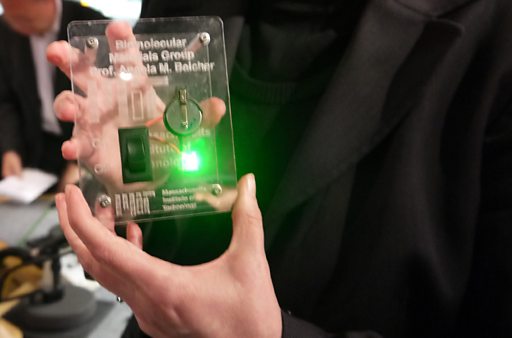
Angela Belcher with Virus Battery. Photo: BBC
Viral motoring
What Dr Belcher would really like to do, however, is to scale the process up so that one day it is possible to produce a virus battery powerful enough to run an electric car. With a paper in Nature Communications in November 2013, that day moved a step closer. The MIT team demonstrated how to use viruses to make a lightweight lithium-air battery, which the researchers think could have an energy density more than twice that of the best lithium-ion cells, the type which are currently used in most electric cars, as well as myriad portable electronic devices. But there is still a long way to go before such a battery could be put into commercial use.
“I think it is very appealing that you can grow environmentally friendly battery parts”

Many still find the idea strange. “I am sometimes told: ‘what are you doing using a virus to make a battery? These things don’t go together,’” says Dr Belcher. Yet, as she points out, biological processes tend to be non-toxic, low-energy ways to make things, and result in little waste, unlike many conventional manufacturing processes in which batteries are made with noxious materials in energy-intensive factories. “I think it is very appealing that you can grow environmentally friendly battery parts,” she adds.

When scaled up for commercial use, the viruses may take a back seat. This is the case with some of Dr Belcher’s projects which are already in the shops. In 2002, along with Evelyn Hu, a materials scientist then with the University of California, Santa Barbara, Dr Belcher co-founded Cambrios. This is a Silicon Valley company which makes transparent silver nanowires for use in touch screens. The nanowires are contained in inks which can be spread across the screen to provide a grid that produces an electrical signal when touched. The production process itself does not use viruses, but is based on techniques employed by them.


A number of companies are now using Cambrios’s technology in the screens of their smartphones, tablets and televisions. In December 2013 3M, a giant American maker of numerous innovative products, said it would employ Cambrios’s nanowire ink in a film that can be used to make giant, flexible touchscreens.

Image from Silura Technologies
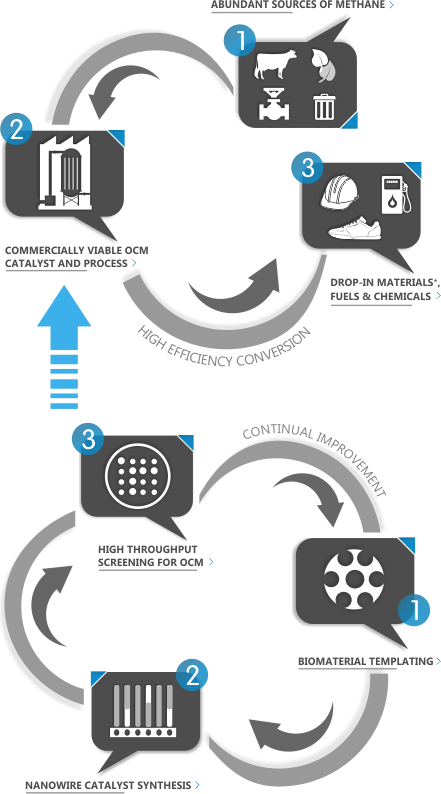
Siluria Technologies, another Californian company, was co-founded by Dr Belcher in 2007. It uses viruses to produce templates for materials that work as catalysts to stimulate novel chemical reactions. Siluria is developing a catalytic process to turn methane, the principal component of natural gas, into petrol (gasoline) for cars. America now has an abundance of natural gas, thanks to the hydraulic fracturing, or “fracking”, of underground rocks. Siluria is building a demonstration plant near Houston to scale up the process and prove its commercial potential.

Siluria Process
How our process fits into industry, and how our catalyst materials are produced and continuously improved.


Siluria's scalable OCM process technology is designed to produce drop-in fuels and chemicals from a virtually endless supply of methane. Our catalyst materials make this process technology possible.
At the heart of Siluria's catalyst-development workflow are unique nano-structures inspired by nature. We have combined three highly innovative technologies to create our growing family of commercially viable OCM catalysts.

* Materials are 100% compatible with existing recycling infrastructure.

The same basic virus toolkit is now being used by Dr Belcher and her colleagues in the medical field. Dr Belcher is a member of two MIT faculties: materials science and engineering, and biological engineering. In 2010 she added a third by joining MIT’s Koch Institute for Integrative Cancer Research. She was nervous about this: “Working on cancer is so important. I didn’t want to take up space and not contribute and make a difference.” But she attended tutorials and became more confident by considering cancer as yet another material to work with. Although it is early days, the work looks promising.

The plan is to produce a medical probe which can be used to locate extremely small tumours. One way this is being tried is to get genetically engineered viruses to latch onto carbon nanotubes which glow under light from a laser. These viruses carrying the tubes would be injected into the body, and with light shining on the skin, be capable of glowing up to 10cm or so inside the body. The glow can be detected with a specialised camera.

To get these beacon viruses into the right places, the researchers engineer them to have a second affinity, one that makes them bind to certain kinds of cancer cells. They would then find any tumours, attach to them and glow.

The technique is still experimental and is being tried out in the laboratory on cellular models of ovarian cancer, which can be difficult for surgeons to detect when the tumours are tiny. There is a lot to do, but, says Dr Belcher, “I know we can find very small tumours and that should allow surgeons to remove them.”

It also raises an obvious question: if the viruses can find tumours and light them up could they also carry with them some kind of lethal weapon? Not surprisingly, that possibility is being explored, with attempts to engineer cancer-seeking viruses that can carry both an imaging material and a chemotherapy agent.

Dr Belcher’s idea of evolving organisms to help build novel materials and new devices is starting to look like a technique with a large number of potential applications. Already she has to be able to switch from discussing with one group of her colleagues the complexities of binding materials to cancer cells, to debating with others how to clean up industrial wastewater with genetically engineered yeasts (her work is not confined to tinkering with the DNA of viruses). “There are so many areas we would like to be involved in, but we can’t do them all,” Dr Belcher laments. The trouble is, her idea born from an abalone shell seems bound to turn up even more problems which are waiting to be solved.

ORIGINAL: The Economist

martes, 4 de marzo de 2014

How Academia and Publishing are Destroying Scientific Innovation: A Conversation with Sydney Brenner


The LMB Governing Board, October 1967. Left to right: Hugh Huxley, John Kendrew, Max Perutz, Francis Crick, Fred Sanger, Sydney Brenner. (From the website of the MRC Laboratory of Molecular Biology)


I recently had the privilege of speaking with Professor Sydney Brenner, a professor of Genetic medicine at the University of Cambridge and Nobel Laureate in Physiology or Medicine in 2002. I had originally intended to ask him about Professor Frederick Sanger, the two-time Nobel Prize winner famous for his discovery of the structure of proteins and his development of DNA sequencing methods, who passed away in November. I wanted to do the classic tribute by exploring his scientific contributions and getting a first hand account of what it was like to work with him at Cambridge’s Medical Research Council’s (MRC) Laboratory for Molecular Biology (LMB) and at King’s College where they were both fellows. What transpired instead was a fascinating account of the LMB’s quest to unlock the genetic code and a critical commentary on why our current scientific research environment makes this kind of breakthrough unlikely today.

http://www2.mrc-lmb.cam.ac.uk/wordpress/wp-content/uploads/newlmbslide1.jpg
LMB at Cambridge. Original LMB

It is difficult to exaggerate the significance of Professor Brenner and his colleagues’ contributions to biology. Brenner won the Nobel Prize for establishing Caenorhabditis elegans, a type of roundworm, as the model organism for cellular and developmental biological research, which led to discoveries in organ development and programmed cell death. He made his breakthroughs at the LMB, where beginning in the 1950s, an extraordinary number of successive innovations elucidated our understanding of the genetic code. This code is the process by which cells in our body translate information stored in our DNA into proteins, vital molecules important to the structure and functioning of cells. It was here that James Watson and Francis Crick discovered the double-helical structure of DNA. Brenner was one of the first scientists to see this ground-breaking model, driving from Oxford, where he was working at the time in the Department of Chemistry, to Cambridge to witness this breakthrough. This young group of scientists, considered renegades at the time, made a series of successive revolutionary discoveries that ultimately led to the creation of a new field called molecular biology.

To begin our interview, I asked Professor Brenner to speak about Professor Sanger and what led him to his Nobel Prize winning discoveries.

Sydney Brenner: Fred realized very early on that if we could sequence DNA, we would have direct contact with the genes. The problem was that you couldn’t get hold of genes in any way. You couldn’t purify what was a gene. That is why right from the start in 1954, we decided we would do this by using Fred’s method of sequencing proteins, which he had achieved [proteins are derived from the information held in DNA]. You have to realise it was only on a small scale. I think there were only forty-five amino acids [the building blocks of proteins] that were in insulin. We thought even scaling that up for proteins would be difficult. But finally DNA sequencing was invented. Then it became clear that we could directly approach the gene, and it produced a completely new period in science.

He was interested in the method and interested in getting the methods to work. I was really clear in my own mind that what he did in DNA sequencing, even at the time, would cause a revolution in the subject, which it did. And of course we immediately, as fast as possible, began to use these methods in our own research.

ED: This foundational research ushered in a new era of biological science. It has formed the basis of nearly all subsequent discoveries in the field, from understanding the mechanisms of diseases, to the development of new drugs for diseases such as cancer. Imagining the creative energy that drove these discoveries was truly inspirational. I asked Professor Brenner what it felt like to be part of this scientific adventure.

SB: I think it’s really hard to communicate that because I lived through the entire period from its very beginning, and it took on different forms as matters progressed. So it was, of course, wonderful. That’s what I tell students. The way to succeed is to get born at the right time and in the right place. If you can do that then you are bound to succeed. You have to be receptive and have some talent as well.

ED: Today, the structure of DNA and how genetic information is translated into proteins are established scientific canon. Brenner joked that he “knew that molecular biology was doomed to success when [he] heard two students speaking in a bus once and asking whether they would get the genetic code in the examination. It had become an academic subject.” But in the 1950s, the hypotheses generated at the LMB were dismissed as inconceivable nonsense.

SB: To have seen the development of a subject, which was looked upon with disdain by the establishment from the very start, actually become the basis of our whole approach to biology today. That is something that was worth living for.

I remember Francis Crick gave a lecture in 1958, in which he discussed the adapter hypothesis at the time. He proposed that there were twenty enzymes, which linked amino acids to twenty different molecules of RNA, which we call adapters. It was these adapters that lined up the amino acids. The adapter hypothesis was conceived I think as early as 1954 and of course it was to explain these two languages: 
DNA, the language of information, and 
proteins, the language of work.

Of course that was a paradox, because how did you get one without the other? That was solved by discovering that a molecule from RNA could actually have function. So this information on RNA, which happened much later really, solved that problem as far as origins were concerned.

ED: (Professor Brenner was far too modest here, as it was he who discovered RNA’s critical role in this translation from gene to protein.)

SB: So he [Crick] gave the lecture and biochemists stood up in the audience and said this is completely ridiculous, because if there were twenty enzymes, we biochemists would have already discovered them. To them, the fact that they still hadn’t went to show that this was nonsense. Little did the man know that at that very moment scientists were in the process of finding the very first of these enzymes, which today we know are the enzymes that combined amino acids with transfer RNA. And so you really had to say that the message kept its purity all the way through.

What people don’t realise is that at the beginning, it was just a handful of people who saw the light, if I can put it that way. So it was like belonging to an evangelical sect, because there were so few of us, and all the others sort of thought that there was something wrong with us.

They weren’t willing to believe. Of course they just said, well, what you’re trying to do is impossible. That’s what they said about crystallography of large molecules. They just said it’s hopeless. It’s a hopeless task. And so what we were trying to do with the chemistry of proteins and nucleic acids looked hopeless for a long time. Partly because they didn’t understand how they were built, which I think we molecular biologists had the first insight into, and partly because they just thought they were amorphous blobs and would never be able to be analysed.

I remember when going to London to talk at meetings, people used to ask me what am I going to do in London, and I used to tell them I’m going to preach to the heathens. We viewed most of everybody else as not doing the right science. Like one says, the young Turks will become old Greeks. That’s the trouble with life. I think molecular biology was marvellous because every time you thought it was over and it was just going to be boring, something new happened. It was happening every day.

So I don’t know if you can ride on the crest of a wave; you can ride on it, I believe, forever. I think that being in science is the most incredible experience to have, and I now spend quite a lot of my time trying to help the younger people in science to enjoy it and not to feel that they are part of some gigantic machine, which a lot of people feel today.

ED: I asked him what inspired them to maintain their faith and pursue these revolutionary ideas in the face of such doubt and opposition.

SB: Once you saw the light you were just certain that you had to be right, that it was the right way to do it and the right answer. And of course our faith, if you like, has been borne out.

I think it would have been difficult to keep going without the strong support we had from the Medical Research Council. I think they took a big gamble when they founded that little unit in the Cavendish. I think all the early people they had were amazing. There were amazing personalities amongst them.

This was not your usual university department, but a rather flamboyant and very exceptional group that was meant to get together. An important thing for us was that with the changes in America then, from the late fifties almost to the present day, there was an enormous stream of talent and American postdoctoral fellows that came to our lab to work with us. But the important thing was that they went back. Many of them are now leaders of American molecular biology, who are alumni of the old MRC.

ED: The 1950s to 1960s at the LMB was a renaissance of biological discovery, when a group of young, intrepid scientists made fundamental advances that overturned conventional thinking. The atmosphere and camaraderie reminded me of another esteemed group of friends at King’s College – the Bloomsbury Group, whose members included Virginia Woolf, John Maynard Keynes, E.M. Forester, and many others. Coming from diverse intellectual backgrounds, these friends shared ideas and attitudes, which inspired their writing and research. Perhaps there was something about the nature of the Cambridge college systems that allowed for such revolutionary creativity?

SB: In most places in the world, you live your social life and your ordinary life in the lab. You don’t know anybody else. Sometimes you don’t even know other people in the same building, these things become so large.

The wonderful thing about the college system is that it’s broken up again into a whole different unit. And in these, you can meet and talk to, and be influenced by and influence people, not only from other scientific disciplines, but from other disciplines. So for me, and I think for many others as well, that was a really important part of intellectual life. That’s why I think people in the college have to work to keep that going.

Cambridge is still unique in that you can get a PhD in a field in which you have no undergraduate training. So I think that structure in Cambridge really needs to be retained, although I see so often that rules are being invented all the time. In America you’ve got to have credits from a large number of courses before you can do a PhD. That’s very good for training a very good average scientific work professional. But that training doesn’t allow people the kind of room to expand their own creativity. But expanding your own creativity doesn’t suit everybody. For the exceptional students, the ones who can and probably will make a mark, they will still need institutions free from regulation.

ED: I was excited to hear that we had a mutual appreciation of the college system, and its ability to inspire interdisciplinary work and research. Brenner himself was a biochemist also trained in medicine, and Sanger was a chemist who was more interested in chemistry than biology.

SB: I’m not sure whether Fred was really interested in the biological problems, but I think the methods he developed, he was interested in achieving the possibility of finding out the chemistry of all these important molecules from the very earliest.

ED: Professor Brenner noted that these scientific discoveries required a new way of approaching old problems, which resist traditional disciplinary thinking.

SB: The thing is to have no discipline at all. Biology got its main success by the importation of physicists that came into the field not knowing any biology and I think today that’s very important.

I strongly believe that the only way to encourage innovation is to give it to the young. The young have a great advantage in that they are ignorant. Because I think ignorance in science is very important. If you’re like me and you know too much you can’t try new things. I always work in fields of which I’m totally ignorant.

ED: But he felt that young people today face immense challenges as well, which hinder their ability to creatively innovate.

SB: Today the Americans have developed a new culture in science based on the slavery of graduate students. Now graduate students of American institutions are afraid. He just performs. He’s got to perform. The post-doc is an indentured labourer. We now have labs that don’t work in the same way as the early labs where people were independent, where they could have their own ideas and could pursue them.

The most important thing today is for young people to take responsibility, to actually know how to formulate an idea and how to work on it. Not to buy into the so-called apprenticeship. I think you can only foster that by having sort of deviant studies. That is, you go on and do something really different. Then I think you will be able to foster it.

But today there is no way to do this without money. That’s the difficulty. In order to do science you have to have it supported. The supporters now, the bureaucrats of science, do not wish to take any risks. So in order to get it supported, they want to know from the start that it will work. This means you have to have preliminary information, which means that you are bound to follow the straight and narrow.

There’s no exploration any more except in a very few places. You know like someone going off to study Neanderthal bones. Can you see this happening anywhere else? No, you see, because he would need to do something that’s important to advance the aims of the people who fund science.

I think I’ve often divided people into two classes: Catholics and Methodists. Catholics are people who sit on committees and devise huge schemes in order to try to change things, but nothing’s happened. Nothing happens because the committee is a regression to the mean, and the mean is mediocre. Now what you’ve got to do is good works in your own parish. That’s a Methodist.

ED: His faith in young, naïve (in the most positive sense) scientists is so strong that he has dedicated his later career to fostering their talent against these negative forces.

SB: I am fortunate enough to be able to do this because in Singapore I actually have started two labs and am about to start a third, which are only for young people. These are young Singaporeans who have all been sent abroad to get their PhDs at places like Cambridge, Stanford, and Berkeley. They return back and rather than work five years as a post-doc for some other person, I’ve got a lab where they can work for themselves. They’re not working for me and I’ve told them that.

But what is interesting is that very few accept that challenge, providing what I think is a good standard deviation from the mean. Exceptional people, the ones who have the initiative, have gone out and got their own funding. I think these are clearly going to be the winners. The eldest is thirty-two.

They can have some money, and of course they’ve got to accept the responsibility of execution. I help them in the sense that I oblige them and help them find things, and I can also guide them and so on. We discuss things a lot because I’ve never believed in these group meetings, which seems to be the bane of American life; the head of the lab trying to find out what’s going on in his lab. Instead, I work with people one on one, like the Cambridge tutorial. Now we just have seminars and group meetings and so on.

So I think you’ve got to try to do something like that for the young people and if you can then I think you will create. That’s the way to change the future. Because if these people are successful then they will be running science in twenty years’ time.

ED: Our discussion made me think about what we consider markers of success today. It reminded me of a paragraph in Professor Brenner’s tribute to Professor Sanger in Science:

“A Fred Sanger would not survive today’s world of science. With continuous reporting and appraisals, some committee would note that he published little of import between insulin in 1952 and his first paper on RNA sequencing in 1967 with another long gap until DNA sequencing in 1977. He would be labelled as unproductive, and his modest personal support would be denied. We no longer have a culture that allows individuals to embark on long-term—and what would be considered today extremely risky—projects.”

I found this particularly striking given that another recent Nobel prize winner, Peter Higgs, who identified the particle that bears his name, the Higgs boson, similarly remarked in an interview with the Guardian that, “he doubts a similar breakthrough could be achieved in today’s academic culture, because of the expectations on academics to collaborate and keep churning out papers. He said that: ‘it’s difficult to imagine how I would ever have enough peace and quiet in the present sort of climate to do what I did in 1964.’”

domingo, 16 de febrero de 2014

New Science Journal to Launch

The American Association for the Advancement of Science, publisher of the journal Science, announces plans for a new digital open-access publication, Science Advances.


ELIZA GRINNELL, HARVARD SCHOOL OF ENGINEERING AND APPLIED SCIENCES

At the Annual Meeting of the American Association for the Advancement of Science (AAAS) in Chicago today (February 12), the organization announced the launch of its newest journal, a broadly focused, online-only publication called Science Advances. The journal will be fully open access, with authors paying article processing fees for publication, and will cover topics from life science to the social sciences to technology, engineering, and mathematics.

“This new publication is designed to encourage transformative research and attract a wide readership,” Science Editor-in-Chief Marcia McNutt said in a press release. “Science is becoming more integrated and interdisciplinary. This is why we decided to establish a single new journal with the broadest possible array of outstanding content, encompassing all fields of science.”

Science Advances is expected to debut next year. Manuscripts submitted to Science, Science Translational Medicine, or Science Signaling that receive favorable reviews will be automatically considered for publication in the new journal. “The goal is to speed publication, alleviate the burden on the reviewer community, and reduce the risk to authors of having to resubmit elsewhere,” McNutt and Alan Leshner, the association’s chief executive officer and executive publisher of Science, wrote in an editorial published this week.

“Since the mid-1990s, technology has posed new challenges for traditional scholarly publications, but it is also creating new opportunities, particularly for online collaboration among researchers,” Leshner said in a statement. “Our new journal will expand authors’ choices as well as the amount of scientific information that reaches the public.”

Tags technology, STEM, science publishing, publishing, open access publishing, open access, mathematics and bioengineering


ORIGINAL: The Scientist

By Jef Akst

February 12, 2014

miércoles, 17 de julio de 2013

Physicists, biologists unite to expose how cancer spreads

ORIGINAL: Princeton
by Catherine Zandonella
April 26, 2013; 01:00 p.m.

Cancer cells that can break out of a tumor and invade other organs are more aggressive and nimble than nonmalignant cells, according to a new multi-institutional nationwide study. These cells exert greater force on their environment and can more easily maneuver small spaces.

The researchers report in the journal Scientific Reports that a systematic comparison of metastatic breast-cancer cells to healthy breast cells revealed dramatic differences between the two cell lines in their mechanics, migration, oxygen response, protein production and ability to stick to surfaces. The researchers discovered new insights into how cells make the transition from nonmalignant to metastatic, a process that is not well understood.

The resulting catalogue of differences could someday help researchers detect cancerous cells earlier and someday prevent or treat metastatic cancer, which is responsible for 90 percent of all cancer deaths, according to the study. It was conducted by a network of 12 federally funded Physical Sciences-Oncology Centers (PS-OC) sponsored by the National Cancer Institute. PS-OC is a collaboration of researchers in the physical and biological sciences seeking a better understanding of the physical and chemical forces that shape the emergence and behavior of cancer.
(Image by Guillaume Lambert)


A multi-institutional study including researchers from Princeton University's Physical Sciences-Oncology Center found that metastatic cancer cells are more aggressive and nimble than nonmalignant cells. The Princeton group used silicon-etched microchannels (above) to study the behavior and physical properties of cancer cells. In this device, metastatic cancer cells enter the narrow channels at one end and accelerate as they rapidly move down the channel. Such high motility is a hallmark of metastasis and also indicative of high glucose metabolism, another hallmark of cancer.

"By bringing together different types of experimental expertise to systematically compare metastatic and nonmetastatic cells, we have advanced our knowledge of how metastasis occurs," said Robert Austin, professor of physics and leader of the Princeton PS-OC, along with senior co-investigator Thea Tlsty of the University of California-San Francisco.

Researchers with the Princeton PS-OC, for instance, determined that metastatic cells, in spite of moving more slowly than nonmalignant cells, move farther and in a straighter line, Austin said. The investigators studied the cells' behavior in tiny cell-sized chambers and channels etched out of silicon and designed to mimic the natural environment of the body's interior.

"The mobility of these metastatic cells is an essential feature of their ability to break through the tough membrane [the extracellular matrix] that the body uses to wall off the tumor from the rest of the body," Austin said. "These cells are essentially jail-breakers."

The tiny silicon chambers were built using Princeton's expertise in microfabrication technology — typically used to create small technologies such as integrated circuits and solar cells — and are an example of the type of expertise that physicists and engineers can bring to cancer research, Austin said. For the current study, the Princeton team included physics graduate students David Liao and Guillaume Lambert, and postdoctoral researchers Liyu Liu and Saurabh Vyawahare. They worked closely with a research group led by James Sturm, Princeton's William and Edna Macaleer Professor of Engineering and Applied Science and director of the Princeton Institute for the Science and Technology of Materials (PRISM) where the microfabrication was done.

The Princeton PS-OC also includes collaborators at the Johns Hopkins University School of Medicine, the Salk Institute for Biological Studies and the University of California-Santa Cruz.

The nationwide PS-OC program aims to crack the difficulty of understanding and treating cancer by bringing in researchers from physics, engineering, computer science and chemistry, said Nastaran Zahir Kuhn, program manager for the PS-OC at the National Cancer Institute.

Other notable findings from the paper include that metastatic cells recover more rapidly from the stress of a low-oxygen environment than nonmetastatic cells, which is consistent with previous studies. Although the low-oxygen environment did kill many of the metastatic cells, the survivors rebounded vigorously, underscoring the likely role of individual cells in the spread of cancer. The study also looked at total protein production and detected proteins in the metastatic cells that are consistent with the physical properties such as mobility that malignant cells need to invade the extracellular matrix.

"The PS-OC program aims to bring physical sciences tools and perspectives into cancer research," Kuhn said. "The results of this study demonstrate the utility of such an approach, particularly when studies are conducted in a standardized manner from the beginning."

For the nationwide project, nearly 100 investigators from 20 institutions and laboratories conducted their experiments using the same two cell lines, reagents and protocols to assure that results could be compared. The experimental methods ranged from physical measurements of how the cells push on surrounding cells to measurements of gene and protein expression.

"Roughly 20 techniques were used to study the cell lines, enabling identification of a number of unique relationships between observations," Kuhn said.

For example, a technique known as atomic force microscopy indicated that metastatic cells are softer than nonmalignant cells whereas a different technique, traction force microscopy, suggested that metastatic cells exert more force on their surroundings, Kuhn said. Together these two findings may indicate that metastatic cells can exert force to stick to, migrate on and remodel the tough extracellular matrix that surrounds the tumor, while remaining flexible enough to squeeze through small spaces in that membrane.