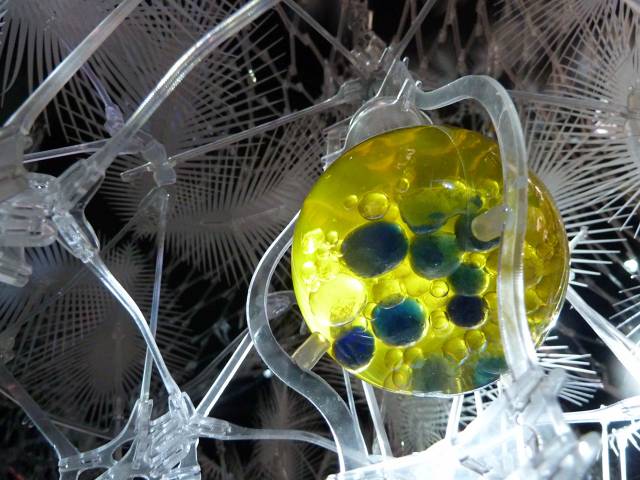
Droplets of filamentous material enclosed in a lipid membrane: these are the models of a "simplified" cell used by the SISSA physicists Luca Giomi and Antonio DeSimone, who simulated the spontaneous emergence of cell motility and division -- that is, features of living material -- in inanimate "objects."The research is one of the cover stories of the April 10th online issue of the journal Physical Review Letters. Giomi and DeSimone's artificial cells are in fact computer models that mimic some of the physical properties of the materials making up the inner content and outer membrane of cells.
The two researchers varied some of the parameters of the materials, recording what happened: "our 'cells' are a 'bare bones' representation of a biological cell, which normally contains microtubules, elongated proteins enclosed in an essentially lipid cell membrane," explains Giomi, first author of the study. "The filaments contained in the 'cytoplasm' of our cells slide over one another exerting a force that we can control."
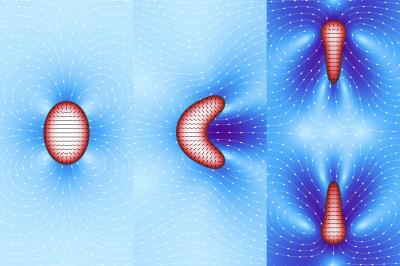
The force exerted by the filaments is the variable that competes with another force, the surface tension that keeps the membrane surrounding the droplet from collapsing. The generates a flow in the fluid surrounding the droplet, which in turn is propelled by such self-generated flow. When the flow becomes very strong, the droplet deforms to the point of dividing. "When the force of the flow prevails over the force that keeps the membrane together we have cellular division," explains DeSimone, director of the SISSA mathLab, SISSA's mathematical modelling and scientific computing laboratory.
"We showed that by acting on a single physical parameter in a very simple model we can reproduce similar effects to those obtained with experimental observations," continues DeSimone. Empirical observations on microtubule specimens have shown that these also move outside the cell environment, in a manner proportional to the energy they have (derived from ATP, the cell "fuel"). "Similarly, our droplets, fuelled by their 'inner' energy alone -- without forces acting from the outside -- are able to move and even divide."
"Acquiring motility and the ability to divide is a fundamental step for life and, according to our simulations, the laws governing these phenomena could be very simple. Observations like ours can prepare the way for the creation of functioning artificial cells, and not only," comments Giomi. "Our work is also useful for understanding the transition from non-living to living matter on our planet. The development of the early forms of life, in other words."
Chemists and biologists who study the origin of life don't have access to cells that are sufficiently simple to be observed directly. "Even the simplest organism existing today has undergone billions of years of evolution," explains Giomi, "and will always contain fairly complex structures. Starting from schematic organisms as we do is like turning the clock back to when the first rudimentary living beings made their first appearance. We are currently starting studies to understand how cell metabolism emerged."
VIDEO: Artificial cell simulation (courtesy of Physical Review Letters):http://goo.gl/vLDcbB
Droplets of filamentous material enclosed in a lipid membrane: these are the models of a "simplified" cell used by the SISSA physicists Luca Giomi and Antonio DeSimone, who simulated the spontaneous emergence of cell motility and division -- that is, features of living material -- in inanimate "objects."The research is one of the cover stories of the April 10th online issue of the journal Physical Review Letters. Giomi and DeSimone's artificial cells are in fact computer models that mimic some of the physical properties of the materials making up the inner content and outer membrane of cells.
The two researchers varied some of the parameters of the materials, recording what happened: "our 'cells' are a 'bare bones' representation of a biological cell, which normally contains microtubules, elongated proteins enclosed in an essentially lipid cell membrane," explains Giomi, first author of the study. "The filaments contained in the 'cytoplasm' of our cells slide over one another exerting a force that we can control."
The force exerted by the filaments is the variable that competes with another force, the surface tension that keeps the membrane surrounding the droplet from collapsing. The generates a flow in the fluid surrounding the droplet, which in turn is propelled by such self-generated flow. When the flow becomes very strong, the droplet deforms to the point of dividing. "When the force of the flow prevails over the force that keeps the membrane together we have cellular division," explains DeSimone, director of the SISSA mathLab, SISSA's mathematical modelling and scientific computing laboratory.
"We showed that by acting on a single physical parameter in a very simple model we can reproduce similar effects to those obtained with experimental observations," continues DeSimone. Empirical observations on microtubule specimens have shown that these also move outside the cell environment, in a manner proportional to the energy they have (derived from ATP, the cell "fuel"). "Similarly, our droplets, fuelled by their 'inner' energy alone -- without forces acting from the outside -- are able to move and even divide."
"Acquiring motility and the ability to divide is a fundamental step for life and, according to our simulations, the laws governing these phenomena could be very simple. Observations like ours can prepare the way for the creation of functioning artificial cells, and not only," comments Giomi. "Our work is also useful for understanding the transition from non-living to living matter on our planet. The development of the early forms of life, in other words."
Chemists and biologists who study the origin of life don't have access to cells that are sufficiently simple to be observed directly. "Even the simplest organism existing today has undergone billions of years of evolution," explains Giomi, "and will always contain fairly complex structures. Starting from schematic organisms as we do is like turning the clock back to when the first rudimentary living beings made their first appearance. We are currently starting studies to understand how cell metabolism emerged."
VIDEO: Artificial cell simulation (courtesy of Physical Review Letters): http://goo.gl/vLDcbB
The ubiquity and diverse functionality of ribonucleic acid (RNA) in today’s world suggest that the information polymer could well have been the leading player early on in the establishment of life on Earth, and, in theory, it’s a logical basis for primitive life. One can readily imagine that RNA, as a catalytic molecule capable of serving as a template for its own replication, might have reproduced itself and grown exponentially in the primordial environment. Perhaps such an RNA-based proto–life-form even replicated with an appropriate level of fidelity to allow natural selection to begin directing its evolution.
But there’s a snag: “The odds of suddenly having a self-replicating RNA pop out of a prebiotic soup are vanishingly low,” says evolutionary biochemist Niles Lehman of Portland State University in Oregon.
For decades, researchers from diverse fields have theorized—and argued—about how early life might have begun, and about what sparked the 3.5 billion years of evolution that led to the plethora of cell-based life that occupies almost every nook and cranny of modern Earth. Different camps emerged. So-called “metabolism first” researchers focus on understanding chemical cycles that may have materialized in a prebiotic environment and could have led to the synthesis of nucleotides and other organic molecules. Those subscribing to the theory of “genetics first” want to identify the first information molecule and understand how it arose, replicated, and evolved.
The RNA world, first posited by Francis Crick1 and others in the late 1960s, remains an attractive hypothesis. Many of the chemical hurdles that once challenged the laboratory synthesis of the molecule under presumed primordial conditions are being overcome, and in vitro evolution experiments are yielding RNA molecules that perform numerous functions, including copying themselves or other RNAs. “I don’t think there can be much doubt that RNA was a major central player as both a catalyst and an early replicator,” says Nick Lane, a biochemist at the University College London whose research falls under the “metabolism first” label. “So the RNA world is absolutely correct, as far as I’m concerned, in that.”
But the notion that RNA, on its own, spontaneously assembled and evolved on early Earth has fallen out of favor. More likely, whatever conditions spawned compounds as complex as nucleotides also generated other organics, perhaps early forms of modern amino acids and fatty acids, the constituent parts of proteins and membranes. “I’m not sure how many people anymore believe in a pure RNA world. I certainly don’t,” says Lane. “I think the field has drifted away from that, and there’s now an acknowledgment it had to be ‘dirty.’ ”
“I think most people would argue that there’s . . . more than just RNA,” agrees Matthew Powner, a “genetics first” origins-of-life researcher, also at University College London. (See “Matthew Powner: Origin Solver,” The Scientist, March 2014) “People have relaxed their opinions of the RNA world . . . from its original inception where RNA was fundamental to all parts of biology in the earliest form of life.”
Dec. 20, 2012 — A coherent pathway -- which starts from no more than rocks, water and carbon dioxide and leads to the emergence of the strange bio-energetic properties of living cells -- has been traced for the first time in a major hypothesis paper in Cell this week.
A major new hypothesis outlines a coherent pathway that starts from no more than rocks, water and carbon dioxide and leads to the emergence of the strange bio-energetic properties of living cells. (Credit: iStockphoto/Henrik Jonsson)
At the origin of life the first protocells must have needed a vast amount of energy to drive their metabolism and replication, as enzymes that catalyse very specific reactions were yet to evolve. Most energy flux must have simply dissipated without use.
So where did it all that energy come from on the early Earth, and how did it get focused into driving the organic chemistry required for life?
The answer lies in the chemistry of deep-sea hydrothermal vents. In their paper Nick Lane (UCL, Genetics, Evolution and Environment) and Bill Martin (University of Dusseldorf) address the question of where all this energy came from -- and why all life as we know it conserves energy in the peculiar form of ion gradients across membranes.
"Life is, in effect, a side-reaction of an energy-harnessing reaction. Living organisms require vast amounts of energy to go on living," said Nick Lane.
Humans consume more than a kilogram (more than 700 litres) of oxygen every day, exhaling it as carbon dioxide. The simplest cells, growing from the reaction of hydrogen with carbon dioxide, produce about 40 times as much waste product from their respiration as organic carbon (by mass). In all these cases, the energy derived from respiration is stored in the form of ion gradients over membranes.
This strange trait is as universal to life as the genetic code itself. Lane and Martin show that bacteria capable of growing on no more than hydrogen and carbon dioxide are remarkably similar in the details of their carbon and energy metabolism to the far-from-equilibrium chemistry occurring in a particular type of deep-sea hydrothermal vent, known as alkaline hydrothermal vents.
Based on measured values, they calculate that natural proton gradients, acting across thin semi-conducting iron-sulfur mineral walls, could have driven the assimilation of organic carbon, giving rise to protocells within the microporous labyrinth of these vents.
They go on to demonstrate that such protocells are limited by their own permeability, which ultimately forced them to transduce natural proton gradients into biochemical sodium gradients, at no net energetic cost, using a simple Na+/H+ transporter. Their hypothesis predicts a core set of proteins required for early energy conservation, and explains the puzzling promiscuity of respiratory proteins for both protons and sodium ions.
These considerations could also explain the deep divergence between bacteria and archaea (single celled microorganisms) . For the first time, says Lane, "It is possible to trace a coherent pathway leading from no more than rocks, water and carbon dioxide to the strange bioenergetic properties of all cells living today."
We are on the verge of producing “synthetic cells,” or protocells, in which some, many or all of the tasks of a real biological cell are harnessed into a synthetic platform. Such advances are made possible through genetic engineering, microfabrication technologies, and the development of cellular membranes from new surfactants that extend beyond phospholipids in stability and chemical control, and can be used to introduce designer functionality into membranes and cells. We review some of the recent advances in the development of synthetic cells and suggest future exciting directions.
Highlights
► We review recent advances in the development of artificial cells.
► Synthetic gene circuits will enable signaling and control systems within artificial membranes.
► We discuss the constructing of vesicle membranes using recombinant biotechnology.
► We highlight studies in which catalysis, compartmentalization, and adhesion is conducted.
► We discuss recent work conducted to create regenerating membranes.
(Phys.org) -- The discovery of a synthetic molecule, made up of 60 simple components that are able to reorganise themselves to produce new functions, will lead to better understanding of nature's processes.
p-Toluidine, 6,6′-diformyl-3,3′-bipyridine and cobalt(II) triflimide react to form a complex dynamic library of interconverting coordination complexes 1 (i). A Co4L6 tetrahedron 2 (shown in diagrammatic form above the crystal structure)
a, Side view of the cationic part of the crystal structure of3·(ClO4)5·Cl, which shows the parallel rings of equatorial ligands (red and blue) and the axial bridging ligands (green); cobalt, orange. b, Side view of a ball-and-stick representation
The perchlorate anion is shown in red, triflate in green and hexafluorophosphate in blue. Co4L6 tetrahedra 2 shown in brackets are kinetic products observed to evolve to the corresponding thermodynamic Co10L15 products, 3, on heating.
The incredibly complex structure of the pentagonal prismatic molecule was discovered when researchers working at The University of Queensland (UQ), The University of Cambridge, and Randolph-Macon College in the USA, formed the structure by transforming a tetrahedral molecule into a second structure - a barrel-like pentagonal prism.
Understanding the structure of synthetic molecules which are able to reorganise themselves is important as it helps scientists to understand natural processes in molecules such as viruses which are assembled from small parts.
The finding was published this month in the journal Nature Chemistry and the researchers have produced a movie showing the molecule and its 60 simple components to assist readers to understand its complexity.
In synthesising the molecule, the researchers used a technique known as “self-assembly”, which regulates many of the complex and functional components in biological systems like DNA, to prepare a molecular tetrahedron from twenty-two simple building blocks.
The building blocks employed were then chemically programmed to spontaneously react together to form the desired molecule.
UQ's School of Chemistry & Molecular Biosciences Dr Jack Clegg said in addition of a chemical template, the tetrahedral molecule was reconfigured into a new barrel-like structure composed of an impressive 60 smaller molecules.
“Up until now we've only be able to do this on a very basic level,” Dr Clegg said.
"We've succeeded in preparing and characterising a new chemical system that is capable of structural reconstitution on receipt of one molecular signal to create a tight binding pocket for a chloride anion."
More information: Nature Chemistry ( DOI:10.1038/NCHEM.1407 , published online 5 August 2012).
By: Laura E. Bratton, MD, Rodney Shackelford, DO, Ph.D.
May 3, 2012
The idea of producing artificial or synthetic life has long fascinated mankind and from ancient times many human and animal-imitating “automata” or self-operating machines have been created for entertainment, instructional, and sometimes religious purposes. The creation of actual synthetic biological life only became possible with the discovery of the structure of DNA, the genetic code, and the development of the basic tools of molecular biology, such as the ability to isolate, sequence, and join different DNA sequences. Especially important has been the recently developed ability to artificially synthesize relatively long DNA molecules with designed sequences. Although the creation of completely synthetic biological life was first accomplished in 2010, the field is already yielding significant information concerning the core gene groups or genetic “chassis” indispensible for life and how these gene products (proteins, RNAs, and lipids) function as an integrated unit. With the identification of these chassis, exogenous natural or synthetic gene sequences can be integrated into organisms designed for specific purposes and applications.
The first genetically engineered organism was created in 1973 when a naturally occurring DNA sequence was transferred into and expressed in a bacterium, conferring antibiotic resistance. The first organism to actually have a synthetic (or man-made “added”) biochemical pathway was created in 2003, when an E. coli was artificially created with a new genetic code and amino acid synthesizing enzymes. The engineered bacterium could synthesize and incorporate an amino acid (O-methyl-L-tyrosine) that does not normally occur in nature into proteins, increasing the number of amino acids used in virtually all life forms from twenty to twenty-one amino acids. Thus a new, human-designed functioning genetic chassis and genetic code was placed into a microorganism.
In 2010, after some fifteen years of intense research effort, the first entirely synthetic organism was created with a genome entirely synthesized “out of four bottles” i.e., chemically synthesized from the four DNA bases; thymine, cytosine, guanine, and adenine. The organism was partially based on M. mycoides, a genetically simple microorganism containing roughly 480 protein-encoding genes and a genome size of 1.08 million DNA base pairs – in comparison the human genome has roughly 20,500 genes over three billion DNA base pairs. The synthetic genome was chemically synthesized in 80-90 base units and slowly assembled into “DNA cassettes”, verified by sequencing, and assembled into a circular genome. To insure that no natural DNA contaminated the synthetic DNA “watermark” sequences were inserted into synthetic genome to differentiate it from the natural M. mycoides genome. Additionally, antibiotic resistance genes were added and a disease-inducing gene was removed from the synthetic genome. The resulting genome was place in an empty M. capricolum cell (i.e., without a nucleus) and the resulting synthetic life from was able to grow in culture indefinitely. Since 2010 this synthetic organism has been useful in identifying the “minimal genome” required for life – about 380 of the 480 protein-encoding genes. Additionally, comparison of the synthetic organism to similar naturally occurring organisms (Mycoplasmas), allowed the identification of gene groups involved in cellular processes such as
information storage,
metabolism,
energy production and conversion, and
cell membrane biogenesis.
Identification of these gene sets is an important first step designing synthetic life that can perform specific functions.
Although a significant first step in the creation of synthetic biological life, this initial work met with extensive criticism. The researchers who made synthetic life were accused of “playing God” and possibly opening up a new technology that would allow the creation of “biological super weapons”. The later objection has some validity, as existing DNA synthesis and end-joining technology could allow the synthesis of fully infective polio or smallpox viruses. Other researchers pointed out that the new synthetic organism was a nearly one-to-one copy of a naturally occurring organism and for it to grow the synthetic genome had to be placed into a naturally occurring Mycoplasma that had its nucleus removed. Thus, other than the DNA being artificially synthesized, there was relatively little that was actually new about the organism. The creators of the new organism pointed out that this is a first step of many and “creating life from scratch” will come later.
Currently the immediate focus in synthetic biological life research is to use simple synthetic organisms to define the “minimal genome”, or the smallest set of genes required to support life and identify the components and functions of “biological gene-chassis” and find ways to modify these chassis. Specific applications include the creation of synthetic organisms that can:
efficiently produce pharmaceuticals and vaccines that are otherwise difficult and expensive to produce,
efficiently produce hydrocarbon biofuels (replacing oil, coal, etc.), and
be useful as plant feedstock in agriculture, lowering the need for increasingly expensive petroleum-based fertilizers.
An example of such an application has been inserting the enzymes for artemisinic acid synthesis into baker’s yeast. Artemisinic acid is the chemical precursor anti-malarial drug artmisinin, a drug that is currently extracted from the sweet wormwood plant at high cost, reducing the drugs availability in poorer countries. Once the enzymatic pathway is in place and efficiently working, the drug could be produced cheaply in large amounts through a process resembling brewing beer. Several of these projects are being researched at Synthetic Genomics, a new biotechnology company specializing in the creation of synthetic life for specific applications.
Not surprisingly the creation of synthetic animal life is more complex and difficult than for simpler microorganisms. However, a round worm (C. elegans) was created that carried an extensively expanded genetic code and protein synthesis pathways, allowing the incorporation of multiple novel (or “unnatural”) amino acids into the animal’s proteins. These protein modifications would facilitate the study of protein localization and interactions within a living animal. Additionally, modified proteins could be designed for specific purposes, such as protein-based drugs with very long half-lives due to novel amino acids that inhibit normal cellular protein degradation.
Although difficult, our present molecular biology technology could allow the creation of more complex organisms, including fungi and even animals. The present challenges in creating synthetic life include the following:
Create synthetic life “from scratch” without the need to largely copy existing life forms.
Improve on our ability to design and integrate molecular pathways within synthetic life.
Create a strategy or “algorithm” to for the efficient creation of synthetic life forms.
Create policies and rules to prevent the creation of synthetic life forms that may be harmful, such as human pathogens (smallpox, virulent influenza viral types, etc.).
With time these goals could be achieved and the technology to accomplish these goals is largely in place.
In the more distant future synthetic biology could allow the extensive modification of existing genomes and even the creation of entirely new genomes and species. While this is the goal of many Transhumanists, one hopes that if and when such technology exists, the human race has the intelligence to apply such technology with wisdom.
Dr. Shackelford is an Assistant Professor of Clinical Pathology at Tulane Medical Center. He has a DO degree from Des Moines University of Osteopathic Medicine and a Ph.D. in molecular pathology from Duke University. His areas of research include DNA repair, molecular mechanisms of carcinogenesis, and cell division.
Our built environment doesn’t have to be static. With the right synthetic biology, it can respond automatically to changes in temperature or moisture level, and even react to natural disasters, hunkering down during earthquakes or removing toxins after a toxic spill.
Synthetic-biology-based approaches to design practices, which have a material engagement with design and engineering practices, propose a new set of conditions in which architectures can alter their characteristics to suit changing environmental conditions. Living materials raise the possibility that buildings can make a positive impact on their local surroundings by performing remedial functions, that the construction of architecture could actually heal a stressed environment, for example, by removing toxins or fixing greenhouse gases. These new technologies could be on building exteriors, which present a managed interface with the environment.
EDITOR’S NOTE: This is an excerpt from Rachel Armstrong’s TED Book, Living Architecture. You can purchase it on Amazon here.
Responsive architectures that are sensitive to their local environment can revitalize cities and equip communities with the ability to deal with and recover from radical disturbances in their surroundings, such as a natural disaster. Indeed, all cities should be designed with environmental crises in mind, whether they have reached the proportions of a megacity or not. Densely populated areas need to be considered potential disaster zones, where living spaces are at risk from the accumulation of toxic waste and from physical damage as a consequence of our unstable Earth. Given the present environmental challenges and worldwide population growth, fundamental changes in the expectations of buildings must be considered globally. This is a more urgent and radical requirement than current notions of sustainable development that pander to industrial developers; it promotes and demands an immediate rethinking of the way that we build our homes and cities. The strategic use of these new materials, woven into the substance of the urban landscape on building surfaces and into structural fabrics, provides an opportunity for buildings to actively participate in environmental challenges.
Architectural performance is currently optimized under stable conditions, but its suitability to any given environment will change when even minor variations occur, such as changes in the weather. Current predictions suggest that a worldwide trend toward increasingly variable weather patterns can be expected over the course of the century. The inflexibility of today’s buildings to deal with daily fluctuations, where walkways regularly flood after a moderate downpour in places such as New York, offers a telling snapshot of how unprepared cities are for even more challenging environmental changes like rises in sea level. In general, radical changes in infrastructure are contemplated following, rather than in anticipation of, a natural disaster. For example, Japan’s world leadership in disaster-prevention technologies has been prompted by a century of devastating earthquakes.
Synthetic-biology approaches change our expectations of architecture. Rather than being inert, buildings could respond to the seasons as our parks and gardens do, with living coatings adapting to the availability of more or less wind, sunlight and water. Protocell-based coatings offer not only the capacity for a unique growth of materials but also potential applications in "healing" "broken" buildings, by which molecular interactions detect and deposit material into stress fractures to form "scar tissue" at the microscale.
In the right contexts these kinds of surfaces could stabilize unsafe buildings such as those in Sendai and the surrounding region, which was so recently devastated by seismic activity. These new materials do not replace existing forms of architectural practice but are symbiotic with them and ultimately equip existing buildings with the capacity to engage in a literal struggle for survival so they can co-evolve with their surroundings. These approaches can produce a range of building types that are uniquely tuned to the particular niche conditions of an environment to create a range of responsive architectural experiences.
Novel materials may change the "fertility" of an urban environment. Cities could be active sites of resource production rather than sumps of consumption. Living materials could be used on the roofs of our cities, like solar panels, to harvest carbon dioxide and produce energy in the form of liquid fuel rather than electricity, rather as the green leaves of plants do, as an alternative to cutting down trees or burning fossil fuels.
Places such as Yemen, the saltbush country in Australia, and the Colorado River in the United States, which are all experiencing effects of the worldwide water crisis, need buildings that enable communities to conserve and recycle water. Living materials could function as an integral part of the recycling of domestic water supplies, so that waste could be filtered within the building fabric in a similar way to how soils purify water. Protocell technology and synthetic-biology-based techniques also raise the possibility of a hygroscopic architecture that retains and processes water after absorbing it as dew in the morning, or during a rainfall, to provide readily available sources for human consumption. Excess water could be channeled into reservoirs within the fabric of a building rather than tipped as waste runoff into drains, or used to create clouds of moisture-containing minerals that could precipitate as carbon-dioxide-fixing rain. Traditional materials that are stressed by water could possess paradoxical properties when used in combination with living technologies and may, in fact, blossom in the presence of water. They could tolerate water excesses and manage water shortages during droughts.
Designer chemistries could also produce new functionality within bioscaffolding coats such as resins that are applied to building facades. There, environmental triggers could cause a species of protocell activated by moisture to produce pockets of gas such as carbon dioxide, which would create reversibly spongy matrixes that allowed materials to float in wet conditions and return to a stronger, unexpanded state on drying. Such novel building properties could change the appearance of the built environment during times of rainfall; walkways, for example, could be raised by the increased turgor and swelling of materials. When water was extracted from the materials by usage, convection, and evaporation, the buildings would dry out and return to a less fleshy, more familiar appearance.When water was extracted from the materials by usage, convection, and evaporation, the buildings would dry out and return to a less fleshy, more familiar appearance.
Protocell technologies function in a dynamic and useful way in conditions that are hostile to biology. The recent chemical spill from an alumina plant in Ajka in western Hungary--where an avalanche of toxic, flesh-corroding, alkaline, chemical waste burst from a reservoir about 160 kilometers (100 miles) from the capital Budapest--affected an area of 40 square kilometers (15.4 square miles). Seven villages and towns were affected, including Devecser, where the torrent was 2 meters deep. The heavy contamination means that almost an inch of soil has to be removed from the whole of the contaminated region. Even after neutralization of the chemicals, dust from the affected area is likely to pose a cancer risk to residents. This is a situation in which nonbiological protocell technologies could be used to perform remedial functions under conditions that would destroy most natural organisms.
Protocell coatings could be designed to neutralize the effect of the alkali through application to building exteriors once the main spill has been neutralized. Since protocells are active under even very strongly alkaline conditions, they could be used to treat unneutralized alkali that is carried on contaminated dust from the site of the disaster into living spaces. In other toxic situations synthetic biologies, which can tolerate extreme environmental conditions, could also act as remediating display systems to warn residents about the presence of dangerous toxins, especially when these chemicals cannot be smelled or seen, like radioactive waste (for example, genetically modified radioactivity-resistant bacteria could be engineered to express a fluorescent gene in the presence of nuclear waste).
Living technologies may ultimately have the ability to change the fundamental relationship between human development and the environment. This would be a major shift in our building practices that could contribute to our continued survival rather than the destruction of our biosphere. One day, this pastoral role conferred by architecture on the environment may extend to its human inhabitants. We may think of our buildings as domestic guardians that offer robust protection against the consequences of climate change, or the advent of natural disasters.
Rachel Armstrong is the co-director of AVATAR (Advanced Virtual and Technological Architectural Research) specializing in Architecture and Synthetic Biology at the School of Architecture & Construction, University of Greenwich, London. She is also a Senior TED Fellow and a Visiting Researching Assistant at the Center for Fundamental Living Technology, Department of Physics and Chemistry, University of Southern Denmark.
You can view Armstrong’s TED Talk on self-repairing architecture here.



 PDF (174 K)