Mostrando entradas con la etiqueta U of Cambridge. Mostrar todas las entradas

domingo, 30 de octubre de 2016

Functioning ‘mechanical gears’ seen in nature for the first time (2013)


The gear teeth on the opposing hind-legs lock together like those in a car gear-box, ensuring almost complete synchronicity in leg movement - the legs always move within 30 ‘microseconds’ of each other, with one microsecond equal to a millionth of a second.


Previously believed to be only man-made, a natural example of a functioning gear mechanism has been discovered in a common insect - showing that evolution developed interlocking cogs long before we did.

"In Issus, the skeleton is used to solve a complex problem that the brain and nervous system can’t " 
Malcolm Burrows

The juvenile Issus - a plant-hopping insect found in gardens across Europe - has hind-leg joints with curved cog-like strips of opposing ‘teeth’ that intermesh, rotating like mechanical gears to synchronise the animal’s legs when it launches into a jump.

The finding demonstrates that gear mechanisms previously thought to be solely man-made have an evolutionary precedent. Scientists say this is the “first observation of mechanical gearing in a biological structure”.

Through a combination of anatomical analysis and high-speed video capture of normal Issus movements, scientists from the University of Cambridge have been able to reveal these functioning natural gears for the first time. The findings are reported in the latest issue of the journal Science.

The gears in the Issus hind-leg bear remarkable engineering resemblance to those found on every bicycle and inside every car gear-box.

Each gear tooth has a rounded corner at the point it connects to the gear strip; a feature identical to man-made gears such as bike gears – essentially a shock-absorbing mechanism to stop teeth from shearing off.
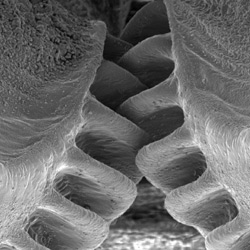
Image: Cog wheels connecting the hind legs
of the plant hopper, Issus.

Credit: Burrows/Sutton
This is critical for the powerful jumps that are this insect’s primary mode of transport, as even miniscule discrepancies in synchronisation between the velocities of its legs at the point of propulsion would result in “yaw rotation” - causing the Issus to spin hopelessly out of control.


The juvenile Issus - a plant-hopping insect found in gardens across Europe - has hind-leg joints with curved cog-like strips of opposing ‘teeth’ that intermesh, rotating like mechanical gears to synchronise the animal’s legs when it launches into a jump.

The finding demonstrates that gear mechanisms previously thought to be solely man-made have an evolutionary precedent. Scientists say this is the “first observation of mechanical gearing in a biological structure”.

Through a combination of anatomical analysis and high-speed video capture of normal Issus movements, scientists from the University of Cambridge have been able to reveal these functioning natural gears for the first time. The findings are reported in the latest issue of the journal Science.

The gears in the Issus hind-leg bear remarkable engineering resemblance to those found on every bicycle and inside every car gear-box.

Each gear tooth has a rounded corner at the point it connects to the gear strip; a feature identical to man-made gears such as bike gears – essentially a shock-absorbing mechanism to stop teeth from shearing off.

Image: Cog wheels connecting the hind legs
of the plant hopper, Issus.

Credit: Burrows/Sutton
This is critical for the powerful jumps that are this insect’s primary mode of transport, as even miniscule discrepancies in synchronisation between the velocities of its legs at the point of propulsion would result in “yaw rotation” - causing the Issus to spin hopelessly out of control.

“This precise synchronisation would be impossible to achieve through a nervous system, as neural impulses would take far too long for the extraordinarily tight coordination required,” said lead author Professor Malcolm Burrows, from Cambridge’s Department of Zoology.

“By developing mechanical gears, the Issus can just send nerve signals to its muscles to produce roughly the same amount of force - then if one leg starts to propel the jump the gears will interlock, creating absolute synchronicity.

“In Issus, the skeleton is used to solve a complex problem that the brain and nervous system can’t,” said Burrows. “This emphasises the importance of considering the properties of the skeleton in how movement is produced.”

"We usually think of gears as something that we see in human designed machinery, but we've found that that is only because we didn't look hard enough,” added co-author Gregory Sutton, now at the University of Bristol.</ 1px #666; font-size: large; margin: 10px; padding: 10px; position: center; width: 450px;">
"In Issus, the skeleton is used to solve a complex problem that the brain and nervous system can’t "
Malcolm Burrows

The juvenile Issus - a plant-hopping insect found in gardens across Europe - has hind-leg joints with curved cog-like strips of opposing ‘teeth’ that intermesh, rotating like mechanical gears to synchronise the animal’s legs when it launches into a jump.

The finding demonstrates that gear mechanisms previously thought to be solely man-made have an evolutionary precedent. Scientists say this is the “first observation of mechanical gearing in a biological structure”.

Through a combination of anatomical analysis and high-speed video capture of normal Issus movements, scientists from the University of Cambridge have been able to reveal these functioning natural gears for the first time. The findings are reported in the latest issue of the journal Science.

The gears in the Issus hind-leg bear remarkable engineering resemblance to those found on every bicycle and inside every car gear-box.

Each gear tooth has a rounded corner at the point it connects to the gear strip; a feature identical to man-made gears such as bike gears – essentially a shock-absorbing mechanism to stop teeth from shearing off.

Image: Cog wheels connecting the hind legs
of the plant hopper, Issus.

Credit: Burrows/Sutton
This is critical for the powerful jumps that are this insect’s primary mode of transport, as even miniscule discrepancies in synchronisation between the velocities of its legs at the point of propulsion would result in “yaw rotation” - causing the Issus to spin hopelessly out of control.

“This precise synchronisation would be impossible to achieve through a nervous system, as neural impulses would take far too long for the extraordinarily tight coordination required,” said lead author Professor Malcolm Burrows, from Cambridge’s Department of Zoology.

“By developing mechanical gears, the Issus can just send nerve signals to its muscles to produce roughly the same amount of force - then if one leg starts to propel the jump the gears will interlock, creating absolute synchronicity.

“In Issus, the skeleton is used to solve a complex problem that the brain and nervous system can’t,” said Burrows. “This emphasises the importance of considering the properties of the skeleton in how movement is produced.”

"We usually think of gears as something that we see in human designed machinery, but we've found that that is only because we didn't look hard enough,” added co-author Gregory Sutton, now at the University of Bristol.

Image: Cog wheels connecting the hind legs of the plant hopper, Issus.
Credit: Burrows/Sutton

“These gears are not designed; they are evolved - representing high speed and precision machinery evolved for synchronisation in the animal world.”

Interestingly, the mechanistic gears are only found in the insect’s juvenile – or ‘nymph’ – stages, and are lost in the final transition to adulthood. These transitions, called ‘molts’, are when animals cast off rigid skin at key points in their development in order to grow.

It’s not yet known why the Issus loses its hind-leg gears on reaching adulthood. The scientists point out that a problem with any gear system is that if one tooth on the gear breaks, the effectiveness of the whole mechanism is damaged. While gear-teeth breakage in nymphs could be repaired in the next molt, any damage in adulthood remains permanent.

It may also be down to the larger size of adults and consequently their ‘trochantera’ – the insect equivalent of the femur or thigh bones. The bigger adult trochantera might allow them to create enough friction to power the enormous leaps from leaf to leaf without the need for intermeshing gear teeth to drive it, say the scientists.
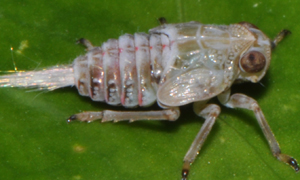
Inset image: an Issus nymph
Each gear strip in the juvenile Issus was around 400 micrometres long and had between 10 to 12 teeth, with both sides of the gear in each leg containing the same number – giving a gearing ratio of 1:1.

Unlike man-made gears, each gear tooth is asymmetrical and curved towards the point where the cogs interlock – as man-made gears need a symmetric shape to work in both rotational directions, whereas the Issus gears are only powering one way to launch the animal forward.

While there are examples of apparently ornamental cogs in the animal kingdom - such as on the shell of the cog wheel turtle or the back of the wheel bug - gears with a functional role either remain elusive or have been rendered defunct by evolution.

The Issus is the first example of a natural cog mechanism with an observable function, say the scientists.


For more information, please contact fred.lewsey@admin.cam.ac.uk


Malcolm Burrows†, Gregory Sutton*
12 Sep 2013
div>

Image: Cog wheels connecting the hind legs of the plant hopper, Issus.
Credit: Burrows/Sutton

“These gears are not designed; they are evolved - representing high speed and precision machinery evolved for synchronisation in the animal world.”

Interestingly, the mechanistic gears are only found in the insect’s juvenile – or ‘nymph’ – stages, and are lost in the final transition to adulthood. These transitions, called ‘molts’, are when animals cast off rigid skin at key points in their development in order to grow.

It’s not yet known why the Issus loses its hind-leg gears on reaching adulthood. The scientists point out that a problem with any gear system is that if one tooth on the gear breaks, the effectiveness of the whole mechanism is damaged. While gear-teeth breakage in nymphs could be repaired in the next molt, any damage in adulthood remains permanent.

It may also be down to the larger size of adults and consequently their ‘trochantera’ – the insect equivalent of the femur or thigh bones. The bigger adult trochantera might allow them to create enough friction to power the enormous leaps from leaf to leaf without the need for intermeshing gear teeth to drive it, say the scientists.

Inset image: an Issus nymph
Each gear strip in the juvenile Issus was around 400 micrometres long and had between 10 to 12 teeth, with both sides of the gear in each leg containing the same number – giving a gearing ratio of 1:1.

Unlike man-made gears, each gear tooth is asymmetrical and curved towards the point where the cogs interlock – as man-made gears need a symmetric shape to work in both rotational directions, whereas the Issus gears are only powering one way to launch the animal forward.

While there are examples of apparently ornamental cogs in the animal kingdom - such as on the shell of the cog wheel turtle or the back of the wheel bug - gears with a functional role either remain elusive or have been rendered defunct by evolution.

The Issus is the first example of a natural cog mechanism with an observable function, say the scientists.


For more information, please contact fred.lewsey@admin.cam.ac.uk


Malcolm Burrows†, Gregory Sutton*
12 Sep 2013
text-align: justify;"> “This precise synchronisation would be impossible to achieve through a nervous system, as neural impulses would take far too long for the extraordinarily tight coordination required,” said lead author Professor Malcolm Burrows, from Cambridge’s Department of Zoology.

“By developing mechanical gears, the Issus can just send nerve signals to its muscles to produce roughly the same amount of force - then if one leg starts to propel the jump the gears will interlock, creating absolute synchronicity.

“In Issus, the skeleton is used to solve a complex problem that the brain and nervous system can’t,” said Burrows. “This emphasises the importance of considering the properties of the skeleton in how movement is produced.”

"We usually think of gears as something that we see in human designed machinery, but we've found that that is only because we didn't look hard enough,” added co-author Gregory Sutton, now at the University of Bristol.</ 1px #666; font-size: large; margin: 10px; padding: 10px; position: center; width: 450px;">
"In Issus, the skeleton is used to solve a complex problem that the brain and nervous system can’t "
Malcolm Burrows

The juvenile Issus - a plant-hopping insect found in gardens across Europe - has hind-leg joints with curved cog-like strips of opposing ‘teeth’ that intermesh, rotating like mechanical gears to synchronise the animal’s legs when it launches into a jump.

The finding demonstrates that gear mechanisms previously thought to be solely man-made have an evolutionary precedent. Scientists say this is the “first observation of mechanical gearing in a biological structure”.

Through a combination of anatomical analysis and high-speed video capture of normal Issus movements, scientists from the University of Cambridge have been able to reveal these functioning natural gears for the first time. The findings are reported in the latest issue of the journal Science.

The gears in the Issus hind-leg bear remarkable engineering resemblance to those found on every bicycle and inside every car gear-box.

Each gear tooth has a rounded corner at the point it connects to the gear strip; a feature identical to man-made gears such as bike gears – essentially a shock-absorbing mechanism to stop teeth from shearing off.

Image: Cog wheels connecting the hind legs
of the plant hopper, Issus.

Credit: Burrows/Sutton
This is critical for the powerful jumps that are this insect’s primary mode of transport, as even miniscule discrepancies in synchronisation between the velocities of its legs at the point of propulsion would result in “yaw rotation” - causing the Issus to spin hopelessly out of control.

“This precise synchronisation would be impossible to achieve through a nervous system, as neural impulses would take far too long for the extraordinarily tight coordination required,” said lead author Professor Malcolm Burrows, from Cambridge’s Department of Zoology.

“By developing mechanical gears, the Issus can just send nerve signals to its muscles to produce roughly the same amount of force - then if one leg starts to propel the jump the gears will interlock, creating absolute synchronicity.

“In Issus, the skeleton is used to solve a complex problem that the brain and nervous system can’t,” said Burrows. “This emphasises the importance of considering the properties of the skeleton in how movement is produced.”

"We usually think of gears as something that we see in human designed machinery, but we've found that that is only because we didn't look hard enough,” added co-author Gregory Sutton, now at the University of Bristol.

Image: Cog wheels connecting the hind legs of the plant hopper, Issus.
Credit: Burrows/Sutton

“These gears are not designed; they are evolved - representing high speed and precision machinery evolved for synchronisation in the animal world.”

Interestingly, the mechanistic gears are only found in the insect’s juvenile – or ‘nymph’ – stages, and are lost in the final transition to adulthood. These transitions, called ‘molts’, are when animals cast off rigid skin at key points in their development in order to grow.

It’s not yet known why the Issus loses its hind-leg gears on reaching adulthood. The scientists point out that a problem with any gear system is that if one tooth on the gear breaks, the effectiveness of the whole mechanism is damaged. While gear-teeth breakage in nymphs could be repaired in the next molt, any damage in adulthood remains permanent.

It may also be down to the larger size of adults and consequently their ‘trochantera’ – the insect equivalent of the femur or thigh bones. The bigger adult trochantera might allow them to create enough friction to power the enormous leaps from leaf to leaf without the need for intermeshing gear teeth to drive it, say the scientists.

Inset image: an Issus nymph
Each gear strip in the juvenile Issus was around 400 micrometres long and had between 10 to 12 teeth, with both sides of the gear in each leg containing the same number – giving a gearing ratio of 1:1.

Unlike man-made gears, each gear tooth is asymmetrical and curved towards the point where the cogs interlock – as man-made gears need a symmetric shape to work in both rotational directions, whereas the Issus gears are only powering one way to launch the animal forward.

While there are examples of apparently ornamental cogs in the animal kingdom - such as on the shell of the cog wheel turtle or the back of the wheel bug - gears with a functional role either remain elusive or have been rendered defunct by evolution.

The Issus is the first example of a natural cog mechanism with an observable function, say the scientists.


For more information, please contact fred.lewsey@admin.cam.ac.uk


Malcolm Burrows†, Gregory Sutton*
12 Sep 2013
div>

Image: Cog wheels connecting the hind legs of the plant hopper, Issus.
Credit: Burrows/Sutton

“These gears are not designed; they are evolved - representing high speed and precision machinery evolved for synchronisation in the animal world.”

Interestingly, the mechanistic gears are only found in the insect’s juvenile – or ‘nymph’ – stages, and are lost in the final transition to adulthood. These transitions, called ‘molts’, are when animals cast off rigid skin at key points in their development in order to grow.

It’s not yet known why the Issus loses its hind-leg gears on reaching adulthood. The scientists point out that a problem with any gear system is that if one tooth on the gear breaks, the effectiveness of the whole mechanism is damaged. While gear-teeth breakage in nymphs could be repaired in the next molt, any damage in adulthood remains permanent.

It may also be down to the larger size of adults and consequently their ‘trochantera’ – the insect equivalent of the femur or thigh bones. The bigger adult trochantera might allow them to create enough friction to power the enormous leaps from leaf to leaf without the need for intermeshing gear teeth to drive it, say the scientists.

Inset image: an Issus nymph
Each gear strip in the juvenile Issus was around 400 micrometres long and had between 10 to 12 teeth, with both sides of the gear in each leg containing the same number – giving a gearing ratio of 1:1.

Unlike man-made gears, each gear tooth is asymmetrical and curved towards the point where the cogs interlock – as man-made gears need a symmetric shape to work in both rotational directions, whereas the Issus gears are only powering one way to launch the animal forward.

While there are examples of apparently ornamental cogs in the animal kingdom - such as on the shell of the cog wheel turtle or the back of the wheel bug - gears with a functional role either remain elusive or have been rendered defunct by evolution.

The Issus is the first example of a natural cog mechanism with an observable function, say the scientists.


For more information, please contact fred.lewsey@admin.cam.ac.uk


Malcolm Burrows†, Gregory Sutton*
12 Sep 2013

jueves, 23 de junio de 2016

Ten institutions that dominated science in 2015

Getty Images/iStockphoto/Thinkstock
The University of Oxford is the top research UK university in the Nature Index for the first time.

The top 10 institutions in the Nature Index are the largest contributors to papers published in 68 leading journals in 2015.


Weighted fractional count (WFC): 1357.82

Established in 1949 in Beijing, the Chinese Academy of Sciences (CAS) is the world’s largest scientific organisation, comprising 114 institutes and 48,500 researchers. In 2015 its scientists made the largest contribution to high-quality research included in the index, a contribution that’s grown by a compound annual growth rate of 6.8% since 2012. Last year, one of the oldest CAS research centres, the Institute of Chemistry, founded in 1956, was also one of the largest contributing departments to the institute’s weighted fractional count. Lei Jiang, from the Institute of Chemistry, says: “Chemistry and materials science are currently strong in China because they were relatively easy subjects to start researching back in the 1980s. They didn’t need expensive equipment. If you look at nanoscience as an example, around half of the top scientists in global nanoscience are Chinese scientists who were educated during this period.”

2. Harvard University, United States

WFC: 772.33

As the second most prolific institution in the Index, and the most prolific university, Harvard University owes two-thirds of its research output to contributions made in the life sciences. Recognising the growth of interdisciplinary research areas such as translational medicine in the life sciences, Harvard has responded by developing an integrated PhD programme that facilitates cross-disciplinary academic and research collaboration. The Harvard Medical School (HMS), established in 1782, is one of the discipline’s high-fliers. Since the 1930s, fifteen researchers from HMS have shared in nine Nobel Prizes. For the most recent of them, in 2009, Jack Szostak discovered how telomeres cap the ends of chromosomes and protect them from degradation, opening up new lines of enquiry into ageing and cancer research. While last year, a popular piece of research from Harvard’s sleep medicine department highlighted the negative effects of light-emitting e-readers on sleep quality.


WFC: 699.45

The French National Centre for Scientific Research (CNRS) is the largest fundamental research organisation in Europe, comprising ten institutions with more than 32,000 researchers, engineers and technicians. The physical sciences made up more than a third of the contributions to the Index in 2015. In recent years the CNRS has become a key player in planetary science. CNRS engineers have been remotely operating and maintaining instruments on board NASA’s Curiosity Rover, which has been exploring Mars since 2012. The mission lead to the confirmation late last year that liquid water currently flows on the planet. This year CNRS researcher Franck Montmessin is leading the European Space Agency’s mission ExoMars 2016 to investigate the planet’s atmosphere and find evidence of past life beneath its surface.

4. Max Planck Society, Germany

WFC: 655.67

Ranked fourth in the Nature Index, the Max Planck Society has the physical sciences to thank for its high position. Since 1914, physics researchers at Max Planck, a government-funded association of research institute, have won nine Nobel Prizes. The society is named after the quantum theorist, Max Planck, the institute’s second Nobel recipient in 1918, four years after Max von Laue won for his pioneering work in X-ray crystallography. During the Second World War, Laue’s gold medal was dissolved in acid to prevent discovery by the Nazis, and then recast by the Nobel Society after the war. Today, two institutes stand out in terms of research output in the index: the polymer and solid state research units. Last year, nanochemistry scientists focusing on solid-state research published a paper in Advanced Materials that explored moisture-sensitive technology and its potential use in touchless screens.

5. Stanford University, United States

WFC: 530.83

When Stanford University opened its doors to students in 1891, it became one of America’s first non-sectarian, co-educational private colleges. Stanford’s first president, David Starr Jordan, said: “Work in applied science is to be carried out side-by-side with the pure sciences and humanities, and to be equally fostered.” This attitude remains true today as research output is equally balanced between all the disciplines. The university is also credited for its entrepreneurial spirit. During the 1950s, the University leased land to a new industrial park that went on to become Silicon Valley. To this day, Stanford researchers continue this legacy of real-world influence. Howard Rose, a Stanford residential fellow and CEO of Deep Stream VR, is currently developing a virtual reality app called Cool! that is designed to immerse patients in a world that enables them to manage chronic pain without drugs.


WFC: 487.03

Last year’s Nobel Prize for Physics went to Takaaki Kajita, the director of the University of Tokyo’s Institute for Cosmic Ray Research. But UTokyo is not resting on its laurels. The university is focused on opening its doors to the outside world by welcoming international collaborations, foreign staff and students, and closer relationships with business. The institute’s latest high-profile research reflects this gearshift. UTokyo’s Graduate School of Frontier Sciences was involved in a decade-long project with four countries to establish the presence of a giant ocean that wraps Saturn’s moon, Encheladus, beneath its crust.


WFC: 483.62

This year marks a hundred years since the Massachusetts Institute of Technology (MIT) moved from Boston to Cambridge in the US. The move ushered in an age of achievement, from the first chemical synthesis of penicillin to building the magnetic core memory that made digital computers possible. The university’s is known for its hands-on approach to teaching and research - students are given a practical-based education in science, technology and related areas of scholarship - appears to be on the money. A 2015 report suggested that 30,000 companies founded by MIT alumni were active as of 2014, employing 4.6 million people and producing annual revenues of $1.9 trillion, equivalent to the world’s 10th largest economy. Eighty-five present and former members of the MIT community have won the Nobel Prize, including nine current faculty members.


WFC: 413.71

The Helmholtz Association of German Research Centres is the country’s largest scientific organisation with almost 38,000 employees and an annual budget of nearly €4 billion. Their research output is dominated by the physical sciences, and last year the Karlsruhe Institute of Technology (KIT) had the biggest impact on the association’s overall ranking in the index. KIT was officially founded in 2009 when the Karlsruhe Research Center and University of Karlsruhe merged. In a recent paper in Nature Photonics, KIT researchers demonstrated a way to store optical information that could dramatically reduce the power consumption and increase the speed of optical communication networks.

9. University of Oxford, United Kingdom

WFC: 398.38

Having produced 16 Nobel Laureates in medicine since 1932, the University of Oxford has a long pedigree in the life sciences. More than 30% of contributions to the most recent Nature Index come from this discipline. In the 21st century, the university focuses on a wide range of fascinating aspects of the life sciences from clinical practice in modern medicine to epidemiological and genetic studies. For example, researchers are currently exploring the negative effects of loud noise in an intensive care unit. Another group of scientists whose research is soon to published, have recently sequenced seven genomes of the Brazilian Zika virus taken from seven different individuals infected with the virus to determine when and where it entered the Americas.

10. University of Cambridge, United Kingdom

WFC: 390.54

A strong showing in the physical sciences has helped put the University of Cambridge in the Nature Index top ten. One of the key contributors to the university’s research output is the Cavendish Laboratory, which is the largest physics department in the UK and birthplace of ground-breaking discoveries such as the structure of DNA, and the splitting the atom. According to Professor Andy Parker, head of the Cavendish Laboratory: “The laboratory’s strength comes from the very wide range of research performed, from cosmology, through solid state and nanoscience, to the physics of medicine, backed up by world-class facilities, and the freedom given to its staff to pursue their own directions. This bottom-up approach to research strategy has proved its worth over many decades.”

How the Nature Index works
Since 2012, every paper published in 68 top-tier journals has been included in the Nature Index database. The index ranks the contribution of research institutions to these articles, by a metric called weighted fractional count (WFC), which divides credit for each article by the affiliations of contributing authors. This measure is weighted to account for the disproportionate number of astronomy articles in the index.

ORIGINAL: Nature Index
By Sarah O'Meara
20 April 2016

martes, 5 de abril de 2016

Scientists have just discovered a new state of matter

Genevieve Martin/Oak Ridge National Laboratory
This is big.

Researchers have just discovered evidence of a mysterious new state of matter in a real material. The state is known as 'quantum spin liquid' and it causes electrons - one of the fundamental, indivisible building blocks of matter - to break down into smaller quasiparticles.

Scientists had first predicted the existence of this state of matter in certain magnetic materials 40 years ago, but despite multiple hints of its existence, they've never been able to detect evidence of it in nature. So it's pretty exciting that they've now caught a glimpse of quantum spin liquid, and the bizarre fermions that accompany it, in a two-dimensional, graphene-like material.

"This is a new quantum state of matter, which has been predicted but hasn't been seen before," said one of the researchers, Johannes Knolle, from the University of Cambridge in the UK.

They were able to spot evidence of quantum spin liquid in the material by observing one of its most intriguing properties - electron fractionalisation - and the resulting Majorana fermions, which occur when electrons in a quantum spin state split apart. These Majorana fermions are exciting because they could be used as building blocks of quantum computers.

To be clear, the electrons aren't actually splitting down into smaller physical particles - which of course would be an even bigger deal (that would mean brand new particles!). What's happening instead is the new state of matter is breaking electrons down into quasiparticles. These aren't actually real particles, but are concepts used by physicists to explain and calculate the strange behaviour of particles.

And the quantum spin liquid state is definitely making electrons act weirdly - in a typical magnetic material, electrons behave like tiny bar magnets. So when the material is cooled to a low enough temperature, these magnet-like electrons order themselves over long ranges, so that all the north magnetic poles point in the same direction.

But in a material containing a quantum spin liquid state, even if a magnetic material is cooled to absolute zero, the electrons don't align, but instead form an entangled soup caused by quantum fluctuations.

"Until recently, we didn't even know what the experimental fingerprints of a quantum spin liquid would look like," said one of the researchers, Dmitry Kovrizhin. "One thing we've done in previous work is to ask, if I were performing experiments on a possible quantum spin liquid, what would I observe?"

To figure out what was going on, the researchers worked alongside a team from Oak Ridge National Laboratory in Tennessee and used neutron scattering techniques to look for evidence of electron fractionalisation in alpha-ruthenium chloride - a material that's structurally similar to graphene.

This also allowed them to measure the signatures of Majorana fermions for the first time by illuminating the material with neutrons, and then observing the pattern of ripples that the neutrons produced when scattered from the sample. 

These patterns were exactly what they'd expect to see based on the main theoretical model of quantum spin liquid, confirming for the first time that they'd seen evidence of it happening in a material.

"This is a new addition to a short list of known quantum states of matter," said Knolle.

"It's an important step for our understanding of quantum matter," added Kovrizhin. "It's fun to have another new quantum state that we've never seen before - it presents us with new possibilities to try new things."

Some of those new things involve quantum computers - which would be exponentially faster than regular computers - so even though all of this sounds pretty theoretical, they could actually have some really exciting potential applications.

The results have been published in Nature Materials.

ORIGINAL: New Scientist
FIONA MACDONALD 
5 APR 2016

martes, 5 de mayo de 2015

Making Sense of the Chemistry That Led to Life on Earth

It was the actions of Jupiter and Saturn that quite inadvertently created life on Earth — not the gods of the Roman pantheon, but the giant planets, which once orbited much closer to the sun.

Driven outward, they let loose a cascade of asteroids, known as the Late Heavy Bombardment, that blasted the surface of the young Earth and created the deep pockmarks still visible on the face of the moon.

In the heat of these impacts, carbon from the meteorites reacted with nitrogen in Earth’s atmosphere to form hydrogen cyanide. Though a deadly poison, cyanide is nonetheless the ancient pathway for inert carbon atoms to enter the chemistry of life.

By the time the Late Heavy Bombardment had eased, some 3.8 billion years ago, the cyanide had rained down into pools, reacted with metals, evaporated, been baked and irradiated with ultraviolet light, and dissolved by streams flowing down to a freshwater pool. The chemicals formed from the interactions of cyanide combined there in various ways to generate the precursors of lipids, nucleotides and amino acids. These are the three significant components of a living cell —
  • lipids make the walls of a cell’s various compartments; 
  • nucleotides store its information; and 
  • amino acids assemble into the proteins that control its metabolism.
All of this is a hypothesis, proposed by John Sutherland, a chemist at the University of Cambridge in England. But he has tested all the required chemical reactions in a laboratory and developed evidence that they are plausible under the conditions expected of primitive Earth.

Having figured out a likely chemistry needed to produce the starting materials of life, Dr. Sutherland then developed this geological scenario because it provides the conditions required by the chemistry.

As for the chemistry itself, that springs from Dr. Sutherland’s discovery six years ago of the key to the RNA world.

Biologists have long favored the idea that the first information-carrying molecule of life was not DNA but its close chemical cousin RNA. RNA can store genetic information and act as an enzyme to create more RNA. Like DNA, RNA is made up of a string of chemical units known as nucleotides. Each nucleotide consists of a sugar, ribose in the case of RNA, joined to a base at one end and to a phosphate group at the other.
The Chemistry of Early Life on Earth
An English chemist has been studying how RNA, a building block of living cells, may have emerged from chemicals present on the Earth’s surface before the first living cells.
The Chemistry of Early Life on Earth
PREVIOUS ATTEMPTS
to explain how RNA formed focused on its three components: a phosphate group, a base and a sugar molecule (ribose).
But chemists could not find a natural way to join the base and sugar to form RNA.

A NEWER MODEL
combines the same starting chemicals in a different order, avoiding the base and sugar molecules.
An RNA molecule can emerge from naturally forming intermediate molecules, part sugar and part base.

Source: Nature
By The New York Times
Researchers trying to reconstruct the chemistry that led to life had shown plausible ways in which ribose and the bases could have arisen. But in prebiotic chemistry, the assumed natural chemistry of Earth before life began, they could find no likely way of joining ribose to a base. So daunting was this obstacle that some began to doubt the idea of an RNA world, looking instead for a pre-RNA system.

After 10 years of testing every possible combination of prebiotic chemicals, Dr. Sutherland discovered that the solution was not to build the ribose and the sugar units separately in textbook fashion, but to construct a substance that was part sugar and part base. The addition of another simple chemical converted this hybrid into a ribonucleotide. The door to the RNA world had at last been opened.

If this step was critical, Dr. Sutherland inferred, then the rest of prebiotic chemistry must somehow be related to it. He and colleagues have spent the last six years doing experiments to see how the ribonucleotide chemistry pathway can be linked back to hydrogen cyanide as its starting point, and how other significant prebiotic chemicals might have emerged from the cyanide-to-nucleotide pathway.

So far they have demonstrated ways to generate
  • 12 of the 20 amino acids used in proteins, 
  • two of the four ribonucleotides of RNA, and 
  • glycerol 1-phosphate, the universal building block of the lipids from which cell membranes are formed. 

Their findings were reported in Nature Chemistry.

Though other researchers have shown how several of these substances could have formed on primitive Earth, these required a variety of conditions, some incompatible. This is the first time that so many significant life chemicals have been shown to emerge from the same chemistry.

Dr. Sutherland’s report “lays out for the first time a scenario for generating potentially all of the building blocks of life in one geological setting,” said Jack W. Szostak, a geneticist at Massachusetts General Hospital who studies the origin of life. “The details of the scenario will be debated for some time, but over all, I think it’s a very big advance,” he said. Dr. Szostak shared the Nobel Prize in Medicine in 2009 for the discovery of the mechanism that protects the ends of chromosomes.

Dr. Sutherland’s chemicals cannot all be mixed together at once. His reaction scheme requires them to be delivered in sequence to a central pool. So in his scenario, separate streams flow over mineral deposits and arrive one by one at the pool. Therein lies a possible weakness, Paul J. Bracher, a chemist at Saint Louis University in Missouri, said in a commentary in Nature Chemistry. “This new report represents a fantastically interesting approach, but origin-of-life chemists still have plenty of work to do in the kitchen,” he wrote.

Others have deeper reservations. Steven Benner, the director of the Foundation for Applied Molecular Evolution in Gainesville, Fla., said that many of the reactions in Dr. Sutherland’s scheme “aren’t real,” meaning that pure chemicals might react as proposed in the laboratory but that the process could not be expected to proceed the same way in a natural mix of chemicals.

Dr. Benner also noted that the popular idea of an RNA world is burdened with several unresolved paradoxes.
  1. One is that if you have a pool of chemicals and pump energy in, “you don’t get life, you get asphalt,” he said, meaning that the chemicals will react together to form a gooey tar. 
  2. Another is that water is essential for life, as are nucleotides, but water destroys nucleotides. 
  3. A third problem is that RNA is assumed to act as an enzyme and as a store of genetic information, but the two roles require contradictory properties: An enzyme must fold up and be reactive, while a genetic molecule should do neither.
The traditional field of prebiotic chemistry has made some headway, in Dr. Benner’s view, but not nearly enough to suggest real answers. “Still, to have these very basic problems left hanging suggests that maybe we’re not answering the correct question,” he said.

Dr. Sutherland is still trying to find plausible routes to the other two RNA nucleotides. He also hopes to understand how the molecules of life could have been built up from their individual units, a process known as polymerization. “In biology, RNA makes protein and proteins make RNA, so the biology is telling you they work in cahoots with each other,” he said. He added that he did not yet know if polymerization would take place on a metal surface, often assumed to be a good catalyst, or inside a cell membrane.

Life may still be unlikely, but at least it’s beginning to seem almost possible.

ORIGINAL: NYTimes
MAY 4, 2015

martes, 4 de marzo de 2014

How Academia and Publishing are Destroying Scientific Innovation: A Conversation with Sydney Brenner


The LMB Governing Board, October 1967. Left to right: Hugh Huxley, John Kendrew, Max Perutz, Francis Crick, Fred Sanger, Sydney Brenner. (From the website of the MRC Laboratory of Molecular Biology)


I recently had the privilege of speaking with Professor Sydney Brenner, a professor of Genetic medicine at the University of Cambridge and Nobel Laureate in Physiology or Medicine in 2002. I had originally intended to ask him about Professor Frederick Sanger, the two-time Nobel Prize winner famous for his discovery of the structure of proteins and his development of DNA sequencing methods, who passed away in November. I wanted to do the classic tribute by exploring his scientific contributions and getting a first hand account of what it was like to work with him at Cambridge’s Medical Research Council’s (MRC) Laboratory for Molecular Biology (LMB) and at King’s College where they were both fellows. What transpired instead was a fascinating account of the LMB’s quest to unlock the genetic code and a critical commentary on why our current scientific research environment makes this kind of breakthrough unlikely today.

http://www2.mrc-lmb.cam.ac.uk/wordpress/wp-content/uploads/newlmbslide1.jpg
LMB at Cambridge. Original LMB

It is difficult to exaggerate the significance of Professor Brenner and his colleagues’ contributions to biology. Brenner won the Nobel Prize for establishing Caenorhabditis elegans, a type of roundworm, as the model organism for cellular and developmental biological research, which led to discoveries in organ development and programmed cell death. He made his breakthroughs at the LMB, where beginning in the 1950s, an extraordinary number of successive innovations elucidated our understanding of the genetic code. This code is the process by which cells in our body translate information stored in our DNA into proteins, vital molecules important to the structure and functioning of cells. It was here that James Watson and Francis Crick discovered the double-helical structure of DNA. Brenner was one of the first scientists to see this ground-breaking model, driving from Oxford, where he was working at the time in the Department of Chemistry, to Cambridge to witness this breakthrough. This young group of scientists, considered renegades at the time, made a series of successive revolutionary discoveries that ultimately led to the creation of a new field called molecular biology.

To begin our interview, I asked Professor Brenner to speak about Professor Sanger and what led him to his Nobel Prize winning discoveries.

Sydney Brenner: Fred realized very early on that if we could sequence DNA, we would have direct contact with the genes. The problem was that you couldn’t get hold of genes in any way. You couldn’t purify what was a gene. That is why right from the start in 1954, we decided we would do this by using Fred’s method of sequencing proteins, which he had achieved [proteins are derived from the information held in DNA]. You have to realise it was only on a small scale. I think there were only forty-five amino acids [the building blocks of proteins] that were in insulin. We thought even scaling that up for proteins would be difficult. But finally DNA sequencing was invented. Then it became clear that we could directly approach the gene, and it produced a completely new period in science.

He was interested in the method and interested in getting the methods to work. I was really clear in my own mind that what he did in DNA sequencing, even at the time, would cause a revolution in the subject, which it did. And of course we immediately, as fast as possible, began to use these methods in our own research.

ED: This foundational research ushered in a new era of biological science. It has formed the basis of nearly all subsequent discoveries in the field, from understanding the mechanisms of diseases, to the development of new drugs for diseases such as cancer. Imagining the creative energy that drove these discoveries was truly inspirational. I asked Professor Brenner what it felt like to be part of this scientific adventure.

SB: I think it’s really hard to communicate that because I lived through the entire period from its very beginning, and it took on different forms as matters progressed. So it was, of course, wonderful. That’s what I tell students. The way to succeed is to get born at the right time and in the right place. If you can do that then you are bound to succeed. You have to be receptive and have some talent as well.

ED: Today, the structure of DNA and how genetic information is translated into proteins are established scientific canon. Brenner joked that he “knew that molecular biology was doomed to success when [he] heard two students speaking in a bus once and asking whether they would get the genetic code in the examination. It had become an academic subject.” But in the 1950s, the hypotheses generated at the LMB were dismissed as inconceivable nonsense.

SB: To have seen the development of a subject, which was looked upon with disdain by the establishment from the very start, actually become the basis of our whole approach to biology today. That is something that was worth living for.

I remember Francis Crick gave a lecture in 1958, in which he discussed the adapter hypothesis at the time. He proposed that there were twenty enzymes, which linked amino acids to twenty different molecules of RNA, which we call adapters. It was these adapters that lined up the amino acids. The adapter hypothesis was conceived I think as early as 1954 and of course it was to explain these two languages: 
DNA, the language of information, and 
proteins, the language of work.

Of course that was a paradox, because how did you get one without the other? That was solved by discovering that a molecule from RNA could actually have function. So this information on RNA, which happened much later really, solved that problem as far as origins were concerned.

ED: (Professor Brenner was far too modest here, as it was he who discovered RNA’s critical role in this translation from gene to protein.)

SB: So he [Crick] gave the lecture and biochemists stood up in the audience and said this is completely ridiculous, because if there were twenty enzymes, we biochemists would have already discovered them. To them, the fact that they still hadn’t went to show that this was nonsense. Little did the man know that at that very moment scientists were in the process of finding the very first of these enzymes, which today we know are the enzymes that combined amino acids with transfer RNA. And so you really had to say that the message kept its purity all the way through.

What people don’t realise is that at the beginning, it was just a handful of people who saw the light, if I can put it that way. So it was like belonging to an evangelical sect, because there were so few of us, and all the others sort of thought that there was something wrong with us.

They weren’t willing to believe. Of course they just said, well, what you’re trying to do is impossible. That’s what they said about crystallography of large molecules. They just said it’s hopeless. It’s a hopeless task. And so what we were trying to do with the chemistry of proteins and nucleic acids looked hopeless for a long time. Partly because they didn’t understand how they were built, which I think we molecular biologists had the first insight into, and partly because they just thought they were amorphous blobs and would never be able to be analysed.

I remember when going to London to talk at meetings, people used to ask me what am I going to do in London, and I used to tell them I’m going to preach to the heathens. We viewed most of everybody else as not doing the right science. Like one says, the young Turks will become old Greeks. That’s the trouble with life. I think molecular biology was marvellous because every time you thought it was over and it was just going to be boring, something new happened. It was happening every day.

So I don’t know if you can ride on the crest of a wave; you can ride on it, I believe, forever. I think that being in science is the most incredible experience to have, and I now spend quite a lot of my time trying to help the younger people in science to enjoy it and not to feel that they are part of some gigantic machine, which a lot of people feel today.

ED: I asked him what inspired them to maintain their faith and pursue these revolutionary ideas in the face of such doubt and opposition.

SB: Once you saw the light you were just certain that you had to be right, that it was the right way to do it and the right answer. And of course our faith, if you like, has been borne out.

I think it would have been difficult to keep going without the strong support we had from the Medical Research Council. I think they took a big gamble when they founded that little unit in the Cavendish. I think all the early people they had were amazing. There were amazing personalities amongst them.

This was not your usual university department, but a rather flamboyant and very exceptional group that was meant to get together. An important thing for us was that with the changes in America then, from the late fifties almost to the present day, there was an enormous stream of talent and American postdoctoral fellows that came to our lab to work with us. But the important thing was that they went back. Many of them are now leaders of American molecular biology, who are alumni of the old MRC.

ED: The 1950s to 1960s at the LMB was a renaissance of biological discovery, when a group of young, intrepid scientists made fundamental advances that overturned conventional thinking. The atmosphere and camaraderie reminded me of another esteemed group of friends at King’s College – the Bloomsbury Group, whose members included Virginia Woolf, John Maynard Keynes, E.M. Forester, and many others. Coming from diverse intellectual backgrounds, these friends shared ideas and attitudes, which inspired their writing and research. Perhaps there was something about the nature of the Cambridge college systems that allowed for such revolutionary creativity?

SB: In most places in the world, you live your social life and your ordinary life in the lab. You don’t know anybody else. Sometimes you don’t even know other people in the same building, these things become so large.

The wonderful thing about the college system is that it’s broken up again into a whole different unit. And in these, you can meet and talk to, and be influenced by and influence people, not only from other scientific disciplines, but from other disciplines. So for me, and I think for many others as well, that was a really important part of intellectual life. That’s why I think people in the college have to work to keep that going.

Cambridge is still unique in that you can get a PhD in a field in which you have no undergraduate training. So I think that structure in Cambridge really needs to be retained, although I see so often that rules are being invented all the time. In America you’ve got to have credits from a large number of courses before you can do a PhD. That’s very good for training a very good average scientific work professional. But that training doesn’t allow people the kind of room to expand their own creativity. But expanding your own creativity doesn’t suit everybody. For the exceptional students, the ones who can and probably will make a mark, they will still need institutions free from regulation.

ED: I was excited to hear that we had a mutual appreciation of the college system, and its ability to inspire interdisciplinary work and research. Brenner himself was a biochemist also trained in medicine, and Sanger was a chemist who was more interested in chemistry than biology.

SB: I’m not sure whether Fred was really interested in the biological problems, but I think the methods he developed, he was interested in achieving the possibility of finding out the chemistry of all these important molecules from the very earliest.

ED: Professor Brenner noted that these scientific discoveries required a new way of approaching old problems, which resist traditional disciplinary thinking.

SB: The thing is to have no discipline at all. Biology got its main success by the importation of physicists that came into the field not knowing any biology and I think today that’s very important.

I strongly believe that the only way to encourage innovation is to give it to the young. The young have a great advantage in that they are ignorant. Because I think ignorance in science is very important. If you’re like me and you know too much you can’t try new things. I always work in fields of which I’m totally ignorant.

ED: But he felt that young people today face immense challenges as well, which hinder their ability to creatively innovate.

SB: Today the Americans have developed a new culture in science based on the slavery of graduate students. Now graduate students of American institutions are afraid. He just performs. He’s got to perform. The post-doc is an indentured labourer. We now have labs that don’t work in the same way as the early labs where people were independent, where they could have their own ideas and could pursue them.

The most important thing today is for young people to take responsibility, to actually know how to formulate an idea and how to work on it. Not to buy into the so-called apprenticeship. I think you can only foster that by having sort of deviant studies. That is, you go on and do something really different. Then I think you will be able to foster it.

But today there is no way to do this without money. That’s the difficulty. In order to do science you have to have it supported. The supporters now, the bureaucrats of science, do not wish to take any risks. So in order to get it supported, they want to know from the start that it will work. This means you have to have preliminary information, which means that you are bound to follow the straight and narrow.

There’s no exploration any more except in a very few places. You know like someone going off to study Neanderthal bones. Can you see this happening anywhere else? No, you see, because he would need to do something that’s important to advance the aims of the people who fund science.

I think I’ve often divided people into two classes: Catholics and Methodists. Catholics are people who sit on committees and devise huge schemes in order to try to change things, but nothing’s happened. Nothing happens because the committee is a regression to the mean, and the mean is mediocre. Now what you’ve got to do is good works in your own parish. That’s a Methodist.

ED: His faith in young, naïve (in the most positive sense) scientists is so strong that he has dedicated his later career to fostering their talent against these negative forces.

SB: I am fortunate enough to be able to do this because in Singapore I actually have started two labs and am about to start a third, which are only for young people. These are young Singaporeans who have all been sent abroad to get their PhDs at places like Cambridge, Stanford, and Berkeley. They return back and rather than work five years as a post-doc for some other person, I’ve got a lab where they can work for themselves. They’re not working for me and I’ve told them that.

But what is interesting is that very few accept that challenge, providing what I think is a good standard deviation from the mean. Exceptional people, the ones who have the initiative, have gone out and got their own funding. I think these are clearly going to be the winners. The eldest is thirty-two.

They can have some money, and of course they’ve got to accept the responsibility of execution. I help them in the sense that I oblige them and help them find things, and I can also guide them and so on. We discuss things a lot because I’ve never believed in these group meetings, which seems to be the bane of American life; the head of the lab trying to find out what’s going on in his lab. Instead, I work with people one on one, like the Cambridge tutorial. Now we just have seminars and group meetings and so on.

So I think you’ve got to try to do something like that for the young people and if you can then I think you will create. That’s the way to change the future. Because if these people are successful then they will be running science in twenty years’ time.

ED: Our discussion made me think about what we consider markers of success today. It reminded me of a paragraph in Professor Brenner’s tribute to Professor Sanger in Science:

“A Fred Sanger would not survive today’s world of science. With continuous reporting and appraisals, some committee would note that he published little of import between insulin in 1952 and his first paper on RNA sequencing in 1967 with another long gap until DNA sequencing in 1977. He would be labelled as unproductive, and his modest personal support would be denied. We no longer have a culture that allows individuals to embark on long-term—and what would be considered today extremely risky—projects.”

I found this particularly striking given that another recent Nobel prize winner, Peter Higgs, who identified the particle that bears his name, the Higgs boson, similarly remarked in an interview with the Guardian that, “he doubts a similar breakthrough could be achieved in today’s academic culture, because of the expectations on academics to collaborate and keep churning out papers. He said that: ‘it’s difficult to imagine how I would ever have enough peace and quiet in the present sort of climate to do what I did in 1964.’”