Mostrando entradas con la etiqueta Arduino. Mostrar todas las entradas

sábado, 2 de noviembre de 2019

The scientists who are creating a bio-internet of things

The internet of things connects devices across the globe. Now researchers are considering how bacteria can join the network.
by Emerging Technology from the arXiv
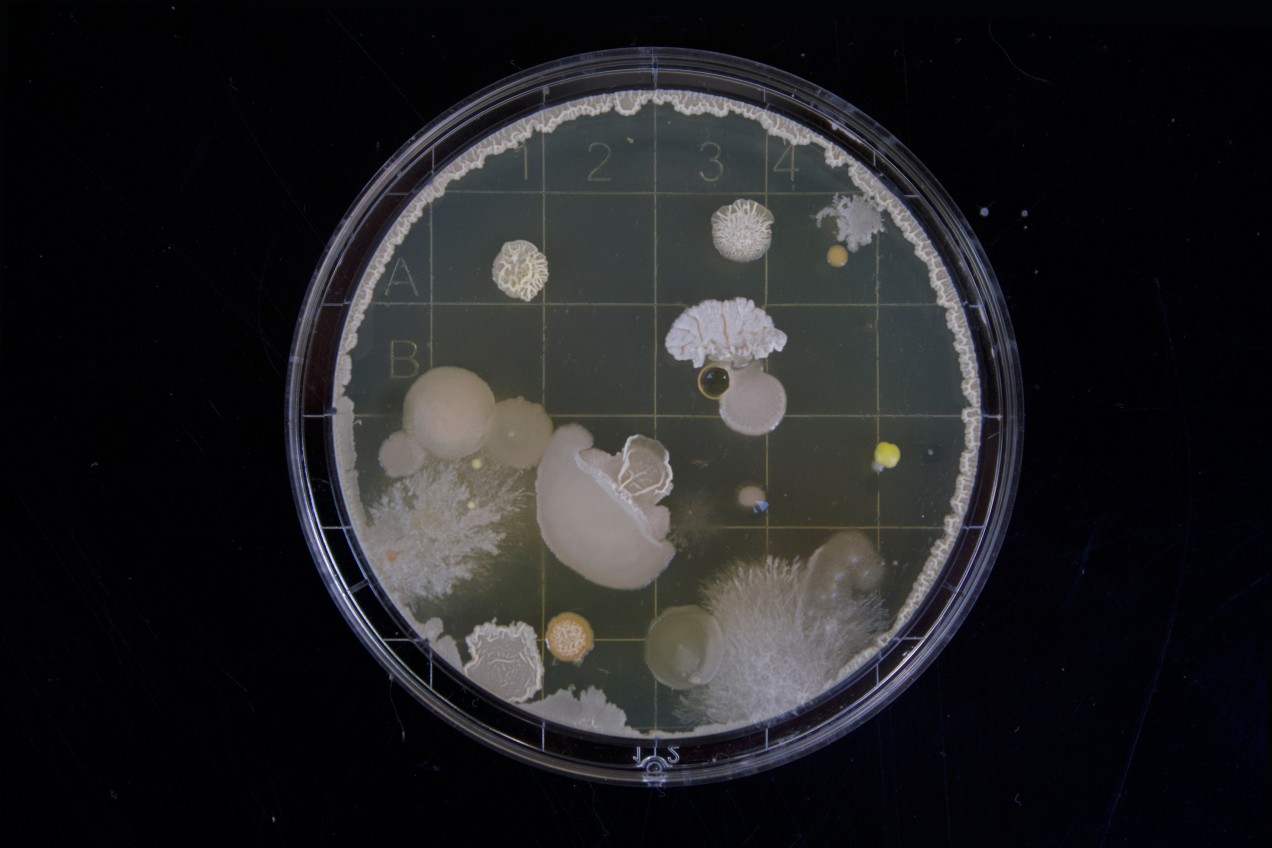

conceptual image of bacterial in a petri dish 
Imagine designing the perfect device for the internet of things. What functions must it have? For a start,  
  • it must be able to communicate, both with other devices and with its human overlords. 
  • It must be able to store and process information. 
  • And it must monitor its environment with a range of sensors. 
  • Finally, it will need some kind of built-in motor.
There is no shortage of devices that have many of these features. Most are based on widely available, low-cost devices such as Raspberry Pis, Arduino boards, and the like.

But another set of machines with similar functions is much more plentiful, say Raphael Kim and Stefan Poslad at Queen Mary University of London in the UK. They point out that bacteria communicate effectively and have built-in engines and sensors, as well as powerful information storage and processing architecture.

And that raises an interesting possibility, they say. Why not use bacteria to create a biological version of the internet of things? Today, in a call to action, they lay out some of the thinking and the technologies that could make this possible.

The way bacteria store and process information is an emerging area of research, much of it focused on the bacterial workhorse Escherichia coli. These (and other) bacteria store information in ring-shaped DNA structures called plasmids, which they transmit from one organism to the next in a process called conjugation.
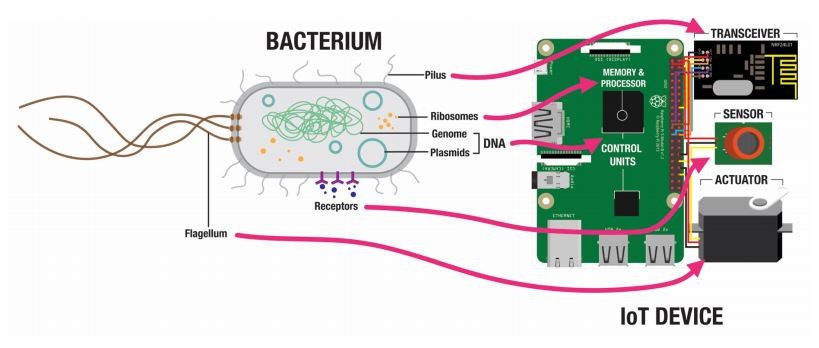
 Bacterial IoT


Last year, Federico Tavella at the University of Padua in Italy and colleagues built a circuit in which one strain of immotile E. coli transmitted a simple “Hello world” message to a motile strain, which carried the information to another location.

This kind of information transmission occurs all the time in the bacterial world, creating a fantastically complex network. But Tavella and co’s proof-of-principle experiment shows how it can be exploited to create a kind of bio-internet, say Kim and Poslad.

E. coli make a perfect medium for this network. They are motile—they have a built-in engine in the form of waving, thread-like appendages called flagella, which generate thrust. They have receptors in their cell walls that sense aspects of their environment—temperature, light, chemicals, etc. They store information in DNA and process it using ribosomes. And they are tiny, allowing them to exist in environments that human-made technologies have trouble accessing.

E. coli are relatively easy to manipulate and engineer as well. The grassroots movement of DIY biology is making biotechnology tools cheaper and more easily available. The Amino Lab, for example, is a genetic engineering kit for schoolchildren, allowing them to reprogram E. coli to glow in the dark, among other things.

This kind of biohacking is becoming relatively common and shows the remarkable potential of a bio-internet of things. Kim and Poslad talk about a wide range of possibilities. “Bacteria could be programmed and deployed in different surroundings, such as the sea and ‘smart cities’, to sense for toxins and pollutants, gather data, and undertake bioremediation processes,” they say.

Bacteria could even be reprogrammed to treat diseases. “Harbouring DNA that encode useful hormones, for instance, the bacteria can swim to a chosen destination within the human body, [and] produce and release the hormones when triggered by the microbe’s internal sensor,” they suggest.

Of course, there are various downsides. While genetic engineering makes possible all kinds of amusing experiments, darker possibilities give biosecurity experts sleepless nights. It’s not hard to imagine bacteria acting as vectors for various nasty diseases, for example.

It’s also easy to lose bacteria. One thing they do not have is the equivalent of GPS. So tracking them is hard. Indeed, it can be almost impossible to track the information they transmit once it is released into the wild.

And therein lies one of the problems with a biological internet of things. The conventional internet is a way of starting with a message at one point in space and re-creating it at another point chosen by the sender. It allows humans, and increasingly devices, to communicate with each other across the planet.

Kim and Poslad’s bio-internet, on the other hand, offers a way of creating and releasing a message but little in the way of controlling where it ends up. The bionetwork created by bacterial conjugation is so mind-bogglingly vast that information can spread more or less anywhere. Biologists have observed the process of conjugation transferring genetic material from bacteria to yeast, to plants, and even to mammalian cells.

Evolution plays a role too.
All living things are subject to its forces. No matter how benign a bacterium might seem, the process of evolution can wreak havoc via mutation and selection, with outcomes that are impossible to predict.

Then there is the problem of bad actors influencing this network. The conventional internet has attracted more than its fair share of individuals who release malware for nefarious purposes. The interest they might have in a biological internet of things is the stuff of nightmares.

Kim and Poslad acknowledge some of these issues, saying that creating a bacteria-based network presents fresh ethical issues. “Such challenges offer a rich area for discussion on the wider implication of bacteria driven Internet of Things systems,” they conclude with some understatement.

That’s a discussion worth having sooner rather than later.
Ref: arxiv.org/abs/1910.01974 : The Thing with E. coli: Highlighting Opportunities and Challenges of Integrating Bacteria in IoT and HCI.
By Michael Schiffer / unsplash
Nov 1, 2019

lunes, 1 de diciembre de 2014

DIY Exoplanet Detector Using a DSLR


Your DSLR can do much more than just take a few nice portraits or the occasional vacation photos – with some DIY magic you can actually turn it into a device which can detect planets outside our solar system – something that 20 years ago was impossible even with the most sophisticated telescopes.

So how can you achieve this? David Schneider who you can see in the video above was able to use his Canon EOS Rebel XS (a.k.a Canon 1000D) camera. With old manual-focus 300mm Nikon telephoto lens he got from eBay for under a $100 with a $17 adapter

After he had his camera setup Schneider needed a way to track stars in a very precise way. There are of course very expensive options that you can buy, However as a DIY enthusiast he decided to create something on his own based on a device called a barn door tracker (a relatively simple device that will allow you to shoot longer exposures and track the stars to compensate for the Earth’s rotation).

Looking online you can find many different designs for creating a barn door tracker (see for example here and here) – some are very basic and manual and some are more advanced and use a computer – which is exactly what Schneider decided to do (using arduino) – costing him another few dollars (including an inexpensive power adapter that can run his camera for hours).

Buying and building the hardware you see in the video was actually the easy part. The hard part was finding a way to look for a target star, track it and be able to measure the brightness of the star changing as a planet passes by it. Now it is important to realize at this point that the star chosen for this task – called simply HD 189733 (about 63 light-years away from us in the constellation of Vulpecula) is known to have an exoplanet orbiting it since 2005 – so Schneider did not actually discover a planet outside our solar system but was “only” able to confirm its existence. However given the very basic and inexpensive equipment he used – this is still a pretty impressive achievement. Finding a new expoplanet this way will probably require a lot more patience but it might not be impossible if you have the right information from other observations of the same region of space.

All this makes us wonder if NASA can actually do something that will significantly improve our ability to detect expoplanets and cost a fraction of any existing observatory. By funding a competition between companies and entrepreneurs to create a low cost but functional hardware that will be sold at a relatively low price to the consumer (say below $300 or so) and use any DSLR with a telephoto lens and a simple distributed computing software along the lines of SETI@home or Orbit@home that will coordinate worldwide efforts to locate, track and confirm the existence and orbits of exoplanets – it can drastically improve the rate in which we discover and confirm planets outside our solar system (and help raise a new generation interested in Astronomy).

Astrophotography is nothing new of course and we have covered the topic in the past including How To Photograph The Milky Way (or Die Trying) and PBS: The Beauty of Space Photography.

VIA: IEEE spectrum (where you can read Schneider’s full report).

ORIGINAL: Lens Vid
NOV30

viernes, 28 de noviembre de 2014

miniPCR: A DNA Discovery System for Everyone


 miniPCR: A DNA Discovery System for Everyone's video poster
DNA curious? Open up the world of DNA science and exploration with a portable, powerful, and affordable PCR-based DNA Discovery System

We live in a DNA world. DNA technology helps us diagnose disease, understand our ancestry and origins, establish guilt or innocence in our justice system, and test the water and food we consume every day. Yet DNA technology is still a black box for most of us.

We've created miniPCR to open the world of DNA science to everyone, everywhere.
This is the miniPCR DNA Discovery System:

Together we've reached our first Goal! Here are our Stretch Goals:

To prepare, amplify (copy), and visualize your DNA: With the DNA Family Tree kit, extract your own DNA and make so many million copies of it (in miniPCR) that you’ll see it shine before your eyes (with miniPCR visualizer).

Real-world biotech applications: Learn how DNA can be used to identify people, to detect bacteria in our food, to clone pieces of DNA from one organism into another, and more.

Learn more about the world around you: Engage in citizen science projects such as DNA barcoding, sushi-gate, detect food mislabeling, and (as you get more advanced) use PCR to characterize and discover new animals, plants, and fungi.

How DNA replication works (in our cells and in test tubes): PCR and our software will teach you how the chemistry of DNA allows our cells (and our miniPCR machines) to propagate genetic information.

The polymerase chain reaction (PCR) is at the heart of DNA analysis. PCR is a Nobel-winning technology that lets us make billions of copies of a specific piece of DNA that can be used for genetic analysis.


DNA testing and analysis kits everyone can use.

Get miniPCR for yourself, but don't forget to give one to a school.
More schools have asked for miniPCR, and we've added them!

Schools can now access a case full of DNA technology:

With the miniPCR DNA Discovery System:

  • YOU can take DNA science into your own hands, and share it with your kids.
  • OUR SCHOOLS can teach essential biotechnology and discovery.
  • EVERY LAB in the globe can have access to fundamental DNA analysis tools.

In the past few months, we have made and sold more than one hundred miniPCR machines that have been in use by scientists and students in four continents. See what miniPCR users are saying through these testimonials, and read:


You choice of:

  • The complete miniPCR DNA Discovery System (including a miniPCR Machine)
  • Or just the miniPCR machine (if you already own Pipetting Tools, Gel Electrophoresis, and Visualizer). PLUS you'll get the opportunity to donate cutting-edge DNA science to schools. 

Don't forget to add-on one or more DNA Testing Kits which contain all necessary reagents to do the labs!

The Amplyus team is led by Ezequiel (Zeke) Alvarez Saavedra and Sebastian Kraves. We met >15 years ago in college, where we shared the dream of becoming DNA scientists. Lacking access to lab tools, we learned DNA science mostly from lectures and textbooks. It wasn't ideal, but we fell in love with modern biology. After getting our PhDs at Harvard and MIT, we realized that we could create tools to give everyone access to the world of DNA science and discovery.

Amplyus is currently at the MassChallenge accelerator amidst other like-minded startups that strive to have a positive impact in our world.

Zeke Alvarez Saavedra, PhD, is a geneticist trained at MIT. His work has been cited thousands of times and profiled in The New York Times, National Public Radio and the BBC. Zeke is a patented and licensed inventor of gene-detection technologies.

Sebastian Kraves, PhD, is a molecular neurobiologist trained at Harvard. He has spent more than six years with the Boston Consulting Group addressing high-impact problems in healthcare, such as access to diagnostic technologies in Sub-Saharan Africa. Sebastian has also published on neural circuits, optogenetics, and the genetic regulation of behavior.


miniPCR comes out of the box and into the palm of your hand!

miniPCR will give you access to the full power and quality of a professional grade DNA lab instrument. If you're an experienced PCR user, you'll love its simplicity and convenience. If you're new to DNA analysis, miniPCR and its software will make it incredibly easy to learn.

  • Powerful. miniPCR delivers the same powerful genetic analysis as 10-times larger, $3,000-$10,000 instruments used by biomedical professionals. 
  • Portable. 2 x 5 x 4 inches, so you can take your science with you, or conveniently put miniPCR away when not in use.
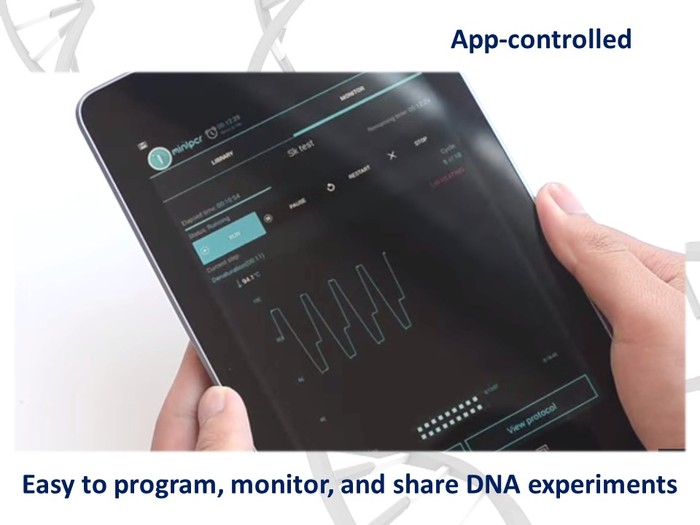
  • Simple. Easy to control directly from your Android device or Mac/Windows computer through the miniPCR app.
  • Ready to use. Requires no assembly. Simply plug into your computer, smartphone, or tablet. Or just flick it ON (miniPCR will store its program in memory).
  • Engaging. Through the app, visualize experiments and understand DNA science in real time. Through the clear case, see and understand how miniPCR works.
  • Affordable. At one-tenth the cost of commercial PCR machines, miniPCR is within the reach of homes, schools, and every lab budget.

The miniPCR software makes DNA science more intuitive. It's easy to program and monitor PCR conditions in real time, and export and share data for verification and analysis. It works on Android, MacOS, and Windows, and it's free with miniPCR.

Newcomers more easily grasp the underlying science 

Professional users enjoy the convenience of programming, storing, and monitoring experiments on their own phone or computer

To help you get up and running, we've created these DNA testing kits:

  • DNA Food Safety Lab
  • Forensic DNA Crime Lab
  • DNA Family Tree (see the schematic below)

miniPCR kits come with detailed instructions and have already been used by dozens of teachers and hundreds of students from middle school to college.

If the campaign meets our stretch goal, we will create a GMO detection lab to test whether your food has been genetically engineered.

It's 2014. More than 60 years since Watson and Crick's double helix, and more thanten since we've sequenced the human genome. Yet it's still hard to teach DNA science in our schools. Science is best learned by doing it, but biotech equipment available today is complex, expensive, and hardly education-friendly.

We're out to change that. We won't stop until every kid has access to the exciting world of biotech experimentation and the opportunities it creates.Download this brief document, and share it with your teacher, parent-teacher association, or principal to garner support to bring miniPCR to your classroom

Your pledge will help transform the landscape of science education through our technology, lesson plans, and teacher support.

Why? Just listen to Howard Goldsweig, MD, Biology teacher at The Codman Academy Public Charter School, a Boston inner city school:

PLAY


In PCR, small DNA sequences called primers search the millions or billions of letters in the genome for the target gene (or DNA region), in the same way that Google searches for a specific set of words in the World Wide Web. During PCR, that target DNA of interest is amplified or copied billions of times, in the same way that a small snippet of text can be broadcast widely using Twitter. To learn how PCR works watch the brief primer below.

PLAY

Our DNA Discovery System includes everything you'll need for steps 1, 2, and 3. We'll guide and support you if you've never done it before.

miniPCR will allow you to learn, discover, and explore in new ways:
Contribute to citizen science projects: DNA barcoding, sampling biodiversity, detecting food mislabeling, and more...

Make a billion copies of any gene from any organism

Understand more about yourself and the world around us

WHAT ELSE CAN SCIENTISTS DO WITH PCR? The range of DNA detection and modification experiments that doctors and scientists can do with PCR is virtually limitless. Copying DNA has countless applications; this wiki cites a few. PCR can be used to read genes, to detect infections (Ebola, HIV, malaria, many more), and to solve crimes. It can also just bring joy into the lives of biology nerds like us.

DISCLAIMER: We make miniPCR available to homes and schools for research and educational purposes only, and we offer it only with that intent. We believe that as more of us better understand DNA technology, society will be better equipped to make collective and individual decisions related to DNA analysis. We do not make/market/endorse miniPCR for use as a diagnostic or medical tool by laypersons, as we believe that people seeking to make medical decisions should be appropriately supported by medical professionals.

We are serious about science and education -- we love to experiment, but the last thing we’d do is experiment with you. miniPCR has gone through 10 prototypes, 3 beta versions, and one full year of validation of the final design in research labs and classrooms.
We've designed miniPCR from the ground up to make DNA science more accessible

Out of MIT, Zeke worked with a team at Templeman Automation. The team that undertook development and built the first prototype was formed by Zeke, Chris Templeman, Sean Jeffries, Cameron Dube, Dave Thomas, Randy Creasi, and Michael White. We open sourced the design. Early on the team received input from Josh Perfetto and Mac Cowell, who shared ideas and expertise. Thanks to you all!

Sebastian and Zeke decided to found Amplyus to further develop and validate the technology and bring it into manufacturing scale, making miniPCR machines available to everyone, everywhere.

We are now ready to bring miniPCR into full-scale production. Your pledge will help usset up our manufacturing operations locally in Massachusetts, creating jobs and helping lower production cost. It will also help us finalize development of our gel electrophoresis and visualization system.

The primary risk this campaign faces is the timely and efficient procurement of parts, components, and tools needed to manufacture at a larger scale. Luckily, we've spent the last year working with the same supply chain partners, getting to know them, and ensuring their quality and commitment meets ours. We are proud to be working with many local machine shops and suppliers that meet stringent specifications. That said, sourcing components can be a source of delays.

The second risk we'll face is the transition from small-batch production in our own hands to full-scale manufacturing. We've done a number of things to ensure a smooth hand-off. We have identified a local factory right here, in Massachusetts. This will allow us to work closely with our partners to get production rolling (while creating jobs!). Together, we have established standard processes, a quality control and testing plan, and we will soon run a production pilot.

The final challenge will be in working closely with our supporters to keep translating advanced concepts in DNA science into experiences accessible to a broad audience. This is the reason we started this company, and a challenge that we readily embrace.

Some may ask whether there are collateral risks with putting DNA technology into the hands of more people. Can miniPCR fall into the wrong hands and give birth to synthetic species that will colonize earth overnight? Extremely unlikely (sorry to disappoint). First off, it takes years of blood, sweat, and tears by entire teams of highly overtrained biologists to deliver any meaningful genetic transformation. Secondly, any evildoers lurking in the biosphere have access to laboratory tools already capable of doing the same genetic tricks as miniPCR (they are just much more expensive). All this said, we encourage everyone to explore biotechnology with the same spirit of exploration and curiosity that every scientist embodies. With great genetic power comes great responsibility. We believe that the greater risk lies in misinformation and ignorance, not in the dissemination of knowledge.

FAQ

ORIGINAL: Kickstarter

viernes, 15 de agosto de 2014

Building Mind-Controlled Gadgets Just Got Easier

A new brain-computer interface lets DIYers access their brain waves
Photo: Chip AudetteEngineer Chip Audette used the OpenBCI system to control a robot spider with his mind.

The guys who decided to make a mind-reading tool for the masses are not neuroscientists. In fact, they’re artists who met at Parsons the New School for Design, in New York City. In this day and age, you don’t have to be a neuroscientist to muck around with brain signals.

With Friday’s launch of an online store selling their brain-computer interface (BCI) gear, Joel Murphy and Conor Russomanno hope to unleash a wave of neurotech creativity. Their system enables DIYers to use brain waves to control anything they can hack—a video game, a robot, you name it. “It feels like there’s going to be a surge,” says Russomanno. “The floodgates are about to open.” And since their technology is open source, the creators hope hackers will also help improve the BCI itself.
Photo: OpenBCI The OpenBCI board takes in data from up to eight electrodes.

Their OpenBCI system makes sense of an electroencephalograph (EEG), signal, a general measure of electrical activity in the brain captured via electrodes on the scalp. The fundamental hardware component is a relatively new chip from Texas Instruments, which takes in analog data from up to eight electrodes and converts it to a digital signal. Russomanno and Murphy used the chip and an Arduino board to create OpenBCI, which essentially amplifies the brain signal and sends it via Bluetooth to a computer for processing. “The big issue is getting the data off the chip and making it accessible,” Murphy says. Once it’s accessible, Murphy expects makers to build things he hasn’t even imagined yet.

The project got its start in 2011, when Russomanno was a student in Murphy’s physical computing class at Parsons and told his professor he wanted to hack an EEG toy made by Mattel. The toy’s EEG-enabled headset supposedly registered the user’s concentrated attention (which in the game activated a fan that made a ball float upward). But the technology didn’t seem very reliable, and since it wasn’t open source, Russomanno couldn’t study the game’s method of collecting and analyzing the EEG data. He decided that an open-source alternative was necessary if he wanted to have any real fun.

Happily, Russomanno and his professor soon connected with engineer Chip Audette, of the New Hampshire R&D firm Creare, who already had a grant from the U.S. Defense Advanced Research Projects Agency (DARPA) to develop a low-cost, high-quality EEG system for “nontraditional users.” Once the team had cobbled together a prototype of their OpenBCI system, they decided to offer their gear to the world with a Kickstarter campaign, which ended in January and raised more than twice the goal of US $100,000.

Murphy and Russomanno soon found that production would be more difficult and take longer than expected (as is the case with so many Kickstarter projects), so they had to push back their shipping date by several months. Now, though, they’re in business—and Russomanno says that shipping a product is only the beginning. “We don’t just want to sell something; we want to teach people how to use it and also develop a community,” he says. OpenBCI wants to be an online portal where experimenters can swap tips and post research projects.


So once a person’s brain-wave data is streaming into a computer, what is to be done with it? OpenBCI will make some simple software available, but mostly Russomanno and Murphy plan to watch as inventors come up with new applications for BCIs.

Audette, the engineer from Creare, is already hacking robotic “battle spiders” that are typically steered by remote control. Audette used an OpenBCI prototype to identify three distinct brain-wave patterns that he can reproduce at will, and he sent those signals to a battle spider to command it to turn left or right or to walk straight ahead. “The first time you get something to move with your brain, the satisfaction is pretty amazing,” Audette says. “It’s like, ‘I am king of the world because I got this robot to move.’ ”

In Los Angeles, a group is using another prototype to give a paralyzed graffiti artist the ability to practice his craft again. The artist, Tempt One, was diagnosed with Lou Gehrig’s disease in 2003 and gradually progressed to the nightmarish “locked in” state. By 2010 he couldn’t move or speak and lay inert in a hospital bed—but with unimpaired consciousness, intellect, and creativity trapped inside his skull. Now his supporters are developing a system called the BrainWriter: They’re using OpenBCI to record the artist’s brain waves and are devising ways to use those brain waves to control the computer cursor so Tempt can sketch his designs on the screen.

Another early collaborator thinks that OpenBCI will be useful in mainstream medicine. David Putrino, director of telemedicine and virtual rehabilitation at the Burke Rehabilitation Center, in White Plains, N.Y., says he’s comparing the open-source system to the $60,000 clinic-grade EEG devices he typically works with. He calls the OpenBCI system robust and solid, saying, “There’s no reason why it shouldn’t be producing good signal.”

Putrino hopes to use OpenBCI to build a low-cost EEG system that patients can take home from the hospital, and he imagines a host of applications. Stroke patients, for example, could use it to determine when their brains are most receptive to physical therapy, and Parkinson’s patients could use it to find the optimal time to take their medications. “I’ve been playing around with these ideas for a decade,” Putrino says, “but they kept failing because the technology wasn’t quite there.” Now, he says, it’s time to start building.


ORIGINAL: IEEE Spectrum
By Eliza Strickland
11 Aug 2014

domingo, 16 de febrero de 2014

Robots with insect brains

(Credit: Freie Universität Berlin)

German researchers have developed a robot that mimics the simple nervous system used for olfactory learning in the honeybee, using color instead of odors.

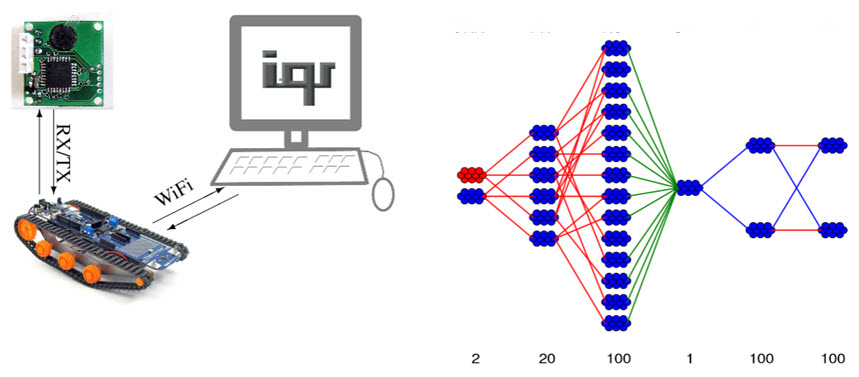
The researchers have installed a camera on a small robotic vehicle connected to a computer. The computer program replicates, in a simplified way, the sensorimotor neural network of the insect brain and operates the motors of the robot wheels to control its motion and direction based on the colors.

“The network-controlled robot is able to link certain external stimuli with behavioral rules,” said Professor Martin Paul Nawrot, head of the research team and professor of neuroscience at Freie Universität Berlin. “Much like honeybees learn to associate certain flower colors with tasty nectar, the robot learns to approach certain colored objects and to avoid others.”

The learning experiment

The scientists located the network-controlled robot in the center of a small arena with red and blue objects on the walls. Once the robot’s camera focused on an object with the desired color, the scientists triggered a light flash. This signal activated a “reward sensor nerve cell” in the spiking neural network. The simultaneous processing of red and the reward caused the robot to move toward the object; blue made it move backwards.

Left: robot hardware. The camera output is processed on the Arduino board and is sent to the open-source iqr spiking neural network simulator software as a 1 or 0, depending on whether or not a colored region was found, and is translated into spike trains.
Right: neural network architecture from sensory input to motor output. Red or blue connections indicate excitatory or inhibitory synapses. Green connections indicate modulatory synapses that are adjusted during reinforcement. Numbers under each group indicate the number of artificial neurons (credit: L. I. Helgadóttir et al.).

“Within seconds, the robot accomplishes the task to find an object in the desired color and to approach it,” explained Nawrot. “Only a single learning trial is needed, similar to experimental observations in honeybees.”

The scientists are planning to expand their neural network by adding more learning principles.

Future real-world applications
“Our work and the paper focus on basic science,” Tim Landgraf, head of the Biorobotics Lab at Freie Universität Berlin, explained to KurzweilAI in an email interview. “We first want to understand how fundamental processes like learning and memory enable the animal (many of our studies use the honeybee as a model) to accomplish complex tasks.

“Ultimately, this will improve our understanding of the function of our own human brain. And once we understood how we can employ realistic, brain-like processing structures to solve real-world problems, this will have an impact on how robots or artificial systems in general are being programmed.

“Rather than writing millions of lines of code for solving problems, we will lean back and watch adaptive, neural systems learn the structure of their environments. First as virtual brains in a simulation of the world and then, once they have sufficiently matured, in the real world.

“As far as we know, we were the first to show that robots can be conditioned in a one-shot learning experiment with spiking neural networks.” However, he admits that the biggest unknown is the neuromorphic (spiking) hardware. “Currently, researchers are using simulations on big computing machines, nothing that would fit on a robot. Neuromorphic chips emulate neuronal activity in small analog circuits. They might be available commercially within the next ten years or so. I can’t say whether they will be powerful enough (number of neurons, synaptic plasticity, etc.) to be applicable in complex real-world scenarios by then.”

Funding for the research is provided by the National Bernstein Network Computational Neuroscience in Germany and the German Federal Ministry of Education and Research.


Abstract of 6th International IEEE/EMBS Conference on Neural Engineering (NER) paper
Insects show a rich repertoire of goal-directed and adaptive behaviors that are still beyond the capabilities of today’s artificial systems. Fast progress in our comprehension of the underlying neural computations make the insect a favorable model system for neurally inspired computing paradigms in autonomous robots. Here, we present a robotic platform designed for implementing and testing spiking neural network control architectures. We demonstrate a neuromorphic realtime approach to sensory processing, reward-based associative plasticity and behavioral control. This is inspired by the biological mechanisms underlying rapid associative learning and the formation of distributed memories in the insect.

References:
L. I. Helgadóttir, J. Haenicke, T. Landgraf, R. Rojas, M. P. Nawrot, Conditioned behavior in a robot controlled by a spiking neural network, 6th International IEEE/EMBS Conference on Neural Engineering (NER), 2013, DOI: 10.1109/NER.2013.6696078

Related:
Robots with Insect Brains

ORIGINAL: KurzweilAI

February 14, 2014