Mostrando entradas con la etiqueta Hydrogen Peroxide. Mostrar todas las entradas

martes, 27 de septiembre de 2016

Soft Robot With Microfluidic Logic Circuit


Perhaps our future overlords won’t be made up of electrical circuits after all but will instead be soft-bodied like ourselves. However, their design will have its origins in electrical analogues, as with the Octobot.

The Octobot is the brainchild a team of Harvard University researchers who recently published an article about it in Nature. Its body is modeled on the octopus and is composed of all soft body parts that were made using a combination of 3D printing, molding and soft lithography. Two sets of arms on either side of the Octobot move, taking turns under the control of a soft oscillator circuit. You can see it in action in the video below.

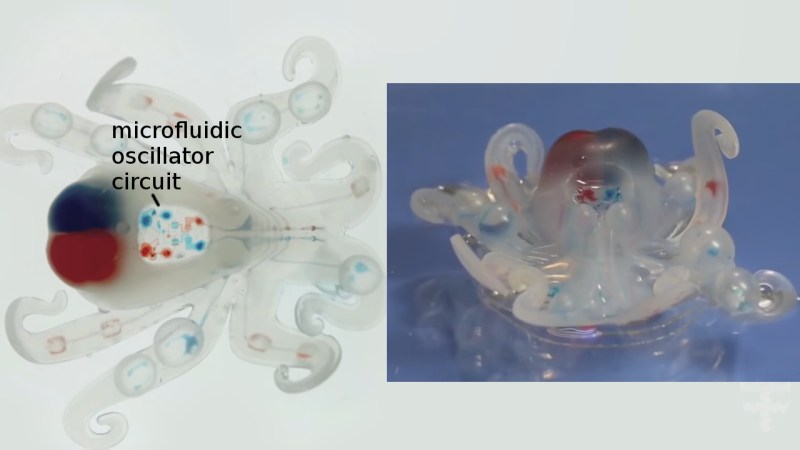
Octobot mechanical and electrical analogue circuits (credit: Michael Wehner at al./Nature)

As shown in the diagram, the fuel is a liquid hydrogen peroxide (H2O2) which the oscillator gets from one of two fuel reservoirs and feeds into one of two reaction chambers. In the oscillator, pinch valves act like JFETs. When fuel from one reservoir is flowing into one reaction chamber, one of the pinch valves pinches off the flow of fuel to the other reaction chamber. It’s not clear how but somehow or other that fuel flow is then pinched off by another pinch valve as fuel then flows from the other reservoir to the other reaction chamber.

The reaction chamber contains a small amount of platinum as a catalyst which reacts with the hydrogen peroxide to release a much larger volume of oxygen gas into actuators in the arms. Those actuators expand like balloons causing the arms to move. The reaction chambers are the analogues of amplifiers. Other analogues are check valves for diodes, vent orifices for resistors as well as other chambers which appear to be capacitors.

This is a proof of concept and as yet the Octobot doesn’t walk but the team hopes to make one that can crawl, swim and interact with its environment. When it does we look forward to it joining this other soft-bodied bot modeled after a stingray. It looks like our overlords might all come from the sea.


Here’s you can see the Octobot in action.


And here’s another video from Harvard demonstrating the chemical reaction between hydrogen peroxide and platinum that produces oxygen. ("Powering the Octobot: A chemical reaction")


sábado, 20 de agosto de 2016

This tiny device makes dirty water drinkable in just 20 minutes

Jin Xie/Stanford University
Genius.

Scientists have developed a tiny device the size of a postage stamp that can kill 99.99 percent of bacteria in water in just 20 minutes.

Exposing contaminated water to sunlight can naturally clean it up – because UV rays blitz germs – but this distillation process usually takes up to 48 hours to complete. Instead, this new gadget harnesses a broader spectrum of the Sun's rays to speed everything up.


"Our device looks like a little rectangle of black glass," explains lead researcher Chong Liu from Stanford University. "We just dropped it into the water and put everything under the Sun, and the Sun did all the work."

It's the visible part of the solar spectrum, rather than UV rays, that contains most of the Sun's energy – around 50 percent for visible sunlight, compared with 4 percent for UV rays.

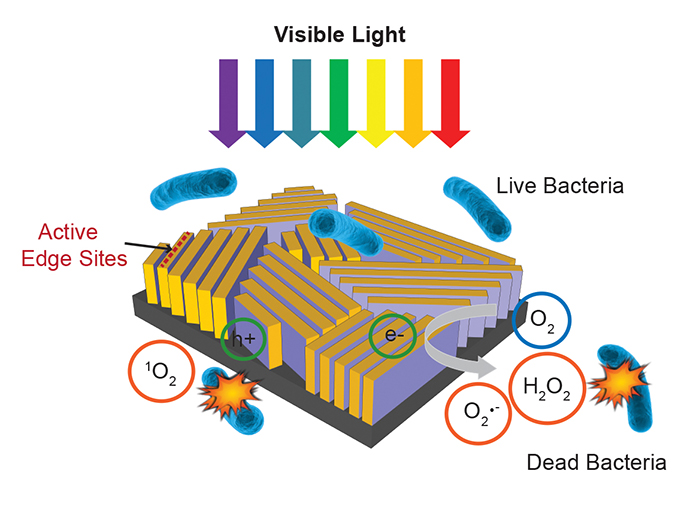
This visible sunlight attracts electrons in the device's coating of molybdenum disulfide (often used as an industrial lubricant), which sparks chemical reactions in the water.

Hydrogen peroxide and other disinfectants are generated from these reactions, which set about clearing the germs from the water.

Viewed under a microscope, the material is made up of many miniature walls of molybdenum disulfide, closely stacked together like a labyrinth on top of a rectangle of glass. From further out, it resembles a fingerprint.

A close-up look showing the molybdenum disulfide in purple and the copper in yellow. Credit: C. Liu et al., Nature Nanotechnology
"It's very exciting to see that by just designing a material you can achieve a good performance," says Liu. "It really works. Our intention is to solve environmental pollution problems so people can live better."

One important factor that could make the technology viable for the market is that molybdenum disulfide is cheap to produce. On top of that, money is also saved on fuel used in other purification methods, because the new device doesn't require the water to be boiled first.

The technique joins a number of other research efforts that are looking to purify water affordably for those in need. Earlier this year, we saw the cleaning properties of thin graphene sheets laid on water, and a biomaterial that pulls condensation from the air.

There's more work for the Stanford team to do before the device is ready for public use - only three strains of bacteria have been tested so far, and the coating isn't currently effective against chemical pollutants.

But while fresh and clean drinking water is something many of us take for granted, that's not the case for some 650 million people across the world –and that's something that has to change.

The research has been published in Nature Nanotechnology.

ORIGINAL: Science Alert
DAVID NIELD
19 AUG 2016