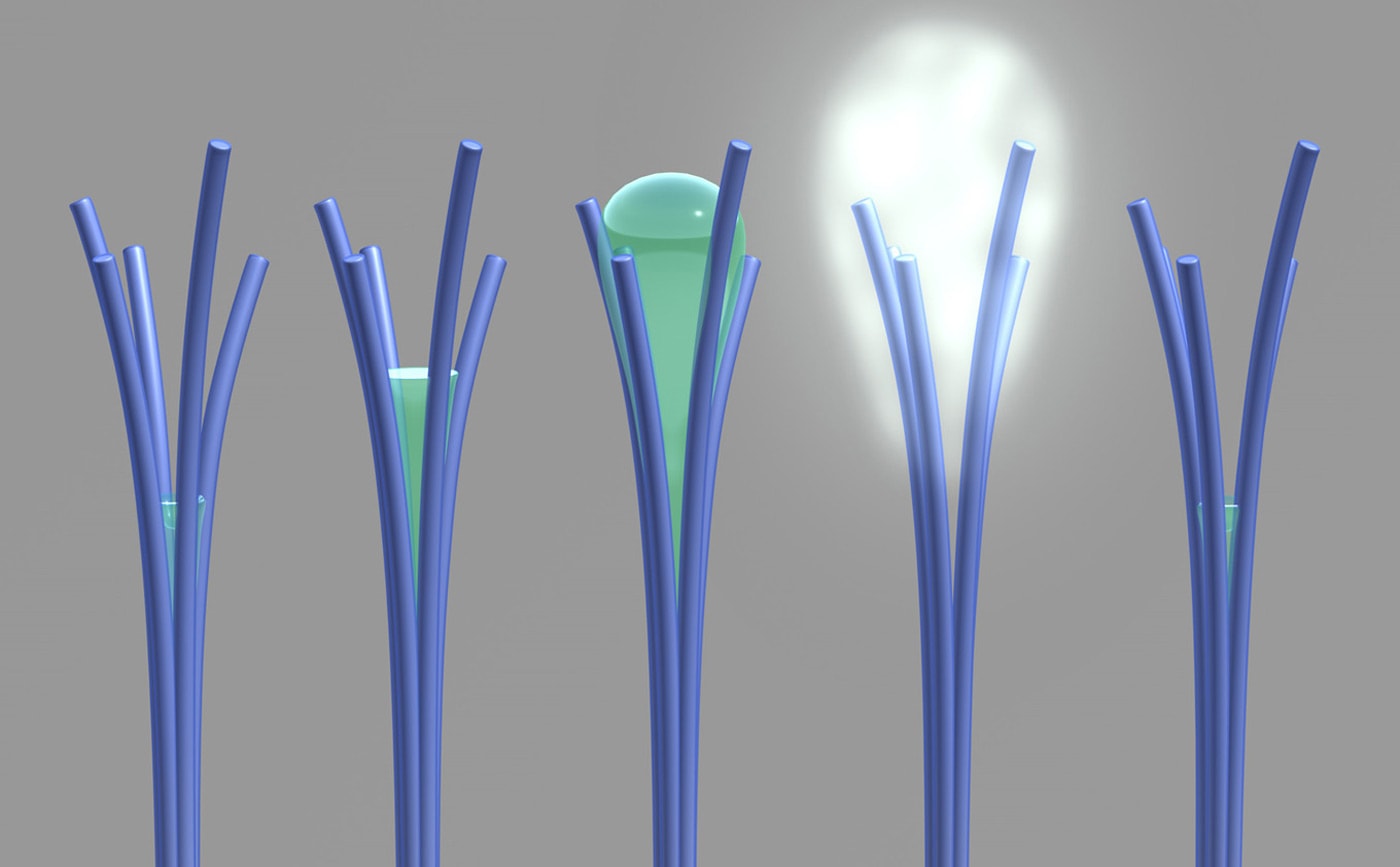
Sometimes it's the accidental discoveries that make the biggest impact. Researchers at Pacific Northwest National Laboratory have learned that carbon-rich nanorods created in a botched experiment might be ideal for harvesting water. When there's relatively low humidity (below 50 percent), the rods trap water inside their gaps; if it's any more humid, however, they promptly expel that water as vapor. It's a very unusual trait that's likely caused by water condensing into a "bridge" in the nanorods, whose surface tension forces them to close and eventually kick the water out.
If scientists can refine the shape of these nanorods and get them to spray water on a consistent basis (only 10 to 20 percent do that right now), the implications are huge. They'd be ideal for harvesting and purifying water in dry climates -- you could gather ambient moisture until there's enough to drink. Alternately, you could use it for anti-sweat clothing that soaks up your perspiration and spits it outside. All told, you'd have direct control over just when and how you get water.
One of the ways of sourcing drinking water in areas afflicted by drought is by harvesting it from the air, and now a new material developed by scientists in the US could make this tricky feat easier than ever.
Researchers at Harvard University have taken inspiration from a variety of water-collecting traits in different natural species to develop what could be an unrivalled composite system for harvesting and transporting atmospheric H20.
"Everybody is excited about bio-inspired materials research," said chemical biologist Joanna Aizenberg from Harvard's Wyss Institute for Biologically Inspired Engineering. "However, so far, we tend to mimic one inspirational natural system at a time."
Instead, the team's system combines elements from three distinct plant and animal species to create a material that they claim outperforms other synthetic surfaces designed to trap condensation.
According to the researchers, the major challenges in harvesting water from the air lie in controlling the size, speed, and direction of water droplets as they form and flow on a surface. At the core of their solution to this problem, the researchers copy the external bumps of Namib desert beetles, which help the insect to collect water droplets on its shell.
Aizenberg Lab/Harvard SEAS
Scientists already knew that the bumps' hydrophilic (water-attracting) tops and hydrophobic (water-repelling) surroundings helped them collect water, but Aizenberg's team realised that the convex shape of the protrusions themselves might also be able to harvest water too.
Using modelling, the team found that this natural water-trapping mechanism could be enhanced by mimicking the geometry and slopes of cactus spines, which help drive collected droplets down the slopes.
By combining this further with a nano-coating designed to emulate the slippery surfaces of pitcher plants, the material facilitates greater droplet formation as the water beads downwards.
optimising that bump shape through detailed theoretical modelling and
combining it with the asymmetry of cactus spines and
the nearly friction-free coatings of pitcher plants,
we were able to design a material that can collect and transport a greater volume of water in a short time compared to other surfaces."
The tandem effect of the system – together with a technology developed by the researchers called Slippery Liquid-Infused Porous Surfaces – helps the material collect water in ways that could otherwise prove impossible.
"Bumps that are rationally designed to integrate these mechanisms are able to grow and transport large droplets even against gravity and overcome the effect of an unfavourable temperature gradient," the authors write in their paper, published in Nature.
Not only could this technique help to harvest water from the air in areas affected by water shortages, but it could also be of use to enhance condensation in industrial machinery.
"Thermal power plants, for example, rely on condensers to quickly convert steam to liquid water," said one of the team, Philseok Kim. "This design could help speed up that process and even allow for operation at a higher temperature, significantly improving the overall energy efficiency."
INSPIRED BY A DESERT BEETLE, CACTUS AND PITCHER PLANT, RESEARCHERS DESIGN A NEW MATERIAL TO COLLECT WATER DROPLETS
February 24, 2016
By Leah Burrows
An array of slippery asymmetric bumps shows a significantly greater volume of water collected at the bottom of the surface compared to the flat slippery surfaces. (Courtesy of the Aizenberg Lab/Harvard SEAS)
Organisms such as cacti and desert beetles can survive in arid environments because they’ve evolved mechanisms to collect water from thin air. The Namib desert beetle, for example, collects water droplets on the bumps of its shell while V-shaped cactus spines guide droplets to the plant’s body.
“Everybody is excited about bioinspired materials research,” said Joanna Aizenberg, the Amy Smith Berylson Professor of Materials Science at SEAS and core faculty member of the Wyss Institute. “However, so far, we tend to mimic one inspirational natural system at a time. Our research shows that a complex bio-inspired approach, in which we marry multiple biological species to come up with non-trivial designs for highly efficient materials with unprecedented properties, is a new, promising direction in biomimetics.”
The new system, described in Nature, is inspired by
the bumpy shell of desert beetles,
the asymmetric structure of cactus spines and
slippery surfaces of pitcher plants.
The material harnesses the power of these natural systems, plus Slippery Liquid-Infused Porous Surfaces technology (SLIPS) developed in Aizenberg’s lab, to collect and direct the flow of condensed water droplets.
This approach is promising not only for harvesting water but also for industrial heat exchangers.
“Thermal power plants, for example, rely on condensers to quickly convert steam to liquid water,” said Philseok Kim, co-author of the paper and co-founder and vice president of technology at SEAS spin-off SLIPS Technologies, Inc. “This design could help speed up that process and even allow for operation at a higher temperature, significantly improving the overall energy efficiency.”
The major challenges in harvesting atmospheric water are controlling the size of the droplets, speed in which they form and the direction in which they flow.
For years, researchers focused on the hybrid chemistry of the beetle’s bumps — a hydrophilic top with hydrophobic surroundings — to explain how the beetle attracted water. However, Aizenberg and her team took inspiration from a different possibility – that convex bumps themselves also might be able to harvest water.
Time lapse of droplets growing faster on the apex of the bumps compared to a flat region with the same height. (Courtesy of the Aizenberg Lab/Harvard SEAS)
“We experimentally found that the geometry of bumps alone could facilitate condensation,” said Kyoo-Chul Park, a postdoctoral researcher and the first author of the paper. “By optimizing that bump shape through detailed theoretical modeling and combining it with the asymmetry of cactus spines and the nearly friction-free coatings of pitcher plants, we were able to design a material that can collect and transport a greater volume of water in a short time compared to other surfaces.”
Inspired by a cactus spine, asymmetric topography guides the droplet off the bump. (Courtesy of the Aizenberg Lab/Harvard SEAS)
“Without one of those parameters, the whole system would not work synergistically to promote both the growth and accelerated directional transport of even small, fast condensing droplets,” said Park.
“This research is an exciting first step towards developing a passive system that can efficiently collect water and guide it to a reservoir,” said Kim.
This research was supported by the Department of Energy.
The WarkaWater tower is an unlikely structure to find jutting from the Ethiopian landscape. At 30 feet tall and 13 feet wide, it’s not half as big as its namesake tree (which can loom 75 feet tall), but it’s striking nonetheless. The spindly tower, of latticed bamboo lined with orange polyester mesh, isn’t art—though it does kind of look like it. Rather, the structure is designed to wring water out of the air, providing a sustainable source of H 2O for developing countries.
Created by Arturo Vittori and his team at Architecture and Vision, the towers harvest water from rain, fog and dew. This isn’t a new idea—people have been doing this for as long as they’ve needed water, often with air wells.
Often built as high-rising stone structures, air wells gather moisture
from the air and funnel it into a basin for collection. The
WarkaWater functions in much the same way, using mesh netting to
capture moisture and direct it into hygienic holding tank accessed via a
spout.
How the system works. Illustration: WarkaWater
We wrote about the towers last year when Vittori unveiled a full-size prototype. The company has a newer version of the WarkaWater and a Kickstarter campaign to fund field testing in Ethiopia later this year. Based on tests performed in its Italian lab, the company claims the latest iteration can harvest 13 to 26.4 gallons of water daily.
That’s less than most people flush away each day, but a significant
quantity in a country where some 60 million people lack sufficient
potable water.
The WarkaWater tower produces water by harvesting rain, fog and dew from the air. WarkaWater
Caption: A Warka tree. WarkaWater
The tower uses three system to capture each of the weather phenomena. A
polyester mesh net fathers moisture from fog, rain collects directly
into a holding tank and dew is directly down a funnel into the tank.
WarkaWater
Caption: A Warka tree. WarkaWater
A prototype of the fog-harvesting netting. WarkaWater
The new prototype has some key upgrades:
The exterior is of bamboo rather than juncus,
the top of the tower has reflective pieces to deter birds, and
the structure is larger (13 feet wide, up from 7). This doubled the surface area of its water-resistant polyester mesh netting—the orange material you see—so more water is collected as fog permeates the fine mesh.
MIT has been researching a similar fog harvesting technique that draws inspiration from the Namib beetle. The process of collecting rain is straightforward, but capturing dew is slightly more complicated. Dew forms when the surface area temperature drops relative to the surrounding air. This happens most often in the time between nightfall and sunrise. Vittori is researching materials for the funnel section of the WarkaWater (between mesh netting and the tank) that will lose heat as quickly as possible in order to optimize the small window of dew-production.
The WarkaWater will cost around $1,000 to produce and requires no electricity. Vittori says it takes less than an hour to assemble the five modules into a finished tower, making it easily packed and moved as necessary. The practical goal is for the WarkaWater to become an efficient round-the-clock water production machine. But populating the landscape with alien towers is about more than just functionality, it’s about architecture. You can tell Vittori wanted to design something iconic, but beyond that is the tower’s potential to the social nexus of a village. With fabric canopies that stretch out like a peplum skirt, the towers could be a place where people gather to socialize and seek shelter from the sun, just as they would beneath a leafy Warka tree.