Mostrando entradas con la etiqueta Molybdenum Disulfide. Mostrar todas las entradas

sábado, 20 de agosto de 2016

This tiny device makes dirty water drinkable in just 20 minutes

Jin Xie/Stanford University
Genius.

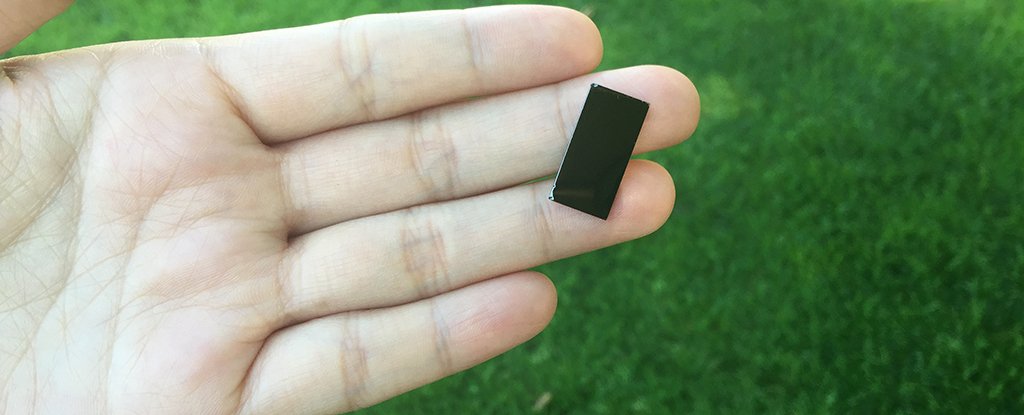
Scientists have developed a tiny device the size of a postage stamp that can kill 99.99 percent of bacteria in water in just 20 minutes.

Exposing contaminated water to sunlight can naturally clean it up – because UV rays blitz germs – but this distillation process usually takes up to 48 hours to complete. Instead, this new gadget harnesses a broader spectrum of the Sun's rays to speed everything up.


"Our device looks like a little rectangle of black glass," explains lead researcher Chong Liu from Stanford University. "We just dropped it into the water and put everything under the Sun, and the Sun did all the work."

It's the visible part of the solar spectrum, rather than UV rays, that contains most of the Sun's energy – around 50 percent for visible sunlight, compared with 4 percent for UV rays.

This visible sunlight attracts electrons in the device's coating of molybdenum disulfide (often used as an industrial lubricant), which sparks chemical reactions in the water.

Hydrogen peroxide and other disinfectants are generated from these reactions, which set about clearing the germs from the water.

Viewed under a microscope, the material is made up of many miniature walls of molybdenum disulfide, closely stacked together like a labyrinth on top of a rectangle of glass. From further out, it resembles a fingerprint.
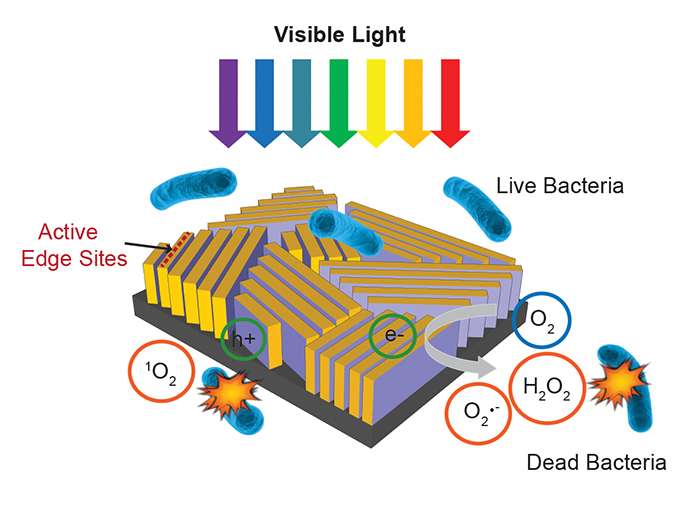
A close-up look showing the molybdenum disulfide in purple and the copper in yellow. Credit: C. Liu et al., Nature Nanotechnology
"It's very exciting to see that by just designing a material you can achieve a good performance," says Liu. "It really works. Our intention is to solve environmental pollution problems so people can live better."

One important factor that could make the technology viable for the market is that molybdenum disulfide is cheap to produce. On top of that, money is also saved on fuel used in other purification methods, because the new device doesn't require the water to be boiled first.

The technique joins a number of other research efforts that are looking to purify water affordably for those in need. Earlier this year, we saw the cleaning properties of thin graphene sheets laid on water, and a biomaterial that pulls condensation from the air.

There's more work for the Stanford team to do before the device is ready for public use - only three strains of bacteria have been tested so far, and the coating isn't currently effective against chemical pollutants.

But while fresh and clean drinking water is something many of us take for granted, that's not the case for some 650 million people across the world –and that's something that has to change.

The research has been published in Nature Nanotechnology.

ORIGINAL: Science Alert
DAVID NIELD
19 AUG 2016

lunes, 2 de enero de 2012

A Superfast DNA Sequencer Based on Motion Detection

Illustration: Alex Smolyanitsky/NIST

For more than 20 years, the practice of using a low-intensity electric current to pull long strands of DNA through nanometer-scale pores in a membraneand measure the electric field variations of the four nucleic acids—A, C, G, T—has been growing as the main approach for DNA sequencers. 

We’ve seen the development of this technology reach the point where U.K.-based Oxford Nanopore has been offering portable DNA sequencers based on this fundamental measurement principle for more than a year. Meanwhile, in the research labs, scientists have been tinkering with better materials for the membrane and have started to work with the “wonder material” graphene to see what benefits it might provide in these types of devices.

Now researchers at the National Institute of Standards and Technology (NIST) may have changed the technology paradigm for DNA sequencers in their proposal for an entirely new material architecture that would represent the first DNA sequencer based on sensing motion in the membrane as the DNA thread passes through it.

In research described in the journal ACS Nano, the NIST researchers proposed a device in which a nanoscale ribbon of molybdenum disulfide is suspended over a metal electrode immersed in water. In this arrangement, the molybdenum disulfide acts as a kind of capacitor, storing an electrical charge. When a single strand of DNA is passed through a pore in the membrane, the membrane only flexes when a DNA base pairs up with and then separates from a complementary base affixed to the hole. It is this flexing that the motion sensor detects as an electrical signal.

In the paper, the NIST researchers performed numerical simulations of how fast and accurate this DNA sequencer could be, and they concluded that the membrane would be 79 to 86 percent accurate in identifying DNA bases in a single measurement at speeds up to about 70 million bases per second. It is this speed and accuracy that the NIST researchers see as a game changer.

“It is the promise of true single-base resolution and the ability to reliably detect repeated DNA motifs at the rates of millions of bases per second,” said Alex Smolyanitsky, a NIST researcher and lead author, in an email interview with IEEE Spectrum. “An array of sensors described in our paper has the potential to accurately sequence DNA at speeds far greater than anything on the current market, while the device itself is envisioned to be portable and low-power.”

In a head-to-head comparison with research darling du jour graphene, the benefits are clear.

“The molybdenum disulfide is much less prone to ‘sticking’ to DNA, compared to graphene,” said Smolyanitsky. “Also, it is expected to be electrically conductive at room temperature.”

Before a complete prototype is built, the NIST researchers will be working on chemical functionalization of the material. But there does seem to be an urgency to the research with a patent already being sought on the design.

“We have immediate plans and expertise to work on the experimental aspects of this technology,” said Smolyanitsky. “In addition, we are open to forming early-stage partnerships with the industry.”

DNA sequencing may be just be a starting application for this design with a wide variety of nanoelectromechanical system and device applications on the NIST researchers’ horizon.

ORIGINAL: IEEE Spectrum
By Dexter Johnson
29 Sep 2016