Mostrando entradas con la etiqueta DOE. Mostrar todas las entradas

viernes, 16 de junio de 2017

Scientists Design Molecular System for Artificial Photosynthesis

System is designed to mimic key functions of the photosynthetic center in green plants to convert solar energy into chemical energy stored by hydrogen fuel
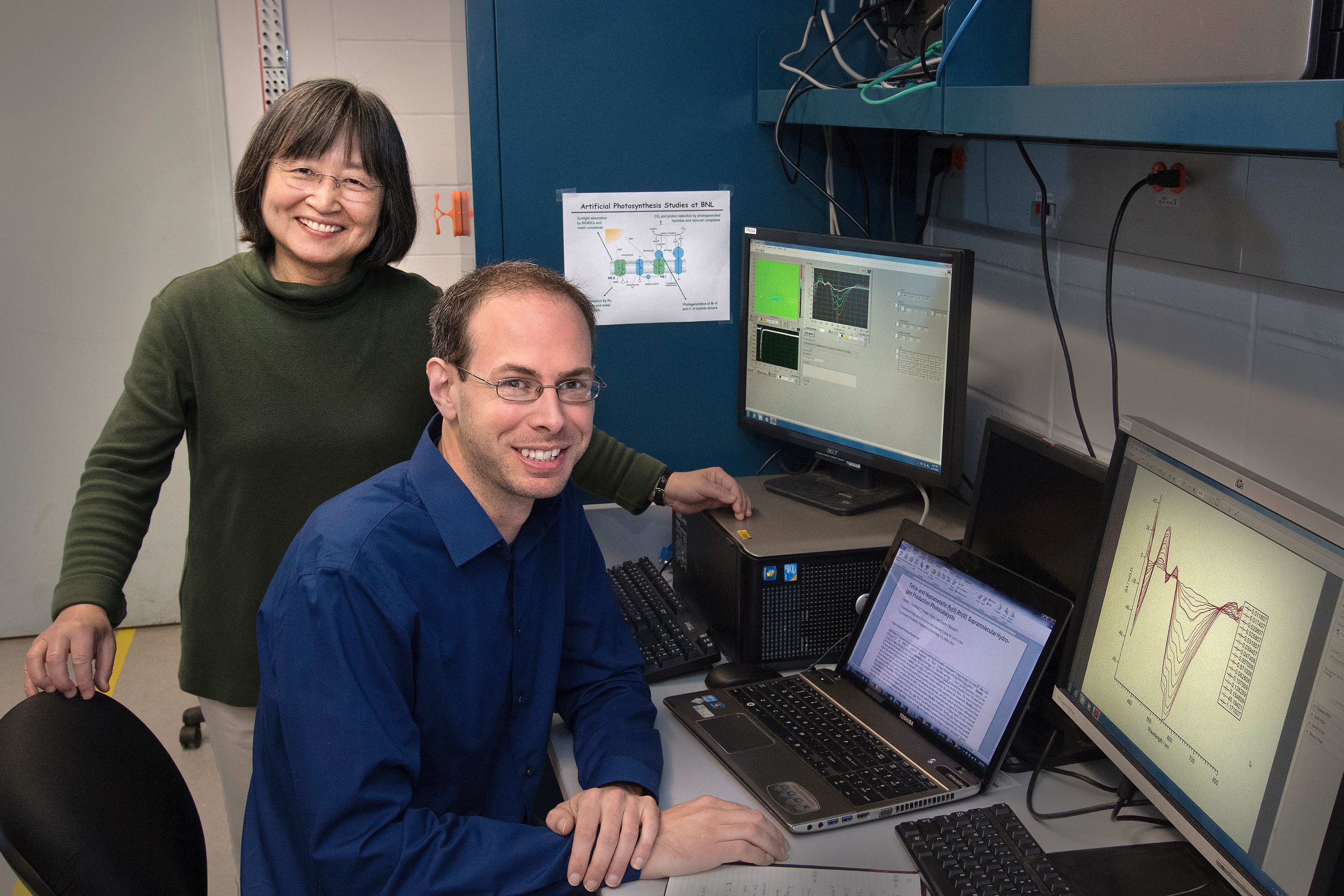
Etsuko Fujita and Gerald Manbeck of Brookhaven Lab's Chemistry Division carried out a series of experiments to understand why their molecular system with six light-absorbing centers (made of ruthenium metal ions bound to organic molecules) produced more hydrogen than the system with three such centers. This understanding is key to designing more efficient molecular complexes for converting solar energy into chemical energy—a conversion that green plants do naturally during photosynthesis.
Finding inspiration from nature
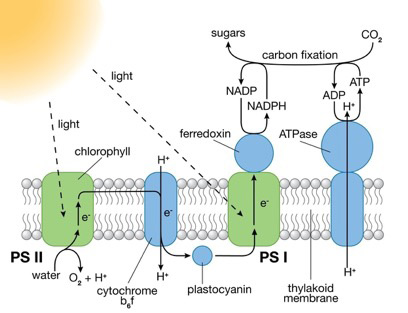
The leaves of green plants contain hundreds of pigment molecules (chlorophyll and others) that absorb light at particular wavelengths. When light of the proper wavelength strikes one of these molecules, the molecule enters an excited state. Energy from this excited state is shuttled along a chain of pigment molecules until it reaches a specific type of chlorophyll in the photosynthetic reaction center. Here, the energy is used to drive the charge-separation process required for photosynthesis to proceed. The electron “hole” left behind in the chlorophyll molecule is used for water-to-oxygen conversion. Hydrogen ions formed during the water-splitting process are eventually used for the reduction of carbon dioxide to glucose in the second stage of photosynthesis, known as the light-independent reaction.
UPTON, NY—Photosynthesis in green plants converts solar energy to stored chemical energy by transforming atmospheric carbon dioxide and water into sugar molecules that fuel plant growth. Scientists have been trying to artificially replicate this energy conversion process, with the objective of producing environmentally friendly and sustainable fuels, such as hydrogen and methanol. But mimicking key functions of the photosynthetic center, where specialized biomolecules carry out photosynthesis, has proven challenging. Artificial photosynthesis requires designing a molecular system that can absorb light, transport and separate electrical charge, and catalyze fuel-producing reactions—all complicated processes that must operate synchronously to achieve high energy-conversion efficiency.

Now, chemists from the U.S. Department of Energy’s (DOE) Brookhaven National Laboratory and Virginia Tech have designed two photocatalysts (materials that accelerate chemical reactions upon absorbing light) that incorporate individual components specialized for light absorption, charge separation, or catalysis into a single “supramolecule.” In both molecular systems, multiple light-harvesting centers made of ruthenium (Ru) metal ions are connected to a single catalytic center made of rhodium (Rh) metal ions through a bridging molecule that promotes electron transfer from the Ru centers to the Rh catalyst, where hydrogen is produced.
Photosystems (PS) I and II are large protein complexes that contain light-absorbing pigment molecules needed for photosynthesis. PS II captures energy from sunlight to extract electrons from water molecules, splitting water into oxygen and hydrogen ions (H+) and producing chemical energy in the form of ATP. PS I uses those electrons and H+ to reduce NADP+ (an electron-carrier molecule) to NADPH. The chemical energy contained in ATP and NADPH is then used in the light-independent reaction of photosynthesis to convert carbon dioxide to sugars.
They compared the hydrogen-production performance and analyzed the physical properties of the supramolecules, as described in a paper published in the June 1 online edition of Journal of the American Chemical Society, to understand why the photocatalyst with six as opposed to three Ru light absorbers produces more hydrogen and remains stable for a longer period of time. 
Developing efficient molecular systems for hydrogen production is difficult because processes are occurring at different rates,” said lead author Gerald Manbeck, a chemist in the artificial photosynthesis group at Brookhaven Lab. “Completing the catalytic turnover of hydrogen before the separated charges—the negatively charged light-excited electron and positive “hole” left behind after the excited molecule absorbs light energy—have a chance to recombine and wastefully produce heat is one of the major challenges.”

Another complication is that two electrons are needed to produce each hydrogen molecule. For catalysis to happen, the system must be able to hold the first electron long enough for the second to show up. “By building supramolecules with multiple light absorbers that may work independently, we are increasing the probability of using each electron productively and improving the molecules’ ability to function under low light conditions,” said Manbeck.

Manbeck began making the supramolecules at Virginia Tech in 2012 with the late Karen Brewer, coauthor and his postdoctoral advisor. He discovered that the four-metal (tetrametallic) system with three Ru light-absorbing centers and one Rh catalytic center yielded only 40 molecules of hydrogen for every catalyst molecule and ceased functioning after about four hours. In comparison, the seven-metal (heptametallic) system with six Ru centers and one Rh center was more than seven times more efficient, cycling 300 times to produce hydrogen for 10 hours. This great disparity in efficiency and stability was puzzling because the supramolecules contain very similar components.
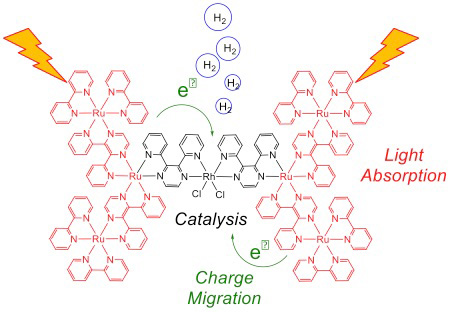
This depiction of the heptametallic system upon exposure to light shows light harvesting by the six Ru centers (red) and electron transfer to the Rh catalyst (black), where hydrogen is produced. Efficient electron transfer to Rh is essential for realizing high catalytic performance.

Manbeck joined Brookhaven in 2013 and has since carried out a series of experiments with coauthor Etsuko Fujita, leader of the artificial photosynthesis group, to understand the fundamental causes for the difference in performance.

The ability to form the charge-separated state is a partial indicator of whether a supramolecule will be a good photocatalyst, but realizing efficient charge separation requires fine-tuning the energetics of each component,” said Fujita. “To promote catalysis, the Rh catalyst must be low enough in energy to accept the electrons from the Ru light absorbers when the absorbers are exposed to light.

Through cyclic voltammetry, an electrochemical technique that shows the energy levels within a molecule, the scientists found that the Rh catalyst of the heptametallic system is slightly more electron-poor and thus more receptive to receiving electrons than its counterpart in the tetrametallic system. This result suggested that the charge transfer was favorable in the heptametallic but not the tetrametallic system.

They verified their hypothesis with a time-resolved technique called nanosecond transient absorption spectroscopy, in which a molecule is promoted to an excited state by an intense laser pulse and the decay of the excited state is measured over time. The resulting spectra revealed the presence of a Ru-to-Rh charge transfer in the heptametallic system only.

The data not only confirmed our hypothesis but also revealed that the excited-state charge separation occurs much more rapidly than we had imagined,” said Manbeck. “In fact, the charge migration happens faster than the time resolution of our instrument, and probably involves short-lived, high-energy excited states.” The researchers plan to seek a collaborator with faster instrumentation who can measure the exact rate of charge separation to help clarify the mechanism.

In a follow-up experiment, the scientists performed the transient absorption measurement under photocatalytic operating conditions, with a reagent used as the ultimate source of electrons to produce hydrogen (a scalable artificial photosynthesis of hydrogen fuel from water would require replacing the reagent with electrons released during water oxidation). The excited state generated by the laser pulse rapidly accepted an electron from the reagent. They discovered that the added electron resides on Rh in the heptametallic system only, further supporting the charge migration to Rh predicted by cyclic voltammetry.

The high photocatalytic turnover of the heptametallic system and the principles governing charge separation that were uncovered in this work encourage further studies using multiple light-harvesting units linked to single catalytic sites,” said Manbeck.

This research is supported by DOE’s Office of Science.
Brookhaven National Laboratory is supported by the Office of Science of the U.S. Department of Energy. The Office of Science is the single largest supporter of basic research in the physical sciences in the United States, and is working to address some of the most pressing challenges of our time. For more information, please visit science.energy.gov.

Related Links

ORIGIN: Brookhaven National Lab
June 2, 2017
Contact: Ariana Tantillo, (631) 344-2347, or Peter Genzer, (631) 344-3174

miércoles, 15 de marzo de 2017

New Materials Could Turn Water into the Fuel of the Future

High-throughput materials discovery approach puts solar fuels on the fast track to commercial viability

Scientists at the Department of Energy’s Lawrence Berkeley National Laboratory (Berkeley Lab) and the California Institute of Technology (Caltech) have—in just two years—nearly doubled the number of materials known to have potential for use in solar fuels.

They did so by developing a process that promises to speed the discovery of commercially viable generation of solar fuels that could replace coal, oil, and other fossil fuels.
Researchers are using a new high-throughput method of identifying new materials. (Photo Credit: Caltech)
Solar fuels, a dream of clean-energy research, are created using only sunlight, water, and carbon dioxide. Researchers are exploring a range of possible target fuels, but one possibility is to produce hydrogen by splitting water.

Each water molecule is comprised of an oxygen atom and two hydrogen atoms. Pure hydrogen is highly flammable, making it an ideal fuel. If you could find a way to extract that hydrogen from water using sunlight, then, you would have a plentiful and renewable energy source. The problem, however, is that water molecules do not simply break down when sunlight shines on them—if they did, the oceans would not cover three-fourths of the planet. Instead, they need a little help from a solar-powered catalyst.

To create practical solar fuels, scientists have been trying to develop low-cost and efficient materials that perform the necessary chemistry using only visible light as an energy source.

Over the past four decades, researchers identified only 16 of these “photoanode” materials. Now, using a new high-throughput method of identifying new materials, a team of researchers led by Caltech’s John Gregoire and Berkeley Lab’s Jeffrey Neaton, Kristin Persson, and Qimin Yan have found 12 promising new photoanodes.

A paper about the method and the new photoanodes appears the week of March 6 in the online edition of the Proceedings of the National Academy of Sciences.


The new method was developed through a partnership between the Joint Center for Artificial Photosynthesis (JCAP) and Berkeley Lab’s Materials Project, using resources at the Molecular Foundry and the National Energy Research Scientific Computing Center (NERSC). JCAP is a DOE Energy Innovation Hub focused on developing a cost-effective method of turning sunlight, water, and carbon dioxide into fuel. It is led by Caltech with Berkeley Lab as a major partner. The Materials Project is a DOE program based at Berkeley Lab that aims to remove the guesswork from materials design in a variety of applications. The Molecular Foundry and NERSC are both DOE Office of Science User Facilities located at Berkeley Lab.
The Molecular Foundry at Berkeley Lab 
(Photo by Roy Kaltschmidt, Berkeley Lab)


What is particularly significant about this study, which combines experiment and theory, is that in addition to identifying several new compounds for solar fuel applications, we were also able to learn something new about the underlying electronic structure of the materials themselves,” says Neaton, the director of the Molecular Foundry.

Gregoire, JCAP coordinator for Photoelectrocatalysis and leader of the High Throughput Experimentation group, adds “It’s exciting to find 12 new potential photoanodes for making solar fuels, but even more so to have a new materials discovery pipeline going forward.

Previous materials discovery processes relied on cumbersome testing of individual compounds to assess their potential for use in specific applications. Instead, the scientists combined computational and experimental approaches by first mining a materials database for potentially useful compounds, and then rapidly test the most promising candidates using high-throughput experimentation.

In the work described in the PNAS paper, they explored 174 metal vanadates—compounds containing the elements vanadium and oxygen along with one other element from the periodic table. The research reveals how different choices for this third element can produce materials with different properties, and reveals how to “tune” those properties to make a better photoanode.

Computational resources at NERSC performed hundreds of comprehensive high-throughput theoretical calculations, and software and expertise at the Molecular Foundry enabled the scientists to analyze and understand the most promising photoanode materials candidates.

Through analysis of nearly 200 compounds in the Materials Project database, the scientists found that compounds composed of vanadium, oxygen, and a third element possess a highly tunable electronic structure with band gaps in the visible light range that is uniquely favorable for water oxidation.

Importantly, we were able to explain the origin of their tunability, and identify several promising vanadate photoanode compounds,” says Neaton.

Added Gregoire, “The key advance made by the team was to combine the best capabilities enabled by theory and supercomputers with novel high throughput experiments to generate scientific knowledge at an unprecedented rate.

The study is titled “Solar fuels photoanode materials discovery by integrating high-throughput theory and experiment.” This research was funded by the Department of Energy’s Office of Science.

###

Lawrence Berkeley National Laboratory addresses the world’s most urgent scientific challenges by advancing sustainable energy, protecting human health, creating new materials, and revealing the origin and fate of the universe. Founded in 1931, Berkeley Lab’s scientific expertise has been recognized with 13 Nobel Prizes. The University of California manages Berkeley Lab for the U.S. Department of Energy’s Office of Science. For more, visit www.lbl.gov.

DOE’s Office of Science is the single largest supporter of basic research in the physical sciences in the United States, and is working to address some of the most pressing challenges of our time. For more information, please visit science.energy.gov.

ORIGINAL: Berkeley Lab
By Dan Krotz 510-486-4019
MARCH 6, 2017

miércoles, 7 de septiembre de 2016

New genus of bacteria found living inside hydraulic fracturing wells

'Frackibacter' one of dozens of microbes forming sustainable ecosystems there, study finds

OHIO STATE UNIVERSITY

Ohio State University researchers and their colleagues have identified a new genus of bacteria living inside hydraulic fracturing wells. These jars contain samples of "produced water fluids" -- the fluid that is collected at the surface of a hydraulic fracturing well after fracturing -- from wells in Marcellus and Utica shale formations. The fluids are orange because they contain large amounts of iron that oxidizes when the fluids are brought to the surface. By analyzing the genomes of microbes in the water, the researchers are piecing together the existence of microbial communities inside the wells. 
CREDIT: Photo by Rebecca Daly, courtesy of The Ohio State University.


COLUMBUS, Ohio--Researchers analyzing the genomes of microorganisms living in shale oil and gas wells have found evidence of sustainable ecosystems taking hold there--populated in part by a never-before-seen genus of bacteria they have dubbed "Frackibacter."

The new genus is one of the 31 microbial members found living inside two separate fracturing wells, Ohio State University researchers and their colleagues report in the Sept. 5 online edition of the journal Nature Microbiology.

Even though the wells were hundreds of miles apart and drilled in different kinds of shale formations, the microbial communities inside them were nearly identical, the researchers discovered.

Almost all the microbes they found had been seen elsewhere before, and many likely came from the surface ponds that energy companies draw on to fill the wells. But that's not the case with the newly identified Candidatus Frackibacter, which may be unique to hydraulic fracturing sites, said Kelly Wrighton, assistant professor of microbiology and biophysics at Ohio State.

In biological nomenclature, "Candidatus" indicates that a new organism is being studied for the first time using a genomic approach, not an isolated organism in a lab culture. The researchers chose to name the genus "Frackibacter" as a play on the word "fracking," shorthand for "hydraulic fracturing."

Candidatus Frackibacter prospered alongside the microbes that came from the surface, forming communities in both wells which so far have lasted for nearly a year.

"We think that the microbes in each well may form a self-sustaining ecosystem where they provide their own food sources," Wrighton explained. "Drilling the well and pumping in fracturing fluid creates the ecosystem, but the microbes adapt to their new environment in a way to sustain the system over long periods."

By sampling fluids taken from the two wells over 328 days, the researchers reconstructed the genomes of bacteria and archaea living in the shale. To the researchers' surprise, both wells--one drilled in Utica shale and the other drilled in Marcellus shale--developed nearly identical microbial communities.

In addition, the two wells are each owned by different energy companies that utilized different fracturing techniques. The two types of shale exist more than a mile and a half below ground, were formed millions of years apart, and contained different forms of fossil fuel. Yet one bacterium, Halanaerobium, emerged to dominate communities in both wells.

"We thought we might get some of the same types of bacteria, but the level of similarity was so high it was striking. That suggests that whatever's happening in these ecosystems is more influenced by the fracturing than the inherent differences in the shale," Wrighton said.

Wrighton and her team are still not 100 percent sure of the microbes' origins. Some almost undoubtedly came from the ponds that provide water to the wells, she said. But other bacteria and archaea could have been living in the rock before drilling began, Candidatus Frackibacter among them.

Shale energy companies typically formulate their own proprietary recipes for the fluid they pump into wells to break up the rock and release oil or gas, explained Rebecca Daly, research associate in microbiology at Ohio State and lead author of the Nature Microbiology paper. They all start with water and add other chemicals. Once the fluid is inside a well, salt within the shale leaches into it, making it briny.

The microorganisms living in the shale must tolerate high temperature, pressure and salinity, but this study suggests that salinity is likely the most important stressor on the microbes' survival. Salinity forces the microbes to synthesize organic compounds called osmoprotectants to keep themselves from bursting. When the cells die, the osmoprotectants are released into the water, where other microbes can use them for protection themselves or eat them as food. In that way, salinity forced the microbes to generate a sustainable food source.

In addition to the physical constraints in the environment, the microbes also must protect themselves from viruses. The researchers reconstructed the genomes of viruses living inside the wells, and found genetic evidence that some bacteria were indeed falling prey to viruses, dying, and releasing osmoprotectants into the water.

By examining the genomes of the different microbes, the researchers found that the osmoprotectants were being eaten by Halanaerobium and Candidatus Frackibacter. In turn, these bacteria provided food for other microbes called methanogens, which ultimately produced methane.

To validate their findings from the field, the researchers grew the same microbes in the lab under similar conditions. The lab-grown microbes also produced osmoprotectants that were converted into methane--a confirmation that the researchers are on the right track to understanding what's happening inside the wells.

One implication of the study is that methane produced by microbes living in shale wells could possibly supplement the wells' energy output.

Wrighton and Daly described the amount of methane produced by the microbes as likely minuscule compared to the amount of oil and gas harvested from the shale even a year after initial fracturing. But, they point out, there is a precedent in a related industry, that of coal-bed methane, to use microbes to greater advantage.

"In coal-bed systems they've shown that they can facilitate microbial life and increase methane yields," Wrighton said. "As the system shifts over time to being less productive, the contribution of biogenic methane could become significantly higher in shale wells. We haven't gotten to that point yet, but it's a possibility."

In the meantime, research led by co-author Michael Wilkins, assistant professor of earth sciences and microbiology, has used genomics information to grow Candidatus Frackibacter in the lab and is further testing its ability to handle high pressure and salinity.

###

This work is funded by the National Science Foundation's Dimensions of Biodiversity program, the Department of Energy and the Deep Carbon Observatory.

Among the study's co-authors from Ohio State is Paula Mouser, principal investigator on the Dimensions of Biodiversity grant. Other co-principal investigators and co-authors include Wrighton; Michael Wilkins, assistant professor of earth sciences and microbiology; and David Cole, professor of earth sciences and Ohio Research Scholar. Co-author David Hoyt of the Environmental Molecular Sciences Laboratory at the Pacific Northwest National Laboratory analyzed the compounds in the fluids that provided evidence of microbial metabolism.

Contact: Kelly Wrighton, 614-688-2189; Wrighton.1@osu.edu

Written by Pam Frost Gorder, 614-292-9475; Gorder.1@osu.edu

Disclaimer: AAAS and EurekAlert! are not responsible for the accuracy of news releases posted to EurekAlert! by contributing institutions or for the use of any information through the EurekAlert system.

ORIGINAL: EurekAlert
by Pam Frost Gorder
 5-SEP-2016

martes, 7 de junio de 2016

A Big Leap for an Artificial Leaf

A new system for making liquid fuel from sunlight, water, and air is a promising step for solar fuels.

The bionic leaf is one step closer to reality.
Daniel Nocera, a professor of energy science at Harvard who pioneered the use of artificial photosynthesis, says that he and his colleague Pamela Silver have devised a system that completes the process of making liquid fuel from sunlight, carbon dioxide, and water. And they’ve done it at an efficiency of 10 percent, using pure carbon dioxidein other words, one-tenth of the energy in sunlight is captured and turned into fuel. That is much higher than natural photosynthesis, which converts about 1 percent of solar energy into the carbohydrates used by plants, and it could be a milestone in the shift away from fossil fuels. The new system is described in a new paper in Science.

Bill Gates has said that to solve our energy problems, someday we need to do what photosynthesis does, and that someday we might be able to do it even more efficiently than plants,” says Nocera. “That someday has arrived.

In nature, plants use sunlight to make carbohydrates from carbon dioxide and water. Artificial photosynthesis seeks to use the same inputs—solar energy, water, and carbon dioxide—to produce energy-dense liquid fuels. Nocera and Silver’s system uses a pair of catalysts to split water into oxygen and hydrogen, and feeds the hydrogen to bacteria along with carbon dioxide. The bacteria, a microörganism that has been bioengineered to specific characteristics, converts the carbon dioxide and hydrogen into liquid fuels.

Several companies, including Joule Unlimited and LanzaTech, are working to produce biofuels from carbon dioxide and hydrogen, but they use bacteria that consume carbon monoxide or carbon dioxide, rather than hydrogen. Nocera’s system, he says, can operate at lower temperatures, higher efficiency, and lower costs.

Nocera’s latest work “is really quite amazing,” says Peidong Yang of the University of California, Berkeley. Yang has developed a similar system with much lower efficiency. “The high performance of this system is unparalleled” in any other artificial photosynthesis system reported to date, he says.

The new system can use pure carbon dioxide in gas form, or carbon dioxide captured from the air—which means it could be carbon-neutral, introducing no additional greenhouse gases into the atmosphere. “The 10 percent number, that’s using pure CO2,” says Nocera. Allowing the bacteria themselves to capture carbon dioxide from the air, he adds, results in an efficiency of 3 to 4 percent—still significantly higher than natural photosynthesis.That’s the power of biology: these bioörganisms have natural CO2 concentration mechanisms.

Nocera’s research is distinct from the work being carried out by the Joint Center for Artificial Photosynthesis, a U.S. its fusing of two usually separate fields:
  • inorganic chemistry (to split water) and 
  • biology (to convert hydrogen and carbon dioxide into fuel). 
What’s really exciting is the hybrid approach” to artificial photosynthesis, says Co. “It’s exciting to see chemists pairing with biologists to advance the field.

Commercializing the technology will likely take years. In any case, the prospect of turning sunlight into liquid fuel suddenly looks a lot closer.


ORIGINAL: Technology Review
by Richard Martin
June 7, 2016

sábado, 28 de mayo de 2016

UCI chemists create battery technology with off-the-charts charging capacity

UCI doctoral candidate Mya Le Thai has developed a nanowire-based technology that allows lithium-ion batteries to be recharged hundreds of thousands of times. Steve Zylius / UCI 
All powered up

Irvine, Calif., April 20, 2016 — University of California, Irvine researchers have invented nanowire-based battery material that can be recharged hundreds of thousands of times, moving us closer to a battery that would never require replacement. The breakthrough work could lead to commercial batteries with greatly lengthened lifespans for computers, smartphones, appliances, cars and spacecraft.

Scientists have long sought to use nanowires in batteries. Thousands of times thinner than a human hair, they’re highly conductive and feature a large surface area for the storage and transfer of electrons. However, these filaments are extremely fragile and don’t hold up well to repeated discharging and recharging, or cycling. In a typical lithium-ion battery, they expand and grow brittle, which leads to cracking.

UCI researchers have solved this problem by coating a gold nanowire in a manganese dioxide shell and encasing the assembly in an electrolyte made of a Plexiglas-like gel. The combination is reliable and resistant to failure.

The study leader, UCI doctoral candidate Mya Le Thai, cycled the testing electrode up to 200,000 times over three months without detecting any loss of capacity or power and without fracturing any nanowires. The findings were published today in the American Chemical Society’s Energy Letters.

Hard work combined with serendipity paid off in this case, according to senior author Reginald Penner.

Mya was playing around, and she coated this whole thing with a very thin gel layer and started to cycle it,” said Penner, chair of UCI’s chemistry department. “She discovered that just by using this gel, she could cycle it hundreds of thousands of times without losing any capacity.

That was crazy,” he added, “because these things typically die in dramatic fashion after 5,000 or 6,000 or 7,000 cycles at most.”


The researchers think the goo plasticizes the metal oxide in the battery and gives it flexibility, preventing cracking.

The coated electrode holds its shape much better, making it a more reliable option,” Thai said. “This research proves that a nanowire-based battery electrode can have a long lifetime and that we can make these kinds of batteries a reality.

The study was conducted in coordination with the Nanostructures for Electrical Energy Storage Energy Frontier Research Center at the University of Maryland, with funding from the Basic Energy Sciences division of the U.S. Department of Energy.

About the University of California, Irvine: Currently celebrating its 50th anniversary, UCI is the youngest member of the prestigious Association of American Universities. The campus has produced three Nobel laureates and is known for its academic achievement, premier research, innovation and anteater mascot. Led by Chancellor Howard Gillman, UCI has more than 30,000 students and offers 192 degree programs. It’s located in one of the world’s safest and most economically vibrant communities and is Orange County’s second-largest employer, contributing $4.8 billion annually to the local economy. For more on UCI, visit www.uci.edu.

Media access: Radio programs/stations may, for a fee, use an on-campus ISDN line to interview UC Irvine faculty and experts, subject to availability and university approval. For more UC Irvine news, visit news.uci.edu. Additional resources for journalists may be found at communications.uci.edu/for-journalists.

ORIGINAL: UCI.edu
ON APRIL 20, 2016

lunes, 7 de marzo de 2016

This new material pulls clean drinking water straight out of the air

Daniel Taeger/Shutterstock.com
This could solve a lot of problems.
One of the ways of sourcing drinking water in areas afflicted by drought is by harvesting it from the air, and now a new material developed by scientists in the US could make this tricky feat easier than ever.

Researchers at Harvard University have taken inspiration from a variety of water-collecting traits in different natural species to develop what could be an unrivalled composite system for harvesting and transporting atmospheric H20.

"Everybody is excited about bio-inspired materials research," said chemical biologist Joanna Aizenberg from Harvard's Wyss Institute for Biologically Inspired Engineering. "However, so far, we tend to mimic one inspirational natural system at a time."

Instead, the team's system combines elements from three distinct plant and animal species to create a material that they claim outperforms other synthetic surfaces designed to trap condensation.

According to the researchers, the major challenges in harvesting water from the air lie in controlling the size, speed, and direction of water droplets as they form and flow on a surface. At the core of their solution to this problem, the researchers copy the external bumps of Namib desert beetles, which help the insect to collect water droplets on its shell.

Aizenberg Lab/Harvard SEAS
Scientists already knew that the bumps' hydrophilic (water-attracting) tops and hydrophobic (water-repelling) surroundings helped them collect water, but Aizenberg's team realised that the convex shape of the protrusions themselves might also be able to harvest water too.

Using modelling, the team found that this natural water-trapping mechanism could be enhanced by mimicking the geometry and slopes of cactus spines, which help drive collected droplets down the slopes.

By combining this further with a nano-coating designed to emulate the slippery surfaces of pitcher plants, the material facilitates greater droplet formation as the water beads downwards.

"We experimentally found that the geometry of bumps alone could facilitate condensation," said one of the researchers, Kyoo-Chul Park. "By 
  • optimising that bump shape through detailed theoretical modelling and 
  • combining it with the asymmetry of cactus spines and 
  • the nearly friction-free coatings of pitcher plants, 
we were able to design a material that can collect and transport a greater volume of water in a short time compared to other surfaces."

The tandem effect of the system – together with a technology developed by the researchers called Slippery Liquid-Infused Porous Surfaces – helps the material collect water in ways that could otherwise prove impossible.

"Bumps that are rationally designed to integrate these mechanisms are able to grow and transport large droplets even against gravity and overcome the effect of an unfavourable temperature gradient," the authors write in their paper, published in Nature.

Not only could this technique help to harvest water from the air in areas affected by water shortages, but it could also be of use to enhance condensation in industrial machinery.

"Thermal power plants, for example, rely on condensers to quickly convert steam to liquid water," said one of the team, Philseok Kim. "This design could help speed up that process and even allow for operation at a higher temperature, significantly improving the overall energy efficiency."

With about 1.2 billion people around the world living with water scarcity and two-thirds of the global population experiencing water shortages on a monthly basis, the potential of technology like this could make a huge difference to so many lives.

ORIGINAL: Science Alert
PETER DOCKRILL
7 MAR 2016

http://www.seas.harvard.edu/news/2016/02/pulling-water-from-thin-air

Pulling water from thin air

INSPIRED BY A DESERT BEETLE, CACTUS AND PITCHER PLANT, RESEARCHERS DESIGN A NEW MATERIAL TO COLLECT WATER DROPLETS


February 24, 2016


An array of slippery asymmetric bumps shows a significantly greater volume of water collected at the bottom of the surface compared to the flat slippery surfaces. (Courtesy of the Aizenberg Lab/Harvard SEAS)
Organisms such as cacti and desert beetles can survive in arid environments because they’ve evolved mechanisms to collect water from thin air. The Namib desert beetle, for example, collects water droplets on the bumps of its shell while V-shaped cactus spines guide droplets to the plant’s body.  
As the planet grows drier, researchers are looking to nature for more effective ways to pull water from air. Now, a team of researchers from the Harvard John A. Paulson School of Engineering and Applied Sciences (SEAS) and the Wyss Institute for Biologically Inspired Engineering at Harvard University have drawn inspiration from these organisms to develop a better way to promote and transport condensed water droplets.
Everybody is excited about bioinspired materials research,” said Joanna Aizenberg, the Amy Smith Berylson Professor of Materials Science at SEAS and core faculty member of the Wyss Institute. “However, so far, we tend to mimic one inspirational natural system at a time. Our research shows that a complex bio-inspired approach, in which we marry multiple biological species to come up with non-trivial designs for highly efficient materials with unprecedented properties, is a new, promising direction in biomimetics.
The new system, described in Natureis inspired by 
  • the bumpy shell of desert beetles, 
  • the asymmetric structure of cactus spines and 
  • slippery surfaces of pitcher plants. 


The material harnesses the power of these natural systems, plus Slippery Liquid-Infused Porous Surfaces technology (SLIPS) developed in Aizenberg’s lab, to collect and direct the flow of condensed water droplets.
This approach is promising not only for harvesting water but also for industrial heat exchangers.
Thermal power plants, for example, rely on condensers to quickly convert steam to liquid water,” said Philseok Kim, co-author of the paper and co-founder and vice president of technology at SEAS spin-off SLIPS Technologies, Inc. “This design could help speed up that process and even allow for operation at a higher temperature, significantly improving the overall energy efficiency.”   
The major challenges in harvesting atmospheric water are controlling the size of the droplets, speed in which they form and the direction in which they flow.  
For years, researchers focused on the hybrid chemistry of the beetle’s bumps — a hydrophilic top with hydrophobic surroundings — to explain how the beetle attracted water.  However, Aizenberg and her team took inspiration from a different possibility – that convex bumps themselves also might be able to harvest water.
Time lapse of droplets growing faster on the apex of the bumps compared to a flat region with the same height. (Courtesy of the Aizenberg Lab/Harvard SEAS)
We experimentally found that the geometry of bumps alone could facilitate condensation,” said Kyoo-Chul Park, a postdoctoral researcher and the first author of the paper.  “By optimizing that bump shape through detailed theoretical modeling and combining it with the asymmetry of cactus spines and the nearly friction-free coatings of pitcher plants, we were able to design a material that can collect and transport a greater volume of water in a short time compared to other surfaces.
 
Inspired by a cactus spine, asymmetric topography guides the droplet off the bump. (Courtesy of the Aizenberg Lab/Harvard SEAS)
Without one of those parameters, the whole system would not work synergistically to promote both the growth and accelerated directional transport of even small, fast condensing droplets,” said Park.
This research is an exciting first step towards developing a passive system that can efficiently collect water and guide it to a reservoir,” said Kim.
This research was supported by the Department of Energy.