Mostrando entradas con la etiqueta Harvard. Mostrar todas las entradas

miércoles, 27 de diciembre de 2017

Scientists Develop A Battery That Can Run For More Than A Decade

Credit: Harvard University


Researchers from the Harvard John A. Paulson School of Engineering and Applied Sciences (SEAS) have developed a new flow battery that stores energy in organic molecules dissolved in neutral pH water. This new chemistry allows for a
  • non-toxic,
  • non-corrosive battery
  • with an exceptionally long lifetime and
  • offers the potential to significantly decrease the costs of production.
The research, published in ACS Energy Letters, was led by Michael Aziz, the Gene and Tracy Sykes Professor of Materials and Energy Technologies and Roy Gordon, the Thomas Dudley Cabot Professor of Chemistry and Professor of Materials Science.

A Neutral pH Aqueous Organic–Organometallic Redox Flow Battery with Extremely High Capacity Retention
Eugene S. Beh†‡ , Diana De Porcellinis†#, Rebecca L. Gracia∥, Kay T. Xia∥, Roy G. Gordon*†‡, and Michael J. Aziz*
† John A. Paulson School of Engineering and Applied Sciences, Harvard University, Cambridge, Massachusetts 02138, United States
‡ Department of Chemistry and Chemical Biology, Harvard University, Cambridge, Massachusetts 02138, United States
# Department of Chemical Science and Technologies, University of Rome “Tor Vergata”, 00133 Rome, Italy
∥ Harvard College, Cambridge, Massachusetts 02138, United States
ACS Energy Lett., 2017, 2 (3), pp 639–644
DOI: 10.1021/acsenergylett.7b00019
Publication Date (Web): February 7, 2017
Copyright © 2017 American Chemical Society
*E-mail: gordon@chemistry.harvard.edu., *E-mail: maziz@harvard.edu.

Abstract
Abstract Image
We demonstrate an aqueous organic and organometallic redox flow battery utilizing reactants composed of only earth-abundant elements and operating at neutral pH. The positive electrolyte contains bis((3-trimethylammonio)propyl)ferrocene dichloride, and the negative electrolyte contains bis(3-trimethylammonio)propyl viologen tetrachloride; these are separated by an anion-conducting membrane passing chloride ions. Bis(trimethylammoniopropyl) functionalization leads to ∼2 M solubility for both reactants, suppresses higher-order chemical decomposition pathways, and reduces reactant crossover rates through the membrane. Unprecedented cycling stability was achieved with capacity retention of 99.9943%/cycle and 99.90%/day at a 1.3 M reactant concentration, increasing to 99.9989%/cycle and 99.967%/day at 0.75–1.00 M; these represent the highest capacity retention rates reported to date versus time and versus cycle number. We discuss opportunities for future performance improvement, including chemical modification of a ferrocene center and reducing the membrane resistance without unacceptable increases in reactant crossover. This approach may provide the decadal lifetimes that enable organic–organometallic redox flow batteries to be cost-effective for grid-scale electricity storage, thereby enabling massive penetration of intermittent renewable electricity.
Flow batteries store energy in liquid solutions in external tanks—the bigger the tanks, the more energy they store. Flow batteries are a promising storage solution for renewable, intermittent energy like wind and solar but today’s flow batteries often suffer degraded energy storage capacity after many charge-discharge cycles, requiring periodic maintenance of the electrolyte to restore the capacity.

By modifying the structures of molecules used in the positive and negative electrolyte solutions, and making them water soluble, the Harvard team was able to engineer a battery that loses only one percent of its capacity per 1000 cycles.

Lithium ion batteries don’t even survive 1000 complete charge/discharge cycles,” said Aziz.

Because we were able to dissolve the electrolytes in neutral water, this is a long-lasting battery that you could put in your basement,” said Gordon. “If it spilled on the floor, it wouldn’t eat the concrete and since the medium is noncorrosive, you can use cheaper materials to build the components of the batteries, like the tanks and pumps.

This reduction of cost is important. The Department of Energy (DOE) has set a goal of building a battery that can store energy for less than $100 per kilowatt-hour, which would make stored wind and solar energy competitive to energy produced from traditional power plants.

If you can get anywhere near this cost target then you change the world,” said Aziz. “It becomes cost effective to put batteries in so many places. This research puts us one step closer to reaching that target.

This work on aqueous soluble organic electrolytes is of high significance in pointing the way towards future batteries with vastly improved cycle life and considerably lower cost,” said Imre Gyuk, Director of Energy Storage Research at the Office of Electricity of the DOE. “I expect that efficient, long duration flow batteries will become standard as part of the infrastructure of the electric grid.

The key to designing the battery was to first figure out why previous molecules were degrading so quickly in neutral solutions, said Eugene Beh, a postdoctoral fellow and first author of the paper. By first identifying how the molecule viologen in the negative electrolyte was decomposing, Beh was able to modify its molecular structure to make it more resilient.

Next, the team turned to ferrocene, a molecule well known for its electrochemical properties, for the positive electrolyte.

Ferrocene is great for storing charge but is completely insoluble in water,” said Beh. “It has been used in other batteries with organic solvents, which are flammable and expensive.

But by functionalizing ferrocene molecules in the same way as with the viologen, the team was able to turn an insoluble molecule into a highly soluble one that could also be cycled stably.

Aqueous soluble ferrocenes represent a whole new class of molecules for flow batteries,” said Aziz.

The neutral pH should be especially helpful in lowering the cost of the ion-selective membrane that separates the two sides of the battery. Most flow batteries today use expensive polymers that can withstand the aggressive chemistry inside the battery. They can account for up to one third of the total cost of the device. With essentially salt water on both sides of the membrane, expensive polymers can be replaced by cheap hydrocarbons.

This research was coauthored by Diana De Porcellinis, Rebecca Gracia, and Kay Xia. It was supported by the Office of Electricity Delivery and Energy Reliability of the DOE and by the DOE’s Advanced Research Projects Agency-Energy.

With assistance from Harvard’s Office of Technology Development (OTD), the researchers are working with several companies to scale up the technology for industrial applications and to optimize the interactions between the membrane and the electrolyte. Harvard OTD has filed a portfolio of pending patents on innovations in flow battery technology.

ORIGINAL: Daily Accord
Credit: Harvard University
Feb 9, 2017 

lunes, 27 de febrero de 2017

A toolkit for transformable materials

How to design materials with reprogrammable shape and function


Reconfigurable materials
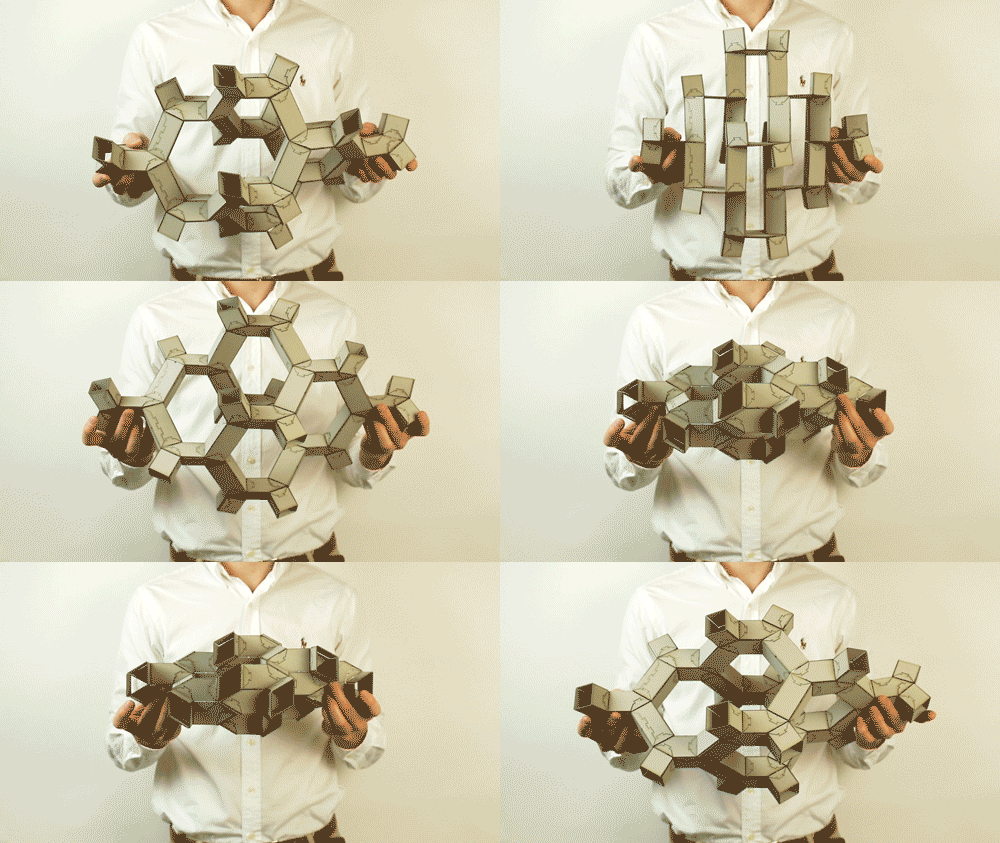
Harvard researchers have developed a general framework to design reconfigurable metamaterials that is scale independent, meaning it can be applied to everything from meter-scale architectures to reconfigurable nano-scale systems (Image courtesy of Johannes Overvelde/Harvard SEAS).

Metamaterials — materials whose function is determined by structure, not composition — have been designed to
  • bend light and sound, 
  • transform from soft to stiff, and 
  • even dampen seismic waves from earthquakes. 
But each of these functions requires a unique mechanical structure, making these materials great for specific tasks, but difficult to implement broadly.
But what if a material could contain within its structure, multiple functions and easily and autonomously switch between them?

Researchers from the Harvard John A. Paulson School of Engineering and Applied Sciences (SEAS) and the Wyss Institute of Biologically Inspired Engineering at Harvard University have developed a general framework to design reconfigurable metamaterials. The design strategy is scale independent, meaning it can be applied to everything from meter-scale architectures to reconfigurable nano-scale systems such as photonic crystals, waveguides and metamaterials to guide heat.

The research is published in Nature.

In terms of reconfigurable metamaterials, the design space is incredibly large and so the challenge is to come up with smart strategies to explore it,” said Katia Bertoldi, John L. Loeb Associate Professor of the Natural Sciences at SEAS and senior author of the paper. “Through a collaboration with designers and mathematicians, we found a way to generalize these rules and quickly generate a lot of interesting designs.
Bertoldi and former graduate student Johannes Overvelde, who is the first author of the paper, collaborated with Chuck Hoberman, of the Harvard Graduate School of Design (GSD) and associate faculty at the Wyss and James Weaver, a senior research scientist at the Wyss, to design the metamaterial.

The research began in 2014, when Hoberman showed Bertoldi his original designs for a family of foldable structures, including a prototype of an extruded cube.We were amazed by how easily it could fold and change shape,” said Bertoldi. “We realized that these simple geometries could be used as building blocks to form a new class of reconfigurable metamaterials but it took us a long time to identify a robust design strategy to achieve this.

The interdisciplinary team realized that assemblies of polyhedra can be used as a template to design extruded reconfigurable thin-walled structures, dramatically simplifying the design process.

By combining design and computational modeling, we were able to identify a wide range of different rearrangements and create a blueprint or DNA for building these materials in the future, ” said Overvelde, now scientific group leader of the Soft Robotic Matter group at FOM Institute AMOLF in the Netherlands.


The same computational models can also be used to quantify all the different ways in which the material could bend and how that affected effective material properties like stiffness. This way they could quickly scan close to a million different designs, and select those with the preferred response.

Once a specific design was selected, the team constructed working prototypes of each 3D metamaterial both using laser-cut cardboard and double-sided tape, and multimaterial 3D printing. Like origami, the resulting structure can be folded along their edges to change shape.

Now that we’ve solved the problem of formalizing the design, we can start to think about new ways to fabricate and reconfigure these metamaterials at smaller scales, for example through the development of 3D-printed self actuating environmentally responsive prototypes,” said Weaver.

This formalized design framework could be useful for
  • structural and aerospace engineers, 
  • material scientists, 
  • physicists, 
  • robotic engineers, 
  • biomedical engineers, 
  • designers and 
  • architects.
This framework is like a toolkit to build reconfigurable materials,” said Hoberman. “These building blocks and design space are incredibly rich and we’ve only begun to explore all the things you can build with them.

This work was supported by the Materials Research Science and Engineering Center and the National Science Foundation.

ORIGINAL:
Harvard SEAS
By Leah Burrows
January 18, 2017

lunes, 11 de julio de 2016

Meet the First Artificial Animal

Scientists genetically engineered and 3-D-printed a biohybrid being, opening the door further for lifelike robots and artificial intelligence.

CREDIT: Getty Images
If you met this lab-created critter over your beach vacation, you'd swear you saw a baby ray. In fact, the tiny, flexible swimmer is the product of a team of diverse scientists. They have built the most successful artificial animal yet. This disruptive technology opens the door much wider for lifelike robots and artificial intelligence.

Like most disruption, it started with a simple idea. Kit Kevin Parker, PhD, a Harvard professor researching how to build a human heart, saw his daughter entranced by watching stingrays at the New England Aquarium in Boston. He wondered if he could engineer a muscle that could move in the same sinuous, undulating fashion. The quest for a material led to creating an artificial ray with a 3-D-printed rubber body at the School of Engineering and Applied Sciences at Harvard. Scientists from the University of Illinois at Urbana-Champaign, the University of Michigan, and Stanford University's Medical Center joined the team.

They reinforced the soft rubber body with a 3-D-printed gold skeleton so thin it functions like cartilage. Geneticists adapted rat heart cells so they could respond to light by contracting. Then, they were grown in a carefully arranged pattern on the rubber and around the gold skeleton.

The muscular circuitry is one of the most interesting parts of the research, and there's more about it in this video:


The birth of biohybrid beings
The new engineered animal responds to light so well scientists were able to guide it through an obstacle course 15 times its length using strong and weak light pulses.

The study authors write, "Our ray outperformed existing locomotive biohybrid systems in terms of speed, distance traveled, and durability (six days), demonstrating the potential of self-propelled, phototactically activated tissue-engineered robots."

What biohybrid mean for robots and artificial intelligence
Science of this type is fundamental for engineering special-purpose creations such as artificial worms that sniff out and eat cancer. Or bionic body parts for those who have suffered accidents or disease. Imagine having little swimmers in your system that rush to the site of a medical emergency such as a stroke. The promise of sensor-rich soft tissue frees robots to move more easily and yet not be cut off from needed input. Sensitized robot soft tissue could perform without the energy-sucking heaviness of metal or the artificial barrier of hard-plastic exoskeletons.

Thanks to disruptive, cross-disciplinary applied science like this, entrepreneurs in the next few years will be able to play on the border of what life is, what alive means, and what life can be. Expect to see companies use biohybrid beings to commercialize applications that solve some of the largest, and most lucrative, challenges we face today.

ORIGINAL: INC
BY LISA CALHOUN General partner, Valor Ventures@Lisa_Calhoun

jueves, 23 de junio de 2016

Ten institutions that dominated science in 2015

Getty Images/iStockphoto/Thinkstock
The University of Oxford is the top research UK university in the Nature Index for the first time.

The top 10 institutions in the Nature Index are the largest contributors to papers published in 68 leading journals in 2015.


Weighted fractional count (WFC): 1357.82

Established in 1949 in Beijing, the Chinese Academy of Sciences (CAS) is the world’s largest scientific organisation, comprising 114 institutes and 48,500 researchers. In 2015 its scientists made the largest contribution to high-quality research included in the index, a contribution that’s grown by a compound annual growth rate of 6.8% since 2012. Last year, one of the oldest CAS research centres, the Institute of Chemistry, founded in 1956, was also one of the largest contributing departments to the institute’s weighted fractional count. Lei Jiang, from the Institute of Chemistry, says: “Chemistry and materials science are currently strong in China because they were relatively easy subjects to start researching back in the 1980s. They didn’t need expensive equipment. If you look at nanoscience as an example, around half of the top scientists in global nanoscience are Chinese scientists who were educated during this period.

2. Harvard University, United States

WFC: 772.33

As the second most prolific institution in the Index, and the most prolific university, Harvard University owes two-thirds of its research output to contributions made in the life sciences. Recognising the growth of interdisciplinary research areas such as translational medicine in the life sciences, Harvard has responded by developing an integrated PhD programme that facilitates cross-disciplinary academic and research collaboration. The Harvard Medical School (HMS), established in 1782, is one of the discipline’s high-fliers. Since the 1930s, fifteen researchers from HMS have shared in nine Nobel Prizes. For the most recent of them, in 2009, Jack Szostak discovered how telomeres cap the ends of chromosomes and protect them from degradation, opening up new lines of enquiry into ageing and cancer research. While last year, a popular piece of research from Harvard’s sleep medicine department highlighted the negative effects of light-emitting e-readers on sleep quality.


WFC: 699.45

The French National Centre for Scientific Research (CNRS) is the largest fundamental research organisation in Europe, comprising ten institutions with more than 32,000 researchers, engineers and technicians. The physical sciences made up more than a third of the contributions to the Index in 2015. In recent years the CNRS has become a key player in planetary science. CNRS engineers have been remotely operating and maintaining instruments on board NASA’s Curiosity Rover, which has been exploring Mars since 2012. The mission lead to the confirmation late last year that liquid water currently flows on the planet. This year CNRS researcher Franck Montmessin is leading the European Space Agency’s mission ExoMars 2016 to investigate the planet’s atmosphere and find evidence of past life beneath its surface.

4. Max Planck Society, Germany

WFC: 655.67

Ranked fourth in the Nature Index, the Max Planck Society has the physical sciences to thank for its high position. Since 1914, physics researchers at Max Planck, a government-funded association of research institute, have won nine Nobel Prizes. The society is named after the quantum theorist, Max Planck, the institute’s second Nobel recipient in 1918, four years after Max von Laue won for his pioneering work in X-ray crystallography. During the Second World War, Laue’s gold medal was dissolved in acid to prevent discovery by the Nazis, and then recast by the Nobel Society after the war. Today, two institutes stand out in terms of research output in the index: the polymer and solid state research units. Last year, nanochemistry scientists focusing on solid-state research published a paper in Advanced Materials that explored moisture-sensitive technology and its potential use in touchless screens.

5. Stanford University, United States

WFC: 530.83

When Stanford University opened its doors to students in 1891, it became one of America’s first non-sectarian, co-educational private colleges. Stanford’s first president, David Starr Jordan, said: “Work in applied science is to be carried out side-by-side with the pure sciences and humanities, and to be equally fostered.” This attitude remains true today as research output is equally balanced between all the disciplines. The university is also credited for its entrepreneurial spirit. During the 1950s, the University leased land to a new industrial park that went on to become Silicon Valley. To this day, Stanford researchers continue this legacy of real-world influence. Howard Rose, a Stanford residential fellow and CEO of Deep Stream VR, is currently developing a virtual reality app called Cool! that is designed to immerse patients in a world that enables them to manage chronic pain without drugs.


WFC: 487.03

Last year’s Nobel Prize for Physics went to Takaaki Kajita, the director of the University of Tokyo’s Institute for Cosmic Ray Research. But UTokyo is not resting on its laurels. The university is focused on opening its doors to the outside world by welcoming international collaborations, foreign staff and students, and closer relationships with business. The institute’s latest high-profile research reflects this gearshift. UTokyo’s Graduate School of Frontier Sciences was involved in a decade-long project with four countries to establish the presence of a giant ocean that wraps Saturn’s moon, Encheladus, beneath its crust.


WFC: 483.62

This year marks a hundred years since the Massachusetts Institute of Technology (MIT) moved from Boston to Cambridge in the US. The move ushered in an age of achievement, from the first chemical synthesis of penicillin to building the magnetic core memory that made digital computers possible. The university’s is known for its hands-on approach to teaching and research - students are given a practical-based education in science, technology and related areas of scholarship - appears to be on the money. A 2015 report suggested that 30,000 companies founded by MIT alumni were active as of 2014, employing 4.6 million people and producing annual revenues of $1.9 trillion, equivalent to the world’s 10th largest economy. Eighty-five present and former members of the MIT community have won the Nobel Prize, including nine current faculty members.


WFC: 413.71

The Helmholtz Association of German Research Centres is the country’s largest scientific organisation with almost 38,000 employees and an annual budget of nearly €4 billion. Their research output is dominated by the physical sciences, and last year the Karlsruhe Institute of Technology (KIT) had the biggest impact on the association’s overall ranking in the index. KIT was officially founded in 2009 when the Karlsruhe Research Center and University of Karlsruhe merged. In a recent paper in Nature Photonics, KIT researchers demonstrated a way to store optical information that could dramatically reduce the power consumption and increase the speed of optical communication networks.

9. University of Oxford, United Kingdom

WFC: 398.38

Having produced 16 Nobel Laureates in medicine since 1932, the University of Oxford has a long pedigree in the life sciences. More than 30% of contributions to the most recent Nature Index come from this discipline. In the 21st century, the university focuses on a wide range of fascinating aspects of the life sciences from clinical practice in modern medicine to epidemiological and genetic studies. For example, researchers are currently exploring the negative effects of loud noise in an intensive care unit. Another group of scientists whose research is soon to published, have recently sequenced seven genomes of the Brazilian Zika virus taken from seven different individuals infected with the virus to determine when and where it entered the Americas.

10. University of Cambridge, United Kingdom

WFC: 390.54

A strong showing in the physical sciences has helped put the University of Cambridge in the Nature Index top ten. One of the key contributors to the university’s research output is the Cavendish Laboratory, which is the largest physics department in the UK and birthplace of ground-breaking discoveries such as the structure of DNA, and the splitting the atom. According to Professor Andy Parker, head of the Cavendish Laboratory: “The laboratory’s strength comes from the very wide range of research performed, from cosmology, through solid state and nanoscience, to the physics of medicine, backed up by world-class facilities, and the freedom given to its staff to pursue their own directions. This bottom-up approach to research strategy has proved its worth over many decades.

How the Nature Index works
Since 2012, every paper published in 68 top-tier journals has been included in the Nature Index database. The index ranks the contribution of research institutions to these articles, by a metric called weighted fractional count (WFC), which divides credit for each article by the affiliations of contributing authors. This measure is weighted to account for the disproportionate number of astronomy articles in the index.

ORIGINAL: Nature Index
By Sarah O'Meara
20 April 2016

sábado, 11 de junio de 2016

The Inner Life of The Cell: Protein Packing

Src: XVivo.net

Harvard University and XVIVO come together again to add to the growing series of scientific animations for BioVisions -- Harvard's multimedia lab in the department of Molecular and Cellular Biology. 'Protein Packing' strives to more accurately depict the molecular chaos in each and every cell, with proteins jittering around in what may seem like random motion. Proteins occupy roughly 40% of the cytoplasm, creating an environment that risks unintentional interaction and aggregation. Via diffusion and motor protein transport, these molecules are directed to sites where they are needed.

View the first two of this 3D animation series, The Inner Life of the Cell, and Powering the Cell: Mitochondria, on our website.


ORIGINAL: XVivo BioVisions

martes, 7 de junio de 2016

A Big Leap for an Artificial Leaf

A new system for making liquid fuel from sunlight, water, and air is a promising step for solar fuels.

The bionic leaf is one step closer to reality.
Daniel Nocera, a professor of energy science at Harvard who pioneered the use of artificial photosynthesis, says that he and his colleague Pamela Silver have devised a system that completes the process of making liquid fuel from sunlight, carbon dioxide, and water. And they’ve done it at an efficiency of 10 percent, using pure carbon dioxidein other words, one-tenth of the energy in sunlight is captured and turned into fuel. That is much higher than natural photosynthesis, which converts about 1 percent of solar energy into the carbohydrates used by plants, and it could be a milestone in the shift away from fossil fuels. The new system is described in a new paper in Science.

Bill Gates has said that to solve our energy problems, someday we need to do what photosynthesis does, and that someday we might be able to do it even more efficiently than plants,” says Nocera. “That someday has arrived.

In nature, plants use sunlight to make carbohydrates from carbon dioxide and water. Artificial photosynthesis seeks to use the same inputs—solar energy, water, and carbon dioxide—to produce energy-dense liquid fuels. Nocera and Silver’s system uses a pair of catalysts to split water into oxygen and hydrogen, and feeds the hydrogen to bacteria along with carbon dioxide. The bacteria, a microörganism that has been bioengineered to specific characteristics, converts the carbon dioxide and hydrogen into liquid fuels.

Several companies, including Joule Unlimited and LanzaTech, are working to produce biofuels from carbon dioxide and hydrogen, but they use bacteria that consume carbon monoxide or carbon dioxide, rather than hydrogen. Nocera’s system, he says, can operate at lower temperatures, higher efficiency, and lower costs.

Nocera’s latest work “is really quite amazing,” says Peidong Yang of the University of California, Berkeley. Yang has developed a similar system with much lower efficiency. “The high performance of this system is unparalleled” in any other artificial photosynthesis system reported to date, he says.

The new system can use pure carbon dioxide in gas form, or carbon dioxide captured from the air—which means it could be carbon-neutral, introducing no additional greenhouse gases into the atmosphere. “The 10 percent number, that’s using pure CO2,” says Nocera. Allowing the bacteria themselves to capture carbon dioxide from the air, he adds, results in an efficiency of 3 to 4 percent—still significantly higher than natural photosynthesis.That’s the power of biology: these bioörganisms have natural CO2 concentration mechanisms.

Nocera’s research is distinct from the work being carried out by the Joint Center for Artificial Photosynthesis, a U.S. its fusing of two usually separate fields:
  • inorganic chemistry (to split water) and 
  • biology (to convert hydrogen and carbon dioxide into fuel). 
What’s really exciting is the hybrid approach” to artificial photosynthesis, says Co. “It’s exciting to see chemists pairing with biologists to advance the field.

Commercializing the technology will likely take years. In any case, the prospect of turning sunlight into liquid fuel suddenly looks a lot closer.


ORIGINAL: Technology Review
by Richard Martin
June 7, 2016

domingo, 29 de mayo de 2016

Edificio de la Empresa de Desarrollo Urbano de Medellín (EDU) renueva el Parque San Antonio

Esta semana realizamos un recorrido al interior del edificio, el cual deberá estar listo en diciembre de este año. 
FOTOS JAIME PÉREZ
Un inglés de madre paisa renueva arquitectura localA la mezcla de diseño, arquitectura e ingeniería, la Empresa de Desarrollo Urbano (EDU) le sumó otro componente: ecosostenible. La nueva sede de la entidad será un ícono de la transformación del Centro de Medellín, en especial, del parque San Antonio.

Cortesía. El Mundo.com
EDU.gov.co
La principal y más curiosa característica de este edificio es que va a respirar, a través de una chimenea solar. Esto le permitirá tener una ventilación natural constante, que reemplaza el uso de un aire acondicionado; con esto y un sistema de iluminación especial gracias a su diseño, llevará el ahorro de energía eléctrica a otro nivel.

Así mismo, el edificio cuenta con otras particularidades únicas (ver claves) que lo convierten en un ejemplo a seguir para el desarrollo urbano de la ciudad.

La pasada Administración Municipal invirtió 8.600 millones de pesos para la construcción de este edificio y la actual inyectará otros 5.600 millones para poder terminarlo. (Total 14,200MCo$ / 4.7M$USD)
SALMAAN CRAIG
Esta estructura también es el fruto del trabajo articulado entre Conconcreto y el Taller de Diseño de la EDU, bajo el direccionamiento de Salmaan Craig, uno de los profesores de la Universidad de Harvard más destacados a nivel mundial en el diseño y construcción de estos edificios que rompen el molde de lo tradicional.

EL COLOMBIANO aprovechó la última visita de Craig, el ideólogo de este tipo de edificio ecosostenible, para conversar con él, saber más de este proyecto y conocer su concepto de la arquitectura de Medellín.

EDU. Flicker
 ¿Cuál es el principio que usted aplica para lograr que un edificio aproveche su entorno natural?
Es muy simple. Para mí, Medellín tiene un clima perfecto, en lo que a temperatura se refiere. Es muy estable ya que no tiene variaciones de estaciones, el único problema es el poco viento que hay. En este sentido lo que se busca resolver es cómo tener un ambiente fresco, con una temperatura agradable y estable dentro del edificio, manteniendo un flujo constante de aire. Hay varios principios para el diseño bioclimático, no se trata simplemente de abrir las ventanas y esperar a que el viento sople; además esto tampoco sería suficiente ya que al interior del edificio estará muy caliente por el calor que generan las personas, los computadores y demás. Entonces, con el diseño, lo que nosotros hacemos es tomar ese calor que se genera dentro de la estructura y aprovecharlo para generar un flujo cíclico entre el aire caliente que sale por una especie de ‘chimenea’ central que tiene el edificio y el aire fresco que entra a través de las paredes, que también son no convencionales. La razón por la que este sistema es innovador, es porque el principal problema de las construcciones tradicionales es que no dejan tener disponible el viento. Aquí la estrategia es perfecta, ya que mientras más gente tenga el edificio, más calor se produce y más aire entra, en una perfecta sincronización”.


¿Existe la manera de transformar, para este propósito, los edificios convencionales?
Lo que estamos haciendo acá es probar sistemas que usan este principio básico, el cual no había sido utilizado antes a gran a escala, en grandes edificios. Este lo vemos como un experimento, será el laboratorio para la ciudad de Medellín. Vamos a monitorear el rendimiento del edificio de la EDU y vamos a compartir los resultados, en tiempo real, en Internet, para que todos puedan conocer y entender lo que sucede, en qué momento funciona como se espera y cuándo no. Con esta información, los expertos locales podrán adaptarlos a sus propios y futuros diseños. Sí hay casos en los que edificios existentes podrían ser adecuados a este principio. Lo importante que debemos entender es que esta no es una tecnología para incorporar después de, sino que debe ir integrada en el diseño desde el principio”.

¿Estos edificios se deben construir con materiales especiales?
No, los materiales son los mismos. El resto está en el diseño y la arquitectura, lograr orquestar todo de la manera adecuada para tener un resultado extraordinario. Este principio se puede aplicar para toda clase de edificios y presupuestos que se vayan a construir en Medellín de ahora en adelante”.

¿Se ha podido reunir o conversar con los estudiantes de ingeniería, diseño y arquitectura de Medellín?
¡Claro! Esta semana tuvimos un gran charla en San Antonio. Tuve la oportunidad de contarles las principales ideas de este proyecto. Les hablé acerca del monitoreo que tendrá el edificio en Internet y de la publicación, en una plataforma, del análisis y la hipótesis del rendimiento, para que todos, expertos y estudiantes, puedan entrar, hacer preguntas y sugerencias y así iniciar un diálogo en línea que, no necesariamente tendrá que ser del edificio de la EDU, también podemos hablar de cualquier proyecto que tengan en Medellín o en Colombia. Esperamos que puedan entender bien estos principios para que los apliquen en sus proyectos”.

¿Qué opina de la nueva arquitectura de Medellín, de los nuevos edificios icónicos que se han construido en la ciudad como el de Ruta N, EPM, los parques biblioteca, entre otros?
Conozco la excelente arquitectura de Medellín gracias a mi conexión con Harvard. Hay muchos arquitectos de esta ciudad que han estado vinculados con la universidad. Ustedes tienen grandes ejemplos y todos esos que tú mencionas tienen una arquitectura fantástica. Sin embargo, no me fijo en los edificios especiales, sino que me enfoco en lo genérico, en todos los edificios convencionales de Medellín que no tienen ningún tipo de ventaja bioclimática”.

¿El edificio de la EDU es un prototipo o ya hay otros como este en el mundo?
He trabajado en proyectos similares pero no como este. El edificio de la EDU es algo nuevo, es un gran experimento y vamos a compartir los resultados con todo el mundo

Finalmente, en lo personal, ¿qué es lo que más le gusta de Medellín, de cada visita que nos hace?
Le voy a contar un pequeño secreto: mi madre es colombiana, de Medellín. El apellido de mi familia materna es Galeano. Cuando ella era muy pequeña se mudó a Londres (Inglaterra) y cuando tenía 20 años conoció a mi padre, él sí es inglés. Yo nací y me crié en Londres y ahora vivo muy feliz en Estados Unidos. Entonces, para mí, hay razones académicas, intelectuales y personales que me atan a este proyecto y a Medellín. Es una gran oportunidad para mí, que me permite aprender más de esta maravillosa cultura, que también es mía pero que no había tenido la oportunidad de conocer a fondo, porque cuando era pequeño no teníamos en casa suficiente dinero para venir acá y visitar esta maravillosa ciudad”.

CONTEXTO DE LA NOTICIA
SERÁ OTRO EDIFICIO REFERENTE DE CIUDAD
  1. Reciclaje de aguas lluvias: se destinará para regar las zonas verdes del edificio y su entorno.
  2. Chimenea solar: el sistema permitirá evacuar el aire caliente por succión, ayudado por entradas de aire frío.
  3. Energías alternativas: páneles solares traslúcidos con membrana recolectora que alimentarán las oficinas de día.
  4. Iluminación y ventilación natural: estudio bioclimático para aprovechar los recursos naturales.
  5. Urbanismo y paisaje: su arquitectura ralatará la transformación urbana y visual del centro de Medellín.
  6. Información visual: tendrá un sistema de alta definición que busca mejorar la participación ciudadana.
Profesor de Harvard.
Salmaa Craig. EDU. Flicker
Salmaan es Licenciado (con honores) de Diseño de Productos de la Escuela de Ingeniería y Diseño de Brune University de Londres, Inglaterra. EngD en Tecnología Ambiental de la Escuela de Ingeniería y Diseño también de Brunel University. Es profesor de la universidad de Harvard y miembro del Centro de Edificios y Ciudades Verdes de la misma universidad. Es diseñador, investigador y experto mundial en bioclimática especialmente en edificios de alto perfil como: Buro Happold, Louvre Abu Dhabi, Apple Campus y Bloomberg Place. Enseña a los arquitectos, con la composición de materiales simples, cómo usar mejor las corrientes térmicas que fluyen a través de los edificios.
ORIGINAL: El Colombiano
POR CAMILO TRUJILLO VILLA
2016/05/29

domingo, 15 de mayo de 2016

Should we synthesise a human genome?

As specialists gather in private to discuss a grand plan for constructing a human genome, Drew Endy and Laurie Zoloth argue that such an enormous moral gesture should not be discussed behind closed doors.
CREDIT: MARIO TAMA/GETTY IMAGES
At Harvard today, an invitation-only group of about 150 scientists, lawyers, and entrepreneurs, met to discuss if and how to construct from scratch an entire human genome – the heritable genetic material that in nature is transferred from parents to children.

The meeting was originally organised to focus on “deliverables and industry involvement” with the primary goal of the project being “to synthesise a complete human genome in a cell line within a period of 10 years”.

Such a synthetic genome could then be tested in a laboratory by replacing the existing genome within a human cell. All this would still be far removed from making a synthetic human.

However, the possibility of making a human cell, whose genome is realised from only digital information and raw materials, should trigger broader considerations. 

For context, total synthesis of a human genome is becoming plausible at an accelerating rate. Thanks to new production techniques developed since 2003 the cost of assembling the genetic material encoding genes, the “building blocks” of life, has decreased from $4.00 to just three cents per individual letter, or “base pair” of deoxyribonucleic acid (DNA). 

As a result, the estimated initial cost of printing the DNA fragments encoding a three billion base pair human genome has dropped from $12 billion to $90 million

If cost reductions continue in the way they have been, then this price would approach $100,000 within 20 years. However, such dramatic additional cost reductions might never be realised without an overwhelming demand.

Advocates of synthetising a human genome, therefore argue that some open, collaborative “grand challenge” is needed to drive development of such technologies. 

While we strongly agree that sustained improvements in DNA construction tools are essential for advancing basic biological science and improving public health we are sceptical that synthesising a human genome is an appropriate demand driver.

We recall how controversies associated with many of the earliest genome synthesis projects delivered unintended consequences. 

For example, a project that made polio virus from scratch in 2002 generated such fear that public funding for improving DNA synthesis tools was cancelled, unwittingly harming research across diverse and unrelated fields while policy makers struggled to imagine how such tools could ever be controlled.

We argue that the synthesis of less controversial and more immediately useful genomes along with greatly improved sub-genomic synthesis capacities (for example, the real-time printing of plasmids the casettes that transfer genes between cells) should be pursued instead.
"In a world where human reproduction has already become a competitive marketplace...
it is easy to make up far stranger uses of human genome synthesis."
These are alternatives that would deliver broad and diverse public benefits.

Other topics on today’s agenda included changing the human genome itself. For example, could scientists synthetise a modified human genome that is resistant to all natural viruses? 

They likely could, for purely beneficial purposes, but what if others then sought to synthesise modified viruses that overcame such resistance? Might doing so start a genome-engineering arms race? 

And, what of even greater changes that can be imagined?

In a world where human reproduction has already become a competitive marketplace, with eggs, sperm and embryos carrying a price, it is easy to make up far stranger uses of human genome synthesis capacities. 

Would it be OK, for example, to sequence and then synthesise Einstein’s genome? If so how many Einstein genomes should be made and installed in cells, and who would get to make them? 

Taking a step back, just because something becomes possible, how should we approach determining if it is ethical to pursue?

Given that human genome synthesis is a technology that can completely redefine the core of what now joins all of humanity together as a species, we argue that discussions of making such capacities real, like today’s Harvard conference, should not take place without open and advance consideration of whether it is morally right to proceed.

When the first people at the table mostly have significant and direct material interests in proceeding, everyone, not just those in the room, risk out-of-control competition between public and private interests, ethical conflicts of interest, and temptations to manipulate human subject consent.

Pluralistic, public, and deliberative discussions are instead the best appropriate way to frame paths forward.

We note that the narrative of creation of the human is the central narrative for many religious communities.

To create a human genome from scratch would be an enormous moral gesture whose consequences should not be framed initially on the advice of lawyers and regulators alone.

The perspectives of others including self-identified theologians, philosophers, and ethicists from a variety of traditions should be sought out from the very beginning.

Critical voices representing civil society, who have long been sceptical of synthetic biology’s claims, should also be included. 

The creation of new human life is one of the last human-associated processes that has not yet been industrialised or fully commodified. It remains an act of faith, joy, and hope. 

Discussions to synthetise, for the first time, a human genome should not occur in closed rooms. 

Drew Endy is Associate Professor of Bioengineering at Stanford University.
Laurie Zoloth is a professor of medical ethics and humanities at Northwestern University, Chicago.

ORIGINAL: Cosmos Magazine

sábado, 26 de marzo de 2016

Medio ambiente debe ser clave en el urbanismo

El experto Charles Waldheim visitó Medellín, Santiago de Chile y Brasilia para conocer más sobre los trabajos locales y, el cruce entre los procesos urbanísticos y el interés ambiental. FOTO CORTESÍA

Con la evolución de la arquitectura el paisaje juega un rol más representativo en las ciudades contemporáneas. Experto Charles Waldheim visitó Medellín para disertar y conocer más sobre el tema.

Medellín junto con Santiago de Chile y Brasilia forma parte de las tres ciudades latinoamericanas escogidas por los expertos de la Universidad de Harvard para plantear discusiones sobre las relaciones entre paisaje y urbanismo.

Charles Waldheim, experto en el tema y profesor de la escuela de diseño de la Universidad de Harvard, participó en Medellín en un encuentro realizado en el Museo de Arte Moderno de Medellín, Mamm y que fue liderado por la Universidad de Harvard y el Centro David Rockefeller para Estudios Latinoamericanos.

El certamen denominado Landscape as Urbanism in the Americas (paisaje como urbanismo en las Américas) fue realizado por la Universidad Eafit, a través de su Centro de Estudios Urbanos y Ambientales, Urbam.

¿Por qué el interés en urbanismo y paisaje?
En mi trabajo como arquitecto encontré limitaciones en la inclusión del urbanismo en profesiones como arquitectura e ingeniería y descubrí que había otros caminos, desde el paisaje en el campo norteamericano. Nosotros importamos el modelo español de construir la ciudad americana de la Ley de Indias, que le da prioridad principalmente a la arquitectura. Pese a que se trata de un modelo muy importante y las ciudades partieron de allí, este opera sacando la ecología, la biología de él. Se trata de un modelo puramente arquitectónico. Y la oposición entre la ciudad y lo que no forma parte de lo construido (los recursos) ha redundado en unas ciudades no tan sanas y sostenibles como podrían serlo”.

¿Cómo ve usted las obras de urbanismo en la ciudad?
Colombia ha formado parte de la discusión internacional en los últimos 10 o 15 años. Y desde la Universidad de Harvard hemos tenido contacto y conocimiento directo con algunos de los proyectos y especialmente con Medellín. En los últimos años aparecieron una seria de oficinas que hacían algo diferente con el paisaje. Una de las prácticas conocidas muestra que el paisaje no está subyugado a otra disciplina, juega un papel primordial”.

¿Qué reconocimientos urbanísticos hará usted en la ciudad?
Vamos a recorrer Parques del Río y las piscinas del complejo acuático de los juegos suramericanos, entre otros, donde la naturaleza y el componente ecológico o biológico juega un destacado papel, pero me gustaría ver y confirmar si ese componente biológico va más allá de la función estética”.

¿Cuál es el papel diferente al decorativo?
Que limpie el agua, el aire, sea un buen lugar para que las especies habiten y puedan generar comida”.

En Medellín se mencionó que Parques del Río podría mejorar la calidad de vida de la ciudad. ¿Cómo incide el paisaje en la calidad de vida de los habitantes?
Sin lugar a dudas generará un cambio y un bienestar en el medio ambiente, pero hay dos condiciones

  • una de ellas, es que habitualmente la calidad de la vivienda alrededor de estos lugares no está en el mismo nivel del parque, del espacio público. Pero puede aparecer la posibilidad de que el diseñador pueda controlar la ecología con el diseño de la vivienda: los dos estén conectados. 
  • Otro elemento presente en Latinoamérica está relacionado con el hecho de que el medio ambiente en el diseño está mas dirigido a lo estético, a la apariencia. Lo estético es importante pero, si tuviera más de biología, biodiversidad sería mucho mejor”.
¿Cómo las personas ubicadas alrededor de Parques del Río pueden conectarse más con él?
Parte del problema es que se entiende la vivienda separada del parque. Se piensa uno disgregado del otro. Debe pensarse junto, que pertenecen al mismo sistema”.

Y qué se recomienda
Planeación, políticas y darle potestad a los diseñadores para que esas relaciones entren a jugar desde el primer momento, para tenerlas en cuenta en los diseños y en la operación. Porque hay una tendencia a entender que cada predio lo desarrolla un arquitecto, un desarrollador de una sola manera y tiende a ser cerrado. Pensarlo de una manera más colectiva, más conectada”.

¿Qué ventaja tiene para el habitante que haya mayor conexión entre el parque y el ciudadano?
Salud pública, si un ciudadano puede caminar por un ambiente no dominado por el auto. También hay calidad de vida. Existe buena evidencia que bajo este sistema se reduce la polución en la ciudad y la calidad del aire. El calor disminuye. Esto también da la oportunidad de que la ciudad consuma lo que produce ella misma, en vez de traer de afuera, insumos que aumentan la huella de carbono”.

¿Por qué está incluida Medellín en ese programa de conferencias y discusiones junto con Santiago de Chile, Chile y Brasilia, Brasil?
En Latinoamérica ha sido lento el acercamiento a las prácticas que involucran el paisaje. Miramos una serie de culturas en Latinoamérica que tuvieran secuelas de paisaje o hubieran manifestaciones alrededor del paisaje a través de escuelas u oficinas. Se quiere mirar y verificar qué está pasando y, las tres ciudades seleccionadas muestran dentro del panorama las prácticas más alternativas en el marco general de la pregunta que nos estamos haciendo. Queremos entender la especificidad de cada cultura y conectar varios nodos, para determinar si la conversación puede ser más grande y que esas personas se conecten como en una red”.

¿Cómo se retroalimenta Medellín?
Se ampliará la discusión que ya se ha tenido a través de una serie de comunicaciones. Además, habrá una página web donde se podrán vincular los proyectos y difundir este tipo de prácticas. También hay un tema de reclutamiento de profesores y estudiantes que puedan ejercer esas nuevas prácticas. Estudiantes que regresen a sus países de origen o profesores que generen la discusión alrededor de esa mirada”.

CONTEXTO DE LA NOTICIA
PARA SABER MÁS
BUSCA SOCIOS EN LATINOAMÉRICA
Charles Waldheim es un arquitecto norteamericano. El profesor de la escuela de diseño de la Universidad de Harvard realiza un trabajo enfocado en las ciudades. Uno de sus intereses particulares está relacionado con investigar cómo funcionan los sistemas naturales en las ciudades. En la Universidad de Harvard organiza grupos estudiantiles y de investigadores para explorar, analizar y estudiar ciertos temas que son del interés de la institución universitaria y del socio estratégico del caso de estudio. Busca socios en universidades, empresas y gobiernos para los proyectos.

viernes, 15 de enero de 2016

This Millenial Might Be The New Einstein

Now 22, Pasterski is getting her Ph.D. at Harvard.SOURCE: Michael Noble Jr. / Landov
WHY YOU SHOULD CARE
Her research could change our understanding of the fundamentals as we know them.

One of the things the brilliant minds at MIT do — besides ponder the nature of the universe and build sci-fi gizmos, of course — is notarize aircraft airworthiness for the federal government. So when Sabrina Gonzalez Pasterski walked into the campus offices one cold January morning seeking the OK for a single-engine plane she had built, it might have been business as usual. Except that the shaggy-haired, wide-eyed plane builder before them was just 14 and had already flown solo. “I couldn’t believe it,” recalls Peggy Udden, an executive secretary at MIT, “not only because she was so young, but a girl.

OK, it’s 2016, and gifted females are not exactly rare at MIT; nearly half the undergrads are women. But something about Pasterski led Udden not just to help get her plane approved, but to get the attention of the university’s top professors. Now, eight years later, the lanky, 22-year-old Pasterski is already an MIT graduate and Harvard Ph.D. candidate who has the world of physics abuzz. She’s exploring some of the most challenging and complex issues in physics, much as Stephen Hawking and Albert Einstein (whose theory of relativity just turned 100 years old) did early in their careers. Her research delves into black holes, the nature of gravity and spacetime. A particular focus is trying to better understand “quantum gravity,” which seeks to explain the phenomenon of gravity within the context of quantum mechanics. Discoveries in that area could dramatically change our understanding of the workings of the universe.

Among the many skills she lists on her no-frills website: “spotting elegance within the chaos.

She’s also caught the attention of some of America’s brightest working at NASA. Also? Jeff Bezos, founder of Amazon.com and aerospace developer and manufacturer Blue Origin, who’s promised her a job whenever she’s ready. Asked by e-mail recently whether his offer still stands, Bezos told OZY: “God, yes!

But unless you’re the kind of rabid physics fan who’s seen her papers on semiclassical Virasoro symmetry of the quantum gravity S-matrix and Low’s subleading soft theorem as a symmetry of QED (both on approaches to understanding the shape of space and gravity and the first two papers she ever authored), you may not have heard of Pasterski. A first-generation Cuban-American born and bred in the suburbs of Chicago, she’s not on Facebook, LinkedIn or Instagram and doesn’t own a smartphone. She does, however, regularly update a no-frills website called PhysicsGirl, which features a long catalog of achievements and proficiencies. Among them: “spotting elegance within the chaos.

Pasterski stands out among a growing number of newly minted physics grads in the U.S. There were 7,329 in 2013, double the four-decade low of 3,178 in 1999, according to the American Institute of Physics. Nima Arkani-Hamed, a Princeton professor and winner of the inaugural $3 million Fundamental Physics Prize, told OZY he’s heard “terrific things” about Pasterski from her adviser, Harvard professor Andrew Strominger, who is about to publish a paper with physics rock star Hawking. She’s also received hundreds of thousands of dollars in grants from the Hertz Foundation, the Smith Foundation and the National Science Foundation.

Pasterski, who speaks in frenetic bursts, says she has always been drawn to challenging what’s possible. “Years of pushing the bounds of what I could achieve led me to physics,” she says from her dorm room at Harvard. Yet she doesn’t make it sound like work at all: She calls physics “elegant” but also full of “utility.

Despite her impressive résumé, MIT wait-listed Pasterski when she first applied. Professors Allen Haggerty and Earll Murman were aghast. Thanks to Udden, the pair had seen a video of Pasterski building her airplane. “Our mouths were hanging open after we looked at it,” Haggerty said. “Her potential is off the charts.” The two went to bat for her, and she was ultimately accepted, later graduating with a grade average of 5.00, the school’s highest score possible.


An only child, Pasterski speaks with some awkwardness and punctuates her e-mails with smiley faces and exclamation marks. She says she has a handful of close friends but has never had a boyfriend, an alcoholic drink or a cigarette. Pasterski says: “I’d rather stay alert, and hopefully I’m known for what I do and not what I don’t do.

While mentors offer predictions of physics fame, Pasterski appears well grounded. “A theorist saying he will figure out something in particular over a long time frame almost guarantees that he will not do it,” she says. And Bezos’s pledge notwithstanding, the big picture for science grads in the U.S. is challenging: The U.S. Census Bureau’s most recent American Community Survey shows that only about 26 percent of science grads in the U.S. had jobs in their chosen fields, while nearly 30 percent of physics and chemistry post-docs are unemployed. Pasterski seems unperturbed. “Physics itself is exciting enough,” she says. ”It’s not like a 9-to-5 thing. When you’re tired you sleep, and when you’re not, you do physics.

ORIGINAL: MIT News
BY Farah Halimejan