Mostrando entradas con la etiqueta UCBerkeley. Mostrar todas las entradas

lunes, 3 de junio de 2013

Imaging Breakthrough: See Atomic Bonds Before and After Molecular Reaction

ORIGINAL: Wired
By Nadia Drake
05.30.13

Molecular Rearrangements
A ringed, carbon-containing molecule, shown both before and after it has rearranged itself, with the two most common reaction products included. The scale bars measure 3 angstroms, or three ten-billionths of a meter, across. Image and Caption: Lawrence Berkeley National Laboratory and University of California at Berkeley

Reactant 1


Product 2


Product 3


Product 4


Product 5
The team predicted the existence of Product 5, but it accounted for less than 1 percent of the reaction mixture. Image: S. Wickenburg, A. Riss, D. J. Mowbray, F. R. Fischer
For the first time, scientists have visually captured a molecule at single-atom resolution in the act of rearranging its bonds. The images look startlingly similar to the stick diagrams in chemistry textbooks.

Until now, scientists were only able to infer molecular structures. Using atomic force microscopy, the individual atomic bonds — each a few ten-millionths of a millimeter long – that connect the carbon molecule’s 26 carbon and 14 hydrogen atoms are clearly visible. The results are reported online May 30 in Science.

The team initially set out to precisely assemble nanostructures made from graphene
, a single-layer material in which carbon atoms are arranged in repeating, hexagonal patterns. Building the carbon honeycombs required rearranging atoms from a linear chain into the six-sided shapes; the reaction can produce several different molecules. UC Berkeley chemist Felix Fischer and his colleagues wanted to visualize the molecules to make sure they’d done it right.

To document the graphene recipe, Fischer needed a powerful imaging device, and he turned to the atomic force microscope housed in physicist Michael Crommie’s UC Berkeley lab. Non-contact atomic force microscopy uses a very fine, sharp point to read the electrical forces produced by molecules; as the tip is moved near a molecule’s surface, it’s deflected by different charges, producing an image of how the atoms and bonds are aligned.

With it, the team managed to visualize not only the carbon atoms but the bonds between them, created by shared electrons. They placed a ringed carbon structure on a silver plate and heated it until the molecule rearranged. Subsequent cooling trapped the reaction products, which as it turned out, contained three unexpected products and one molecule the scientists had predicted.

viernes, 17 de mayo de 2013

Artificial Forest for Solar Water-Splitting. First Fully Integrated Artificial Photosynthesis Nanosystem


ORIGINAL: Berkeley Lab
Lynn Yarris
May 16, 2013

Berkeley Lab Researchers Report First Fully Integrated Artificial Photosynthesis Nanosystem

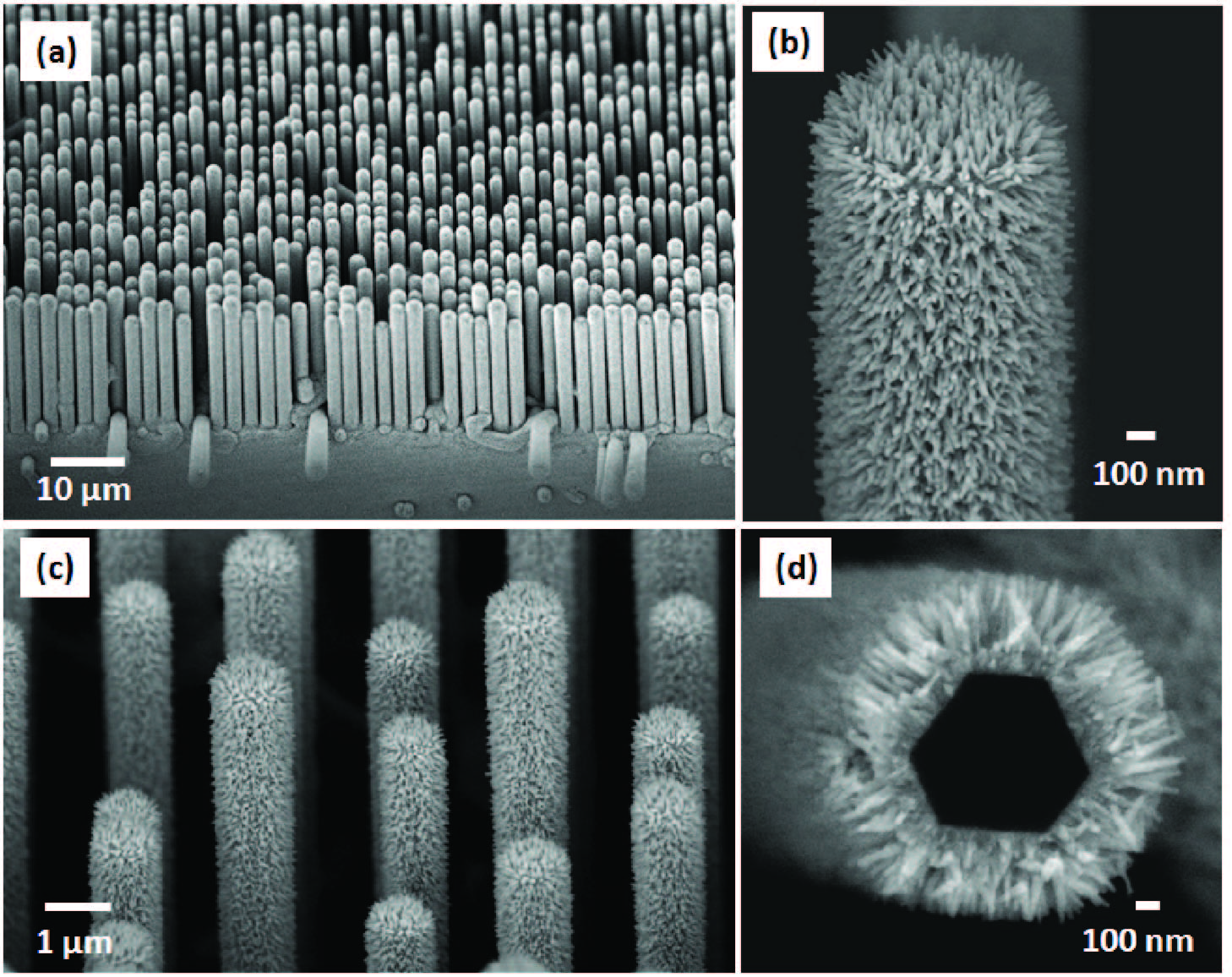
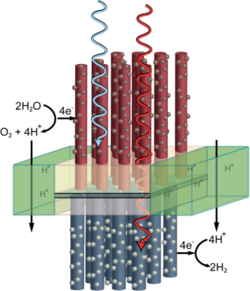
InGaN nanowires grown on Si nanowires for Solar Water Splitting. Peidong Yang

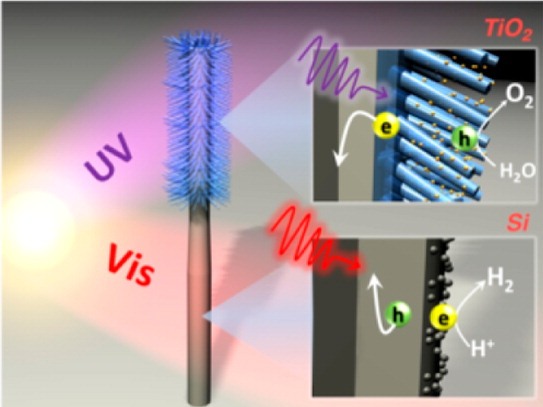
Schematic shows TiO2 nanowires (blue) grown on the upper half of a Si nanowire (gray) and the two absorbing different regions of the solar spectrum. Insets display photoexcited electron−hole pairs separated at the semiconductor-electrolyte interface to carry out water splitting with the help of co-catalysts (yellow and gray dots).

In the wake of the sobering news that atmospheric carbon dioxide is now at its highest level in at least three million years, an important advance in the race to develop carbon-neutral renewable energy sources has been achieved. Scientists with the U.S. Department of Energy (DOE)’s Lawrence Berkeley National Laboratory (Berkeley Lab) have reported the first fully integrated nanosystem for artificial photosynthesis. While “artificial leaf” is the popular term for such a system, the key to this success was an “artificial forest.”

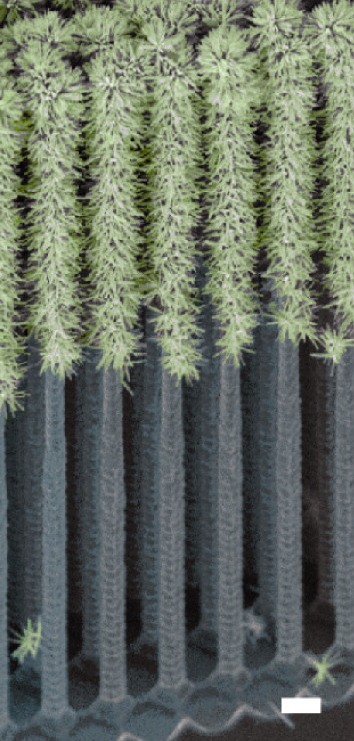
“Similar to the chloroplasts in green plants that carry out photosynthesis, our artificial photosynthetic system is composed of two semiconductor light absorbers, an interfacial layer for charge transport, and spatially separated co-catalysts,” says Peidong Yang, a chemist with Berkeley Lab’s Materials Sciences Division, who led this research. “To facilitate solar water- splitting in our system, we synthesized tree-like nanowire heterostructures, consisting of silicon trunks and titanium oxide branches. Visually, arrays of these nanostructures very much resemble an artificial forest.”

Yang, who also holds appointments with the University of California Berkeley’s Chemistry Department and Department of Materials Science and Engineering, is the corresponding author of a paper describing this research in the journal NANO Letters. The paper is titled “A Fully Integrated Nanosystem of Semiconductor Nanowires for Direct Solar Water Splitting.” Co-authors are Chong Liu, Jinyao Tang, Hao Ming Chen and Bin Liu.

Solar technologies are the ideal solutions for carbon-neutral renewable energy – there’s enough energy in one hour’s worth of global sunlight to meet all human needs for a year. Artificial photosynthesis, in which solar energy is directly converted into chemical fuels, is regarded as one of the most promising of solar technologies. A major challenge for artificial photosynthesis is to produce hydrogen cheaply enough to compete with fossil fuels. Meeting this challenge requires an integrated system that can efficiently absorb sunlight and produce charge-carriers to drive separate water reduction and oxidation half-reactions.
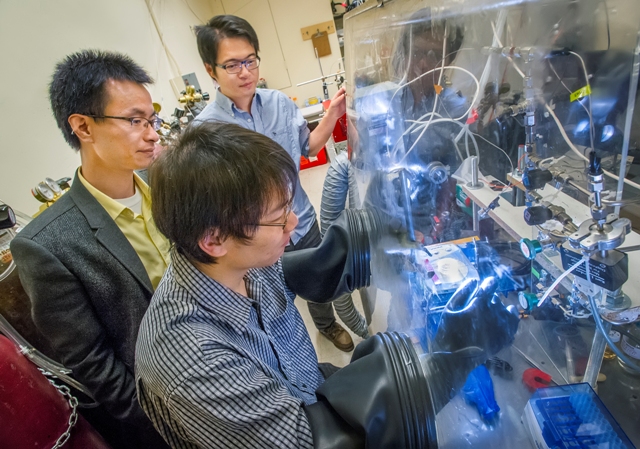
Peidong Yang (left), Hao Ming Chen and Chong Liu (glove box) have developed the first fully integrated nanoscale artificial photosynthesis system. (Photo by Roy Kaltschmidt)

“In natural photosynthesis the energy of absorbed sunlight produces energized charge-carriers that execute chemical reactions in separate regions of the chloroplast,” Yang says. “We’ve integrated our nanowire nanoscale heterostructure into a functional system that mimics the integration in chloroplasts and provides a conceptual blueprint for better solar-to-fuel conversion efficiencies in the future.”

When sunlight is absorbed by pigment molecules in a chloroplast, an energized electron is generated that moves from molecule to molecule through a transport chain until ultimately it drives the conversion of carbon dioxide into carbohydrate sugars. This electron transport chain is called a “Z-scheme” because the pattern of movement resembles the letter Z on its side. Yang and his colleagues also use a Z-scheme in their system only they deploy two Earth abundant and stable semiconductors – silicon and titanium oxide – loaded with co-catalysts and with an ohmic contact inserted between them. Silicon was used for the hydrogen-generating photocathode and titanium oxide for the oxygen-generating photoanode. The tree-like architecture was used to maximize the system’s performance. Like trees in a real forest, the dense arrays of artificial nanowire trees suppress sunlight reflection and provide more surface area for fuel producing reactions.

“Upon illumination photo-excited electron−hole pairs are generated in silicon and titanium oxide, which absorb different regions of the solar spectrum,” Yang says. “The photo-generated electrons in the silicon nanowires migrate to the surface and reduce protons to generate hydrogen while the photo-generated holes in the titanium oxide nanowires oxidize water to evolve oxygen molecules. The majority charge carriers from both semiconductors recombine at the ohmic contact, completing the relay of the Z-scheme, similar to that of natural photosynthesis.”
Arrays of tree-like nanowires consisting of Si trunks and TiO2 branches facilitate solar water-splitting in a fully integrated artificial photosynthesis system.
Under simulated sunlight, this integrated nanowire-based artificial photosynthesis system achieved a 0.12-percent solar-to-fuel conversion efficiency. Although comparable to some natural photosynthetic conversion efficiencies, this rate will have to be substantially improved for commercial use. However, the modular design of this system allows for newly discovered individual components to be readily incorporated to improve its performance. For example, Yang notes that the photocurrent output from the system’s silicon cathodes and titanium oxide anodes do not match, and that the lower photocurrent output from the anodes is limiting the system’s overall performance.

“We have some good ideas to develop stable photoanodes with better performance than titanium oxide,” Yang says. “We’re confident that we will be able to replace titanium oxide anodes in the near future and push the energy conversion efficiency up into single digit percentages.”

This research was supported by the DOE Office of Science.

# # #

Lawrence Berkeley National Laboratory addresses the world’s most urgent scientific challenges by advancing sustainable energy, protecting human health, creating new materials, and revealing the origin and fate of the universe. Founded in 1931, Berkeley Lab’s scientific expertise has been recognized with 13 Nobel prizes. The University of California manages Berkeley Lab for the U.S. Department of Energy’s Office of Science. For more, visit www.lbl.gov.

DOE’s Office of Science is the single largest supporter of basic research in the physical sciences in the United States, and is working to address some of the most pressing challenges of our time. For more information, please visit the Office of Science website at science.energy.gov/.

Additional Information
For more about the research of Peidong Yang go here

lunes, 25 de marzo de 2013

This Protein Could Change Biotech Forever

ORIGINAL: Forbes
3/19/2013

It started with a quest to make better yogurt.
(Photo credit: Wikipedia)
A tiny molecular machine used by bacteria to kill attacking viruses could change the way that scientists edit the DNA of plants, animals and fungi, revolutionizing genetic engineering. The protein, called Cas9, is quite simply a way to more accurately cut a piece of DNA.

“This could significantly accelerate the rate of discovery in all areas of biology, including gene therapy in medicine, the generation of improved agricultural goods, and the engineering of energy-producing microbes,” says Luciano Marraffini of Rockefeller University.

The biotech revolution that created drugs like EPO for anemia and interferon for multiple sclerosis and crops like Monsanto‘s Roundup Ready soybeans was based on relatively crude methods for inserting a gene from one organism into another. For a decade some biologists have been touting a new approach, dubbed synthetic biology, that makes more genetic alterations in order to treat living things more like machines that can be engineered. The ability to make modular changes in the DNA of bacteria and primitive algae has resulted in drug and biofuel companies such as Amyris and LS9. But figuring out how to make changes in the genomes of more complicated organisms has been tough.
Although it’s possible to insert a single gene from one species into another, it’s much harder to cut the genetic code in specific places to make real copy-editing possible. Two techniques for doing so were placed among the top innovations of 2012 by Science, and NIH director Francis Collins wrote in a blog post that they are “revealing tantalizing new possibilities for treating human diseases” in a blog post. But one, zinc finger nucleases, can cost $6,000 per edit, and a second, Transcription Activator-Like Effector Nucleases (TALENs), appears only a fifth as efficient as Cas9.

“It is spreading like wildfire from everyone who knows about it and it certainly is very tantalizing,” says George Church of Harvard University. “It’s easy to get in and start doing lots of experiments.”

Originally, Phillipe Horvath and Rodolphe Barrangou, scientists at Danesco, now part of DuPont, were hoping to find a better way to make yogurt. The bacteria used to culture milk are particularly prone to becoming infected with viruses that kill them, lowering productivity. For decades, researchers had realized that bacteria had strange, repeating patterns of DNA sequence scattered throughout their DNA, known as clustered regularly interspaced short palindromic repeats (CRISPR). Horvath and Barrangou figured out what these were: mug shots.

The bacteria were keeping track of tell-tale bits of genetic code from viruses that might try to infect them, and, somehow, they were using these codes to kill those viruses when they attacked. CRISPR was a primitive immune system. Horvath recognized that this knowledge could be used to create bacteria that were more resistant to infection, which would be useful in making yogurt and perhaps in manufacturing drugs. But he was quick to realize something else: somehow the bacteria had the ability to target specific bits of genetic code. If scientists could harness that, they would have a new way to edit DNA.

Horvath and Barrangou’s paper set off a race to figure out what the bacteria’s mysterious secret weapon was. Obviously, there was some kind of DNA-cutting enzyme, a protein that had the ability to cut genetic material.

Emmanuelle Charpentier of Umea University of Sweden had picked up hints of one likely protein. At a scientific conference, she struck up a friendship with Jennifer Doudna, a Howard Hughes Medical Institute investigator at UC Berkeley. Their transatlantic collaboration bloomed in part because Martin Jinek, a scientist in Doudna’s lab, spoke the same dialect of Polish as Krzysztof Chylinsk, one of Charpentier’s scientists. They named the protein they found CRISPR-associated system 9 — Cas9.
The Cas9 team: Emmanuelle Charpentier, Jennifer Doudna, Martin Jinek, Krzysztof Chylinski and Ines Fonfara.
In a paper published in Science last summer, they found that the bacteria combined Cas9 with genetic material to create “homing molecules” that attack viruses. Bacteria, like human beings and almost every other living thing, keeps its genetic code in a library of DNA molecules. But to use that code, the organism copies the DNA into a related molecule called RNA. Cas9 can be paired with an RNA transcript to target a matching DNA sequence and cut it. That kills viruses, but scientists use it to cut DNA in exactly the place they want. The result is not so much like using a word processor as a biology lab version of what movie editors had to do back when they spliced together pieces of film.

Church and his colleagues showed that they could use the system to make multiple edits at once to a cell’s DNA, and, better yet, industrialize their use. Feng Zheng, a former student of Church’s, also got it to work, and hopes to use it to better understand the brain. Both results were published in Science in January. Doudna’s own paper has been accepted by the electronic journal eLife. Doudna has started a company, Caribou Biosciences, to commercialize her work.

In the short term, Church says, the potential of Cas9 is that it could be used to study genetics in a way that was heretofore impossible. Let’s say there are three changes in the DNA in or around a gene that might cause a disease. Right now, it’s hard to study them directly. But now, Church says, you could take a cell from a person who has already had their DNA sequenced, as he is doing with his Personal Genome Project. Then you’d create what’s known as an induced pluripotent stem cell, a cell that behaves much like one in an embryo. After that, you could use Cas9 to change each of those DNA spelling changes.

The ability to do all of this in parallel is “what’s really going to blow things up,” says Northwestern University‘s Erik Sontheimer. Researchers could compare cells that are genetically identical except for single, specific changes. That could be hugely useful in, for instance, developing new drugs.

Recently, there was a bit of an internet uproar when some outlets took an interview Church gave a German newspaper out of context and made made it sound as if he were looking to clone Neanderthals. He’s not. But this is the kind of technology that one would use to bring back Neanderthals or, for that matter, mammoths, when their actual DNA is lost to time. Church has said that, in theory, this could be done by changing the genes of a human stem cell (in the case of a Neanderthal) or an elephant (in the case of the mammoth) to match a prehistoric relative. If you want to bring back ice age animals, Cas9 might be the way to do it.

Anything like that is a long way off. Right now, scientists are using this technology largely on cells in laboratory dishes, not on whole organisms. And the road from lab experiment to treatment is a long one. Sangamo Biosciences has been working to commercialize the earlier zinc finger nuclease technology as a form of medicine for more than a decade. Moving Cas9 out of the lab could take just as long. But that doesn’t make it any less tantalizing.

jueves, 14 de marzo de 2013

Berkeley creates the first graphene earphones, and (unsurprisingly) they’re awesome

ORIGINAL: Berkeley
March 13, 2013


Researchers at the University of Berkeley in California have created the first ever graphene audio speaker (earphone). In its raw state, without any kind of optimization, the researchers show that graphene’s superior physical and electrical properties allow for an earphone with frequency response comparable to or better than a pair of commercial Sennheiser earphones.

A loudspeaker (or earphone or headphone) works by vibrating a (usually) paper diaphragm (aka a cone), creating pressure waves in the air around you. Depending on the frequency of these waves, different sounds are created. Human ears, depending on their age, can usually hear frequencies between 20Hz (very low pitch) and 20KHz (very high). Generally, the quality of a speaker is defined by how flat its frequency response is — in other words, whether it produces sounds equally well, no matter where they fall on the 20Hz to 20KHz scale. A poor speaker, or, say, a bassy set of headphones, might be very strong in the lower ranges, but weaker at the top. (See: In search of the perfect headphones.)


In Berkeley’s graphene earphone, the diaphragm is made from a 30nm-thick, 7mm-wide sheet of graphene. This diaphragm is then sandwiched between two silicon electrodes, which are coated with silicon dioxide to prevent any shorting if the diaphragm is driven too hard. By applying power to the electrodes, an electrostatic force is created, which causes the graphene diaphragm to vibrate, creating sound. By oscillating the electricity, different sounds are created.
Graphene earphone frequency response (top), vs. Sennheiser MX-400 earphones (bottom)
Given graphene’s status as a wonder material we shouldn’t really be surprised, but it turns out that this graphene speaker — the first of its kind — has intrinsically excellent performance. As you can see in the graph above, the graphene earphone’s frequency response is superb. The reason for this is down to the graphene diaphragm’s simplicity: Whereas most diaphragms/cones must be damped (padded, restricted) to prevent undesirable frequency responses, the graphene diaphragm requires no damping. This is because graphene is so strong that the diaphragm can be incredibly thin — and thus very light. Instead of being artificially damped, the graphene diaphragm is damped by air itself. As a corollary, the lack of damping means that the graphene diaphragm is also very energy efficient — which could be important for reducing the power usage of smartphone and tablet speakers.

Remember, we are talking about a completely untuned, unoptimized earphone, and yet its frequency response is superior to a magnetic coil speaker that has been the target of decades of research and development. If that wasn’t exciting enough, the researchers say that their method of growing graphene with chemical vapor deposition can easily be scaled to produce larger diaphragms and thus larger speakers. In all likelihood, following some more research, graphene will go on to become the material of choice for studio speakers — and hopefully, cost permitting, consumer speakers and earphones as well.


Research paper: arXiv:1303.2391 - “Electrostatic Graphene Loudspeaker”

miércoles, 20 de febrero de 2013

Jean Fréchet (UC Berkeley) wins 2013 Japan Prize

ORIGINAL: Berkeley
January 30, 2013

Jean Fréchet
Emeritus chemistry and CBE professor Jean Fréchet, a Professor of the Graduate School, has received a 2013 Japan Prize, one of the most prestigious international awards in science and technology.

Fréchet won the Japan Prize in Materials and Production jointly with UT Austin chemistry professor C. Grant Willson for their development of chemically amplified resist polymer materials for semiconductor manufacturing. Fréchet and Willson were honored for their work, which has significantly contributed to the development of our modern information society.

A second Japan Prize, in Biological Production and Biological Environment, was awarded to Rutgers University emeritus professor John Frederick Grassle for his contribution to marine environmental conservation.

These prizes reward those who have made a substantial contribution to the advancement of science and technology as well as to peace and prosperity of mankind. The award includes a certificate of recognition and a commemorative gold medal. A cash award of 50 million Japanese yen (approximately $560,000) is also given in each field.

Fréchet was born in France and received his first university degree at the Institut de Chimie et Physique Industrielles (now CPE) in Lyon, before coming to the United States for graduate studies in organic and polymer chemistry at the State University of New York, College of Forestry, and at Syracuse University.

He joined the chemistry faculty at the University of Ottawa in Canada in 1973 and remained there until 1987 when he became IBM Professor of Polymer Chemistry at Cornell University. In 1995 he was named to the Peter J. Debye Chair of Chemistry at Cornell University. In 1997, he joined the chemistry faculty at Berkeley and was named the Henry Rapoport Chair of Organic Chemistry in 2003 and Professor of Chemical Engineering in 2005.

While at Berkeley, Fréchet was also a senior scientist at the Lawrence Berkeley National Laboratory and served as a scientific director at LBNL’s Molecular Foundry.

In 2010 Fréchet became the vice president for research at King Abdullah University of Science and Technology (KAUST), Saudi Arabia. As a Berkeley emeritus professor and Professor of the Graduate School, he maintains an active research lab in Latimer Hall.

Fréchet and Willson began working together at the IBM San Jose Research Center in 1979, when Fréchet was a visiting scientist on a sabbatical leave from the University of Ottawa and Willson was a manager at the San Jose center.

At the time, semiconductor manufacturers were approaching the limits of the existing lithography processes and resist materials. Together with the late Hiroshi Ito, Fréchet and Willson invented chemically amplified resists that helped the fabrication of even smaller microstructures. These materials are now used to manufacture nearly all of the microprocessors and memory chips that are the heart of personal computers, mobile phones and many other electronic devices.

More Information


martes, 12 de febrero de 2013

Berkeley researchers find evidence for a "molecular fountain of youth"

ORIGINAL: GizMag
February 5, 2013


The SIRT3 protein molecule that appears to play a central role in regulating aging and longevity

The quest for longer and healthier life, if not immortality, has been part of the human experience since we evolved the ability to recognize the total annihilation of individual death. Our understanding of the biology of aging at the molecular level is advancing so rapidly that it appears inevitable that another decade or two of life will be enabled before long. A new step in what may be the right direction has just been published by researchers at the University of California, Berkeley.

The ravages of aging appear to be related to oxidative stress combined with telomere exhaustion, along with many other known and unknown factors. The subject of the new Berkeley study is a class of proteins called sirtuins that are known to play a central role in regulating aging and longevity in many non-human models (such as mice).

There is good evidence that these proteins also play a similar role in humans. For example, research has shown that, of two variants of the SIRT3 sirtuin protein (known to have strong anti-oxidant properties), humans who live past 90 years of age only have one of the variants in their bodies, the variant that enhances production of SIRT3. The difference between the two variants results from a change of one gene by one mutation, and appears to be sufficient to significantly affect an organism's longevity. This suggests a strong link between SIRT3 and longevity.

The genetics of longevity are quite interesting, but still more interesting would be finding an approach to offset the hand you were dealt at birth, or better yet, to stack the deck. The authors of the Berkeley study decided to see if SIRT3 could rejuvenate blood stem cells extracted from old mice.

Their first step was to see what happened as mice, which did not possess the SIRT3 gene, aged. When young, these "knockout" mice followed the same course of aging as did a set of normal control mice. However, when the mice were two years old (about an average lifespan for a lab mouse), the knockout mice had far fewer blood stem cells than did the control group.

What causes the difference in the course of aging? Young cells have low levels of oxidative stress (the generation of reactive oxygen species during metabolism), low enough that the body's normal anti-oxidants can keep up with the resulting damage. When they get older, they can't keep up, and need a boost of SIRT3 to help them. When there is no SIRT3, the progress of old age occurs sooner and more rapidly.

“When we get older, our system doesn’t work as well, and we either generate more oxidative stress or we can’t remove it as well, so levels build up,” said Chen. “Under this condition, our normal anti-oxidative system can’t take care of us, so that’s when we need SIRT3 to kick in to boost the anti-oxidant system. However, SIRT3 levels also drop with age, so over time, the system is overwhelmed.”

So it appears that age-related degeneration speeds up in the absence of SIRT3 in the system – at least among mice. The Berkeley team decided to see if increasing SIRT3 levels could rehabilitate the blood stem cells. This was done by infusing the blood stem cells with the SIRT3 protein, following which their ability to make new blood cells did indeed return.

Further studies will address if SIRT3-induced rejuvenation will apply to whole organisms, so that they might live longer when so treated, even after experiencing normal aging events.


About the Author
From an early age Brian wanted to become a scientist. He did, earning a Ph.D. in physics and embarking on an R&D career which has recently broken the 40th anniversary. What he didn't expect was that along the way he would become a patent agent, a rocket scientist, a gourmet cook, a biotech entrepreneur, an opera tenor and a science writer. All articles by Brian Dodson

domingo, 16 de diciembre de 2012

How Thirsty Trees Drink Cloud Water

ORIGINAL: LiveScience
by LiveScience Staff
Date: 13 December 2012

Graduate student Greg Goldsmith in the montaine cloud forest of Monteverde Cloud Forest Reserve, Costa Rica. CREDIT: Photo courtesy of Drew Fulton (Canopy in the Clouds)
0When roots just aren't getting the job done, leaves on some thirsty tropical trees can suck up water from low-hanging clouds, new research shows.

miércoles, 24 de octubre de 2012

Una iniciativa de fotosíntesis artificial echa raíces

ORIGINAL: Technology Review
Por Kevin Bullis
Traducido por Francisco Reyes (Opinno)
23 de octubre de 2012

Un centro de innovación valorado en 122 millones de dólares (93 millones de euros) podría acelerar el desarrollo de dispositivos para la fabricación de combustible a partir de agua y luz solar.


Al tiempo que se produce un acalorado debate sobre el papel del Gobierno de Estados Unidos en la financiación de la innovación energética, provocado por los prominentes fracasos de compañías con respaldo gubernamental como Solyndra y A123 Systems, una estrategia de inversión federal en tecnología limpia menos controvertida ha estado funcionando a buen ritmo y de forma discreta, consiguiendo un apoyo bipartidista. Los llamados centros de innovación, es decir, centros multidisciplinarios de investigación diseñados para emular los a legendarios Laboratorios Bell mediante la combinación de investigación científica con tecnología aplicada, han logrado obtener financiación continua del Gobierno incluso en una época en la que el Congreso de EE.UU. trabaja para recortar el presupuesto federal total.
Hoja artificial: Este prototipo del Centro Conjunto para la Fotosíntesis Artificial utiliza la energía de la luz solar para aislar el hidrógeno del agua. Fuente: Centro Conjunto para la Fotosíntesis Artificial
Dos años después de obtener financiación por primera vez, uno de los centros actuales, una iniciativa de Caltech (Instituto de Tecnología de California, en EE.UU.) centrada en el uso de luz solar para producir combustibles líquidos, afirma haber conseguido un progreso sustancial hacia dispositivos capaces de convertir la luz del sol y el agua en oxígeno e hidrógeno. Este podría utilizarse para proporcionar energía a un automóvil o generar electricidad de acuerdo a la demanda. Con el tiempo, los investigadores esperan poder combinar el hidrógeno con el carbono del dióxido de carbono para producir combustibles líquidos similares a la gasolina o el diésel.

Los investigadores han estado persiguiendo lo que se conoce como fotosíntesis artificial durante décadas. El progreso ha sido lento, y hacer que el proceso sea económico a gran escala sigue siendo un objetivo aparentemente distante. El nuevo centro de innovación, que recibiría 122 millones de dólares (93 millones de euros) a lo largo de cinco años, planea acelerar esta investigación, reuniendo a un gran número de expertos en diferentes áreas, entre ellas la catálisis, la óptica y la tecnología de membranas.

Para acelerar el descubrimiento de materiales, los investigadores del centro Caltech, que colaboran con investigadores del Laboratorio Nacional Lawrence en Berkeley (EE.UU.) y con más de 20 centros de investigación distintos, han desarrollado un proceso de impresión por chorro de tinta capaz de generar millones de variaciones ligeramente diferentes de prometedores catalizadores. Cada muestra puede llegar a ser tan pequeña como el píxel de una pantalla. También están desarrollando equipos capaces de poner a prueba rápidamente la actividad de cada catalizador. "Acelerará radicalmente el ritmo de descubrimiento de electrocatalizadores y fotocatalizadores para pasar de tener solo algunos candidatos al año a tener varios cada pocos milisegundos, produciendo miles de millones al día", señala Nate Lewis, director del Centro Conjunto para la Fotosíntesis Artificial.

Esquemático de una célula fotoelectroquímica que está siendo diseñada para aprovechar la luz solar para la generación de combustible químico. Una gran cantidad de investigaciones basadas en simulaciones son necesarias para ayudar a comprender, diseñar y fabricar sus componentes. Imagen: NERSC
Al mismo tiempo, el centro ha instalado impresoras avanzadas en 3D capaces de crear prototipos de dispositivos para albergar los materiales absorbentes de luz y los catalizadores, aplicarles agua y separar y recoger el hidrógeno y el oxígeno. Hasta ahora, los investigadores han construido dos prototipos de este tipo capaces de producir combustible a partir de la luz solar, aunque aún no económicamente. El plan es poseer por lo menos cuatro o cinco versiones diferentes de los dispositivos, cada una con distintas fortalezas y debilidades. Los investigadores quieren tener múltiples versiones, ya que no se puede predecir dónde se producirá el siguiente avance en materiales.

La idea de desarrollar nuevas tecnologías energéticas en los centros de innovación es muy diferente del enfoque de ayudar a las empresas a aumentar su producción a través de subvenciones o garantías de préstamo, tal y como hizo el Departamento de Energía de EE.UU. en el caso del A123 y Solyndra. También es muy distinto de financiar proyectos de investigación a través del programa ARPA-E, cuyo objetivo es conseguir avances específicos a un laboratorio o empresa, como el descubrimiento de un nuevo material prometedor, y demostrar su potencial en tres años, por ejemplo, mediante la construcción de una batería funcional con ese material.

Los centros de innovación reúnen a investigadores de diferentes grupos con el objetivo de crear grandes avances para problemas en los que se lleva trabajando desde hace tiempo. Trabajan a muchos niveles diferentes, haciendo de todo, desde descubrir nuevos materiales y estudiar cuidadosamente la forma en que funcionan, así como diseñar y construir dispositivos que podrían utilizar dichos materiales. Mientras ARPA-E otorga subvenciones a cada proyecto valoradas en unos pocos millones de dólares, está previsto que cada centro de innovación reciba más de cien millones de dólares en cinco años como reconocimiento de la gran escala de los problemas que abordan.

Hasta el momento han sido financiados cinco centros, pero la financiación a lo largo de cinco años no está garantizada. El dinero tiene que ser asignado cada año y el presupuesto para el próximo no ha sido aprobado. Aunque los correspondientes comités del Senado y la Cámara de Representantes apoyan la financiación continua durante cinco años, el Congreso se enfrenta a una creciente presión por encontrar partidas donde recortar gastos.

jueves, 11 de octubre de 2012

Grants help scientists explore boundary between science & science fiction

ORIGINAL: Berkeley
By Robert Sanders, Media Relations | October 5, 2012
BERKELEY —

Two University of California, Berkeley, scientists have received research grants to explore areas of science that bleed into science fiction.

Lasers in use by telescopes atop Mauna Kea in Hawaii. If aliens elsewhere in the galaxy use lasers for astronomy or communications, we may be able to detect them from Earth. Courtesy of Keck Observatory.
Lasers in use by telescopes atop Mauna Kea in Hawaii. If aliens elsewhere in the galaxy use lasers for astronomy or communications, we may be able to detect them from Earth. Courtesy of Keck Observatory.

Astronomer Geoff Marcy, who kicked off the search for extrasolar planets 20 years ago, plans to rummage through data from the Kepler space telescope in search of evidence for civilizations advanced enough to have built massive orbiting “solar” power stations.

Theoretical physicist Raphael Bousso will look for ways of detecting universes other than our own, and try to understand what these alternate universes, or multiverses, will look like.

Marcy and Bousso are among 20 innovative researchers who will share more than $4 million in New Frontiers in Astronomy & Cosmology International Grants that were announced Thursday, Oct. 4, by the University of Chicago. The grants were made possible through funding from the Pennsylvania-based John Templeton Foundation as a way to encourage scientists and students worldwide to explore fundamental, big questions in astronomy and cosmology that engage groundbreaking ideas on the nature of the universe.

Many of the recipients, including Marcy, will describe their projects during a joint conference Oct. 12 and 13 at the Franklin Institute in Philadelphia. Joining these presenters will be high school and college students, including UC Berkeley undergraduate Taro Yamaguchi-Phillips, who wrote winning essays about the universe and its habitats for a contest also sponsored by the University of Chicago. His essay, “From Bang to Brain: How Complexity Arises in the Universe,” won an honorable mention. UC Berkeley Nobel Laureate Charles Townes, professor emeritus of physics and 2005 Templeton Prize recipient, will help present the essay prizes.

“Through these awards, the program aims to support bold, innovative research with the potential to expand boundaries and catalyze breakthrough discoveries, as well as inspire students to pursue scientific knowledge and become original, forward-looking big question thinkers of tomorrow,” said Donald G. York, the Horace B. Horton Professor in Astronomy and Astrophysics at the University of Chicago, who led the competition.

Marcy, a professor of astronomy, is a member of the Kepler space telescope team that is observing the light from 160,000 stars in our galaxy in search of ones that dim periodically because of a planet passing or transiting in front of them.

Marcy realized that the Kepler data might also reveal stars with orbiting power stations called Dyson Spheres: megastructures that orbit a star and capture a large proportion of its energy. They were proposed by physicist Freeman Dyson more than 50 years ago as a likely way for advanced civilizations to power their power-hungry societies. Marcy will look at 1,000 of Kepler’s extrasolar systems in search of solar arrays that pass in front of stars and make them wink on and off.

Cosmologist and string theorist Raphael Bousso and astronomer Geoff Marcy are exploring areas of science bordering on science fiction.
“Kepler has now discovered over 2,000 new worlds around other stars, most of them smaller than twice the size of Earth, and many probably having water,” Marcy said. “This flood of nearly Earth-size planets offers the first opportunity for us humans to hunt for other intelligent species that may have evolved on them.”

Marcy’s grant - $200,000 for two years – will also pay for time on the enormous Keck telescopes in Hawaii to take spectra of 1,000 planet-hosting stars in search of laser emissions from advanced civilizations,

“Technological civilizations may communicate with their space probes located throughout the galaxy by using laser beams, either in visible light or infrared light,” he said. ”Laser light is detectable from other civilizations because the power is concentrated into a narrow beam and the light is all at one specific color or frequency. The lasers outshine the host star at the color of the laser.”

Bousso, a professor of physics, is known for his proposal with Joseph Polchinski, a UC Berkeley Ph.D. now at UC Santa Barbara, that string theory implies that the universe is comprised of possibly an infinite number of multiverses, each with its own physical characteristics but operating under the same laws of physics. Though we are unlikely to be able to visit them or even see them with the largest telescopes – light hasn’t had time to travel that far since the universe began – he is optimistic that it’s possible to find predictions of the hypothesis that can be tested. His two-year, $125,000 grant will help him explore the implications of his hypothesis.

“People were initially skeptical of Einstein’s general theory of relativity, but now, decades later, your GPS runs on it and it has led to incredibly profound questions in physics, such as how the universe began and what happens inside a black hole,” Bousso said. “We are just at the early stages of this multiverse theory, but it is a very serious, plausible proposition that we have to take seriously and test – and try to shoot down as hard as we can.”

martes, 14 de agosto de 2012

The Solution To Our Mysterious Dying Bees Might Be Right Under Our Nose

ORIGINAL: FastCo
WRITTEN BY: EarthSky


Our entire food system is threatened by the mass die-off of imported honey bees, but one scientist thinks she’s found a way around the problem: the bees we already have.

Each year, farmers in the U.S. import millions of honeybees, which aren’t native, to pollinate crops like apples, strawberries, and almonds. But those honey bees are dying quickly from the ravages of the still mysterious colony collapse disorder, which is decimating our bee population and making it difficult for farmers to pollinate crops. 

But Berkeley conservation biologist Claire Kremen’s research with test farms in California shows importing these now-fragile populations isn’t necessary. Wild bees, which have so far been unaffected by colony collapse, can alone can provide enough crop pollination to keep us fed.

For more videos and stories on innovative solutions in food technology, check out the rest of our Feeding the Future series.

martes, 24 de julio de 2012

UC Berkeley joins edX

ORIGINAL: MIT News
July 24, 2012

UC Berkeley joins Harvard and MIT not-for-profit online-learning collaborative; edX broadens free course offerings into public health, computer science and solid-state chemistry; opens registration

The following is adapted from a press release issued today by edX. More information on fall course registration, as well as FAQs, can be found on the edX website. 

EdX, the online-learning initiative founded by Harvard University and MIT and launched in May, announced today the addition of the University of California, Berkeley to its platform. UC Berkeley, ranked No. 1 among public universities in the United States in 2012 by US News & World Report, will collaborate with edX to expand the group of participating “X Universities” — universities offering their courses on the edX platform. 

Through edX, the “X Universities” will provide interactive education wherever there is access to the Internet and will enhance teaching and learning through research about how students learn, and how technologies can facilitate effective teaching both on-campus and online. EdX plans to add other “X Universities” from around the world to the edX platform in the coming months. 

UC Berkeley will offer two courses on edX this fall, and the university will also serve as the inaugural chair of the to-be-formed “X University” Consortium.

Robert J. Birgeneau, the chancellor of UC Berkeley, announced: “We are committed to excellence in online education with the dual goals of distributing higher education more broadly and enriching the quality of campus-based education. We share the vision of MIT and Harvard leadership and believe that collaborating with the not-for-profit model of edX is the best way to do this. Fiat Lux.”

Meanwhile, edX announced two new courses each from HarvardX and MITx to be launched on edX this fall, along with MITx’s 6.002x Circuits & Electronics. All of the courses will be hosted from edX’s website, www.edx.org. 

MIT launched its MITx online-learning initiative in December 2011, with 6.002x as its prototype course, and more than 150,000 students worldwide enrolled. EdX was announced by Harvard and MIT in May, with each university committing to contribute $30 million toward the online partnership.

“We are very excited that UC Berkeley is joining us in this effort,” said Anant Agarwal, president of edX. “EdX is about revolutionizing learning, and we have received a tremendous outpouring of excitement and interest from universities around the world. UC Berkeley is an extraordinary public institution known not only for its academic excellence but also for its innovativeness. With this collaboration, edX is now positioned to improve education more rapidly, both online and on-campus worldwide.”

“From the outset, we have imagined edX as a platform to be shared with other educational institutions,” said MIT President L. Rafael Reif. “Berkeley's decision to join the effort is great news: MIT is already seeing the benefits of its collaboration with Harvard, and we look forward to working with our remarkable colleagues at Berkeley as we explore the future of online education. Together, we are sure to learn much about how to enrich residential education even as we reach new learners far from our campuses.”

In addition to the funding commitments by Harvard and MIT, edX has already garnered outside financial support, including two individual leadership gifts. MIT alumnus Philippe Laffont, founder and chief investment officer of Coatue Management, LLC, has made a gift to support MITx in honor of MIT Professor Stephen A. Ward, Laffont’s thesis advisor at MIT. Harvard alumnus Jonathan Grayer, former chairman and CEO of Kaplan, Inc. and co-founder of Weld North LLC, has made a gift in support of HarvardX. 

Foundation support has also begun to flow in. Earlier in the summer, MIT received a grant from the Bill & Melinda Gates Foundation. Grant funds will go toward developing an introduction to computer science course on the edX platform and partnering with a postsecondary institution that targets low-income young adults to offer this introductory course in a “flipped classroom” setting, where students watch course videos at home and work together in the classroom. 

“Interest from other institutions in collaborating with edX has been enormous from the outset and we are delighted that the partnership announced today by Berkeley has come together so quickly,” said Harvard President Drew Faust. “Since the beginning, our goal has been to broaden edX offerings by partnering with other universities who are equally committed to both expanding access to education and improving research about teaching and learning. Today’s announcement is an important step in that direction.”

UC Berkeley will bring significant, new, open-source technology to the edX platform. Developers from UC Berkeley are working directly with the edX team to integrate the technology. 

EdX will release its learning platform as open-source software so that anyone around the world can adopt and improve this shared tool. Timing of the release has not yet been determined. 

The classes to be offered on edX this fall are: 

HarvardX — “Health in Numbers: Quantitative Methods in Clinical and Public Health Research” is a course in Biostatistics and Epidemiology focused on teaching a diversity of health care practitioners and other students from around the world how to design rigorous clinical and public health studies and analyze complex health data, thereby furthering the school’s mission of improving global health. The course is taught by Professors E. Francis Cook and Marcello Pagano. Dr. Cook is a Professor of Epidemiology at the Harvard School of Public Health (HSPH) and at the Harvard Medical School and he has won citations for Excellence in Teaching from the Harvard School of Public Health on four occasions. Dr. Pagano obtained a Ph.D. from Johns Hopkins University and has spent the last 35 years on the faculty at HSPH teaching biostatistics and advising students.

HarvardX — “Computer Science 50” (CS 50) is Harvard College’s introduction to the intellectual enterprises of computer science and the art of programming for majors and non-majors alike. An entry-level course, CS50 teaches students how to think algorithmically and solve problems efficiently. Topics include abstraction, data structures, memory management and security. Languages include C, PHP and JavaScript. The course is designed for students with or without prior programming experience. As of Fall 2011, CS50 was Harvard College's third-largest course. It is taught by Harvard Senior Lecturer David J. Malan. He received his A.B., S.M. and Ph.D. in Computer Science from Harvard in 1999, 2004 and 2007, respectively.
MITx — “Introduction to Computer Science and Programming” provides an understanding of computational approaches to scientific problem solving for students with little or no prior programming experience. It is based on the most popular course on MIT’s OpenCourseWare platform and provides a tour of the major features of the Python programming language and object-oriented programming, algorithmic design and analysis and computational approaches to generating and understanding data, with examples drawn largely from the sciences and social sciences. The principal instructors for the course are John Guttag, W. Eric Grimson, and Chris Terman. John Guttag is the Dugald C. Jackson Professor of Computer Science and Electrical Engineering at MIT, and currently heads the Computer Science and Artificial Intelligence Laboratory's Data-driven Medical Research Group. Christopher J. Terman has taught computer science courses in the EECS department for many years; his research has been in the areas of programming languages, compilers, computer-aided design tools and educational technologies. W. Eric Grimson is the Bernard Gordon Professor of Medical Engineering and Chancellor of MIT.

MITx — “Introduction to Solid State Chemistry” is a first-year college course where chemical principles are explained by examination of the properties of materials. The electronic structure and chemical bonding of materials is related to applications and engineering systems throughout the course. The on-campus version of the course has been taught for more than 40 years and is one of the largest classes at MIT. The instructor for the course is MIT Professor of Materials Science and Engineering Michael J. Cima. Cima is author or co-author of more than 200 peer-reviewed scientific publications and 45 patents.
MITx — “Circuits and Electronics” is an introductory undergraduate electrical engineering course taught by visiting MIT Associate Professor Khurram K. Afridi and developed by edX president MIT Professor Anant Agarwal, MIT Professor Gerald J. Sussman, MIT Senior Lecturer Christopher J. Terman and edX Chief Scientist Piotr Mitros.

BerkeleyX — "Artificial Intelligence” is a course in the basic ideas and techniques underlying the design of intelligent computer systems, with a specific emphasis on the statistical and decision-theoretic modeling paradigm. By the end of this course, students will have built autonomous agents that reason in uncertain environments and will have developed machine learning algorithms that will classify handwritten digits and photographs. The on-campus version of the course is one of the most popular computer science courses at UC Berkeley. It will be taught by UC Berkeley Assistant Professor Pieter Abbeel and Associate Professor Dan Klein, a recent recipient of the Distinguished Teaching Award, UC Berkeley's highest teaching honor.

BerkeleyX — “Software as a Service” teaches the fundamentals for engineering long-lived software using highly-productive agile techniques to develop Software as a Service (SaaS) using Ruby on Rails. The topics include test-driven development, behavior-driven/user-centric design, design patterns, legacy code, refactoring and deployment. It will be taught by UC Berkeley Adjunct Associate Professor Armando Fox, who has received teaching and mentoring awards from Stanford University, the Society of Women Engineers and Tau Beta Pi Honor Society, and Professor David A. Patterson, winner of the ACM Karl Karlstrom Teaching Award and the IEEE Mulligan Medal in Education.For this introductory set of courses, certificates of mastery will be available at no charge for each of the courses to those learners motivated and able to demonstrate their knowledge of the course material.

sábado, 30 de junio de 2012

Programmable DNA Scissors Found for Bacterial Immune System

ORIGINAL: ScienceDaily
Programmable DNA scissors: A double-RNA structure in the bacterial immune system has been discovered that directs Cas9 protein to cleave and destroy invading DNA at specific nucleotide sequences. This same dual RNA structure should be programmable for genome editing. (Credit: Image by H. Adam Steinberg, artforscience.com)
ScienceDaily (June 28, 2012) — Genetic engineers and genomics researchers should welcome the news from the Lawrence Berkeley National Laboratory (Berkeley Lab) where an international team of scientists has discovered a new and possibly more effective means of editing genomes. This discovery holds potentially big implications for advanced biofuels and therapeutic drugs, as genetically modified microorganisms, such as bacteria and fungi, are expected to play a key role in the green chemistry production of these and other valuable chemical products.

Jennifer Doudna, a biochemist with Berkeley Lab's Physical Biosciences Division and professor at the University of California (UC) Berkeley, helped lead the team that identified a double-RNA structure responsible for directing a bacterial protein to cleave foreign DNA at specific nucleotide sequences. Furthermore, the research team found that it is possible to program the protein with a single RNA to enable cleavage of essentially any DNA sequence.

"We've discovered the mechanism behind the RNA-guided cleavage of double-stranded DNA that is central to the bacterial acquired immunity system," says Doudna, who holds appointments with UC Berkeley's Department of Molecular and Cell Biology and Department of Chemistry, and is an investigator with the Howard Hughes Medical Institute (HHMI). "Our results could provide genetic engineers with a new and promising alternative to artificial enzymes for gene targeting and genome editing in bacteria and other cell types."

Doudna is one of two corresponding authors of a paper in the journal Science describing this work titled "A programmable dual RNA-guided DNA endonuclease in adaptive bacterial immunity." The second corresponding author is Emmanuelle Charpentier of the Laboratory for Molecular Infection Medicine at Sweden's Umeå University. Other co-authors of the paper were Martin Jinek, Krzysztof Chylinski, Ines Fonfara and Michael Hauer.

Bacterial and archaeon microbes face a never-ending onslaught from viruses and invading circles of nucleic acid known as plasmids. To survive, the microbes deploy an adaptive-type nucleic acid-based immune system that revolves around a genetic element known as CRISPR, which stands for Clustered Regularly Interspaced Short Palindromic Repeats. Through the combination of CRISPRs and associated endonucleases, called CRISPR-associated -- "Cas" -- proteins, bacteria and archaeons are able to utilize small customized crRNA molecules (for CRISPR-derived RNA) to target and destroy the DNA of invading viruses and plasmids.

There are three distinct types of CRISPR/Cas immunity systems. Doudna and her colleagues studied the Type II system which relies exclusively upon one family of endonucleases for the targeting and cleaving of foreign DNA, the Cas9 proteins.

"For the Type II CRISPR/Cas system, we found that crRNA connects via base-pairs with a trans-activating RNA (tracrRNA), to form a two-RNA structure," Doudna says. "These dual RNA molecules (tracrRNA:crRNA) direct Cas9 proteins to introduce double-stranded DNA breaks at specific sites targeted by the crRNA-guide sequence."

Doudna and her colleagues demonstrated that the dual tracrRNA:crRNA molecules can be engineered as a single RNA chimera for site-specific DNA cleavage, opening the door to RNA-programmable genome editing.

"Cas9 binds to the tracrRNA:crRNA complex which in turn directs it to a specific DNA sequence through base-pairing between the crRNA and the target DNA," Doudna says. "Microbes use this elegant mechanism to cleave and destroy viruses and plasmids, but for genome editing, the system could be used to introduce targeted DNA changes into the genome.

Doudna notes that the "beauty of CRISPR loci" is that they can be moved around on plasmids.

"It is well-established that CRISPR systems can be transplanted into heterologous bacterial strains," she says. "Also, there is evidence to suggest that CRISPR loci are horizontally transferred in nature."

Doudna and her colleagues are now in the process of gathering more details on how the RNA-guided cleavage reaction works and testing whether the system will work in eukaryotic organisms including fungi, worms, plants and human cells.

"Although we've not yet demonstrated genome editing, given the mechanism we describe it is now a very real possibility," Doudna says.

This work was funded primarily by the Howard Hughes Medical Institute, the Austrian Science Fund and the Swedish Research Council.

Story Source:
The above story is reprinted from materials provided by DOE/Lawrence Berkeley National Laboratory .

Note: Materials may be edited for content and length. For further information, please contact the source cited above.

Journal Reference:
M. Jinek, K. Chylinski, I. Fonfara, M. Hauer, J. A. Doudna, E. Charpentier. A Programmable Dual-RNA-Guided DNA Endonuclease in Adaptive Bacterial Immunity.Science, 2012; DOI: 10.1126/science.1225829