Mostrando entradas con la etiqueta Drugs. Mostrar todas las entradas

miércoles, 29 de noviembre de 2017

Semi-Synthetic Life Form Now Fully Armed and Operational

WILLIAM B. KIOSSES, PHD, THE SCRIPPS RESEARCH INSTITUTE

Could life have evolved differently? A germ with “unnatural” DNA letters suggests the answer is yes.

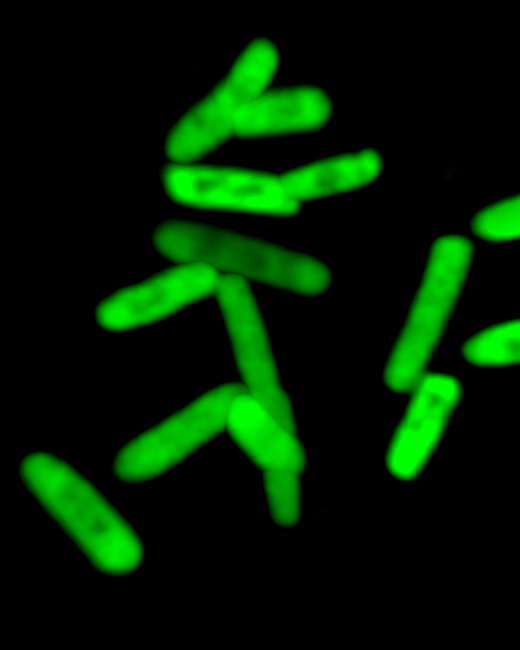
E. coli bacteria with an expanded genetic code could help manufacture new drugs.

Every living thing on Earth stores the instructions for life as DNA, using the four genetic bases A, G, C, and T.

All except one, that is.

In the San Diego laboratory of Floyd Romesberg—and at a startup he founded—grow bacteria with an expanded genetic code. They have two more letters, an “unnatural” pair he calls X and Y.

Romesberg, head of a laboratory at the Scripps Research Institute, first amended the genes of the bacterium E. Coli to harbor the new DNA components in 2014. Now, for the first time, the germs are using their expanded code to manufacture proteins with equally unusual components.

We wanted to prove the concept that every step of information storage and retrieval could be mediated by an unnatural base pair,” he says. “It’s not a curiosity anymore.

The bacterium is termed a “semi-synthetic” organism, since while it harbors an expanded alphabet, the rest of the cell hasn’t been changed. Even so, Peter Carr, a biological engineer at MIT’s Lincoln Laboratory, says it suggests that scientists are only beginning to learn how far life can be redesigned, a concept known as synthetic biology.

We don’t know what the ultimate limits are on our ability to engineer living systems, and this paper helps show we’re not limited to four bases,” he says. “I think it’s pretty impressive.

Humankind has been disappointed in the quest to find life on Mars or Jupiter. Yet the alien germs growing in San Diego already hint that our Earth biology isn’t the only one possible. “It suggests that if life did evolve elsewhere, it might have done so using very different molecules or different forces,” says Romesberg. “Life as we know it is may not be the only solution, and may not be the best one.”

Romesberg’s efforts to lay a genetic cuckoo’s egg inside bacteria started 15 years ago. After creating a candidate pair of new genetic letters, the first step was to add them to a bacterium’s genome and show it could use them to store information. That is, could the organism abide by the unnatural DNA and also copy it faithfully as it divided?

The answer, his lab showed in 2014, was yes. But early versions of the bacteria were none too healthy. They died or got rid of the extra letters in their DNA, which are stored in a mini-chromosome called a plasmid. In Romesberg’s words, his creations “lacked the fortitude of real life.”

By this year, the team had devised a more stable bacterium. But it wasn’t enough to endow the germ with a partly alien code—it needed to use that code to make a partly alien protein. That’s what Romesberg’s team, reporting today in the journal Nature, says it has done.

Using the extra letters, they instructed bacteria to manufacture a glowing green protein that has in it a single unnatural amino acid. “We stored information, and now we retrieved it. The next thing is to use it. We are going to do things no one else can,” says Romesberg.

The practical payoff of an organism with a bigger genetic alphabet is that it has a bigger vocabulary—it can assemble proteins with components not normally found in nature. That could solve some tricky problems in medicinal chemistry, which is the art of shaping molecules so they do exactly what’s wanted in the body, and nothing that isn’t.

Pursuing such aims is a startup Romesberg founded, named Synthorx. It has raised $16 million so far and hopes to turn the science into new drugs. One project aims to make a new version of interleukin-2, an anticancer drug with some nasty side effects. Maybe the semi-synthetic germs could fix that by swapping in some unusual components at key points. “This company needs to get out of the lab and into the clinic,” says its newly installed CEO, Laura Shawver.

Carr says an expanded genetic code could have implications beyond providing a shortcut for programming new properties into proteins. He also thinks the new letters might be used to hide information in ways other biologists couldn’t easily see. That could be useful in concealing intellectual property or, perhaps, to disguise a bioweapon.

Synthorx Inc 2015


Credit: William B. Kiosses, PhD, The Scripps Research Institute


November 29, 2017
William B. Kiosses, PhD, The Scripps Research Institute

viernes, 25 de diciembre de 2015

This Device Lets You Brew Your Own Drugs At Home

 www.fastcoexist.com
IN BRIEF
New concept technology sees a future that lets people brew their own drugs in their own home--posing numerous positive benefits and (of course) a few possible downsides.

PROTOTYPE
A machine prototype called Farma can let you manufacture your daily prescription of drugs right in your own home. Designed by MIT Media Lab graduate Will Patrick, the concept tech features a green cylinder and uses blue-green algae that’s genetically engineered to produce pharmaceutical drugs.

After the drugs are produced, the device then measures, filters, and dries it into a powder. Once in powder form, it can then be molded into pill form.
Image credit: Farma
Part of my goal of the project is to demonstrate how easy it is to build an at-home system that could ferment microbes,” says Patrick, who designed the Farma gadget during a residency at Autodesk.

Currently, opiates can already be can be brewed in a lab and Artemisinin is made using genetically engineered yeast, which makes the possibility of using synthetic biology as a way to create other drugs feasible.

While still at the very early concept stage, the artist responsible for envisioning the machine believes the technology might be feasible for widespread use in five to ten years.

IMPLICATIONS
The technical challenges lie in genetic engineering and biochemistry —engineering the organisms that can produce the drugs at useful quantities and processing and separating the drugs from the organism,” says Patrick in the release. And soon, the cost might make the tech feasible. As Patrick asserts, “The cost, tools, and knowledge required for genetically modifying organisms are all becoming more accessible. The hardware required for fermentation is fairly rudimentary in comparison.

It’s hard to guarantee that a pill brewed in your own home might meet the same quality and production standards followed by a factory; but there are also implications that large pharmaceutical organizations might want to protect their intellectual property, which means that the biggest obstacles might not be making the technology work; rather, policy and business challenges are far bigger hurdles.

While the artist believes in the potential of the technology and its benefits, he expresses apprehension regarding the possibility of the machine enabling drug addiction.

However, the concept behind it is really meant to make people realize how well synthetic biology can be incorporated into lifestyles and how it could be used to assist individuals. “My main goal with Farma is to provoke the audience to consider how this new technology should be used,” he says.


ORIGINAL: Futurism

sábado, 30 de junio de 2012

Programmable DNA Scissors Found for Bacterial Immune System

ORIGINAL: ScienceDaily
Programmable DNA scissors: A double-RNA structure in the bacterial immune system has been discovered that directs Cas9 protein to cleave and destroy invading DNA at specific nucleotide sequences. This same dual RNA structure should be programmable for genome editing. (Credit: Image by H. Adam Steinberg, artforscience.com)
ScienceDaily (June 28, 2012) — Genetic engineers and genomics researchers should welcome the news from the Lawrence Berkeley National Laboratory (Berkeley Lab) where an international team of scientists has discovered a new and possibly more effective means of editing genomes. This discovery holds potentially big implications for advanced biofuels and therapeutic drugs, as genetically modified microorganisms, such as bacteria and fungi, are expected to play a key role in the green chemistry production of these and other valuable chemical products.

Jennifer Doudna, a biochemist with Berkeley Lab's Physical Biosciences Division and professor at the University of California (UC) Berkeley, helped lead the team that identified a double-RNA structure responsible for directing a bacterial protein to cleave foreign DNA at specific nucleotide sequences. Furthermore, the research team found that it is possible to program the protein with a single RNA to enable cleavage of essentially any DNA sequence.

"We've discovered the mechanism behind the RNA-guided cleavage of double-stranded DNA that is central to the bacterial acquired immunity system," says Doudna, who holds appointments with UC Berkeley's Department of Molecular and Cell Biology and Department of Chemistry, and is an investigator with the Howard Hughes Medical Institute (HHMI). "Our results could provide genetic engineers with a new and promising alternative to artificial enzymes for gene targeting and genome editing in bacteria and other cell types."

Doudna is one of two corresponding authors of a paper in the journal Science describing this work titled "A programmable dual RNA-guided DNA endonuclease in adaptive bacterial immunity." The second corresponding author is Emmanuelle Charpentier of the Laboratory for Molecular Infection Medicine at Sweden's Umeå University. Other co-authors of the paper were Martin Jinek, Krzysztof Chylinski, Ines Fonfara and Michael Hauer.

Bacterial and archaeon microbes face a never-ending onslaught from viruses and invading circles of nucleic acid known as plasmids. To survive, the microbes deploy an adaptive-type nucleic acid-based immune system that revolves around a genetic element known as CRISPR, which stands for Clustered Regularly Interspaced Short Palindromic Repeats. Through the combination of CRISPRs and associated endonucleases, called CRISPR-associated -- "Cas" -- proteins, bacteria and archaeons are able to utilize small customized crRNA molecules (for CRISPR-derived RNA) to target and destroy the DNA of invading viruses and plasmids.

There are three distinct types of CRISPR/Cas immunity systems. Doudna and her colleagues studied the Type II system which relies exclusively upon one family of endonucleases for the targeting and cleaving of foreign DNA, the Cas9 proteins.

"For the Type II CRISPR/Cas system, we found that crRNA connects via base-pairs with a trans-activating RNA (tracrRNA), to form a two-RNA structure," Doudna says. "These dual RNA molecules (tracrRNA:crRNA) direct Cas9 proteins to introduce double-stranded DNA breaks at specific sites targeted by the crRNA-guide sequence."

Doudna and her colleagues demonstrated that the dual tracrRNA:crRNA molecules can be engineered as a single RNA chimera for site-specific DNA cleavage, opening the door to RNA-programmable genome editing.

"Cas9 binds to the tracrRNA:crRNA complex which in turn directs it to a specific DNA sequence through base-pairing between the crRNA and the target DNA," Doudna says. "Microbes use this elegant mechanism to cleave and destroy viruses and plasmids, but for genome editing, the system could be used to introduce targeted DNA changes into the genome.

Doudna notes that the "beauty of CRISPR loci" is that they can be moved around on plasmids.

"It is well-established that CRISPR systems can be transplanted into heterologous bacterial strains," she says. "Also, there is evidence to suggest that CRISPR loci are horizontally transferred in nature."

Doudna and her colleagues are now in the process of gathering more details on how the RNA-guided cleavage reaction works and testing whether the system will work in eukaryotic organisms including fungi, worms, plants and human cells.

"Although we've not yet demonstrated genome editing, given the mechanism we describe it is now a very real possibility," Doudna says.

This work was funded primarily by the Howard Hughes Medical Institute, the Austrian Science Fund and the Swedish Research Council.

Story Source:
The above story is reprinted from materials provided by DOE/Lawrence Berkeley National Laboratory .

Note: Materials may be edited for content and length. For further information, please contact the source cited above.

Journal Reference:
M. Jinek, K. Chylinski, I. Fonfara, M. Hauer, J. A. Doudna, E. Charpentier. A Programmable Dual-RNA-Guided DNA Endonuclease in Adaptive Bacterial Immunity.Science, 2012; DOI: 10.1126/science.1225829