Mostrando entradas con la etiqueta Membranas. Mostrar todas las entradas

domingo, 5 de mayo de 2013

Purdue professor identifies proton pathway in photosynthesis

ORIGINAL: Purdue BioNews
Posted on April 22, 2013 

A Purdue University-led team has revealed the proton transfer pathway responsible for a majority of energy storage in photosynthesis.
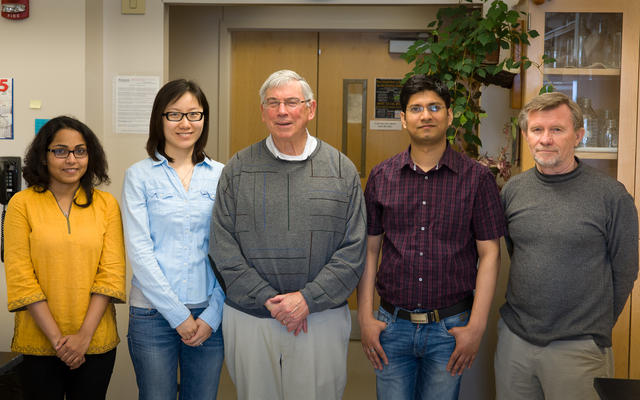
From left to right: Danas Baniulus, Jason Stofleth, William Cramer, Stanislav Zakharov and S.Saif Hasan. Not pictured in photo: E.Yamashita and Mariya V. Zhainina
Through photosynthesis, plants, algae and bacteria convert sunlight, carbon dioxide and water into chemical energy stored in the membrane of special cells, a process similar to charging a battery, said William A. Cramer, the Henry Koffler Distinguished Professor of Biological Sciences and research team leader.

The key to photosynthesis is the movement of electrical charge from a positive to a negative pole, just as in a battery,” Cramer said. “In this case, the electrical charge is in the form of electrons and protons passed along by amino acids and water molecules in a ‘bucket brigade’ through the cellular membrane. We identified and found the structure and orientation of the individual bucket carriers.

His team looked at the pathway through the cytochrome complex, a group of eight proteins responsible for transporting two-thirds of the protons that energize the plant cell “battery.” The proteins are made up of different sequences of amino acids, including those that participate in the “bucket brigade” of proton transfer.

Cramer credits S. Saif Hasan, a graduate student in his research group who will receive his doctoral degree in May, with leading the project.

The team used X-ray crystallography to describe the molecular structure of the cytochrome complex isolated from cyanobacteria, the most primitive photosynthetic organism.

A paper detailing the National Institutes of Health-funded work was published in the Proceedings of the National Academy of Sciences.

Although a mechanism for energy storage involving transfer of protons across biological membranes was the subject of the 1978 Nobel Prize in chemistry and advances had been made in its understanding, the amino acids involved and how they are connected for proton transfer in the photosynthetic protein complex was unknown, Cramer said.

In addition to Cramer and Hasan, team members include E. Yamashita of the Institute for Protein Chemistry in Osaka, Japan, and D. Baniulis of the Lithuanian Research Institute for Agriculture and Forestry.

Understanding details of the process of photosynthesis aids work toward the development of artificial photosynthesis, which could allow for the conversion of solar energy into alternative environmentally friendly sources of biofuels.

The findings also contribute to the understanding of membrane proteins, which regulate all traffic into and out of the cell and are important for drug delivery and structural biology.

Membrane proteins are fat-soluble, which makes them especially difficult to isolate and crystallize for examination, Cramer said.

Membrane proteins dissolve only in fat, not water, and if you pull them out of the cell membrane they tend to congeal like grease on a frying pan dipped in cold water,” he said. “Scientists have only been able to determine the structure of relatively few of this group of proteins, and we have much more to learn.

Writer: Elizabeth Gardner, 765-494-2081, ekgardner@purdue.edu

Source: William Cramer, 765-494-4956, waclab@purdue.edu

Related website:


ABSTRACT

Quinone-Dependent Proton Transfer Pathways in the 
Photosynthetic Cytochrome b6f Complex

S. Saif Hasan, Eiki Yamashita, Danas Baniulis, and William A. Cramer

As much as two-thirds of the proton gradient used for transmembrane free energy storage in oxygenic photosynthesis is generated by the cytochrome b6f complex. The proton uptake pathway from the electrochemically negative (n) aqueous phase to the n-side quinone binding site of the complex, and a probable route for proton exit to the positive phase resulting from quinol oxidation, are defined in a 2.70-Å crystal structure and in structures with quinone analog inhibitors at 3.07 Å (tridecyl-stigmatellin) and 3.25 Å (2-nonyl-4-hydroxyquinoline N-oxide) resolution. The simplest n-side proton pathway extends from the aqueous phase via Asp20 and Arg207 (cytochrome b6 subunit) to quinone bound axially to heme cn. On the positive side, the heme-proximal Glu78 (subunit IV), which accepts protons from pastosemiquinone, defines a route for H+ transfer to the aqueous phase. These pathways provide a structure-based description of the quinone-mediated proton transfer responsible for generation of the transmembrane electrochemical potential gradient in oxygenic photosynthesis.

This work was funded in part by National Institutes of Health Grant GM-038323.
This article originally appeared in Purdue Today on April 22, 2013




miércoles, 24 de octubre de 2012

Una iniciativa de fotosíntesis artificial echa raíces

ORIGINAL: Technology Review
Por Kevin Bullis
Traducido por Francisco Reyes (Opinno)
23 de octubre de 2012

Un centro de innovación valorado en 122 millones de dólares (93 millones de euros) podría acelerar el desarrollo de dispositivos para la fabricación de combustible a partir de agua y luz solar.


Al tiempo que se produce un acalorado debate sobre el papel del Gobierno de Estados Unidos en la financiación de la innovación energética, provocado por los prominentes fracasos de compañías con respaldo gubernamental como Solyndra y A123 Systems, una estrategia de inversión federal en tecnología limpia menos controvertida ha estado funcionando a buen ritmo y de forma discreta, consiguiendo un apoyo bipartidista. Los llamados centros de innovación, es decir, centros multidisciplinarios de investigación diseñados para emular los a legendarios Laboratorios Bell mediante la combinación de investigación científica con tecnología aplicada, han logrado obtener financiación continua del Gobierno incluso en una época en la que el Congreso de EE.UU. trabaja para recortar el presupuesto federal total.
Hoja artificial: Este prototipo del Centro Conjunto para la Fotosíntesis Artificial utiliza la energía de la luz solar para aislar el hidrógeno del agua. Fuente: Centro Conjunto para la Fotosíntesis Artificial
Dos años después de obtener financiación por primera vez, uno de los centros actuales, una iniciativa de Caltech (Instituto de Tecnología de California, en EE.UU.) centrada en el uso de luz solar para producir combustibles líquidos, afirma haber conseguido un progreso sustancial hacia dispositivos capaces de convertir la luz del sol y el agua en oxígeno e hidrógeno. Este podría utilizarse para proporcionar energía a un automóvil o generar electricidad de acuerdo a la demanda. Con el tiempo, los investigadores esperan poder combinar el hidrógeno con el carbono del dióxido de carbono para producir combustibles líquidos similares a la gasolina o el diésel.

Los investigadores han estado persiguiendo lo que se conoce como fotosíntesis artificial durante décadas. El progreso ha sido lento, y hacer que el proceso sea económico a gran escala sigue siendo un objetivo aparentemente distante. El nuevo centro de innovación, que recibiría 122 millones de dólares (93 millones de euros) a lo largo de cinco años, planea acelerar esta investigación, reuniendo a un gran número de expertos en diferentes áreas, entre ellas la catálisis, la óptica y la tecnología de membranas.

Para acelerar el descubrimiento de materiales, los investigadores del centro Caltech, que colaboran con investigadores del Laboratorio Nacional Lawrence en Berkeley (EE.UU.) y con más de 20 centros de investigación distintos, han desarrollado un proceso de impresión por chorro de tinta capaz de generar millones de variaciones ligeramente diferentes de prometedores catalizadores. Cada muestra puede llegar a ser tan pequeña como el píxel de una pantalla. También están desarrollando equipos capaces de poner a prueba rápidamente la actividad de cada catalizador. "Acelerará radicalmente el ritmo de descubrimiento de electrocatalizadores y fotocatalizadores para pasar de tener solo algunos candidatos al año a tener varios cada pocos milisegundos, produciendo miles de millones al día", señala Nate Lewis, director del Centro Conjunto para la Fotosíntesis Artificial.

Esquemático de una célula fotoelectroquímica que está siendo diseñada para aprovechar la luz solar para la generación de combustible químico. Una gran cantidad de investigaciones basadas en simulaciones son necesarias para ayudar a comprender, diseñar y fabricar sus componentes. Imagen: NERSC
Al mismo tiempo, el centro ha instalado impresoras avanzadas en 3D capaces de crear prototipos de dispositivos para albergar los materiales absorbentes de luz y los catalizadores, aplicarles agua y separar y recoger el hidrógeno y el oxígeno. Hasta ahora, los investigadores han construido dos prototipos de este tipo capaces de producir combustible a partir de la luz solar, aunque aún no económicamente. El plan es poseer por lo menos cuatro o cinco versiones diferentes de los dispositivos, cada una con distintas fortalezas y debilidades. Los investigadores quieren tener múltiples versiones, ya que no se puede predecir dónde se producirá el siguiente avance en materiales.

La idea de desarrollar nuevas tecnologías energéticas en los centros de innovación es muy diferente del enfoque de ayudar a las empresas a aumentar su producción a través de subvenciones o garantías de préstamo, tal y como hizo el Departamento de Energía de EE.UU. en el caso del A123 y Solyndra. También es muy distinto de financiar proyectos de investigación a través del programa ARPA-E, cuyo objetivo es conseguir avances específicos a un laboratorio o empresa, como el descubrimiento de un nuevo material prometedor, y demostrar su potencial en tres años, por ejemplo, mediante la construcción de una batería funcional con ese material.

Los centros de innovación reúnen a investigadores de diferentes grupos con el objetivo de crear grandes avances para problemas en los que se lleva trabajando desde hace tiempo. Trabajan a muchos niveles diferentes, haciendo de todo, desde descubrir nuevos materiales y estudiar cuidadosamente la forma en que funcionan, así como diseñar y construir dispositivos que podrían utilizar dichos materiales. Mientras ARPA-E otorga subvenciones a cada proyecto valoradas en unos pocos millones de dólares, está previsto que cada centro de innovación reciba más de cien millones de dólares en cinco años como reconocimiento de la gran escala de los problemas que abordan.

Hasta el momento han sido financiados cinco centros, pero la financiación a lo largo de cinco años no está garantizada. El dinero tiene que ser asignado cada año y el presupuesto para el próximo no ha sido aprobado. Aunque los correspondientes comités del Senado y la Cámara de Representantes apoyan la financiación continua durante cinco años, el Congreso se enfrenta a una creciente presión por encontrar partidas donde recortar gastos.

miércoles, 19 de septiembre de 2012

Towards an artificial cell

ORIGINAL: Science Direct
Universally Available
Edited by Miguel De la Rosa, Felix Wieland and Wilhelm Just
Daniel A. Hammera, b, , ,
Neha P. Kamata
a Department of Bioengineering, University of Pennsylvania, Philadelphia, PA 19104, USA
b Department of Chemical and Biomolecular Engineering, University of Pennsylvania, Philadelphia, PA 19104, USA
http://dx.doi.org/10.1016/j.febslet.2012.07.044, How to Cite or Link Using DOI

Abstract

We are on the verge of producing “synthetic cells,” or protocells, in which some, many or all of the tasks of a real biological cell are harnessed into a synthetic platform. Such advances are made possible through genetic engineering, microfabrication technologies, and the development of cellular membranes from new surfactants that extend beyond phospholipids in stability and chemical control, and can be used to introduce designer functionality into membranes and cells. We review some of the recent advances in the development of synthetic cells and suggest future exciting directions.

Highlights

► We review recent advances in the development of artificial cells. 
► Synthetic gene circuits will enable signaling and control systems within artificial membranes. 
► We discuss the constructing of vesicle membranes using recombinant biotechnology. 
► We highlight studies in which catalysis, compartmentalization, and adhesion is conducted. 
► We discuss recent work conducted to create regenerating membranes.

Keywords


Protocell; 
Vesicle; 
Bilayer membrane

lunes, 2 de julio de 2012

IBM researchers unleash plastic 'ninjas' to fight deadly bacteria

ORIGINAL: IBMLabs

Having discovered that materials could be manipulated at the atomic level to control their movement, IBM researchers used this knowledge to create staph-killing 'ninja polymers' that leave healthy cells alone. They move quickly to target infected cells in the body, destroy the harmful content inside, and then disappear from the body by biodegrading without damaging side effects or accumulating in the organs.

viernes, 27 de abril de 2012

A shiny new tool for imaging biomolecules

ORIGINAL: EurekAlert
Berkeley Lab researchers embed artificial membranes with billions of nanoantennas for enhanced optical studies
Gold triangle nanoparticles paired tip-to-tip in a bow-tie formation, serve as optical antennas. When a protein (green) bound to a fluorescently labeled SOS-catalyst passes through the the gaps between opposing tips of the triangles (plasmonic hot spots) fluorescence is amplified. Credit: (Image by Groves, et. al., Berkeley Lab) Usage Restrictions: courtesy of Jay Groves, Berkeley Lab, UC Berkeley, HHMI
At the heart of the immune system that protects our bodies from disease and foreign invaders is a vast and complex communications network involving millions of cells, sending and receiving chemical signals that can mean life or death. At the heart of this vast cellular signaling network are interactions between billions of proteins and other biomolecules. These interactions, in turn, are greatly influenced by the spatial patterning of signaling and receptor molecules. The ability to observe signaling spatial patterns in the immune and other cellular systems as they evolve, and to study the impact on molecular interactions and, ultimately, cellular communication, would be a critical tool in the fight against immunological and other disorders that lead to a broad range of health problems including cancer. Such a tool is now at hand.
An array of gold nanoparticles in the shape of triangles that are paired in a tip-to-tip formation, like a bow-tie, can serve as optical antennas, capturing and concentrating light waves into well-defined hot spots, where the plasmonic effect is greatly amplified. Credit: (Image by Groves, et. al., Berkeley Lab). Usage Restrictions: courtesy of Jay Groves, Berkeley Lab, UC Berkeley, HHMI. 
Researchers with the U.S. Department of Energy (DOE)'s Lawrence Berkeley National Laboratory (Berkeley Lab) and the University of California (UC) Berkeley, have developed the first practical application of optical nanoantennas in cell membrane biology. A scientific team led by chemist Jay Groves has developed a technique for lacing artificial lipid membranes with billions of gold "bowtie" nanoantennas. Through the phenomenon known as "plasmonics," these nanoantennas can boost the intensity of a fluorescent or Raman optical signal from a protein passing through a plasmonic "hot-spot" tens of thousands of times without the protein ever being touched.
"Our technique is minimally invasive since enhancement of optical signals is achieved without requiring the molecules to directly interact with the nanoantenna," Groves says. "This is an important improvement over methods that rely on adsorption of molecules directly onto antennas where their structure, orientation, and behavior can all be altered."
Groves holds joint appointments with Berkeley Lab's Physical Biosciences Division and UC Berkeley's Chemistry Department, and is also a Howard Hughes Medical Institute investigator. He is the corresponding author of a paper that reports these results in the journal NanoLetters. The paper is titled "Single Molecule Tracking on Supported Membranes with Arrays of Optical Nanoantennas." Co-authoring the paper were Theo Lohmuller, Lars Iversen, Mark Schmidt, Christopher Rhodes, Hsiung-Lin Tu and Wan-Chen Lin.
Jay Groves is a chemist who holds appointments with Berkeley Lab, UC Berkeley and HHMI. Credit: (Photo by Roy Kaltschmidt, Berkeley Lab).