Mostrando entradas con la etiqueta Oxígeno. Mostrar todas las entradas

jueves, 31 de julio de 2014

RCA graduate develops an artificial leaf that’s capable of producing oxygen


http://newlaunches.com/wp-content/uploads/2014/07/silk-leaf-1.jpg
Human beings have long since been looking up at space, wondering when mankind will finally be technologically-advanced enough to colonize space. While staring heavenwards recently, we stumbled across this jaw-dropping development by Royal College of Art (RCA) graduate Julian Melchiorri. A synthetically developed leaf, this concept called the Silk Leaf Project, is capable of absorbing water and carbon dioxide to produce oxygen, just the way a real plant does! Quoting Melchiorri, “NASA is researching different ways to produce oxygen for long-distance space journeys to let us live in space. This material could allow us t0 explore space much further than we can now.”

silk-leaf-2 
The Silk Leaf Project was developed as part of the Royal College of Art’s Innovation Design Engineering course in collaboration with Tufts University silk lab. Made from chloroplasts suspended in a matrix made out of silk protein, the leaf “as an amazing property of stabilizing molecules.” Not unlike real plants, these leaves created by Melchiorri also require light and a small amount of water to produce oxygen. This is the first man-made biological leaf in the history of mankind and an idea as such could help us step beyond boundaries, in terms of technology and lifestyle. Melchiorri sure deserves a pat on his back for his brilliance!
silk-leaf-3silk-leaf-6silk-leaf-7
source
dezeen


ORIGINAL: Newlaunches

martes, 4 de junio de 2013

Chemist Hopes 'Artificial Leaf' Can Power Civilization Using Photosynthesis

ORIGINAL: Yahoo News
By Carrie Halperin
Jun 3, 2013


Imagine an artificial leaf that mimics photosynthesis, which lets plants harness energy from the sun. But this leaf would have the ability to power your homes and cars with clean energy using only sunlight and water.

This is not some far-off idea of the future. It's reality, and the subject of a jury-prize-winning film in the GE Focus Forward Film Competition.

Jared P. Scott and Kelly Nyks' short film, " The Artificial Leaf," showcases chemist Daniel Nocera, the inventor of the artificial leaf, a device that he says can power the world.

"The truth is stranger than fiction," Kelly Nyks, a partner at PF Pictures, told ABC News. "What I think is so exciting is that Dan has taken this science and applied it in a way that makes bringing it to scale to solve the energy crisis for the planet real and possible."

Nocera's leaf is simply a silicon wafer coated with catalysts that use sunlight to split water to into hydrogen and oxygen components.

"Essentially, it mimics photosynthesis," Nocera told ABC News.

The gases that bubble up from the water can be turned into a fuel to produce electricity in the form of fuel cells. The device may sound like science fiction fantasy, but Nocera said he hopes one day it will provide an alternative to the centralized energy system - the grid.

Worldwide, more than 1.6 billion people live without access to electricity and 2.6 billion people live without access to clean sources of fuel for cooking.

"This is the model: We're going to have a very distributed energy system," Nocera told ABC News. With the leaf, "using just sunlight and water, you can be off the grid. If you're poor, you don't have a grid, so this gives them a way to have energy in the day and at night."

With just the artificial leaf, 1.5 bottles of drinking water and sunlight, you could have enough electricity to power a small home, but the cost is still a problem, though Nocera said he believes that will come down with time and research.

The artificial leaf is cheaper than solar panels but still expensive. Hydrogen from a solar panel and electrolysis unit can currently be made for about $7 per kilogram; the artificial leaf would come in at $6.50.

Nocera is looking for ways to drive down the costs make these devices more widely available. He recently replaced the platinum catalyst that produces hydrogen gas with a less-expensive nickel-molybdenum-zinc compound. He's also looking for ways to reduce the amount of silicon needed.

In 2009, Nocera's artificial leaf was selected as a recipient of funding by the U.S. Department of Energy's Advanced Research Projects Agency (ARPA-E), which supports energy technologies that could create a more secure and affordable American future.

Nyks and Scott said they hope "The Artificial Leaf" will bring awareness to the public that sustainable energy solutions do exist.

"We make films for social action," Scott, also a partner at PF Pictures, told ABC News. "We see films as a tool for social change. And what I think Dan sketches out is that we start with energy. And if we solve the energy crisis, we'll solve the climate crisis, and then we'll solve the water crisis, and then we'll solve the food crisis. But it starts with energy."

30 filmmaking teams were asked to make a movie that could highlight an innovation that could change the world as part of GE Focus Forward, a series of three-minute films created by award-winning documentary makers including Alex Gibney, Lucy Walker, Albert Maysles and Morgan Spurlock. Nyks and Scott won a jury prize in a related global competition.

Dan Nocera, inventor of the artificial leaf.
Anyone with an Internet connection has access to the videos online. All the films are featured at focusforwardfilms.com.

So far, total media impressions for GE Focus Forward have exceeded 1.5 billion. In addition, the films are screening at all the major film festivals around the world and have played on every continent, including Antarctica.

Nyks and Scott said they hope to take the success of the short and turn it into a feature-length documentary. 

sábado, 25 de mayo de 2013

Scientists offer first definitive proof of bacteria-feeding behavior in green algae

ORIGINAL: RD Mag | Cell
05/23/2013
The green alga used in this study and shown here is from the genus Cymbomonas, which presumably resembles early ancestors of the group. The scale bar represents 10 micrometers. Credit: AMNH/E. Kim
A team of researchers has captured images of green alga consuming bacteria, offering a glimpse at how early organisms dating back more than 1 billion years may have acquired free-living photosynthetic cells. This acquisition is thought to have been a critical first step in the evolution of photosynthetic algae and land plants, which, in turn, contributed to the increase in oxygen levels in Earth's atmosphere and ocean and provided one of the conditions necessary for animal evolution.

In a paper that appears in the June 17 issue of Current Biology and is available online today, researchers identify a mechanism by which a green alga that resembles early ancestors of the group engulfs bacteria, providing conclusive evidence for a process that had been proposed but not definitely shown.

"This behavior had previously been suggested but we had not had clear microscopic evidence until this study," said Eunsoo Kim, assistant curator in the Museum's Division of Invertebrate Zoology and corresponding author on the paper. "These results offer important clues to an evolutionary event that fundamentally changed the trajectory of the evolution of not just photosynthetic algae and land plants, but also animals."

In green algae and land plants, photosynthesis, or the conversion of light into food, is carried out by a specialized cell structure known as a chloroplast. The origin of chloroplast is linked to endosymbiosis, a process in which a single-celled eukaryote—an organism whose cells contain a nucleus—captures a free-living photosynthetic cyanobacterium but does not digest it, allowing the photosynthetic cell to eventually evolve into a chloroplast. The specific feeding mechanisms for this process, however, have remained largely unknown until now.

In this study, researchers used transmission electron microscopy and feeding and staining experiments to take conclusive images showing how a basic green alga from the genus Cymbomonas feeds on bacteria. The alga draws bacterial cells into a tubular duct through a mouth-like opening and then transports these food particles into a large, acidic vacuole where digestion takes place. The complexity of this feeding system in photosynthetic modern alga suggests that this bacteria-feeding behavior, and the unique feeding apparatus to support it, descend from colorless ancestors of green algae and land plants and may have played important roles in the evolution of early photosynthetic eukaryotes, the precursors to plants like trees and shrubs that cover the Earth today.

Eunsoo Kim joined the Museum in 2012 as curator of the protist collection, which includes algae, protozoa, and fungus-like protists. A native of South Korea, Kim received her Ph.D. in botany from the University of Wisconsin-Madison and conducted postdoctoral research at Dalhousie University in Halifax, Nova Scotia. She works closely with associate curator Susan Perkins and curator Rob DeSalle as part of one of the first natural history museum microbial research programs.

Shinichiro Mauyama, currently a postdoctoral researcher at the Division of Environmental Photobiology at the National Institute for Basic Biology in Okazaki, Japan, is a co-author on this paper. In addition to Kim's laboratory at the Museum, this work was conducted in John Archibald's laboratory at Dalhousie University. Funding was provided by the American Museum of Natural History and Japan Society for the Promotion of Science.


Source: American Museum of Natural History

A Modern Descendant of Early Green Algal Phagotrophs

  To view the full text, please login as a subscribed user or purchase a subscription. Click here to view the full text on ScienceDirect.
Current Biology, 23 May 2013
Copyright © 2013 Elsevier Ltd All rights reserved.
10.1016/j.cub.2013.04.063

Authors

  • Highlights
  • We present microscopic evidence for phagocytosis in an early-diverging green alga
  • A nonphotosynthetic ancestor of plants possessed a distinct phagocytotic apparatus

Summary

Green algae, land plants, and other photosynthetic eukaryotes possess plastids, such as chloroplasts, which have evolved from cyanobacterial ancestors via endosymbiosis [1]. An early evolutionary merger between heterotrophic eukaryotes and cyanobacteria called primary endosymbiosis gave rise to the first photosynthetic eukaryotes. A series of plastid acquisitions involving engulfment of eukaryotic phototrophs, known as secondary or tertiary endosymbiosis, followed [2]. Through these repeated symbiotic events, photosynthesis spread across a number of eukaryotic lineages [2,3]. While the origin of eukaryotic photosynthesis was undoubtedly a fundamentally important evolutionary event in Earth’s history, without which much of the modern marine phytoplankton would not exist, the cellular processes that shaped this initial plastid genesis remain largely unknown. Here, we report ultrastructural evidence for bacterial phagocytosis in a primary plastid-bearing alga. This mixotrophic green alga utilizes a mouth-like opening, a tubular channel, and a large permanent vacuole to engulf, transport, and digest bacterial cells. This mode of phagocytosis, likely inherited from its plastid-lacking ancestor, differs from those displayed by many other eukaryotes, including animals, amoebas, and ciliates. These results provide insight into the key phagocytosis step during the origin of the first photosynthetic eukaryotes.

viernes, 17 de mayo de 2013

Artificial Forest for Solar Water-Splitting. First Fully Integrated Artificial Photosynthesis Nanosystem


ORIGINAL: Berkeley Lab
Lynn Yarris
May 16, 2013

Berkeley Lab Researchers Report First Fully Integrated Artificial Photosynthesis Nanosystem

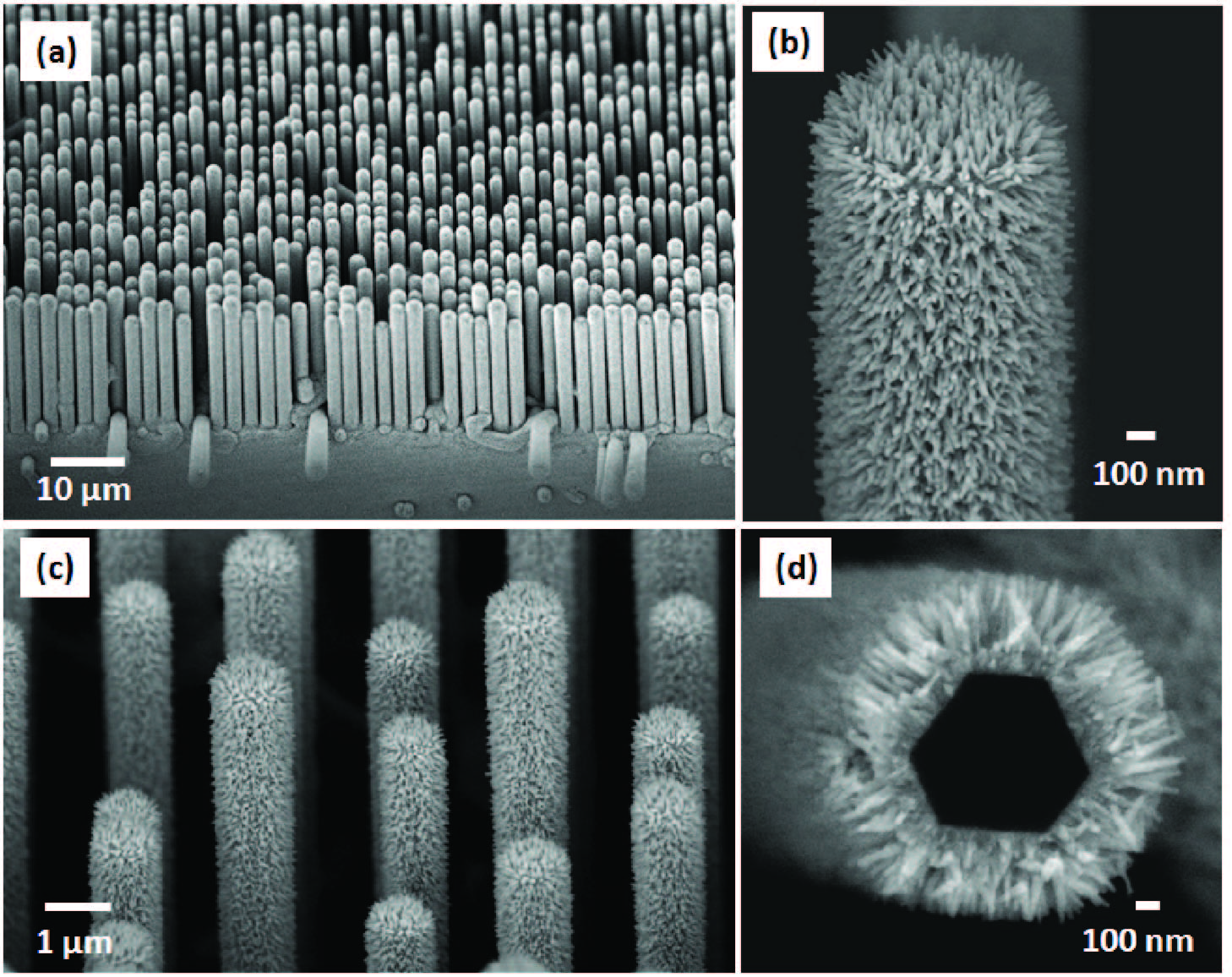
InGaN nanowires grown on Si nanowires for Solar Water Splitting. Peidong Yang

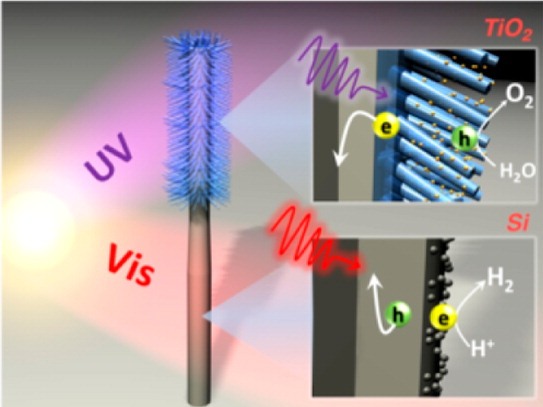
Schematic shows TiO2 nanowires (blue) grown on the upper half of a Si nanowire (gray) and the two absorbing different regions of the solar spectrum. Insets display photoexcited electron−hole pairs separated at the semiconductor-electrolyte interface to carry out water splitting with the help of co-catalysts (yellow and gray dots).

In the wake of the sobering news that atmospheric carbon dioxide is now at its highest level in at least three million years, an important advance in the race to develop carbon-neutral renewable energy sources has been achieved. Scientists with the U.S. Department of Energy (DOE)’s Lawrence Berkeley National Laboratory (Berkeley Lab) have reported the first fully integrated nanosystem for artificial photosynthesis. While “artificial leaf” is the popular term for such a system, the key to this success was an “artificial forest.”

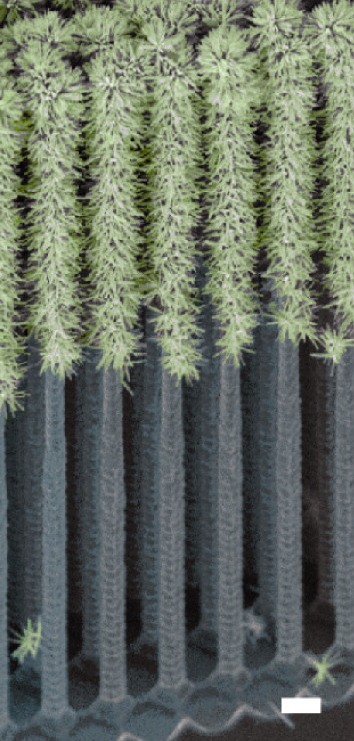
“Similar to the chloroplasts in green plants that carry out photosynthesis, our artificial photosynthetic system is composed of two semiconductor light absorbers, an interfacial layer for charge transport, and spatially separated co-catalysts,” says Peidong Yang, a chemist with Berkeley Lab’s Materials Sciences Division, who led this research. “To facilitate solar water- splitting in our system, we synthesized tree-like nanowire heterostructures, consisting of silicon trunks and titanium oxide branches. Visually, arrays of these nanostructures very much resemble an artificial forest.”

Yang, who also holds appointments with the University of California Berkeley’s Chemistry Department and Department of Materials Science and Engineering, is the corresponding author of a paper describing this research in the journal NANO Letters. The paper is titled “A Fully Integrated Nanosystem of Semiconductor Nanowires for Direct Solar Water Splitting.” Co-authors are Chong Liu, Jinyao Tang, Hao Ming Chen and Bin Liu.

Solar technologies are the ideal solutions for carbon-neutral renewable energy – there’s enough energy in one hour’s worth of global sunlight to meet all human needs for a year. Artificial photosynthesis, in which solar energy is directly converted into chemical fuels, is regarded as one of the most promising of solar technologies. A major challenge for artificial photosynthesis is to produce hydrogen cheaply enough to compete with fossil fuels. Meeting this challenge requires an integrated system that can efficiently absorb sunlight and produce charge-carriers to drive separate water reduction and oxidation half-reactions.
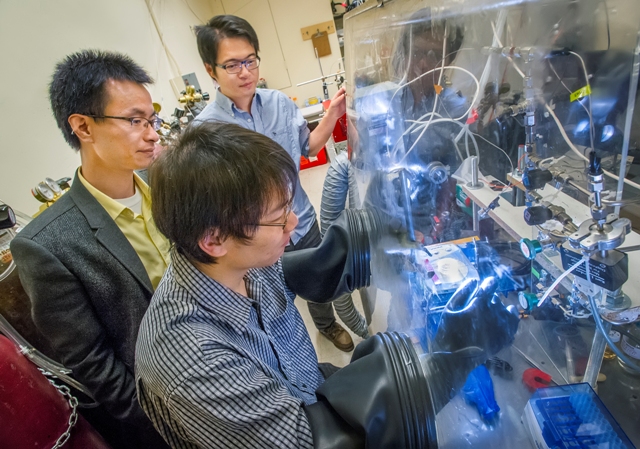
Peidong Yang (left), Hao Ming Chen and Chong Liu (glove box) have developed the first fully integrated nanoscale artificial photosynthesis system. (Photo by Roy Kaltschmidt)

“In natural photosynthesis the energy of absorbed sunlight produces energized charge-carriers that execute chemical reactions in separate regions of the chloroplast,” Yang says. “We’ve integrated our nanowire nanoscale heterostructure into a functional system that mimics the integration in chloroplasts and provides a conceptual blueprint for better solar-to-fuel conversion efficiencies in the future.”

When sunlight is absorbed by pigment molecules in a chloroplast, an energized electron is generated that moves from molecule to molecule through a transport chain until ultimately it drives the conversion of carbon dioxide into carbohydrate sugars. This electron transport chain is called a “Z-scheme” because the pattern of movement resembles the letter Z on its side. Yang and his colleagues also use a Z-scheme in their system only they deploy two Earth abundant and stable semiconductors – silicon and titanium oxide – loaded with co-catalysts and with an ohmic contact inserted between them. Silicon was used for the hydrogen-generating photocathode and titanium oxide for the oxygen-generating photoanode. The tree-like architecture was used to maximize the system’s performance. Like trees in a real forest, the dense arrays of artificial nanowire trees suppress sunlight reflection and provide more surface area for fuel producing reactions.

“Upon illumination photo-excited electron−hole pairs are generated in silicon and titanium oxide, which absorb different regions of the solar spectrum,” Yang says. “The photo-generated electrons in the silicon nanowires migrate to the surface and reduce protons to generate hydrogen while the photo-generated holes in the titanium oxide nanowires oxidize water to evolve oxygen molecules. The majority charge carriers from both semiconductors recombine at the ohmic contact, completing the relay of the Z-scheme, similar to that of natural photosynthesis.”
Arrays of tree-like nanowires consisting of Si trunks and TiO2 branches facilitate solar water-splitting in a fully integrated artificial photosynthesis system.
Under simulated sunlight, this integrated nanowire-based artificial photosynthesis system achieved a 0.12-percent solar-to-fuel conversion efficiency. Although comparable to some natural photosynthetic conversion efficiencies, this rate will have to be substantially improved for commercial use. However, the modular design of this system allows for newly discovered individual components to be readily incorporated to improve its performance. For example, Yang notes that the photocurrent output from the system’s silicon cathodes and titanium oxide anodes do not match, and that the lower photocurrent output from the anodes is limiting the system’s overall performance.

“We have some good ideas to develop stable photoanodes with better performance than titanium oxide,” Yang says. “We’re confident that we will be able to replace titanium oxide anodes in the near future and push the energy conversion efficiency up into single digit percentages.”

This research was supported by the DOE Office of Science.

# # #

Lawrence Berkeley National Laboratory addresses the world’s most urgent scientific challenges by advancing sustainable energy, protecting human health, creating new materials, and revealing the origin and fate of the universe. Founded in 1931, Berkeley Lab’s scientific expertise has been recognized with 13 Nobel prizes. The University of California manages Berkeley Lab for the U.S. Department of Energy’s Office of Science. For more, visit www.lbl.gov.

DOE’s Office of Science is the single largest supporter of basic research in the physical sciences in the United States, and is working to address some of the most pressing challenges of our time. For more information, please visit the Office of Science website at science.energy.gov/.

Additional Information
For more about the research of Peidong Yang go here

lunes, 13 de mayo de 2013

Unleashing oxygen ‘Superlattice’ structure could give a huge boost to oxygen reaction in fuel cells, increasing their power potential.

ORIGINAL: MIT
David L. Chandler, MIT News Office
April 30, 2013

Professor Bilge Yildiz (left) and graduate student Yan Chen stand in front of the scanning tunneling microscope used for their research. PHOTO COURTESY OF BILGE YILDIZ
New research at MIT could dramatically improve the efficiency of fuel cells, which are considered a promising alternative to batteries for powering everything from electronic devices to cars and homes.

Fuel cells make electricity by combining hydrogen, or hydrocarbon fuels, with oxygen. But the most efficient types, called solid oxide fuel cells (SOFC), have drawbacks that have limited their usefulness — including operating temperatures above 700 degrees Celsius (roughly 1300 degrees Fahrenheit). Now, MIT researchers have unraveled the properties of a promising alternative material structure for a key component of these devices.

The new structure, a “superlattice” of two compounds interleaved at a tiny scale, could serve as one of the two electrodes in the fuel cell. The complex material, discovered about six years ago and known as LSC113/214, is composed of two oxides of the elements lanthanum, strontium and cobalt. While one of the oxides was already known as an especially good material for such electrodes, the combination of the two is far more potent in promoting oxygen reduction than either oxide alone. 

The interfaces between these two oxides were thought to be the key. But until now, no one had been able to observe the LSC113/214 interface properties in operation, at sufficiently high resolution, to figure out why it worked so well.
The MIT team used a scanning tunneling microscope (STM) to study the electrical activity of a superlattice material composed of two different compounds of the elements strontium, lanthanum and cobalt. At bottom, a diagram of how they "sliced" the material on an angle to expose wider bands of the thin layers of material. The center two images show the resulting measurements of the surface topography of the material, and the activity of electrons moving through it. At top, a diagram of the molecular structures of the two compounds. 
GRAPHIC COURTESY OF CHEN ET AL
Oxygen reduction is one of two main reactions in a fuel cell, and the one that has limited their overall performance — so finding improved materials for that reaction could be a key advance for fuel cells, the researchers say. The new findings are published in the journal Advanced Energy Materials in a paper co-authored by graduate student Yan Chen, professors Harry Tuller and Bilge Yildiz, and three other researchers at MIT.

Yildiz, an associate professor of nuclear science and engineering, says LSC113/214 has been “a singular example” of a material with extremely high reactivity to oxygen reduction; the new results explaining why it works so well could lead to further optimization or the discovery of other materials that might perform even better.

The best of both
The key to the material’s performance, she explains, is the marriage of complementary qualities from its two constituents. One of the oxides allows superior conduction and transfer of electrons, while the other excels at holding onto oxygen atoms; to perform well as a fuel cell’s cathode — one of its two electrodes — a material needs to have both qualities. 

The close proximity of the two materials in this superlattice causes them to “borrow” one another’s attributes, the MIT team found. The result is a material whose reactivity exceeds that of the best materials currently used in fuel cells, Yildiz says: “It’s the best of the two worlds.”

Now that the MIT team has analyzed LSC113/214, it may be possible to discover even better materials by conducting systematic searches, Yildiz says; the team is now working on that. “If we can crack this problem, then we can make great strides in improving the performance,” adds Tuller, a professor of ceramics and electronic materials in MIT’s Department of Materials Science and Engineering.

Unique tool enables observations
The finding was made possible by instrumentation developed in Yildiz’s laboratory at MIT for observation of electron-transfer properties on surfaces: The instrument, a modified scanning tunneling microscope (STM), can observe materials at high temperatures and in an oxygen-rich environment — “representative of the operating conditions of a fuel-cell cathode,” Yildiz says. This high-temperature phenomenon would not have been detectable with conventional methods.

Tuller describes the superlattice as a “layer cake” of the two different oxides. But these layers are vanishingly thin. To overcome this, the team “sliced” the layers on an extreme angle, exposing much wider surfaces of each. “That magnifies the layers by a hundredfold,” Tuller says.

That slicing is done using a focused ion beam, Chen explains, to expose the interface in a way that the STM can observe more easily at high temperature.

The researchers hope that with this new knowledge, it will be possible to make rapid progress in the search for better electrode materials, helping make fuel cells practical for a wide range of energy applications, from powering homes to powering mobile devices. 

John Kilner, a professor of energy materials at Imperial College, London, who was not involved in this project, calls this “a very elegant set of experiments that contributes a great deal toward our understanding of the very complex problem of oxygen surface exchange.”

Kilner adds, “It waits to be seen if we can capitalize on this knowledge to aid in the construction of practical devices, but it opens up the possibility of engineering new structures with enhanced performance at low temperatures.”

The work was supported by the U.S. Department of Energy’s Basic Energy Sciences Program.

miércoles, 31 de octubre de 2012

Rodolfo Llinás busca crear un agua que mejoraría la función de células

ORIGINAL: El Tiempo
Por: VIDA DE HOY
29 de Octubre del 2012

Rodolfo Llinás, neurocientífico colombiano.Foto: Milton Díaz / EL TIEMPO
Neurocientífico colombiano habló de un líquido más vital. Serviría para tratar males degenerativos.

El uso de nanomoléculas de agua que optimizan la función celular podría revolucionar muy pronto el campo de la medicina.

Así lo afirmó el neurocientífico colombiano Rodolfo Llinás, de visita en el país, quien está trabajando en un proyecto que busca crear un agua más eficiente, pero sin modificar su estructura, para convertirla en un elemento que les provea a las células mayores elementos de funcionamiento, de defensa y de sobrevida.

"Se trata de una nueva agua, diferente a la que conocemos, que optimiza el estado vital... Una se puede tomar y podrían utilizarla los atletas; la otra puede administrarse por vía intravenosa", explicó Llinás.

De acuerdo con el neurocientífico, el agua normal es sometida al influjo de una alta concentración de energía, a través de un proceso de nanotecnología. Con eso se logra que en el líquido ocurra un fenómeno llamado cavitación, gracias a lo cual se producen nanoburbujas de vacío en las que se inserta el oxígeno (dentro del cristal normal del agua), multiplicando así su capacidad de oxigenación.

Esta propiedad le confiere al oxígeno un poder especial sobre todas las células, principalmente por un cambio de relación entre las membranas de éstas con la nueva forma de agua (una nueva relación entre las células y un agua mucho más eficiente dentro de su capacidad vital).

En últimas, el agua como elemento vital se potencializa, dándole a la estructura celular unas mayores condiciones de actividad, de defensa, de funcionamiento y de sobrevida. Eso permite que las células sean más resistentes a enfermedades, que funcionen mejor y que sobrevivan más.

Al tener las células estas propiedades, se podrán tratar, e incluso prevenir, enfermedades causadas por el deterioro celular.

"Hemos generado un nuevo concepto en medicina y es una sustancia que optimiza la vida; no son drogas, no son hormonas, no son vitaminas... Estamos produciendo algo totalmente diferente que tiene que ver con la física del agua, la relación entre agua y vida. Es revolucionario", agregó el científico.

Se cree que esta tecnología podría tener otras aplicaciones, como la descontaminación de lagos e incluso la creación de nuevos medicamentos.

Llinás y su equipo, conformado por investigadores estadounidenses, esperan tener resultados definitivos para el año próximo. La compañía estadounidense Revalesio participa en esta investigación.


El anuncio de este proyecto lo hizo en el marco de la IV Semana Nacional de la Ciencia y la Tecnología, en Maloka.

Actualmente, Llinás es catedrático de neurociencia en la Escuela de Medicina de la Universidad de Nueva York (Estados Unidos) y director del departamento de Physiology and Neuroscience de la misma institución.

sábado, 20 de octubre de 2012

Scientists unlock the secrets behind growing giant bugs

ORIGINAL: IO9
BY LAUREN DAVIS
NOV 1, 2010


In an effort to understand the makeup of Earth's prehistoric atmosphere, a group of researchers has been trying to grow insects as large as their giant ancestors. It's all fun and games until they start overrunning the countryside.

Ancient Earth saw dragonflies with wingspans up to 28 inches, and their size is thought to be linked to higher levels of oxygen in the prehistoric atmosphere. Now John VandenBrooks of Arizona State University has tested that hypothesis by growing himself some big bugs.

VanderBrooks raised groups of dragonflies, cockroaches, grasshoppers, meal worms, beetles, and other insects in atmospheres with different levels of oxygen. As predicted, the dragonflies and many of the other insects raised in higher oxygen matured more quickly and became larger adults; when these same species of insects were raised in atmospheres with oxygen levels lower than modern Earth's they grew to be smaller than those reared in modern atmosphere.

There was, however, a significant exception. Ancient cockroaches were no larger than modern ones, and in VanderBrooks' experiment, the cockroaches grew no larger in higher levels of oxygen. In fact, the cockroaches raised in hyperoxia stayed in their larval stage longer, as if waiting for less oppressive levels of oxygen. So at least this particular bout of mad science won't end with giant roaches raiding your pantry.


lunes, 2 de julio de 2012

How Bacteria Change Movement Direction in Response to Oxygen: Molecular Interactions Unravelled


ScienceDaily (June 25, 2012) — How single cell organisms like bacteria manage to react to their environment is not yet completely understood. Together with colleagues from Japan, Dr. Samir El-Mashtoly from the RUB Department of Biophysics, led by Prof. Dr. Klaus Gerwert, has gained new insights into the molecular interactions during aerotaxis of Bacillus subtilis, i.e., the dependence of the movement direction on the oxygen concentration in the environment. The research team investigated the conformational changes within the protein HemAT. Via a signal transduction chain, this protein sends a command to the flagellar motor which controls the movement direction. They report in the Journal of Biological Chemistry.
Conformational changes within HemAT: When oxygen binds to the sensor domain (for methodological reasons, the experiment was carried out with carbon monoxide, CO, instead of oxygen), the protein conformation in the vicinity of the sensor domain changes. Thus, helices B and G are displaced. This affects the neighboring H-helix which is continuous with the signalling domain. (Credit: Illustration: Samir El-Mashtoly)

Signal transduction chain
The signal transduction chain starts with binding of oxygen to HemAT's heme domain, which is also known from haemoglobin in the red blood cells and is called the sensor domain of HemAT. Oxygen binding leads to a conformational change in the sensor domain. This in turn provokes several further conformational changes within HemAT that finally affect the signalling domain of the protein. The signalling domain then transmits the information about a rise in oxygen concentration to other proteins within the cell. These proteins forward the message to the motor of the flagellum. The research team investigated how the information travels from the sensor domain of HemAT to its signalling domain.

Protein helices forward the information
For that purpose, Dr. El-Mashtoly used the time-resolved ultraviolet resonance Raman spectroscopic facilities in the Picobiology Institute in Japan. This method provides, for instance, structural information about the conformation of the protein and hydrogen bonding interactions on a nanosecond to microsecond time scale. The results suggest that the conformational change in the sensor domain, i.e., the heme structure, induces the displacement of two protein helices within HemAT. This displacement affects another helix which is continuous with the structure of the signalling domain. Due to a series of conformational changes, the information about oxygen binding thus reaches the signalling domain of the protein.

Share this story on Facebook, Twitter, and Google:

martes, 26 de junio de 2012

La extraña relación del ARN con el hierro


Cuando comenzó la vida en la Tierra, el hierro pudo haber realizado en diversos aspectos el trabajo del magnesio, haciendo posible la vida en un entorno muy distinto del actual.

En la tabla periódica de los elementos, el hierro y el magnesio están alejados. Pero un nuevo hallazgo sugiere que hace tres mil millones de años, el hierro hizo el trabajo que el magnesio hace hoy para que el ácido ribonucleico (ARN), una molécula esencial para la vida, asuma las formas moleculares necesarias para la biología.

Hay bastantes indicios de que la evolución de la vida pasó por una etapa arcaica durante la cual el ARN desempeñó un papel protagonista, haciendo en muchos aspectos el trabajo del ADN y de las proteínas antes de su aparición. En aquel pasado remoto, hace más de tres mil millones de años, el entorno carecía de oxígeno , pero tenía gran cantidad de hierro disponible.

Tal como subraya Carl Pilcher, director del Instituto de Astrobiología de la NASA, uno de los mayores desafíos en la astrobiología es comprender cómo comenzó la vida en la Tierra hace miles de millones de años, cuando el entorno era muy diferente al de hoy. Los resultados del nuevo estudio sugieren de qué modo las condiciones en la Tierra primigenia pudieron ser propicias para el desarrollo de la vida.

En este estudio, el equipo de Loren Williams, del Instituto Tecnológico de Georgia (Georgia Tech) en Atlanta, Estados Unidos, realizó experimentos y cálculos numéricos para demostrar que en un escenario con las mismas condiciones de la Tierra primigenia, incluyendo una gran escasez de oxígeno, el hierro es capaz de sustituir al magnesio y permitir al ARN asumir las formas que necesita para catalizar las reacciones químicas de la vida simple. De hecho, aquel ARN primigenio catalizó las reacciones mejor con el hierro que con el magnesio.

La motivación principal de esta investigación fue atisbar la función del ARN bajo las condiciones más probables de la Tierra primitiva. La hipótesis de Williams y sus colegas es que el ARN evolucionó en presencia del hierro y está optimizado para funcionar con ese elemento.

Loren Williams. (Foto: Gary Meek / Georgia Tech)
El oxígeno gaseoso libre era casi inexistente en la atmósfera terrestre de hace más de tres mil millones de años. Cuando el oxígeno comenzó a entrar en el ambiente, como producto de la fotosíntesis, oxidó al hierro terrestre disponible, formando así masivos depósitos de hierro en bandas. El estudio reciente indica que el ARN empezó entonces a utilizar el magnesio, resultando ello en el desarrollo de la vida tal como la conocemos hoy.

En futuros estudios, los investigadores planean investigar qué funciones del ARN se pueden realizar con hierro y no con magnesio.

En la investigación, también han trabajado Shreyas Athavale, Anton Petrov, Roger Wartell, Stephen Harvey, Chiaolong Hsiao y Nicholas Hud, todos del Georgia Tech.

El estudio fue financiado por el Instituto de Astrobiología de la NASA, dirigido desde el Centro de Investigación Ames de la NASA, en Moffett Field, California.


Copyright © 1996-2012 Amazings® / NCYT® | (Noticiasdelaciencia.com / Amazings.com). Todos los derechos reservados. 
Depósito Legal B-47398-2009, ISSN 2013-6714 - Amazings y NCYT son marcas registradas. Noticiasdelaciencia.com y Amazings.com son las webs oficiales de Amazings. 
Todos los textos y gráficos son propiedad de sus autores. Prohibida la reproducción total o parcial por cualquier medio sin consentimiento previo por escrito. 
Excepto cuando se indique lo contrario, la traducción, la adaptación y la elaboración de texto adicional de este artículo han sido realizadas por el equipo de Amazings® / NCYT®.