Mostrando entradas con la etiqueta Ingeniería Genética. Mostrar todas las entradas

sábado, 1 de noviembre de 2014

IGEM Giant Jamboree 2014


More than just a competition! 
The iGEM competition encourages university student researchers to work in teams and solve real-world challenges by building genetically engineered biological systems with standard, interchangeable parts called BioBricks from the Registry of Standard Biological Parts. Each team manages their own projects, advocates for their research, and secures funding. Teams are also challenged to actively consider and address the safety, security and environmental implications of their work.

In celebration of iGEM’s 10-year anniversary this year, we are doing things a bit differently.
Unlink previous year’s competition two tiered structure, this year ALL participants advance to compete in Boston,MA. With no regionals, all participants are invited to the Giant Jamboree to present their accomplishments and compete in front of a global audience.

Come join the fun and share in the excitement as teams showcase their work in Synthetic Biology.

The Giant Jamboree is organized by the iGEM Foundation

GIANT JAMBOREE
The iGEM competition encourages University student researchers to work in teams and attempted to solve real-world challenges by building genetically engineered biological systems with standard, interchangeable parts called BioBricks from the Registry of Standard Biological Parts. Each team manages their own projects, advocates for their research, and secures funding. Teams are also challenged to actively consider and address the safety, security and environmental implications of their work.

In celebration of iGEM’s 10-year anniversary this year, we are doing things a bit differently.

Unlink previous year’s competition two tiered structure, this year ALL participants advance to compete in Boston, MA. With no regionals, all participants are invited to the Giant Jamboree to present their accomplishments and compete in front of a global audience.

Come join the fun and share in the excitement as teams showcase their work in Synthetic Biology.


iGEM Foundation
The International Genetically Engineered Machine (iGEM) Foundation is dedicated to education and competition, advancement of synthetic biology, and the development of open community and collaboration. In 2012, iGEM spun out of MIT and became an independent nonprofit organization located in Cambridge, Massachusetts, USA. The iGEM Foundation fosters scientific research and education through organizing and operating the iGEM Competition, the premier student synthetic biology competition.

It also fosters scientific research and education by establishing and operating the Registry of Standard Biological Parts, a community collection of biological components. The organization promotes the advancement of science and education by developing an open community of students and practitioners in schools, laboratories, research institutes, and industry. The iGEM community has a long history of involving students and the public in the development of the new field of synthetic biology.

Visit iGEM.org for more information

ORIGINAL: IGEM

Genetically Modified Organisms Risk Global Ruin, Says Black Swan Author

Experts have severely underestimated the risks of genetically modified food, says a group of researchers lead by Nassim Nicholas Taleb


It is 20 years since the FDA approved the Flavr Savr tomato for human consumption, the first genetically engineered food to gain this status. Since then, genetically modified food has become a significant part of the human diet in many parts of the world, particularly in the US. In 2013 roughly 85 per cent of corn and 90 per cent of soybeans produced in the US were genetically modified.

Given the ubiquity of this kind of foodstuff, you could be forgiven for thinking that the scientific debate over its safety has been largely settled. It is certainly true that a large number of scientists seem to take that view. In 2012, for example, the American Association for the Advancement of Science declared that genetically modified crops pose no greater risk than the same foods made from crops modified by conventional plant breeding techniques.

Today, Nassim Nicholas Taleb at New York University and a few pals say that this kind of thinking vastly underestimates the threat posed by genetically modified organisms. “Genetically modified organisms represent a public risk of global harm,” they say. Consequently, this risk should be treated differently from those that only have the potential for local harm. “The precautionary principle should be used to prescribe severe of limits on genetically modified organisms,” they conclude.

Taleb and co begin by making a clear distinction between risks with consequences that are local and those with consequences that have the potential to cause global ruin. When global harm is possible, an action must be avoided unless there is scientific near-certainty that it is safe. This approach is known as the precautionary principle.

The question, of course, is when the precautionary principle should be applied. Taleb and co begin by saying that their aim is to place the precautionary principle within a formal statistical structure that is grounded in probability theory and the properties of complex systems. “Our aim is to allow decision-makers to discern which circumstances require the use of the precautionary principle and in which cases evoking the precautionary principle is inappropriate.


miércoles, 24 de septiembre de 2014

Hacked photosynthesis could boost crop yields

Algal enzyme can speed up rate at which plants make food.

chain45154/Moment/Getty

Rice is one of the crops that could increase their yields by converting solar energy more efficiently.

It is difficult to find fault with a process that can create food from sunlight, water and air, but for many plants, there is room for improvement. Researchers have taken an important step towards enhancing photosynthesis by engineering plants with enzymes from blue-green algae that speed up the process of converting carbon dioxide into sugars.

The results, published today in Nature1, surmount a daunting hurdle on the path to boosting plant yields — a goal that is taking on increasing importance as the world’s population grows.

With the limited ability to increase land use for agriculture, there’s a huge interest in trying to improve yield across all the major crops,” says Steven Gutteridge, a research fellow at chemical firm DuPont’s crop-protection division in Newark, Delaware.

Researchers have long wanted to increase yields by targeting Rubisco, the enzyme responsible for converting carbon dioxide into sugar. Rubisco is possibly the most abundant protein on Earth, and can account for up to half of all the soluble protein found in a leaf.

But one reason for its abundance is its inefficiency: plants produce so much Rubisco in part to compensate for its slow catalysis. Some have estimated that tinkering with Rubisco and ways to boost the concentration of carbon dioxide around it could generate up to a 60% increase2 in the yields of crops such as rice and wheat.

Light speed
Plant geneticist Maureen Hanson of Cornell University in Ithaca, New York, and her colleagues decided to borrow a faster Rubisco from the cyanobacterium Synechococcus elongatus.

Related stories
Solar energy: Springtime for the artificial leaf
Experiment aims to steep rainforest in carbon dioxide
Life found deep under the sea

More related stories

A team including Hanson and plant physiologist Martin Parry of Rothamsted Research in Harpenden, UK, shuttled bacterial Rubisco genes into the genome of the chloroplast — the cellular organelle where photosynthesis takes place — in the tobacco plant (Nicotiana tabacum), a common model organism for genetic-engineering research. In some of the plants the researchers also added a bacterial protein that is thought to help Rubisco to fold properly. In others, they added a bacterial protein that structurally supports Rubisco.

Both lines of tobacco were able to use the bacterial Rubisco for photosynthesis, and both converted CO2 to sugar faster than normal tobacco1.

The work provides an important foundation for testing the hypothesis that a faster Rubisco can yield a more productive plant, says Donald Ort, a plant biologist at the University of Illinois at Urbana–Champaign. But Hanson is quick to note that her team will need to do more before that hypothesis has been proven.

Although the bacterial Rubisco works faster than the tobacco enzyme, it is also more prone to wasting energy by reacting with oxygen rather than CO2. Photosynthetic bacteria overcome this problem by creating specialized structures called carboxysomes, which enclose the enzyme and create a CO2-rich environment, discouraging wasteful reactions.

Without carboxysomes, Hanson’s engineered plants — which also express much less Rubisco than normal plants — must be grown in chambers that can maintain artificially high CO2 concentrations.

There is hope, however, that they may soon be weaned off this requirement. In June, Hanson’s team reported3 the creation of tobacco that could generate structures resembling bacterial carboxysomes. The next step, says Hanson, will be to try this experiment in plants that express the turbocharged bacterial Rubisco.

Ort says that it may be possible to generate tobacco plants with functional carboxysomes in the next five years. Naturedoi:10.1038/nature.2014.15949
Read the related Editorial and News & Views.

References

Lin, M. T., Occhialini, A., Andralojc, P. J., Parry, M. A. J. & Hanson, M. R. Nature http://dx.doi.org/10.1038/nature13776 (2014).
PubMed Show context

McGrath, J. M. & Long, S. P. Plant Physiol. 164, 2247–2261 (2014).
Article
PubMed
ISI
ChemPort Show context

Lin, M. T. et al. Plant J. 79, 1–12 (2014).
Article
PubMed
ISI
ChemPort Show context


ORIGINAL: Nature
By Heidi Ledford
17 September 2014

viernes, 14 de marzo de 2014

The DNA of materials

Angela Belcher is a materials scientist who makes things with viruses. She is now using them to attack cancer

IT’S getting a little challenging,” says Angela Belcher. “I feel I am having to make choices now, which I never really wanted to.” But there are only so many hours in the day and she already combines multiple academic disciplines into a repertoire of research that spans an ambition to drive an electric car powered by a virus battery to building better touch-screens for digital devices and lately to giving surgeons new tools to detect and potentially treat minute traces of cancer.

There is more, but as eclectic as her work seems, it is united by a single intriguing idea. Evolution is a great problem solver and over millions of years has produced creatures of incredible breadth and complexity that can survive in the changing world around them. So why not copy the way nature innovates, speed it up and use it to help solve some of the problems researchers are presently working on. And that, in essence, is what Dr Belcher and her colleagues at the Massachusetts Institute of Technology (MIT) do. They rapidly evolve genetically engineered organisms to manufacture new materials and devices.

From the ocean
It began in the 1990s with an abalone shell, the sturdy home of a mollusc with a beautifully decorated mother-of-pearl interior. Dr Belcher was researching her PhD at the University of California, Santa Barbara, and was studying how abalones build their shells. The molluscs produce proteins which combine with ions of calcium and carbonate in seawater. This provides the material for them to make two types of crystals, which they assemble into layers to create an immensely strong composite structure.


Angela Belcher, 2013 winner of the Lemelson-MIT Prize Video: Lemelson-MIT

As she looked out of the window one day while wondering about this, her gaze drifted to a periodic table of elements stuck on the wall. If an abalone has within its DNA the ability to code for the proteins needed to gather the materials to construct a shell, would it be possible to tinker with the DNA sequences in other creatures to gather some of the elements on the periodic table? In particular, Dr Belcher asked herself, could creatures build semiconductors like those used in electronic circuits?

The idea might seem far fetched, but Dr Belcher thought that the reason it had not happened before could be that nature had never been given the opportunity to try. Sea creatures once had soft bodies but started to build shells and bones 500m years ago in a geological period known as the Cambrian. That could have been in response to increasing levels of minerals in the ocean. “It took them 50m years to get good at it,” says Dr Belcher. “Students in a research lab are not that patient. So the process would need to be speeded up.

The leap from evolutionary biology to semiconductors came naturally to Dr Belcher. She did her bachelor’s degree in creative studies and was allowed to combine different sciences. This highly multidisciplinary approach continued with her three PhD supervisors being experts in molecular biology, chemistry and physics. But it caused a bit of a problem with her first grant proposal in 1999, on becoming a professor at the University of Texas, Austin. The project was to find bacteriophages (a type of virus that infects bacteria, not people) that could be genetically engineered to bind to inorganic materials that they would not normally have an affinity for—in particular, semiconductors. If that was possible, then the viruses might be used as a template to grow and assemble electronic circuits, much like an abalone constructs its shell. It was, said one reviewer of her proposal, an “insane” idea.

Nevertheless, Dr Belcher stuck with her research and eventually was funded by the US Army. (Though interested in promoting basic science, the army likes to keep a look-out for potential breakthroughs in electronics which might benefit the increasing amount of technological kit it now uses.) In a paper published in 2000 in Nature, Dr Belcher demonstrated that her idea did indeed work. In 2002 she joined MIT and further scientific papers followed in collaboration with a number of her colleagues. Some of those papers explored making the components of a battery using viruses.

The technique begins by genetically modifying the somewhat basic DNA of a bacteriophage. This can be done to produce small but multiple changes in a billion or so viruses. All these variants, huge in number but individually tiny enough to be contained in a droplet of liquid, are then exposed to the material which the researchers are interested in manufacturing. Any viruses that show an affinity towards the material by attaching to it are gathered up. There may be only one or two in a billion, but when these candidates are used to infect a bacteria, millions of copies with identical DNA are made. The process can then be repeated to refine the characteristics. It is akin to high-speed natural selection. With further genetic modification and by changing the growth conditions, the selected viruses are used to bind with specific materials and assemble battery components.

Having found viruses happy to attach to nanowires of cobalt oxide, the researchers were able to produce a negative anode, one of the two main functioning parts of a battery. Making a positively charged cathode, the other important bit, was more difficult because for a battery to work well the cathode needs to be highly conductive. Nevertheless, Dr Belcher and her colleagues succeeded in getting some viruses to attach to carbon nanotubes, which are very good at conducting electrons. This resulted in a suitable cathode. It was then possible to assemble virus-made components into a small cell battery capable of lighting up an LED. This work was published in Science in 2009, to wide acclaim. Even Barack Obama was given a demonstration of the battery in action.
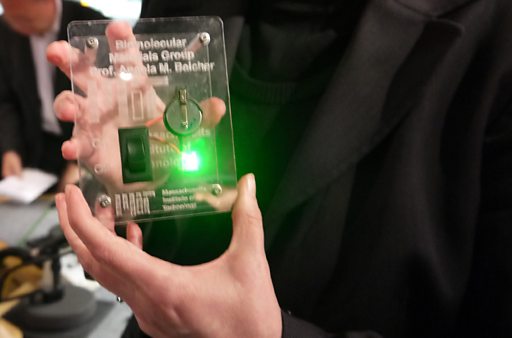
Angela Belcher with Virus Battery. Photo: BBC
Viral motoring
What Dr Belcher would really like to do, however, is to scale the process up so that one day it is possible to produce a virus battery powerful enough to run an electric car. With a paper in Nature Communications in November 2013, that day moved a step closer. The MIT team demonstrated how to use viruses to make a lightweight lithium-air battery, which the researchers think could have an energy density more than twice that of the best lithium-ion cells, the type which are currently used in most electric cars, as well as myriad portable electronic devices. But there is still a long way to go before such a battery could be put into commercial use.
I think it is very appealing that you can grow environmentally friendly battery parts

Many still find the idea strange. “I am sometimes told: ‘what are you doing using a virus to make a battery? These things don’t go together,’” says Dr Belcher. Yet, as she points out, biological processes tend to be non-toxic, low-energy ways to make things, and result in little waste, unlike many conventional manufacturing processes in which batteries are made with noxious materials in energy-intensive factories. “I think it is very appealing that you can grow environmentally friendly battery parts,” she adds.

When scaled up for commercial use, the viruses may take a back seat. This is the case with some of Dr Belcher’s projects which are already in the shops. In 2002, along with Evelyn Hu, a materials scientist then with the University of California, Santa Barbara, Dr Belcher co-founded Cambrios. This is a Silicon Valley company which makes transparent silver nanowires for use in touch screens. The nanowires are contained in inks which can be spread across the screen to provide a grid that produces an electrical signal when touched. The production process itself does not use viruses, but is based on techniques employed by them.


A number of companies are now using Cambrios’s technology in the screens of their smartphones, tablets and televisions. In December 2013 3M, a giant American maker of numerous innovative products, said it would employ Cambrios’s nanowire ink in a film that can be used to make giant, flexible touchscreens.

Image from Silura Technologies
Siluria Technologies, another Californian company, was co-founded by Dr Belcher in 2007. It uses viruses to produce templates for materials that work as catalysts to stimulate novel chemical reactions. Siluria is developing a catalytic process to turn methane, the principal component of natural gas, into petrol (gasoline) for cars. America now has an abundance of natural gas, thanks to the hydraulic fracturing, or “fracking”, of underground rocks. Siluria is building a demonstration plant near Houston to scale up the process and prove its commercial potential.

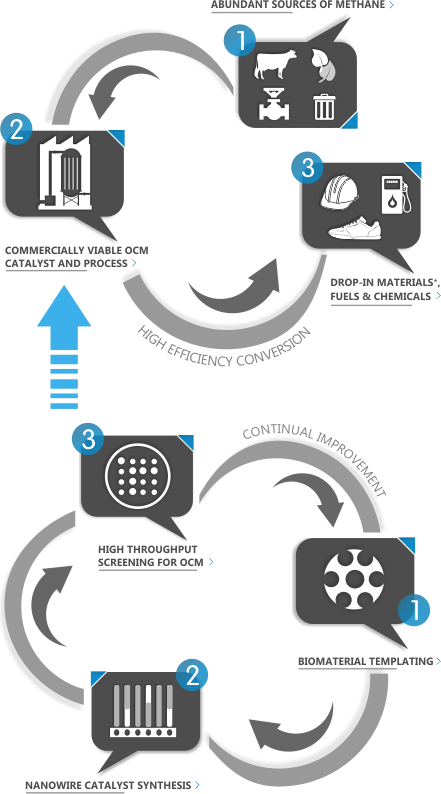
Siluria Process
How our process fits into industry, and how our catalyst materials are produced and continuously improved.


Siluria's scalable OCM process technology is designed to produce drop-in fuels and chemicals from a virtually endless supply of methane. Our catalyst materials make this process technology possible.
At the heart of Siluria's catalyst-development workflow are unique nano-structures inspired by nature. We have combined three highly innovative technologies to create our growing family of commercially viable OCM catalysts.

* Materials are 100% compatible with existing recycling infrastructure.

The same basic virus toolkit is now being used by Dr Belcher and her colleagues in the medical field. Dr Belcher is a member of two MIT faculties: materials science and engineering, and biological engineering. In 2010 she added a third by joining MIT’s Koch Institute for Integrative Cancer Research. She was nervous about this: “Working on cancer is so important. I didn’t want to take up space and not contribute and make a difference.” But she attended tutorials and became more confident by considering cancer as yet another material to work with. Although it is early days, the work looks promising.

The plan is to produce a medical probe which can be used to locate extremely small tumours. One way this is being tried is to get genetically engineered viruses to latch onto carbon nanotubes which glow under light from a laser. These viruses carrying the tubes would be injected into the body, and with light shining on the skin, be capable of glowing up to 10cm or so inside the body. The glow can be detected with a specialised camera.

To get these beacon viruses into the right places, the researchers engineer them to have a second affinity, one that makes them bind to certain kinds of cancer cells. They would then find any tumours, attach to them and glow.

The technique is still experimental and is being tried out in the laboratory on cellular models of ovarian cancer, which can be difficult for surgeons to detect when the tumours are tiny. There is a lot to do, but, says Dr Belcher, “I know we can find very small tumours and that should allow surgeons to remove them.

It also raises an obvious question: if the viruses can find tumours and light them up could they also carry with them some kind of lethal weapon? Not surprisingly, that possibility is being explored, with attempts to engineer cancer-seeking viruses that can carry both an imaging material and a chemotherapy agent.

Dr Belcher’s idea of evolving organisms to help build novel materials and new devices is starting to look like a technique with a large number of potential applications. Already she has to be able to switch from discussing with one group of her colleagues the complexities of binding materials to cancer cells, to debating with others how to clean up industrial wastewater with genetically engineered yeasts (her work is not confined to tinkering with the DNA of viruses). “There are so many areas we would like to be involved in, but we can’t do them all,” Dr Belcher laments. The trouble is, her idea born from an abalone shell seems bound to turn up even more problems which are waiting to be solved.

ORIGINAL: The Economist

lunes, 10 de marzo de 2014

Under the covers (Nature revealed) – Week 8

In week eight of the Of Schemes and Memes blog series, which features weekly interviews with the art team at Nature, Art Director Kelly Krause explains this week’s front cover choice.


Caption:
CRISPR/Cas9
-based DNA targeting has quickly become a leading tool in the fields of synthetic biology and genome engineering. It exploits the ability of a bacterial endonuclease, Cas9, guided by an RNA molecule, to target virtually any matching DNA sequence of interest for binding and/or cleavage. A study published in this issue of Nature reports the use of single-molecule and bulk biochemical experiments to reveal the mechanism by which RNA-guided Cas9 locates unique 20-base-pair sequences within DNA genomes, which can be billions of base pairs long.

The results highlight the role of a trinucleotide protospacer adjacent motif (PAM; yellow in the cover image) in recruiting Cas9–RNA complexes to potential DNA target sites, and in catalytically activating the nuclease (outlined in brown). Target DNA sequences are recognized via a ‘zip-up‘ mechanism, where the sequential formation of RNA–DNA base pairs (red) offsets the energetic cost of unwinding the DNA double helix (purple and blue). In addition to its relevance for gene manipulation, this work reveals how DNA is interrogated by Cas9–RNA in its role as an effector of adaptive immunity in bacteria. Cover: K.C. Roeyer.

PAM sequences recruit and activate Cas9 endonuclease in CRISPR/Cas9 genome-editing tool.

From the Art Desk:

Art Director, Kelly Krause, explains:

This cover is a fantastic example of visual storytelling. We can see the CRISPR process going on in the centre, with a real sense of action and movement, as well as the manipulated genes in the background, giving a sense of time and context.

The artist has done a wonderful job of conveying a complex process simply and beautifully, using colour and composition to convey key information.

For additional behind the scenes commentary each week, check out Nature Graphics Tumblr and last week’s Under the Covers on Quantum droplets.

ORIGINAL: Nature
by Alex Jackson
07 Mar 2014

viernes, 7 de marzo de 2014

The dawning of the age of genomic medicine, finally

Craig Venter (R) speaks with Eric Topol, Scripps Health chief academic officer and director of the Scripps Translational Science Institute, during a symposium on ''The Future of Genomic Medicine'' at Scripps Seaside Forum in La Jolla, California March 6, 2014. Credit: Reuters/Sam Hodgson


Director of the Cardiovascular Research Institute Dr. Elizabeth McNally (L) looks on as Megan Puckelwartz prepares DNA from human patients at the University of Chicago in Chicago, March 4, 2014. Picture taken March 4, 2014.


(Reuters) - When President Bill Clinton announced in 2000 that Craig Venter and Dr. Francis Collins of the National Human Genome Research Institute had succeeded in mapping the human genome, he solemnly declared that the discovery would "revolutionize" the treatment of virtually all human disease.

The expectation was that this single reference map of the 3 billion base pairs of DNA -- the human genetic code -- would quickly unlock the secrets of Alzheimer's, diabetes, cancer and other scourges of human health.

As it turns out, Clinton's forecast was not unlike President George Bush's "mission accomplished" speech in the early days of the Iraq war, said Dr. Eric Topol of Scripps Translational Science Institute, which is running a meeting On the Future of Genomic Medicine here March 6-7.

Thirteen years after Clinton's forecast, even Venter acknowledges that mapping the human genome has had little clinical impact. "Yes, there's been progress, but we all would have hoped it would have been more rapid," he said in an interview in his offices this week.

But that is finally changing.

"We are at an inflection point," said Collins, who now directs the National Institutes of Health. In a telephone interview, he said he never expected an "overnight, dramatic impact" from sequencing the human genome, in part because of cost.

Recently, a combination of lower-cost sequencing technology and a growing list of wins in narrow corners of medicine are starting to show that genomic medicine is on the verge of delivering on at least some of those early claims.

Recent advances in sequencing have been "pretty stunning" and genomics is "just on the threshold" of delivering results, Venter told Reuters.

Although much is left to be learned about the genome, scientists believe knowing a person's genetic code will lead to highly personalized treatments for cancer, better predictions for diseases in babies and help unlock the puzzle of mysterious genetic diseases that currently go undiagnosed and untreated.

Venter is staking his latest entrepreneurial venture on that expectation. Earlier this week, he announced formation of a new company, Human Longevity Inc., to undertake a massive project: sequencing 40,000 human genomes a year in a search for new therapies to preserve health and fight off diseases, including cancer, heart disease and Alzheimer's.

To do that, Human Longevity will use two HiSeq X Ten machines and has an option to buy three more. The sequencers, made by Illumina Inc., can map a single genome for as little as $1,000.

Collins' government-funded Human Genome Project spent $3 billion and took 13 years to sequence the human genome.

Breaching the $1,000 genome could prove to be a watershed. At that cost, said Illumina Chief Executive Jay Flatley, ambitious projects like Venter's are economically feasible and clinical results more achievable.

"We've still only scratched the surface of what the genome holds," he said. "What we need to do now is get hundreds of thousands to millions of genomes in databases with clinical information," he added.

MAKING A DIFFERENCE
Advances in sequencing equipment and the advent of next-generation sequencing has transformed the work Dr. Elizabeth McNally does as director of the Cardiovascular Genetics Clinic at the University of Chicago.

In seven short years, she said, her group has gone from testing just one gene at a time to testing 60 to 70 genes and she is moving quickly into whole genome sequencing.

McNally points to the case of Jeanne Sambrookes - a patient who is alive today because of these advances.

As a child, Sambrookes often noticed the distinct, hunched posture of her mother, her aunt and her grandmother as they struggled to climb a flight of stairs.

Sambrookes had been very athletic as a young teen, but as she matured, she noticed a heaviness in her legs. By age 20, running left her tired. At 40, she needed a pacemaker, just like her mother did at that age.

"I started thinking there is something to this," said Sambrookes, now 56, who lives in Michigan City, Indiana.

After some dead ends, she found McNally, who cast a wide net, testing for more than two dozen genes that could account for Sambrookes' heart and muscle problems.

The culprit turned out to be a mutation in a gene called Lamin that causes Limb-girdle muscular dystrophy. The disease can cause weakness and wasting of the muscles between the shoulders and knees. The mutation can also cause electrical disturbances of the heart.

McNally recommended Sambrookes replace her pacemaker with an implantable cardiac defibrillator that could protect against sudden cardiac death.

That proved to be the right call. Last August, Sambrookes' heart stopped three times. Each time, the defibrillator shocked her back to life.

"She literally tried to die three times," McNally recalls of her patient. "It still takes my breath away."

Although McNally uses panels of 70 to 80 genes in her clinic, she has started experimenting with whole genomes. With the reduced cost of gene mapping, whole gene sequencing is a potentially cheaper, more powerful tool.

The reduced cost of mapping is cutting the cost of research, too -- another factor that could speed clinical outcomes. McNally's team recently published a paper in the journal Bioinformatics in which she used Beagle, a supercomputer housed at Argonne National Laboratory, to analyze 240 full genomes in about two days. Such an endeavor normally takes months.

"That dramatically decreases the cost associated with analysis because we sped up the time," said McNally.

CORNERS OF MEDICINE
Dr. Jay Shendure, associate professor of Genome Sciences at the University of Washington in Seattle, said the impact of gene sequencing is beginning to emerge in specific areas -- after a startup period that was longer and narrower than expected.

"I do think there are these corners of medicine, which are important ones, that may happen relatively quickly," he said.

A key example is the use of a pregnant woman's blood to see if her fetus may have trisomies -- chromosomal abnormalities associated with Down syndrome and other disorders.

"Almost overnight, sequencing is in the process of taking over as the primary means of screening for trisomies in at-risk populations, and maybe eventually to everyone," Shendure said.

The clinical results are promising. A trial of Illumina's test published last week in the New England Journal of Medicine found about 3.6 percent of standard tests for trisomies had false positive results, compared with 0.3 percent with Illumina's Verify test.

That means fewer women would need to go through invasive follow-up diagnostic tests using amniocentesis or chorionic villus sampling, both of which can cause miscarriages.

If the tests become routine practice, Goldman Sachs analyst Issac Ro estimates the market could reach $6 billion a year.

Venter's new company, Human Longevity, has picked cancer as its first sequencing target. Working with the University of -California, San Diego, the company plans to sequence the genomes, as well as the tumors, of every cancer patient treated at UCSD's Moores Cancer Center.

Collins calls cancer a "disease of the genome" and notes that genomics has revealed cancer to be a collection of different mutations, all of which contribute to its growth.

Drug companies have responded with treatments that block aberrant pathways, an approach called precision medicine.

"That's happened pretty quickly because of this window that DNA sequencing has provided," said Collins.

(Reporting by Julie Steenhuysen; Editing by David Greising and Dan Grebler)

ORIGINAL:
Reuters
Mar 6, 201

jueves, 6 de marzo de 2014

Researchers Cure Diabetes in Mice


Researchers in California have turned skin cells in mice into insulin producing beta cells, effectively curing the animals of diabetes. They hope to achieve similar results in human cells, paving the way to an eventual cure for a disease that affects millions of people around the world.

Original story by Ben Gruber for Reuters:


ORIGINAL: Singularity Web

Can Gene Therapy Cure HIV?


Why It Matters

There is no cure for HIV, which can cause AIDS. In 2012, 1.6 million people died of AIDS-related illnesses.

The immune cells of HIV patients can be genetically engineered to resist infection, say researchers. In a small study in humans, scientists report that by creating a beneficial mutation in T cells, they may be able to nearly cure patients of HIV.

In a study published in the New England Journal of Medicine on Wednesday, researchers report that they can use genome editing to re-create the rare mutations responsible for protecting about 1 percent of the population from the virus in infected patients. They report that some of the patients receiving the genome-modifying treatment showed decreased viral loads during a temporary halt of their antiretroviral drugs. In one patient, the virus could no longer be detected in his blood.


Zinc-finger nucleases are one of a few genome-editing tools that researchers use to create specific changes to the genomes of living organisms and cells (see “Genome Surgery”). Scientists have previously used genome-editing techniques to modify DNA in human cells and nonhuman animals, including monkeys (see “Monkeys Modified with Genome Editing”). Now, the NEJM study suggests the method can also be safely used in humans.

From each participating patient, the team harvested bone marrow stem cells, which give rise to T cells in the body. They then used a zinc finger nuclease to “break” copies of the CCR5 gene that encodes for proteins on the surface of immune cells that are a critical entry point of HIV. The stem cells were then infused back into each patient’s bloodstream. The modification process isn’t perfect, so only some of the cells end up carrying the modification. “About 25 percent of the cells have at least one of the CCR5 genes interrupted,” says Edward Lanphier, CEO of Sangamo Biosciences, the Richmond, California, biotech company that manufactures zinc finger nucleases.

Because the cells are a patient’s own, there is no risk of tissue rejection. The modified stem cells then give rise to modified T cells that are more resistant to infection by HIV, say the researchers.

One week after the infusion, researchers were able to find modified T cells in the patients’ blood. Four weeks after the infusion, six of the 12 patients in the study temporarily stopped taking their antiretroviral drugs so the researchers could assess the effect of the genome-editing treatment on the amount of the virus in the patients’ bodies. In four of these patients, the amount of HIV in the blood dropped. In one patient, the virus could no longer be detected at all. The team later discovered that this best responder had naturally already had one mutated copy of the CCR5 gene.

Patients who carry one broken copy of the CCR5 progress to AIDS more slowly than those who don’t, says Bruce Levine, a cell and gene therapy researcher at the University of Pennsylvania School of Medicine and coauthor on the study. Because all of the cells in that best-responder patient already carried one disrupted copy of CCR5, the modification by the zinc finger nuclease led to T cells with no functional copies of the gene. That means the cells are fully resistant to HIV infection. The team is now working to increase the number of immune cells that end up carrying two broken copies of CCR5.