Mostrando entradas con la etiqueta Impresión 3D. Mostrar todas las entradas

miércoles, 19 de noviembre de 2014

3-D Printer Powered Up on the International Space Station

NASA astronaut Butch Wilmore installs a 3-D Printer in the Microgravity Science Glovebox on the International Space Station. Image Credit: NASA-TV

Darian Bryant, left, and Melissa Hopper, stowage engineers with the Payload Operations Integration Center at NASA's Marshall Space Flight Center in Huntsville, Alabama, work with NASA astronautBarry "Butch" Wilmore to calibrate the first 3-D Printer flown on the International Space Station. Image Credit: NASA/MSFC/Emmett Given

Today, NASA took a big step toward changing the way we plan for long-duration space voyages when astronaut Barry “Butch” Wilmore successfully installed and prepared the first 3-D printer for upcoming manufacturing operations on the International Space Station.

"This printer is a critical first step for in-space manufacturing," said Jason Crusan, director of NASA's Advanced Exploration Systems Division at NASA Headquarters in Washington. "Additive manufacturing with 3-D printers will allow space crews to be less reliant on supply missions from Earth and lead to sustainable, self-reliant exploration missions where resupply is difficult and costly. The space station provides the optimal place to perfect this technology in microgravity."

Wilmore installed the printer in the station’s Microgravity Science Glovebox and started the printer, which extruded plastic to form the first of a series of calibration coupons, a small plastic sample about the size of a postage stamp. After calibration of the printer is complete and verified, the printer will make the first NASA-designed 3-D printed object in space. The goal of the 3-D Printing in Zero-G Technology Demonstration on the space station is to show that additive manufacturing can make a variety of parts and tools in space. The 3-D printerheats a relatively low-temperature plastic filament to build parts layer on top of layer in designs supplied to the machine.

Before the printer left Earth in September 2014 on SpaceX’s fourth commercial cargo resupply mission, engineers loaded the first files to be printed. These initial parts -- primarily test coupons -- will be returned to Earth for detailed analysis and comparison to identical ground control samples made earlier this year prior to launch with the same printer while it was at NASA’s Marshall Space Flight Center in Huntsville, Alabama.

"The goal of the first phase of printing is to verify that the 3-D printing process works the same in microgravity as it does on the ground," said Niki Werkheiser, NASA's 3-D printer project manager at Marshall. "Once we confirm that the process works, we will move to the second phase of printing which focuses more on the design and utilization of the parts we print, which will ultimately lead to establishing an on-demand machine shop in space."


Niki Werkheiser, project manager for the NASA's 3-D Printing investigation at the Marshall Space Flight Center, explains the calibration and check-out process during a recent episode of Space Station Live on NASA-TV. (Video: NASA)


NASA contracted Made In Space, Inc. at NASA’s Ames Research Center in Moffett Field, California, to design and build the printer. Going forward, Made In Space engineers will use NASA-provided software and work with controllers at NASA’s Payload Operations Integration Center (POIC) in Huntsville to send commands directly to the printer from the ground. As the first objects are printed, NASA and Made In Space engineers will monitor printing via downlinked images and videos. The majority of the printing process is controlled from the ground to limit crew time required for operations.

"We’re approaching the most exciting moment of this experiment after years of intensive work, which dates back to Made In Space's first microgravity testing with NASA's Flight Opportunities Program in 2011," said Aaron Kemmer, CEO of Made In Space, Inc. “Our team is on standby to send the command to print the first object in space. We are taking everything we are learning on the space station and using it to design an even more elaborate 3-D printer, which will be available for anyone to use.”

That printer is scheduled to be launched to the station next year and will be available to meet manufacturing needs of both NASA and commercial users.

NASA invited students to propose what they would print in space as part of a Future Engineers competition. Students can create and submit a digital 3-D model of a tool they think astronauts need in space. The winning student will watch from the POIC alongside the operations control team as their design is printed in space. The deadline for entry is Dec. 15.

Learn more about additive manufacturing at NASA's 3-D printing website or follow updates on Twitter at @NASA3DPrinter.


Joshua Buck
Headquarters, Washington
202-358-1100

Tracy McMahan
Marshall Space Flight Center, Huntsville, Ala.
256-544-0034

Dan Huot
Johnson Space Center
281-483-5111

ORIGINAL: NASA
By Bill Hubscher International Space Station Program Science Office
November 17, 2014

martes, 18 de noviembre de 2014

What is the 3D Print Canal House?


The 3D Print Canal House is an exhibition, research- and building site for 3D Printing Architecture. A unique project where an international team of partners collaborates in ‘research & doing’ linking science, design, construction and community, by 3D printing a canal house at an expo-site in the very heart of Amsterdam.


FREQUENTLY ASKED QUESTIONS

1. Why 3D Printing?
3D printing is a fascinating new production technique. It allows you to directly translate a digital file into a physical product. 3D printing can have huge implications for the way we fabricate things - for example the elimination of waste, transport costs and standardisation of elements - DUS architects is investigating what the implications of 3D printing are for the building industry. What better way to do this than by 3D printing an entire house?


2. Why a canal house?
The canal house is a symbol of Amsterdam. When the canal belt was built 400 years ago, Amsterdam was a prime example of innovation. Each canal house can house several functions, such as trade, storage, living, craft, and each canal house is richly ornamented and unique. A canal house is recognizable and attractive. It is interesting to investigate what this traditional architype can be in a 21st century context. 3D printing a canal house shows the world how to combine traditional local values with new innovative ideas.

3. What are some of the advantages and disadvantages of 3D printing a building?
One great advantage of 3D printing over traditional buidling techniques (such as prefabricated concrete) is the possibilities of using a high level of detail and ornament and variation. Rather than using standardized elements, 3D printed designs can each be modified and customized to fit the user's needs and taste. It will no longer be more expensive or more labour intensive to add details to for example your façade and it is easy to create unique objects.

3D printing is an additive manufacturing technique. That means the process goes straight from the raw material to the final product, thus eliminating waste. There are no transport costs, as designs can simply be transferred digitally and printed locally. This also implies that when 3D printing is used widely in each part of the world, it will no longer be cheaper to have things produced in countries like China or Bangladesh as opposed to the Netherlands. Everyone can just produce everything in their own local context.

In terms of disadvantages, it is obviously a huge challenge to create a building that complies with all the current building regulations. There is the question of insulation, fireproofing, wind loads, foundations...these, as well as the possible materials to print with (using this printer) are all things that are being researched and investigated.

4. How does the Kamermaker work?
The Kamermaker works in exactly the same way as the Ultimaker, the small desktop 3D printer, as it is simply an upscaled version. A digital design is placed in the 'brain' of the printer, a very simple computer, where it is translated into a G-code. A G-code is a file that slices a 3D model into layers. This file programs the printer to move along a path that is optimal for that design, layer by layer. 

In the 'control room' of the printer is also the material supply. We print with plastic in the form of granulate which enters an extruder via a funnel. In the extruder the granulate is heated (the material melts at 170 degrees Celsius) and pressed together to a homogeneous liquid. This is brought to the printer head by a heated tube. The printer head extrudes the melted material along the programmed path on the X and Y axes and when finished moves up one step along the Z axis. This is fairly similar to a normal printer, only with one more direction, which allows objects to be printed layer by layer.

5. What materials does the Kamermaker print with?
We are currently printing with bioplastics. The granulate that goes into the Kamermaker is called Macromelt, a type of industrial glue (Hotmelt) developed by Henkel. It is made of 80% of vegetable oil. It melts at 170 degrees Celsius. We aim to print with a material that is sustainable, of biological origin, melts at a relatively low temperature, and of course is sturdy and stable. We are also researching the possibilities of printing with recycled materials: Plastics of course, but we’re also looking into using wood pallets and natural stone waste.

Technically, the Kamermaker can print with any material that melts (at a temperature that isn't too high) and then hardens again.

7. Who are the initiators and partners? 
DUS architects is the initiator of both de KamerMaker and the 3D Print Canal House. DUS architects  is an Amsterdam based architecture office founded in 2004 by Hans Vermeulen, Hedwig Heinsman and Martine de Wit. DUS architcts builds ‘public architecture’: Architecture that influences the public domain using scale 1:1 models, urban process- and strategy design, and that ranges from temporary interiors to long-term urban transformation trajectories.  www.dusarchitects.com

DUS architects is collaborating with lots of important partners who invest in the project with knowledge and means. For example:

  • Henkel is developing a new sustainable 3D print material for the building industries. 
  • Heijmans is researching what new construction techniques are needed for 3D printing buildings. 
  • The Municipality of Amsterdam investigates the effect of the digital maker-industries on regulations and opportunities for employment.
Check the 'partners' section at this website for an actual overview of all our courageous partners!


8. How is the house financed?
The project is partially funded by the contributions of our partners and partially funded by the municipality of Amsterdam, Amsterdam Fund for the Arts and the DOEN Foundation. A lot of the sponsorship the 3D Print Canal House gets is in natura, through contributing knowledge or materials. In fact, the 3D Print Canal House is one big collaboration project, in which everybody shares and gets a share.

And of course our visitors help finance the house by paying an entrance fee!

9. How much does the house cost?
That is impossible to say since all of the materials we use have never been on the market for this purpose. The 3D Print Canal House is a research project partially funded and partially created by DUS architects and its partners. At the end of the research trajectory, we hope to be able to give an accurate estimate of what it takes to 3D print a house. The goal is to create a cost-effective building technique for building sustainable and comfortable houses.

10. What is there to do at the 3D print canal house?
The construction site of the 3D print canal house not just a building site, it is an open workplace where an international team of partners collaborates in 'research and doing (R&DO), as well as an open source expo. You can visit it like a regular museum to learn more about the techniques being researched and used, and you can watch the team at work! We have an audiotour to explain you everything you see.

The building is constantly under construction: in three years time more and more rooms will be printed and assembled on site as the design and printing techniques progresses. So evry week this museum changes!

Also there are regular workshops and events held at the expo (watch our calendar). If you wish to book a personalised tour, attend a workshop or lecture, or rent out the expo for a special event, please contact info@3dprintcanalhouse.com

11. Why do I need to pay an entrance fee?
When you visit the 3d Print Canal House, you are not just visiting a building site, you are visiting an open research workplace and exhibition. By paying €2,50 entrance fee, we can create an informative and secure tour for visitors without being of to much disturbance for the research and work progress. With the fee you pay, you are directly funding the development of the project. Don't worry, you'll be getting value for your money, such as a free audiotour.

12. How can I contribute?
The 3D Print Canal House is an open project. That means that we are learning from our audience during the project. We are always happy to hear about your ideas.

You can contribute by sharing your knowledge or simply by visiting and paying entrance fee or booking a group tour.

If you wish to make further contributions, find out how by clicking on 'Become a Friend!'

13. When will the house be finished?
The 3D Print Canal House is a 3 year research and development project. This does not mean that the expected time it will take to 3D print a building in the future will be 3 years. On the contrary: The aim for the use of 3D printing in architecture is to build faster compared to traditional building techniques. Within the 3 years research project of the 3D print Canal House, DUS architects is building the Canal House and by doing so building up new knowledge for this purpose and sharing this with the community through the website and expo center.

14. What will happen to the building after it's finished?
Most likely it will be a public building. We hope that the 3D Print Canal House will become a hub for innovation and new production techniques and materials for the building industry. And of course that many more 3D printed buildings will pop up around the globe!

15. What sets this print project apart from other large scale 3D print initiatives?
Currently, 3D printing is on the rise, and there are many other initiatives, both on a large and small scale (also see 'other 3D printing initiatives' for a bit more in depth overview) going on that we can hardly keep track.

What makes the 3D Print Canal House special is that it is a project which is 'open' in every way: The initiators, designers and builders (DUS architects) are the client: the focus is on research, experimentation and development, instead of finishing a house. The project involves many different industries, disciplines and parties tied together by a common goal. More importantly, the process is being shown to the public (not only the successes but also the possible failures it will encounter!) in order to learn and develop.

16. What are some other interesting 3D printing initiatives?
3D printing is already widely used in many industries, particularly when on a small scale a high level of unique detail is required (big chances are that if you need a crown or hearing aid, it will be 3D printed). It is a production technique that is becoming more and more widely available. The great thing is that 3D printing can easily create objects or parts of objects that are custom fit and have a high level of detail and variety.

The 3D Print Canal House is a pioneering example and the first house that is being printed on the spot with the largest portable 3D printer. However, there are quite a few other initiatives on a similar large scale around right now, and chances are there will be more and more over the next months and years.

Some interesting examples to look at are:

Examples of using ‘our’ FDM printing technique combined with a concrete like material are
and 
  • Shanghai WinSun Decoration Design Engineering Co. 
http://www.3ders.org/articles/20140401-10-completely-3d-printed-houses-appears-in-shanghai-built-in-a-day.html
  • A different technique is developed by Enrico Dini in Italy using first a layer of sand and immediately after a layer of binder (glue) - turning the sand into a solid concrete like object. This printer is also used for Universe Architecture's Landscape House.
  • Dirk van der Kooij in Zaandam produces interior objects like chairs and vases with a FDM like printing technique using recycled plastics. www.dirkvanderkooij.nl

On a smaller scale 3D printing is used in the

  • medical industry, 
  • machinery, 
  • prototyping, 
  • jewerly, 
  • art, 
  • furniture, and 
  • many more. 
Would you like to start 3D printing yourself? Visit open fablabs like Protospace or i-Fabrica (in the Netherlands). If you would like to have your digital model 3D printed by a thirt party upload your model on one of these websites:

Your 3D printed object will be shipped right to your home!There is plenty of information on 3D printing to find on the internet. An example of an easy to read overview on 3D printing can be found here. But the best way to learn more is of course to visit the expo centre!


domingo, 16 de noviembre de 2014

3D Printing Using Genetically Modified Bacteria and Orange Juice

This post is coming to you live from the Elephant & Castle Mini Maker Faire being held today at the London College of Communication.


The JuicyPrint prototype—here the redder light indicates where the cellulose wouldn’t be growing, and the bluer light is where it would. In this case the 3d bio-printer would be printing an ‘H’ symbol.

While the field is still fairly quiet right now, biohacking is the next big thing. There’s a grown segment of the maker movement that is talking about it, but not just that, they’re getting on and doing it.

I talked to Ilya Levantis from the London Biohackspace about JuicyPrint a 3d printer that can be fed with fruit juice and used to print out useful shapes made of bacterial cellulose using a genetically engineered strain of cellulose producing bacteria.


The G. hansenii (Gluconacetobacter hansenii) bacteria that the London Biohackspace is using is a is able to grow on a wide range of things like fruit juice, tea or even brewing waste. Once completed, building objects with the new printer will require only a computer, and a local a trip to your local market for supplies.

The Elephant & Castle Mini Maker Faire was held at the London College of Communication from 10am till 6pm. Entry is free to children (under 16) and students, tickets are £5 otherwise and available on the door.

Alasdair Allan is a scientist, author, hacker, tinkerer and co-founder of a startup working on fixing the Internet of Things. He spends much of his time probing current trends in an attempt to determine which technologies are going to define our future.

ORIGINAL: Make
November 15th, 2014

viernes, 12 de septiembre de 2014

This Drivable Car Was Just 3D Printed In 44 Hours


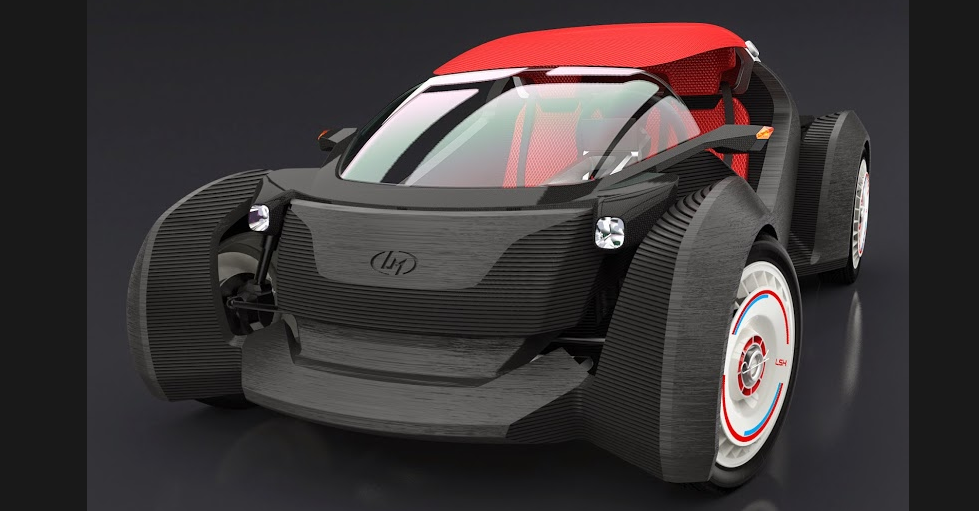
At the International Manufacturing Technology Show in Chicago, Local Motors 3D printed a plastic car called the Strati in front of thousands of attendees.

Local Motors took the chassis, seats, door panels, and thousands of other components, and 3D printed all those parts into just one piece. The first phase of the process, completed on Tuesday, took just 44 hours. 

"A 3D printed car like ours will only have dozens of components," Local Motors engineer James Earle tells Business Insider. In the near future, he says, it could cost only about $7,000 to manufacture, perhaps the start of what will become a niche market for customized cars.

"You can make a vehicle for yourself that's basically a one-0ff, do the entire design," he says. "You could create custom-fit seats that conform to your shape, things like that, that you couldn't do with cars now."


ORIGINAL: Business Insider
By Will Wei.
SEP. 10, 2014

martes, 26 de agosto de 2014

Biomimicry Chair Could Change Furniture as we Know It


A common complaint about 3D printing is that it is not capable of producing things in a wide range of materials. Industrial printers can currently print items from wood, metal, plastics, and… thats basically it. If you aren’t the owner of a successful manufacturing firm and you’re just an average consumer or hobbyist looking to try your hand at 3D printing, then the only available options for you come in the form of cheap, hard plastics like ABS and PLA. This would be great if you wanted to make figurines, jewelry for little girls or even handy devices, parts and gadgets. But if you wanted to print something bigger or softer, you simply couldn’t. Until now.

The Royal Academy of Art, The Hague graduate student Lilian van Daal has created a 3D printed chair out of a single recyclable material influenced by plant materials. The chair was made as an alternative to traditional furniture that is usually upholstered and glued together from many different materials, which makes it difficult to recycle.
Source: Dezeen

“A lot of materials are used in normal furniture production, including several types of foam, and it’s very difficult to recycle because everything is glued together,” Van Daal told Dezeen.

Van Daal, a design student, decided to experiment with various materials and design methods to see if it would be possible to create environmentally-friendly furniture. By using 3D printing technology and mimicking plant cell structures, van Daal was able to produce the ‘Biomimicry’ chair.

Unlike most 3D printed objects, the biomimicry chair is not entirely hard. Van Daal mimicked plant cells by distributing the material differently at different parts of the chair. She decreased the density of the material in certain places and increased it in others. This enabled some sections of the chair to be soft and some to be hard – yet the entire chair was made from just one material.

Source: Dezeen

“I was testing the flexibility and the stiffness you can get from one material by 3D printing various structures,” said Van Daal. “I did lots of experiments with different structures to identify the kind of properties each structure has. When you adjust the structure a little bit you immediately get a different function. In the strong parts I used as little material as possible but enough to still have the good stiffness.”

According to Dezeen, Van Daal is currently in talks with furniture companies to discuss developing the project further. Not only is her concept much more environmentally-friendly than traditional furniture, but it also saves costs associated with purchasing multiple materials and having to transport them all separately to a factory. The ability to 3D print a soft, recyclable chair is a big step both for furniture and also for 3D printing technology, as the stigma of being able to print only rock hard objects is slowly diminishing.

ORIGINAL: Inside 3DP
15Aug 2014

jueves, 17 de abril de 2014

Five Tech Trends That Can Drive Company Success

The ability to innovate is a driver of productivity, competitiveness and prosperity. Innovation requires entrepreneurs to rethink and adopt new approaches to their businesses, and embracing new technologies and manufacturing opportunities can distinguish you from your competitors.

But what are some powerful tech trends that can drive company success? What should you pay attention to?

Here are five trends that, if you haven’t embraced them yet, have the potential to transform your business.

1- Biomimicry: Innovation Inspired By Nature
Biomimicry is the design and production of materials, structures and systems that are modeled after biological organisms and processes.

“It’s not really technology or biology; it’s the technology of biology. It’s making a fiber like a spider, or lassoing the sun’s energy like a leaf,” Janine Benyus co-founder of the international organization Biomimicry 3.8, writes.

Companies are increasingly looking at ways to incorporate biologically inspired design into their products, and organizations like Biomimicry 3.8 are helping them redesign carpets, furniture, airplanes and even entire manufacturing processes.

In Northeast Ohio, Great Lakes Biomimicry, a founding affiliate partner of Biomimicry 3.8, is working with schools, companies and economic development organizations to engage students, entrepreneurs and funders to advance the field.

The University of Akron has committed $4.25 million to biomimicry research and innovation, and companies like Parker Hannifin and Sherwin-Williams are getting involved. They realize biomimicry has many applications, particularly when it comes to creating sustainable technologies.

“Biomimicry represents the possibility of a revolutionary change in our economy, transforming many of the ways we think about designing, producing, transporting and distributing goods and services,” Tom Tyrrell, founder and CEO of Great Lakes Biomimicry, says. “This field is just emerging. Nazarene University’s Fermanian Institute estimates, by 2025, biomimicry could represent $300 billion of the annual U.S. GDP, account for 1.6 million U.S. jobs and represent $1 trillion of global GDP.”

2- Additive Manufacturing: Innovation From A Printer
Additive manufacturing is becoming a viable manufacturing alternative, particularly for makers of highly customized products. The technology can significantly reduce the time and cost it takes to design and produce prototypes. Thus, additive manufacturing is particularly well suited for R&D.

But additive manufacturing has evolved to a point where it now also makes sense for volume production. Combining the technology with printed electronics, for example, could create the next generation of embedded electronics.

Printed electronics can be directly applied to 3D surfaces to advance integration, size and weight reduction, durability and performance. This provides new opportunities for electronic device manufacturers, who want to pack more functionality into less space.

Youngstown, Ohio, is the center of additive manufacturing at the moment. The region is home to America Makes, also known as the National Additive Manufacturing Innovation Institute. Its goal is to elevate additive manufacturing into mainstream manufacturing.

3- The Internet of Things: A Web Of Innovation
There’s lots of talk about “the Internet of Things.” But what exactly does it mean?

“It’s the marriage of minds and machines,” Marco Annunziata, chief economist at General Electric, said in a TED talk on the topic. “This is a transformation as powerful as the industrial revolution.”


Simply, the Internet of Things refers to a network of physical objects with embedded technology that is connected (either wired or wirelessly) for communication, remote control, data transfer or some other function. Sensors, radio-frequency identification (RFID) technology and microelectronics are critical components of the Internet of Things.

Connecting products, machines or entire factories to the Internet can increase efficiency and reduce the loss of information. This potentially has far-reaching implications and impact across many industries. Already, coffee shops, airports and major corporations like Rockwell Automation have embraced the Internet of Things. Cisco Systems CSCO +0.44% CEO John Chambers calls it the “fourth wave of the Internet.”

“We believe we’re at an inflection point, driven by the convergence of integrated control and information technologies, and accelerated by the arrival of the Internet of Things,” Rockwell Chairman and CEO Keith Nosbusch said. “We call this vision ‘The Connected Enterprise.’ It involves industrial operations that are more productive, more agile and more sustainable.”

4- Software: Transforming Traditional Industries
“Today’s manufacturing is really one of the most sophisticated industries in the world,” Siemens USA CEO Eric Spiegel said recently. “That’s mainly because software has really transformed the whole manufacturing process.”

Spiegel made his remarks at the “Building the Future: Manufacturing’s Software Revolution” event in Norwood, Ohio, where Siemens announced a $66.8 million in-kind software grant to Cincinnati State Technical and Community College. It gave additional grants to Mott Community College ($55.8 million) and Youngstown State University ($440 million) to train students how to use its product lifecycle management software in careers like robotics design and computer-aided engineering.

But software is not only impacting the manufacturing industry. Tech and non-tech businesses large and small are in need of software solutions to respond to customer demands and process large amounts of data. It’s no surprise the demand for software engineers is higher than ever and many businesses can’t find enough people to fill open positions, according to Today’s Engineer.

5- Big Data: Understanding Your Customers
The ability to collect, process and interpret large and complex data sets, known as Big Data, is at the core of many business operations. It allows you to more effectively communicate with consumers, perform risk-analyses and create new revenue streams, among other things.

“The ability to evaluate and apply data has always been an integral part of an organization’s success. But the unprecedented amount of information available today demands far more sophisticated approaches to analysis and execution,” said former Microsoft MSFT COO Bob Herbold, who recently donated $2.6 million to launch a data science program at Case Western Reserve University.

Big data increases the efficiency of shipping companies and retailers, for example, and makes manufacturers more efficient and responsive to clients’ needs.

“The potential that exists today to enhance operations and outcomes is nearly limitless,” Herbold said. “Those who understand how data works and what it can yield will carry enormous advantage in the new economy.”

How have you embraced any of these trends? What are some other innovations that have taken your business to the next level?

Share your insights by commenting below or send me a tweet at @NorTech!

ORIGINAL: Forbes
Rebecca O. BagleyContributor
4/01/2014

martes, 8 de abril de 2014

$299 3D printer achieves Kickstarter goal in minutes

The 'cheap' M3D printer may be the first one to appeal to a mass market

An ultra-cheap 3D printer has hit its Kickstarter goal in just 11 minutes, with some lauding it as the first mass market version of the technology.

Makers M3D have currently raised over $1m (£597,000) well ahead of their $400,000 target with 28 days to go.

Early backers will get the machine for just $199 and other backers can pledge as little as $299.

Dubbed Micro, it comes with easy-to-use software that allows users to search, drag and drop objects to print.


Kickstarter is a crowd-funding website that has breathed life into a range of technology projects, including the virtual reality headset Oculus Rift, which was subsequently bought by Facebook for $2bn.

'Exciting thing'
At just 7.3in (18.5cm) square and weighing 1kg (2.2lbs), the device will be easy to move around. It can be used with Windows, Mac or Linux.

Users can choose a design to make.
It comes with software that allows users to search and browse objects online. Once they have picked something they would like to print they drag it into the printer and hit print.

"It's our goal to make the Micro accessible to everyday users," reads the pitch on Kickstarter.

The tagline on its Kickstarter page calls it "the first truly consumer 3D printer".

Some believe that it could be a game changer.

"Along with the market entry of New Kinpo I think it's one of the most interesting things to happen in desktop 3D printing," said expert Joris Peels.

"New price points and lower pricing will be key in getting people to buy a 3D printer. Not many people can afford to pay $2,000 for a printer but many more can try one for $500 or $300," he added.

The team hope to be able to start shipping the machines in August.

While those supporting the device on Kickstarter will get it for $299 or below, a retail price has not yet been set although it is expected to be "within the same price bracket" according to a company spokeswoman.


ORIGINAL: BBC
8 April 2014 

miércoles, 26 de febrero de 2014

Printer makes human skin for burn patients

Technology can replace cosmetic healing and is seen as biggest breakthrough since antibiotics's invention.

A new invention could signal a major breakthrough in the way patients with burns injuries are treated.

A researcher in Canada has developed a three-dimensional prototype printer which will produce human skin from a patient's own cells.

Doctors say it will revolutionise the process of skin graft operations, and can save the lives of hundreds of burns victims every year.

And not just skin: the technology may also pave the way for producing entire organs for transplants.

Al Jazeera's Danel Lak reports from Toronto.


ORIGINAL: AlJazeera
26 Feb 2014

martes, 11 de febrero de 2014

Blooming marvellous! Pretty flowers that open up before your eyes are the world's first ever INFLATABLE 3D printed objects

Richard Clarkson created the design as part of his seamless blossom project
Flowers open as air is pumped into chambers, revealing a colourful core


They were produced using Objet’s 3D printer which is able to simultaneously print a mix of both a flexible and rigid material

As remarkable as 3D printing is, most objects created using the technique have, up until now, been limited to rigid structures.

But this could be about to change with a new generation of materials that are allowing designers to create morphing 3D designs.

Richard Clarkson from Victoria University of Wellington has become one of the first to make use of multi-material 3D printing by creating inflatable rubber-like flowers.

Scroll down for video...

MULTI-MATERIAL 3D PRINTING

As well as creating beautiful art installations, multi-material 3D printing aims reduce the number of manufacturing steps for one object.

it allows, for instance a working product to be created with different properties without the need to bring together separate components.

Experts claim it increases speed to market by allowing organisations to prototype increasingly complex parts. It also reduces waste products by using exactly the right amount of material required.

The flowers, created as part of the ‘seamless blossom project’, open up as air is pumped into inner chambers, revealing a colourful inner core.
Mr Clarkson claims they are the first ever inflatable objects to be created with 3D printing.


‘Basically, it’s a curved hollow chamber with flexible rubber. As you inflate it, it creates a gap of air that pushes against the inner layer, forcing the outer layers open. It almost blooms, like a flower,’ he said.


Recent advances in 3D printing now allow the simultaneous layering of different build materials in a single print


Incredible inflatable 3D printing technology shows flowers...


Seamless Blossom - Richard Clarkson (video)

A screenshot from the computer aided design (CAD) programme Richard Clarkson used to create the flowers


The flowers were created using Objet’s multi-material printer which is able to simultaneously print a mix of both a flexible and rigid material at point of print.


Mr Clarkson has designed his project as an interactive installation without any electronics, sensors or computer control, working only on air pressure.


It is the first in what experts are predicting could be a wave of 3D printed objects that use different materials to morph shape.


Last year, for instance, U.S. architect Skylar Tibbits announced a project to develop morphing materials in collaboration with Minneapolis-based group Stratasys

Mr Clarkson has designed his project as an interactive installation without any electronics, sensors or computer control, working only on air pressure


The flowers, created as part of the 'seamless blossom project' open up as air is pumped into inner chambers, revealing a colourful inner core


Mr Tibbits has now set up a radical lab at the Massachusetts Institute of Technology (MIT) to create materials that self-assemble.


Like Mr Clarkson, the MIT lab plans to use of multi-material 3D printing to programme different properties into various parts of a product’s geometry.


The idea is that these parts will have varying water-absorbing characteristics that activate a change in shape when they come into contact with moisture.

Te technique could lead to structures such as self-assembling furniture, or water pipes that know when to expand and contract.

Mr Clarkson claims these flowers are the first ever inflatable objects to be created using 3D printing

The technique could lead to structures such as self-assembling furniture, or water pipes that know when to expand and contract

ORIGINAL: Daily Mail
By Ellie Zolfagharifard
24 January 2014

sábado, 25 de enero de 2014

StrandBeests: 3D Print Crazy Live Animals… Well Almost

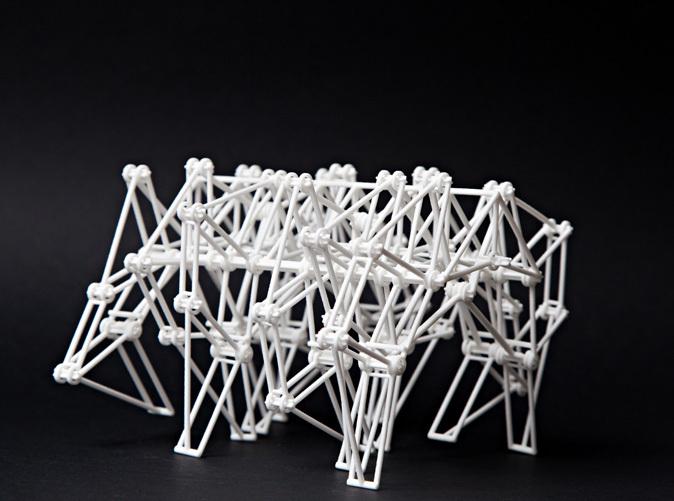
While browsing Shapeways this afternoon I stumbled upon something that caught my eye. No, it’s not another life saving device that has been 3D printed, or even something that you can get any real use out of, but I still could not look away. What are these 3D Printed objects you may ask? They’re Strandbeests, and they have been created by an extremely talented fellow by the name of Theo Jansen.

Theo is a 65 year old Dutch artist with quite the imagination, who gained fame for his work with PVC piping in the 1990′s to create what were also known back then as StrandBeests. They were basically large structures that could move on their own, many resembling animals or insects. Because of the fact that they have several leg-like extremities, they also usually have the ability to move on sand better than wheels can. Unlike a wheel, only small portions of the “Animals” need to touch the ground. Many Strandbeests can move on their own with the help of a wind driven propeller. The work was quite an engineering as well as artistic feat.

Theo has recently decided to take those same skills and apply them to 3D modelling and printing, bringing his creations to Shapeways so that anyone around the world can buy his famous StrandBeests. He has produced the following video, somewhat humorous, showing off his new 3D printed Beests, comparing them to wild animals:


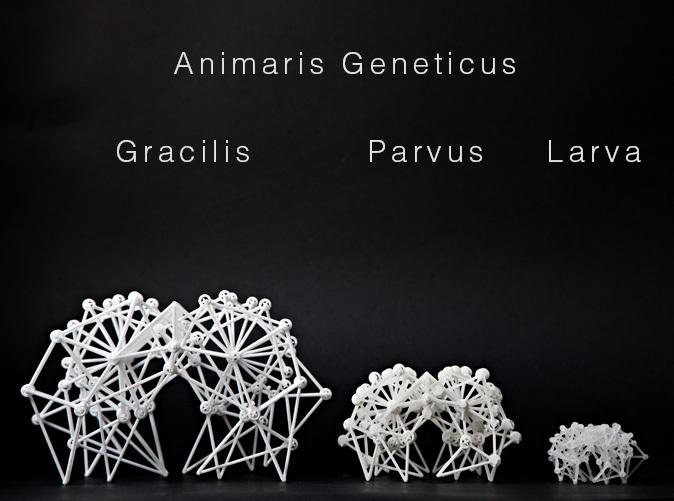
Currently he is offering four different Strandbeests on Shpaeways, they include the following:
  • Animaris Geneticus Gracilis
  • Animaris Geneticus Larva
  • Animaris Geneticus Ondularis
  • Animaris Geneticus Parvus
Prices for his little works of art range anywhere from $39 to $110, and make amazing coffee table toys. You can discuss these little creatures in the 3DPrintBoard Forum here: http://3dprintboard.com/showthread.php?1518-Introducing-Theo-Jansen-s-StrandBeests


ORIGINAL: 3DPrint
by Randall Desmond
January 24, 2014

miércoles, 22 de enero de 2014

Polish 3D Printer Zortrax Sells 5,000 Units To Dell


It may seem like small potatoes, but Polish 3D printer manufacturer Zortrax has chalked a 5,000 unit order from Dell. This is the first I’ve heard of a mass order of home 3D-printing equipment and it means a real boon for the budding Olsztyn-based company.

“Dell kept in touch with us when we were still in the middle of our Kickstarter campaign. We weren’t in a position to make them a reasonable business offer at that time, since our production volume was very limited,” said Rafał Tomasiak, Zortrax CEO. “At that point in time the production was very tedious, every single printer was quality checked and tested by us. Business negotiations with Dell were stalled at some point and we focused on shipping the printers to our Kickstarter backers. Now the situation is much different, we are prepared for large quantity orders.”

Zortrax launched last May and is now shipping to happy Kickstarter backers. I’ve used the printer multiple times and was very impressed by the print quality and build. The company is poised to be a major player in the European market and, with this investment by Dell, potentially globally. The company said the the printers are headed toward Dell’s central and east Asia offices.

“Frankly speaking, we were surprised that any company, even a company like Dell, wants to place such an order! But after a while we realized how many printers we use in our own office… For a designer who prints a large number of prototypes it is much more useful to use 10 smaller printers on one desk, which operate simultaneously, rather than one with a larger build volume,” said Tomasiak.


domingo, 29 de diciembre de 2013

Gorgeous Computer-Generated Flowers Bloom: Photos


British philosopher and mathematician Bertrand Russell once said, "Mathematics, rightly viewed, possesses not only truth, but supreme beauty." One look at these computer-generated images from Daniel Brown and Russell's words come to life.

Brown, a London-based designer, programmer and artist who specializes in digital technology and interactive design uses custom algorithms to "grow" gorgeous floral artwork that will blow your mind. Here are 11 of our favorites.
Courtesy Daniel Brown


It all started in 1999, when Brown demonstrated a computer program and mathematical model that used special code to produce fractals. The resulting animations were almost hypnotic. "It was the first time I realized that non-technical people could aesthetically appreciate mathematical formulas if they saw them 'come alive,'" he said.
Courtesy Daniel Brown


Brown created the pieces in this slideshow for the Victoria and Albert Museum and the D'Arcy Thompson Zoology Museum, as well as projects for corporate clients. A swimming accident in 2003 broke Brown's spinal cord, causing paralysis. As a result, he uses a finger-splint device and a large track pad to operate a computer. Even without this added challenge, his flowers are uniquely beautiful; no two look exactly the same.
Courtesy Daniel Brown


Several years ago Brown produced a three-story-high projection of flowers for the Victoria and Albert Museum. Each petal generated contained combinations of images from the museum's textile collection. The work was named in honor of D'Arcy Wentworth Thompson, a pioneering bio-mathematician known for his 1917 book On Growth and Form.
Courtesy Daniel Brown


Last year, the D'Arcy Thompson Zoology Museum at the University of Dundee in Scotland contacted Brown after seeing his Victoria and Albert Museum work and asked him to create a piece for them. Brown said he used generative design to create the realistic flowers for this newer exhibition, which went up last spring. Each flower shape is determined by an algorithm that is then altered to take into account natural variation.
Courtesy Daniel Brown


Another mathematical formula is used to generate the color and texture applied to the shapes. Each arrangement is grown over about 50 seconds, resembling time-lapse photography that's been sped up. "After this, they fade out and another arrangement is created," he said.
Courtesy Daniel Brown


Brown's original pieces only used two-dimensional computer graphics that mimicked a 3-D look. However, in the past few years, computer technology has evolved so that he can simulate surfaces, behaviors and lighting in real time.

Sometimes Brown produces a flower that even amazes him. "I can't work out the particular parameters that would have gone into it, and am left scratching my head," he said. "Because the flowers regenerate every minute or so, it's a fleeting moment, and there is something almost poetic knowing that no one will ever see that one flower again."
Courtesy Daniel Brown


D'Arcy Wentworth Thompson was a Scottish scientist and scholar who took various natural processes such as evolution and tried to question them mathematically. He sought to discover out how differences in shape and form between two genetically related species could be mathematically modeled, Brown explained.

He also wondered about physical processes like weather, and how they could change one shape into another. Getting contacted by the D'Arcy Thompson Zoology Museum was the ultimate honor, Brown said. "I couldn't think of a more fitting thing to do for one of my scientific heroes."
Courtesy Daniel Brown


Brown's flowers are so realistic that occasionally museum visitors won't realize they're computer graphics and will insist on asking him what kind of flowers they are. Other reactions are more visceral.

"When my work was on show in the Victoria and Albert Museum, young children -- toddlers rather -- would run up to the wall it was being projected on and try and hug it," he said. "At that moment people stop seeing technology, and just see beauty."
Courtesy Daniel Brown


While he's staying quiet about plans for future art projects, Brown said he looks forward to a future when 3-D printing is refined enough to print realistic versions of his computer flowers.

Courtesy Daniel Brown


He imagines he'll be able to make ever more intricate and extraordinary flowers. "Although I was both an artist and programmer before my injury, I have switched to creating art purely with code," Brown said. "In that way I consider myself incredibly lucky. I think I had one of the only jobs in the world that could 'survive' such a life changing event as that."

To see more images, visit Daniel Brown's Flickr page.
Courtesy Daniel Brown


ORIGINAL: Discovery
by Alyssa Danigelis
Nov 21, 2013