Mostrando entradas con la etiqueta Energía Solar. Mostrar todas las entradas

viernes, 12 de diciembre de 2014

Medellín ingresó bien a la era espacial


300 millones de pesos más o menos, contando todo, puede ser el costo de la misión

No estuvieron involucrados Cabo Cañaveral ni el cosmódromo de Baikonur, tampoco el puerto espacial de Kourou en la Guayana Francesa. Su lugar lo tomó Cerro Verde en Santa Elena y el centro de control estuvo en un edificio de la calle 67.

Desde ese corregimiento comenzó con éxito ayer casi al mediodía la carrera espacial de Medellín. Dos globos aerospaciales llegaron a la estratosfera como primer paso de un programa que busca llevar en un comienzo nanosatélites al espacio.

Esta es una oportunidad que abre una ventana al desarrollo de la sociedad. Es solo el comienzo”, expresó Elkin Echeverrí, director de Inteligencia y Planeación CTI de Ruta N.

El lanzamiento es un paso adelante de la empresa Ideatech, que emprendió el camino de la conquista del espacio con el fin de brindar alternativas de información útil no solo a empresas, entidades y personas del país sino de otras naciones.

Y hace parte de Medellín espacial, iniciativa de Ruta N que busca mostrar a los ciudadanos que se tienen capacidades para abordar el tema aerospacial y desarrollarlo.

Las fronteras son mentales”, enfatizó, tras destacar que a bordo de uno de los globos iban tres experimentos presentados por niños de la Institución Educativa Kennedy sección Minerva.

Estaba previsto que los globos fueran lanzados a las 10 de la mañana, pero mientras se esperaba una mejor ventana y se organizaban algunos detalles se retrasó un poco.

En el Vivelab de la sede de Ruta N estuvo el Centro de Control, con las dos primeras filas reservadas para personal de Ideatech y otros participantes en la misión.

El resto lleno de periodistas ansiosos de tener la noticia. Al lugar del lanzamiento no se permitió el acceso de nadie ajeno al proyecto.

Primero se informó que poco después de las 10 se lanzarían. Luego que a las 11. Pero pasaron los minutos y no se tenían noticias.

Cuando iban a ser las 12 llegó lo esperado: Aurora A (de austral) había salido hacia el espacio.

En una de las pantallas dispuestas en el Vivelab comenzaron a recibirse los datos vía telemetría: altura, velocidad, temperatura. Todo según lo esperado.

Minutos después llegó la otra noticia: el segundo globo, Aurora B (de boreal) había partido también con los cuatro experimentos de la misión y un prototipo de nanosatélite. El A llevaba la cámara para registrar el vuelo.

¿Qué llevaba el B? Diego Jiménez, gerente de Ideatech, explicó los experimentos:

  • Un paquete con microalgas para estudiar su resistencia y comportamiento en el espacio, diseñado por el grupo de Biotecnología de Lucía Atehortúa.
  • Un paquete con tardígrados, los minúsculos osos de agua, organismos extremófilos, para analizar los mismos parámetros.
  • El detector de rayos cósmicos del profesor Jorge Iván Zuluaga (ver recuadro), y los experimentos de los niños del grado cuarto de la Kennedy-Minerva.
Se probaban además los sistemas de comunicaciones, según indicó Julián Arenas, de Ideatech, y componentes del prototipo de nanosatélite.

En este se buscaba analizar el sistema de imágenes, el control y el funcionamiento energético con los paneles solares dijo Jiménez.

Los resultados preliminares de estas experiencias podrían tenerse en unos pocos días, pero el examen detallado tomará más.

Los detalles
Los dos globos de látex, inflados con helio, iniciaron vuelo poco antes de las 12. Primero el A, a los pocos minutos el B.

En el Centro de Control se observó la transmisión originada desde el A. Y los datos del vuelo. Entre los asistentes llamó la atención cómo hacia los 18.000 metros de altura la temperatura era de unos -60 grados, pero pasados los 25.000 era de -20.

El aire se calienta a medida que se sube a partir de los 15.000-20.000 metros. Esa es la estratosfera, una región casi seca, sin vapor de agua.

Jorge Iván Zuluaga, quien siguió la misión desde Harvard y la comentó a través de Twitter explicó que la luz ultravioleta se absorbe continuamente en esa capa y calienta el aire.

A la 1:44 de la tarde se reportó el estallido de Aurora A cuando estaba a 26.490 metros de altura.

En ese momento su velocidad alcanzó los 180 kilómetros por hora, reveló Zuluaga.

Cuando se esperaba que Aurora B estallara a los pocos minutos, continuó ascendiendo, sobrepasando la meta inicial de los 30.000 metros.

Cuando estaba en los 31.630 metros reventó e inició el descenso. Eran las 2;38.


El temor era que los paracaídas no funcionaran, pero pronto se disipó.

Los datos de telemetría mostraban que el desplazamiento había sido hacia el oriente, a la jurisdicción de Guarne. Según la planeación inicial se esperaba que cayeran en una zona entre Ebéjico y Heliconia en el occidente, pero eso dependía del comportamiento de los vientos.

A las 3:05 de la tarde la empresa Ideatech confirmó que el segundo globo había tocado tierra, muy cerca del A.

La misión de rescate estaba ya en marcha, con personal y equipos de la Fuerza Aérea y Defensa Civil, y a las 4:46 reportó la recuperación del primero, Aurora A.

Las góndolas que descendieron en los paracaídas transmitían datos de ubicación.

Un camino
Podría parecer simple enviar globos a la estratosfera, pero el significado para la ciudad puede ser prometedor: mostrarles a más emprendedores que pueden comenzar el camino de la conquista espacial no solo como fuente de ingresos económicos sino para el desarrollo de la región.

En el Centro de Control había alegría por la forma como transcurrió la jornada. Cerca de 160 minutos entre el inicio del vuelo y el final fueron poco frente a lo que puede venir en materia espacial.

Los niños de la Minerva, que siguieron la jornada desde el Vivelab, entraron en la historia local al ser los primeros escolares de Medellín en enviar experimentos al espacio.

Lo que sigue será también aprendizaje. Hasta que se convierta en rutina creativa .

CONTEXTO DE LA NOTICIA
ANÉCDOTA: NIÑOS IDEARON TRES EXPERIMENTOS
En la I. E. Kennedy-Minerva existe un semillero de astronomía, IE Cosmos Kennedy Minerva, con los estudiantes del grado 4° liderados por la profesora Claudia Emilsen Vera. Al recibir invitación a participar con ideas para los globos se lo comunicó a sus alumnos. Estos idearon tres experimentos (botella de agua para ver qué le pasaba, una manzana para ver su reacción en el espacio y un reloj para ver si se modificaba el tiempo). Cuando los escogieron, la profe les dijo: -Se metieron en un gran problema.

LA DETECCIÓN DE RAYOS CÓSMICOS Y SU APLICACIÓN CLIMÁTICA
Los temas de la ciencia, la astronomía y el medio ambiente con énfasis en cambio climático son mis campos de acción periodística. Con vocación por el mundo de los pequeños felinos y la defensa animal.

ORIGINAL: El Colombiano
Por Ramiro Velásquez Gómez 

domingo, 16 de noviembre de 2014

Solar-Powered Glowing Bicycle Path In Netherlands Inspired By Van Gogh’s Starry Night

Dutch artist and designer Daan Roosegaarde has created a beautiful and innovative glowing bike path that, when illuminated at night by glowing pebbles and LEDs, looks like Van Gogh’s famous Starry Night painting.

The kilometer-long bike path, which was created using both glow-in-the-dark technology and solar-powered LEDs, is located in Brabant, the Dutch county where Van Gogh was born and raised. The swirling, glowing forms on the path’s surface will help bicyclists stay on track when they ride at night.

We’ve seen similar glowing paths before in the U.K. We can only hope that more artists and innovators join forces to create such beautiful and environmentally friendly paths!


ORIGINAL: Bored Panda
 by Dovas

lunes, 20 de octubre de 2014

'Green' solar cell is made from plants

To make super cheap solar cells, MIT researchers look to commandeer the process of photosynthesis in plants.


In a mashup of biology and electronics, researchers said they've made progress in making low-cost solar cell from plants.

A paper published in Scientific Reports today describes an improved method for making electricity-producing "biophotovoltaics" without the sophisticated laboratory equipment previously needed. Researchers said custom-designed chemicals could be mixed with green plants, even grass clippings, to create a photovoltaic material by harnessing photosynthesis.

"Take that bag (of chemicals), mix it with anything green and paint it on the roof," said MIT researcher Andreas Mershin, who is one of the paper's co-authors, in a statement. He imagines that this sort of cheap solar cell could be used by people in developing countries who don't have the power grid to charge lamps or cell phones.

The advance represents a 10,000 percent efficiency improvement on previous plant-based solar cells, but these cells are far from being practical. Experimental solar cells made using this process only convert 0.1 percent of sunlight to electricity, which would need to improve tenfold to be practical, Mershin said.

Scientists for years have sought to make solar cells from the set of molecules within plant cells that do the work of photosynthesis, called photosystem-I. However, this material required specialized thin-film deposition and optical equipment. And the current produced was too low.

Related stories

Mershin was able to create a workable solar cell made using a combination of new materials that isolate the PS-I molecules and form an array of tiny zinc oxide nanowires, which carry the flow of current and provide a large surface area. These nanowires, which also provide structure for a multi-layered solar cell, can be grown at room temperature on a variety of flexible and inexpensive substrates, according to the paper.

"After many ears of research, we've managed to make the process of extracting this protein and stabilizing it and putting on a surface that is made in a way to allow for the photovoltaic effect to happen to be very easy," he said in a video provided by MIT.


In their paper, the researchers note a number of challenges to these "green" solar cells, including the durability and efficiency. But the initial performance tests for this new technique offers a promising route for further research, they said. "Commandeering this intricately organized photosynthetic nanocircuitry and re-wiring it to produce electricity carries the promise of inexpensive and environmentally friendly solar power," according to the paper.

ORIGINAL: CNet
February 2, 2012 7:52 AM PST

lunes, 28 de abril de 2014

The disruptive potential of solar power

As costs fall, the importance of solar power to senior executives is rising.
The economics of solar power are improving. It is a far more cost-competitive power source today than it was in the mid-2000s, when installations and manufacturing were taking off, subsidies were generous, and investors were piling in. Consumption continued rising even as the MAC Global Solar Energy Index fell by 50 percent between 2011 and the end of 2013, a period when dozens of solar companies went bankrupt, shut down, or changed hands at fire-sale prices.

Image Original: MAC Global Solar Energy Index
The bottom line: the financial crisis, cheap natural gas, subsidy cuts by cash-strapped governments, and a flood of imports from Chinese solar-panel manufacturers have profoundly challenged the industry’s short-term performance. But they haven’t undermined its potential; indeed, global installations have continued to rise—by over 50 percent a year, on average, since 2006. The industry is poised to assume a bigger role in global energy markets; as it evolves, its impact on businesses and consumers will be significant and widespread. Utilities will probably be the first, but far from the only, major sector to feel solar’s disruptive potential.

Economic fundamentals 
Sharply declining costs are the key to this potential. The price US residential consumers pay to install rooftop solar PV (photovoltaic) systems has plummeted from nearly $7 per watt peak of best-in-class system capacity in 2008 to $4 or less in 2013.1 Most of this decline has been the result of steep reductions in upstream (or “hard”) costs, chiefly equipment. Module costs, for example, fell by nearly 30 percent a year between 2008 and 2013, while cumulative installations soared from 1.7 gigawatts in 2009 to an estimated 11 gigawatts by the end of 2013, according to GTM Research.

While module costs should continue to fall, even bigger opportunities lurk in the downstream (or “soft”) costs associated with installation and service. Financing, customer acquisition, regulatory incentives, and approvals collectively represent about half the expense of installing residential systems in the United States. Our research suggests that as they become cheaper, the overall costs to consumers are poised to fall to $2.30 by 2015 and to $1.60 by 2020.

These cost reductions will put solar within striking distance, in economic terms, of new construction for traditional power-generation technologies, such as coal, natural gas, and nuclear energy. That’s true not just for residential and commercial segments, where it is already cost competitive in many (though not all) geographies, but also, eventually, for industrial and wholesale markets. Exhibit 1 highlights the progress solar already has made toward “grid parity” in the residential segment and the remaining market opportunities as it comes further down the curve. China is investing serious money in renewables. Japan’s government is seeking to replace a significant portion of its nuclear capacity with solar in the wake of the Fukushima nuclear accident. And in the United States and Europe, solar adoption rates have more than quadrupled since 2009.

Exhibit 1
A sharp decline in installation costs for solar photovoltaic systems has boosted the competitiveness of solar power.

While these economic powerhouses represent the biggest prizes, they aren’t the only stories. Sun-drenched Saudi Arabia, for example, now considers solar sufficiently attractive to install substantial capacity by 2032,2 with an eye toward creating local jobs. And in Africa and India, where electric grids are patchy and unreliable, distributed generation is increasingly replacing diesel and electrifying areas previously without power. Economic fundamentals (and in some cases, such as Saudi Arabia, the desire to create local jobs) are creating a brighter future for solar.

Business consumption and investment
Solar’s changing economics are already influencing business consumption and investment. In consumption, a number of companies with large physical footprints and high power costs are installing commercial-scale rooftop solar systems, often at less than the current price of buying power from a utility. For example, Wal-Mart Stores has stated that it will switch to 100 percent renewable power by 2020, up from around 20 percent today. Mining and defense companies are looking to solar in remote and demanding environments. In the hospitality sector, Starwood Hotels and Resorts has partnered with NRG Solar to begin installing solar at its hotels. Verizon is spending $100 million on solar and fuel-cell technology to power its facilities and cell-network infrastructure. Why are companies doing such things? To

  • diversify their energy supply, s
  • ave money, and 
  • appeal to consumers. 
These steps are preliminary, but if they work, solar initiatives could scale up fast.

As for investment, solar’s long-term contracts and relative insulation from fuel-price fluctuations are proving increasingly attractive. The cost of capital also is falling. Institutional investors, insurance companies, and major banks are becoming more comfortable with the risks (such as weather uncertainty and the reliability of components) associated with long-term ownership of solar assets. Accordingly, investors are more and more willing to underwrite long-term debt positions for solar, often at costs of capital lower than those of traditional project finance.

Major players also are creating advanced financial products to meet solar’s investment profile. The best example of this to date is NRG Yield, and we expect other companies to unveil similar securities that pool renewable operating assets into packages for investors. Google has been an active tax-equity investor in renewable projects, deploying more than $1 billion since 2010. It also will be interesting to track the emergence of solar projects financed online via crowdsourcing (the best example is Solar Mosaic, which brings investors and solar-energy projects together). This approach could widen the pool of investors while reducing the cost of capital for smaller installations, in particular.

Disruptive potential
The utility sector represents a fascinating example of the potential for significant disruption as costs fall, even as solar’s scale remains relatively small. Although solar accounts for only less than half a percent of US electricity generation, the business model for utilities depends not so much on the current generation base as on installations of new capacity. Solar could seriously threaten the latter because its growth undermines the utilities’ ability to count on capturing all new demand, which historically has fueled a large share of annual revenue growth. (Price increases have accounted for the rest.)

Depending on the market, new solar installations could now account for up to half of new consumption (in the first ten months of 2013, more than 20 percent of new US installed capacity was solar). By altering the demand side of the equation, solar directly affects the amount of new capital that utilities can deploy at their predetermined return on equity. In effect, though solar will continue to generate a small share of the overall US energy supply, it could well have an outsize effect on the economics of utilities—and therefore on the industry’s structure and future (Exhibit 2).

Exhibit 2

Although solar power will continue to account for a small share of the overall US energy supply, it could well have an outsize effect on the economics of utilities.

That’s already happening in Europe. Over the last several years, the demand for power has fallen while the supply of renewables (including solar) has risen, driven down power prices, and depressed the penetration of conventional power sources. US utilities can learn many lessons from their European counterparts, which for the most part stood by while smaller, more nimble players led the way. Each US utility will have to manage the risks of solar differently. All of them, however, will have to do something.

Broader management implications
As solar becomes more economic, it will create new battlegrounds for business and new opportunities for consumers. When a solar panel goes up on a homeowner’s roof, the installer instantly develops a potentially sticky relationship with that customer. Since the solar installation often puts money in the homeowner’s pocket from day one, it is a relationship that can generate goodwill. But, most important, since solar panels are long-lived assets, often with power-purchase agreements lasting 15 or 20 years, the relationship also should be enduring.

That combination may make solar installers natural focal points for the provision of many products and services, from security systems to mortgages to data storage, thermostats, smoke detectors, energy-information services, and other in-home products. As a result, companies in a wide range of industries may benefit from innovative partnerships built on the deep customer relationships that solar players are likely to own. Tesla Motors already has a relationship with SolarCity, for example, to develop battery storage coupled with solar. It is easy to imagine future relationships between many other complementary players. These possibilities suggest a broader point: the solar story is no longer just about technology and regulation. Rather, business-model innovation and strong management practices will play an increasingly important role in the sector’s evolution and in the way it engages with a range of players from other industries. Segmenting customers, refining pricing strategies, driving down costs, and optimizing channel relationships all will figure prominently in the solar-energy ecosystem, as they do elsewhere.

As solar becomes integrated with energy-efficiency solutions, data analytics, and other technologies (such as storage), it will become an increasingly important element in the next generation of resource-related services and of the world’s coming resource revolution. In the not too distant future, a growing number of industries will have to take note of the promise, and sometimes the threat, of solar to business models based on traditional energy economics. But, in the meantime, the battle for the customer is taking place today, with long-term ramifications for existing industry structures.

About the authors
David Frankel is an associate principal in McKinsey’s San Francisco office, where Dickon Pinner is a principal; Ken Ostrowski is a director in the Atlanta office.

The authors would like to thank Stefan Heck, Sean Kane, and Farah Mandich for their contributions to this article.

ORIGINAL: McKinsey
by David Frankel, Kenneth Ostrowski, and Dickon Pinner 
April 2014 |

lunes, 10 de marzo de 2014

Promising News for Solar Fuels from Berkeley Lab Researchers at JCAP


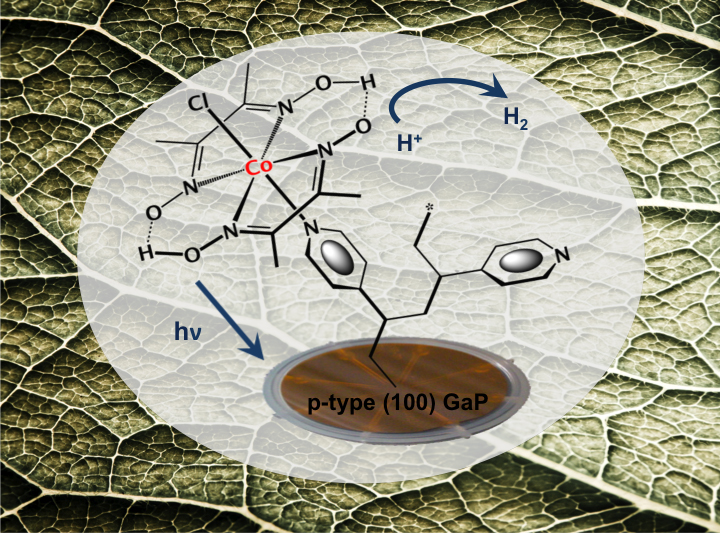
Interfacing the semiconductor gallium phosphide with a cobaloxime catalyst provides an inexpensive photocathode for bionic leaves that produce energy-dense fuels.

There’s promising news from the front on efforts to produce fuels through artificial photosynthesis. A new study by Berkeley Lab researchers at the Joint Center for Artificial Photosynthesis (JCAP) shows that nearly 90-percent of the electrons generated by a hybrid material designed to store solar energy in hydrogen are being stored in the target hydrogen molecules.

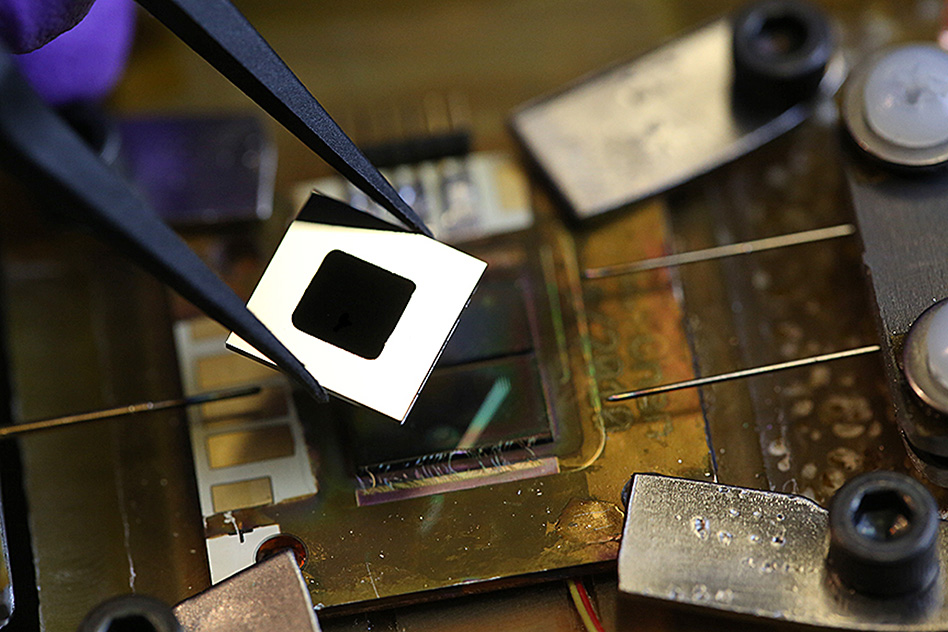
Gary Moore, a chemist and principal investigator with Berkeley Lab’s Physical Biosciences Division, led an efficiency analysis study of a unique photocathode material he and his research group have developed for catalyzing the production of hydrogen fuel from sunlight. This material, a hybrid formed from interfacing the semiconductor gallium phosphide with a molecular hydrogen-producing cobaloxime catalyst, has the potential to address one of the major challenges in the use of artificial photosynthesis to make renewable solar fuels.

Ultimately the renewable energy problem is really a storage problem,” Moore says. “Given the intermittent availability of sunlight, we need a way of using the sun all night long. Storing solar energy in the chemical bonds of a fuel also provides the large power densities that are essential to modern transport systems. We’ve shown that our approach of coupling the absorption of visible light with the production of hydrogen in a single material puts photoexcited electrons where we need them to be, stored in chemical bonds.

Moore is the corresponding author of a paper describing this research in the journal Physical Chemistry Chemical Physics titled “Energetics and efficiency analysis of a cobaloxime-modified semiconductor under simulated air mass 1.5 illumination.” Co-authors are Alexandra Krawicz and Diana Cedeno.

Bionic leaves that produce energy-dense fuels from nothing more than sunlight, water and atmosphere-warming carbon dioxide, with no byproducts other than oxygen, represent an ideal sustainable energy alternative to fossil fuels. However, realizing this artificial photosynthesis ideal will require a number of technological breakthroughs including high performance photocathodes that can catalyze fuel production from sunlight alone.

Last year, Moore and his research group at JCAP took an important step towards the photocathode goal with their gallium phosphide/cobaloxime hybrid. Gallium phosphide is an absorber of visible light, which enables it to produce significantly higher photocurrents than semiconductors that only absorb ultraviolet light. The cobaloxime catalyst is also Earth-abundant, meaning it is a relatively inexpensive replacement for the highly expensive precious metal catalysts, such as platinum, currently used in many solar-fuel generator prototypes.

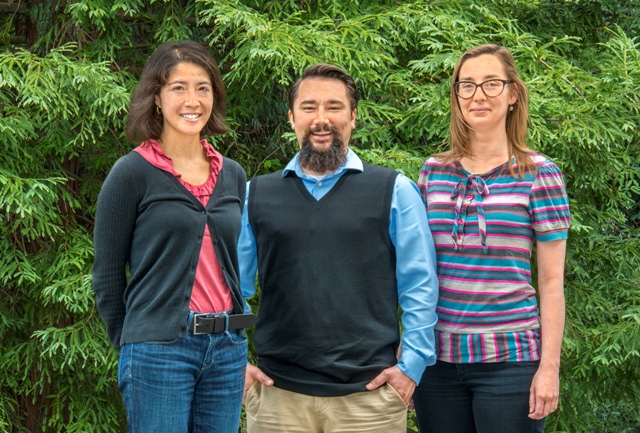
From left, Diana Cedeno, Gary Moore and Alexandra Krawicz of the Joint Center for Artificial Photosynthesis conducted an efficiency analysis study of a unique photocathode material designed to store solar energy in hydrogen molecules. (Photo by Roy Kaltschmidt)

The novelty of our approach is the use of molecular catalytic components interfaced with visible-light absorbing semiconductors,” Moore says. “This creates opportunities to use discrete three-dimensional environments for directly photoactivating the multi-electron and multi-proton chemistry associated with the production of hydrogen and other fuels.

The efficiency analysis performed by Moore and his colleagues also confirmed that the light-absorber component of their photocathode is a major bottleneck to obtaining higher current densities. Their results showed that of the total number of solar photons striking the hybrid-semiconductor surface, measured over the entire wavelength range of the solar spectrum (from 200 to 4,000 nanometers) only 1.5-percent gave rise to a photocurrent.

This tells us that the use of light absorbers with improved spectral coverage of the sun is a good start to achieving further performance gains, but it is likely we will also have to develop faster and more efficient catalysts as well as new attachment chemistries. Our modular assembly method provides a viable strategy to testing promising combinations of new materials,” Moore says.

Efficiency is not the only consideration that should go into evaluating materials for applications in solar-fuel generator technologies. Along with the durability and feasible scalability of components, the selectivity of photoactivating a targeted reaction is also critical. This is where molecular approaches offer significant opportunities, especially in catalyzing complex chemical transformations such as the reduction of carbon dioxide.

JCAP, which has a northern branch in Berkeley and a southern branch on the campus of the California Institute of Technology (Caltech), was established in 2010 by the U.S. Department of Energy (DOE) as an Energy Innovation Hub. Operated as a partnership between Caltech and Berkeley Lab, JCAP is the largest research program in the United States dedicated to developing an artificial solar-fuel technology. It is funded through the DOE Office of Science.


(Video from: The Joint Center for Artificial Photosynthesis (JCAP) is the nation's largest research program dedicated to the development of an artificial solar-fuel generation technology. Established in 2010 as a U.S. Department of Energy (DOE) Energy Innovation Hub, JCAP aims to find a cost-effective method to produce fuels using only sunlight, water, and carbon dioxide as inputs.

JCAP brings together more than 140 top scientists and researchers from the California Institute of Technology and its lead partner, Berkeley Lab, along with collaborators from the SLAC National Accelerator Laboratory, and the University of California campuses at Irvine and San Diego.
http://solarfuelshub.org/index.html )

ORIGINAL:   Lawrence Berkeley Lab
March 07, 2014 Lynn Yarris (510) 486-5375  lcyarris@lbl.gov

sábado, 1 de marzo de 2014

Could Solar-powered Desalination Solve California's Water Supply Problem?


California is suffering through its worst drought in decades, and it has gotten so bad that officials announced that 17 communities across the state are in danger of running out of water within 60 to 120 days. But what if the solution to California’s water crisis is as simple as sunlight – a resource the state has in abundance? That’s exactly what California-based startup WaterFX is proposing with its solar-powered desalination system. Renewable desalination could solve water scarcity issues not just in California but in other drought-stricken and desertified areas across the world.


WaterFX‘s system cleans water with a Concentrated Solar Still (CSS), which collects the sun’s thermal energy and transfers it through pipes filled with heat transfer fluid to a heat pump. The heat is then used for the distillation process, which evaporates freshwater out of the saltwater source. The condensate is then recovered as pure, fresh H2O. A thermal storage system holds excess heat for the times when the sun isn’t shining.


If we roll out the technology … we could produce 8% of all the water used in California, with just the land that was fallowed during the last drought,” WaterFX Founder and Chairman Aaron Mandell recently told Forbes Magazine. “That’s enough water for over 7M acres of irrigated farmland. You would begin to change the economics and change the course of how water is used. The whole idea is to wean the State off of the Central Aqueduct and become water independent. The current system is unsustainable and unreliable.

However solar desalination systems are not without their challenges – it takes a lot of energy to suck up large quantities of ocean water, and the process can capture local marine life as well. There’s also the issue of solar desalination’s byproducta salty sludge that can harm ecosystems if it’s pumped back into the ocean.

Other parts of the world working on renewable desalination include
South Australia, where Sundrop Farms has installed a desalination plant near Port Augusta;
Qatar, where the Sahara Forest Project is experimenting with a pilot system; and
Saudi Arabia, where there are plans to build a solar-powered plant in Al-Khafji. Saudi Arabia currently uses the equivalent of around 300,000 barrels of crude oil a day for its desalination plants, so switching from fossil fuels to renewable energy could have a huge positive impact on climate change and sustainability.

What we are trying to do is to develop a model that can be replicated. The problems in California are identical to those in many parts of the world. China is depending on delicate river systems to provide water for all types of economic growth that will not be sustainable. We could also do this in Saudi Arabia – they use an enormous amount of oil for water consumption, to evaporate or move water around the country,” said Mandell.

Images via WaterFX


ORIGINAL: Inhabitat
by Josh Marks
02/27/14

lunes, 17 de febrero de 2014

This Crazy Brick Structure Is Grown From Mushrooms, And Can Keep Itself Cool All Summer


A new kind of building is set to sprout amid New York City’s garden of glass and steel.

 Using bricks biologically engineered to grow themselves from plant waste and fungal cells, David Benjamin’s Hy-Fi will rise as a giant circular tower.

It will help create a cool micro-climate for pedestrians in searing city heat.

Hy-Fi was selected by MoMA PS1 as the winner of its Young Architects Program for 2014

It could also present a radical alternative to building up our city’s future.

Made from organic material that can be turned into fertilizer, this installation will show off a radical, zero-waste building technology that could help chill down sweltering city streets.

This summer, a new kind of building will sprout amid New York City’s garden of glass and steel. Using bricks biologically engineered to grow themselves from plant waste and fungal cells, David Benjamin’s Hy-Fi will rise as a giant circular tower that creates a cool micro-climate for pedestrians in searing city heat. Bet you’ve never seen a brownstone do that before.

Hy-Fi was selected by the art museum MoMA PS1 as the winner of its Young Architects Program for 2014. The prize: Constructing the building in the museum courtyard, starting this June. But Hy-Fi is more than just an art piece. It could also present a radical alternative to building up our city’s future--one that’s inspired by biology, stretched even further by human technology, and part of a zero-waste, cradle-to-grave cycle.


Mushroom Bricks Photo: Ecovative

Instead of mining sandstone or carting in metal by truck, all of Hy-Fi’s prep work will take place on-site, explains Benjamin, principal architect at The Living and director of Columbia University’s Living Architecture Lab. The bricks, produced by the startup Ecovative, are grown from mycelium, or mushroom cells that grow upwards and outwards like a branch. Combined with agricultural waste like corn stalks, the materials fuse and shape into a solid brick--or into whatever shape the architect wants.

“It’s really inexpensive, almost cheaper than anything,” Benjamin says. “It emits no carbon, it requires almost zero energy, and it doesn’t create any waste--in fact it almost absorbs waste. We think that’s a pretty new and pretty revolutionary way of making building materials.”

If Hy-Fi is the way of the future, it looks very different from many of the stark, Jetsons-like visions we often see. But Benjamin is convinced that biology can teach us how to build structures that are more than just resilient--he believes nature can show us how to make materials that actually perform better under stress. Buildings, he believes, are just as much a part of the larger ecosystem as flora and fauna.

It’s our interest and our belief that a single building, a single piece of architecture, can’t and shouldn’t be considered alone,” Benjamin says. “When that building comes down, those materials need to go somewhere. The building interacts with the forces of wind and water. The building consumes energy. The building interacts with people and culture and society.

But the building’s a hybrid--it’s part-synthetic, too. Hy-Fi will also feature a material designed by 3M, the manufacturer of Post-Its and Scotch Tape, to make some of the bricks at the top of the structure reflective. Some of the brick molds, or plastic trays, will also act like mirrors that grab sunlight from the top of the structure and bounce it down into the low, cool, dark spaces at the bottom.

Hi-Fy also inverts the way typical brick buildings work. Instead of having heavier materials at the bottom, Hi-Fy draws in cool air at the base, which is more porous, then pushes hot air out the top, similar to how a heart muscle pumps blood.

At the end of the installation, the local nonprofit Build It Green will help compost the building and put the materials to use as fertilizer.

To Benjamin, the building represents a fusion of natural systems and human ingenuity, though wherever you draw the line between the two is an ongoing debate. “We’re using some of the most fascinating properties of biological systems, but also extending them, using human technologies to enable new possibilities with them,” Benjamin says. “This is not just a return to nature, but a hyper nature.


ORIGINAL: FastCo Exist

domingo, 2 de febrero de 2014

Leila Madrone: Solar Energy Roboticist

Otherlab’s Leila Madrone is trying to make solar power finally work

 
Photo: Gabriela Hasbun Leila Madrone
IEEE member
Age 37

What she does Investigates ways to produce solar energy cheaply.
For whom Otherlab
Where she does it San Francisco
Fun factors Her office appears in the National Register of Historic Places.

Leila Madrone’s earliest aspiration was to work for the National Aeronautics and Space Administration. “When I was seven, I wore a black NASA jacket every single day,” says Madrone. A quarter century later, after earning two degrees and designing robots of all shapes and sizes at MIT, she attained that goal, landing a job at NASA’s Ames Research Center in Mountain View, Calif.


Her work there—on the GigaPan imaging project, a spin-off of the Mars rover missions—was enjoyable, but deep down she didn’t find it satisfying. Madrone wanted her toils to have greater social impact. So after careful thought, she decided to apply her background in robotics to solving some of the problems of renewable energy. Her new ambition is “to make solar energy actually work.” She’s now pursuing that objective at Otherlab in San Francisco, where she’s doing R&D that could one day make solar energy competitive with coal, even in the developing world.

Madrone didn’t expect to make significant inroads right away. Her first step was identifying a solar company that could use her skills in robotics so that she could learn more about the solar industry. At the time, GreenVolts, then based in Fremont, Calif., seemed to fill the bill. It was developing systems to concentrate sunlight on high-efficiency photovoltaic cells, so it needed equipment capable of tracking the sun precisely.This is great,” Madrone remembers thinking. “This is robots, but with a solar device on the end of it.”

After working at GreenVolts for a couple of years, Madrone began to have misgivings. “I started to realize how expensive it was to have a precision robot, a big metal precision robot, move around something to collect photons,” she says. “I didn’t see this being an energy source that’s going to change the world.

She was discouraged, too, by the economy, which at the time—2009—was taking a beating, causing GreenVolts to lay off most of her engineering colleagues. She decided to leave as well and travel overseas. As she had just gotten married, it would be an extended honeymoon but with a professional component. “I wanted to see how people actually interact with energy in the world,” says Madrone.

Her conclusion about solar energy after five months touring Europe, Asia, the Middle East, and Mexico? “It really had to be cheap,” she says. “It couldn’t just be cheap for someone in San Francisco or the U.S. It had to be cheap for people everywhere.

Returning to California, she wrote in some desperation to Saul Griffith, a friend from her MIT days. Griffith had recently founded Otherlab, which Madrone describes as being “like a cross between a start-up company and an academic lab.” By happy coincidence, he, too, had been toying with various solar-energy ideas, and he invited her to improve on his preliminary work.

Their premise was that equipment to harness the sun’s rays could be made very cheaply. If the manufacturing costs could be kept low, they reasoned, the price would be proportional to the mass and cost per kilogram of the constituent materials. So the key would be to use, as much as possible, stuff that is both lightweight and inexpensive. What stuff? The answer struck them as obvious. Solar energy’s future, to borrow a line from The Graduate, could be summed up in one word: plastics.

Madrone and Griffith eventually got funding from the Advanced Research Projects Agency–Energy (ARPA-E) to work on better ways to steer the mirrors of a solar-thermal-energy plant. These mirrors focus sunlight throughout the day on towers containing steam-driven generators. Mechanisms that accomplish that task—called heliostats—have been around for decades, but they are not cheap.

Madrone and Griffith realized that they could cut down on the heft required of the heliostats by using a huge number of small mirrors to replace what would normally be a smaller number of big ones. Small mirrors hug the ground and thus carry smaller wind loads. And small, light-duty heliostats could be built from plastic, following an approach that’s similar to the way certain flowering plants track the sun’s daily movements. “Originally, we were origami inspired, and now we’re bio inspired,” says Madrone.

Her latest prototype aims a mirror by varying the pressures within pneumatically inflated plastic chambers, which can be mass-produced with the same tooling used to make plastic bottles. “If we keep using heliostats that have been around for half a century, there’s no way the price is going to go down,” says Madrone. “If we don’t start taking advantage of new technologies, we’re just going to lose the solar game.

A typical workday for Madrone as she tries to win that game might entail consulting with outside experts, modeling electronics in SPICE (Simulation Program with Integrated Circuit Emphasis), writing reports for ARPA-E, laying out a printed-circuit board, preparing a patent application, or any combination of such tasks. And she gets to do those things in historic surroundings: a building in San Francisco’s Mission District that once housed a pipe-organ factory. With antique organ pipes adorning the walls and aging hardwood everywhere, the building retains a turn-of-the-20th-century air. Other projects being pursued there include inflatable robots, form-fitting fuel tanks for natural-gas cars, and an electric cargo tricycle that lets the rider lean into turns.

The engineers at Otherlab have tried to preserve their building’s Arts and Crafts aesthetic, foregoing steel desks for oak ones and using old library card catalogs in place of the usual plastic parts bins. Casual visitors could easily imagine they’ve wandered into the mad inventor’s lair from a steampunk novel.

Even more pleasant than the ambiance, Madrone explains, is the nature of the people she’s laboring alongside. “There’s this cultural bias that if you want a hard-core engineering company, everyone’s got to be intense and aggressive and arrogant and all of that,” she says. “Here people are confident but not arrogant, and thoughtful instead of aggressive.

Best of all for her, though, is knowing that her designs could have a real impact. “I think a dream job is getting to work on something that is really relevant that you’re passionate about every day,” she says. “For me, that is what the dream is.

This article originally appeared in print as “Solar-Energy Innovator.”


Dream Jobs 2014


ORIGINAL: IEEE Spectrum
By David Schneider
28 Jan 2014

martes, 28 de enero de 2014

How to Tap the Sun’s Energy Through Heat as Well as Light

New approach developed at MIT could generate power from sunlight efficiently and on demand.

A new approach to harvesting solar energy, developed by MIT researchers, could improve efficiency by using sunlight to heat a high-temperature material whose infrared radiation would then be collected by a conventional photovoltaic cell. This technique could also make it easier to store the energy for later use, the researchers say.
Photo courtesy John Freidah. A nanophotonic solar thermophotovoltaic device composed of
  • an array of multi‑walled carbon nanotubes as the absorber
  • a one‑dimensional silicon/silicon dioxide photonic crystal as the emitter, and 
  • a 0.55 eV photovoltaic cell
In this case, adding the extra step improves performance, because it makes it possible to take advantage of wavelengths of light that ordinarily go to waste. The process is described in a paper published this week in the journal Nature Nanotechnology, written by graduate student Andrej Lenert, associate professor of mechanical engineering Evelyn Wang, physics professor Marin Soljačić, principal research scientist Ivan Celanović, and three others.

A conventional silicon-based solar cell “doesn’t take advantage of all the photons,” Wang explains. That’s because converting the energy of a photon into electricity requires that the photon’s energy level match that of a characteristic of the photovoltaic (PV) material called a bandgap. Silicon’s bandgap responds to many wavelengths of light, but misses many others.

To address that limitation, the team inserted a two-layer absorber-emitter device — made of novel materials including carbon nanotubes and photonic crystals — between the sunlight and the PV cell. This intermediate material collects energy from a broad spectrum of sunlight, heating up in the process. When it heats up, as with a piece of iron that glows red hot, it emits light of a particular wavelength, which in this case is tuned to match the bandgap of the PV cell mounted nearby.


This basic concept has been explored for several years, since in theory such solar thermophotovoltaic (STPV) systems could provide a way to circumvent a theoretical limit on the energy-conversion efficiency of semiconductor-based photovoltaic devices. That limit, called the Shockley-Queisser limit, imposes a cap of 33.7 percent on such efficiency, but Wang says that with TPV systems, “the efficiency would be significantly higher — it could ideally be over 80 percent.

There have been many practical obstacles to realizing that potential; previous experiments have been unable to produce a STPV device with efficiency of greater than 1 percent. But Lenert, Wang, and their team have already produced an initial test device with a measured efficiency of 3.2 percent, and they say with further work they expect to be able to reach 20 percent efficiencyenough, they say, for a commercially viable product.

The design of the two-layer absorber-emitter material is key to this improvement. Its outer layer, facing the sunlight, is an array of multiwalled carbon nanotubes, which very efficiently absorbs the light’s energy and turns it to heat. This layer is bonded tightly to a layer of a photonic crystal, which is precisely engineered so that when it is heated by the attached layer of nanotubes, it “glows” with light whose peak intensity is mostly above the bandgap of the adjacent PV, ensuring that most of the energy collected by the absorber is then turned into electricity.

In their experiments, the researchers used simulated sunlight, and found that its peak efficiency came when its intensity was equivalent to a focusing system that concentrates sunlight by a factor of 750. This light heated the absorber-emitter to a temperature of 962 degrees Celsius.

This level of concentration is already much lower than in previous attempts at STPV systems, which concentrated sunlight by a factor of several thousand. But the MIT researchers say that after further optimization, it should be possible to get the same kind of enhancement at even lower sunlight concentrations, making the systems easier to operate.

Such a system, the team says, combines the advantages of solar photovoltaic systems, which turn sunlight directly into electricity, and solar thermal systems, which can have an advantage for delayed use because heat can be more easily stored than electricity. The new solar thermophotovoltaic systems, they say, could provide

  • efficiency because of their broadband absorption of sunlight
  • scalability and compactness, because they are based on existing chip-manufacturing technology; and 
  • ease of energy storage, because of their reliance on heat.
Some of the ways to further improve the system are quite straightforward. Since the intermediate stage of the system, the absorber-emitter, relies on high temperatures, its size is crucial: The larger an object, the less surface area it has in relation to its volume, so heat losses decline rapidly with increasing size. The initial tests were done on a 1-centimeter chip, but follow-up tests will be done with a 10-centimeter chip, they say.

Zhuomin Zhang, a professor of mechanical engineering at the Georgia Institute of Technology who was not involved in this research, says, “This work is a breakthrough in solar thermophotovoltaics, which in principle may achieve higher efficiency than conventional solar cells because STPV can take advantage of the whole solar spectrum. … This achievement paves the way for rapidly boosting the STPV efficiency.

The research team also included MIT graduate students David Bierman and Walker Chan, former postdoc Youngsuk Nam, and research scientist Ivan Celanović. The work was funded by the U.S. Department of Energy through MIT’s Solid-State Solar Thermal Energy Conversion (S3TEC) Center, as well as the Martin Family Society, the MIT Energy Initiative, and the National Science Foundation.


ORIGINAL: Tech Review
By David L. Chandler
January 23, 2014

martes, 21 de enero de 2014

ESA’s ‘sleeping beauty’ wakes up from deep space hibernation

Rosetta Wake-up signal

It was a fairy-tale ending to a tense chapter in the story of the Rosetta space mission this evening as ESA heard from its distant spacecraft for the first time in 31 months.

 
"Rosetta wakes up from deep space hibernation". Video from ESA

Video from ITN on Rosetta Mission

Rosetta is chasing down Comet 67P/Churyumov-Gerasimenko, where it will become the first space mission to rendezvous with a comet, the first to attempt a landing on a comet’s surface, and the first to follow a comet as it swings around the Sun.

Since its launch in 2004, Rosetta has made three flybys of Earth and one of Mars to help it on course to its rendezvous with 67P/Churyumov-Gerasimenko, encountering asteroids Steins and Lutetia along the way.

Operating on solar energy alone, Rosetta was placed into a deep space slumber in June 2011 as it cruised out to a distance of nearly 800 million km from the warmth of the Sun, beyond the orbit of Jupiter.

Now, as Rosetta’s orbit has brought it back to within ‘only’ 673 million km from the Sun, there is enough solar energy to power the spacecraft fully again.


Rosetta calls home

Thus today, still about 9 million km from the comet, Rosetta’s pre-programmed internal ‘alarm clock’ woke up the spacecraft. After warming up its key navigation instruments, coming out of a stabilising spin, and aiming its main radio antenna at Earth, Rosetta sent a signal to let mission operators know it had survived the most distant part of its journey.

The signal was received by both NASA’s Goldstone and Canberra ground stations at 18:18 GMT/ 19:18 CET, during the first window of opportunity the spacecraft had to communicate with Earth. It was immediately confirmed in ESA’s space operations centre in Darmstadt and the successful wake-up announced via the @ESA_Rosetta twitter account, which tweeted: “Hello, World!

We have our comet-chaser back,” says Alvaro Giménez, ESA’s Director of Science and Robotic Exploration. “With Rosetta, we will take comet exploration to a new level. This incredible mission continues our history of ‘firsts’ at comets, building on the technological and scientific achievements of our first deep space mission Giotto, which returned the first close-up images of a comet nucleus as it flew past Halley in 1986.

How Rosetta wakes up from deep space hibernation
Access the video

This was one alarm clock not to hit snooze on, and after a tense day we are absolutely delighted to have our spacecraft awake and back online,” adds Fred Jansen, ESA’s Rosetta mission manager.

Comets are considered the primitive building blocks of the Solar System and likely helped to ‘seed’ Earth with water, perhaps even the ingredients for life. But many fundamental questions about these enigmatic objects remain, and through its comprehensive, in situ study of Comet 67P/Churyumov-Gerasimenko, Rosetta aims to unlock the secrets contained within.

All other comet missions have been flybys, capturing fleeting moments in the life of these icy treasure chests,” says Matt Taylor, ESA’s Rosetta project scientist. “With Rosetta, we will track the evolution of a comet on a daily basis and for over a year, giving us a unique insight into a comet’s behaviour and ultimately helping us to decipher their role in the formation of the Solar System.

But first, essential health checks on the spacecraft must be completed. Then the eleven instruments on the orbiter and ten on the lander will be turned on and prepared for studying Comet 67P/Churyumov-Gerasimenko.

We have a busy few months ahead preparing the spacecraft and its instruments for the operational challenges demanded by a lengthy, close-up study of a comet that, until we get there, we know very little about,” says Andrea Accomazzo, ESA’s Rosetta operations manager.


Rosetta and Philae at comet

Rosetta’s first images of 67P/Churyumov-Gerasimenko are expected in May, when the spacecraft is still 2 million km from its target. Towards the end of May, the spacecraft will execute a major manoeuvre to line up for its critical rendezvous with the comet in August.

After rendezvous, Rosetta will start with two months of extensive mapping of the comet’s surface, and will also make important measurements of the comet’s gravity, mass and shape, and assess its gaseous, dust-laden atmosphere, or coma. The orbiter will also probe the plasma environment and analyse how it interacts with the Sun’s outer atmosphere, the solar wind.

Using these data, scientists will choose a landing site for the mission’s 100 kg Philae probe. The landing is currently scheduled for 11 November and will be the first time that a landing on a comet has ever been attempted.

In fact, given the almost negligible gravity of the comet’s 4 km-wide nucleus, Philae will have to use ice screws and harpoons to stop it from rebounding back into space after touchdown.

Among its wide range of scientific measurements, Philae will send back a panorama of its surroundings, as well as very high-resolution pictures of the surface. It will also perform an on-the-spot analysis of the composition of the ices and organic material, including drilling down to 23 cm below the surface and feeding samples to Philae’s on-board laboratory for analysis.

The focus of the mission will then move to the ‘escort’ phase, during which Rosetta will stay alongside the comet as it moves closer to the Sun, monitoring the ever-changing conditions on the surface as the comet warms up and its ices sublimate.

The comet will reach its closest distance to the Sun on 13 August 2015 at about 185 million km, roughly between the orbits of Earth and Mars. Rosetta will follow the comet throughout the remainder of 2015, as it heads away from the Sun and activity begins to subside.

We will face many challenges this year as we explore the unknown territory of comet 67P/Churyumov-Gerasimenko and I’m sure there will be plenty of surprises, but today we are just extremely happy to be back on speaking terms with our spacecraft,” adds Matt Taylor.

ORIGINAL: ESA
20 January 2014