Mostrando entradas con la etiqueta Science. Mostrar todas las entradas

jueves, 19 de septiembre de 2019

I have a dream that the powerful take the climate crisis seriously. The time for their fairytales is over

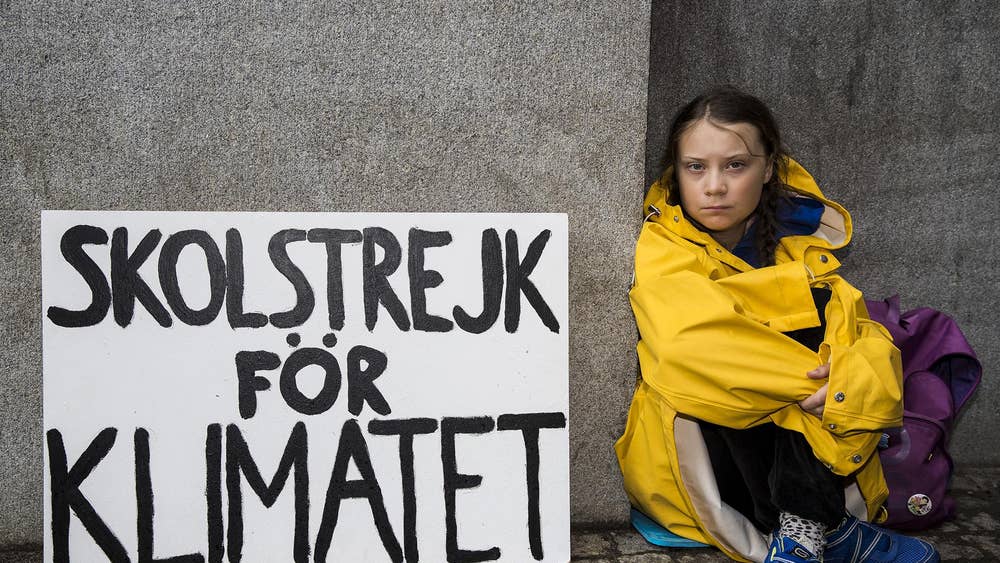
IN A HIGHLY ANTICIPATED SPEECH IN CONGRESS AFTER TRAVELLING HALF THE WAY ACROSS THE ATLANTIC BY BOAT, GRETA THUNBERG URGES US SENATORS TO LEARN FROM THE SACRIFICES OF MARTIN LUTHER KING AND OTHER CIVIL RIGHTS ACTIVISTS IN THE FIGHT AGAINST CLIMATE CHANGE. HERE IS THE TRANSCRIPT



My name is Greta Thunberg, I am 16 years old and I’m from Sweden. I am grateful for being with you here in the USA. A nation that, to many people, is the country of dreams.

I also have a dream: that governments, political parties, and corporations grasp the urgency of the climate and ecological crisis and come together despite their differences - as you would in an emergency - and take the measures required to safeguard the conditions for a dignified life for everybody on earth.

Because then - we millions of school striking youth - could go back to school.

I have a dream that the people in power, as well as the media, start treating this crisis like the existential emergency it is. So that I could go home to my sister and my dogs. Because I miss them.

In fact, I have many dreams. But this is the year 2019. This is not the time and place for dreams. This is the time to wake up. This is the moment in history when we need to be wide awake.

And yes, we need dreams, we can not live without dreams. But there’s a time and place for everything. And dreams can not stand in the way of telling it like it is.

Greta Thunberg inspires climate activists everywhere: in pictures

And yet, wherever I go I seem to be surrounded by fairytales. Business leaders, elected officials all across the political spectrum spending their time making up and telling bedtime stories that soothe us, that make us go back to sleep.

These are “feel-good” stories about how we are going to fix everything. How wonderful everything is going to be when we have “solved” everything. But the problem we are facing is not that we lack the ability to dream or to imagine a better world. The problem now is that we need to wake up. It’s time to face the reality, the facts, the science.

And the science doesn’t mainly speak of “great opportunities to create the society we always wanted”. It tells of unspoken human sufferings, which will get worse and worse the longer we delay action - unless we start to act now. And yes, of course, a sustainable transformed world will include lots of new benefits. But you have to understand. This is not primarily an opportunity to create new green jobs, new businesses or green economic growth. This is above all an emergency, and not just any emergency. This is the biggest crisis humanity has ever faced.

And we need to treat it accordingly so that people can understand and grasp the urgency. Because you can not solve a crisis without treating it as one. Stop telling people that everything will be fine when in fact, as it looks now, it won’t be very fine. This is not something you can package and sell or ”like” on social media.

Stop pretending that you, your business idea, your political party or plan will solve everything. We must realize that we don’t have all the solutions yet. Far from it. Unless those solutions mean that we simply stop doing certain things.

Changing one disastrous energy source for a slightly less disastrous one is not progress. Exporting our emissions overseas is not reducing our emission. Creative accounting will not help us. In fact, it’s the very heart of the problem.

Some of you may have heard that we have 12 years from 1 January 2018 to cut our emissions of carbon dioxide in half. But I guess that hardly any of you have heard that there is a 50 percent chance of staying below a 1.5 degree Celsius of global temperature rise above pre-industrial levels. Fifty percent chance.

And these current, best available scientific calculations do not include nonlinear tipping points as well as most unforeseen feedback loops like the extremely powerful methane gas escaping from rapidly thawing arctic permafrost. Or already locked in warming hidden by toxic air pollution. Or the aspect of equity; climate justice.

So a 50 percent chance - a statistical flip of a coin - will most definitely not be enough. That would be impossible to morally defend. Would anyone of you step onto a plane if you knew it had more than a 50 percent chance of crashing? More to the point: would you put your children on that flight?


And why is it so important to stay below the 1.5 degree limit? Because that is what the united science calls for, to avoid destabilizing the climate so that we stay clear of setting off an irreversible chain reaction beyond human control. Even at 1 degree of warming, we are seeing an unacceptable loss of life and livelihoods.

So where do we begin? Well, I would suggest that we start looking at chapter 2, on page 108 in the IPCC report that came out last year. Right there it says that if we are to have a 67 per cent chance of limiting the global temperature rise to below 1.5 degrees Celsius, we had, on 1 January 2018, about 420 Gtonnes of CO2 left to emit in that carbon dioxide budget. And of course, that number is much lower today. As we emit about 42 Gtonnes of CO2 every year if you include land use.

With today’s emissions levels, that remaining budget is gone within less than 8 and a half years. These numbers are not my opinions. They aren’t anyone’s opinions or political views. This is the current best available science. Though a great number of scientists suggest even these figures are too moderate, these are the ones that have been accepted by all nations through the IPCC.

And please note that these figures are global and therefore do not say anything about the aspect of equity, clearly stated throughout the Paris Agreement, which is absolutely necessary to make it work on a global scale. That means that richer countries need to do their fair share and get down to zero emissions much faster, so that people in poorer countries can heighten their standard of living, by building some of the infrastructures that we have already built. Such as roads, hospitals, schools, clean drinking water, and electricity.

The USA is the biggest carbon polluter in history. It is also the world’s number one producer of oil. And yet, you are also the only nation in the world that has signaled your strong intention to leave the Paris Agreement. Because quote ”it was a bad deal for the USA”.

Four-hundred and twenty GTons of CO2 left to emit on 1 January 2018 to have a 67 percent chance of staying below 1.5 degrees of global temperature rise. Now that figure is already down to less than 360 GTons.

These numbers are very uncomfortable. But people have the right to know. And the vast majority of us have no idea these numbers even exist. In fact, not even the journalists that I meet seem to know that they even exist. Not to mention the politicians. And yet they all seem so certain that their political plan will solve the entire crisis.

But how can we solve a problem that we don’t even fully understand? How can we leave out the full picture and the current best available science?

I believe there is a huge danger in doing so. And no matter how political the background to this crisis may be, we must not allow this to continue to be a partisan political question. The climate and ecological crisis are beyond party politics. And our main enemy right now is not our political opponents. Our main enemy now is physics. And we can not make “deals” with physics.

Everybody says that making sacrifices for the survival of the biosphere - and to secure the living conditions for future and present generations - is an impossible thing to do.

Americans have indeed made great sacrifices to overcome terrible odds before.

Think of the brave soldiers that rushed ashore in that first wave on Omaha Beach on D Day. Think of Martin Luther King and the 600 other civil rights leaders who risked everything to march from Selma to Montgomery. Think of President John F. Kennedy announcing in 1962 that America would “choose to go to the moon in this decade and do the other things, not because they are easy, but because they are hard…

Perhaps it is impossible. But looking at those numbers - looking at the current best available science signed by every nation - then I think that is precisely what we are up against.

But you must not spend all of your time dreaming or see this as some political fight to win.

And you must not gamble your children’s future on the flip of a coin.

Instead, you must unite behind the science.

You must take action.

You must do the impossible.

Because giving up can never ever be an option.

ORIGINAL: The Independent
by Greta Thumberg
2019/09/19

domingo, 15 de septiembre de 2019

Greta Thunberg speech at the National Assembly in Paris 2019-07-23


Transcript:
"I have some good news and some bad news regarding the climate emergency. I will start with the good news.

The world, as a small number of people have been saying lately, will not end in 11 years.

The bad news, however, is that around the year 2030, if we continue with business as usual, we will likely be in a position where we may pass a number of tipping points. And then we might no longer be able to undo the irreversible climate breakdown.

A lot of people, a lot of politicians, business leaders, journalists say they don't agree with what we are saying. They say we children are exaggerating, that we are alarmists. To answer this I would like to refer to page 108, chapter 2 in the latest IPCC report. There you will find all our "opinions" summarized because there you find a remaining carbon dioxide budget. Right there it says that: if we are to have a 67% chance of limiting the global temperature rise to below 1.5 degrees, we had on January 1st, 2018, 420 gigatons of carbon dioxide left in our CO2 budget. And of course, that number is much lower today. We emit about 42 gigatons of CO2 every year.

At current emissions levels, that remaining budget is gone within roughly eight and a half years. These numbers are as real as it gets, though a great number of scientists suggests that they are too generous, these are the ones that have been accepted by all nations through the IPCC.

And not once, not one single time have I heard any politician, journalists or business leader even mention these numbers. It is almost like you don't even know they exist, as if you haven't even read the latest IPCC reports on which the future of our civilization is depending.

Or maybe you are simply not mature enough to tell it like it is. Because even that burden you leave to us children. We become the bad guys who have to tell people these uncomfortable things because no one else wants to or dares to. And just for quoting and acting on these numbers, these scientific facts, we receive unimaginable amounts of hate and threats. We are being mocked and lied about by elected officials, members of Parliament's, business leaders, journalists. What I really would like to ask all of those who question our so-called "opinions" or think that we are extreme: - Do you have a different budget for at least a reasonable chance of staying below the 1.5 degrees of warming limit? Is there another intergovernmental panel on climate change? Is there a secret Paris agreement that we don't know about? One that not includes the aspect of equity? Because these are the numbers that count, this is the current best available science. You can't simply make up your own facts just because you don't like what you hear.

There is no middle ground when it comes to the climate and ecological emergency. Of course, you could argue that we should go for a more risky pathway, such as the alternative of 580 gigatons of CO2 from January 1st, 2018, which gives us a 50/50 percent chance of limiting the global temperature rise to below 1.5 degrees. That amount of carbon dioxide will run out in about 12 years of current business as usual. But why should we do that, why should we accept taking that risk, leaving the future living conditions for humankind to a 50/50 flip of a coin. 420 gigatons left of CO2 to emit. And now that number is down to less than 360 gigatons. And please note that these figures are global and therefore do not say anything about the aspect of equity, clearly stated throughout the Paris agreement, which is absolutely necessary to make it work on a global scale. That means that richer countries need to get down to zero emissions faster, so the people in poorer parts of the world can heighten their standard of living by building some of the infrastructures that we have already built, such as roads, hospitals, electricity, schools and providing clean drinking water.

And because you have ignored these facts, because you and pretty much all of the media to this very minute, keep ignoring them, people do not know what is going on. If you respect science, if you understand science, then this is it. 420 gigatons of CO2 left to emit on January 1st to have a 67% chance of staying below 1.5 degrees of global temperature rise, according to the IPCC.

In the Paris agreement, we have only signed up for staying below 1.5 to 2 degrees of temperature rise. And that, of course, gives us a bigger remaining carbon dioxide budget. But the latest IPCC report shows that aiming instead for below 1.5 degrees would significantly reduce the climate impacts, and that would most certainly save countless human lives.

This is what it's all about, this is all that we are saying. But I will also tell you this: -You cannot solve the crisis without treating it as a crisis, without seeing the full picture. You cannot leave the responsibility to individuals, politicians, the market or other parts of the world to take. This has to include everything and everyone.

Once you realize how painfully small the size of our remaining carbon dioxide budget is, once you realize how fast it is disappearing, once you realize that basically nothing is being done about it and once you realize that almost no one is even aware of the fact that carbon dioxide budgets even exists, then tell me what exactly do you do? And how do we do it without sounding alarmist? That is the question we must ask ourselves, and the people in power.

The science is clear and all we children are doing is communicating and acting on that united science. Now political leaders in some countries are starting to talk. They are starting to declare climate emergencies and announcing dates for so-called climate neutrality. And declaring a climate emergency is good. But only setting up these vague, distant dates and saying things which give the impression of that things are being done and that action is on the way, will most likely do more harm than good. Because of the changes required are still nowhere in sight. Not in France, not in the EU, nowhere. And I believe that the biggest danger is not our inaction. The real danger is when companies and politicians are making it look like real action is happening, when in fact almost nothing is being done, apart from clever accounting and creative PR.

The climate and ecological emergency is right here, right now. But it has only just begun, it will get worse. 420 gigatons of CO2 left to emit on January 1st 2018 to have a 67 percent chance of staying below a 1.5 degrees of global temperature rise. And now that figure is already down to less than 360 gigatons.

At current emissions levels that remaining budgets is gone within roughly eight and a half years. In fact, since I started this speech the world has emitted about 800,000 tons of carbon dioxide. And if anyone still has excuses not to listen, not to act, not to care, I ask you once again: -Is there another Intergovernmental Panel on Climate Change? Is there a secret Paris agreement that we don't know about? One that does not include the aspect of equity? Do you have a different budget for at least a reasonable chance of staying below 1.5 degrees of global temperature rise? Some people have chosen not to come here today, some people have chosen not to listen to us, and that is fine, we are after all just children. You don't have to listen to us, but you do have to listen to the United science, the scientists. And that is all we ask, just unite behind the science!"


domingo, 16 de abril de 2017

With this new system, scientists never have to write a grant application again

Johan Bollen (left) and Marten Scheffer (right) say scientists should give each other money instead of writing and reviewing grants. Ingrid van de Leemput
AMSTERDAM—Almost every scientist agrees: Applying for research funding is a drag. Writing a good proposal can take months, and the chances of getting funded are often slim. Funding agencies, meanwhile, spend more and more time and money reviewing growing stacks of applications.

That’s why two researchers are proposing a radically different system that would do away with applications and reviews; instead scientists would just give each other money. “Self-organized fund allocation(SOFA), as it’s called, was developed by computer scientist Johan Bollen at Indiana University in Bloomington. When he first published about the idea in 2014, many people were skeptical. But interest appears to be growing, and thanks to the work of an enthusiastic advocate, ecologist Marten Scheffer of Wageningen University in the Netherlands, the Dutch parliament adopted a motion last year asking the country’s main funding agency, the Netherlands Organization for Scientific Research (NWO), to set up a SOFA pilot project.

Competition for funding has become too intense, especially for young scientists, Scheffer and Bollen say, and the current peer-review system is inefficient. It’s also unfair, they argue, because a few scientists get lots of grants—Scheffer is one of them—whereas many others get few or nothing. But when Scheffer explained his idea at an NWO workshop about “application pressure” here last week, the agency didn’t appear sold yet.

The duo says the numbers speak for themselves. At the U.S. National Institutes of Health, the overall success rate for grants applications has dropped from 30% in 2003 to 19.1% in 2016. In the latest round of European Research Council Starting Grants, the rate was a paltry 11.3%. At NWO, the success rate for grants for young scientists has dropped to 14%. A 2013 study estimated that writing and reviewing applications for €40 million worth of these grants costs €9.5 million annually.

In Bollen’s system, scientists no longer have to apply; instead, they all receive an equal share of the funding budget annually—some €30,000 in the Netherlands, and $100,000 in the United States—but they have to donate a fixed percentage to other scientists whose work they respect and find important. “Our system is not based on committees’ judgments, but on the wisdom of the crowd,” Scheffer told the meeting.

Bollen and his colleagues have tested their idea in computer simulations. If scientists allocated 50% of their money to colleagues they cite in their papers, research funds would roughly be distributed the way funding agencies currently do, they showed in a paper last year—but at much lower overhead costs.

Not everybody is convinced. At the meeting, some worried that scientists might give money mostly to their friends. Scheffer said an algorithm would prevent that, for instance by banning donations to people you have published with, but he acknowledged it would be a challenge in small research communities. SOFA might also result in a mismatch between what scientists need and what their colleagues donate, and a competition for donations could lead to a time-consuming and costly circus, comparable to an election campaign.

The way to find out, Scheffer and Bollen say, is a real-world test, and they say the Netherlands, a small country with short lines of communication between scientists, politicians, and funding agencies, is a good place for one. Last year, Scheffer convinced Eppo Bruins, a member of the Dutch House of Representatives, to submit a motion calling for a pilot program at NWO, which the parliament approved in June 2016. The money could be taken from a €150 million NWO pot currently distributed among consortia of innovative Dutch scientists, Bruins suggested.

But NWO is not obliged to carry out the proposal, and so far has shown little enthusiasm. “NWO is willing to explore together with scientists and other stakeholders how to improve allocation rates, but is still considering practicality and support” for SOFA, a spokesperson tells ScienceInsider. At last week’s meeting, NWO President Stan Gielen said the funds Bruins has in mind are distributed by NWO but are earmarked by the Ministry of Education, Culture and Science, which would have to give permission. Gielen added that any experiment should not come at the expense of existing funding.

Scheffer says he’s not giving up. It’s not a risky experiment, he says: “The money would not be wasted, after all, but just be given to other scientists.But he says he understands why NWO is not thrilled: If applied universally, the novel system would make the agency redundant. Perhaps it’s telling, Scheffer says, that he has not been invited to an international conference on applications and peer review that NWO is organizing in June.
DOI: 10.1126/science.aal1055

ORIGINAL: Science Magazine
Apr. 13, 2017 , 3:00 PM

jueves, 30 de junio de 2016

More than 100 Nobel laureates are calling on Greenpeace to end its anti-GMO campaign

Rice field in the Philippines. No Golden Rice here (yet).(Shutterstock)
This week, 109 Nobel laureates signed onto a sharply worded letter to Greenpeace urging the environmental group to rethink its longstanding opposition to genetically modified organisms (GMOs). The writers argue that the anti-GMO campaign is scientifically baseless and potentially harmful to poor people in the developing world.

Joel Achenbach broke the news in the Washington Post, and you can read the full letter here. The signatories include past winners of the Nobel Prize in medicine, chemistry, physics, and economics.

Nobel laureates to Greenpeace: Your anti-GMO campaign has to end
The letter notes that scientific assessments have repeatedly found GM foods are just as safe to eat as conventional foods and don’t pose an inherent risk to the environment (though, like any technology, they can be misused). Greenpeace, it argues, is on the wrong side here:
We urge Greenpeace and its supporters to re-examine the experience of farmers and consumers worldwide with crops and foods improved through biotechnology, recognize the findings of authoritative scientific bodies and regulatory agencies, and abandon their campaign against "GMOs" in general and Golden Rice in particular.

Scientific and regulatory agencies around the world have repeatedly and consistently found crops and foods improved through biotechnology to be as safe as, if not safer than those derived from any other method of production. There has never been a single confirmed case of a negative health outcome for humans or animals from their consumption. Their environmental impacts have been shown repeatedly to be less damaging to the environment, and a boon to global biodiversity.
The laureates also take Greenpeace to task for seeking to block Golden Rice, a strain of not-yet-approved rice that has been genetically enhanced to produce beta carotene — which, its creators hope, might one day alleviate the Vitamin A deficiency that’s causing widespread death and blindness in the developing world:
Greenpeace has spearheaded opposition to Golden Rice, which has the potential to reduce or eliminate much of the death and disease caused by a vitamin A deficiency (VAD), which has the greatest impact on the poorest people in Africa and Southeast Asia. ...

WE CALL UPON GREENPEACE to cease and desist in its campaign against Golden Rice specifically, and crops and foods improved through biotechnology in general;

Now, Greenpeace is far from the only reason Golden Rice has struggled to get regulatory approval — the crop also faces very serious technical challenges. Greenpeace isn’t even the only group seeking to block it. But they’re certainly a high-profile face of GMO opposition, so the laureates are focusing on them.

In a posted response, Greenpeace denied that they were the main reason Golden Rice has failed to come to market, but still showed no sign of ending their broader anti-GMO campaign. We'll get to that, but I do want to elaborate on a few issues the letter raises.

Greenpeace accepts climate science. So why do they dismiss GMO science?
(MICHAEL KAPPELER/AFP/Getty Images)A picture taken on May 3, 2005, shows Greenpeace activists flying a kite displaying a giant corn cob on a field in Seelow, Eastern Germany, to protest against the cultivation of genetically modified maize.

Let’s start off by noting that GMOs will never be a purely scientific issue. Like every policy matter on the planet, the question of how best to incorporate biotechnology into agriculture involves value judgments about what an ideal food system might look like, how to weigh the risks against the benefits, and so on.

But those positions can at least be informed by scientific understanding. To take a different example, on climate change, Greenpeace tends to take very seriously what scientists are telling them. Their website refers frequently to the scientific consensus that the world is getting warmer and humans are the cause.

By contrast, Greenpeace’s public statements on GMOs tend to be startlingly unscientific. On their website, they refer to transgenic crops as "genetic pollution." This is absurd. When scientists create transgenic crops, they frequently use Agrobacterium to transfer genes from one plant or organism to another. But nature does this too: Scientists recently discovered that on two separate occasions in history, Agrobacterium transferred bacterial DNA into the sweet potatoes we now eat. Are sweet potatoes also "polluted"? Because it's the same thing.

In fact, many crop scientists tend to see GMOs as sitting along a continuumHumans have long used all sorts of tools to alter plant DNA and get crops with the traits we desire — this is a big reason farms can feed 7 billion people every year. For thousands of years, farmers interbred crops to alter their genes. Like so:
(James Kennedy)

In the 20th century, plant breeders began exposing crops to radiation or mutagenic chemicals to scramble their DNA and get new traits. Today, scientists use advanced techniques (like transferring genes or CRISPR) that allow even more precision. But it’s the same basic idea. Under the circumstances, it’s no surprise that GMOs don't appear to pose a special health risk. They’re just not fundamentally different.

Now, the vast majority of the public is unaware of this fact. Most people don’t spend much time thinking about how our food is created. (One of the lovely things about the modern age is that we don’t have to.) So, in the abstract, people tend to fall back on their intuitions: Tampering with the DNA of food seems inherently unnatural. Anything "unnatural" triggers disgust. Therefore, GMOs are bad.

Those intuitions are understandable. But they're unsupported by scientific evidence. And rather than seeking to correct those misapprehensions, as they do on climate change, Greenpeace has long sought to inflame those fears. Take this line from their website: "When we force life forms and our world's food supply to conform to human economic models rather than their natural ones, we do so at our own peril." (Never mind that we’ve been doing this since the dawn of civilization.)

The Nobel laureates are, in essence, telling them to knock it off.

Ultimately, the world will face staggering challenges around food and agriculture in the 21st century. The global population is expected to soar past 9 billion, and we’ll need to figure out how to feed everyone without razing too many forests for farmland. Farmers will have to handle the droughts and heat waves that will come with global warming. There are tricky issues around antibiotic overuse, nitrogen pollution, food distribution, and much more.

Genetic engineering certainly won’t solve all those problems. (It might not even solve most of them.) But it ispotentially a valuable tool for, say, breeding plants with higher drought tolerance or engineering foods that are more nutritious. See, for example, this important work on vitamin-fortified bananas in Africa. We should be thinking seriously about how to use these tools as a larger strategy for improving our food system — not sowing fears about "genetic pollution."

Greenpeace’s campaign against Golden Rice is incoherent — though the crop faces other serious challenges

(David Greedy/Getty Images)Plant Biotechnologist Dr. Swapan Datta inspects a genetically modified "Golden Rice" plant at the International Rice Research Institute (IRRI), November 27, 2003.
The Nobel laureate letter particularly criticizes Greenpeace’s opposition to Golden Rice — rice that’s being modified in an attempt to alleviate Vitamin A deficiency — and here it’s worth expanding a bit.

Last year in Slate, Will Saletan wrote a damning piece on how incoherent Greenpeace’s campaign against Golden Rice was. As research advanced, the group kept shifting its position. A sample:
In 2001, Benedikt Haerlin, Greenpeace’s anti-GMO coordinator, appeared with Potrykus at a press conference in France. Haerlin conceded that Golden Rice served "a good purpose" and posed "a moral challenge to our position." Greenpeace couldn’t dismiss the rice as poison. So it opposed the project on technical grounds: Golden Rice didn’t produce enough beta carotene. …

While critics tried to block the project, Potrykus and his colleagues worked to improve the rice. By 2003 they had developed plants with eight times as much beta carotene as the original version. In 2005 they unveiled a line that had 20 times as much beta carotene as the original. GMO critics could no longer dismiss Golden Rice as inadequate. So they reversed course. Now that the rice produced plenty of beta carotene, anti-GMO activists claimed that beta carotene and vitamin A were dangerous. …

In the Philippines, where Greenpeace was fighting to block field trials of Golden Rice, its hypocrisy was egregious. "It is irresponsible to impose GE 'Golden' rice on people if it goes against their religious beliefs, cultural heritage and sense of identity, or simply because they do not want it," Greenpeace declared. But just below that pronouncement, Greenpeace recommended "vitamin A supplementation and vitamin fortification of foods as successfully implemented in the Philippines.

Under Philippine law, beta carotene and vitamin A had to be added to sugar, flour, and cooking oil prior to distribution. The government administered capsules to preschoolers twice a year, and to some pregnant women for 28 consecutive days. If Greenpeace seriously believed that retinoids caused birth defects and should be a matter of personal choice, it would never have endorsed these programs.
It goes on and on like this. Greenpeace has simply dismissed scientific reviews showing that Golden Rice does not pose a threat to human health or the environment. Instead, it continues to file petitions to block all field trials and feeding studies in places like the Philippines.

Now, to repeat what I said above: Greenpeace and other anti-GMO groups aren’t the only obstacle to getting Golden Rice into farmers’ fields. It is fundamentally hard to create a high-yielding strain of rice that consistently produces higher levels of beta carotene. Even after 24 years of testing, researchers still haven’t been able to get Golden Rice to work perfectly in field trials. And they might be struggling even if Greenpeace had given them a pass all along.

In a reply to the Nobel laureates' letter, Greenpeace insisted as much: "Accusations that anyone is blocking genetically engineered ‘Golden’ rice are false," said Wilhelmina Pelegrina, Campaigner at Greenpeace Southeast Asia "‘Golden’ rice has failed as a solution and isn’t currently available for sale, even after more than 20 years of research."

True. But rather irrelevant. It is also fundamentally hard to create a Zika vaccine. It would nonetheless be misguided for me to wage a campaign against researchers working on the project or file a petition to stop trials without any good evidence that it was a risk — even if my protests weren’t the main hold-up.

On a final note, I do think Greenpeace does enormously vital work around the world. They played a crucial role in pressuring soy and beef companies in Brazil to reduce deforestation of the Amazon. Their efforts in China to pare back unnecessary coal-burning plants are one of the most consequential climate campaigns going.

But on GMOs, they are very much in the wrong. Let's hope this letter prods them to reflect and reconsider.
Go deeper:

ORIGINAL: Vox
June 30, 2016

viernes, 24 de junio de 2016

How Brexit will impact the science and technology industry

Policy, regulation, trade, and science funding will all be hit by the UK's decision to leave the EU

Credit Getty Images / Saeed Khan 
The United Kingdom has voted to leave the European Union.
Prime minister David Cameron has stated his intention to step-down from the role in three months, but said Article 50, which would legally invoke leaving Europe, would not be enacted immediately.

The responsibility for invoking the Article will fall with the new prime minister and it is expected that negotiations on the exact terms of the UK leaving will take two years. The vote has prompted stock market declines around the world and a drop in the value of Sterling as investors react to the position of the UK.

Many in the science and technology community predicted that a vote to leave would have a significant impact on the industries. This is how they have responded to the result.

Startups and technology industry
None of the UK's private companies valued at more than $1 billion supported leaving the EU, The Guardian report in May. The 14 unicorns, of which five explicitly said they would be supporting remain, were concerned that leaving the Union would affect trade and business.

The International Monetary Fund (IMF) said the UK leaving the EU "could do severe regional and global damage" to trade relationships.

TechUK, a trade body representing more than 900 UK companies in the technology sector, has responded to the vote saying that it "opens up many uncertainties about the future". The group said it had starting to plan how it should respond to policy and regulatory changes that will be caused by leaving the EU.

"Tech companies will need to come together and speak with one voice to ensure their needs are understood and acted upon," TechUK said in a statement.

Whether the UK is able to stay in the single market will be a key point that will impact businesses. London Mayor Sadiq Khan has said he will push for the country to stay within the trading agreement as part of the forthcoming negotiations between EU and the UK.

Science funding
Academic researchers at UK universities benefit from European Union funded grants. Approximately 18.3 per cent of the UK's funding from the EU goes to scientific research and development, a House of Lords committee has said. A reduction on this funding would have a significant impact on UK universities.

Following the referendum result, Dame Julia Goodfellow, the president of Universities UK – a collection 133 universities – said the body would look to "secure opportunities" for students and researchers to be able to access "vital pan-European programmes".

"Our first priority will be to convince the UK government to takes steps to ensure that staff and students from EU countries can continue to work and study at British universities," Goodfellow said in a statement.
Universities UK statement on the outcome of the EU referendum
24 June 2016
Source. Universities UK
Dame Julia Goodfellow, President of Universities UK said:

'Leaving the EU will create significant challenges for universities. Although this is not an outcome that we wished or campaigned for, we respect the decision of the UK electorate. We should remember that leaving the EU will not happen overnight – there will be a gradual exit process with significant opportunities to seek assurances and influence future policy.

'Throughout the transition period our focus will be on securing support that allows our universities to continue to be global in their outlook, internationally networked and an attractive destination for talented people from across Europe. These features are central to ensuring that British universities continue to be the best in the world.

'Our first priority will be to convince the UK Government to take steps to ensure that staff and students from EU countries can continue to work and study at British universities in the long term, and to promote the UK as a welcoming destination for the brightest and best minds. They make a powerful contribution to university research and teaching and have a positive impact on the British economy and society. We will also prioritise securing opportunities for our researchers and students to access vital pan-European programmes and build new global networks.

Notes
Universities UK is the representative organisation for the UK's universities. Founded in 1918, its mission is to be the definitive voice for all universities in the UK, providing high quality leadership and support to its members to promote a successful and diverse higher education sector. With 133 members and offices in London, Cardiff (Universities Wales) and Edinburgh (Universities Scotland), it promotes the strength and success of UK universities nationally and internationally. Visit: www.universitiesuk.ac.uk

Policy and regulation
Many UK laws and regulations are derived from EU legislation. The UK's position in relation to these will be negotiated once Article 50 has been invoked.

The Institute of Environmental Management and Assessment (IEMA), a membership body of environmentalists and those working in the industry said "environment and climate policy risked being watered down" as a result of Brexit.

"It is therefore essential that the government gives a commitment that, in negotiating the terms of the UK’s exit from the EU, an equivalent or enhanced level of environmental protection and climate policy will be implemented here in the UK," the group said in a statement.

Data protection is another EU-prescribed area. A new European Data Protection Regulation (GDPR) was passed in April after more than four years of negotiation. The regulations, which will outline how citizen's data is processed, is set to be implemented across the EU in 2018.

ORIGINAL: Wired
Friday 24 June 2016 

jueves, 23 de junio de 2016

Ten institutions that dominated science in 2015

Getty Images/iStockphoto/Thinkstock
The University of Oxford is the top research UK university in the Nature Index for the first time.

The top 10 institutions in the Nature Index are the largest contributors to papers published in 68 leading journals in 2015.


Weighted fractional count (WFC): 1357.82

Established in 1949 in Beijing, the Chinese Academy of Sciences (CAS) is the world’s largest scientific organisation, comprising 114 institutes and 48,500 researchers. In 2015 its scientists made the largest contribution to high-quality research included in the index, a contribution that’s grown by a compound annual growth rate of 6.8% since 2012. Last year, one of the oldest CAS research centres, the Institute of Chemistry, founded in 1956, was also one of the largest contributing departments to the institute’s weighted fractional count. Lei Jiang, from the Institute of Chemistry, says: “Chemistry and materials science are currently strong in China because they were relatively easy subjects to start researching back in the 1980s. They didn’t need expensive equipment. If you look at nanoscience as an example, around half of the top scientists in global nanoscience are Chinese scientists who were educated during this period.

2. Harvard University, United States

WFC: 772.33

As the second most prolific institution in the Index, and the most prolific university, Harvard University owes two-thirds of its research output to contributions made in the life sciences. Recognising the growth of interdisciplinary research areas such as translational medicine in the life sciences, Harvard has responded by developing an integrated PhD programme that facilitates cross-disciplinary academic and research collaboration. The Harvard Medical School (HMS), established in 1782, is one of the discipline’s high-fliers. Since the 1930s, fifteen researchers from HMS have shared in nine Nobel Prizes. For the most recent of them, in 2009, Jack Szostak discovered how telomeres cap the ends of chromosomes and protect them from degradation, opening up new lines of enquiry into ageing and cancer research. While last year, a popular piece of research from Harvard’s sleep medicine department highlighted the negative effects of light-emitting e-readers on sleep quality.


WFC: 699.45

The French National Centre for Scientific Research (CNRS) is the largest fundamental research organisation in Europe, comprising ten institutions with more than 32,000 researchers, engineers and technicians. The physical sciences made up more than a third of the contributions to the Index in 2015. In recent years the CNRS has become a key player in planetary science. CNRS engineers have been remotely operating and maintaining instruments on board NASA’s Curiosity Rover, which has been exploring Mars since 2012. The mission lead to the confirmation late last year that liquid water currently flows on the planet. This year CNRS researcher Franck Montmessin is leading the European Space Agency’s mission ExoMars 2016 to investigate the planet’s atmosphere and find evidence of past life beneath its surface.

4. Max Planck Society, Germany

WFC: 655.67

Ranked fourth in the Nature Index, the Max Planck Society has the physical sciences to thank for its high position. Since 1914, physics researchers at Max Planck, a government-funded association of research institute, have won nine Nobel Prizes. The society is named after the quantum theorist, Max Planck, the institute’s second Nobel recipient in 1918, four years after Max von Laue won for his pioneering work in X-ray crystallography. During the Second World War, Laue’s gold medal was dissolved in acid to prevent discovery by the Nazis, and then recast by the Nobel Society after the war. Today, two institutes stand out in terms of research output in the index: the polymer and solid state research units. Last year, nanochemistry scientists focusing on solid-state research published a paper in Advanced Materials that explored moisture-sensitive technology and its potential use in touchless screens.

5. Stanford University, United States

WFC: 530.83

When Stanford University opened its doors to students in 1891, it became one of America’s first non-sectarian, co-educational private colleges. Stanford’s first president, David Starr Jordan, said: “Work in applied science is to be carried out side-by-side with the pure sciences and humanities, and to be equally fostered.” This attitude remains true today as research output is equally balanced between all the disciplines. The university is also credited for its entrepreneurial spirit. During the 1950s, the University leased land to a new industrial park that went on to become Silicon Valley. To this day, Stanford researchers continue this legacy of real-world influence. Howard Rose, a Stanford residential fellow and CEO of Deep Stream VR, is currently developing a virtual reality app called Cool! that is designed to immerse patients in a world that enables them to manage chronic pain without drugs.


WFC: 487.03

Last year’s Nobel Prize for Physics went to Takaaki Kajita, the director of the University of Tokyo’s Institute for Cosmic Ray Research. But UTokyo is not resting on its laurels. The university is focused on opening its doors to the outside world by welcoming international collaborations, foreign staff and students, and closer relationships with business. The institute’s latest high-profile research reflects this gearshift. UTokyo’s Graduate School of Frontier Sciences was involved in a decade-long project with four countries to establish the presence of a giant ocean that wraps Saturn’s moon, Encheladus, beneath its crust.


WFC: 483.62

This year marks a hundred years since the Massachusetts Institute of Technology (MIT) moved from Boston to Cambridge in the US. The move ushered in an age of achievement, from the first chemical synthesis of penicillin to building the magnetic core memory that made digital computers possible. The university’s is known for its hands-on approach to teaching and research - students are given a practical-based education in science, technology and related areas of scholarship - appears to be on the money. A 2015 report suggested that 30,000 companies founded by MIT alumni were active as of 2014, employing 4.6 million people and producing annual revenues of $1.9 trillion, equivalent to the world’s 10th largest economy. Eighty-five present and former members of the MIT community have won the Nobel Prize, including nine current faculty members.


WFC: 413.71

The Helmholtz Association of German Research Centres is the country’s largest scientific organisation with almost 38,000 employees and an annual budget of nearly €4 billion. Their research output is dominated by the physical sciences, and last year the Karlsruhe Institute of Technology (KIT) had the biggest impact on the association’s overall ranking in the index. KIT was officially founded in 2009 when the Karlsruhe Research Center and University of Karlsruhe merged. In a recent paper in Nature Photonics, KIT researchers demonstrated a way to store optical information that could dramatically reduce the power consumption and increase the speed of optical communication networks.

9. University of Oxford, United Kingdom

WFC: 398.38

Having produced 16 Nobel Laureates in medicine since 1932, the University of Oxford has a long pedigree in the life sciences. More than 30% of contributions to the most recent Nature Index come from this discipline. In the 21st century, the university focuses on a wide range of fascinating aspects of the life sciences from clinical practice in modern medicine to epidemiological and genetic studies. For example, researchers are currently exploring the negative effects of loud noise in an intensive care unit. Another group of scientists whose research is soon to published, have recently sequenced seven genomes of the Brazilian Zika virus taken from seven different individuals infected with the virus to determine when and where it entered the Americas.

10. University of Cambridge, United Kingdom

WFC: 390.54

A strong showing in the physical sciences has helped put the University of Cambridge in the Nature Index top ten. One of the key contributors to the university’s research output is the Cavendish Laboratory, which is the largest physics department in the UK and birthplace of ground-breaking discoveries such as the structure of DNA, and the splitting the atom. According to Professor Andy Parker, head of the Cavendish Laboratory: “The laboratory’s strength comes from the very wide range of research performed, from cosmology, through solid state and nanoscience, to the physics of medicine, backed up by world-class facilities, and the freedom given to its staff to pursue their own directions. This bottom-up approach to research strategy has proved its worth over many decades.

How the Nature Index works
Since 2012, every paper published in 68 top-tier journals has been included in the Nature Index database. The index ranks the contribution of research institutions to these articles, by a metric called weighted fractional count (WFC), which divides credit for each article by the affiliations of contributing authors. This measure is weighted to account for the disproportionate number of astronomy articles in the index.

ORIGINAL: Nature Index
By Sarah O'Meara
20 April 2016