Mostrando entradas con la etiqueta drought. Mostrar todas las entradas

lunes, 16 de noviembre de 2015

Scientists develop ‘nanopores’ that inexpensively filter the salt out of seawater

Mohammad Heiranian/University of Illinois
Just think what this could mean.
There’s filtration and then there’s filtration. Engineers in the US have been working on the latter, coming up with a new markedly more energy-efficient way of taking the salt out of seawater, which could deliver huge advantages in terms of providing people with access to drinking water and help combat problems like drought.

The researchers have developed a material that allows high volumes of water to pass through extremely tiny holes called ‘nanopores’ while blocking salt and other contaminants. The material they’re using – a nanometre-thick sheet of molybdenum disulphide (MoS2) riddled with these nanopore holes – is the most efficient of a number of thin-film membranes that the engineers modelled, filtering up to 70 percent more water than graphene.

“Even though we have a lot of water on this planet, there is very little that is drinkable,” said Narayana Aluru, a professor of mechanical science and engineering at the University of Illinois and leader of the study. “If we could find a low-cost, efficient way to purify sea water, we would be making good strides in solving the water crisis."

Molybdenum disulphide coupled with nanopores could be that solution. While desalination isn’t a new concept, the efficiency gains with this kind of new material – both in terms of the energy required to make the filtration work, and also the cost of keeping a desalination system running – could make a world of difference when it comes to processing large amounts of seawater.

“Finding materials for efficient desalination has been a big issue, and I think this work lays the foundation for next-generation materials,” said Aluru. “These materials are efficient in terms of energy usage and fouling, which are issues that have plagued desalination technology for a long time.”

Conventional desalination relies on reverse osmosis to channel seawater through a thin plastic membrane, but the process suffers from a number of bottlenecks. While the membrane appears thin to the eye, from a microscopic perspective it’s more tube- or tunnel-like than a sheet that’s only a nanometre in thickness, which means it requires more pressure (and thus energy) to operate. They’re also susceptible to more clogging, which ramps up operational costs.

In comparison, the extreme thinness of the molybdenum disulphide membrane allows water to pass through with much less resistance, lessening or negating many of the above drawbacks. But the ingenuity behind the system isn’t just in its engineering.

“MoS2 has inherent advantages in that the molybdenum in the centre attracts water, then the sulphur on the other side pushes it away, so we have much higher rate of water going through the pore,” said Mohammad Heiranian, first author of the study. “It’s inherent in the chemistry of MoS2 and the geometry of the pore, so we don’t have to functionalise the pore, which is a very complex process with graphene.”

There you have it, folks – the world’s first thirsty water filter. We love it! The next steps for the researchers are partnering with manufacturers who can bring their modelled desalination technique to life. The first step will be testing, but they’re confident their findings – which are published in Nature Communications – could be applied on an industrial scale for everybody’s benefit.

“I’m in California now, and there’s a lot of talk about the drought and how to tackle it,“ said Amir Barati Farimani, a postdoctoral fellow at Stanford University who worked on the research at Illinois as a graduate student. ”I’m very hopeful that this work can help the designers of desalination plants."

ORIGINAL: Science Alert
PETER DOCKRILL
12 NOV 2015

viernes, 13 de noviembre de 2015

Scientists discover that trees yelp when they’re running out of water


Add caption
If a tree falls in the forest with no one around, does it make a sound? According to new research by French scientists, dying trees emit noises that indicate their imminent demise before they ever hit the ground. Huffington Post reports that lab experiments carried out by researchers at Grenoble University in France have determined that when trees are suffering in drought conditions, they make “ultrasonic pops” that are 100 times faster than the human ear can hear. The researchers used slivers of dead pine trees soaked in a hydrogel to simulate a living tree, then exposed the gel to an artificially dry environment and listened for noises caused by air bubbles building up—which simulates what a tree goes through during a drought.


According to lead researcher Philippe Marmottant, this process helps to speed up the dehydration process so scientists can study the phenomenon more quickly than if they had to use a living tree. “We can track the articulation of bubbles, and what we found is the majority of sounds that we hear are linked to bubbles,” Marmottant told the Huffington Post. “I say majority, because there may be other causes like cracks in the wood, or insects. But the majority of sounds that occur during cavitations (tiny air bubbles that pop out in the water) are due to these bubbles.”


Now that the phenomenon has been discovered, researchers are racing to come up with equipment capable of listening to the tree sounds. According to Huffington Post, a research team at Duke University is trying to adapt acoustic sensor technology used for detecting bridge cracks, while Marmottant’s team of physicists is in currently in early discussions about how to create a sensor, and plans to work with biologists to gain the tree knowledge they need. “These biologists have good experience to do this, so we hope our study will bring some new information about the sounds that could be heard in trees,” he said.


Images via Shutterstock and nicholas_t, Flickr Creative Commons

ORIGINAL: Inhabitat
12/30/2014

lunes, 28 de mayo de 2012

Mims: Lack of bugs may be drought-related

ORIGINAL: My San Antonio
By Forrest M. Mims III, Express-News columnist
May 20, 2012

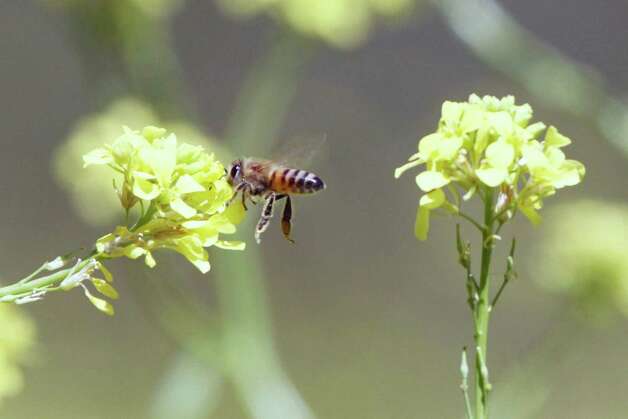
Whether due to colony collapse disorder, the drought or both, bees, such as this April visitor, are rare on the Mims place this spring. Photo: Forrest M. Mims III, For The Express-News / ALL RIGHTS RESERVED. 
By now myriad bees and exotic flies should be sipping nectar from wildflowers. Wasps, dragonflies and spiders should be prowling the landscape looking for dinner.

Where are these creatures and the critters that eat them?

There might be a normal population of insects and spiders in some areas, especially in cities and towns where lawns and gardens were watered during last summer's record drought. But there's a very obvious shortage of insects, spiders and lizards on our rural place.

Only two or three honeybees can be seen in 6-foot-square sections of Indian blanket wildflowers here. In a normal year, the count would be much higher. Bluebonnets require insects to pollinate their flowers, so I examined four patches of bluebonnets on our place. Only 53 per cent of their flower spikes produced seed pods.

So far this spring, only two carpenter bees have appeared where a dozen or more usually patrol the sky. Only one red wasp, two grasshoppers, several dragonflies and a few beetles, crickets and pill bugs have been observed during daily walks. Only one toad, several geckos and no other lizards have been seen around our house.

Some species have returned, apparently assisted by abundant winter rain. While no fireflies appeared during 2011, each evening a dozen or so can be seen flashing away at the edge the woods behind our house.

Last month, countless crane flies invaded portions of South Central Texas.

Butterflies are now in abundance.

Paul Schattenberg wrote about the effect of the 2011 drought on Texas insects in the June 14 issue of Agrilife Today, a Texas A&M publication.

Fire ant mounds are smaller, presumably because their builders are less active.

Another drought spin-off is that some creatures are moving into homes to find moisture and food. This includes scorpions, and that's certainly the case at our place.

A search of the Web for insect activity during droughts revealed that populations of some insects that attack crops and trees can increase during droughts.

There are also insect reports virtually identical to what I am observing. For example, a report by Edward Mawley about the 1898 drought in England summarized surveys by rural observers who found sharply reduced insect populations with very few wasps.

Spiders are beginning to return to our place, and this may signal an increase in the insect population.

It will be interesting to see what happens next, especially if the drought returns.

While it might seem good to have fewer bugs around, they form a vital link in nature's food chain. Many pollinate wildflowers, fruit trees and various vegetables.

Forrest Mims, an expert reviewer for the Intergovernmental Panel on Climate Change (IPCC), was named one of the 50 Best Brains in Science by Discover Magazine. His science is featured at www.forrestmims.org. Email him at forrest.mims@ieee.org.