Mostrando entradas con la etiqueta Prosthetics. Mostrar todas las entradas

domingo, 18 de octubre de 2015

Stanford engineers create artificial skin that can send pressure sensation to brain cell

Stanford engineers have created a plastic skin-like material that can detect pressure and deliver a Morse code-like signal directly to a living brain cell. The work takes a big step toward adding a sense of touch to prosthetic limbs.

Stanford chemical engineering Professor Zhenan Bao and her team have created a skin-like material that can tell the difference between a soft touch and a firm handshake. The device on the golden “fingertip” is the skin-like sensor developed by Stanford engineers. (Bao Lab)


Stanford engineers have created a plastic "skin" that can detect how hard it is being pressed and generate an electric signal to deliver this sensory input directly to a living brain cell.

Zhenan Bao, a professor of chemical engineering at Stanford, has spent a decade trying to develop a material that mimics skin's ability to flex and heal, while also serving as the sensor net that sends touch, temperature and pain signals to the brain. Ultimately she wants to create a flexible electronic fabric embedded with sensors that could cover a prosthetic limb and replicate some of skin's sensory functions.

Bao's work, reported today in Science, takes another step toward her goal by replicating one aspect of touch, the sensory mechanism that enables us to distinguish the pressure difference between a limp handshake and a firm grip.

"This is the first time a flexible, skin-like material has been able to detect pressure and also transmit a signal to a component of the nervous system," said Bao, who led the 17-person research team responsible for the achievement.

Benjamin Tee, a recent doctoral graduate in electrical engineering; Alex Chortos, a doctoral candidate in materials science and engineering; and Andre Berndt, a postdoctoral scholar in bioengineering, were the lead authors on the Science paper.

DIGITIZING TOUCH
The heart of the technique is a two-ply plastic construct: the top layer creates a sensing mechanism and the bottom layer acts as the circuit to transport electrical signals and translate them into biochemical stimuli compatible with nerve cells. The top layer in the new work featured a sensor that can detect pressure over the same range as human skin, from a light finger tap to a firm handshake.

Five years ago, Bao's team members first described how to use plastics and rubbers as pressure sensors by measuring the natural springiness of their molecular structures. They then increased this natural pressure sensitivity by indenting a waffle pattern into the thin plastic, which further compresses the plastic's molecular springs.

To exploit this pressure-sensing capability electronically, the team scattered billions of carbon nanotubes through the waffled plastic. Putting pressure on the plastic squeezes the nanotubes closer together and enables them to conduct electricity.

This allowed the plastic sensor to mimic human skin, which transmits pressure information to the brain as short pulses of electricity, similar to Morse code. Increasing pressure on the waffled nanotubes squeezes them even closer together, allowing more electricity to flow through the sensor, and those varied impulses are sent as short pulses to the sensing mechanism. Remove pressure, and the flow of pulses relaxes, indicating light touch. Remove all pressure and the pulses cease entirely.

The team then hooked this pressure-sensing mechanism to the second ply of their artificial skin, a flexible electronic circuit that could carry pulses of electricity to nerve cells.

IMPORTING THE SIGNAL
Bao's team has been developing flexible electronics that can bend without breaking. For this project, team members worked with researchers from PARC, a Xerox company, which has a technology that uses an inkjet printer to deposit flexible circuits onto plastic. Covering a large surface is important to making artificial skin practical, and the PARC collaboration offered that prospect.

Finally the team had to prove that the electronic signal could be recognized by a biological neuron. It did this by adapting a technique developed by Karl Deisseroth, a fellow professor of bioengineering at Stanford who pioneered a field that combines genetics and optics, called optogenetics. Researchers bioengineer cells to make them sensitive to specific frequencies of light, then use light pulses to switch cells, or the processes being carried on inside them, on and off.

For this experiment the team members engineered a line of neurons to simulate a portion of the human nervous system. They translated the electronic pressure signals from the artificial skin into light pulses, which activated the neurons, proving that the artificial skin could generate a sensory output compatible with nerve cells.

Optogenetics was only used as an experimental proof of concept, Bao said, and other methods of stimulating nerves are likely to be used in real prosthetic devices. Bao's team has already worked with Bianxiao Cui, an associate professor of chemistry at Stanford, to show that direct stimulation of neurons with electrical pulses is possible.

Bao's team envisions developing different sensors to replicate, for instance, the ability to distinguish corduroy versus silk, or a cold glass of water from a hot cup of coffee. This will take time. There are six types of biological sensing mechanisms in the human hand, and the experiment described in Science reports success in just one of them.

But the current two-ply approach means the team can add sensations as it develops new mechanisms. And the inkjet printing fabrication process suggests how a network of sensors could be deposited over a flexible layer and folded over a prosthetic hand.

"We have a lot of work to take this from experimental to practical applications," Bao said. "But after spending many years in this work, I now see a clear path where we can take our artificial skin."

ORIGINAL: Stanford
By Tom Abate

lunes, 14 de septiembre de 2015

Neurotechnology Provides Near-Natural Sense of Touch

Revolutionizing Prosthetics program achieves goal of restoring sensation


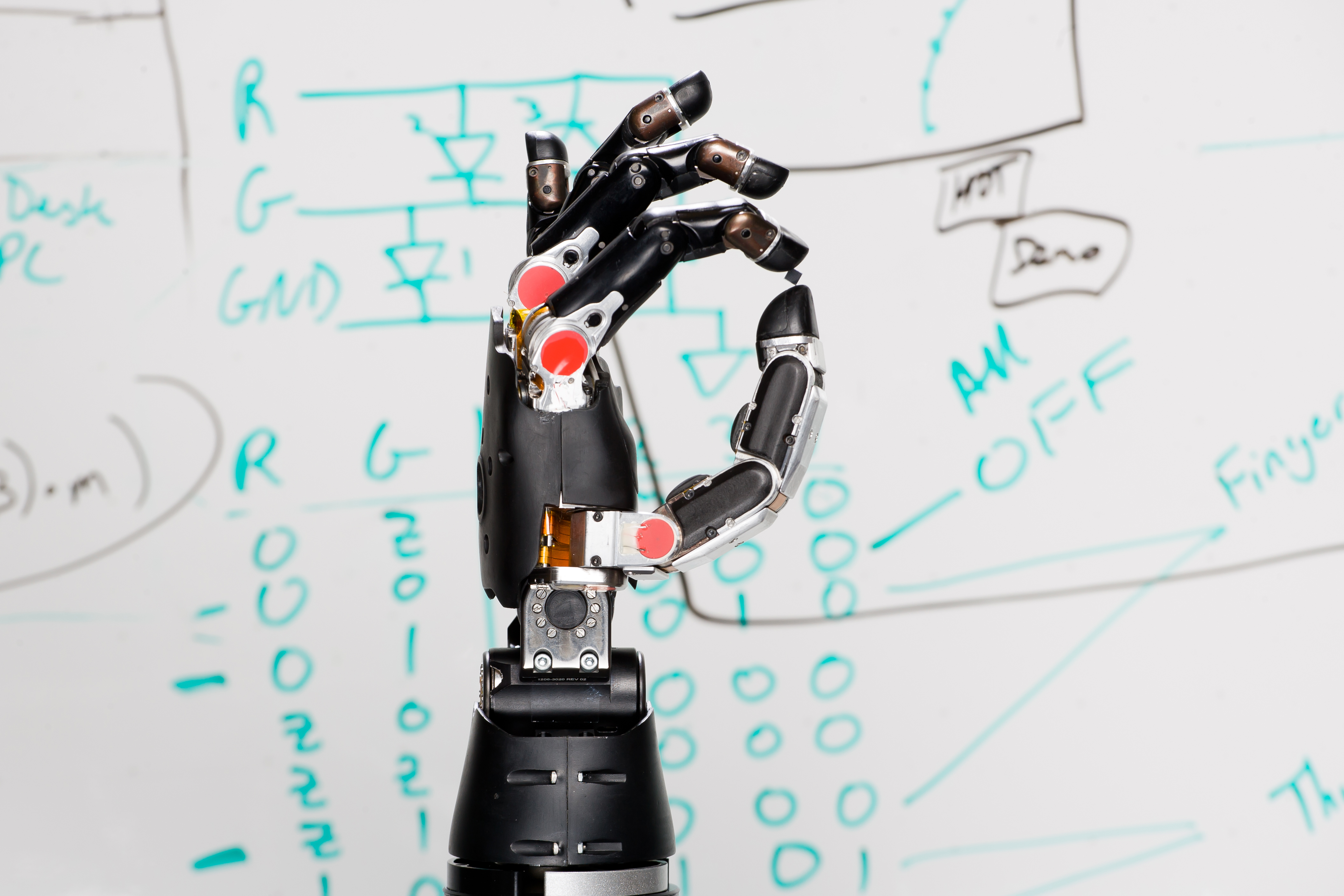
Modular Prosthetic Limb courtesy of the Johns Hopkins University 

A 28-year-old who has been paralyzed for more than a decade as a result of a spinal cord injury has become the first person to be able to “feel” physical sensations through a prosthetic hand directly connected to his brain, and even identify which mechanical finger is being gently touched.

The advance, made possible by sophisticated neural technologies developed under DARPA’s Revolutionizing Prosthetics points to a future in which people living with paralyzed or missing limbs will not only be able to manipulate objects by sending signals from their brain to robotic devices, but also be able to sense precisely what those devices are touching.

“We’ve completed the circuit,” said DARPA program manager Justin Sanchez. “Prosthetic limbs that can be controlled by thoughts are showing great promise, but without feedback from signals traveling back to the brain it can be difficult to achieve the level of control needed to perform precise movements. By wiring a sense of touch from a mechanical hand directly into the brain, this work shows the potential for seamless bio-technological restoration of near-natural function.”

The clinical work involved the placement of electrode arrays onto the paralyzed volunteer’s sensory cortex—the brain region responsible for identifying tactile sensations such as pressure. In addition, the team placed arrays on the volunteer’s motor cortex, the part of the brain that directs body movements.

Wires were run from the arrays on the motor cortex to a mechanical hand developed by the Applied Physics Laboratory (APL) at Johns Hopkins University. That gave the volunteer—whose identity is being withheld to protect his privacy—the capacity to control the hand’s movements with his thoughts, a feat previously accomplished under the DARPA program by another person with similar injuries.


Then, breaking new neurotechnological ground, the researchers went on to provide the volunteer a sense of touch. The APL hand contains sophisticated torque sensors that can detect when pressure is being applied to any of its fingers, and can convert those physical “sensations” into electrical signals. The team used wires to route those signals to the arrays on the volunteer’s brain.

In the very first set of tests, in which researchers gently touched each of the prosthetic hand’s fingers while the volunteer was blindfolded, he was able to report with nearly 100 percent accuracy which mechanical finger was being touched. The feeling, he reported, was as if his own hand were being touched.

“At one point, instead of pressing one finger, the team decided to press two without telling him,” said Sanchez, who oversees the Revolutionizing Prosthetics program. “He responded in jest asking whether somebody was trying to play a trick on him. That is when we knew that the feelings he was perceiving through the robotic hand were near-natural.”

Sanchez described the basic findings on Thursday at Wait, What? A Future Technology Forum, hosted by DARPA in St. Louis. Further details about the work are being withheld pending peer review and acceptance for publication in a scientific journal.

The restoration of sensation with implanted neural arrays is one of several neurotechnology-based advances emerging from DARPA’s 18-month-old Biological Technologies Office, Sanchez said. “DARPA’s investments in neurotechnologies are helping to open entirely new worlds of function and experience for individuals living with paralysis and have the potential to benefit people with similarly debilitating brain injuries or diseases,” he said.

In addition to the Revolutionizing Prosthetics program that focuses on restoring movement and sensation, DARPA’s portfolio of neurotechnology programs includes the
which seek to develop closed-loop direct interfaces to the brain to restore function to individuals living with memory loss from traumatic brain injury or complex neuropsychiatric illness.

For more information about Wait, What? please visit: www.darpawaitwhat.com (!!)


ORIGINAL: DARPA
OUTREACH@DARPA.MIL
9/11/2015

jueves, 19 de marzo de 2015

A Brain-Computer Interface That Lasts for Weeks

Photo: John Rogers/University of Illinois
Brain signals can be read using soft, flexible, wearable electrodes that stick onto and near the ear like a temporary tattoo and can stay on for more than two weeks even during highly demanding activities such as exercise and swimming, researchers say.

The invention could be used for a persistent brain-computer interface (BCI) to help people operate prosthetics, computers, and other machines using only their minds, scientists add.

For more than 80 years, scientists have analyzed human brain activity non-invasively by recording electroencephalograms (EEGs). Conventionally, this involves electrodes stuck onto the head with conductive gel. The electrodes typically cannot stay mounted to the skin for more than a few days, which limits widespread use of EEGs for applications such as BCIs.

Now materials scientist John Rogers at the University of Illinois at Urbana-Champaign and his colleagues have developed a wearable device that can help record EEGs uninterrupted for more than 14 days. Moreover, their invention survived despite showering, bathing, and sleeping. And it did so without irritating the skin. The two weeks might be "a rough upper limit, defined by the timescale for natural exfoliation of skin cells," Rogers says. 

The device consists of a soft, foldable collection of gold electrodes only 300 nanometers thick and 30 micrometers wide mounted on a soft plastic film. This assemblage stays stuck to the body using electric forces known as van der Waals interactions—the same forces that help geckoes cling cling to walls.

The electrodes are flexible enough to mold onto the ear and the mastoid process behind the ear. The researchers mounted the device onto three volunteers using tweezers. Spray-on bandage was used once twice a day to help the electrodes survive normal daily activities.

The electrodes on the mastoid process recorded brain activity while those on the ear were used as a ground wire. The electrodes were connected to a stretchable wire that could plug into monitoring devices. "Most of the experiments used devices mounted on just one side, but dual sides is certainly possible," Rogers says.

The device helped record brain signals well enough for the volunteers to operate a text-speller by thought, albeit at a slow rate of 2.3 to 2.5 letters per minute.

According to Rogers, this research: 

...could enable a persistent BCI that one could imagine might help disabled people, for whom mind control is an attractive option for operating prosthetics… It could also be useful for monitoring cognitive states—for instance, 
  • to see if people are paying attention while they're driving a truck, 
  • flying an airplane, or 
  • operating complex machinery. 
It could also help monitor patterns of sleep to better understand sleep disorders such as sleep apnea, or for monitoring brain function during learning.

The scientists hope to improve the speed at which people can use this device to communicate mentally, which could expand its use into commercial wearable electronics. They also plan to explore devices that can operate wirelessly, Rogers says. The researchers detailed their findings online March 16 in the journal Proceedings of the National Academy of Sciences.

ORIGINAL: IEEE Spectrum
By Charles Q. Choi
16 Mar 2015 

lunes, 19 de enero de 2015

A Bendable Implant Taps the Nervous System without Damaging It

Swiss researchers allow rats to walk again with a rubbery electronic implant.

Why It Matters

Neuroscientists need new materials to restore movement to paralyzed people.

An implant made of silicone and gold wires is as stretchy as human tissue.

Medicine these days entertains all kinds of ambitious plans for reading off brain signals to control wheelchairs, or using electronics to bypass spinal injuries.
But most of these ideas for implants that can interface with the nervous system run up against a basic materials problem: wires are stiff and bodies are soft.

That motivated some researchers at the École Polytechnique Fédérale, in Lausanne, Switzerland, to design a soft, flexible electronic implant, which they say has the same ability to bend and stretch as dura mater, the membrane that surrounds the brain and spinal cord.

The scientists, including Gregoire Courtine, have previously showed that implants can allow mice with spinal injuries to walk again. They did this by sending patterns of electrical shocks to the spinal cord via electrodes placed inside the spine (see “Paralyzed Rats Take 1,000 Steps, Orchestrated by Computer”). But the rigid wires ended up damaging the mice’s nervous systems.

So Courtine joined electrical engineer Stéphanie Lacour (see “Innovators Under 35, 2006: Stéphanie Lacour”) to come up with a new implant they call “e-dura.” It’s made from 
  • soft silicone, 
  • stretchy gold wires, and 
  • rubbery electrodes flecked with platinum, 
  • as well as a microchannel through which the researchers were able to pump drugs.
The work builds on ongoing advances in flexible electronics. Other scientists have built patches that match the properties of the skin and include circuits, sensors, or even radios (see “Stick-On Electronic Tattoos”).

What’s new is how stretchable electronics are merging with a widening effort to invent new ways to send and receive signals from nerves (see “Neuroscience’s New Toolbox”). “People are pushing the limits because everyone wants to precisely interact with the brain and nervous system,” says Polina Anikeeva, a materials scientist at MIT who develops ultrathin fiber-optic threads as a different way of interfacing with neural tissue.

The reason metal or plastic electrodes eventually cause damage, or stop working, is that they cause compression and tissue damage. A stiff implant, even if it’s very thin, will still not stretch as the spinal cord does. “It slides against the tissue and causes a lot of inflammation,” says Lacour. “When you bend over to tie your shoelaces, the spinal cord stretches by several percent.”

The implant mimics a property of human tissue called viscoelasticity—somewhere between rubber and a very thick fluid. Pinch the skin on your hand with force and it will deform, but then flow back into place.

Using the flexible implant, the Swiss scientists reported today in the journal Science that they could overcome spinal injury in rats by wrapping it around the spinal cord and sending electrical signals to make the rodent’s hind legs move. They also pumped in chemicals to enhance the process. After two months, they saw few signs of tissue damage compared to conventional electrodes, which ended up causing an immune reaction and impairing the animal’s ability to move.

The ultimate aim of this kind of research is an implant that could restore a paralyzed person’s ability to walk. Lacour says that is still far off, but believes it will probably involve soft electronics. “If you want a therapy for patients, you want to ensure it can last in the body,” she says. “If we can match the properties of the neural tissue we should have a better interface.”

ORIGINAL:
Tech Review
By Antonio Regalado 
January 8, 2015

domingo, 21 de diciembre de 2014

Double amputee controls two robotic arms with his mind


Here's one other DARPA-funded robotic limb controlled by thoughts alone -- actually make that two, because Colorado man Les Baugh had two bionic arms attached from shoulder level. Baugh got them this summer, 40 years after losing both arms, as part of a Revolutionizing Prosthetics Program test run at the Johns Hopkins Applied Physics Laboratory. The project's researchers have been developing these Modular Prosthetic Limbs (MPL) over the past decade, but they say Baugh is the "first bilateral shoulder-level amputee" to wear two MPLs at the same time. Unlike Jan Scheuermann who controlled a robotic arm with a pair of neural implants, though, Baugh had to undergo a procedure called targeted muscle reinnervation, which reassigned the nerves that once controlled his arms and hands.

Once that was done, the team recorded the patterns his brain makes for each muscle he moves, and then they had him control virtual arms to prepare for the real things. Since his arms were cut off from the shoulder, they also had to design a custom socket for his torso where the prosthetics can be attached. All their preparations were worth it in the end, though, as Baugh turned out to be a brilliant test subject: after just 10 days of training, he was already moving cups from one shelf to the other just by thinking it.

As Courtney Moran, one of the researchers, said:
We expected him to exceed performance compared to what he might achieve with conventional systems, but the speed with which he learned motions and the number of motions he was able to control in such a short period of time was far beyond expectation. What really was amazing, and was another major milestone with MPL control, was his ability to control a combination of motions across both arms at the same time. This was a first for simultaneous bimanual control.


Baugh can only use the arms in a lab setting at the moment, but the team aims to develop MPLs he can take home and use whenever he wants.

VIA: Kotaku

ORIGINAL: Engadget
December 18th 2014