Mostrando entradas con la etiqueta Princeton. Mostrar todas las entradas

miércoles, 23 de septiembre de 2015

Jeremy England, The Man Who May One-Up Darwin

Source: Rachel Tine for OZY
On a sunny afternoon, at a bustling cafe less than a mile from Stanford University’s Palo Alto campus and more than 5,000 miles from his home, an assistant professor from MIT is telling me about science. Very advanced science. His name is Jeremy England, and at 33, he’s already being called the next Charles Darwin.

Say what?In town to give a lecture, the Harvard grad and Rhodes scholar speaks quickly, his voice rising a few pitches in tone, his long-fingered hands making sudden jerks when he’s excited. He’s skinny, with a long face, scraggly beard and carelessly groomed mop of sandy brown hair — what you might expect from a theoretical physicist. But then there’s the street-style Adidas on his feet and the kippah atop his head. And the fact that this scientist also talks a lot about God.

Every 30 years or so we experience these gigantic steps forward. …And this might be it.
Carl Franck, a Cornell physics professor

The 101 version of his big idea is this: Under the right conditions, a random group of atoms will self-organize, unbidden, to more effectively use energy. Over time and with just the right amount of, say, sunlight, a cluster of atoms could come remarkably close to what we call life. In fact, here’s a thought: Some things we consider inanimate actually may already be “alive.” It all depends on how we define life, something England’s work might prompt us to reconsider. “People think of the origin of life as being a rare process,” says Vijay Pande, a Stanford chemistry professor. “Jeremy’s proposal makes life a consequence of physical laws, not something random.”

England’s idea may sound strange, even incredible, but it’s drawn the attention of an impressive posse of high-level academics. After all, while Darwinism may explain evolution and the complex world we live in today, it doesn’t account for the onset of intelligent beings. England’s insistence on probing for the step that preceded all of our current assumptions about life is what makes him stand out, says Carl Franck, a Cornell physics professor, who’s been following England’s work closely. “Every 30 years or so we experience these gigantic steps forward,” Franck says. “We’re due for one. And this might be it.”

And all from a modern Orthodox Jew with fancy sneakers.

****

Before England became a religious man — he prays three times a day — he was a scientist. From the time he could read, he devoured books on subjects from philosophy to music to fantasy. By 9 he was plowing his way through Stephen Hawking’s opus, A Brief History of Time . “He couldn’t comprehend it, but he tried really hard,” says his father, Richard England, an economics professor at the University of New Hampshire. Yes, Dad is an economics professor and Mom a public school teacher, and the couple took their two children to museums and to visit the Harvard campus, just a few hours from their small seacoast town. But the elder England contends his son’s upbringing doesn’t begin to explain his intellectual curiosity.

Or England’s long timeline of asking big questions. Over drinks some years ago, a childhood friend reminded him of a time that young Jeremy turned to him out of nowhere and reflected: “You know, Adam, if the dinosaurs can go extinct, then so can we.” England was 3 then. For his part, England says it wasn’t until he hit about 7 that he felt a sense of anxiety about “not knowing enough.” That anxiety would compel him through an almost comical list of academic bastions — Harvard, Oxford, Stanford and Princeton, and now, a 3-year-old teaching gig at MIT.

Photography by Rachel Tine and Nervous System for OZY
Still, God wasn’t a big player for England during most of his early life. While his mom is Jewish — his dad was raised Lutheran but never felt strongly about passing on his Protestant ties — there wasn’t a lot of religious talk while he was growing up. The Englands would share a festive meal for Passover and light candles for Hanukkah, but the family didn’t keep a Bible in the home. His mother, England says, was born in Poland in 1947 to a family ravaged by the Holocaust. Much of her extended family — including her grandparents — were killed by the Nazis, and in the wake of such destruction, England says, Judaism brought up negative, painful feelings for her; she distanced herself.

It seems ironic, then, that anti-Semitism would eventually push England to the faith he says his mother spurned. While studying at Oxford in the early 2000s, he faced his first anti-Israel sentiment from classmates — which got him, in expected fashion, reading books and picking people’s brains to figure out where he stood on the issue. And in 2005, he visited Israel for the first time — where he “fell in love.” Studying the Torah provided an opportunity for intellectual engagement that he says was “unlike anything I had ever experienced in terms of subtlety and grandeur of scope.”

****

Back in Palo Alto, between meeting with Berkeley professors and Stanford students, England reboots his computer to show me a simulation he’s been working on, meanwhile explaining that his lab is less test tubes and white coats than blackboards and computers screens. Jet-setting across the country to talk about his theories isn’t England’s usual routine. That, he says, looks more like dirty diapers, brainstorming atop a yoga ball with his infant son, working with students and plugging data into formulas.

England didn’t begin with number-crunching, though. During his postdoc research on embryonic development, he kept coming back to the question: What qualifies something as alive or not? He later superimposed an analytical rigor to that question, publishing an equation in 2013 about how much energy is required for self-replication to take place. For England, that investigation was only the beginning. “I couldn’t stop thinking about it,” he says, his normally deep voice rising until eventually cracking. “It was so frustrating.” Over the next year, he worked on a second paper, which is under peer review now. This one took his past findings and used them to explain theoretically how, under certain physical circumstances, life could emerge from nonlife.

In the most basic terms, Darwinism and the idea of natural selection tell us that well-adapted organisms evolve in order to survive and better reproduce in their environment. England doesn’t dispute this reasoning, but he argues that it’s too vague. For instance, he says, blue whales and phytoplankton thrive in the same environmental conditions — the ocean — but they do so by vastly different means. That’s because that while they’re both made of the same basic building blocks, strings of DNA are arranged differently in each organism.

Now take England’s simulation of an opera singer who holds a crystal glass and sings at a certain pitch. Instead of shattering, England predicts that over time, the atoms will rearrange themselves to better absorb the energy the singer’s voice projects, essentially protecting the glass’s livelihood. So how’s a glass distinct from, say, a plankton-type organism that rearranges it self over several generations? Does that make glass a living organism?

These are pretty things to ponder. Unfortunately, England’s work hasn’t yet provided any answers, leaving the professor in a kind of speculative state as he doggedly tries to put numbers to it all. “He hasn’t put enough cards on the table yet,” Franck says. “He’ll need to make more testable predictions.” So it remains to be seen where England will land in the end. Other scientists have made similar claims about energy dissipation in the context of non-equilibrium thermodynamics, but none has found a definitive means for applying this science to the origin of life.

****

So what does God have to do with all this? In his quest for answers, England, of course, finds himself at the center of the classic struggle between science and spirituality. While Christianity and Darwinism are generally opposed, Judaism doesn’t take issue with the science of life. The Rabbinical Council of America even takes the stance that “evolutionary theory, properly understood, is not incompatible with belief in a Divine Creator.”

For his part, England believes science can give us explanations and predictions, but it can never tell us what we should do with that information. That’s where, he says, the religious teachings come in. Indeed, the man who’s one-upping Darwin has spent the past 10 years painstakingly combing through the Torah, interpreting it word by word much the way he ponders the meaning of life. His conclusion? Common translations are lacking. Take the term “creation.” England suggests we understand it not as the literal making of the Earth but rather as giving Earth a name. All throughout the Bible, he says, there are examples of terms that could be interpreted differently from what we’ve come to accept as standard.

That even applies to some of the good book’s most famous players, like Joseph, the ancient biblical interpreter of dreams, who rose to become the most powerful man in Egypt after the pharaoh. Maybe, England suggests, he wasn’t a fortune-teller. Maybe he was a scientist.

Correction: This story has been revised to reflect the correct date that England first visited Israel.

ORIGINAL: OZY
BY MEGHAN WALSH
APR 20, 2015

viernes, 18 de septiembre de 2015

3-D printed guide helps regrow complex nerves after injury

University of Minnesota. Scientists have developed a first-of-its-kind, 3-D printed guide that helps regrow both the sensory and motor functions of complex nerves after injury. The groundbreaking research has the potential to help more than 200,000 people annually who experience nerve injuries or disease.
This is a 3-D printed nerve regeneration pathway implanted in a rat helped to improve walking in 10 to 12 weeks after implantation. Credit: University of Minnesota College of Science and Engineering

A national team of researchers has developed a first-of-its-kind, 3D-printed guide that helps regrow both the sensory and motor functions of complex nerves after injury. The groundbreaking research has the potential to help more than 200,000 people annually who experience nerve injuries or disease.

Collaborators on the project are from the University of Minnesota, Virginia Tech, University of Maryland, Princeton University, and Johns Hopkins University.

Nerve regeneration is a complex process. Because of this complexity, regrowth of nerves after injury or disease is very rare, according to the Mayo Clinic. Nerve damage is often permanent. Advanced 3D printing methods may now be the solution.

In a new study, published today in the journal Advanced Functional Materials, researchers used a combination of 3D imaging and 3D printing techniques to create a custom silicone guide implanted with biochemical cues to help nerve regeneration. The guide's effectiveness was tested in the lab using rats.

To achieve their results, researchers used a 3D scanner to reverse engineer the structure of a rat's sciatic nerve. They then used a specialized, custom-built 3D printer to print a guide for regeneration. Incorporated into the guide were 3D-printed chemical cues to promote both motor and sensory nerve regeneration. The guide was then implanted into the rat by surgically grafting it to the cut ends of the nerve. Within about 10 to 12 weeks, the rat's ability to walk again was improved.

"This represents an important proof of concept of the 3D printing of custom nerve guides for the regeneration of complex nerve injuries," said University of Minnesota mechanical engineering professor Michael McAlpine, the study's lead researcher. "Someday we hope that we could have a 3D scanner and printer right at the hospital to create custom nerve guides right on site to restore nerve function."

Scanning and printing takes about an hour, but the body needs several weeks to regrow the nerves. McAlpine said previous studies have shown regrowth of linear nerves, but this is the first time a study has shown the creation of a custom guide for regrowth of a complex nerve like the Y-shaped sciatic nerve that has both sensory and motor branches.

"The exciting next step would be to implant these guides in humans rather than rats," McAlpine said. In cases where a nerve is unavailable for scanning, McAlpine said there could someday be a "library" of scanned nerves from other people or cadavers that hospitals could use to create closely matched 3D-printed guides for patients.

In addition to McAlpine, major contributors to the research team include Blake N. Johnson, Virginia Tech; Xiaofeng Jia, University of Maryland and Johns Hopkins University; and Karen Z. Lancaster, Esteban Engel, and Lynn W. Enquist, Princeton University.

This research was funded by grants from the National Institutes of Health, the Defense Advanced Research Projects Agency, the Maryland Stem Cell Research Fund, and the Grand Challenges Program at Princeton University.

To read more about the study entitled "3D Printed Anatomical Nerve Regeneration Pathways," visit the Advanced Functional Materials website.

Story Source:
The above post is reprinted from materials provided by University of Minnesota. 
Note: Materials may be edited for content and length.

Journal Reference:
Blake N. Johnson, Karen Z. Lancaster, Gehua Zhen, Junyun He, Maneesh K. Gupta, Yong Lin Kong, Esteban A. Engel, Kellin D. Krick, Alex Ju, Fanben Meng, Lynn W. Enquist, Xiaofeng Jia, Michael C. McAlpine. 3D Printed Anatomical Nerve Regeneration Pathways. Advanced Functional Materials, 2015; 


ORIGINAL: ScienceDaily
September 18, 2015

jueves, 16 de julio de 2015

After 85-year search, massless particle with promise for next-generation electronics discovered

An international team led by Princeton University scientists has discovered an elusive massless particle theorized 85 years ago. The particle could give rise to faster and more efficient electronics because of its unusual ability to behave as matter and antimatter inside a crystal, according to new research.

The researchers report in the journal Science July 16 the first observation of Weyl fermions, which, if applied to next-generation electronics, could allow for a nearly free and efficient flow of electricity in electronics, and thus greater power, especially for computers, the researchers suggest.

Proposed by the mathematician and physicist Hermann Weyl in 1929, Weyl fermions have been long sought by scientists because they have been regarded as possible building blocks of other subatomic particles, and are even more basic than the ubiquitous, negative-charge carrying electron (when electrons are moving inside a crystal). Their basic nature means that Weyl fermions could provide a much more stable and efficient transport of particles than electrons, which are the principle particle behind modern electronics. Unlike electrons, Weyl fermions are massless and possess a high degree of mobility; the particle's spin is both in the same direction as its motion — which is known as being right-handed — and in the opposite direction in which it moves, or left-handed.

"The physics of the Weyl fermion are so strange, there could be many things that arise from this particle that we're just not capable of imagining now," said corresponding author M. Zahid Hasan, a Princeton professor of physics who led the research team.
An international team led by Princeton University scientists has discovered Weyl fermions, elusive massless particles theorized 85 years ago that could give rise to faster and more efficient electronics because of their unusual ability to behave as matter and antimatter inside a crystal. The team included numerous researchers from Princeton's Department of Physics, including (from left to right) graduate students Ilya Belopolski and Daniel Sanchez; Guang Bian, a postdoctoral research associate; corresponding author M. Zahid Hasan, a Princeton professor of physics who led the research team; and associate research scholar Hao Zheng. (Photo by Danielle Alio, Office of Communications)


The researchers' find differs from the other particle discoveries in that the Weyl fermion can be reproduced and potentially applied, Hasan said. Typically, particles such as the famous Higgs boson are detected in the fleeting aftermath of particle collisions, he said. The Weyl fermion, however, was discovered inside a synthetic metallic crystal called tantalum arsenide that the Princeton researchers designed in collaboration with researchers at the Collaborative Innovation Center of Quantum Matter in Beijing and at National Taiwan University.

The Weyl fermion possesses two characteristics that could make its discovery a boon for future electronics, including the development of the highly prized field of efficient quantum computing, Hasan explained.

For a physicist, the Weyl fermions are most notable for behaving like a composite of monopole- and antimonopole-like particles when inside a crystal, Hasan said. This means that Weyl particles that have opposite magnetic-like charges can nonetheless move independently of one another with a high degree of mobility.
A detector image (top) signals the existence of Weyl fermions. The plus and minus signs note whether the particle's spin is in the same direction as its motion — which is known as being right-handed — or in the opposite direction in which it moves, or left-handed. This dual ability allows Weyl fermions to have high mobility. A schematic (bottom) shows how Weyl fermions also can behave like monopole and antimonopole particles when inside a crystal, meaning that they have opposite magnetic-like charges can nonetheless move independently of one another, which also allows for a high degree of mobility. (Image by Su-Yang Xu and M. Zahid Hasan, Princeton Department of Physics)

The researchers also found that Weyl fermions can be used to create massless electrons that move very quickly with no backscattering, wherein electrons are lost when they collide with an obstruction. In electronics, backscattering hinders efficiency and generates heat. Weyl electrons simply move through and around roadblocks, Hasan said.

"It's like they have their own GPS and steer themselves without scattering," Hasan said. "They will move and move only in one direction since they are either right-handed or left-handed and never come to an end because they just tunnel through. These are very fast electrons that behave like unidirectional light beams and can be used for new types of quantum computing."

Prior to the Science paper, Hasan and his co-authors published a report in the journal Nature Communications in June that theorized that Weyl fermions could exist in a tantalum arsenide crystal. Guided by that paper, the researchers used the Princeton Institute for the Science and Technology of Materials (PRISM) and Laboratory for Topological Quantum Matter and Spectroscopy in Princeton's Jadwin Hall to research and simulate dozens of crystal structures before seizing upon the asymmetrical tantalum arsenide crystal, which has a differently shaped top and bottom.

The crystals were then loaded into a two-story device known as a scanning tunneling spectromicroscope that is cooled to near absolute zero and suspended from the ceiling to prevent even atom-sized vibrations. The spectromicroscope determined if the crystal matched the theoretical specifications for hosting a Weyl fermion. "It told us if the crystal was the house of the particle," Hasan said.

The Princeton team took the crystals passing the spectromicroscope test to the Lawrence Berkeley National Laboratory in California to be tested with high-energy accelerator-based photon beams. Once fired through the crystal, the beams' shape, size and direction indicated the presence of the long-elusive Weyl fermion.

First author Su-Yang Xu, a postdoctoral research associate in Princeton's Department of Physics, said that the work was unique for encompassing theory and experimentalism.

"The nature of this research and how it emerged is really different and more exciting than most of other work we have done before," Xu said. "Usually, theorists tell us that some compound might show some new or interesting properties, then we as experimentalists grow that sample and perform experiments to test the prediction. In this case, we came up with the theoretical prediction ourselves and then performed the experiments. This makes the final success even more exciting and satisfying than before."

In pursuing the elusive particle, the researchers had to pull from a number of disciplines, as well as just have faith in their quest and scientific instincts, Xu said.

"Solving this problem involved physics theory, chemistry, material science and, most importantly, intuition," he said. "This work really shows why research is so fascinating, because it involved both rational, logical thinking, and also sparks and inspiration."

Weyl, who worked at the Institute for Advanced Study, suggested his fermion as an alternative to the theory of relativity proposed by his colleague Albert Einstein. Although that application never panned out, the characteristics of his theoretical particle intrigued physicists for nearly a century, Hasan said. Actually observing the particle was a trying process — one ambitious experiment proposed colliding high-energy neutrinos to test if the Weyl fermion was produced in the aftermath, he said.

Hasan (pictured) and his research group researched and simulated dozens of crystal structures before finding the one suitable for holding Weyl fermions. Once fashioned, the crystals were loaded into this two-story device known as a scanning tunneling spectromicroscope to ensure that they matched theoretical specifications. Located in the Laboratory for Topological Quantum Matter and Spectroscopy in Princeton's Jadwin Hall, the spectromicroscope is cooled to near absolute zero and suspended from the ceiling to prevent even atom-sized vibrations. (Photo by Danielle Alio, Office of Communications)

The hunt for the Weyl fermion began in the earliest days of quantum theory when physicists first realized that their equations implied the existence of antimatter counterparts to commonly known particles such as electrons, Hasan said.

"People figured that although Weyl's theory was not applicable to relativity or neutrinos, it is the most basic form of fermion and had all other kinds of weird and beautiful properties that could be useful," he said.

"After more than 80 years, we found that this fermion was already there, waiting. It is the most basic building block of all electrons," he said. "It is exciting that we could finally make it come out following Weyl's 1929 theoretical recipe."

Ashvin Vishwanath, a professor of physics at the University of California-Berkeley who was not involved in the study, commented: "Professor Hasan's experiments report the observation of both the unusual properties in the bulk of the crystal as well as the exotic surface states that were theoretically predicted. While it is early to say what practical implications this discovery might have, it is worth noting that Weyl materials are direct 3-D electronic analogs of graphene, which is being seriously studied for potential applications."

The team included numerous researchers from Princeton's Department of Physics, including graduate students Ilya Belopolski, Nasser Alidoust and Daniel Sanchez; Guang Bian, a postdoctoral research associate; associate research scholar Hao Zheng; and Madhab Neupane, a Princeton postdoctoral research associate now at the Los Alamos National Laboratory; and Class of 2015 undergraduate Pavel Shibayev.

Other co-authors were Chenglong Zhang, Zhujun Yuan and Shuang Jia from Peking University; Raman Sankar and Fangcheng Chou from National Taiwan University; Guoqing Chang, Chi-Cheng Lee, Shin-Ming Huang, BaoKai Wang and Hsin Lin from the National University of Singapore; Jie Ma from Oak Ridge National Laboratory; and Arun Bansil from Northeastern University. Wang is also affiliated with Northeastern University, and Jia is affiliated with the Collaborative Innovation Center of Quantum Matter in Beijing.

The paper, "Discovery of Weyl fermions and topological Fermi arcs," was published online by Science on July 16. The work was supported by the Gordon and Betty Moore Foundations Emergent Phenomena in Quantum Systems (EPiQS) Initiative (grant no. GBMF4547); the Singapore National Research Foundation (grant no. NRF-NRFF2013-03); the National Basic Research Program of China(grant nos. 2013CB921901 and 2014CB239302); the U.S. Department of Energy (grant no. DE-FG-02-05ER462000); and the Taiwan Ministry of Science and Technology (project no. 102-2119-M- 002-004).


ORIGINAL: Princeton
by Morgan Kelly, Office of Communications
July 16, 2015; 02:00 p.m.

domingo, 14 de junio de 2015

Will Computers Redefine the Roots of Math?

When a legendary mathematician found a mistake in his own work, he embarked on a computer-aided quest to eliminate human error. To succeed, he has to rewrite the century-old rules underlying all of mathematics.

Hannes Hummel for Quanta Magazine

Mathematics is being rebuilt on top of new foundations.

On a recent train trip from Lyon to Paris, Vladimir Voevodsky sat next to Steve Awodey and tried to convince him to change the way he does mathematics.

Voevodsky, 48, is a permanent faculty member at the Institute for Advanced Study (IAS) in Princeton, N.J. He was born in Moscow but speaks nearly flawless English, and he has the confident bearing of someone who has no need to prove himself to anyone. In 2002 he won the Fields Medal, which is often considered the most prestigious award in mathematics.

Now, as their train approached the city, Voevodsky pulled out his laptop and opened a program called Coq, a proof assistant that provides mathematicians with an environment in which to write mathematical arguments. Awodey, a mathematician and logician at Carnegie Mellon University in Pittsburgh, Pa., followed along as Voevodsky wrote a definition of a mathematical object using a new formalism he had created, called univalent foundations. It took Voevodsky 15 minutes to write the definition.

“I was trying to convince [Awodey] to do [his mathematics in Coq],” Voevodsky explained during a lecture this past fall. “I was trying to convince him that it’s easy to do.”

The idea of doing mathematics in a program like Coq has a long history. The appeal is simple: Rather than relying on fallible human beings to check proofs, you can turn the job over to computers, which can tell whether a proof is correct with complete certainty. Despite this advantage, computer proof assistants haven’t been widely adopted in mainstream mathematics. This is partly because translating everyday math into terms a computer can understand is cumbersome and, in the eyes of many mathematicians, not worth the effort.

For nearly a decade, Voevodsky has been advocating the virtues of computer proof assistants and developing univalent foundations in order to bring the languages of mathematics and computer programming closer together. As he sees it, the move to computer formalization is necessary because some branches of mathematics have become too abstract to be reliably checked by people.

“The world of mathematics is becoming very large, the complexity of mathematics is becoming very high, and there is a danger of an accumulation of mistakes,” Voevodsky said. Proofs rely on other proofs; if one contains a flaw, all others that rely on it will share the error.

This is something Voevodsky has learned through personal experience. In 1999 he discovered an error in a paper he had written seven years earlier. Voevodsky eventually found a way to salvage the result, but in an article last summer in the IAS newsletter, he wrote that the experience scared him. He began to worry that unless he formalized his work on the computer, he wouldn’t have complete confidence that it was correct.

But taking that step required him to rethink the very basics of mathematics. The accepted foundation of mathematics is set theory. Like any foundational system, set theory provides a collection of basic concepts and rules, which can be used to construct the rest of mathematics. Set theory has sufficed as a foundation for more than a century, but it can’t readily be translated into a form that computers can use to check proofs. So with his decision to start formalizing mathematics on the computer, Voevodsky set in motion a process of discovery that ultimately led to something far more ambitious: a recasting of the underpinnings of mathematics.


Set Theory and a Paradox

Set theory grew out of an impulse to put mathematics on an entirely rigorous footing — a logical basis even more secure than numbers themselves. Set theory begins with the set containing nothing — the null set — which is used to define the number zero. The number 1 can then be built by defining a new set with one element — the null set. The number 2 is the set that contains two elements — the null set (0) and the set that contains the null set (1). In this way, each whole number can be defined as the set of sets that came before it.
Olena Shmahalo/Quanta Magazine  Set theory constructs all of mathematics by starting with literally nothing — the null set — which is defined to be zero. The set that contains a single element — the null set — becomes the number 1, the set that contains two elements — the null set and the set containing the null set — becomes the number 2, and so on
Once the whole numbers are in place,
  • fractions can be defined as pairs of whole numbers, 
  • decimals can be defined as sequences of digits, 
  • functions in the plane can be defined as sets of ordered pairs, and 
  • so on. 

sábado, 13 de diciembre de 2014

Here’s What Really Killed the Dinosaurs

Portrait of a killer: volcanoes were no friend to the dinos
Sebastian Crespo Photography; Getty Images/Flickr RF
It wasn't just an asteroid
At the start of the 1980s, the question of what forced dinosaurs and huge numbers of other creatures to become extinct 65 million years ago was still a mystery. By the decade’s end, that mystery was solved: a comet or asteroid had slammed into Earth, throwing so much sun-blocking dust into the air that the planet plunged into a deep-freeze. The discovery of a massive impact crater off the coast of Mexico, of just the right age, pretty much sealed the deal in most scientists’ minds.

But a second global-scale catastrophe was happening at much the same time: a series of ongoing volcanic eruptions that dwarf anything humans have ever seen. They were so unimaginably powerful that they left nearly 200,000 square miles (518,000 sq. km) of what’s now India buried in volcanic basalt up to a mile and a half thick. And the gases and particulate matter spewed out by those eruptions, argue at least some scientists, could have played a big role in the dinosaurs’ doom as well.

How big a role, however, depends on exactly when the eruptions began and how long they lasted, and a new report in Science goes a long way toward answering that question. “We can now say with confidence,” says Blair Schoene, a Princeton geologist and lead author of the paper, “that the eruptions started 250,000 years before the extinction event, and lasted for a total of 750,000 years.” And that, he says, strengthens the idea that the eruptions could have contributed to the mass extinction of multiple species.

Schoene and his co-authors don’t claim volcanoes alone wiped out the dinosaurs; only that they changed the climate enough to put ecosystems under stress, setting them up for the final blow. “We don’t know the exact mechanism,” he admits. Volcanoes emit carbon dioxide, which could have triggered an intense burst of global warming, but they also emit sulfur dioxide, which could have caused global cooling. “What we do know,” Schoene says, “is that earlier mass extinctions were caused by volcanic eruptions alone.” The new dates, he and his co-authors believe, will help scientists understand what role these volcanoes played in the dinosaurs’ demise.

If there was such a role, that is, and despite this new analysis, plenty of paleontologists still doubt it seriously. The dating of the eruptions, based on widely accepted uranium-lead measurement techniques, is not an issue, says Brian Huber, of the Smithsonian Institution. “That part of the science is great,” he says. “It moves things forward.”

But the link between eruptions and the disappearance of species, he thinks, is invalid. “The case of the mass extinctions being caused by an impact is overwhelming,” says Huber. “One of the wonderful things about these arguments is that they’ve forced us to look really carefully at the fossil evidence, on land and at sea. We’ve accumulated a really detailed data set.”

And those data, Huber says, make it clear that the extinction rate for the 250,000 years leading up to the asteroid impact wasn’t especially large. Then, at the time of the impact: whammo. The idea that volcanoes played a significant role in this extinction event keeps coming up every so often, and in Huber’s view, “the argument has gotten very tiresome. I no longer feel the need to put any energy into it. It’s from a minority arguing against overwhelming evidence.”

For onlookers, that might seem harsh—not to mention overconfident. Sometimes a vocal scientific minority turns out to be right in its challenge to the scientific mainstream, as when Alfred Wegener argued, to much ridicule, that continents move around the Earth. And sometimes it’s dead wrong—Sir Fred Hoyle’s futile campaign against the Big Bang theory, for example.

In both cases, however, it was the accumulation of evidence that ultimately vindicated one argument and torpedoed the other. So far, the volcanic impact people have most of the torpedoes on their side.


ORIGINAL: Time
Dec. 11, 2014

martes, 9 de diciembre de 2014

Thousands of Einstein Documents Are Now a Click Away

Albert Einstein writing out an equation relating to the density of the Milky Way at the Carnegie Institute in Pasadena, Calif., on Jan. 14, 1931. Einstein left a scattered collection of letters, notebooks and diaries. Credit Associated Press
They have been called the Dead Sea Scrolls of physics. Since 1986, the Princeton University Press and the Hebrew University of Jerusalem, to whom Albert Einstein bequeathed his copyright, have been engaged in a mammoth effort to study some 80,000 documents he left behind.

Starting on Friday, when Digital Einstein is introduced, anyone with an Internet connection will be able to share in the letters, papers, postcards, notebooks and diaries that Einstein left scattered in Princeton and in other archives, attics and shoeboxes around the world when he died in 1955.

The Einstein Papers Project, currently edited by Diana Kormos-Buchwald, a professor of physics and the history of science at the California Institute of Technology, has already published 13 volumes in print out of a projected 30.

The published volumes contain about 5,000 documents that bring Einstein’s story up to 1923, when he turned 44, in ever-thicker, black-jacketed, hard-bound books, dense with essays, footnotes and annotations detailing the political, personal and cultural life of the day. A separate set of white paperback volumes contains English translations. Digitized versions of many of Einstein’s papers and letters have been available on the Einstein Archives of the Hebrew University.

Visitors to the new Digital Einstein website, Dr. Kormos-Buchwald said in an email, will be able to toggle between the English and German versions of the texts. They can dance among Einstein’s love letters, his divorce file, his high school transcript, the notebook in which he worked out his general theory of relativity and letters to his lifelong best friend, Michele Besso, among many other possibilities. Einstein, who like many other 20-year-old college students did not lack for a sense of self-dramatization, once wrote to his sister, Maja, “If everybody lived a life like mine, there would be no need for novels.” As it would turn out, he did not know the half of it.

The 14th volume, with more than 1,000 documents, is due in January. The digital versions are available at einsteinpapers.press.princeton.edu.

ORIGINAL: NYTimes
DEC. 4, 2014

jueves, 11 de septiembre de 2014

Scientists Create Solid Light


photo credit: Princeton University, Engineering School. 
By creating a "self-trapping regime" scientists have made light behave like a crystal

On a late summer afternoon it can seem like sunlight has turned to honey, but could liquid—or even solid—light be more than a piece of poetry? Princeton University electrical engineers say not only is it possible, they’ve already made it happen.

In Physical Review X, the researchers reveal that they have locked individual photons together so that they become like a solid object.

"It's something that we have never seen before," says Dr. Andrew Houck, an associate professor of electrical engineering and one of the researchers. "This is a new behavior for light."

The researchers constructed what they call an “artificial atom” made of 100 billion atoms engineered to act like a single unit. They then brought this close to a superconducting wire carrying photons. In one of the almost incomprehensible behaviors unique to the quantum world, the atom and the photons became entangled so that properties passed between the “atom” and the photons in the wire. The photons started to behave like atoms, correlating with each other to produce a single oscillating system.

As some of the photons leaked into the surrounding environment, the oscillations slowed and at a critical point started producing quantum divergent behavior. In other words, like Schroedinger's Cat, the correlated photons could be in two states at once.

"Here we set up a situation where light effectively behaves like a particle in the sense that two photons can interact very strongly," said co-author Dr. Darius Sadri. "In one mode of operation, light sloshes back and forth like a liquid; in the other, it freezes."

As cool as it is to produce solidified light, the team was not acting out of curiosity alone. When connected together the photons of light behave like subatomic particles, but are in some ways easier to study. Consequently, the team is hoping to use the solid light to simulate subatomic behavior.

Attempts to model the behavior of large numbers of particles usually use statistical mechanics, and often simplify by assuming no interaction between particles and a system at equilibrium. However, in a point we can all relate to, Houck and his colleagues note, “The world around us is rarely in equilibrium.” The solidified light offers a chance to observe a subatomic system as it starts to diverge from equilibrium, with potential for a basic understanding of how these systems operate.

The system created so far is very simple, with the light entangled with the atom at two points. However, it should be possible to increase this, greatly expanding the complexity and range of possibilities of what is being constructed.

As well as providing an easy-to-study model of atomic systems that actually exist, Houck and his team hope the frozen light could be made to behave like materials that do not exist, but have been hypothesised by physicists, allowing them to explore how these things would react if they were real.

ORIGINAL: IFLScience
by Stephen Luntz
September 11, 2014

martes, 8 de abril de 2014

Stress alters children's genomes

Poverty and unstable family environments shorten chromosome-protecting telomeres in nine-year-olds.

Pasieka/Science Photo Library Telomeres (shown in red) protect the ends of chromosomes from fraying over time.

Growing up in a stressful social environment leaves lasting marks on young chromosomes, a study of African American boys has revealed. Telomeres, repetitive DNA sequences that protect the ends of chromosomes from fraying over time, are shorter in children from poor and unstable homes than in children from more nurturing families.

When researchers examined the DNA of 40 boys from major US cities at age 9, they found that the telomeres of children from harsh home environments were 19% shorter than those of children from advantaged backgrounds. The length of telomeres is often considered to be a biomarker of chronic stress.

The study, published today in the Proceedings of the National Academy of Sciences1, brings researchers closer to understanding how social conditions in childhood can influence long-term health, says Elissa Epel, a health psychologist at the University of California, San Francisco, who was not involved in the research.

Participants’ DNA samples and socio-economic data were collected as part of the Fragile Families and Child Wellbeing Study, an effort funded by the US National Institutes of Health to track nearly 5,000 children, the majority of whom were born to unmarried parents in large US cities in 1998–2000. Children's environments were rated on the basis of their mother's level of education; the ratio of a family’s income to needs; harsh parenting; and whether family structure was stable, says lead author Daniel Notterman, a molecular biologist at Pennsylvania State University in Hershey.

The telomeres of boys whose mothers had a high-school diploma were 32% longer compared with those of boys whose mothers had not finished high school. Children who came from stable families had telomeres that were 40% longer than those of children who had experienced many changes in family structure, such as a parent with multiple partners.

Genetic links
The link between stressful home environments and telomere length is moderated by genetic variants in pathways that process two chemical transmitters in the brain, serotonin and dopamine, the study found. Previous studies have correlated variants in some of the genes studied, such as TPH2, with depression, bipolar disorder and other mental-health issues. Variants of another gene, 5-HTT, reduce the amount of the protein that recycles serotonin in nerve synapses. Some alleles of these genes are thought to increase the sensitivity of carriers to external risks.

Related stories


In the latest study, the researchers found that the 'sensitizing' variants of these genes protected telomeres in children from nurturing environments, and caused greater telomere damage in children from disadvantaged homes. Those who lacked these alleles had little difference in their telomeres, regardless of living conditions.

But boys with more than two sensitizing alleles were strongly influenced by their home environments. They had the shortest telomeres in stressful homes, and the longest telomeres in advantaged environments. Although these variants were known to influence chemical responses to stress in the brain, they were not previously linked to telomere length, says Notterman.

The team plans to expand its analysis to approximately 2,500 children and their mothers to see if these preliminary findings hold. However, because the effects of stress are tangible by the age of 9, Notterman suggests that early intervention practices may help to moderate the effects of adversity on children’s health.

“This was a small study testing a big theory,” says Epel. “It is a first but important step in understanding how social disparities get under the skin to affect lifelong health.”Nature doi:10.1038/nature.2014.14997

References
Mitchell, C. et al. Proc. Natl. Acad. Sci. USA http://dx.doi.org/10.1073/pnas.1404293111 (2014).
Show context

Related stories and links
From nature.com

From elsewhere

ORIGINAL: Nature
07 April 2014


lunes, 13 de enero de 2014

A Young Clean-Tech Entrepreneur Learns Even Simple Design Ideas Face Challenges

SunSaluter is a simple idea with a big pay-off. The harder part is getting it to those who need it.

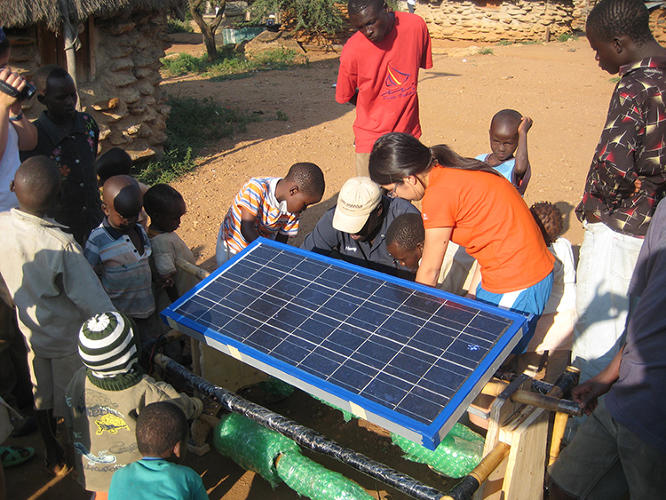
By rotating solar panels with the movement of the sun, the device can improve electricity generation by up to 40%. All that's really involved is a bamboo stand to hold the panel, and a few plastic bottles.


"A lot of it depends on the eagerness of customers," says 21-year-old inventor Eden Full. "Our core focus is now on India."
Once in the spotlight for "dropping out" of college under the tutelage of billionaire Peter Thiel, Eden Full, 21, is now a junior at Princeton University who is still busy refining her big idea for end users.

Eden Full's SunSaluter is a simple idea with a big pay-off. By rotating solar panels with the movement of the sun, the device can improve electricity generation by up to 40%, according to its 21-year-old inventor. All that's really involved is a bamboo stand to hold the panel, and a few plastic bottles. As water drains out during the day, the panel starts to tilt.

The harder part is getting SunSaluter to the people who need it--off-grid villagers in developing countries--and making sure it works properly in their setting. And that's something that Full, currently a junior at Princeton University, is still working out. Like many simple design and technology ideas, it's the practicalities that remain challenging.


"The original design didn't consider the needs of the end-user, which isn't surprising as I was in high school at the time," Full says. "It was too complicated, technical, and difficult to fix."

Over the last year, Full has sent 35 units to six countries, working with "beta" customers. The design, which costs $50, now uses local materials and is simpler to set up and maintain. She's now concentrating on India and Malawi, in southeast Africa, where partners have shown greatest willingness to test the product.

"A lot of it depends on the eagerness of customers," she says. "Our core focus is now on India. That's where we have most of our resources and where we've established connections with people who want to work with us and move quickly." In the first half of 2014, Full hopes to deliver up 100 units, collaborating with up to 10 local groups. 


Two years ago, Full received a lot of media coverage, both for her idea and for the fact that she left her college plans aside to join Peter Thiel's anti-college fellowship program. Several stories talked about her "dropping out" to pursue the SunSaluter idea.

But Full says that was never the case. She only ever planned to take a year two years out and she resists the idea of being a poster-child for the college-is-dead movement. She thinks she can learn a lot of Princeton, and, in fact, a year on the Thiel program has showed her how much she has to learn. It should all be useful as she looks to roll SunSaluter more widely in 2014.

ORIGINAL: FastCo Exist

lunes, 23 de septiembre de 2013

A Jewel at the Heart of Quantum Physics

By: Natalie Wolchover
September 17, 2013

Artist’s rendering of the amplituhedron, a newly discovered mathematical object resembling a multifaceted jewel in higher dimensions. Encoded in its volume are the most basic features of reality that can be calculated — the probabilities of outcomes of particle interactions. . Illustration by Andy Gilmore
Physicists have discovered a jewel-like geometric object that dramatically simplifies calculations of particle interactions and challenges the notion that space and time are fundamental components of reality.

“This is completely new and very much simpler than anything that has been done before,” said Andrew Hodges, a mathematical physicist at Oxford University who has been following the work.

The revelation that particle interactions, the most basic events in nature, may be consequences of geometry significantly advances a decades-long effort to reformulate quantum field theory, the body of laws describing elementary particles and their interactions. Interactions that were previously calculated with mathematical formulas thousands of terms long can now be described by computing the volume of the corresponding jewel-like “amplituhedron,” which yields an equivalent one-term expression.

“The degree of efficiency is mind-boggling,” said Jacob Bourjaily, a theoretical physicist at Harvard University and one of the researchers who developed the new idea. “You can easily do, on paper, computations that were infeasible even with a computer before.”

The new geometric version of quantum field theory could also facilitate the search for a theory of quantum gravity that would seamlessly connect the large- and small-scale pictures of the universe. Attempts thus far to incorporate gravity into the laws of physics at the quantum scale have run up against nonsensical infinities and deep paradoxes. The amplituhedron, or a similar geometric object, could help by removing two deeply rooted principles of physics: locality and unitarity.

“Both are hard-wired in the usual way we think about things,” said Nima Arkani-Hamed, a professor of physics at the Institute for Advanced Study in Princeton, N.J., and the lead author of the new work, which he is presenting in talks and in a forthcoming paper. “Both are suspect.”

Locality is the notion that particles can interact only from adjoining positions in space and time. And unitarity holds that the probabilities of all possible outcomes of a quantum mechanical interaction must add up to one. The concepts are the central pillars of quantum field theory in its original form, but in certain situations involving gravity, both break down, suggesting neither is a fundamental aspect of nature.

In keeping with this idea, the new geometric approach to particle interactions removes locality and unitarity from its starting assumptions. The amplituhedron is not built out of space-time and probabilities; these properties merely arise as consequences of the jewel’s geometry. The usual picture of space and time, and particles moving around in them, is a construct.

“It’s a better formulation that makes you think about everything in a completely different way,” said David Skinner, a theoretical physicist at Cambridge University.

The amplituhedron itself does not describe gravity. But Arkani-Hamed and his collaborators think there might be a related geometric object that does. Its properties would make it clear why particles appear to exist, and why they appear to move in three dimensions of space and to change over time.

Because “we know that ultimately, we need to find a theory that doesn’t have” unitarity and locality, Bourjaily said, “it’s a starting point to ultimately describing a quantum theory of gravity.”

Clunky Machinery

The amplituhedron looks like an intricate, multifaceted jewel in higher dimensions. Encoded in its volume are the most basic features of reality that can be calculated, “scattering amplitudes,” which represent the likelihood that a certain set of particles will turn into certain other particles upon colliding. These numbers are what particle physicists calculate and test to high precision at particle accelerators like the Large Hadron Collider in Switzerland.

United States Postal Service


The iconic 20th century physicist Richard Feynman invented a method for calculating probabilities of particle interactions using depictions of all the different ways an interaction could occur. Examples of “Feynman diagrams” were included on a 2005 postage stamp honoring Feynman.

The 60-year-old method for calculating scattering amplitudes — a major innovation at the time — was pioneered by the Nobel Prize-winning physicist Richard Feynman. He sketched line drawings of all the ways a scattering process could occur and then summed the likelihoods of the different drawings. The simplest Feynman diagrams look like trees: The particles involved in a collision come together like roots, and the particles that result shoot out like branches. More complicated diagrams have loops, where colliding particles turn into unobservable “virtual particles” that interact with each other before branching out as real final products. There are diagrams with one loop, two loops, three loops and so on — increasingly baroque iterations of the scattering process that contribute progressively less to its total amplitude. Virtual particles are never observed in nature, but they were considered mathematically necessary for unitarity — the requirement that probabilities sum to one.

domingo, 15 de septiembre de 2013

Google’s Boss and a Princeton Professor Agree: College Is a Dinosaur

ORIGINAL: Bloomberg
By Peter Coy 
September 13, 2013

Google Executive Chairman Eric Schmidt speaks during an opening ceremony for a Motorola smartphone factory on Sept. 10 in Fort Worth. Photograph by LM Otero/AP Photo

Colleges and universities are indecisive, slow-moving, and vulnerable to losing their best teachers to the Internet
.

That’s the shared view of Google (GOOG) Executive Chairman Eric Schmidt and Anne-Marie Slaughter, a former Department of State official and until this month a tenured professor at Princeton University. They explored the problems of higher education on Friday in a one-on-one conversation sponsored by the New America Foundation, where Schmidt serves as chairman and Slaughter is the new president.

Colleges have the luxury of thorough, democratic deliberation of issues because “they never actually do anything,”
Schmidt said during the event. He cited Princeton, where he graduated in 1976 and once served as trustee, which spent six years deliberating over whether to change its academic calendar—and in the end did nothing. “Don’t get me started on that,” Slaughter laughed.
STORY: Seriously, How Much Did You Learn in College?

Schmidt was more positive about the un-Princeton-like Khan Academy, on whose board he serves. He said the academy, which offers free online video tutorials on dozens of topics, has begun to analyze students’ answers to figure out which questions do the best job of assessing mastery of a topic.

The Google boss also had kind words for EdX, a nonprofit created by Harvard University and the Massachusetts Institute of Technology that lets students take “interesting, fun, and rigorous courses” for free. Google and EdX announced this week that the tech giant will host a platform called Open EdX in a bid to make it easier for anyone to create online courses. “The fun will start,” Schmidt said, as new ventures smash up against incumbents that resist change.

Slaughter agreed that traditional colleges and universities, with their high fixed costs, are at risk. “They’re going to lose their top talent,” she said. “We can become global teachers. The best people can become free agents.”

BLOG: Wharton Puts First-Year MBA Courses Online for Free

Speaking from the audience, BuzzFeed President Jon Steinberg said he doesn’t think his young children will need to attend college. “I don’t want my kids to go to college unless they desperately want to be scholars.”

That was a bridge too far for Schmidt. He said college “just produces a better adult.” While acknowledging that Google’s college recruits aren’t equipped to contribute immediately, he said, “They are phenomenal employees after the training program.”

Schmidt said entrepreneur Peter Thiel, who pays young people to launch startups instead of studying in college, “is just fundamentally wrong. We want more educated people.”