Mostrando entradas con la etiqueta Contamination. Mostrar todas las entradas

domingo, 12 de marzo de 2017

Video captures moment plastic enters food chain

Dr. Richard Kirby. BNPS

Dr Richard Kirby's footage shows plankton ingesting plastic microfibre

A scientist has filmed the moment plastic microfibre is ingested by plankton, illustrating how the material is affecting life beneath the waves.

The footage shows one way that waste plastic could be entering the marine and global food chain.

An estimated 150 million tonnes of plastic "disappears" from the world's waste stream each year.

Waste plastic in the world's seas has been recognised by the United Nations as a major environmental problem.

"When I saw it, I thought that here was something, visually, to convey to the public the problem of plastic in the sea," said Richard Kirby, who recorded the footage.

"What intrigues me is that because the fibre has made a loop inside the animal's gut, you can actually see the consequences of something as small as the arrow worm consuming microplastic.

Dr Kirby, a self-styled Plankton Pundit, said that people were familiar with the idea of large marine animals - such as whales, seals and birds - swallowing plastic bags.

"But here we have something where we actually see that at a tiny fibre has caused a blockage in something as small as a Sagitta setosa, a member of the plankton, stopping food progressing down.

"An arrow worm's gut extends for the whole length of its body, so this has stopped anything moving down the gut from about just below its head."

Choking oceans
Although Dr Kirby had witnessed the effects of microplastic on plankton before, this was the first time he had filmed it.

He added that this incident was not an isolated occurrence, saying that the sight of plankton ingesting plastic was a relatively common sight in the sample he had collected from British waters.

The issue of plastic waste in the marine environment has been rising up the political and policy agenda.

The United Nations has estimated that there are 46,000 pieces of waste plastic per square mile of sea.

The international body's environment agency, UNEP, has launched a #CleanSeas campaign.

Speaking at the launch of the campaign, the organisation's head, Erik Solheim, said: "It is past time that we tackle the plastic problem that blights our oceans."

He added that plastic waste in the ocean was allowing the material to enter the food chain.

Mr Solheim stated: "We've stood by too long as the problem has gotten worse. It must stop."

The UN estimated that as many as 51 trillion (500 times as many stars estimated to be in our galaxy) particles of microplastic are in the world's seas and oceans.

The widespread presence of plastic in our waters meant that it was a problem for arrow worms, said Emily Baxter, senior marine conservation officer for the North West Wildlife Trusts.

"Their scientific name, chaetognaths, means bristle jaw, and that comes directly back to what they look like," she told BBC News.

"There are about 100 species worldwide. In UK waters they tend to be about one to two centimetres in length.

She added: "They play a really important ecological role in the marine food web. They are voracious predators of other planktonic animals and also represent an important food source for fish, squid and other things that eat plankton.

Dr Baxter said that the video posed a very worrying scenario.

"Even if we stopped producing plastic today this problem is going to continue for a long time. We see it now coming into the bottom of the food chain and potentially affecting the food chain all the way up.

"That problem is not going to go away," she observed.

'Genie out of the bottle'
Dr Kirby said that the "genie was out of the bottle" and that this was visual evidence of the impact of plastic waste in the marine environment.

Previous studies have highlighted the problem of plastic waste in the world's oceans. Researchers have voiced concern over the fact that plastic is listed as non-hazardous waste.

Dr Mark Browne, who has published numerous papers on the effects of plastic waste on the marine environment, said: "Plastic waste is infiltrating the ecosystem at a global scale and this video footage adds to the growing body of evidence showing that polymers are routinely ingested by animals.

"The key question remains: does this material cause ecological impacts and why are governments not using robust science to replace problematic products with safer alternatives?

"This could be done if they tasked ecologists and engineers to work together to identify and remove features of products that (if found as debris in habitats) might cause ecological impacts," he told BBC News.

"Similar approaches are already used to engineer infrastructure ecologically or to make less toxic 'biocompatible' medical devices."

Follow Mark on Twitter: @Mark_Kinver

ORIGINAL: BBC
By Mark Kinver. Environment reporter, BBC News
11 March 2017


Plankton eating plastic caught on camera for the first time
By New Scientist
Published on Jul 6, 2015
Watch zooplankton waft tiny, fluorescent beads of plastic towards them, before swallowing the stuff - demonstrating the dangers of marine litter
Full story: New Scientist

jueves, 29 de septiembre de 2016

This Company Wants To Stop Our Algae Epidemic By Sucking It Up And Turning It Into Plastic

The combination of rising temperatures and industrial chemicals in our water is creating a lot of algae. Bloom thinks it has a solution to clean up our lakes—and make products in the process.

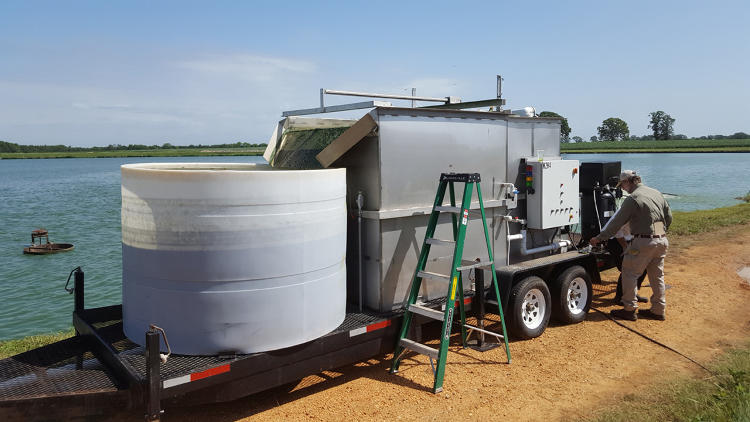
Bloom uses custom technology to carefully harvest wild algae from the water.

There, they collect algae from the top six inches or so of the water column.
The design, with screens and gentle suction, can't harm wildlife in the water.
Looking at the thick green layer of slime on some Florida beaches, most people see only the environmental crisis: out-of-control algae, fed by human activity and climate change, are killing fish, manatees, and other underwater life. Rob Falken sees a solvable problem and your next pair of shoes.


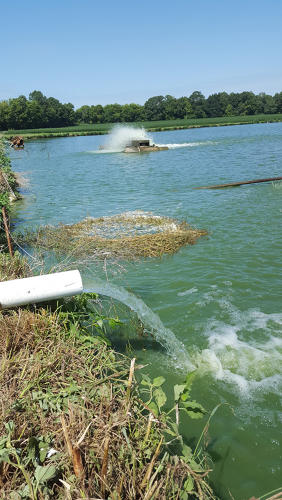
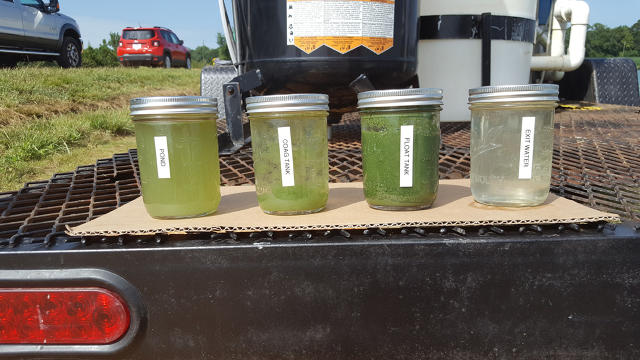
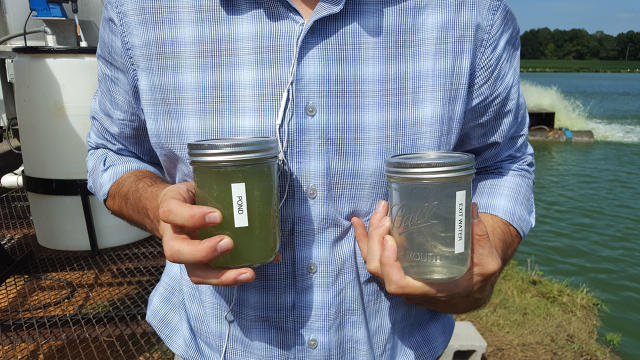
Along with the algae, the harvester also removes nitrogen and phosphorus.
Bloom, Falken's startup, uses custom technology to carefully harvest wild algae from the water, and then transforms it into a raw material to make plastics and foams for use in clothing, sneakers, car upholstery, and other products. The first product—a foam traction pad for surfboards, made with Kelly Slater—will hit shelves on October 1.

All of those products are typically made from petroleum formed into tiny pellets. Bloom makes pellets from algae instead, solar-drying the algae into flakes, pulverizing the flakes into a powder, and then turning that powder into pellets that can be melted down to merge with the petroleum-based ingredients. By partially replacing the pellets made from fossil fuels—and by sucking up carbon as it grows—the algae also helps lower carbon footprints.

"The end goal is to remove as much of the petroleum feedstock as possible," says Falken. "When you take a waste stream from nature—there naturally but there in such mass because of man made inputs—we can take that feedstock, that problem, and functionalize it into usable goods that are the exact same quality, indistinguishable, from the status quo that's out there today."

The company's small mobile harvesting units sit at the edge of a pond or lake, or float on a pontoon in the ocean, and collect algae from the top six inches or so of the water column.
The company's small mobile harvesting units sit at the edge of a pond or lake, or float on a pontoon in the ocean.
"The harvester works like a giant vacuum, basically," Falken says. The design, with screens and gentle suction, can't harm wildlife in the water; the technology was used first at catfish farms, where sucking up a fish with the algae would be an obvious problem.

Along with the algae, the harvester also removes nitrogen and phosphorus—excess fertilizers that end up in the water from farming, sewage overflows, or lawns, and help cause the algae growth in the first place. Pure, filtered water is returned to the body of water.

In Florida, where officials declared a state of emergency in several counties because of algae blooms this summer, much of the problem comes from giant Lake Okeechobee, where runoff from sugar cane plantations and cattle farms fills the lake with algae-boosting fertilizer. Infrastructure and development in the area have made the problem worse. After heavy rains, the state flushes the algae-filled water out through canals, and it ends up also harming beaches at the coasts.

As the algae proliferate in the water, they can cut off oxygen. When the growth is out of control, and the algae die, they release toxins called microcystins that can last for weeks or months.


Bloom hopes to control the problem in Florida—and many other places struggling with algae—by regularly harvesting algae before it reaches a toxic state, and clearing out the fertilizers that cause future overgrowth. While the company can clean out toxic algae, only healthy algae is usable, so it's better to catch the problem before it escalates.

"When you have an algae crisis today, that's because of a lot of negligence, that's because nobody's doing anything to remove the inputs of nitrogen and phosphorus, and there's a massive influx of those inputs running rampant," says Falken. "You also couple that with an extremely high heat index and you've got a perfect storm."

The company has been operating in China at Lake Taihu—an even larger lake than Okeechobee that millions of people rely on for drinking water—for two years, where the company says they have removed millions of pounds of algae.

Now, they're in meetings with Florida officials, along with the infrastructure company AECOM, to make a plan for demonstrating the technology in the state. They hope to begin regularly working at Lake Okeechobee.

While other companies grow algae in tanks, wild harvesting has advantages—the process solves an environmental problem, and doesn't require the energy and cost used to grow algae in the dark. Algae grown in tanks is also genetically engineered, and Bloom argues that it could wipe out natural strains if it escaped into the wild.

The algae-based feedstock can be dropped into current manufacturing without any changes, and the cost is the same as petroleum-based feedstocks on the market today. "We can't convert industries worldwide if the price is higher," Falken says.
Then it transforms it into a raw material to make plastics and foams for use in clothing, sneakers, car upholstery, and other products.
There's also no shortage of wild algae, especially as warming waters make the problem worse. "We've already got more algae than we'll ever need," he says. "In China, Lake Taihu could produce enough algae for us to produce a pair of shoes for every man, woman, and child on this planet."

Even as some governments try to address the larger problems—Florida, for example, plans to spend more than $1 billion buying land to create storage ponds in the hope of naturally treating water—the process isn't guaranteed to work, and will take time.

"Those inputs are not going away," says Falken. "Agriculture's not going away, sugar cane plantations aren't going away, people are not going to en masse stop using fertilizers on their lawn. It's unfortunate. We can educate as much as possible, but the reality here is someone has got to be proactive. Because we can do something with it, and do a lot of good with it, we can ensure that algal bloom crisis is in time a thing of the past."

They hope to use the algae harvesters all over the country and world. "You look at Florida and say that's the epicenter, that's where the crisis is worst because all of the water policy issues and all the negligence," he says. "But if you look at the U.S. as a whole, all 50 states have algal bloom in some semi-crisis mode right now. You've got about 20 states that are really at peak crisis. The algae is everywhere, and the problems are global."

ORIGINAL: Fast Company
09.29.16

martes, 29 de septiembre de 2015

Plastic-eating worms may offer solution to mounting waste, Stanford researchers discover

An ongoing study by Stanford engineers, in collaboration with researchers in China, shows that common mealworms can safely biodegrade various types of plastic.

Mealworms munch on Styrofoam, a hopeful sign that solutions to plastics pollution exist. Wei-Min Wu, a senior research engineer in the Department of Civil and Environmental Engineering, discovered the larvae can live on polystyrene. (Photo: Yu Yang)
Consider the plastic foam cup. Every year, Americans throw away 2.5 billion of them. And yet, that waste is just a fraction of the 33 million tons of plastic Americans discard every year. Less than 10 percent of that total gets recycled, and the remainder presents challenges ranging from water contamination to animal poisoning.

Enter the mighty mealworm. The tiny worm, which is the larvae form of the darkling beetle, can subsist on a diet of Styrofoam and other forms of polystyrene, according to two companion studies co-authored by Wei-Min Wu, a senior research engineer in the Department of Civil and Environmental Engineering at Stanford. Microorganisms in the worms' guts biodegrade the plastic in the process – a surprising and hopeful finding.

"Our findings have opened a new door to solve the global plastic pollution problem," Wu said.

The papers, published in Environmental Science and Technology, are the first to provide detailed evidence of bacterial degradation of plastic in an animal's gut. Understanding how bacteria within mealworms carry out this feat could potentially enable new options for safe management of plastic waste.

"There's a possibility of really important research coming out of bizarre places," said Craig Criddle, a professor of civil and environmental engineering who supervises plastics research by Wu and others at Stanford. "Sometimes, science surprises us. This is a shock."

Plastic for dinner
In the lab, 100 mealworms ate between 34 and 39 milligrams of Styrofoam – about the weight of a small pill – per day. The worms converted about half of the Styrofoam into carbon dioxide, as they would with any food source.

Within 24 hours, they excreted the bulk of the remaining plastic as biodegraded fragments that look similar to tiny rabbit droppings. Mealworms fed a steady diet of Styrofoam were as healthy as those eating a normal diet, Wu said, and their waste appeared to be safe to use as soil for crops.

Researchers, including Wu, have shown in earlier research that waxworms, the larvae of Indian mealmoths, have microorganisms in their guts that can biodegrade polyethylene, a plastic used in filmy products such as trash bags. The new research on mealworms is significant, however, because Styrofoam was thought to have been non-biodegradable and more problematic for the environment.

Researchers led by Criddle, a senior fellow at the Stanford Woods Institute for the Environment, are collaborating on ongoing studies with the project leader and papers' lead author, Jun Yang of Beihang University in China, and other Chinese researchers. Together, they plan to study whether microorganisms within mealworms and other insects can biodegrade plastics such as polypropylene (used in products ranging from textiles to automotive components), microbeads (tiny bits used as exfoliants) and bioplastics (derived from renewable biomass sources such as corn or biogas methane).

As part of a "cradle-to-cradle" approach, the researchers will explore the fate of these materials when consumed by small animals, which are, in turn, consumed by other animals.

Marine diners sought
Another area of research could involve searching for a marine equivalent of the mealworm to digest plastics, Criddle said. Plastic waste is a particular concern in the ocean, where it fouls habitat and kills countless seabirds, fish, turtles and other marine life.

More research is needed, however, to understand conditions favorable to plastic degradation and the enzymes that break down polymers. This, in turn, could help scientists engineer more powerful enzymes for plastic degradation, and guide manufacturers in the design of polymers that do not accumulate in the environment or in food chains.

Criddle's plastics research was originally inspired by a 2004 project to evaluate the feasibility of biodegradable building materials. That investigation was funded by the Stanford Woods Institute's Environmental Venture Projects seed grant program. It led to the launch of a company that is developing economically competitive, nontoxic bioplastics.

Co-authors of the papers, "Biodegradation and Mineralization of Polystyrene by Plastic-Eating Mealworms. 1. Chemical and Physical Characterization and Isotopic Tests" and "Biodegradation and Mineralization of Polystyrene by Plastic-Eating Mealworms. 2. Role of Gut Microorganisms," include Yu Yang, Jun Yang, Lei Jian, Yiling Song and Longcheng Gao of Beihang University, and Jiao Zhao and Ruifu Yang of BGI-Shenzhen.

For more Stanford experts on engineering and other topics, visit Stanford Experts.

ORIGINAL: Stanford
BY ROB JORDAN
September 29, 2015

jueves, 11 de junio de 2015

Plastic to Oil, Fantastic


Blest Japan.

This video brief about the invention of a plastic-to-oil converting machine went viral and exceeded 3.7 million views on YouTube.

This is evidence that concern over “the plastic problem” is certainly not going away, despite encouraging bans on and decreases in the use of plastic shopping bags.

Here on Our World, on the video’s YouTube page and those of re-posters too, as well as on the hot Reddit Science link, the topic has generated much interest and debate amongst commenters.

Many think that this type of recycling is not a solution, but that instead the world should be seriously focused on the first “R” — which is reduce. We should shun single-use plastic (such as your average PET bottle or disposable container) altogether, they argue. The world’s oil resources are diminishing; does technology like this enable our denial of that fact, or is it a hopeful and constructive step in the right direction?

Others are doubtful of the conversion process and have concerns about pollution or toxic residue. But the machine actually
  • uses highly efficient but pretty straightforward pyrolysis: 
  • the plastic is fed into the pressurized oxygen-free oven and 
  • heated to 427° C (800°F), which liquefies it. 
  • The machine then converts the liquefied plastic to gas, 
which condenses to form a crude oil mixture of gasoline, diesel, kerosene and heavy oil.
Blest tells us that, if the proper materials are fed into the machine (i.e., polyethylene, polystyrene and polypropylene — PP, PE, PS plastics), there is no toxic substance produced and the small amount of inert char residue that may be leftover can be disposed of with regular garbage.

They also explain that while methane, ethane, propane and butane gasses are released in the process, the machine is equipped with an off-gas filter that disintegrates these gases into water and carbon.

Lastly, commentators from around the world are anxious to know if and where they can purchase a machine. Though the company still mainly produces larger, industrial-use machines, Blest Co. will be more than happy to hear from you. Please contact them directly at info@blest.co.jp.


Below is the original article, published on April 14, 2009

We are all well aware of plastic’s “rap-sheet”. It has been found guilty on many counts, including the way its production and disposal raises resource issues and lets loose extremely negative environmental impacts.

Typically made from petroleum, it is estimated that 7% of the world’s annual oil production is used to produce and manufacture plastic. That is more than the oil consumed by the entire African continent.

Plastic’s carbon footprint includes landfilling and incineration, since sadly, its recycle rate is dismally low around the globe.

Plastic trash is also polluting our oceans and washing up on beaches around the world. Tons of plastic from the US and Japan are floating in the Pacific Ocean, killing mammals and birds. Perhaps this tragedy is best captured in the TED presentation by Capt. Charles Moore of the Algalita Marine Research Foundation.

Using less, or use it better?

Thankfully, there are those who fully appreciate that plastic has a higher energy value than anything else commonly found in the waste stream. A Japanese company called Blest created a small, very safe and easy to use machine that can convert several types of plastic back into oil.

Though Japan has much improved its “effective utilization” rate over the years to 72% in 2006, that leaves 28% of plastic to be buried in landfills or burned. According to Plastic Waste Management Institute data, “effective utilization” includes not just the 20% that is actually recycled, but also 52% that is being incinerated for “energy recovery” purposes, i.e., generating heat or electric power.

“If we burn the plastic, we generate toxins and a large amount of CO2. If we convert it into oil, we save CO2 and at the same time increase people’s awareness about the value of plastic garbage,” says Akinori Ito, CEO of Blest.

Blest’s conversion technology is very safe because it uses a temperature controlling electric heater rather than flame. The machines are able to process polyethylene, polystyrene and polypropylene but not PET bottles. The result is a crude gas that can fuel things like generators or stoves and, when refined, can even be pumped into a car, a boat or motorbike. One kilogram of plastic produces almost one liter of oil. To convert that amount takes about 1 kwh of electricity, which is approximately ¥20 or 20 cents’ worth.

The company makes the machines in various sizes and has 60 in place at farms, fisheries and small factories in Japan and several abroad.

Sources: Kohei Watanabe, “Waste and Sustainable Consumption” March 2005; Association of Regional Planners and Architects, Detailed Sorting and Measuring of Household Waste, Kyoto 1998.


“To make a machine that anyone can use is my dream,” Ito says. “The home is the oil field of the future.”

Perhaps that statement is not as crazy as it sounds, since the makeup of Japanese household waste has been found to contain over 30% plastic, most of it from packaging.

Continually honing their technology, the company is now able to sell the machines for less than before, and Ito hopes to achieve a product “that any one can buy.”

Currently the smallest version, shown in the videobrief, costs ¥950,000 (US $9,500). [Note of 30 November 2010: Blest informs us that, since we visited them last year, improvements have been made to the machine and the price is now ¥1,060,000 (around US$12,700) without tax.]

Changing how we think

But it is the educational application of the small model of the machine that Ito is most passionate about. He’s taken it on planes on many occasions as part of a project that began some years ago in the Marshall Islands. There he worked with local government and schools to teach people about recycling culture and the value of discarded plastic, spreading the Japanese concept of mottainai, the idea that waste is sad and regrettable.

In such remote places, the machine also serves as a practical solution to the plastic problem, much of it left behind by tourists: the oil produced is used for tour buses or boats, Ito says.


“Plastic’s carbon footprint includes landfilling and incineration, since sadly, its recycle rate is dismally low around the globe.”

“Teaching this at schools is the most important work that I do,” Ito reflects. In Japan too, he visits schools where he shows children, teachers and parents how to convert the packaging and drinking straws leftover from lunch.

If we were to use only the world’s plastic waste rather than oil from oil fields, CO2 emissions could be slashed dramatically, he says.

“It’s a waste isn’t it?” Ito asks. “This plastic is every where in the world, and everyone throws it away.”
Akinori Ito demonstrates the machine to school children, teaching them about the energy embodied in the plastics we too easily throw away.
A mountain to climb down 
The wonderful invention of plastics has spawned a huge problem that we are struggling to solve. With peak oil looming, things are set to change, but we find ourselves on top of an oil and plastic mountain, and the only way forward is down.

So while many solutions like this are not without hiccups or detractors, they are a step forward in coming to terms with our oil and plastics dependence and help raise awareness of the carbon footprint of its production and use. Somehow we all know that plastics is a habit we need to kick. But that doesn’t seem to make it any easier.

Perhaps the best thing you can do is to look more deeply into this issue. A good place to start is the 2008 Addicted to Plastic documentary from Cryptic Moth productions. You can watch the trailer online and maybe request it at your local video rental store.

According to the blurb, “the film details plastic’s path over the last 100 years and provides a wealth of expert interviews on practical and cutting edge solutions to recycling, toxicity and biodegradability.”

Next it is just a matter of taking action to break our love affair with plastic.


Both the Plastic to Oil Fantastic article (by Carol Smith) and the video brief at top are licensed under a Creative Commons Attribution-NonCommercial-ShareAlike 4.0 Unported License.

PLEASE NOTE: The Plastic to Oil Fantastic video brief and any excerpt taken from it must make attribution to the source (United Nations University’s Our World Magazine) and state the conditions of the license under which it was published so that others may also share it. An example of such a note follows:

This work by United Nations University’s Our World Magazine is licensed under a Creative Commons Attribution-NonCommercial-ShareAlike 4.0 International License.

(Use the Creative Commons tool to generate appropriate variations.)


ORIGINAL:
United Nations University - Our World Magazine
Carol Smith United Nations University
2010•08•27 

domingo, 17 de mayo de 2015

Rethinking the water cycle

How moving to a circular economy can preserve our most vital resource.

Horshoe-Bend By Harmon-Phptpgraphy
Three billion people will join the global consumer class over the next two decades, accelerating the degradation of natural resources and escalating competition for them. Nowhere is this growing imbalance playing out more acutely than the water sector. Already, scarcity is so pronounced that we cannot reach many of our desired economic, social, and environmental goals. If we continue business as usual, global demand for water will exceed viable resources by 40 percent by 2030.

Many experts have claimed that wasteful treatment of water results from dysfunctional political or economic systems and ill-defined markets. But the real issue is that water has been pushed into a linear model in which it becomes successively more polluted as it travels through the system, rendering future use impossible. This practice transforms our most valuable and universal resource into a worthless trickle, creating high costs for subsequent users and society at large. Since the linear model is economically and environmentally unsustainable, we must instead view water as part of a circular economy, where it retains full value after each use and eventually returns to the system. And rather than focus solely on purification, we should attempt to prevent contamination or create a system in which water circulates in closed loops, allowing repeated use. These shifts will require radical solutions grounded in a complete mind-set change, but they must happen immediately, given the urgency of the situation.

A new, ‘circular’ perspective on water management
The global water crisis is real and graphically manifest. It’s apparent in 
  • rivers that no longer reach the sea, such as the Colorado; 
  • exhausted aquifers in the Arabian Peninsula and elsewhere; and 
  • polluted water sources like Lake Tai, one of the largest freshwater reserves in China. 
The root of this challenge is the violation of the zero-waste imperative—the principle that lies at the heart of any circular economy. It rests on these three basic beliefs:
  • All durables, which are products with a long or infinite life span, must retain their value and be reused but never discarded or down cycled (broken down into parts and repurposed into new products of lesser value).
  • All consumables, which are products with a short life span, should be used as often as possible before safely returning to the biosphere.
  • Natural resources may only be used to the extent that they can be regenerated.
Even countries with advanced water-management systems violate these fundamental rules. They often fail to purify water before discharging it back into the environment because cleanup costs are high or prohibitive, even when energy or valuable chemicals could be extracted. The substances contained in the water then become pollutants. Equally troubling, any volume of water removed from the system is seldom replaced with return flow of the same quality.

When considering a redesign that will create a new, circular water system, we can take three different views:
  • the product perspective, which calls for a strict distinction between water as a consumable and water as a durable, since there are different strategies for reducing waste in each category
  • the resource perspective, which calls for a balance between withdrawals and return flows
  • the utility perspective, which focuses on maximizing the value of our existing water infrastructure by increasing utilization and ensuring better recovery and refurbishment of assets
Water as a product
If we consider water to be a product—something that is processed, enriched, and delivered—we must follow the same strict design rules applied to any other product in a circular economy.

When water is treated as a durable, it should be kept in a closed loop under zero-liquid-discharge conditions and reused as much as possible. The major goal is not to keep water free of contaminants but to manage the integrity of the closed-loop cycle. Situations that favor the durable view include those in which it would be too costly to dispose of the solvents and re-create them—for instance, when water contains highly specific water-born solvents, electroplating baths, acids, and alkaline solutions used in heavy-duty cleaning. The Pearl Gas to Liquids complex in Qatar, for example, requires large volumes of water to convert gas to hydrocarbon liquids, including kerosene and base oil. To help prevent waste in a country plagued by shortages and droughts, the complex has a water-recycling plant—the largest of its kind—that can process 45,000 cubic meters of water per day without discharging any liquids.

When water is treated as a consumable, it must be kept pure and only brought into solution or suspension with matter that is easy or profitable to extract. For instance, consumable water should not be mixed with estrogenic hormones, toxic ink found on poor-quality toilet paper, or textile dyes. All water, including freshwater and gray water (household waste water still fit for agriculture or industrial use), should flow into subsequent cascades, where it may be used for another purpose. Whenever possible, energy and nutrients should be extracted from consumable water; there are now many revolutionary new techniques to help with this process, as well as other innovations that encourage reuse. Consider the following:

Our ability to extract energy. It is now commercially viable to generate heat and power from sludge and other organic wastes through thermal hydrolysis, which involves boiling them at high pressure followed by rapid decompression. This process sterilizes the sludge and makes it more biodegradable. Facilities at the forefront of this movement include the Billund BioRefinery in Denmark.

Our ability to extract nutrients. We can now recover a wide variety of substances from water, reducing both waste and costs. For instance, the potassium hydroxide that is used to neutralize the hydrofluoric acid in alkylation units can be extracted, decreasing costs for this substance by up to 75 percent. Substances can also be removed from sludge, such as polyhydroxyalkanoates and other biodegradable polyesters. The technology has advanced so much that value can be obtained from substances that were formerly only regarded as contaminants. For instance, ammonia removed from water can be used in the production of ammonium sulfate fertilizer, rather than simply discarded.

Our ability to reuse water. We are witnessing significant improvements in membrane-based treatments that separate water from contaminants, allowing for reuse and commercialization at grand scale. Many types of water benefit from this treatment, from gray water to Singapore’s branded NEWater, which is high-grade reclaimed water. In fact, NEWater is so pure that it is mainly used by water-fabrication plants that have more stringent quality standards than those used for drinking water. In addition to innovative membrane-based technologies, experts have developed new source-separation systems that reduce mixing between chemical-carrying industrial and household waste water, making purification easier.

Although we should celebrate these improvements in treating water and safely returning it to the system, the creation of a truly circular economy will eventually require even more radical solutions. Achieving this would require the prevention of impurity and contamination in the first place. In the European Union, for instance, 95 kilograms of nitrate per hectare are washed away from fields into rivers (an amount higher than the 80 kilograms allowed). Discontinuing this process would reduce both waste and contamination.

Water as a resource
Water can come in the form of a finite stock or a renewable flow. As one example, water used for agriculture in Saudi Arabia comes almost exclusively from fossil aquifers that will be depleted in a few decades. Since these stocks are difficult to regenerate, future Saudi agriculture efforts must eventually involve new irrigation sources, such as gray water, and follow more stringent guidelines for reducing waste.

Luckily, most hydrological systems are flow systems—rivers or replenishable aquifers. Water from such systems can be withdrawn or consumed as long as the volume taken does not exceed the minimum “environmental flow” required to keep the ecosystem intact, or the natural replenishment rates. You cannot be more circular than managing the water balance of a river basin in a rigorous and integrated fashion. Investing in strategies that promote the vitality of a watershed are also circular, including those that involve
  • better forest management (protection, reforestation, and forest-fuel-reduction programs that help control or eliminate wildfires), 
  • improved agricultural practices (such as no-tillage farming), and 
  • restoration of wetlands. 
The list of highly successful watershed-protection programs is long, ranging in location from New York’s Catskill Mountains to Bogotá, and many additional opportunities exist.

Technologies that help balance supply and demand can also help water (both stock and flow) become part of a circular model. These include drip-irrigation systems that promote conservation by directly delivering water to root zones, irrigation scheduling, new technologies for steel dedusting that use air instead of water, and the application of Leadership in Energy & Environmental Design principles, which mandate inclusion of water-saving devices.

Water as an infrastructure system
Our global water networks and treatment plants, which are worth approximately $140 billion, consume about 10 to 15 percent of national power production. Following the principles of a circular economy, we must maximize the benefits over these deployed assets. These approaches may help:

Using existing assets for more services. Utilities have many options here. For instance,

  • they could allow telecommunication companies to install fiber cables through their trenches for a fee and then charge for their maintenance, or 
  • they could use their sewage systems and wastewater-treatment facilities to collect and treat preprocessed food waste with sewage sludge. 

Using the latter technique, New York State has begun a program that has the potential to process 500 tons of food waste daily, generating heat for 5,200 homes. Utilities could also provide their data to governments or other interested parties for use in various initiatives, such as those related to healthcare or flood management.

Selling performance, not water. Instead of selling water and charging by the cubic meter, utilities could pay consumers for curbing use and then sell the conserved volume—termed “nega water”—back to the system. Such an effort, and similar initiatives, would also require a major overhaul of rate-setting mechanisms. Utilities should also promote conservation by selling double-flush toilets and similar devices, or by offering different levels of service, pricing, and convenience, with the goal of encouraging consumers to reduce use. As such, there should also be rate-setting mechanisms in place to encourage utilities to undertake water-conservation efforts.

Driving asset recovery. Utilities should establish asset-recovery centers and create procedures that promote reuse of equipment. This would include standardizing their pipes and meters to ensure they can be easily recovered and refurbished. Utilities should also begin tracking assets, which will allow easier reuse of equipment.

Optimizing resource efficiency. Finally, utilities should invest in ever more efficient operations and use green power, ideally generated in-house, whenever possible. They should be given incentives for doing so—something that does not typically happen today. There are many examples where anaerobic digestion of sludge alone produces biogas that covers more than 60 percent of energy consumed at wastewater-treatment plants.

Next-generation moves for water-system management
Innovators, responsible operators, and committed system developers are spearheading the creation of new technological solutions, pilot cases, and initiatives to improve water management. Many of the technologies are already generating profits or will be soon. These include the bespoke polymers that are created during the biological digestion of wastewater, as well as vapor-transfer irrigation systems that use low-cost plastic tubes that allow water vapor to pass but not water or solutes, making saltwater irrigation possible.

Equally important, leaders are also rethinking their institutional approach to water management. Many of their solutions are only being applied at small scale, however, and this must change over the next ten years to meet the water-resource challenge. So how can the water sector drive the much-needed system-level transition from today’s linear model to tomorrow’s circular design? What are the attractive, integrated plays? Five ideas stand out:
  1. Product-design partnerships. Even in 2015, there is no dialogue between producers—say, of atrazine herbicides, antimicrobial disinfectants, or detergent metabolites—and wastewater operators. Their relationship resembles that between a distant water source and a sink, with diluted accountabilities. As the cost of treatment mounts, pressure will increase on producers to reduce contamination, especially as new technologies make it easier to identify their source. Shouldn’t wastewater operators help by offering their expertise to producers and initiating product-design partnerships to ensure that water stays pure after use?
  2. Resource-positive utilities. Wastewater utilities are ubiquitous, visible, and largely similar. They could soon become energy positive thanks to technical advances related to sludge methanization, waste-heat recovery, potassium hydroxide reduction, or on-site distributed power generation. Who will champion further advances, including those that aim to convert wastewater to energy, integrate grids, and recover nutrients?
  3. Management for yield. Water is a powerful driver of yield in almost any industrial process and the extraction of raw materials. Improved site-level water management can increase beverage yields by 5 percent and oil-well productivity by 20 percent, largely benefitting the bottom line. It can also convey many other advantages, such as reduced heat or nutrient loss during processing. Taken together, these advantages can turn water into a major value driver. For instance, one pulp-and-paper producer discovered that it could improve margins by 7 percentage points through better water management, leaving a much more circular operation behind. Who will help other companies find such value?
  4. Basin management. From Évian-les-Bains to Quito, floodplain protection is a viable method for reducing the risk of flooding and preventing freshwater contamination. But attempts to improve basin management often fail because they require sophisticated multiparty contracts and a deep knowledge of hydrology and engineering. Who will help connect interested parties and minimize the bureaucracy associated with basin-management agreements?
  5. Local organic nutrient cycles. Most communities are struggling to handle low-quality sludge and fragmented, contaminated streams of organic waste coming from households and businesses. Simultaneously, agriculture experts are exploring new sources for nutrients, since mineral fertilizer will soon be in short supply. If we aggregate local organic waste flows, we could help communities deal with their problem while also creating vibrant local markets for fertilizer components. Who will create and manage the local organic nutrient cycle of the future?
Each of these plays represents a new way of looking at water and represents a huge business opportunity. They provide the industry with a chance to reposition itself and develop a new generation of designers, power engineers, yield managers, ecosystem-services marketers, or synthesis-gas tycoons.

The shift to a circular water economy holds much promise. It would replace scarcity with abundance and greatly reduce the resources needed to run our global water infrastructure. At some point, a circular water economy might even eliminate rapidly growing cleanup costs because no harmful substances would ever be added to the water supply. Since water is the single most important shared resource across all supply chains, and wastewater is the largest untapped waste category—as big as all solid-waste categories taken together—it is the natural starting point for the circular revolution. The water sector’s advanced technologies and proven record of multistakeholder agreements also lend themselves to circular solutions. We must capture this unique opportunity now, before localized droughts and shortages become a global crisis.

About the author
Martin Stuchtey is a director in McKinsey’s Munich office and leads the McKinsey Center for Business and Environment.

The author wishes to thank Ellen MacArthur for her contributions to this paper. The Ellen MacArthur Foundation promotes educational and business initiatives that further the development of the circular economy. He would also like to thank Laurent Auguste, the senior executive vice president of innovation and markets at Veolia.


ORIGINAL: McKinsey
by Martin Stuchtey
May 2015